


 Скачать презентацию How Cost Competitive is Wood Pulp Production in
5a966cbaa213466737b6f2463d6ea518.ppt
- Количество слайдов: 29
 How Cost Competitive is Wood Pulp Production in South China? Christopher Barr and Christian Cossalter Center for International Forestry Research (CIFOR) Beijing September 20 -21, 2006
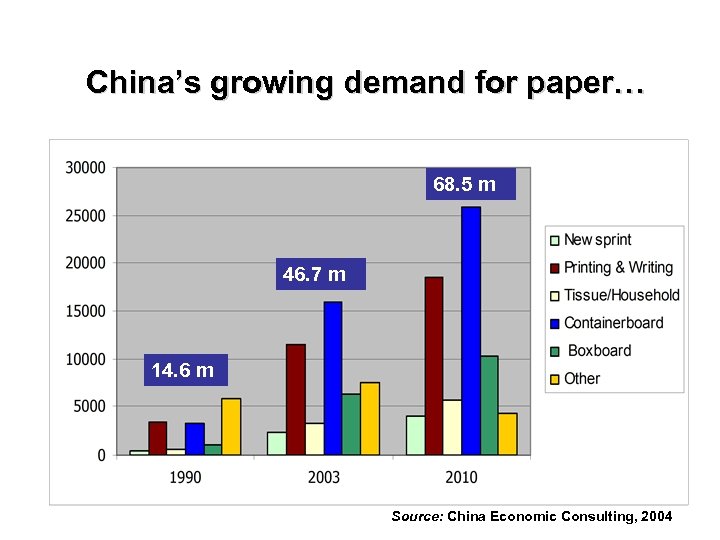 China’s growing demand for paper… 68. 5 m (‘ 000 tonnes) 46. 7 m 14. 6 m Source: China Economic Consulting, 2004 Source: He and Barr, 2004
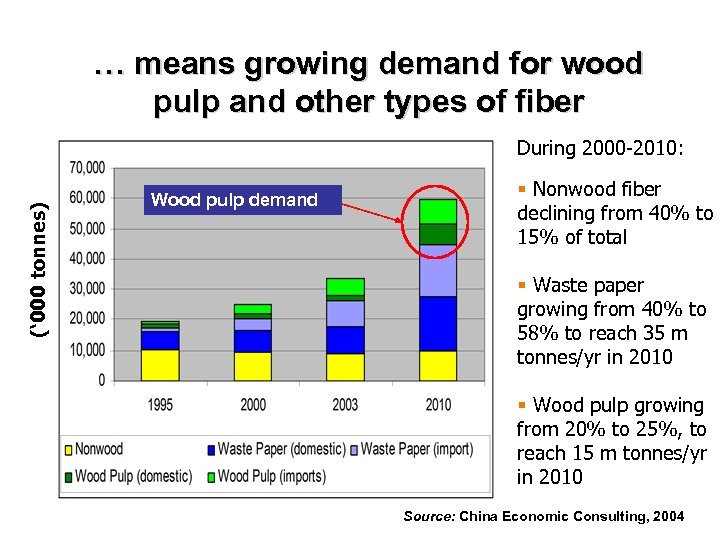 … means growing demand for wood pulp and other types of fiber (‘ 000 tonnes) During 2000 -2010: Wood pulp demand § Nonwood fiber declining from 40% to 15% of total § Waste paper growing from 40% to 58% to reach 35 m tonnes/yr in 2010 § Wood pulp growing from 20% to 25%, to reach 15 m tonnes/yr in 2010 Source: China Economic Consulting, 2004
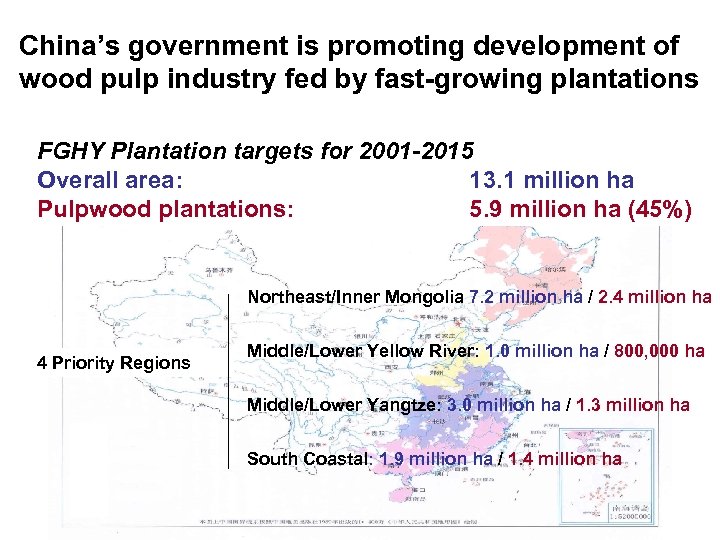 China’s government is promoting development of wood pulp industry fed by fast-growing plantations FGHY Plantation targets for 2001 -2015 Overall area: 13. 1 million ha Pulpwood plantations: 5. 9 million ha (45%) Northeast/Inner Mongolia 7. 2 million ha / 2. 4 million ha 4 Priority Regions Middle/Lower Yellow River: 1. 0 million ha / 800, 000 ha Middle/Lower Yangtze: 3. 0 million ha / 1. 3 million ha South Coastal: 1. 9 million ha / 1. 4 million ha
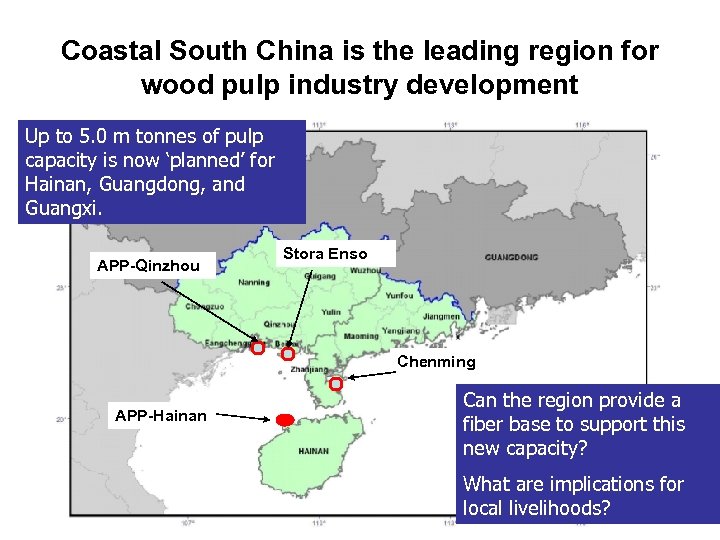 Coastal South China is the leading region for wood pulp industry development Up to 5. 0 m tonnes of pulp capacity is now ‘planned’ for Hainan, Guangdong, and Guangxi. APP-Qinzhou Stora Enso Chenming APP-Hainan Can the region provide a fiber base to support this new capacity? What are implications for local livelihoods?
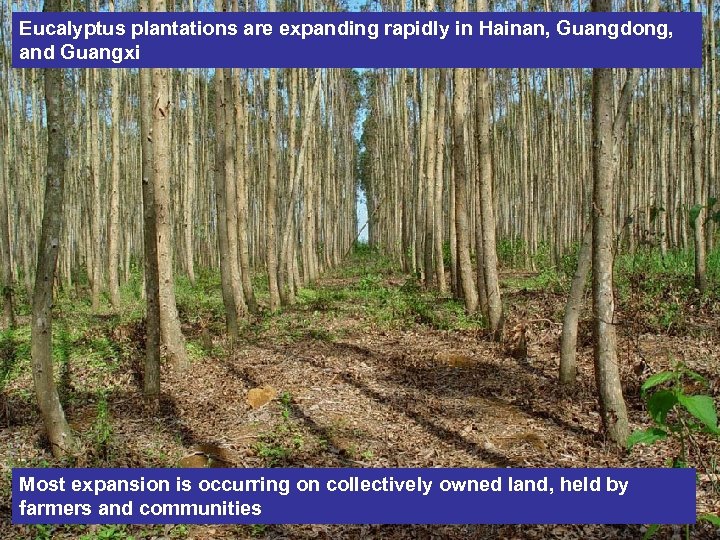 Eucalyptus plantations are expanding rapidly in Hainan, Guangdong, and Guangxi Most expansion is occurring on collectively owned land, held by farmers and communities
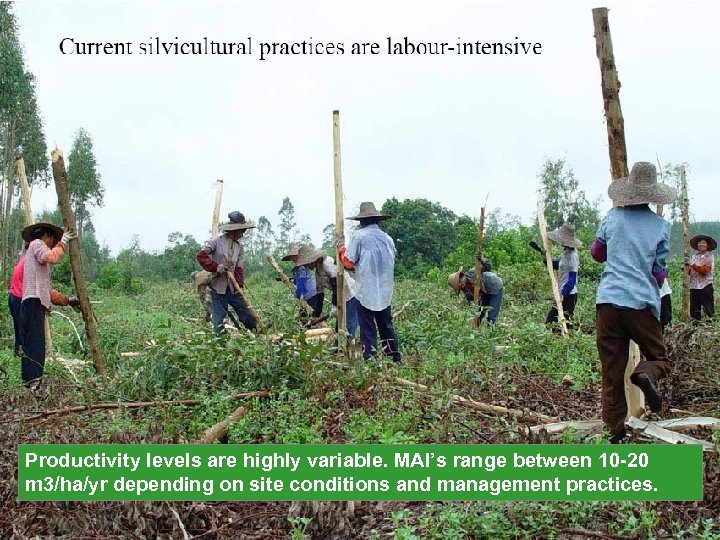 Productivity levels are highly variable. MAI’s range between 10 -20 m 3/ha/yr depending on site conditions and management practices.
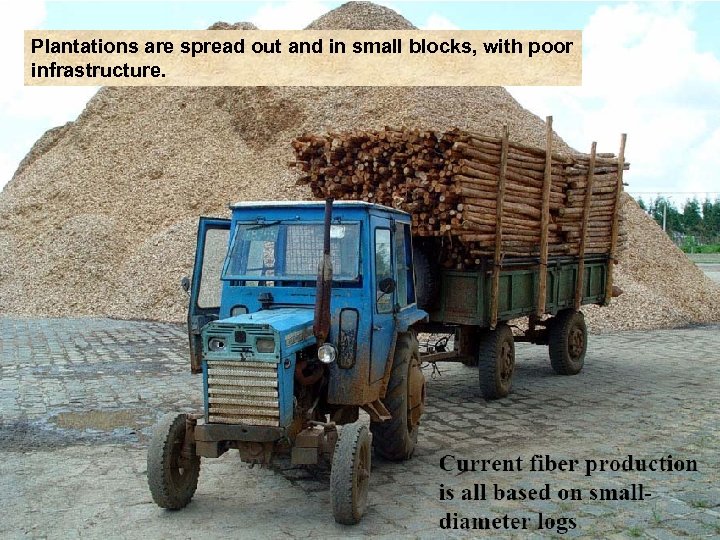 Plantations are spread out and in small blocks, with poor infrastructure.
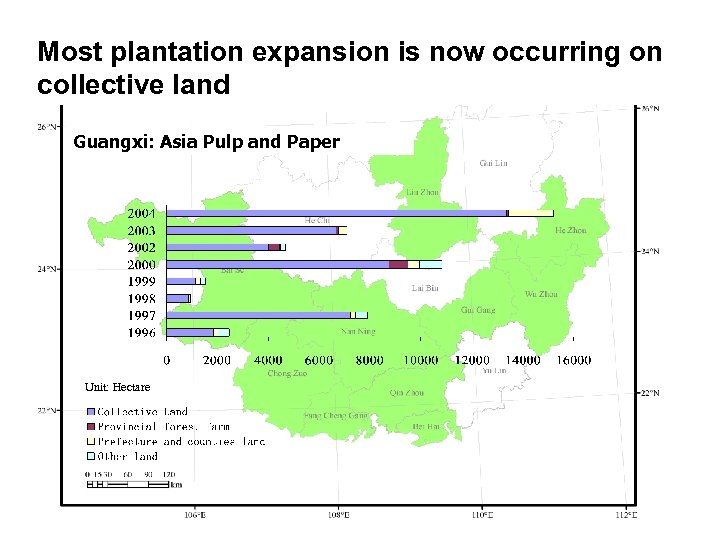 Most plantation expansion is now occurring on collective land Guangxi: Asia Pulp and Paper Unit: Hectare
 Key Question: How competitive is the delivered wood cost? • Wood costs typically account for at 40 -50 % of pulp production costs, so are key to determining competitiveness vis-à-vis market pulp • Eucalypt plantations in South China are generally cost effective compared to other regions in China • However, wood costs in South China are considerably higher compared to Indonesia and Brasil – both of which export pulp to China • Increasingly, domestic pulp producers need to be competitive in a global market
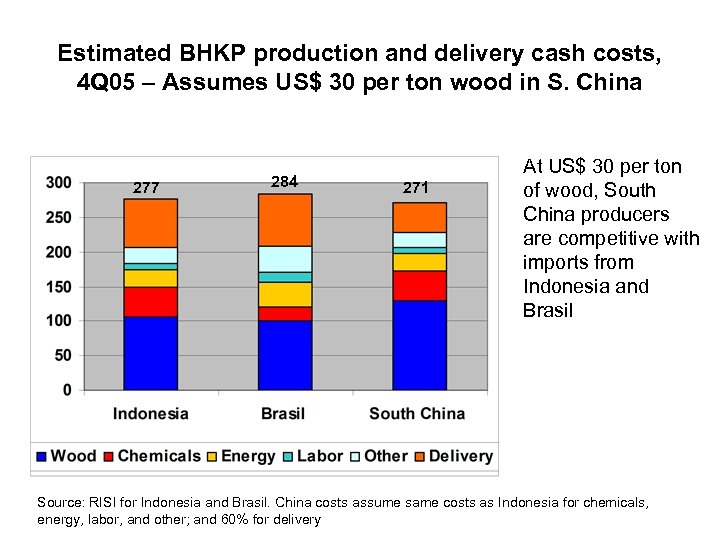 Estimated BHKP production and delivery cash costs, 4 Q 05 – Assumes US$ 30 per ton wood in S. China 277 284 271 At US$ 30 per ton of wood, South China producers are competitive with imports from Indonesia and Brasil Source: RISI for Indonesia and Brasil. China costs assume same costs as Indonesia for chemicals, energy, labor, and other; and 60% for delivery
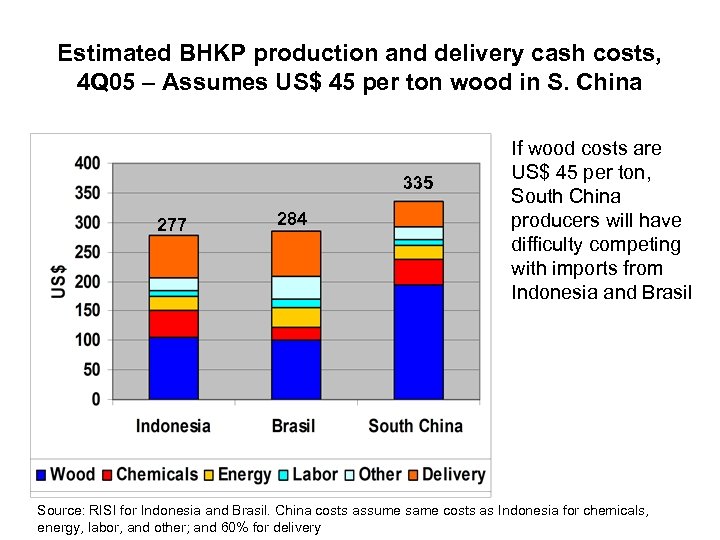 Estimated BHKP production and delivery cash costs, 4 Q 05 – Assumes US$ 45 per ton wood in S. China 335 277 284 If wood costs are US$ 45 per ton, South China producers will have difficulty competing with imports from Indonesia and Brasil Source: RISI for Indonesia and Brasil. China costs assume same costs as Indonesia for chemicals, energy, labor, and other; and 60% for delivery
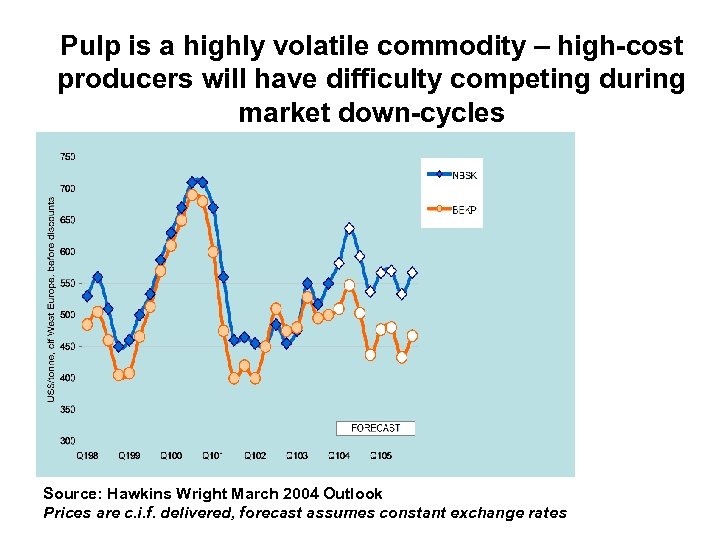 Pulp is a highly volatile commodity – high-cost producers will have difficulty competing during market down-cycles Source: Hawkins Wright March 2004 Outlook Prices are c. i. f. delivered, forecast assumes constant exchange rates
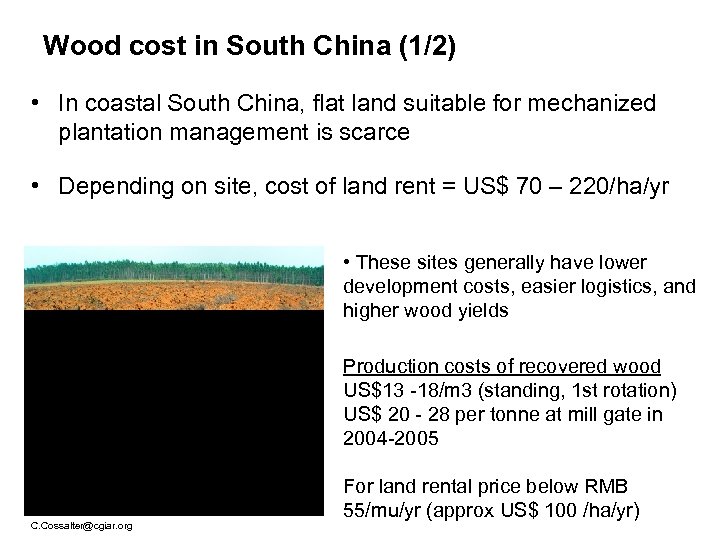 Wood cost in South China (1/2) • In coastal South China, flat land suitable for mechanized plantation management is scarce • Depending on site, cost of land rent = US$ 70 – 220/ha/yr • These sites generally have lower development costs, easier logistics, and higher wood yields Production costs of recovered wood US$13 -18/m 3 (standing, 1 st rotation) US$ 20 - 28 per tonne at mill gate in 2004 -2005 C. Cossalter@cgiar. org For land rental price below RMB 55/mu/yr (approx US$ 100 /ha/yr)
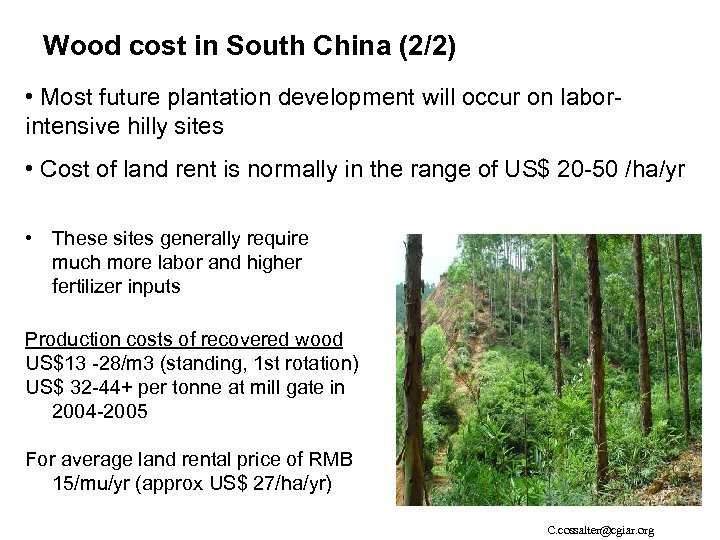 Wood cost in South China (2/2) • Most future plantation development will occur on laborintensive hilly sites • Cost of land rent is normally in the range of US$ 20 -50 /ha/yr • These sites generally require much more labor and higher fertilizer inputs Production costs of recovered wood US$13 -28/m 3 (standing, 1 st rotation) US$ 32 -44+ per tonne at mill gate in 2004 -2005 For average land rental price of RMB 15/mu/yr (approx US$ 27/ha/yr) C. cossalter@cgiar. org
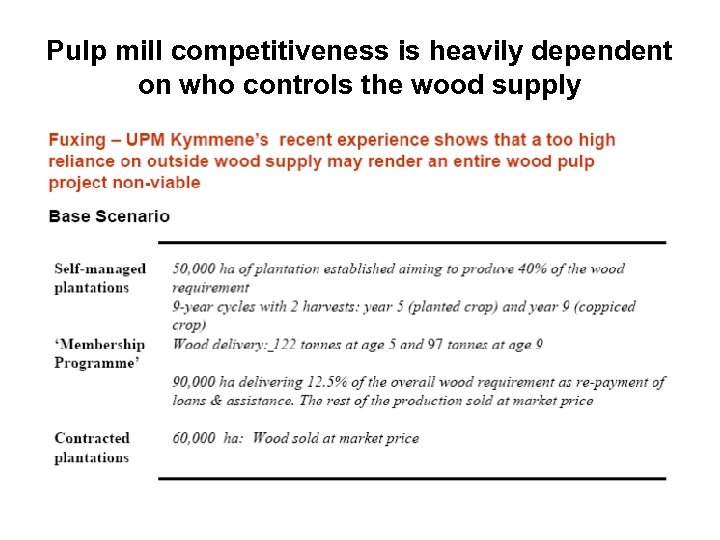 Pulp mill competitiveness is heavily dependent on who controls the wood supply
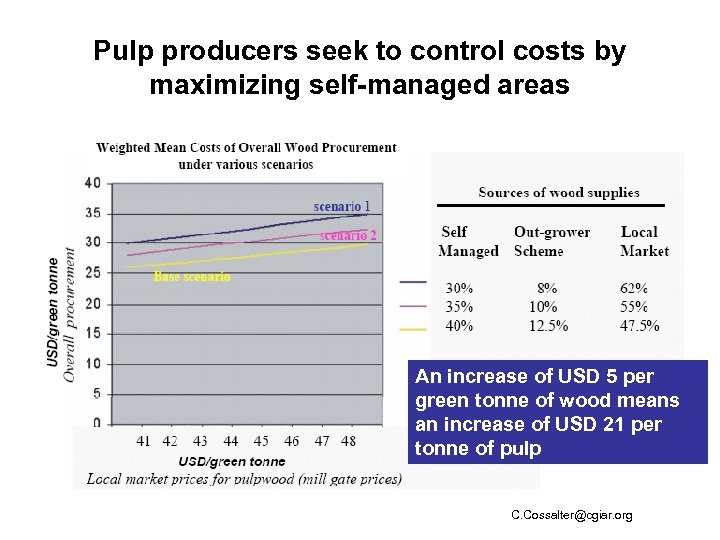 Pulp producers seek to control costs by maximizing self-managed areas An increase of USD 5 per green tonne of wood means an increase of USD 21 per tonne of pulp C. Cossalter@cgiar. org
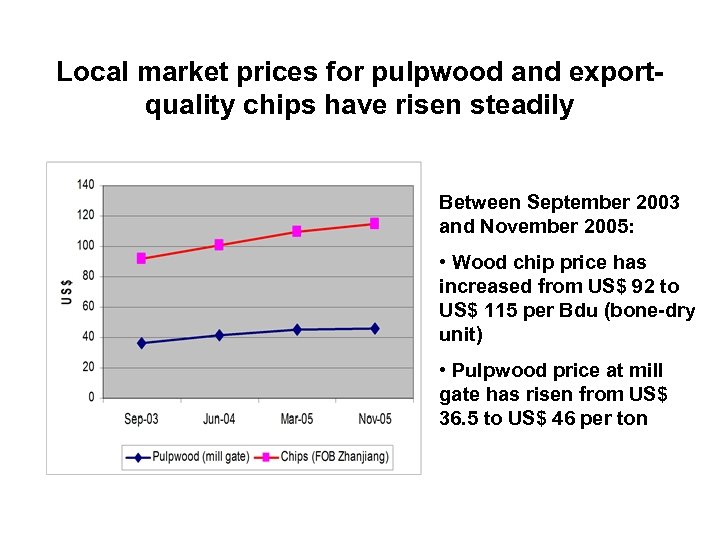 Local market prices for pulpwood and exportquality chips have risen steadily Between September 2003 and November 2005: • Wood chip price has increased from US$ 92 to US$ 115 per Bdu (bone-dry unit) • Pulpwood price at mill gate has risen from US$ 36. 5 to US$ 46 per ton
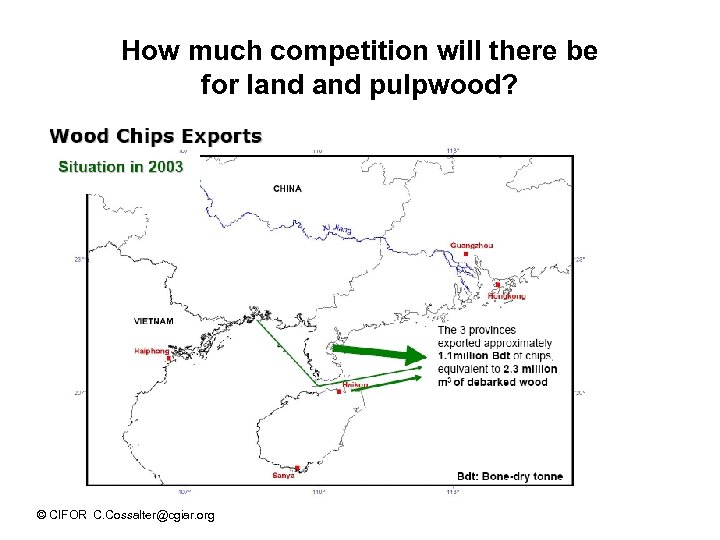 How much competition will there be for land pulpwood? © CIFOR C. Cossalter@cgiar. org
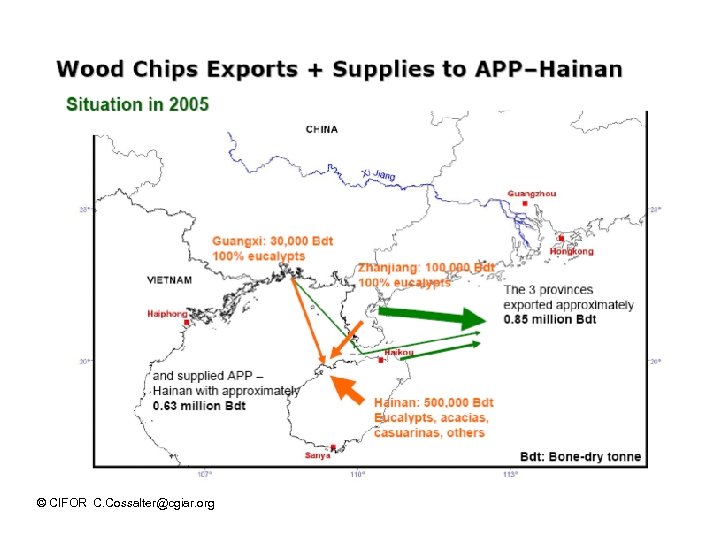 © CIFOR C. Cossalter@cgiar. org
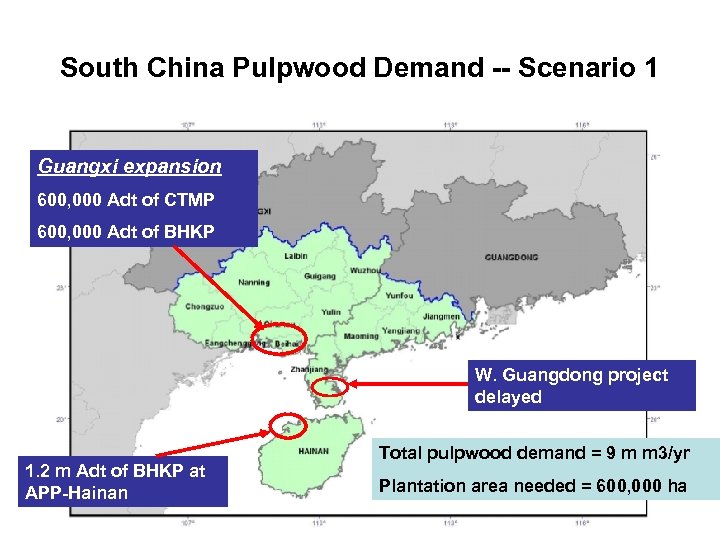 South China Pulpwood Demand -- Scenario 1 Guangxi expansion 600, 000 Adt of CTMP 600, 000 Adt of BHKP W. Guangdong project delayed 1. 2 m Adt of BHKP at APP-Hainan Total pulpwood demand = 9 m m 3/yr Plantation area needed = 600, 000 ha
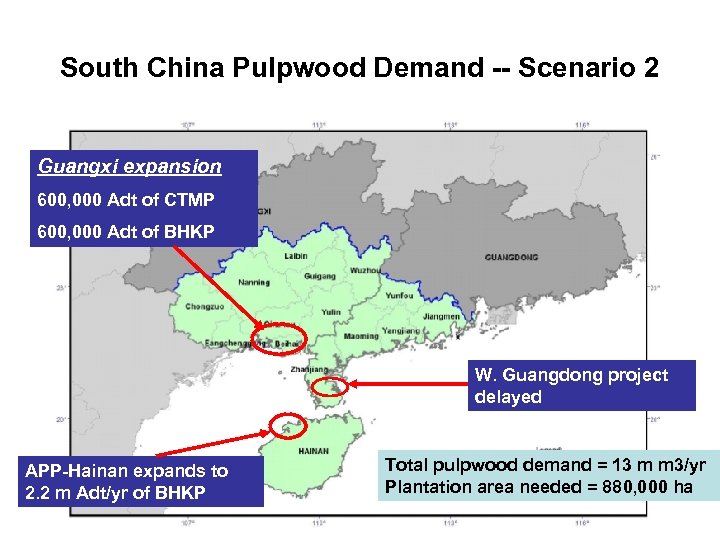 South China Pulpwood Demand -- Scenario 2 Guangxi expansion 600, 000 Adt of CTMP 600, 000 Adt of BHKP W. Guangdong project delayed APP-Hainan expands to 2. 2 m Adt/yr of BHKP Total pulpwood demand = 13 m m 3/yr Plantation area needed = 880, 000 ha
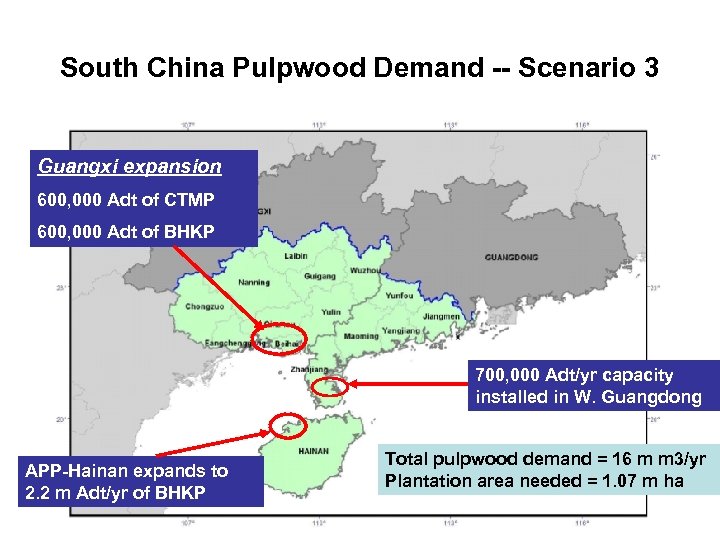 South China Pulpwood Demand -- Scenario 3 Guangxi expansion 600, 000 Adt of CTMP 600, 000 Adt of BHKP 700, 000 Adt/yr capacity installed in W. Guangdong APP-Hainan expands to 2. 2 m Adt/yr of BHKP Total pulpwood demand = 16 m m 3/yr Plantation area needed = 1. 07 m ha
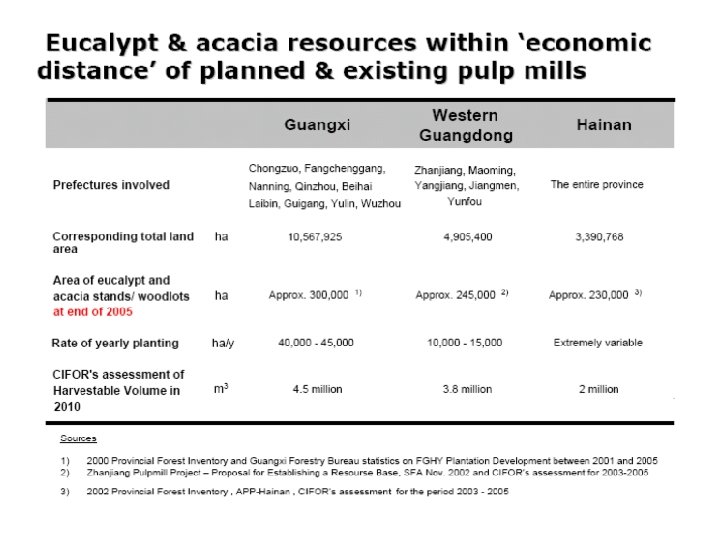
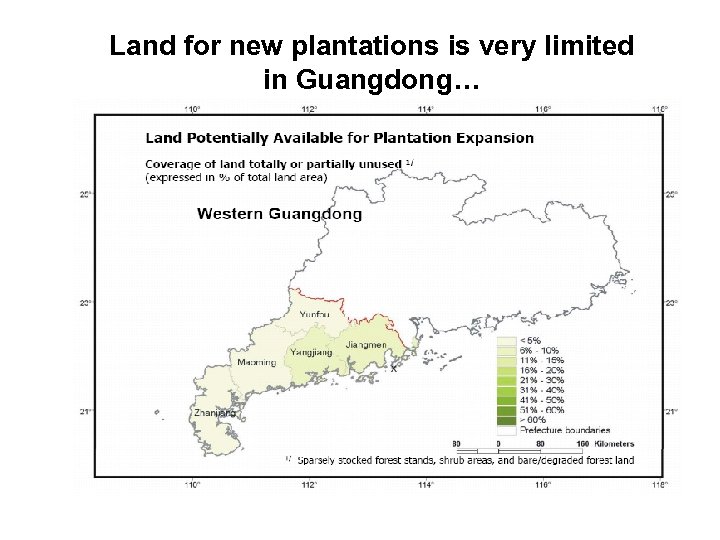 Land for new plantations is very limited in Guangdong…
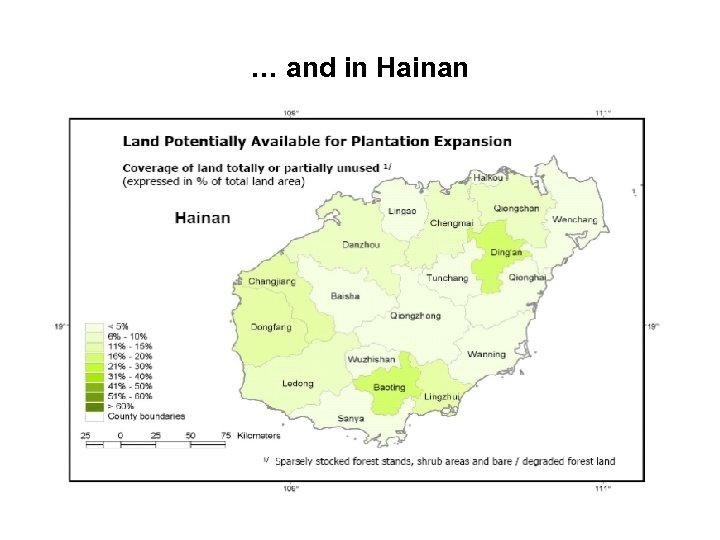 … and in Hainan
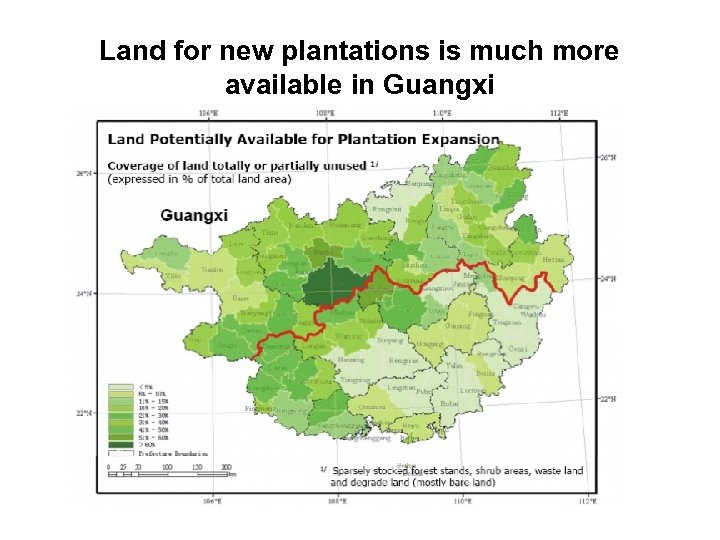 Land for new plantations is much more available in Guangxi
 Summary of key messages § Feasibility of large pulp mills depends on building a sizeable plantation base to control yields and wood costs. § Access to new plantation land is a slow and complex process, as most suitable land is held by farmer households or communities. § On a limited basis, coastal Southern China could potentially become a new “world-class eucalypt pulp producer”. However, the type of land which is required for this is in very short supply and can support limited capacity. § At present, the most common plantation type is ‘labor-intensive plantation on hills’. Most of the future plantation development is expected to occur on hill sites. § Currently, ‘labor-intensive plantation on hills’ can produce small-diameter round wood (wood fiber) at competitive costs compared to imported wood fiber – but this could change if local wood prices rise by US$ 10 -15 per ton
 Summary of key messages § Increasing competition for land fiber is already pushing up wood prices in local markets, and this can be expected to continue as new pulp capacity comes online -- although price increases may be partially offset by increasing supply and/or government subsidies § Overall, pulp production in South China is now only moderately competitive versus market pulp imports from Indonesia and Brasil § Increased production costs will make it harder for Chinese producers to compete with imports, particularly when world pulp prices are low