 Скачать презентацию HOW COMMITTED ARE AUSTRALIAN UNIVERSITIES TO ENVIRONMENTAL SUSTAINABILITY
5ae21df692f049cdbe82390349fc61ea.ppt
- Количество слайдов: 15



HOW COMMITTED ARE AUSTRALIAN UNIVERSITIES TO ENVIRONMENTAL SUSTAINABILITY? : A PERSPECTIVE ON AND FROM THE UNIVERSITY OF MELBOURNE Hans A Baer School of Social and Political Sciences University of Melbourne Arnaud Gallois Office of Environmental Programs University of Melbourne And Australian Anthropological Society Conference 2 December 2014
AUSTRALIAN UNIVERSITIES AND ENVIRONMENTAL SUSTAINABILITY Ø 19 of 38 Australian universities l l Signatories to international Tallories Declaration (1990): ‘Universities educate most of the people who develop and manage society’s institutions. For this reason, universities bear profound responsibilities to increase the awareness, knowledge, technologies, and tools to create an environmentally sustainable future. Universities have all the expertise necessary to develop the intellectual and conceptual framework to achieve this goal. Universities must play a strong role in the education, research, policy development, information exchange, and community outreach to help create an equitable and sustainable future’
JM RAFFERTY AND CM O’DWYER ON GREENSHIFT IN AUSTRALIAN UNIVERSITIES Ø Environmental sustainability practices at 6 universities l ANU, Charles Sturt, Griffith, La Trobe, Macquaire, Sydney Ø Adherence to policy uneven and inconsistent Ø ‘residual – sometimes yawning – green gap between sustainability rhetoric and the active implementation, integration and embedding of sustainable systems across all dimensions of university operations’ Ø ‘While the sustainability strategies and planning methods employed by institutions are overly engaging with community concerns, the tenor and language of discussion and reportage marks a deep complicity with the dominant discourse and global market forces’ Source: Rafferty and O’Dwyer. 2010. The functional dynamics of green universities. Report submitted to the National Tertiary Education Union.
PARTISAN OBSERVERS Ø Both members of Melbourne Uni NTEU branch committee Ø Both convenors along with Graham Willett of NTEU ‘We are the University’ seminar series Ø Member at various times of University Sustainability Forum l Gallois in 2010 -2011 as OEP representative l Baer since late 2010 as NTEU representative Ø Both involved in the Fossil Free Melbourne University campaign Ø Committed to more socially just, democratic, and environmentally work place, society and world Ø Driven by sense of ‘moral outrage’ at condition of world l Including nature of corporate or neoliberal university
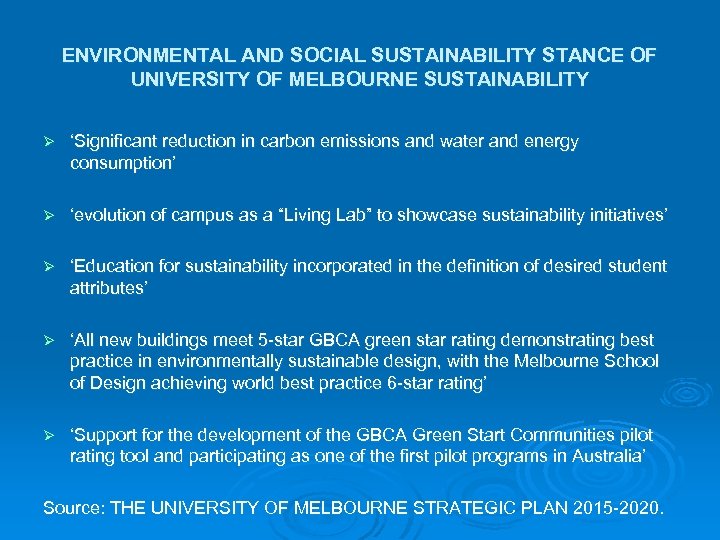
ENVIRONMENTAL AND SOCIAL SUSTAINABILITY STANCE OF UNIVERSITY OF MELBOURNE SUSTAINABILITY Ø ‘Significant reduction in carbon emissions and water and energy consumption’ Ø ‘evolution of campus as a “Living Lab” to showcase sustainability initiatives’ Ø ‘Education for sustainability incorporated in the definition of desired student attributes’ Ø ‘All new buildings meet 5 -star GBCA green star rating demonstrating best practice in environmentally sustainable design, with the Melbourne School of Design achieving world best practice 6 -star rating’ Ø ‘Support for the development of the GBCA Green Start Communities pilot rating tool and participating as one of the first pilot programs in Australia’ Source: THE UNIVERSITY OF MELBOURNE STRATEGIC PLAN 2015 -2020.
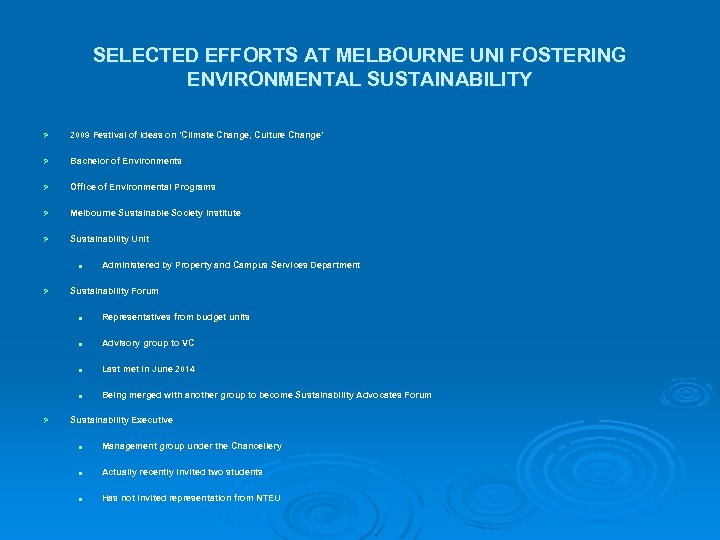
SELECTED EFFORTS AT MELBOURNE UNI FOSTERING ENVIRONMENTAL SUSTAINABILITY Ø 2009 Festival of Ideas on ‘Climate Change, Culture Change’ Ø Bachelor of Environments Ø Office of Environmental Programs Ø Melbourne Sustainable Society Institute Ø Sustainability Unit l Ø Administered by Property and Campus Services Department Sustainability Forum l l Advisory group to VC l Last met in June 2014 l Ø Representatives from budget units Being merged with another group to become Sustainability Advocates Forum Sustainability Executive l Management group under the Chancellery l Actually recently invited two students l Has not invited representation from NTEU
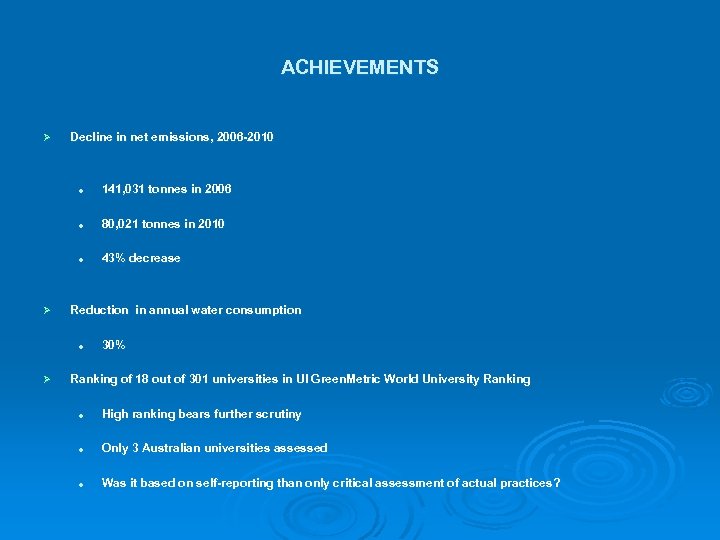
ACHIEVEMENTS Ø Decline in net emissions, 2006 -2010 l l 80, 021 tonnes in 2010 l Ø 141, 031 tonnes in 2006 43% decrease Reduction in annual water consumption l Ø 30% Ranking of 18 out of 301 universities in UI Green. Metric World University Ranking l High ranking bears further scrutiny l Only 3 Australian universities assessed l Was it based on self-reporting than only critical assessment of actual practices?
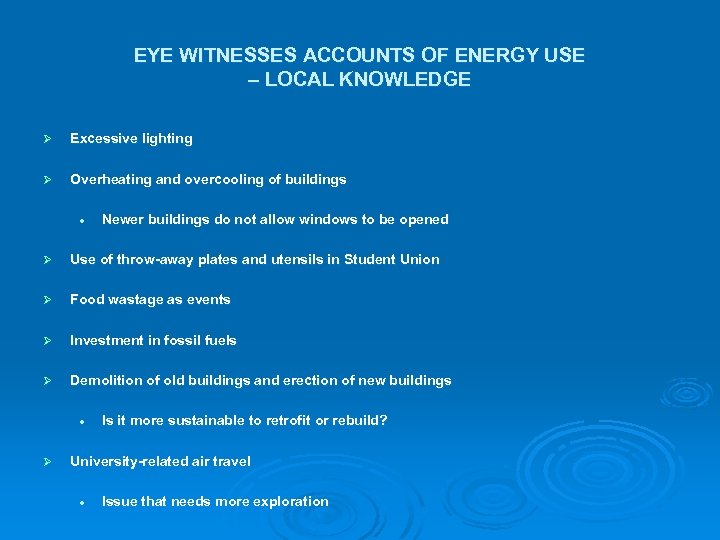
EYE WITNESSES ACCOUNTS OF ENERGY USE – LOCAL KNOWLEDGE Ø Excessive lighting Ø Overheating and overcooling of buildings l Newer buildings do not allow windows to be opened Ø Use of throw-away plates and utensils in Student Union Ø Food wastage as events Ø Investment in fossil fuels Ø Demolition of old buildings and erection of new buildings l Ø Is it more sustainable to retrofit or rebuild? University-related air travel l Issue that needs more exploration
MELBOURNE UNI’S RESPONSE TO DIVESTMENT FROM FOSSIL FUELS CAMPAIGN – 350. ORG Ø VC Glyn Davis l Ø ‘“Does the University of Melbourne invest in fossil fuels? ” ask posters around the campus. Posing the question has triggered a lively discussion among the governing Council, and with our institutional advisors. ’ 1 st draft of University Sustainability Charter released in Oct 2015 l l University plans to ‘strategically focus investment priorities on sectors and organisations that lead in the delivery of a low carbon and ethically sound future, while ensuring the University’s long-term financial position’ Ambiguous in at least 2 ways • What constitutes low-carbon investment • How would ensuring University’s long-term financial positon be determined?
TOWARD AN ECOLOGICAL AND ETHICAL UNIVERSITY – THE REVOLUTION STARTS HERE Ø Divesture and ecological modernisation not enough Ø Universities need to review some of the fundamental institutional logics that they have adopted since industrialisation, and more intensively since the burgeoning forces of globalisation and neoliberalism, otherwise know as global capitalism and/or the great acceleration. Universities will need to renounce the dreams and values of growth-, profit -, and exploitation-oriented economies, be less beholden to rankings, and adopt a long-term and more profoundly fair and compassionate ethic.
TOWARD AN ECOLOGICAL AND ETHICAL UNIVERSITY – A VISION Ø Eco-centric Ø Frugal Ø Inclusive Ø Democratic
TOWARD AN ECOLOGICAL AND ETHICAL UNIVERSITY – A VISION: Ø Eco-centric: - anthropogenic, biospheric emergency; - top priority given to ecologically sustaining, repairing and regenerating research, teaching, and other activities
TOWARD AN ECOLOGICAL AND ETHICAL UNIVERSITY – A VISION: Ø Frugal: - all activities to be within Earth’s per capita carrying capacity (ecological footprint calculator) - employment to reflect this (eg, cap max actual weekly hours to 30, and wages enough to meet essentials without scope for excess consumption/ accumulation)
TOWARD AN ECOLOGICAL AND ETHICAL UNIVERSITY – A VISION: Ø Inclusive: - tuition free (publicly funded), universally available, and secular - no economic barriers to research, conferences and publication - all employees in secure (permanent) employment
TOWARD AN ECOLOGICAL AND ETHICAL UNIVERSITY – A VISION: Ø Democratic: - genuine participation of all members (staff, students and alumni) in substantive decision-making - all leadership positions elected and recall-able
Скачать презентацию HOW COMMITTED ARE AUSTRALIAN UNIVERSITIES TO ENVIRONMENTAL SUSTAINABILITY
5ae21df692f049cdbe82390349fc61ea.ppt