 Скачать презентацию How can it be fixed and
1b82e128c817b45308a129f9cde3dc76.ppt
- Количество слайдов: 13



* • How can it be fixed, and by what or whom? • What is the government’s role during times of economic downturn?
*Two opposing theories existed on the causes of and remedies for economic depression that affected governments’ behaviours during and after the Great Depression: *The theories of John Maynard Keynes (canes) and Friedrich August Hayek (hi-ek) *They recently worked through their differences in a rap battle! *
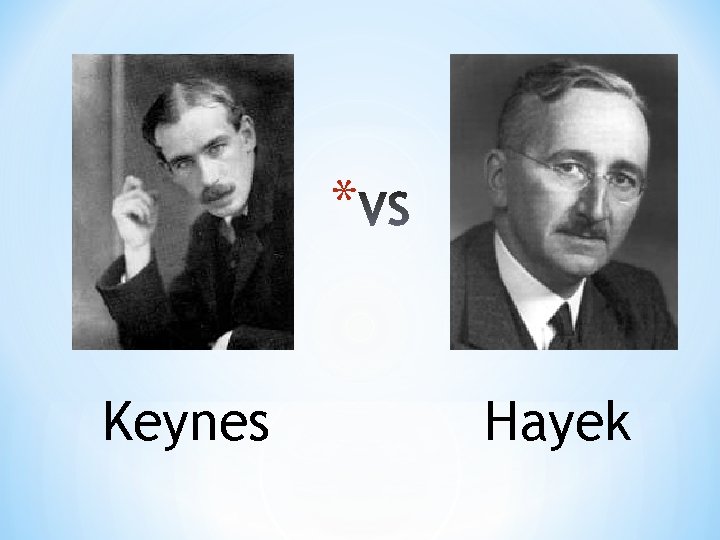
* Keynes Hayek
*Make a t-chart to compare theories of Keynes and Hayek *Read the curriculum handout about economic theories and principles surrounding the Great Depression in Canada and answer the following: *Which economic school of thought would each economist belong to? *
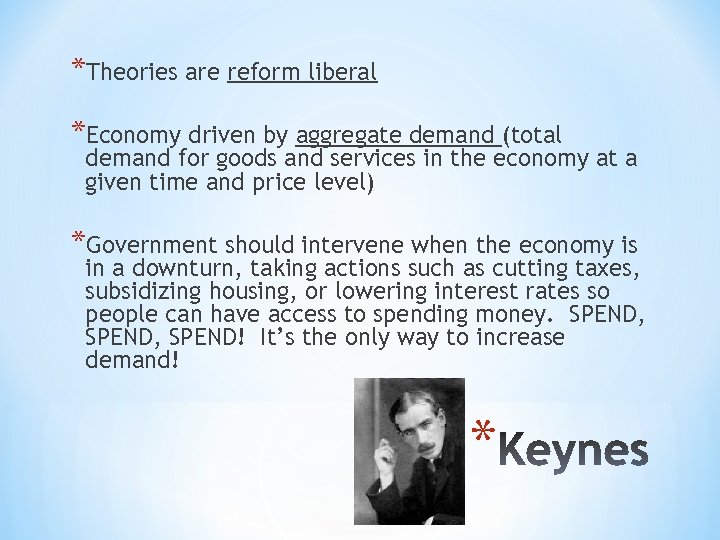
*Theories are reform liberal *Economy driven by aggregate demand (total demand for goods and services in the economy at a given time and price level) *Government should intervene when the economy is in a downturn, taking actions such as cutting taxes, subsidizing housing, or lowering interest rates so people can have access to spending money. SPEND, SPEND! It’s the only way to increase demand! *
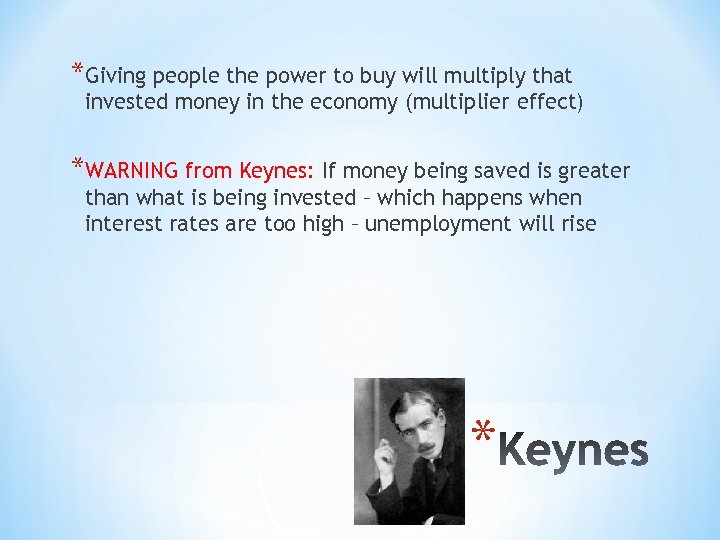
*Giving people the power to buy will multiply that invested money in the economy (multiplier effect) *WARNING from Keynes: If money being saved is greater than what is being invested – which happens when interest rates are too high – unemployment will rise *
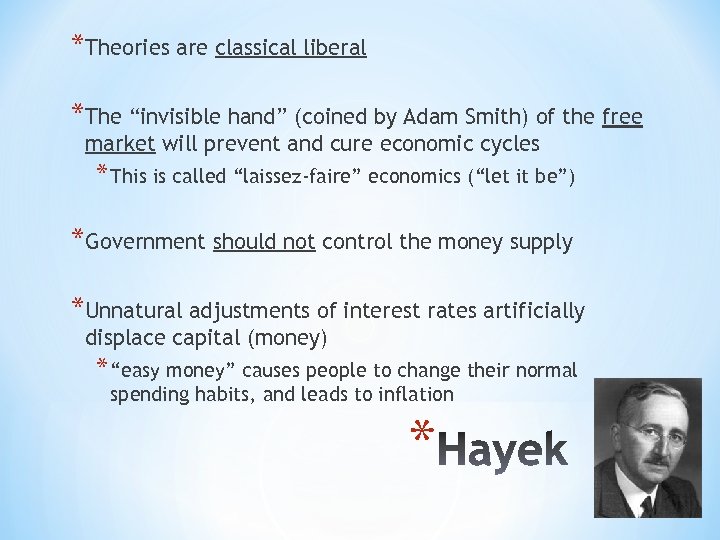
*Theories are classical liberal *The “invisible hand” (coined by Adam Smith) of the free market will prevent and cure economic cycles * This is called “laissez-faire” economics (“let it be”) *Government should not control the money supply *Unnatural adjustments of interest rates artificially displace capital (money) * “easy money” causes people to change their normal spending habits, and leads to inflation *
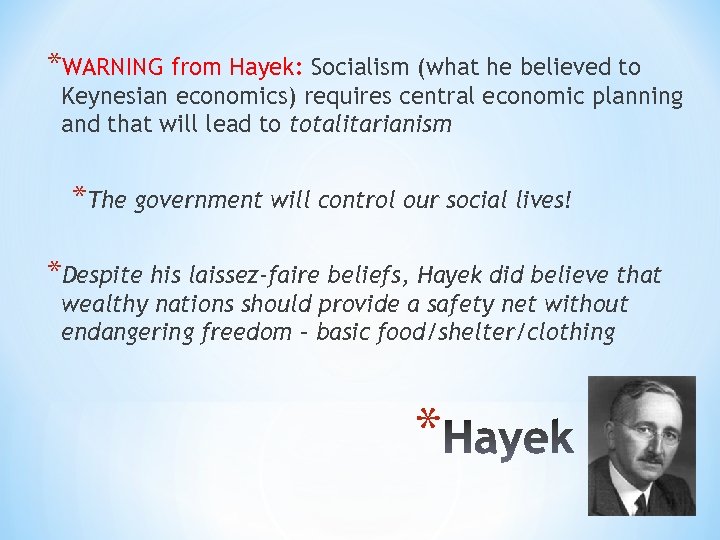
*WARNING from Hayek: Socialism (what he believed to Keynesian economics) requires central economic planning and that will lead to totalitarianism *The government will control our social lives! *Despite his laissez-faire beliefs, Hayek did believe that wealthy nations should provide a safety net without endangering freedom – basic food/shelter/clothing *
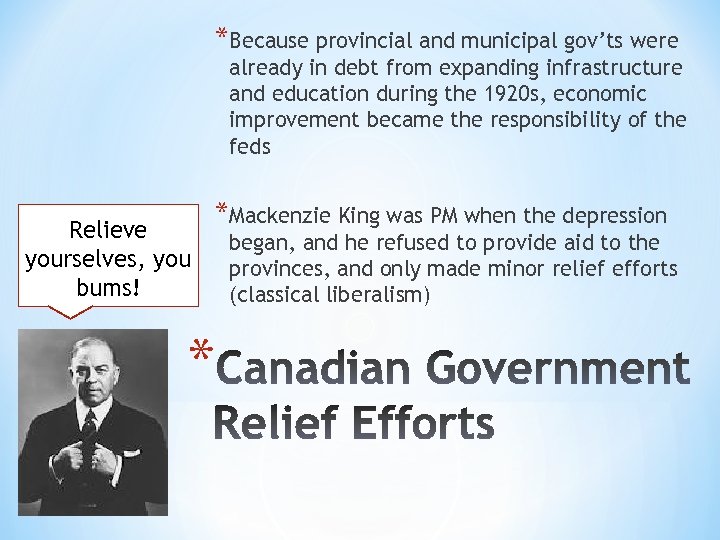
*Because provincial and municipal gov’ts were already in debt from expanding infrastructure and education during the 1920 s, economic improvement became the responsibility of the feds Relieve yourselves, you bums! *Mackenzie King was PM when the depression * began, and he refused to provide aid to the provinces, and only made minor relief efforts (classical liberalism)
* R. B. Bennett’s Conservatives won the 1930 election, and Bennett also initially refused to offer large-scale relief to the provinces * Bennett advocated for high import tariffs and large-scale gov’t spending as remedies * He eventually was forced to offer some relief to the unemployed * His make-work programs and system of unemployment aid got too large and he had to severely cut back federal spending – this deepened the depression because gov’t employees were laid off and make-work projects stopped *
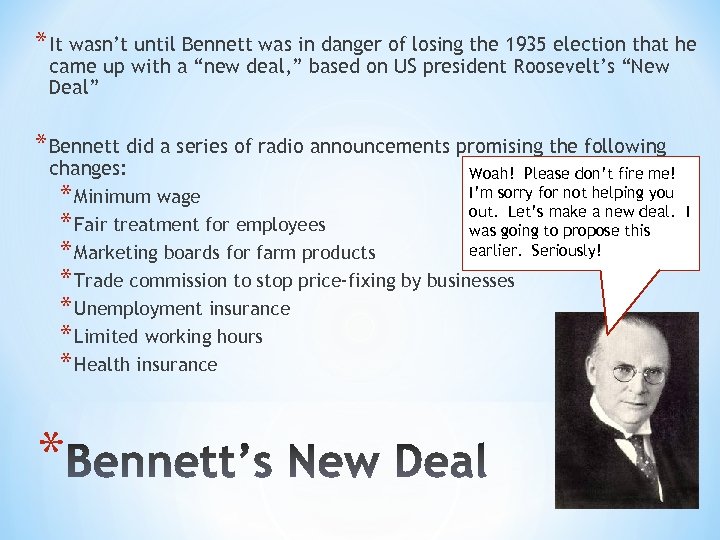
* It wasn’t until Bennett was in danger of losing the 1935 election that he came up with a “new deal, ” based on US president Roosevelt’s “New Deal” * Bennett did a series of radio announcements promising the following changes: Woah! Please don’t fire me! I’m sorry for not helping you out. Let’s make a new deal. I was going to propose this earlier. Seriously! * Minimum wage * Fair treatment for employees * Marketing boards for farm products * Trade commission to stop price-fixing by businesses * Unemployment insurance * Limited working hours * Health insurance *
* Despite the “new deal, ” Bennett was defeated in the 1935 election by his predecessor, Mackenzie King. * King lowered tariffs and signed a new trade agreement with the US, but largely believed in laissez-faire economics * His main goal was to balance the budget but cutting gov’t spending *
* To save $, King closed down relief camps and cut aid to the provinces * After studying economics, however, King decided to become more interventionist and spend more $ to get the economy going * Regardless, King pretty much just waited the depression out * The depression officially ended with the start of WWII in 1939 *
Скачать презентацию How can it be fixed and
1b82e128c817b45308a129f9cde3dc76.ppt