


 Скачать презентацию How Animals in Schools Can Support Learning Andrea
9cad74dd873deda876d39d0bf292d75c.ppt
- Количество слайдов: 46
 How Animals in Schools Can Support Learning Andrea M. Beetz PD Dipl. -Psych. , Dr. phil. habil. Dept. Special Education Dept. Behavioural Biology Andrea M. Beetz – 2015
 Overview § Dogs in School – What does this look like? § Positive Effects of Dogs on Learning and Possible Mechanisms § Oxytocin § Attachment and Caregiving § Biophilia-Effect § Reading with Dogs Andrea M. Beetz – 2015
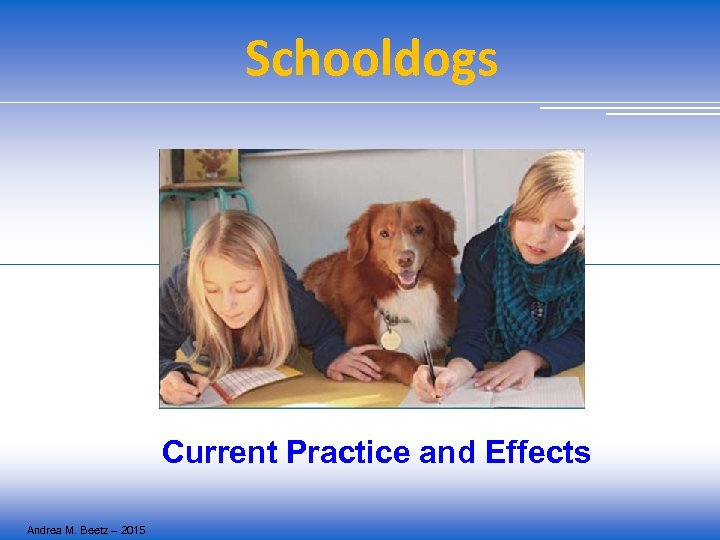 Schooldogs Current Practice and Effects Andrea M. Beetz – 2015
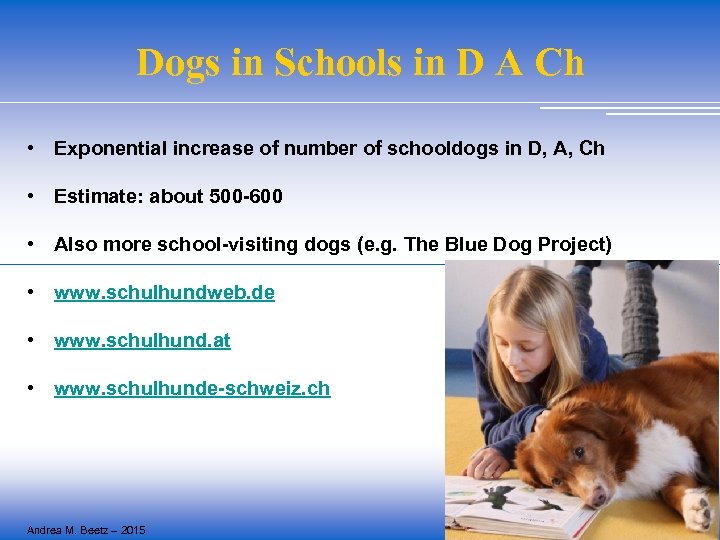 Dogs in Schools in D A Ch • Exponential increase of number of schooldogs in D, A, Ch • Estimate: about 500 -600 • Also more school-visiting dogs (e. g. The Blue Dog Project) • www. schulhundweb. de • www. schulhund. at • www. schulhunde-schweiz. ch Andrea M. Beetz – 2015
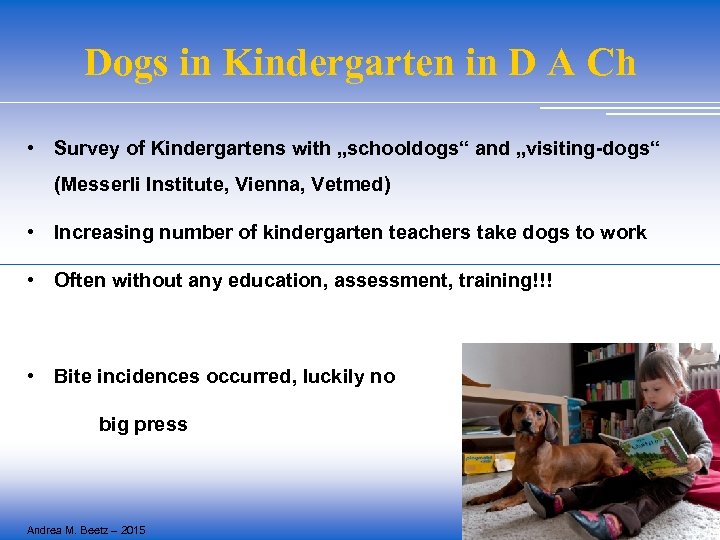 Dogs in Kindergarten in D A Ch • Survey of Kindergartens with „schooldogs“ and „visiting-dogs“ (Messerli Institute, Vienna, Vetmed) • Increasing number of kindergarten teachers take dogs to work • Often without any education, assessment, training!!! • Bite incidences occurred, luckily no big press Andrea M. Beetz – 2015
 Definition - Schooldog (Austrian Ministry of Education BMUKK 2013, Beetz 2012) • Schooldog spends class-time in (one) classroom on a regular basis. • The schooldog is handled by a teacher with an additional education in dog-assisted education. • The dog is assessed for his suitability, health and behavior, is trained and socialized for the clients/students he will meet and is assessed in the class / school on a regular basis. • The main goals are: enhancing social interactions in the classroom, student-teacher relationship, class climate and individual social competences of the students. Andrea M. Beetz – 2015
 Definition – School-visiting dog • School-visiting dogs visit classes (one at a time) once or a few times for 1 -3 hours. • The school-visiting dog is handled by a person with an education in dog-assisted education and is usually not a teacher at this school. • The dog is assessed for his suitabiltity, health and behavior, is trained and socialized for the clients/students he will meet and is assessed in school on a regular basis. • The main goals are: teaching knowledge about dogs (dog-keeping, approaching, care, training, communication) appropriate for this age group and or humane education / animal protection (e. g. animal abuse, breed specific diseases) Andrea M. Beetz – 2015
 Type of Schools Survey of 77 teachers with 84 schooldogs by Marhofer 2011: • > 40% in schools for special education • >30% in regular elementary schools (grade 1 -4/6) • 65% in classes 1 -4 (age 6 -10) • 75% one dog is working only in one class • BUT 25% work in several classes (this means more than 50 children per week) Recommendation BMUKK: Schooldog in only one class Andrea M. Beetz – 2015
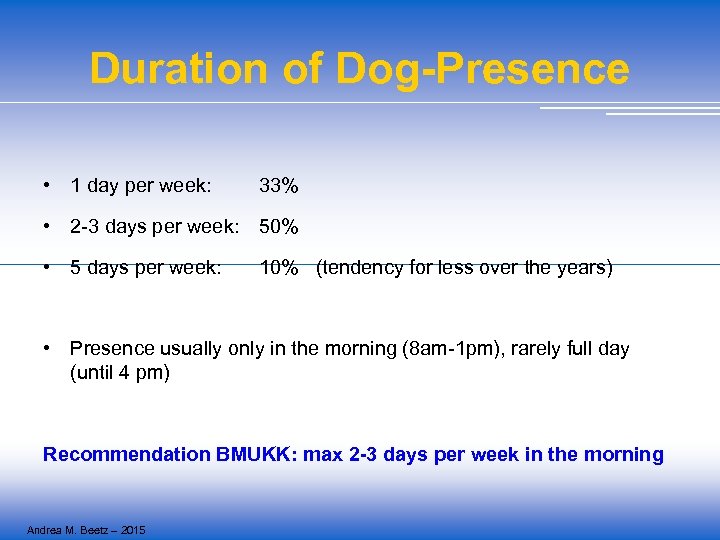 Duration of Dog-Presence • 1 day per week: 33% • 2 -3 days per week: 50% • 5 days per week: 10% (tendency for less over the years) • Presence usually only in the morning (8 am-1 pm), rarely full day (until 4 pm) Recommendation BMUKK: max 2 -3 days per week in the morning Andrea M. Beetz – 2015
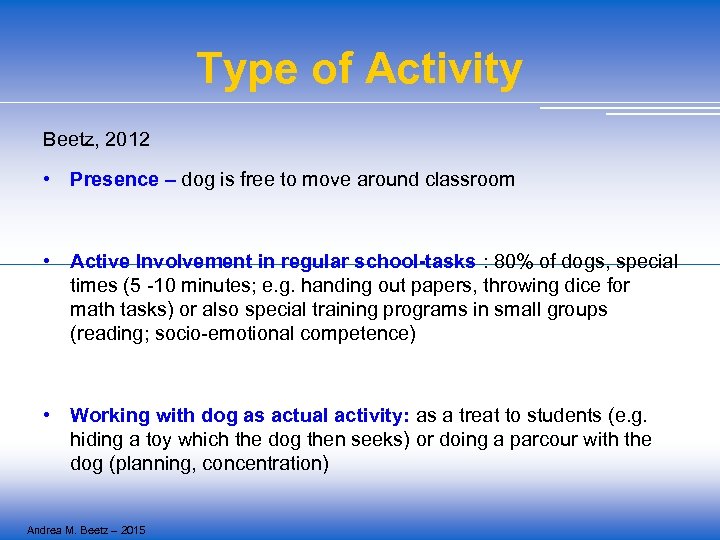 Type of Activity Beetz, 2012 • Presence – dog is free to move around classroom • Active Involvement in regular school-tasks : 80% of dogs, special times (5 -10 minutes; e. g. handing out papers, throwing dice for math tasks) or also special training programs in small groups (reading; socio-emotional competence) • Working with dog as actual activity: as a treat to students (e. g. hiding a toy which the dog then seeks) or doing a parcour with the dog (planning, concentration) Andrea M. Beetz – 2015
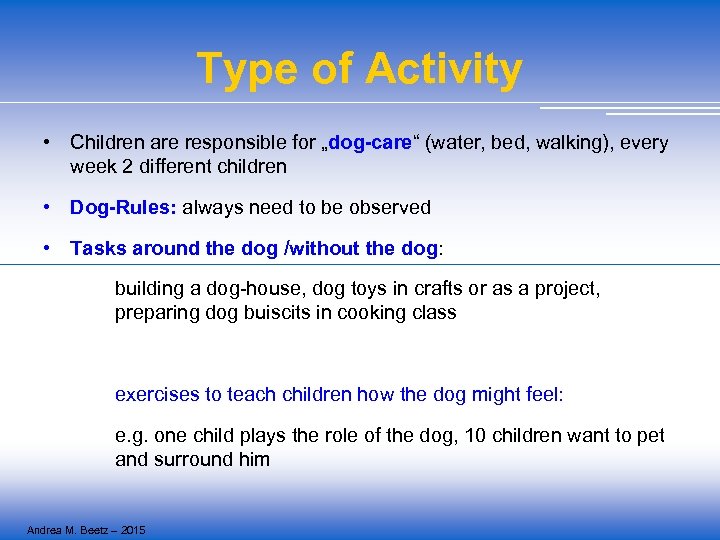 Type of Activity • Children are responsible for „dog-care“ (water, bed, walking), every week 2 different children • Dog-Rules: always need to be observed • Tasks around the dog /without the dog: building a dog-house, dog toys in crafts or as a project, preparing dog buiscits in cooking class exercises to teach children how the dog might feel: e. g. one child plays the role of the dog, 10 children want to pet and surround him Andrea M. Beetz – 2015
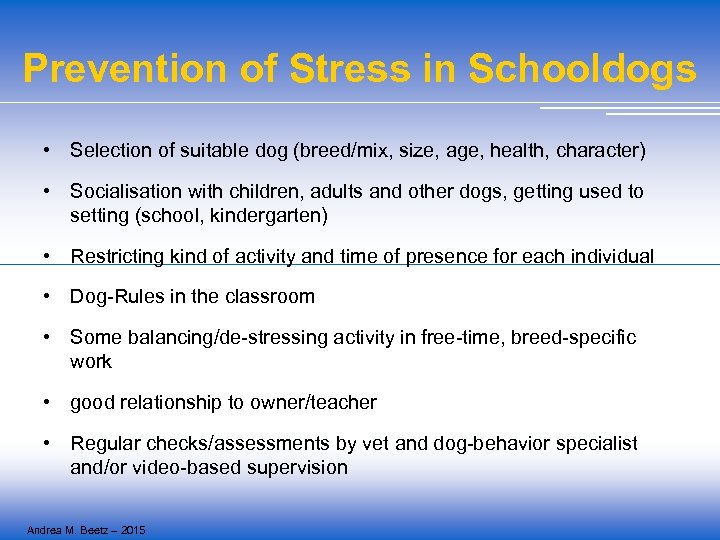 Prevention of Stress in Schooldogs • Selection of suitable dog (breed/mix, size, age, health, character) • Socialisation with children, adults and other dogs, getting used to setting (school, kindergarten) • Restricting kind of activity and time of presence for each individual • Dog-Rules in the classroom • Some balancing/de-stressing activity in free-time, breed-specific work • good relationship to owner/teacher • Regular checks/assessments by vet and dog-behavior specialist and/or video-based supervision Andrea M. Beetz – 2015
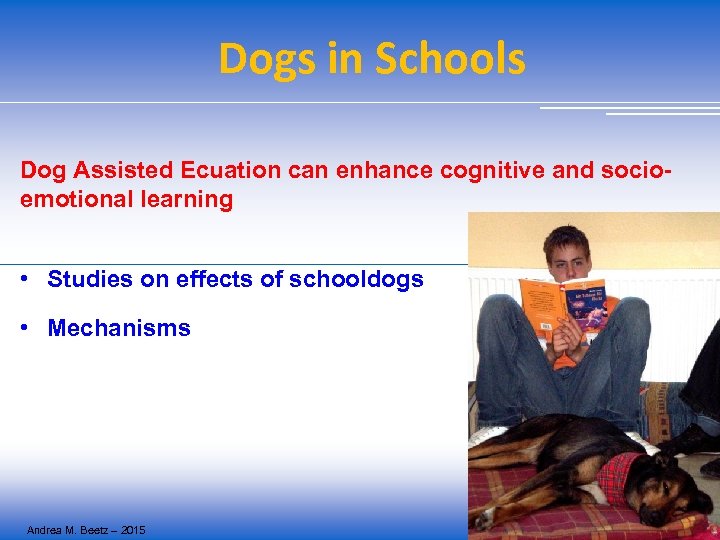 Dogs in Schools Dog Assisted Ecuation can enhance cognitive and socioemotional learning • Studies on effects of schooldogs • Mechanisms Andrea M. Beetz – 2015
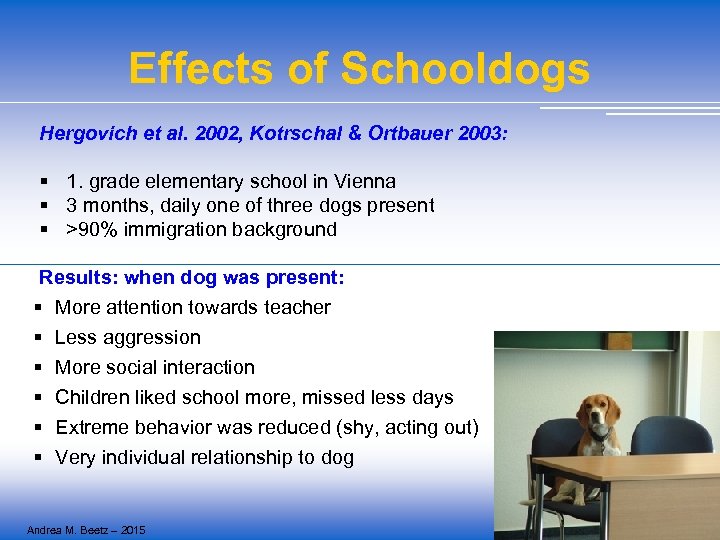 Effects of Schooldogs Hergovich et al. 2002, Kotrschal & Ortbauer 2003: § 1. grade elementary school in Vienna § 3 months, daily one of three dogs present § >90% immigration background Results: when dog was present: § More attention towards teacher § Less aggression § More social interaction § Children liked school more, missed less days § Extreme behavior was reduced (shy, acting out) § Very individual relationship to dog Andrea M. Beetz – 2015
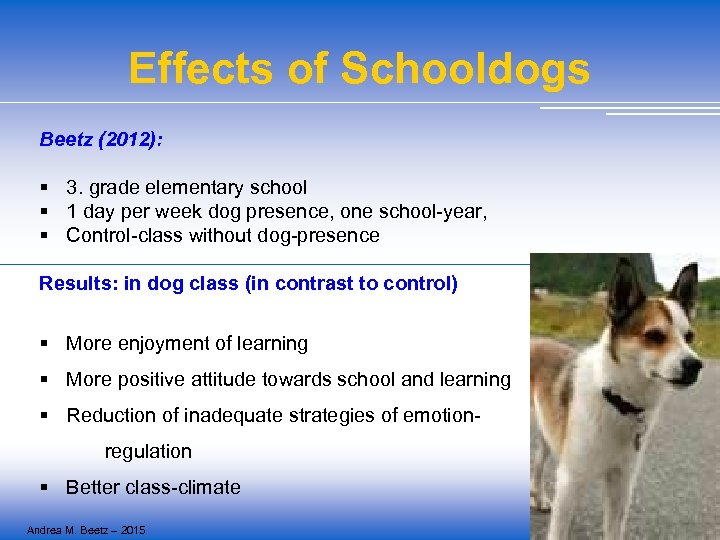 Effects of Schooldogs Beetz (2012): § 3. grade elementary school § 1 day per week dog presence, one school-year, § Control-class without dog-presence Results: in dog class (in contrast to control) § More enjoyment of learning § More positive attitude towards school and learning § Reduction of inadequate strategies of emotionregulation § Better class-climate Andrea M. Beetz – 2015
 Mechanisms behind effects of schooldogs Stress and fear in humans negatively affects Executive Funcions concentration working memory ability to motivate oneself impulse control logical thinking self reflection EF are the basis for successful learning, socially, emotionally, cognitively Andrea M. Beetz – 2015
 Mechanisms behind effects of schooldogs Problem with training programs (e. g. for reading, math, social competence): when humans are asked to do something they are not good at, they feel stressed and afraid (fear of failure and negative reactions of others, shame) and are usually not in a good mood Learning requires: - absence of stress and fear – a good level of activation - a good relationship to the teacher/therapist - a positive mood and attitude Andrea M. Beetz – 2015
 Effects of HAI and AAI Review (up to 2012): Beetz, A. , Uvnäs-Moberg, K. , Julius, H. & Kotrschal, K. (2012). Psychosocial and psychophysiological effects of human-animal interactions: The possible role of oxytocin. Frontiers in Psychology / Psychology for Clinical Settings, doi: 10. 3389/fpsyg. 2012. 00234 Julius, H. Beetz, A. , Kotrschal, K. Turner, D. & Uvnäs-Moberg, K. (2013). Attachment to Pets – An integrative view of human-animal relationships with implications for therapeutic practice. New York: Hogrefe. Data show the potential for the following positive effects – in reality it often depends on many factors Andrea M. Beetz – 2015
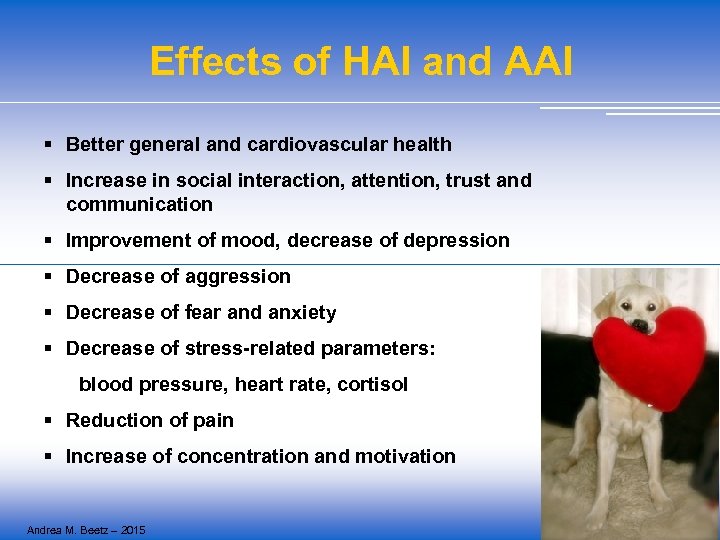 Effects of HAI and AAI § Better general and cardiovascular health § Increase in social interaction, attention, trust and communication § Improvement of mood, decrease of depression § Decrease of aggression § Decrease of fear and anxiety § Decrease of stress-related parameters: blood pressure, heart rate, cortisol § Reduction of pain § Increase of concentration and motivation Andrea M. Beetz – 2015
 Effects of HAI – How and Why? Why does HAI have stronger effects than human interaction? What can an animal do which a human cannot do? What are the mechanisms behind these effects? Under what circumstances? Andrea M. Beetz – 2015
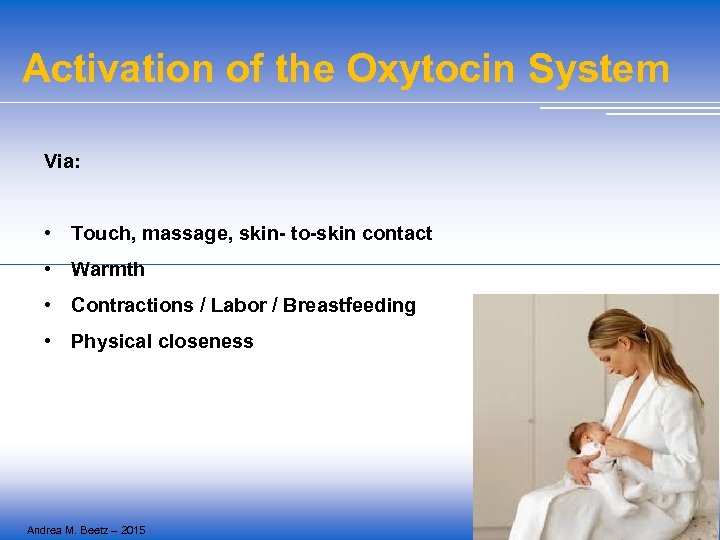 Activation of the Oxytocin System Via: • Touch, massage, skin- to-skin contact • Warmth • Contractions / Labor / Breastfeeding • Physical closeness Andrea M. Beetz – 2015
 Activation of the Oxytocin System Effects of oxytocin (for an overview see Beetz et al. 2012) § § § Better wellbeing / health Increase in social interaction and trust Improvement of mood, decrease in depression Decrease of aggression Decrease of fear and anxiety Decrease of stress-related parameters: blood pressure, heart rate, cortisol § Reduction of pain § Increase of concentration and motivation Andrea M. Beetz – 2015
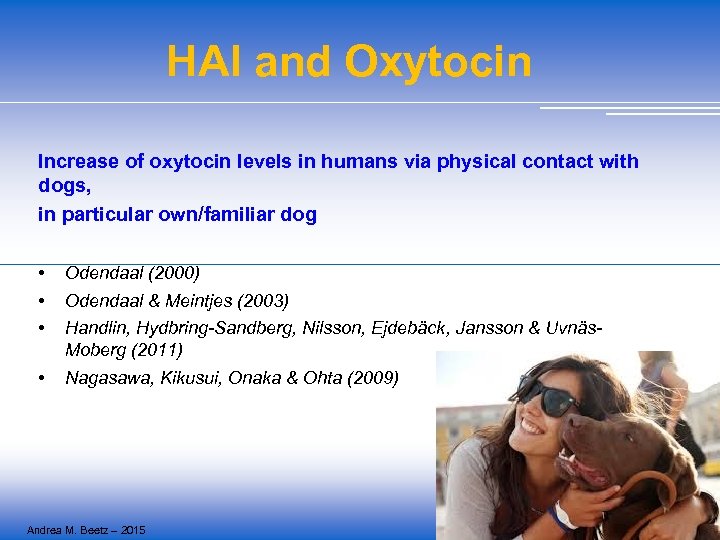 HAI and Oxytocin Increase of oxytocin levels in humans via physical contact with dogs, in particular own/familiar dog • • • Odendaal (2000) • Nagasawa, Kikusui, Onaka & Ohta (2009) Odendaal & Meintjes (2003) Handlin, Hydbring-Sandberg, Nilsson, Ejdebäck, Jansson & Uvnäs. Moberg (2011) Andrea M. Beetz – 2015
 Attachment Theory John Bowlby: Attachment Theory (1960) Julius, Beetz, Kotrschal, Turner, Uvnäs-Moberg (2013). Attachment to Pets. Hogrefe. Function: • protection of offspring • stress regulation • emotion regulation § attachment system in the child § caregiving system in the parent § goal: establishing closeness Andrea M. Beetz – 2015
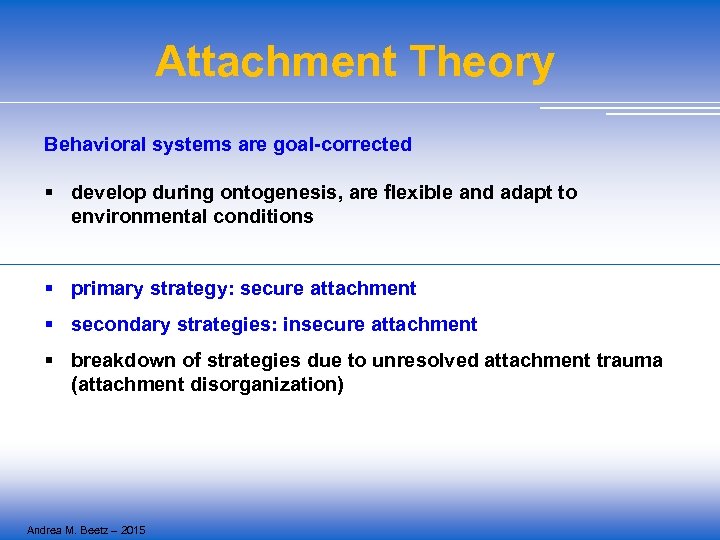 Attachment Theory Behavioral systems are goal-corrected § develop during ontogenesis, are flexible and adapt to environmental conditions § primary strategy: secure attachment § secondary strategies: insecure attachment § breakdown of strategies due to unresolved attachment trauma (attachment disorganization) Andrea M. Beetz – 2015
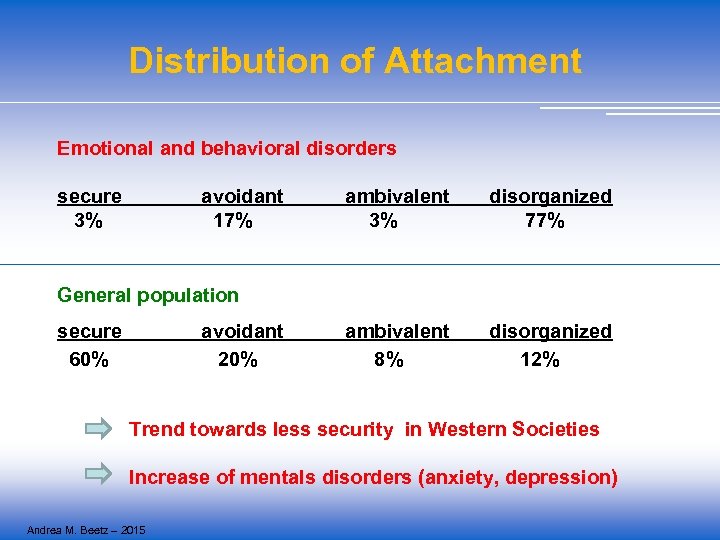 Distribution of Attachment Emotional and behavioral disorders secure 3% avoidant 17% ambivalent 3% disorganized 77% ambivalent 8% disorganized 12% General population secure 60% avoidant 20% Trend towards less security in Western Societies Increase of mentals disorders (anxiety, depression) Andrea M. Beetz – 2015
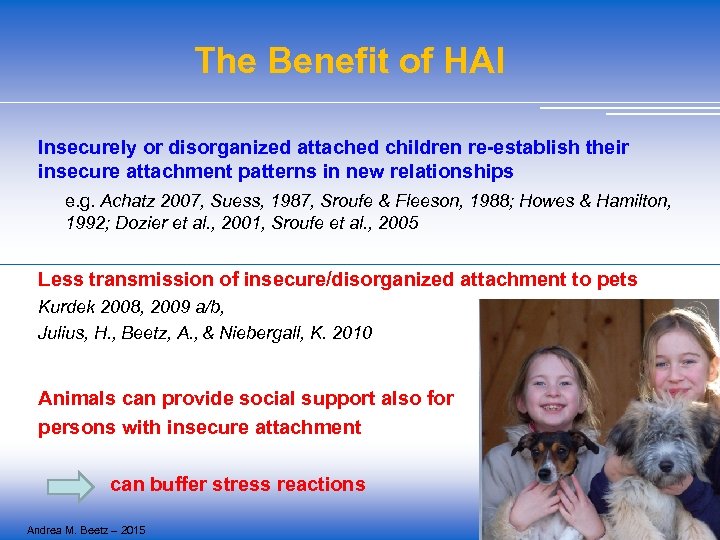 The Benefit of HAI Insecurely or disorganized attached children re-establish their insecure attachment patterns in new relationships e. g. Achatz 2007, Suess, 1987, Sroufe & Fleeson, 1988; Howes & Hamilton, 1992; Dozier et al. , 2001, Sroufe et al. , 2005 Less transmission of insecure/disorganized attachment to pets Kurdek 2008, 2009 a/b, Julius, H. , Beetz, A. , & Niebergall, K. 2010 Animals can provide social support also for persons with insecure attachment can buffer stress reactions Andrea M. Beetz – 2015
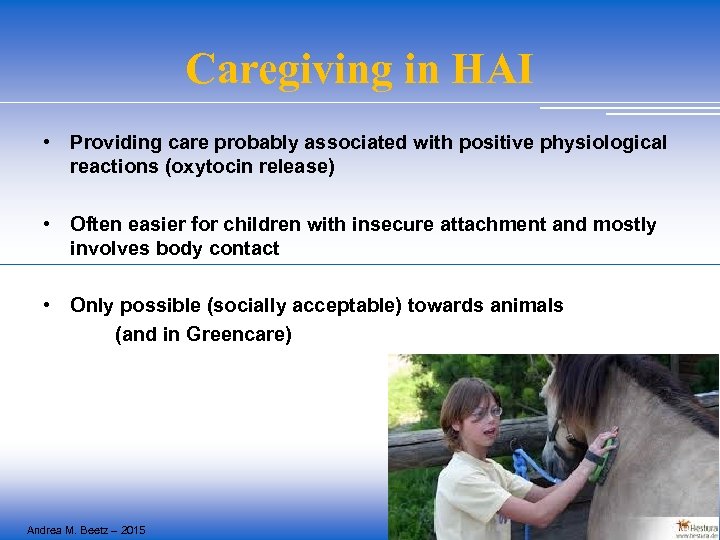 Caregiving in HAI • Providing care probably associated with positive physiological reactions (oxytocin release) • Often easier for children with insecure attachment and mostly involves body contact • Only possible (socially acceptable) towards animals (and in Greencare) Andrea M. Beetz – 2015
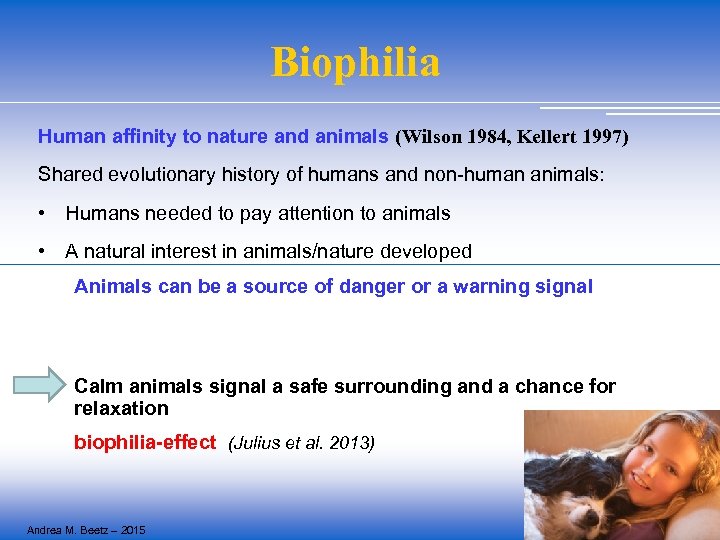 Biophilia Human affinity to nature and animals (Wilson 1984, Kellert 1997) Shared evolutionary history of humans and non-human animals: • Humans needed to pay attention to animals • A natural interest in animals/nature developed Animals can be a source of danger or a warning signal Calm animals signal a safe surrounding and a chance for relaxation biophilia-effect (Julius et al. 2013) Andrea M. Beetz – 2015
 HAI and Learning HAI supports preconditions for optimal learning § Reduction of stress and fear reduction in challenging situations (education, therapy) better EF (impulse control, reflective functioning, memory) § Easier establishment of a good relationship between client and therapist / teacher and student (via OT? ) § Improved mood, positive atmosphere Andrea M. Beetz – 2015
 Motivation Wohlfarth, R. Mutschler, B. , Beetz, A. , Kreuser, F. & Korsten-Reck, U. (2013). Dogs motivate obese children for physical activity: Key elements of a motivational theory of animal-assisted interventions. Frontiers in Psychology, 4 (796), doi: 10. 3389/fpsyg. 2013. 00796. Intrinsic Motivation Extrinsic Motivation Natural incentives Hot mode of pursuit Learned incentives Cold mode of goal-pursuit Animals seem to be „hot stimuli“ and motivate intrinsically – they are interesting, people want contact (biophilia-based? ) Advantage of AAI: Andrea M. Beetz – 2015 to motivate clients who are tired of interventions, feel hopelessness or fear of failure (e. g. reading)
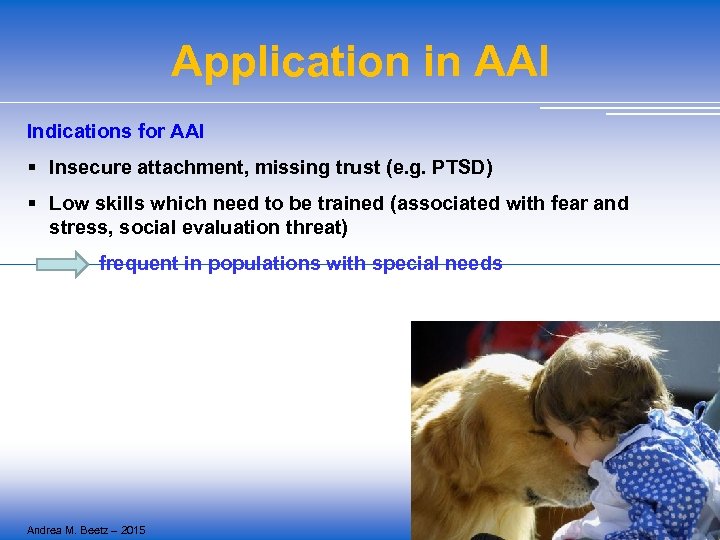 Application in AAI Indications for AAI § Insecure attachment, missing trust (e. g. PTSD) § Low skills which need to be trained (associated with fear and stress, social evaluation threat) frequent in populations with special needs Andrea M. Beetz – 2015
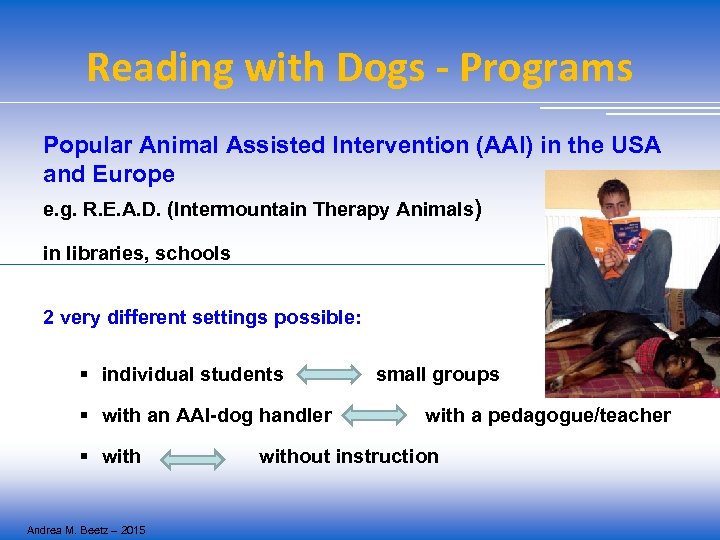 Reading with Dogs - Programs Popular Animal Assisted Intervention (AAI) in the USA and Europe e. g. R. E. A. D. (Intermountain Therapy Animals) in libraries, schools 2 very different settings possible: § individual students § with an AAI-dog handler § with Andrea M. Beetz – 2015 small groups with a pedagogue/teacher without instruction
 Forms of Reading with Dogs … (should) depend on the actual reading skills 1. Mere dog-team presence (no instruction by pedagogue/teacher) or reading with schooldog alone in a corner of the classroom Reading with Dogs (1) § Exercise for disfluent readers § Goal: to improve reading fluency § Based on relaxation, motivation and positive attitude § Not suitable for students lacking basic reading skills Andrea M. Beetz – 2015
 Forms of Reading with Dogs 2. Dog presence and involvment in small group setting (ca. 4 students) with instruction by teacher / pedagogue Dog-Assisted Reading Training (2, Germany, Austria) § Promotion of reading techniques, word recognition, grammar § Talking about content and reading strategies § Very structured approach – comparable to usual reading programs in regular school time without dogs § Dog effect based on relaxation, motivation Andrea M. Beetz – 2015
 Studies on Effects of Reading with Dogs Wohlfarth, Mutschler, Beetz & Schleider (2013) § 12 children, 2 nd grade, age 6 -7 (average reading skills) § assigned to 2 groups, cross-over design § reading in presence or absence of dog (friendly female student) § During dog presence significant improvement in § Word recognition § Correct punctuation recognition § Number of correct line breaks Andrea M. Beetz – 2015
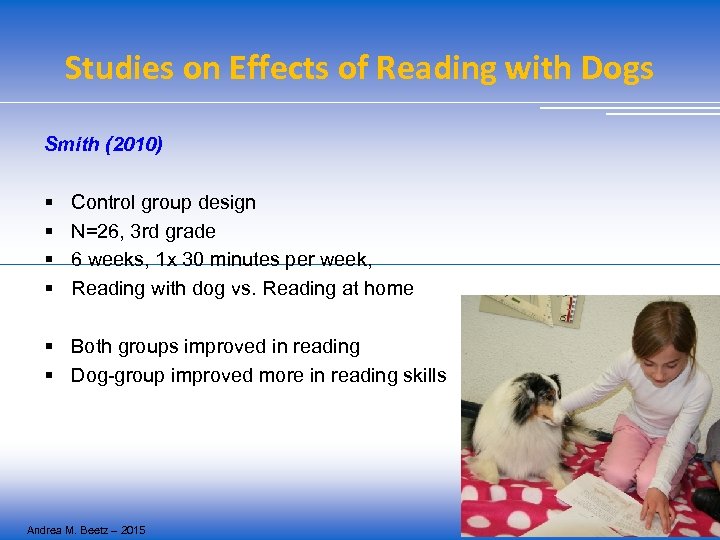 Studies on Effects of Reading with Dogs Smith (2010) § § Control group design N=26, 3 rd grade 6 weeks, 1 x 30 minutes per week, Reading with dog vs. Reading at home § Both groups improved in reading § Dog-group improved more in reading skills Andrea M. Beetz – 2015
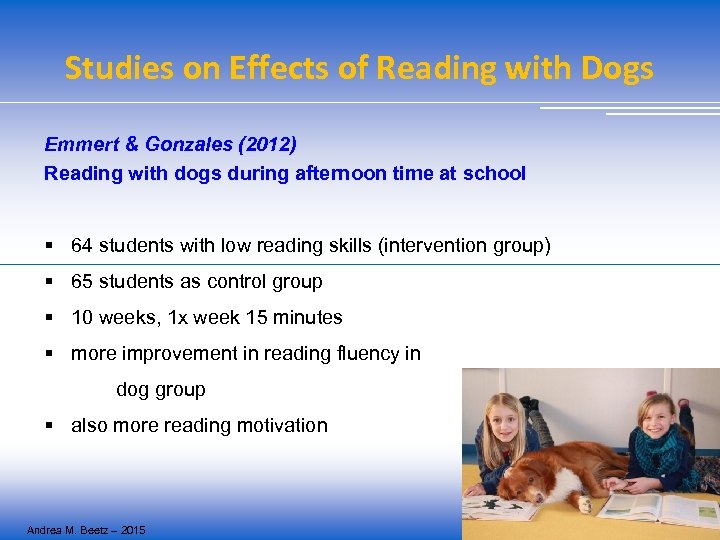 Studies on Effects of Reading with Dogs Emmert & Gonzales (2012) Reading with dogs during afternoon time at school § 64 students with low reading skills (intervention group) § 65 students as control group § 10 weeks, 1 x week 15 minutes § more improvement in reading fluency in dog group § also more reading motivation Andrea M. Beetz – 2015
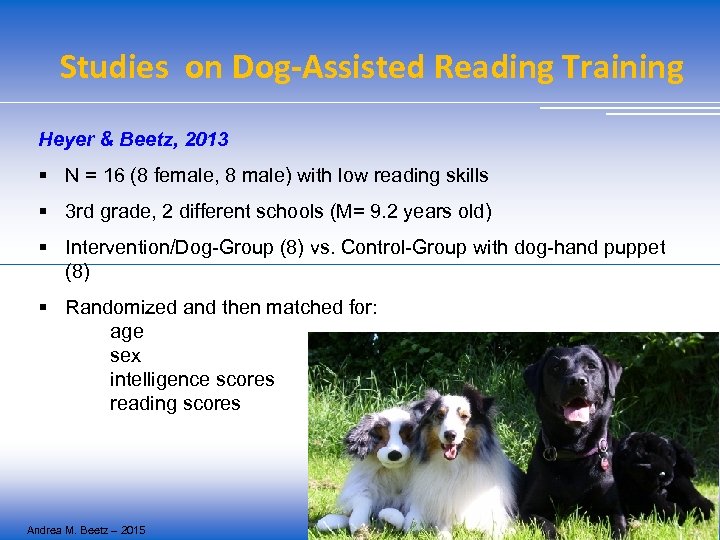 Studies on Dog-Assisted Reading Training Heyer & Beetz, 2013 § N = 16 (8 female, 8 male) with low reading skills § 3 rd grade, 2 different schools (M= 9. 2 years old) § Intervention/Dog-Group (8) vs. Control-Group with dog-hand puppet (8) § Randomized and then matched for: age sex intelligence scores reading scores Andrea M. Beetz – 2015
 Studies on Dog-Assisted Reading Training § Training in groups of 4 children § 14 weeks of reading training (1 x per week, 60 min. ) § Group with real dogs (2 different ones) – control group with dogpuppets § Same exercises (reading aloud, repeated reading, strategies, communication) § 2 different teachers (each one intervention group and one control) Andrea M. Beetz – 2015
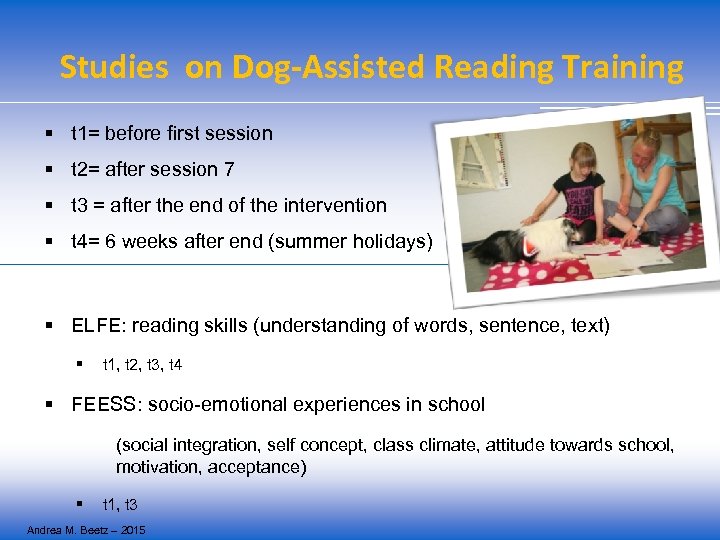 Studies on Dog-Assisted Reading Training § t 1= before first session § t 2= after session 7 § t 3 = after the end of the intervention § t 4= 6 weeks after end (summer holidays) § ELFE: reading skills (understanding of words, sentence, text) § t 1, t 2, t 3, t 4 § FEESS: socio-emotional experiences in school (social integration, self concept, class climate, attitude towards school, motivation, acceptance) § t 1, t 3 Andrea M. Beetz – 2015
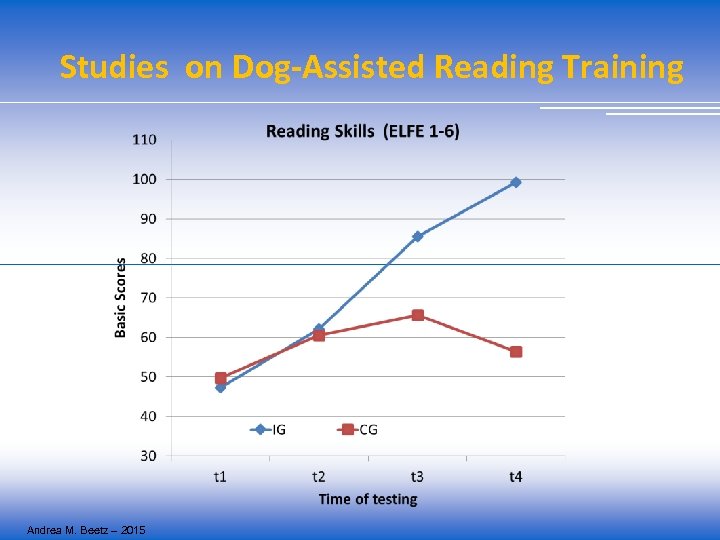 Studies on Dog-Assisted Reading Training Andrea M. Beetz – 2015
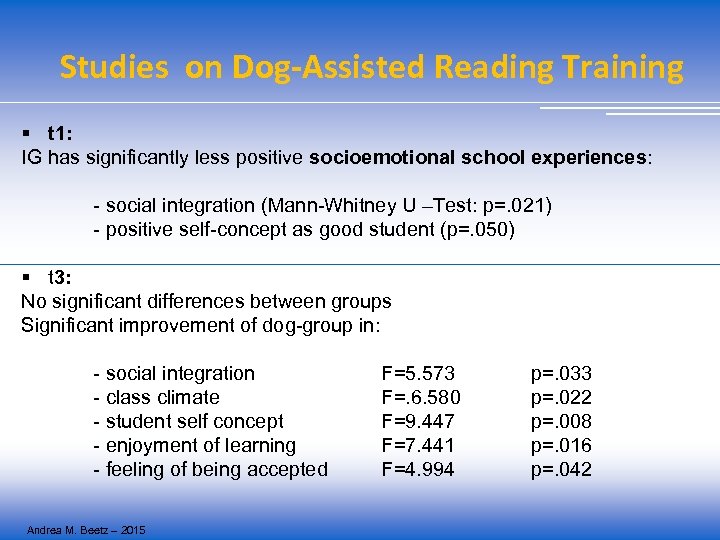 Studies on Dog-Assisted Reading Training § t 1: IG has significantly less positive socioemotional school experiences: - social integration (Mann-Whitney U –Test: p=. 021) - positive self-concept as good student (p=. 050) § t 3: No significant differences between groups Significant improvement of dog-group in: - social integration - class climate - student self concept - enjoyment of learning - feeling of being accepted Andrea M. Beetz – 2015 F=5. 573 F=. 6. 580 F=9. 447 F=7. 441 F=4. 994 p=. 033 p=. 022 p=. 008 p=. 016 p=. 042
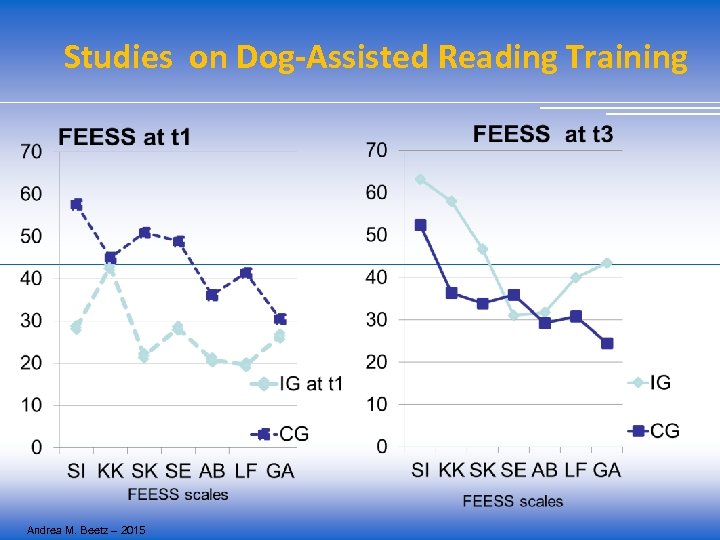 Studies on Dog-Assisted Reading Training Andrea M. Beetz – 2015
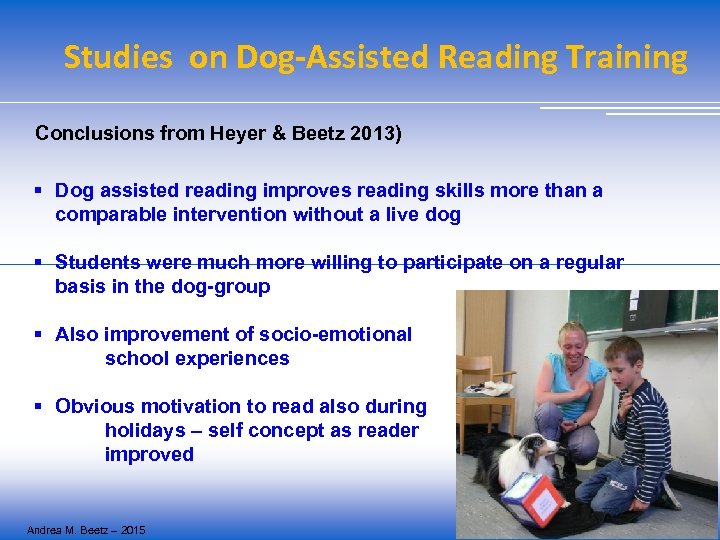 Studies on Dog-Assisted Reading Training Conclusions from Heyer & Beetz 2013) § Dog assisted reading improves reading skills more than a comparable intervention without a live dog § Students were much more willing to participate on a regular basis in the dog-group § Also improvement of socio-emotional school experiences § Obvious motivation to read also during holidays – self concept as reader improved Andrea M. Beetz – 2015
 Thank you for your attention! Contact: andrea. m. beetz@gmail. com Andrea M. Beetz – 2015