 Скачать презентацию Housing Support Enabling Unit Workshops 27 th October
d16185cc294f715451ed213a5f31dc37.ppt
- Количество слайдов: 76



Housing Support Enabling Unit Workshops 27 th October 2009 Edinburgh 30 th October 2009 Glasgow
Aims for Today 1. 2. 3. 4. Benefits and Risks of Collaboration Options for the Structure of a Successful Collaboration Practical Considerations for Successful Collaboration Key Issues in Tendering as a Collaboration Workshops will provide a balance between case studies and checklists for good practice and will provide an opportunity for discussion
Introductions Individually n Name and Organisation / Agency n Experience of Procurement Flip-Chart n Aims for this workshop
SESSION 1 Relevant Background And Benefits and Risks of Collaboration
References for today’s session Discussed later
Chatham House Rule “ Chatham House Rule - participants are free to use the information received, but neither the identity nor the affiliation of the speaker/s, nor that of any other participant, may be revealed ".
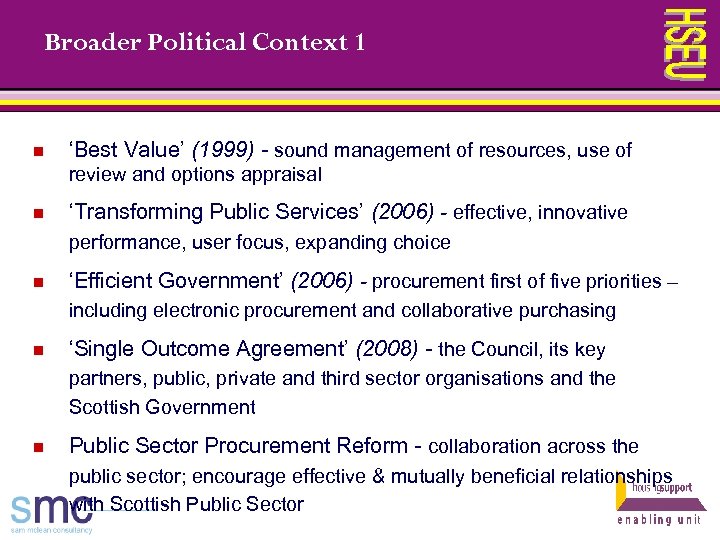
Broader Political Context 1 n ‘Best Value’ (1999) - sound management of resources, use of review and options appraisal n ‘Transforming Public Services’ (2006) - effective, innovative performance, user focus, expanding choice n ‘Efficient Government’ (2006) - procurement first of five priorities – including electronic procurement and collaborative purchasing n ‘Single Outcome Agreement’ (2008) - the Council, its key partners, public, private and third sector organisations and the Scottish Government n Public Sector Procurement Reform - collaboration across the public sector; encourage effective & mutually beneficial relationships with Scottish Public Sector
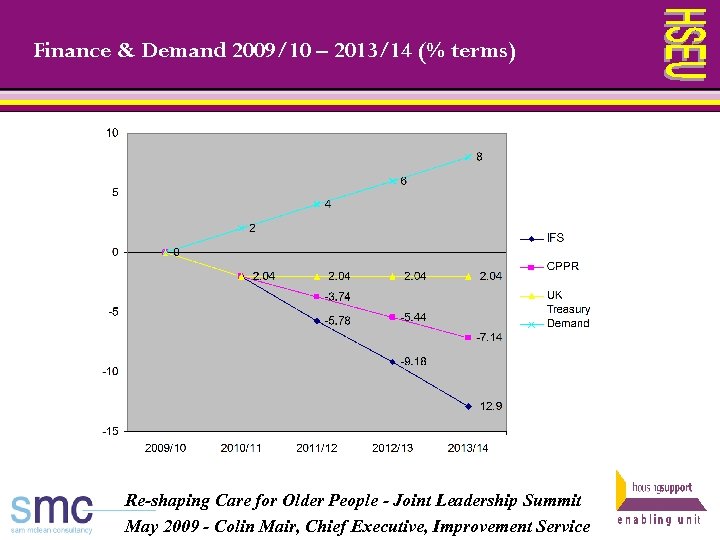
Finance & Demand 2009/10 – 2013/14 (% terms) Re-shaping Care for Older People - Joint Leadership Summit May 2009 - Colin Mair, Chief Executive, Improvement Service
SUMMARY Procurement Reform – Current Opportunities n Less ring-fenced resources – more flexible funding n Greater certainty of funding – 3 year financial planning n Early opportunity to demonstrate commitment to deliver on Shared Services and Public Sector Reform n More Efficiency Savings – Better Services “Procurement Reform – The Chief Government’s Imperative” Gavin Whitefield, Chief Government, North Lanarkshire Council and Vice-Chair SOLACE (Scotland) - Scottish Public Procurement Conference 31 st October 2007
Economic Downturn – 15 Big Questions A. Strategy 1. What effect is the economic downturn having on our charity and its activities? B. Financial Health 2. Financially strong enough to sustain our operations? 3. Impact the economic climate is having on our donors and funders? 4. Do we have any reserves? 5. Have we reviewed banking arrangements and any investments? 6. Have we reviewed our contractual commitments? e. g. premises, equipment 7. Have we reviewed any contracts to deliver public services? 8. If we have a pension scheme, have we reviewed it recently? The economic downturn - 15 questions trustees need to ask : 9. How can we make best use of permanent endowment investments The Charity Commission (June 2009)
Economic Downturn – 15 Big Questions C. Governance 10. Are we an effective trustee body? 11. Do we have adequate safeguards in place to prevent fraud? D. Making best use of resources 12. Are we making best use of the financial benefits we have as a charity? 13. Are we making best use of our staff and volunteers? 14. Have we considered collaborating with other charities? 15. Are we making best use of our property? The economic downturn - 15 questions trustees need to ask : The Charity Commission (June 2009)
First questions n n n What are you hoping to achieve by collaborating? Are you sure that collaborative working is the best way to achieve this? Who proposed the idea? Do they have a vested interest? Do your Trustees and Chief Executive support the idea? Does it fit within your organisation’s charitable objects as stated in your governing document? Do your plans for collaborative working fit your strategic vision, values and current priorities? Should you collaborate? – NCVO (2005)
Working relationships n n How might formal collaboration change an existing relationship with your partner? Do you have clear shared aims for the collaboration? Do you and your partner see your respective inputs and outputs as fair? Do other organisations have experience of working with them? Should you collaborate? – NCVO (2005)
Why collaborate to deliver public services? n Greater capacity to improve outcomes for service users ─ n n n n potentially more effective management, delivery and monitoring of the service Lower overheads mean more money for frontline work Increased capacity to replicate on a larger scale service Increased knowledge pool to contribute to a more effective service Combine different specialisms of organisations Share the risk involved in taking on public service delivery Increase negotiating strength where poor funding practice Increase levels of trust if common culture focused on need and Joint working for public service delivery - A model of quality of service collaborative working. NCVO (2006)
Will collaboration add value? n n Measurable benefits to service users and beneficiaries? Cost savings for your organisation? Affect your potential income? ‘Add value’ to your organisation’s work? ─ n n justifies the time, effort and money invested in the collaboration? Lose by working on your collaborative project? Risk ‘mission drift’ by moving away from your organisation’s main aims? Structure affected by change and long-term implications? Change your organisation’s other existing relationships? Should you collaborate? – NCVO (2005)
The Benefits of Collaborative Working n n n New or improved services Wider geographical reach or access to new beneficiary groups More integrated or co-ordinated approach to beneficiary needs Financial savings and better use of existing resources Knowledge, good practice and information sharing Sharing the risk in new and untested projects Capacity to replicate success Stronger, united voice Better co-ordination of organisations' activities Competitive advantage Mutual support between organisations http: //www. ncvo-vol. org. uk/index. asp? id=2039
The Risks of Collaborative Working n n n n Outcomes do not justify the time and resources invested Loss of flexibility in working practices Complexity in decision-making and loss of autonomy Diverting energy and resources away from core aims – mission drift Damage to or dilution of your brand reputation Damage to organisation and waste of resources if collaboration is unsuccessful Lack of awareness of legal obligations Stakeholder confusion Working together to achieve your mission NCVO
Key obstacles to a successful collaboration: n n n n Personalities Competition between partners Lack of information and experience Lack of resources, especially at decision-making stage Resistance to change Cultural mismatch between organisations Lack of consistency and clarity on roles and responsibilities http: //www. ncvo-vol. org. uk/index. asp? id=2039
Things that can help overcome challenges: n n n n n Good personal relationships Compatible cultures or an understanding of different cultures Written agreements Experience of change management, leadership and vision Resources Clear and agreed mutual benefits and collaborative advantage A focus on the big picture Careful planning ICT tools http: //www. ncvo-vol. org. uk/index. asp? id=2039 The Unit's support, information and materials
WORKSHOP 1 Choose on ‘back office’ function that most organisations fulfil and, with reference to this, suggest – 1. 3 benefits that collaboration might bring 2. and 3 risks
Coffee Resume in 15 minutes
SESSION 2 How to Develop a Successful Collaboration
Collaboration in Action n Working together to achieve your mission ─ n n n e. g. policy development, communication etc. Sharing back office services – e. g. IT, HR, Payroll, Property, Joint working for public service delivery – tendering Collaborative working to generate income ─ e. g. fundraising, payroll giving, appeals, legacy giving etc. n Collaborative working to make more effective use of ICT ─ n e. g. purchasing, support, etc. delivery - A model of Joint working for public service collaborative working. NCVO Campaigning in collaboration (2006)
What forms does collaborative working take? n n n Separate organisations maintain their independence - work jointly on some activities or functions Organisations with resources or expertise – assist other organisations e. g. a larger organisation working with a small local group A new organisation to do joint work on some activities or functions A group structure where a 'parent' organisation governs a group of 'subsidiary' organisations Merger to form a new organisation working as one body on Collaborative Working: Partnership between voluntary organisations all activities NCVO 2007
Joint Projects – Consider n Main options – maintain identity or create a new organisations n Different structures are right for different organisations depending on their aims for the collaboration n Professional advice should help work out what is best in each case Working together to achieve your mission NCVO ( 2006)
Considering Collaboration 1. How can we better meet the needs of our org. and its beneficiaries by working with others? 2. How will potential partners be identified? Do we already have an existing relationship with them? 3. Is the proposed partner org. compatible with us in terms of its objects, culture, governance arrangements, organisational structures and funding base? 4. What are the reasons for collaborating? Choosing to Collaborate: Helping you succeed September 2009 – Charities Commission
Considering Collaboration 5. What will or might our org. gain and lose from collaborating? Have we considered the wider impacts on our charity? 6. Do we plan to approach stakeholders for their views, particularly service users? 7. Does the collaboration further our org. purposes? Is it an appropriate use of org. funds? Is any private benefit incidental? 8. Are there significant reputational or financial risks? If yes, are we carrying out a due diligence exercise? Choosing to Collaborate: Helping you succeed September 2009 – Charities Commission
Is your organisation compatible with your potential partner? n Think about each organisation’s ─ ─ n n Objects - philosophy Governance - policies structure decision-making processes resources assets and funding base - culture - organisational - financial Can any areas of incompatibility be overcome ? What are each organisations strengths and weaknesses ? Should you collaborate? – NCVO (2005)
Who to involve n People who lead the work will vary with the type of collaboration ─ Trustees, Chief Executives or Project Managers Consider - n The skills and qualities needed for this role n A timescaled consultation process and keep stakeholders informed ─ Plan who to involve ü ü Who / how will this process be managed? When and whether to sound out stakeholders ? / Use a facilitator? Who needs to be involved in each stage of decision-making? Should you collaborate? – NCVO (2005) Who can be left until plans have developed further?
Staffing a joint project n n n Staff can be full/part time on the Project May work from existing location or Project Team Foundations are – ─ n n n Be clear about who will employ staff on the project Consider how will the Project will be managed Ensure staff remain informed of the work of partner organisations ─ n careful planning and regular communication clarity and consistency Consider terms and conditions, working practices and organisational culture Working together to achieve your mission – NCVO 2006
Approaches to collaboration n n Consider what type of agreement will be appropriate for our needs Consider professional advice about the type and content of the agreement ─ ─ n Ensure the agreement states the collaboration objectives, benefits for each party, duration and funding arrangement And addresses the identified risks including any conflict/s of interest Consider significant reputational or financial risks ─ If yes, carry out a due diligence exercise – see handout Choosing to Collaborate: Helping you succeed September 2009 – Charities Commission http: //www. charity-commission. gov. uk/enhancingcharities/colltoolkit. asp
Structures for joint projects 1 - Joint working n n n Two or more organisations work together, maintain independence and identity Appropriate level of board and senior management involvement Trustees / Board has ─ ─ n Could form a joint committee with representatives from each board ─ n n final responsibility for the organisation, including collaborations may co-operate to oversee the collaboration for its duration agree a code of conduct to formalise how they will work together Or may approve the collaboration, then delegate its implementation ─ with regular reporting Working together to achieve your mission Consider controlling the collaboration by a written agreement ─ NCVO ( 2006) which separates the joint functions from the ongoing operations of
Structures for joint projects 2 - New organisation n n Create a separate organisation to run activities for beneficiaries Each organisation maintains its own identity distinct from the new organisation New organisation is a legal entity in its own right with appropriate legal structure The degree of influence the partners wish to have in the new organisation will determine which option is chosen - ─ The original organisations may share the governance of the new organisation ü New organisation could have separate board with each partner having an agreed number of seats ü Or one person to represent all the partner organisations on Working together to achieve your mission the board of the new organisation NCVO ( 2006)
New independent body – 1. n n In this model, partners create a new legal entity Although the new entity will not have a track record, all of the risks associated with delivery are transferred to the new body In delivering contracts it is clear where the legal responsibilities lie and there is no need for a lead body However, developing a new body will require resource and there is a risk that it will end up competing for funds against the partner organisations Models for collaborative working around commissioning BASSAC (2009)
Lead Agency Model - 2. n n Agreement will set out how members will work together – (see later) Lead agency holds the main contract ─ ─ n Practically the lead agency will - ─ ─ n ultimately accountable and sub-contracts to partners Must have the capacity & ability to handle a contract management role Be legally and contractually responsible for the services provided by the consortium Receive payments / pay partners Check quality of contracted services & provide monitoring information Participate in any contract reviews Lead agency can either be a consortium member and deliver services or just take a managing and coordinating role, Models for collaborative working around …whatever… costs must be accounted for commissioning BASSAC (2009)
Sub-contracting – 3. n Contract awarded to one contractor who then sub-contracts to others ─ ─ n n n The model allows work together on basis of strengths, expertise and diversity The main contractor may provide services or only management / coordination The sub-contracting relationship is not collaboration in the same way as a consortium ─ ─ n with agreement from the commissioner has capacity and ability to manage the contract and subcontractual relationships practically, the main contractor holds a greater risk and power sub-contracting organisations need to be pragmatic about equality The key contract provisions in sub-contracts include: ─ ─ Models collaborative working around commissioning Duration of contractfor- Respective responsibilities - Payments and charges Insurance BASSAC (2009) - Confidentiality - Assignment
Why create a new (voluntary) organisation? n n n Setting up a new organisations can separate the collaborative working element from the continuing activities of each partner May be appropriate where there are significant financial or liability risks Creating a separate organisation formalises the way that the shared work is managed, meaning that (potentially) ─ ─ none of the partners should benefit unfairly from the advantages or suffer disproportionately from the disadvantages possible when sharing services Working together to achieve your mission NCVO ( 2006)
Legal Issues n Seek legal advice ─ Traditional sub-contracting (one org. is responsible for entire service) ü Less time-consuming for all ü BUT relies on goodwill of lead org. ; trust and equal treatment ü Focus on relationship of two orgs AND service issues ─ Partnership / Consortium agreement (one org. is lead agency, sub-contracts determine relationships etc. ) ü Ensure your governance agrees and accepts consequences of this ü The legal agreement – see next ü The role and composition of the consortium management group ü How each partner will be represented on it HACT – Collaborate ü How decisions will be taken
Legal Agreement – Some Headings n Roles, Responsibilities and Obligations n Accountabilities, Monitoring and Audit – Governance, financial and others n Service – aims, values, referral, assessment, review, contract liaison n Staff – no. , salaries, line management, supervision, induction, training n Communicating with Partners – keeping up to date with the Project…. n Meetings – incl. Board / s…. ■ Public Relations – logo, identity…. Joint working agreements - Developing agreements between n voluntary or community organisations. NCVO (2006) Termination / Exit Strategy – how & by mutual agreement…
Issues to cover in an agreement See also the Charity Commission – n Objectives / benefits to each partner n The duration of the collaboration, including timescales and milestones n Roles, responsibilities and expectations of each partner n Decision making structures and processes n The resources required, contributions from each partner, management cost and how under/overspend will be managed n Clause outlining how disputes will be resolved n Exit strategy and arrangements for terminating the collaboration in case circumstances change, including notice period and cost implications Choosing to Collaborate: Helping you succeed n Plans for review and evaluation. . ETC September 2009 – Charities Commission http: //www. charity-commission. gov. uk/enhancingcharities/colltoolkit. asp
Risk assessment & due diligence n Risk can be managed in a range of ways - ─ ─ n n n By insurance By discovering and removing risk by investigation (due diligence) By making financial provision By the legal obligations created through contractual or partnership agreements Trustees must discharge their duty of care and cover liabilities What level of investigation is appropriate to the size and nature of your collaboration? What skills or professional advice will be needed? Should you collaborate? – NCVO (2005)
Planning and Communication Key Questions for Trustees n n n n Established a project board or group to oversee the project? ─ Is there an individual managing the overall process? Established a project plan with milestones? Identified and mitigated the risks associated with the collaboration? Estimated full cost of collaborating and how it will be resourced? ─ staff time, rebranding, professional fees, relocation, unanticipated costs Stakeholder analysis and appropriate communications plan? How will we manage any joint branding? Identified measures to monitor success of the collaboration? Choosing to Collaborate: Helping you succeed Developed an exit strategy for ending collaborative September 2009 – Charities Commission
The Process - In Summary As with all new joint projects n Ensure the activity fits your aims to provide more/ better services n Check it is compatible with its partner n Discuss how you are going to work together n Agree respective roles and responsibilities n Consider the effect of the collaboration on the activities of the whole organisation and other staff n Project Manage it Joint working for public service delivery - A model of collaborative working. NCVO (2006)
Workshop 2 For your chosen ‘back office function’ consider 1. an appropriate structure for a collaborative organisation that would deliver this and 2. the first steps you would have to consider in taking this forward
Lunch Resume 45 minutes
SESSION 3 Practical Considerations for Successful Collaboration
Governance and Accountability Lessons Learned n Governance and Accountability ─ Informing Boards of activities is variable at best ─ Responsibility for decisions remain with individual ‘organisations’ but scope for decisions may be limited ─ Lack of Board influence on direction of consortia ─ Little understanding of where consortia fit within existing governance structures Governance and Accountability in collaborative working models A Case Study of Social Housing Procurement Consortia in Wales Dr Pauline Card, School of City & Regional Planning, Cardiff University
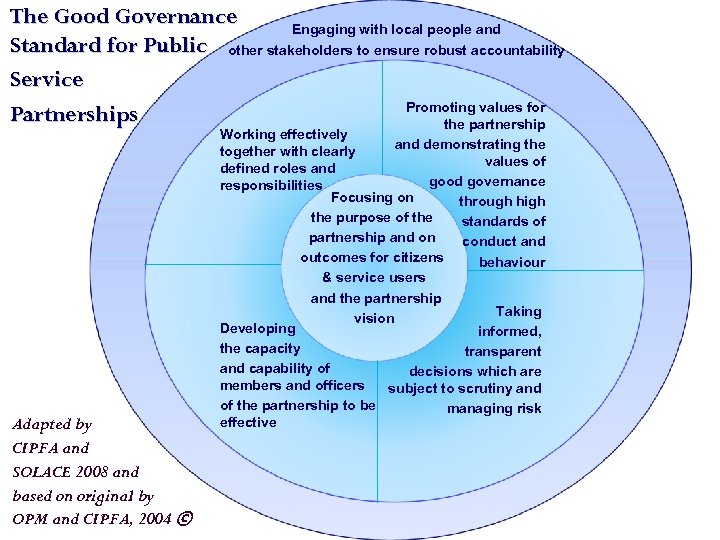
The Good Governance Engaging with local people and Standard for Public other stakeholders to ensure robust accountability Service Promoting values for Partnerships the partnership Adapted by CIPFA and SOLACE 2008 and based on original by OPM and CIPFA, 2004 © Working effectively and demonstrating the together with clearly values of defined roles and good governance responsibilities Focusing on through high the purpose of the standards of partnership and on conduct and outcomes for citizens behaviour & service users and the partnership Taking vision Developing informed, the capacity transparent and capability of decisions which are members and officers subject to scrutiny and of the partnership to be managing risk effective
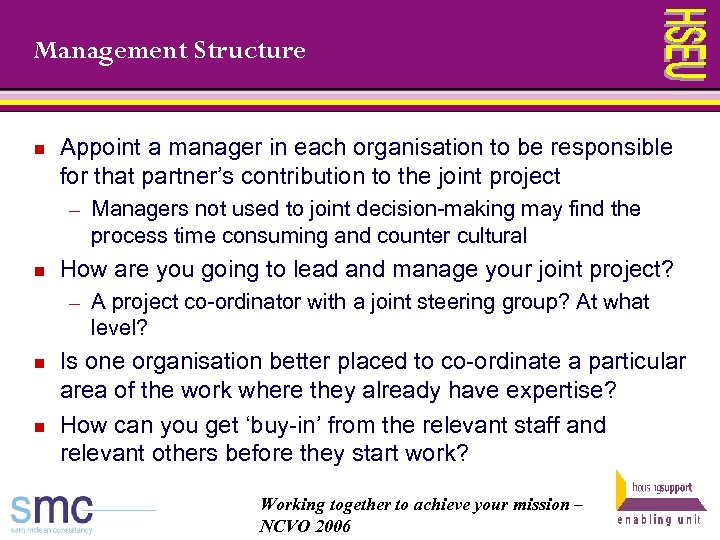
Management Structure n Appoint a manager in each organisation to be responsible for that partner’s contribution to the joint project ─ n How are you going to lead and manage your joint project? ─ n n Managers not used to joint decision-making may find the process time consuming and counter cultural A project co-ordinator with a joint steering group? At what level? Is one organisation better placed to co-ordinate a particular area of the work where they already have expertise? How can you get ‘buy-in’ from the relevant staff and relevant others before they start work? Working together to achieve your mission – NCVO 2006
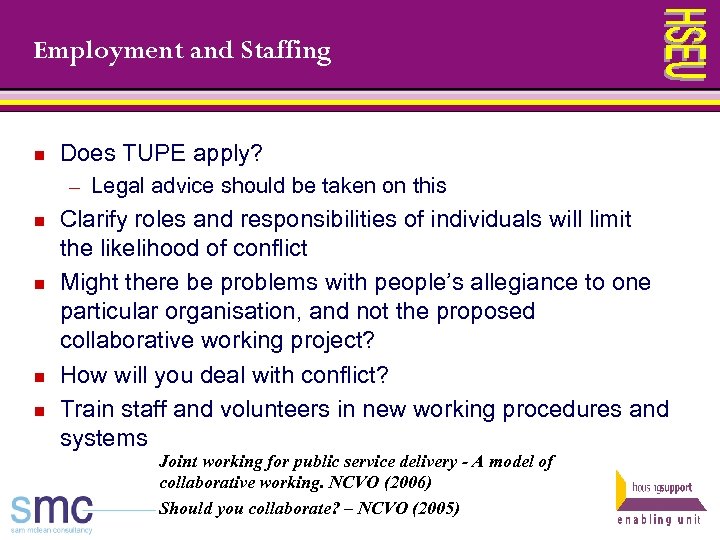
Employment and Staffing n Does TUPE apply? ─ n n Legal advice should be taken on this Clarify roles and responsibilities of individuals will limit the likelihood of conflict Might there be problems with people’s allegiance to one particular organisation, and not the proposed collaborative working project? How will you deal with conflict? Train staff and volunteers in new working procedures and systems Joint working for public service delivery - A model of collaborative working. NCVO (2006) Should you collaborate? – NCVO (2005)
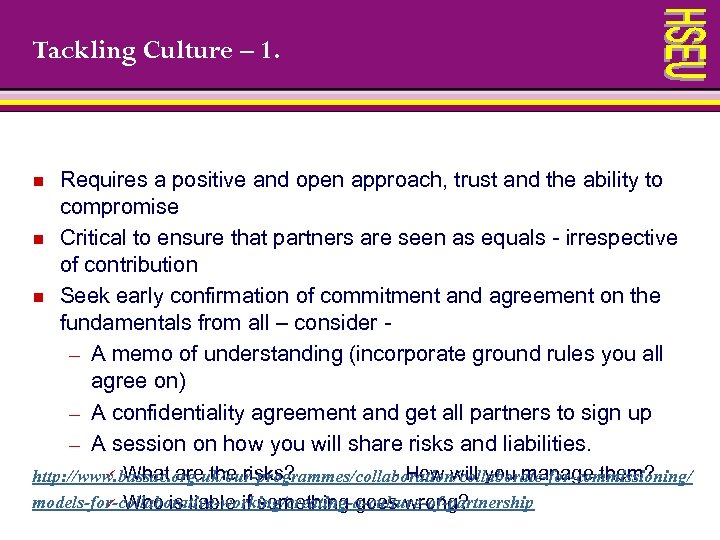
Tackling Culture – 1. n n n Requires a positive and open approach, trust and the ability to compromise Critical to ensure that partners are seen as equals - irrespective of contribution Seek early confirmation of commitment and agreement on the fundamentals from all – consider - ─ A memo of understanding (incorporate ground rules you all agree on) ─ A confidentiality agreement and get all partners to sign up ─ A session on how you will share risks and liabilities. ü What are the risks? - How will you manage them? http: //www. bassac. org. uk/our-programmes/collaboration/collaborate-for-commissioning/ models-for-collaborative-working/creating-a-culture-of-partnership ü Who is liable if something goes wrong?
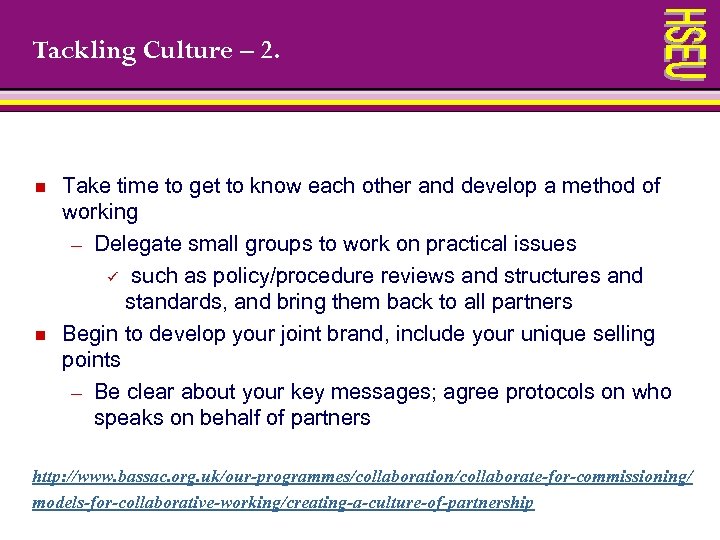
Tackling Culture – 2. Take time to get to know each other and develop a method of working ─ Delegate small groups to work on practical issues ü such as policy/procedure reviews and structures and standards, and bring them back to all partners n Begin to develop your joint brand, include your unique selling points ─ Be clear about your key messages; agree protocols on who speaks on behalf of partners ─ Make sure you communicate consistently with all http: //www. bassac. org. uk/our-programmes/collaboration/collaborate-for-commissioning/ stakeholders n models-for-collaborative-working/creating-a-culture-of-partnership
Communications n n Trustees reputation and ensure brand is not damaged Outline to stakeholders ─ ─ n n n how working on public services contributes to your objectives how the partnership will affect organisational reputation Include communication protocols in your joint working agreement Plan information-sharing about individuals that is data protection compliant Agree who will hold copyright for any guidance material that results? ─ consider intellectual property, design and trademark
Developing Partners n Establish Compatibility ─ ─ ─ n n Quality – respect for the quality of partner services Due Diligence – check-out business viability of partners Bottom Line – what each needs out of the arrangement Added Value – specialism, infra-structure, capacity? Differences – ethos, service delivery, cost structure, decisionmaking Establish Common Purpose - for the service and for the partnership Develop a Positive Culture of Partnership – memo of understanding / heads of agreement, exclusivity, confidentiality, shared risks, get to know partner organisation/s n n Develop an identity – a brand, key messages Agree Leadership and Lead Agency – who drives, sorts out differences n HACT – Collaborate Support – practical help, neutral advice, critical friend
Public Relations n n Is there potential for positive publicity about the collaboration? Consider publicising that you are working collaboratively ─ re-assure service users and public about quality of ‘collaborative’ outcomes ─ demonstrate efficiencies in funding / diminish concerns about duplication ─ give funders and policy makers message about the primacy of beneficiary interests ─ signal to others that the partners are willing to, and good at, work in partnership ─ support organisational buy-in to the project from all stakeholders ü ─ Working together to achieve your mission – promote ‘quick wins’ that motivate people as part of a success NCVO 2006 alert funders to the benefits of collaborative working
Cultural diversity The philosophy and culture of an organisation can be difficult to quantify and risk being ignored. Consider - n The impact of working collaboratively on your organisational culture n Managing a partnership of different working styles & diverse groups n Accommodating the needs of different stakeholders and partner organisations of varied cultures, sizes, ages or management style Should you collaborate? – NCVO (2005)
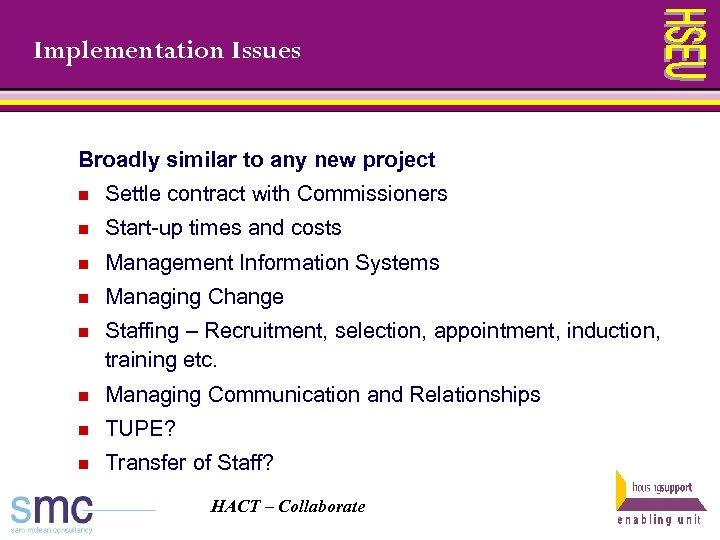
Implementation Issues Broadly similar to any new project n Settle contract with Commissioners n Start-up times and costs n Management Information Systems n Managing Change n Staffing – Recruitment, selection, appointment, induction, training etc. n Managing Communication and Relationships n TUPE? n Transfer of Staff? HACT – Collaborate
Workshop 3 Considering what you have heard, and with reference to the attached handout – ‘Collaborate for Commissioning – Part 3’ 1. Management and Staffing 2. Skills and Competencies 3. Systems and Processes ‘Collaborate for Commissioning’ - Part 3 Tendering and Delivering - bassac (2009)
Coffee Resume in 15 minutes
SESSION 4 Collaboration in Tendering and Contracting
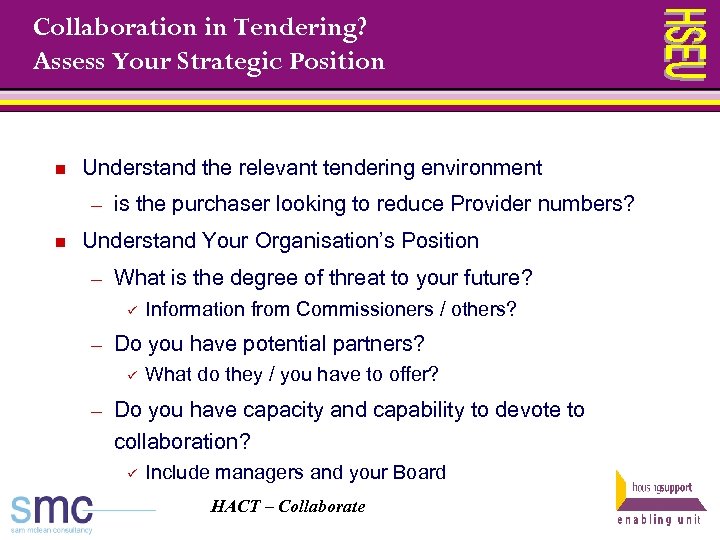
Collaboration in Tendering? Assess Your Strategic Position n Understand the relevant tendering environment ─ n is the purchaser looking to reduce Provider numbers? Understand Your Organisation’s Position ─ What is the degree of threat to your future? ü ─ Do you have potential partners? ü ─ Information from Commissioners / others? What do they / you have to offer? Do you have capacity and capability to devote to collaboration? ü Include managers and your Board HACT – Collaborate
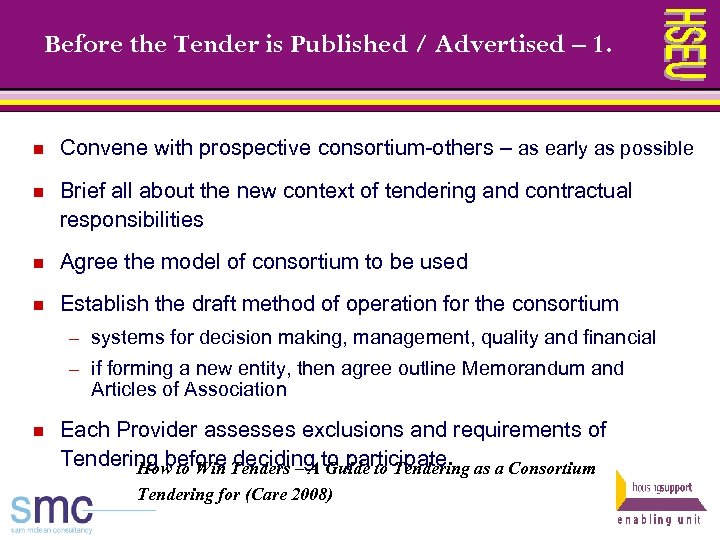
Before the Tender is Published / Advertised – 1. n Convene with prospective consortium-others – as early as possible n Brief all about the new context of tendering and contractual responsibilities n Agree the model of consortium to be used n Establish the draft method of operation for the consortium ─ ─ n systems for decision making, management, quality and financial if forming a new entity, then agree outline Memorandum and Articles of Association Each Provider assesses exclusions and requirements of Tendering before deciding to participate as a Consortium How to Win Tenders – A Guide to Tendering for (Care 2008)
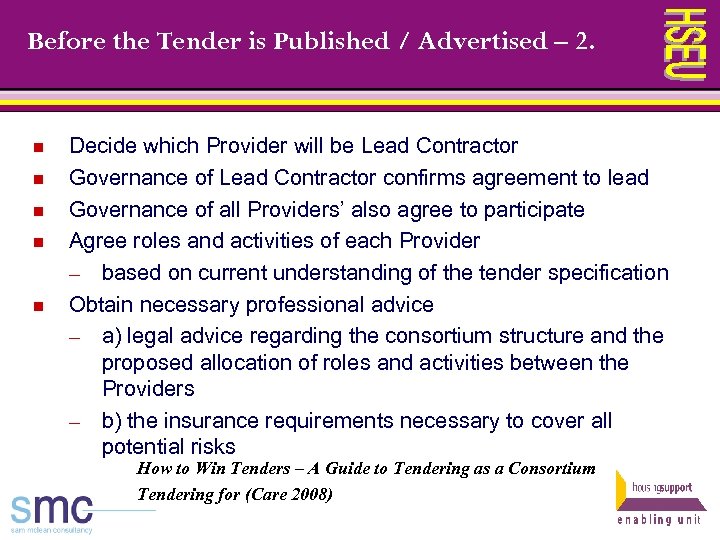
Before the Tender is Published / Advertised – 2. n n n Decide which Provider will be Lead Contractor Governance of Lead Contractor confirms agreement to lead Governance of all Providers’ also agree to participate Agree roles and activities of each Provider ─ based on current understanding of the tender specification Obtain necessary professional advice ─ a) legal advice regarding the consortium structure and the proposed allocation of roles and activities between the Providers ─ b) the insurance requirements necessary to cover all potential risks How to Win Tenders – A Guide to Tendering as a Consortium Tendering for (Care 2008)
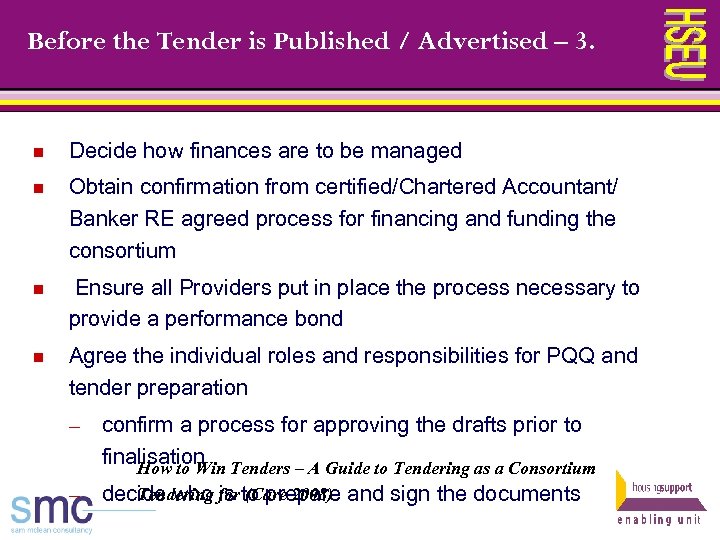
Before the Tender is Published / Advertised – 3. n Decide how finances are to be managed n Obtain confirmation from certified/Chartered Accountant/ Banker RE agreed process for financing and funding the consortium n Ensure all Providers put in place the process necessary to provide a performance bond n Agree the individual roles and responsibilities for PQQ and tender preparation ─ confirm a process for approving the drafts prior to finalisation Tenders – A Guide to Tendering as a Consortium How to Win ─ Tendering for (Care 2008) decide who is to prepare and sign the documents
Managing relationships n Negotiating and relationship management skills are essential ─ n Where organisations are collaborating to work with public bodies ─ ─ n In bidding for contracts become more important the more are involved assign someone to co-ordinate different strands of work likely to be somebody from the organisation which is acting as the accountable body. Partnership working takes time, but the skills are transferable and useful for organisations’ other activities Joint working for public service delivery - A model of collaborative working. NCVO (2006)
Collaboration in Tendering? Influencing the Process n Invest in dialogue with commissioners n Understand the commissioning process n Influence the commissioning process at each stage n Develop relationships with other potential allies n Encourage commissioner to ensure that all providers are treated fairly ─ Small providers, Partnerships, Consortia HACT – Collaborate
Influencing the Local Authority 1 n Commissioning ─ ─ ─ n Get to know commissioners Contribute your knowledge of local user needs Highlight your innovative services and your potential to help Procurement - Seek to influence ─ ─ ─ The fairness and transparency of the process The nature of the service to be delivered The inclusion of outcomes, outputs and ‘community benefits’ The criteria for judgements used, timescales to apply The sort of contracts, or deliver and realistic budgets Bassac (2009)
Influencing the Local Authority 2 n ‘Testing the Market’ ─ n Invitation to Tender ─ ─ n Promote and explain the proposed contract and encourage interest Scoring: Seek to influence the criteria and the proportions of score awarded to price, quality, wider social benefits, and sustainability Interview: Prepare your team and their availability Award of Contract - Request a debrief if you are not successful n Contract delivery - Prepare for evaluation and monitoring including customer satisfaction; plan regular meetings with Bassac (2009) ‘client’
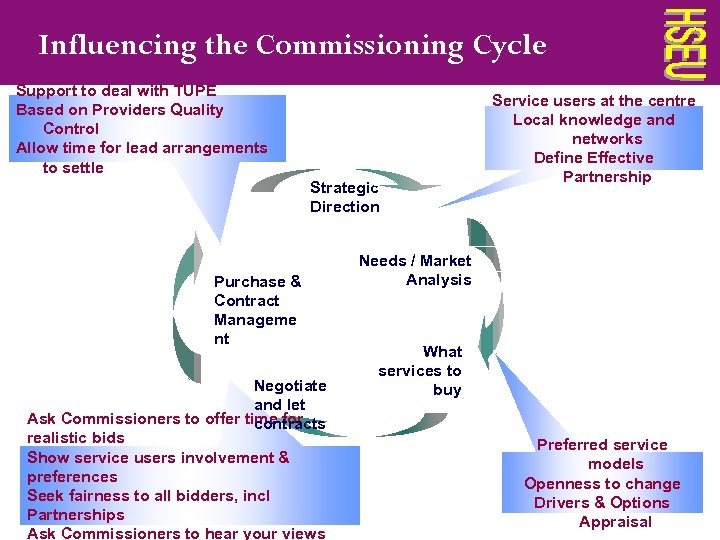
Influencing the Commissioning Cycle Support to deal with TUPE Based on Providers Quality Control Allow time for lead arrangements to settle Strategic Direction Purchase & Contract Manageme nt Negotiate and let Ask Commissioners to offer time for contracts realistic bids Show service users involvement & preferences Seek fairness to all bidders, incl Partnerships Ask Commissioners to hear your views Service users at the centre Local knowledge and networks Define Effective Partnership Needs / Market Analysis What services to buy Preferred service models Openness to change Drivers & Options Appraisal
After the Tender is Published / Advertised n n n Finalise consortium structure in the light of the Instructions to Tenderers Finalise method for operating the consortium All Providers confirm items in exclusions and requirements of Tendering Obtain insurance and other requirements recommended following advice Each Provider obtains from their governance the final agreed consortium structure, management and method of delivering the contract Review the contract specification in light of activities already ─ agreed roles and responsibilities and How to Win Tenders – A Guide to Tendering as ─ obtain a legal check on the final structure a Consortium Tendering for (Care 2008) Prepare the Tender documents as previously agreed
How to sell yourself n n You know that what you are doing is having a positive impact in your local community. There are three main things to prove: 1. 2. 3. Your organisation has the capacity and the quality to deliver excellent services – accredited / robust Quality Standards That you have assessed any risks involved in delivering the services – and have assured risk management practices That you delivering the service is good value for money, and will save the statutory partner money in the long term http: //www. bassac. org. uk/node/578
Multiple Accountabilities n n A collaboration may jointly bid - but there is usually one accountable body ─ managed and maintained through a joint working agreement When the Collaborative signs a contract, all partners, including the commissioning body, need to be clear about their specific liability Responsibilities include ─ Accountability to the funder for public money ─ Accountability to meet regulatory requirements ─ Accountability to beneficiaries, partner organisations, members and others Can all out a greater burden on monitoring and reporting Joint working for public service delivery - A model of collaborative working. NCVO (2006)
Reviewing joint work Regular reviews & users’ feedback can measure collaborative impact - n Partnership achieving its objectives n Achieving more by working collaboratively than by working alone n What has gone well? What has gone less well? n Partnership or activities changed since it began ─ n n do you need to make adjustments to how you work together? Do all the partners still have shared aims? Whatever changes partners may suggest, keep in mind ─ ─ why your organisation got involved in the first place Working together to achieve your mission – what will enable you to obtain the best outcome for your NCVO 2006
What if It All Goes Wrong? n n n n Decide that it's hopeless trying to step back and let others take a lead, and never try it again? Abandon the idea? Not according to feedback from the community anchor organisations we worked with on the community brokerage project. They were keen to point out that failure can be a good lesson. Risk taking is one of the things that makes the voluntary and community sector so creative, and there are bound to be occasions when things don't go as well as intended. Their advice was: Don't abandon a whole model or idea just because it doesn't work in a particular circumstance. Look for elements within the process that have worked well. They may not have been intended, but surely something has developed that is of benefit to the organisations or the beneficiaries Do get together with all involved, and talk through, openly, what has gone wrong and why. This may require a skilled external facilitator if feelings are running high. Revisit the process, picking out where things went wrong, and discussing what interventions might have helped Try and get the statutory partner on board so that they realise what they can do to be http: //www. bassac. org. uk/our-programmes/collaboration/collaborate-for-commissioning/are-you-ready/what-if-it-all-goes-wrong more supportive
Plenary – Reference Material 1. Reference List 2. Checklist for Trustees - Collaborative Working (Charities Commission) 3. Checklist for Trustees - Due Diligence (Charities Commission) 4. Roles and Responsibilities - Part 1 (bassac) 5. Are you prepared to collaborate for commissioning? - Part 2 (bassac) 6. Working Together to Deliver Public Services - Real Life bassac = British Association of Settlements and Social Stories (NCVO) Action Centres
Finally……. n Please complete the evaluation sheet before you leave. n Thank you for attending and participating.
Скачать презентацию Housing Support Enabling Unit Workshops 27 th October
d16185cc294f715451ed213a5f31dc37.ppt