 Скачать презентацию Housing Microfinance Introduction and Best Practice Overview Franck
385ba07b1f2fc1a9df000f570f98e9e2.ppt
- Количество слайдов: 44



Housing Microfinance: Introduction and Best Practice Overview Franck Daphnis June 2016 Development Innovations Group www. developinnovations. com fdaphnis@developinnovations. com +1 (301) 664 9644 1 Daphnis; DIG 2016
Housing Microfinance: Introduction and Best Practice Overview HOUSING MICROFINANCE Purpose: Provide an overview of emerging approaches, products, and issues for housing microfinance 2 Daphnis; DIG 2016
Housing Microfinance: Introduction and Best Practice Overview Why Is HMF Important? From a Microfinance Perspective: 1. 2. 3. 4. Reports of microenterprise loans used for housing; An increasingly important part of financial operations for major MFIs Obvious extension of the finance in microfinance Enough experience that best practices can begin to be documented 3 Daphnis; DIG 2016
Housing Microfinance: Introduction and Best Practice Overview Why Is HMF Important? From a Housing Finance Perspective: Points to an innovative approach to solving the Housing Finance Problem: “The Need to reconcile three partially conflicting objectives: affordability for the households, viability for the financial institutions, and resource mobilization for the expansion of the sector and the national economy. ” (Renaud, 1984) 4 Daphnis; DIG 2016
Housing Microfinance: Introduction and Best Practice Overview Why Is HMF Important? From a Development Perspective Applications in the fields of: § Microfinance § Housing Finance § Urban finance (slum upgrading, urban sanitation) § Land tenure regularization 5 Daphnis; DIG 2016
Housing Microfinance: Introduction and Best Practice Overview DEFINITION: A subset of microfinance, encompassing initiatives that: - Target the habitat needs of the poor or the very poor - Extend Relatively small loan amounts based on estimated repayment capacity - Carry a Short repayment period - Are usually not collateralized - Are priced to ensure long term financial viability of the provider - Incorporate systematic due-diligence and follow up procedures 6 Daphnis; DIG 2016
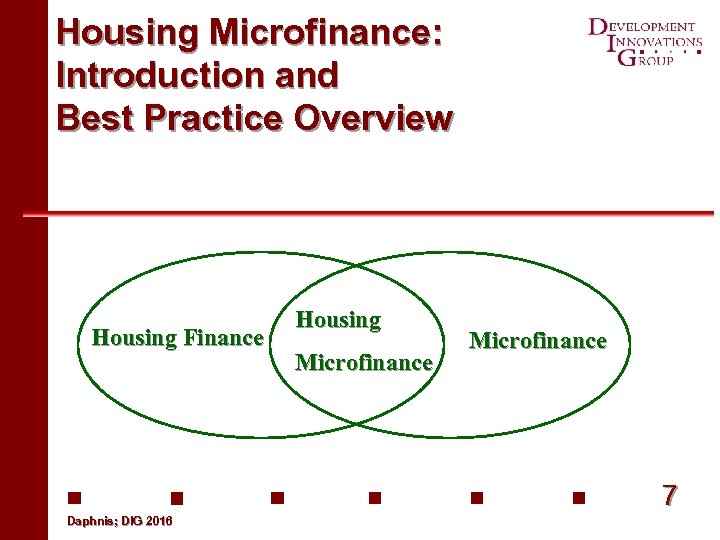
Housing Microfinance: Introduction and Best Practice Overview Housing Finance Housing Microfinance 7 Daphnis; DIG 2016
Housing Microfinance: Introduction and Best Practice Overview DEFINITIONS Who Are the Clients? 1. 2. Existing MFI Clientele (economically active poor working in the “informal” economy) In general, low income earning and poor households that do not enjoy access to traditional housing finance 8 Daphnis; DIG 2016
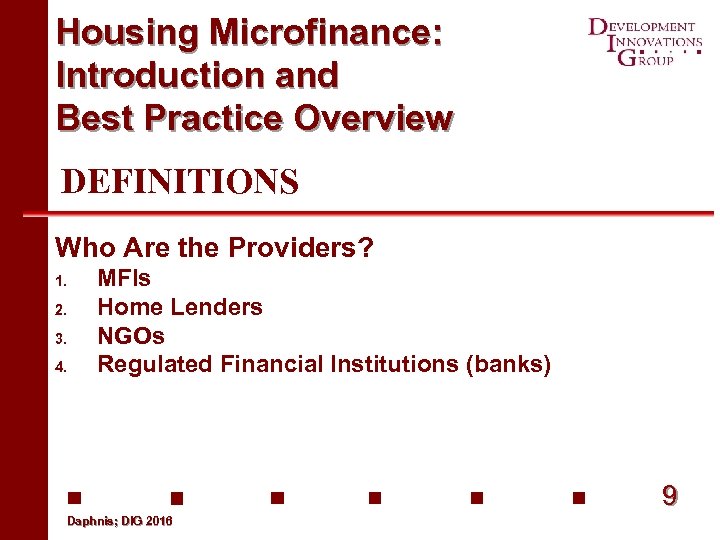
Housing Microfinance: Introduction and Best Practice Overview DEFINITIONS Who Are the Providers? 1. 2. 3. 4. MFIs Home Lenders NGOs Regulated Financial Institutions (banks) 9 Daphnis; DIG 2016
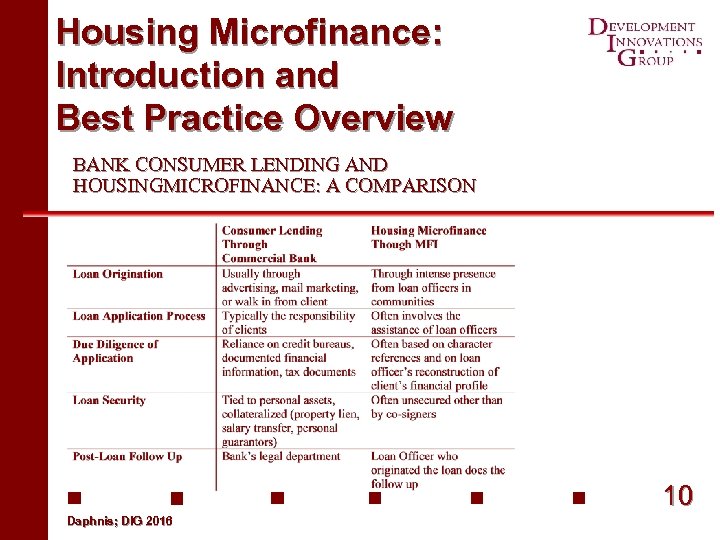
Housing Microfinance: Introduction and Best Practice Overview BANK CONSUMER LENDING AND HOUSINGMICROFINANCE: A COMPARISON 10 Daphnis; DIG 2016
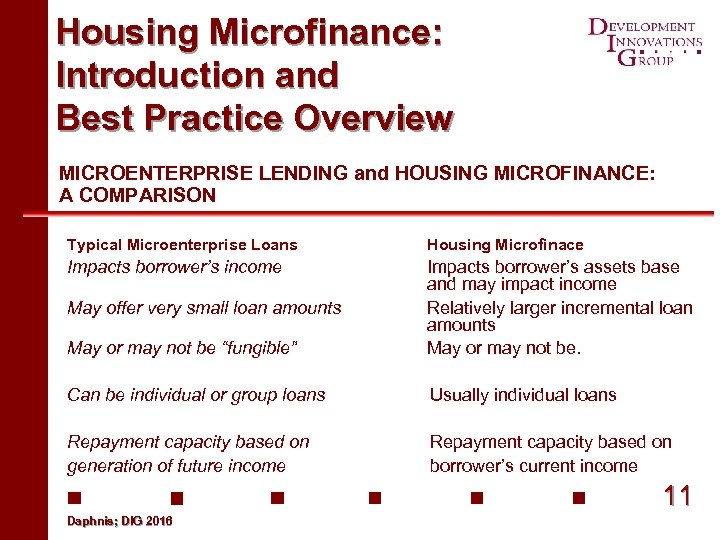
Housing Microfinance: Introduction and Best Practice Overview MICROENTERPRISE LENDING and HOUSING MICROFINANCE: A COMPARISON Typical Microenterprise Loans Housing Microfinace Impacts borrower’s income May or may not be “fungible” Impacts borrower’s assets base and may impact income Relatively larger incremental loan amounts May or may not be. Can be individual or group loans Usually individual loans Repayment capacity based on generation of future income Repayment capacity based on borrower’s current income May offer very small loan amounts 11 Daphnis; DIG 2016
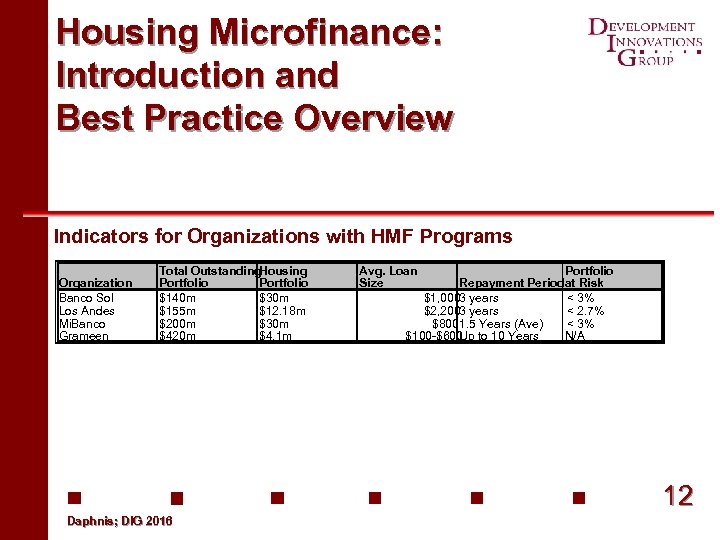
Housing Microfinance: Introduction and Best Practice Overview Indicators for Organizations with HMF Programs Organization Banco Sol Los Andes Mi. Banco Grameen Total Outstanding Housing Portfolio $140 m $30 m $155 m $12. 18 m $200 m $30 m $420 m $4. 1 m Avg. Loan Size Portfolio Repayment Periodat Risk < 3% $1, 0003 years < 2. 7% $2, 2003 years < 3% $8001. 5 Years (Ave) $100 -$600 to 10 Years Up N/A 12 Daphnis; DIG 2016
Housing Microfinance: Introduction and Best Practice Overview Two Families of Products: n A Word on Mortgages n Linked Housing Microfinance n Stand Alone Housing Microfinance 13 Daphnis; DIG 2016
Housing Microfinance: Introduction and Best Practice Overview STAND ALONE MORTGAGE Definition § § § Lien on asset (house as collateral) Long repayment period Typically finances complete housing solution 14 Daphnis; DIG 2016
Housing Microfinance: Introduction and Best Practice Overview A WORD ON STAND ALONE MORTGAGE Why Are We Discussing it? § § Desirable from client’s standpoint; Desirable from “housing as social good” perspective; May be relevant in some countries; Relevant to commercial institutions who already offer mortgages to higher income earning clientele. 15 Daphnis; DIG 2016
Housing Microfinance: Introduction and Best Practice Overview STAND ALONE MORTGAGE Conditions for Success § § Long term sources of capital - Securitization or other “bundling” of loans - Institutional investors Legal Framework 16 Daphnis; DIG 2016
Housing Microfinance: Introduction and Best Practice Overview STAND ALONE MORTGAGE: Conditions for Success Long Term Sources of Capital: Why: Correspondence between clients’ repayment horizon and Institution’s funding repayment constraints Issue: Sustainable MFIs finance lending through client deposits and commercial loans. Repayment horizon not in sync with 10 -30 year loans. Subsidized MFIs also receive soft loans and donor funds; however, opportunity cost of earmarking funds for long repayment periods can be to high. 17 Daphnis; DIG 2016
Housing Microfinance: Introduction and Best Practice Overview STAND ALONE MORTGAGE: Conditions for Success Securitization or Other forms of Private “Bundling” What: Loans are aggregated into securities or otherwise packaged and sold to investors. Secondary mortgage markets allow mortgage lending to flourish in the US and other countries with capital markets by finding investors with horizons that match borrowers’. Issues: Mostly relevant to commercial Institutions - In countries where microfinance flourishes secondary mortgage markets typically do not exist - Private investors have yet to see “bundled” housing loans for low income families as attractive - With no investors to purchase discounted housing loans, mortgages (especially to the poor) is typically not an option 18 Daphnis; DIG 2016
Housing Microfinance: Introduction and Best Practice Overview STAND ALONE MORTGAGE: Conditions for Success Institutional Investors What: Governments, public agencies and pooled investment funds (pension, social security or other mandatory savings systems) provide long term housing loans for families. Issues: Loans tend to be provided post-construction and require the presence of a developer with bridge financing Programs tend to be bureaucratic and are not necessarily models of efficiency and fairness Loans are subsidized (from the standpoint of interest rate) and long term availability of programs seems tenuous 19 Daphnis; DIG 2016
Housing Microfinance: Introduction and Best Practice Overview STAND ALONE MORTGAGE: Conditions for Success Legal Framework § § § Laws must allow MFI to secure a lien against the asset financed Asset should be be transferable - Land tenure - Eviction laws Court system must be reliable enough that mortgage contract can be enforced in case of default 20 Daphnis; DIG 2016
Housing Microfinance: Introduction and Best Practice Overview As Part of Linked Steps in Financing of Micro-entrepreneur Why Are we Discussing it? § § § Relevant to institutions already involved in microfinance: Meets the “Are MFIS Currently Doing it? ” Test Even when MFIs are not consciously doing it, there is strong anecdotal (and some documented) evidence that loans are diverted towards housing purposes Microfinance leaders, including Grameen, Banco. Sol, SEWA, Mi. Banco have developed products 21 Daphnis; DIG 2016
Housing Microfinance: Introduction and Best Practice Overview As Linked to Other Products Offered by MFI Why: - What: - Fits mindset that micro-financing is incremental with income generation loans as steps towards asset building Can be a powerful tool for client retention Client’s history with MFI (through loans or savings) offers good proxy for capacity to pay analysis Provides housing loan as part of a “graduation” process after client has established a lending or savings history with the MFI Can be a longer term loan financing a complete core house or a home improvement loan; 22 Daphnis; DIG 2016
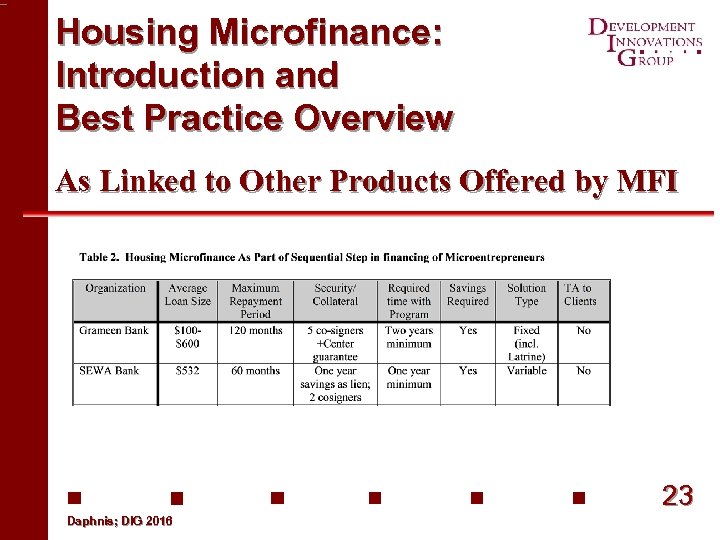
Housing Microfinance: Introduction and Best Practice Overview As Linked to Other Products Offered by MFI Source: Housing Microfinance Initiatives. USAID/DAI, June 2000 Daphnis; DIG 2016 23
Housing Microfinance: Introduction and Best Practice Overview As Stand Alone Incremental Product What: - Provides housing loan based on generally accepted microfinance principles(short repayment period, relatively small amount, based on repayment capacity, market rate) and independently of prior history with MFI Why: - Works within a vision of housing as one of many products MFIs can offer the poor alongside more established products - Can be a tool for diversification (and retention) of clientele - Can help with risk management by diversifying product line Issues: - Client qualification must be rigorous as there is no prior history with MFI 24 Daphnis; DIG 2016
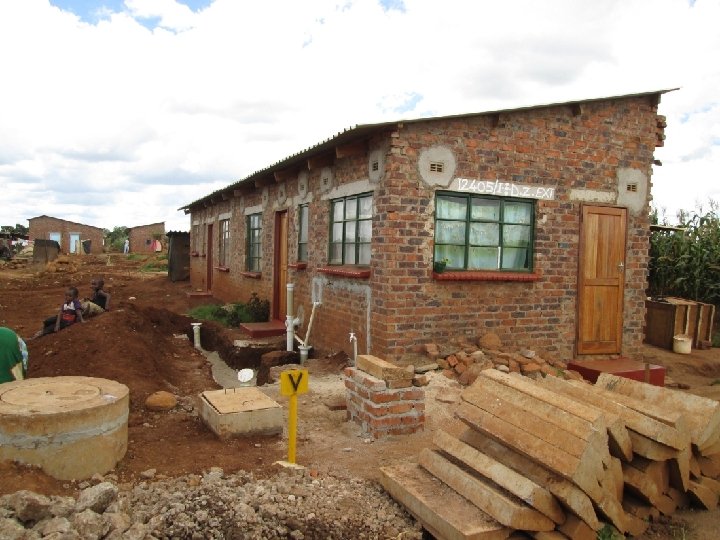
Housing Microfinance: Introduction and Best Practice Overview 25 Daphnis; DIG 2016
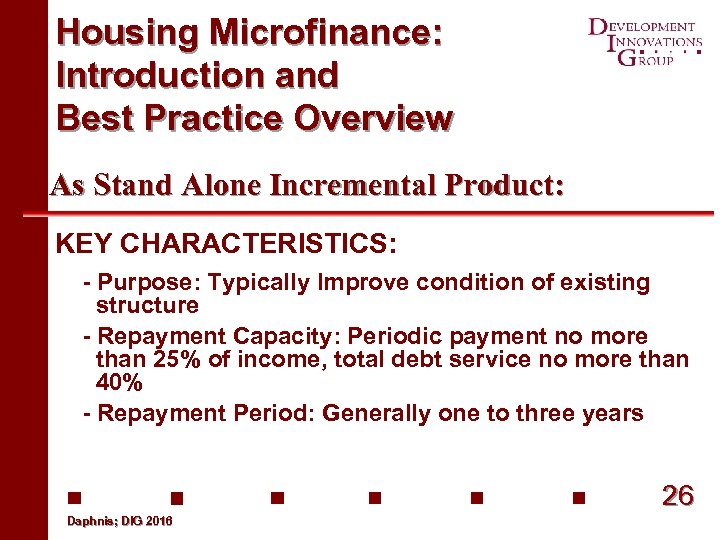
Housing Microfinance: Introduction and Best Practice Overview As Stand Alone Incremental Product: KEY CHARACTERISTICS: - Purpose: Typically Improve condition of existing structure - Repayment Capacity: Periodic payment no more than 25% of income, total debt service no more than 40% - Repayment Period: Generally one to three years 26 Daphnis; DIG 2016
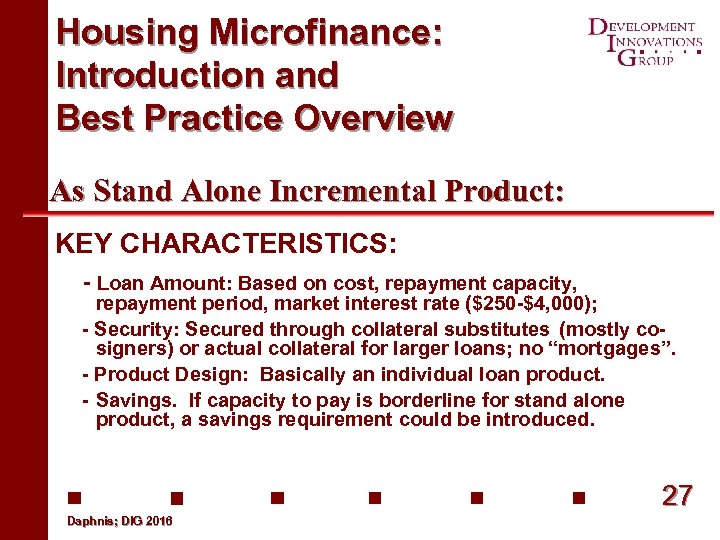
Housing Microfinance: Introduction and Best Practice Overview As Stand Alone Incremental Product: KEY CHARACTERISTICS: - Loan Amount: Based on cost, repayment capacity, repayment period, market interest rate ($250 -$4, 000); - Security: Secured through collateral substitutes (mostly cosigners) or actual collateral for larger loans; no “mortgages”. - Product Design: Basically an individual loan product. - Savings. If capacity to pay is borderline for stand alone product, a savings requirement could be introduced. 27 Daphnis; DIG 2016
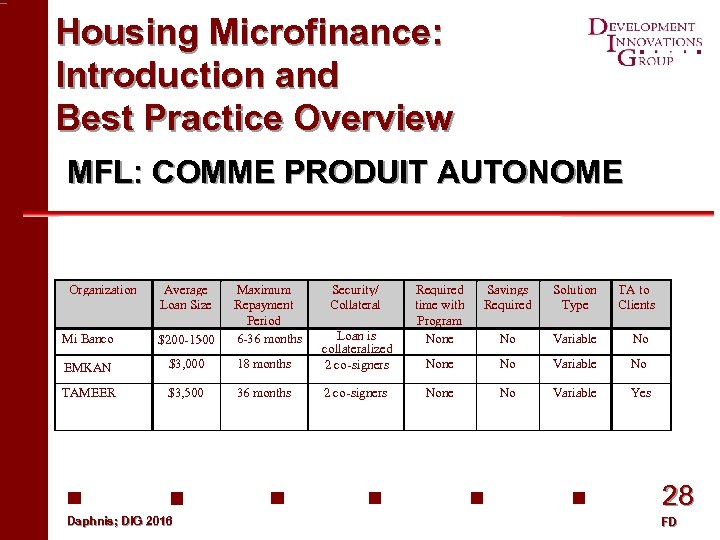
Housing Microfinance: Introduction and Best Practice Overview MFL: COMME PRODUIT AUTONOME Table 3. Housing Microfinance As Incremental “Stand Alone ” Product Organization Average Loan Size Maximum Repayment Period 6 -36 months Security/ Collateral Mi Banco $200 -1500 EMKAN $3, 000 18 months Loan is collateralized 2 co-signers TAMEER $3, 500 36 months 2 co-signers Required time with Program None Savings Required Solution Type TA to Clients No Variable No None No Variable Yes 28 Daphnis; DIG 2016 FD
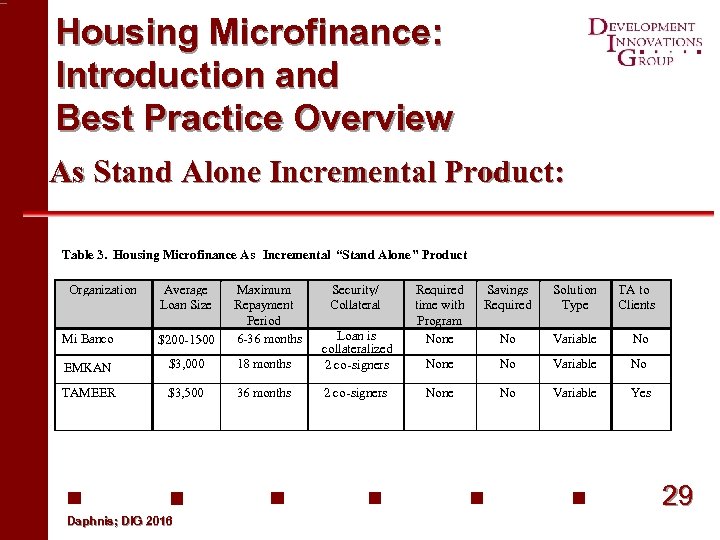
Housing Microfinance: Introduction and Best Practice Overview As Stand Alone Incremental Product: Table 3. Housing Microfinance As Incremental “Stand Alone ” Product Organization Average Loan Size Maximum Repayment Period 6 -36 months Security/ Collateral Mi Banco $200 -1500 EMKAN $3, 000 18 months Loan is collateralized 2 co-signers TAMEER $3, 500 36 months 2 co-signers Required time with Program None Savings Required Solution Type TA to Clients No Variable No None No Variable Yes 29 Daphnis; DIG 2016
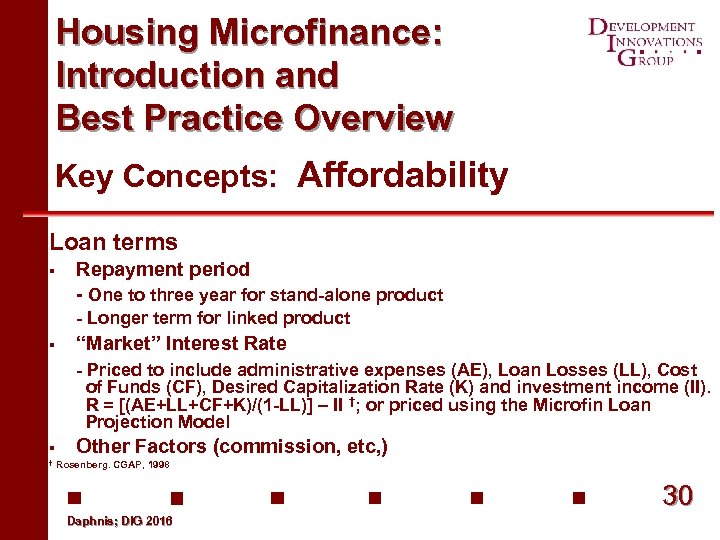
Housing Microfinance: Introduction and Best Practice Overview Key Concepts: Affordability Loan terms § Repayment period - One to three year for stand-alone product - Longer term for linked product § “Market” Interest Rate - Priced to include administrative expenses (AE), Loan Losses (LL), Cost of Funds (CF), Desired Capitalization Rate (K) and investment income (II). R = [(AE+LL+CF+K)/(1 -LL)] – II †; or priced using the Microfin Loan Projection Model § † Other Factors (commission, etc, ) Rosenberg. CGAP, 1998 30 Daphnis; DIG 2016
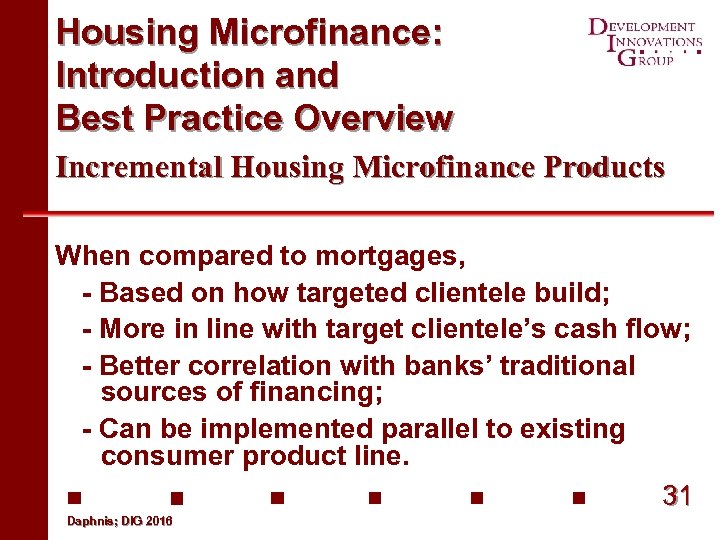
Housing Microfinance: Introduction and Best Practice Overview Incremental Housing Microfinance Products When compared to mortgages, - Based on how targeted clientele build; - More in line with target clientele’s cash flow; - Better correlation with banks’ traditional sources of financing; - Can be implemented parallel to existing consumer product line. 31 Daphnis; DIG 2016
Housing Microfinance: Introduction and Best Practice Overview KEY SIMILARITIES WITH MICROENTERPRISE LENDING PRODUCT: - Similar clientele; - Small loan amount: affordability a function of borrower’s capacity to pay, loan terms and cost; - Relatively Short repayment period; - Similar financial viability considerations. 32 Daphnis; DIG 2016
Housing Microfinance: Introduction and Best Practice Overview DIFFERENCES WITH MICROENTERPRISE LENDING PRODUCT: - Client selection based on current cash flow; - May require additional technical assistance to borrower; - Impacts borrower’s asset base rather than her/his income; - Basically an individual loan product. 33 Daphnis; DIG 2016
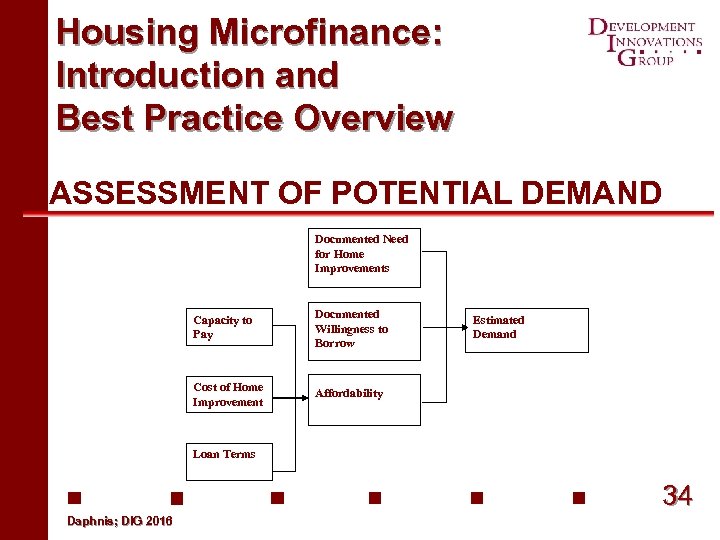
Housing Microfinance: Introduction and Best Practice Overview ASSESSMENT OF POTENTIAL DEMAND Documented Need for Home Improvements Capacity to Pay Documented Willingness to Borrow Cost of Home Improvement Affordability Estimated Demand Loan Terms 34 Daphnis; DIG 2016
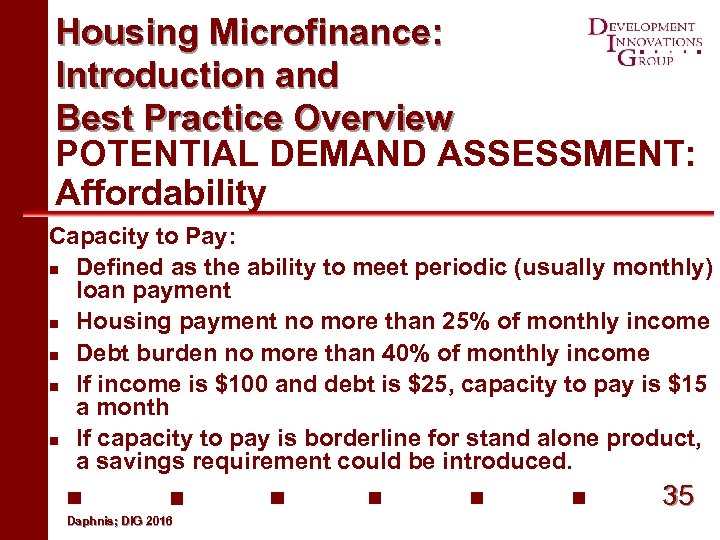
Housing Microfinance: Introduction and Best Practice Overview POTENTIAL DEMAND ASSESSMENT: Affordability Capacity to Pay: n Defined as the ability to meet periodic (usually monthly) loan payment n Housing payment no more than 25% of monthly income n Debt burden no more than 40% of monthly income n If income is $100 and debt is $25, capacity to pay is $15 a month n If capacity to pay is borderline for stand alone product, a savings requirement could be introduced. 35 Daphnis; DIG 2016
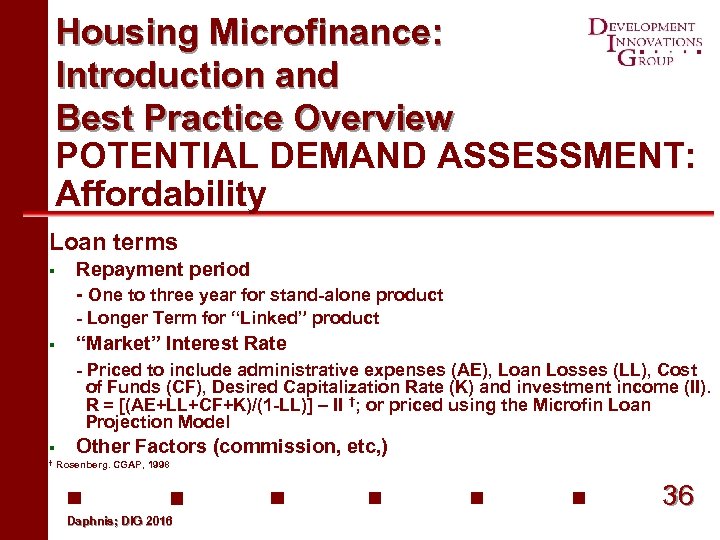
Housing Microfinance: Introduction and Best Practice Overview POTENTIAL DEMAND ASSESSMENT: Affordability Loan terms § Repayment period - One to three year for stand-alone product - Longer Term for “Linked” product § “Market” Interest Rate - Priced to include administrative expenses (AE), Loan Losses (LL), Cost of Funds (CF), Desired Capitalization Rate (K) and investment income (II). R = [(AE+LL+CF+K)/(1 -LL)] – II †; or priced using the Microfin Loan Projection Model § † Other Factors (commission, etc, ) Rosenberg. CGAP, 1998 36 Daphnis; DIG 2016
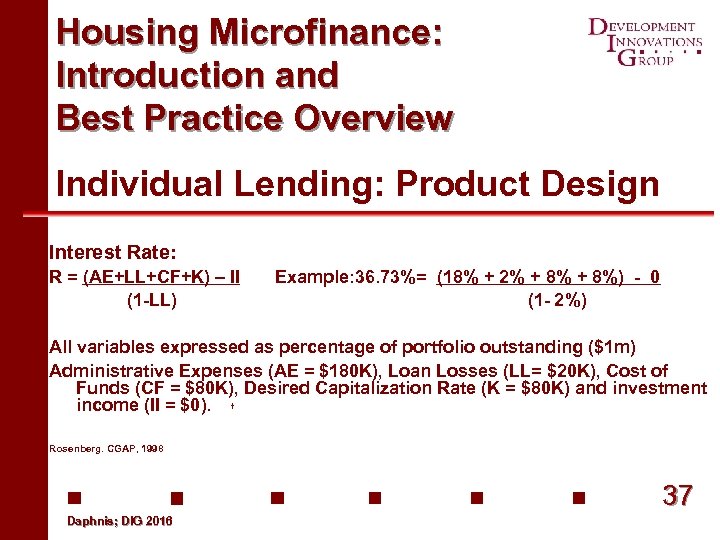
Housing Microfinance: Introduction and Best Practice Overview Individual Lending: Product Design Interest Rate: R = (AE+LL+CF+K) – II (1 -LL) Example: 36. 73%= (18% + 2% + 8%) - 0 (1 - 2%) All variables expressed as percentage of portfolio outstanding ($1 m) Administrative Expenses (AE = $180 K), Loan Losses (LL= $20 K), Cost of Funds (CF = $80 K), Desired Capitalization Rate (K = $80 K) and investment income (II = $0). † Rosenberg. CGAP, 1998 37 Daphnis; DIG 2016
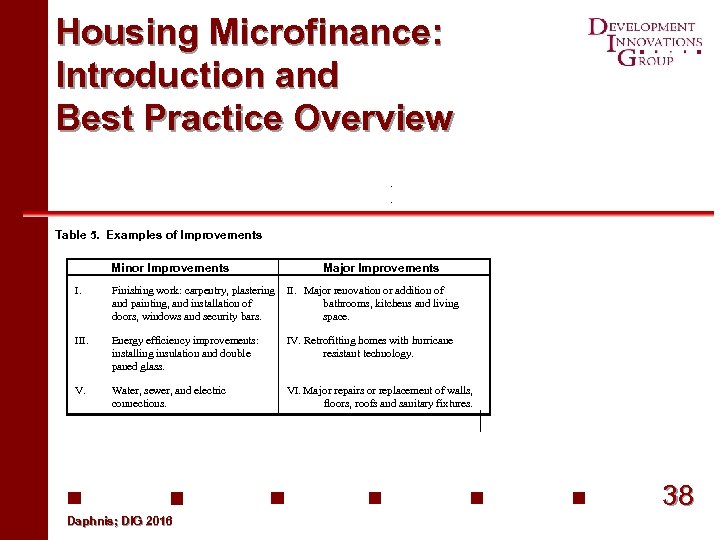
Housing Microfinance: Introduction and Best Practice Overview Table 5. Examples of Improvements Minor Improvements Major Improvements I. Finishing work: carpentry, plastering and painting, and installation of doors, windows and security bars. II. Major renovation or addition of bathrooms, kitchens and living space. III. Energy efficiency improvements: installing insulation and double paned glass. IV. Retrofitting homes with hurricane resistant technology. V. Water, sewer, and electric connections. VI. Major repairs or replacement of walls, floors, roofs and sanitary fixtures. 38 Daphnis; DIG 2016
Housing Microfinance: Introduction and Best Practice Overview 39 Daphnis; DIG 2016
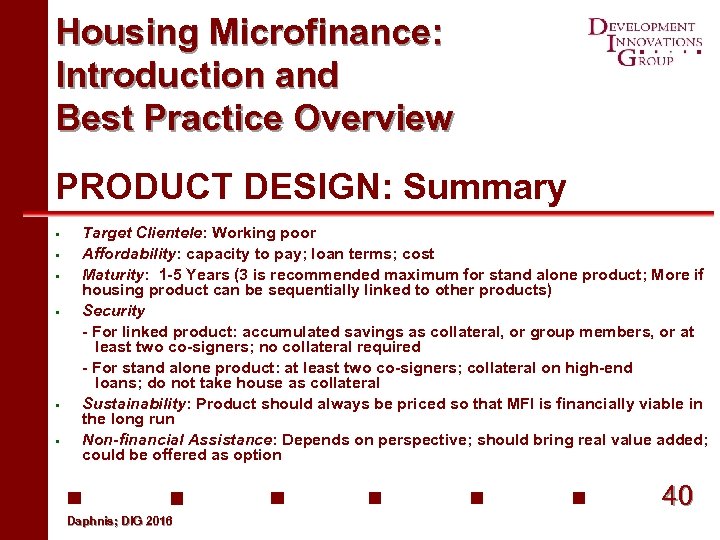
Housing Microfinance: Introduction and Best Practice Overview PRODUCT DESIGN: Summary § § § Target Clientele: Working poor Affordability: capacity to pay; loan terms; cost Maturity: 1 -5 Years (3 is recommended maximum for stand alone product; More if housing product can be sequentially linked to other products) Security - For linked product: accumulated savings as collateral, or group members, or at least two co-signers; no collateral required - For stand alone product: at least two co-signers; collateral on high-end loans; do not take house as collateral Sustainability: Product should always be priced so that MFI is financially viable in the long run Non-financial Assistance: Depends on perspective; should bring real value added; could be offered as option 40 Daphnis; DIG 2016
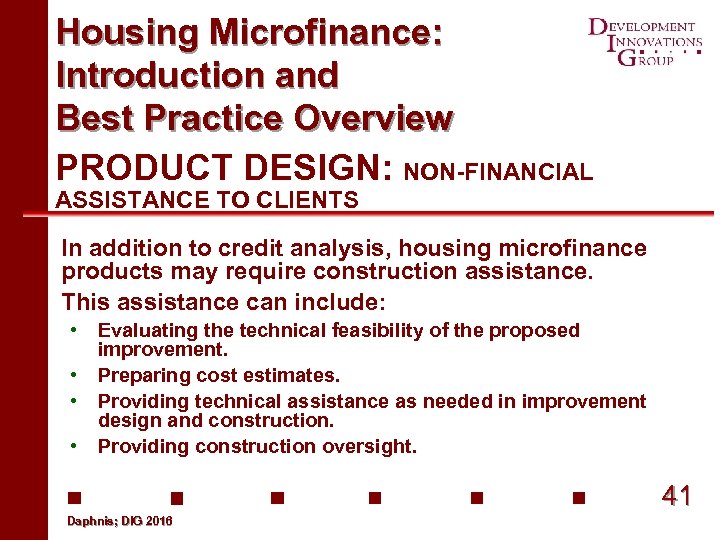
Housing Microfinance: Introduction and Best Practice Overview PRODUCT DESIGN: NON-FINANCIAL ASSISTANCE TO CLIENTS In addition to credit analysis, housing microfinance products may require construction assistance. This assistance can include: • Evaluating the technical feasibility of the proposed improvement. • Preparing cost estimates. • Providing technical assistance as needed in improvement design and construction. • Providing construction oversight. 41 Daphnis; DIG 2016
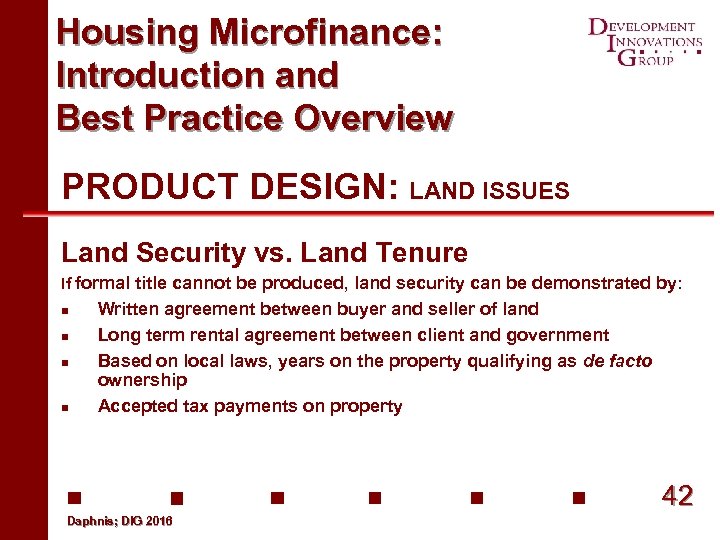
Housing Microfinance: Introduction and Best Practice Overview PRODUCT DESIGN: LAND ISSUES Land Security vs. Land Tenure If formal title cannot be produced, land security can be demonstrated by: n n Written agreement between buyer and seller of land Long term rental agreement between client and government Based on local laws, years on the property qualifying as de facto ownership Accepted tax payments on property 42 Daphnis; DIG 2016
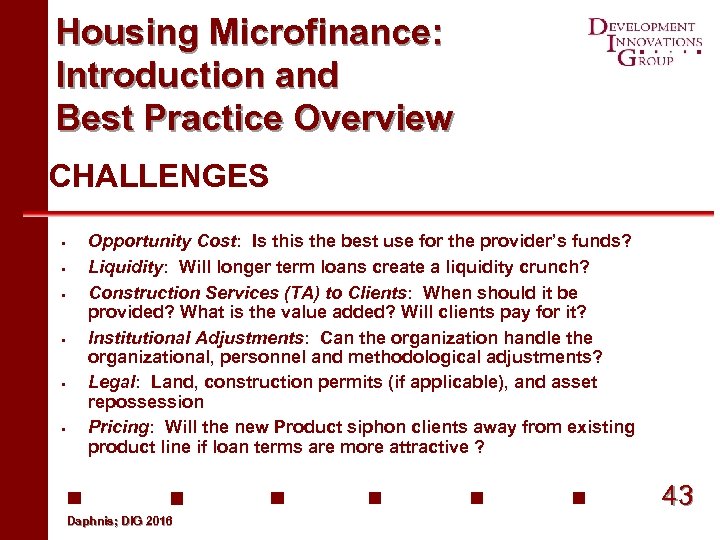
Housing Microfinance: Introduction and Best Practice Overview CHALLENGES § § § Opportunity Cost: Is this the best use for the provider’s funds? Liquidity: Will longer term loans create a liquidity crunch? Construction Services (TA) to Clients: When should it be provided? What is the value added? Will clients pay for it? Institutional Adjustments: Can the organization handle the organizational, personnel and methodological adjustments? Legal: Land, construction permits (if applicable), and asset repossession Pricing: Will the new Product siphon clients away from existing product line if loan terms are more attractive ? 43 Daphnis; DIG 2016
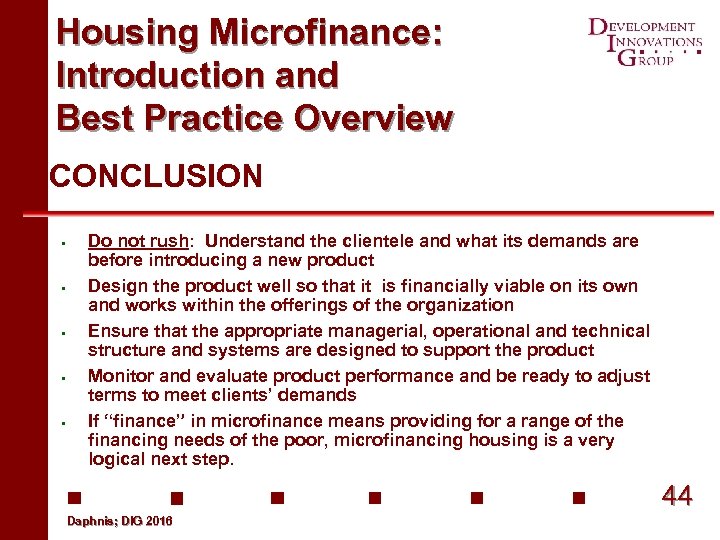
Housing Microfinance: Introduction and Best Practice Overview CONCLUSION § § § Do not rush: Understand the clientele and what its demands are before introducing a new product Design the product well so that it is financially viable on its own and works within the offerings of the organization Ensure that the appropriate managerial, operational and technical structure and systems are designed to support the product Monitor and evaluate product performance and be ready to adjust terms to meet clients’ demands If “finance” in microfinance means providing for a range of the financing needs of the poor, microfinancing housing is a very logical next step. 44 Daphnis; DIG 2016
Скачать презентацию Housing Microfinance Introduction and Best Practice Overview Franck
385ba07b1f2fc1a9df000f570f98e9e2.ppt