


 Скачать презентацию Housing Issues and Services What are some
03c6e193fcb75218c10ea6432b001f36.ppt
- Количество слайдов: 24
 Housing Issues and Services
 What are some of the issues around housing? • • Foreclosures Gentrification Affordable housing Limited Section 8 Housing for elderly Housing for released felons Homelessness
 Terms and Concepts 1. Homeless: • • Living in a place not intended for living in. Staying in a shelter. Went into transitional or supportive housing from shelter or street. Is going to be evicted within a week with nowhere to go.
 Key terms, cont. 2. Housing First • • Quick access to permanent housing. Individual-appropriate services follow placement in housing. Services can be time-limited or long term, depending on individual/family need. Housing is not contingent on compliance.
 Terms, cont. 3. Gentrification-from dictionary. com “The buying and renovation of houses and stores in deteriorated urban neighborhoods by upper- or middleincome families or individuals, thus improving property values but often displacing low-income families and small businesses. ”
 What do you know about the causes of homelessness?
 Strategies of the 10 Year Plan 1. Review in the reading • • • Prevent homelessness Coordinate leadership and initiatives Build and sustain political will and community support Secure 9, 500 units of housing Deliver flexible, culturally competent services Measure success and report outcomes
 Small group discussion 1. Do a go-round with each person identifying one key point from the strategies. 2. Discuss the strategies: Which seem most crucial? Which seem do-able? What recommendations would you like to make to the Committee to End Homelessness? 3. Who are the subpopulations? Why is it important to identify them? 4. Questions/curiosities about the reading?
 Specific Subpopulations: • Single adults • Families • Youth
 Problem solving-use information from the reading assignment to discuss 1. You are given a hypothetical client. 2. Identify the main issues that lead to homelessness for this person. 3. Identify ways this person might make contact with the human services system (or how the system may make contact with her/him). 4. What does this person need to maintain stable housing? 5. What barriers might you encounter in trying to help the client?
 The service system • Shelters – Range of stay is generally from one night to 3 months, sometimes longer. – May target a particular population, e. g. DESC targets people with m. i. , men over 60, Noel House targets women with m. i. , Compass Center’s First Church targets single men downtown, Family and Adult Service Center targets families.
 Transitional Housing • Longer term housing (sometimes up to 2 years) that assists people towards independent housing. • Case management is typical and referrals to all kinds of services are made. • Multiple services are provided on site: Life skills, youth services, parenting skills, etc. • Aloha Inn; Compass Center; Plymouth Housing; Community House targets people leaving psychiatric hospitals.
 Tent City • Run by and for homeless people, usually moves every three months. • Self regulated with rules and responsibilities. • Costs around $4, 600. 00/month.
 Supportive Housing • Housing for a vulnerable population • Includes support services, such as on site supervision, assistance with activities of daily living • Examples include: Plymouth Housing group… 2 nd and Stewart; Community House
 Financial Support • Individual Development Accounts that match savings-El Centro De La Raza • Low interest loans through Homesight • Habitat for Humanity • International District Housing Assistance
 Seattle Housing Authoritywww. seahousing. org • Housing assistance for low income people • Eligibility is <80% of median (61, 500, family of 4) • Very low income is <30% of median ($24, 400 for family of 4) • Rent and utilities are capped at 30% of income • 88% of recipients have incomes <30% of median.
 Housing Choice Voucher Program, AKA Section 8 • Income requirement=<30% of median • Median household income in Seattle is $81, 400; 30% is $24, 440 • Rent and utilities are not to exceed 3040% of income • First 600 on waiting list have received application materials.
 Characteristics of shelter population • 81% enter the system once or twice and stay about a month. • 9% enter nearly five times a year and stay about two months each time. • 10% enter twice a year, stay about 280 days each time. • Single homeless people say their biggest needs are help finding a job, help finding housing and help paying for housing. Only 7% received help finding housing • Needs of homeless families tend to be the same as the needs of poor people…help finding a job, affordable housing and housing subsidies. 20% report getting help finding housing. • 22% of homeless parents left residence due to DV. • Racial disparity is great: 50% African American, 35% Euro American, 12% Latino, 2% Native American, 1%Asian American • Local stats: http: //www. homelessinfo. org/homeless. html
 Implications of these statistics? • What are assumptions we make about the needs of homeless people? • How do these assumptions influence the choice of services to provide? • Services need to be tailored to the actual needs of the homeless subgroup. • How does the ten year plan match up to the picture of homelessness?
 Small group problem solving 1. You will be assigned a scenario. 2. Discuss the situation and the needs of the client, prioritizing the needs. 3. Create the ideal housing situation for the client. Consider: • • Is it temporary, transitional, permanent? What services should be provided as part of the housing? What services would you refer out to? What are the eligibility criteria? Are there any exclusions, or reasons why a client would be ineligible, such as violence, substance use, etc.
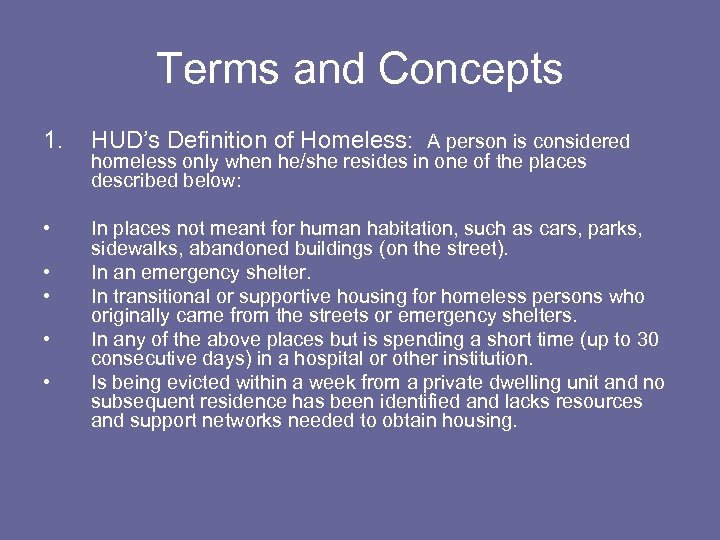 Terms and Concepts 1. HUD’s Definition of Homeless: A person is considered • In places not meant for human habitation, such as cars, parks, sidewalks, abandoned buildings (on the street). In an emergency shelter. In transitional or supportive housing for homeless persons who originally came from the streets or emergency shelters. In any of the above places but is spending a short time (up to 30 consecutive days) in a hospital or other institution. Is being evicted within a week from a private dwelling unit and no subsequent residence has been identified and lacks resources and support networks needed to obtain housing. • • homeless only when he/she resides in one of the places described below:
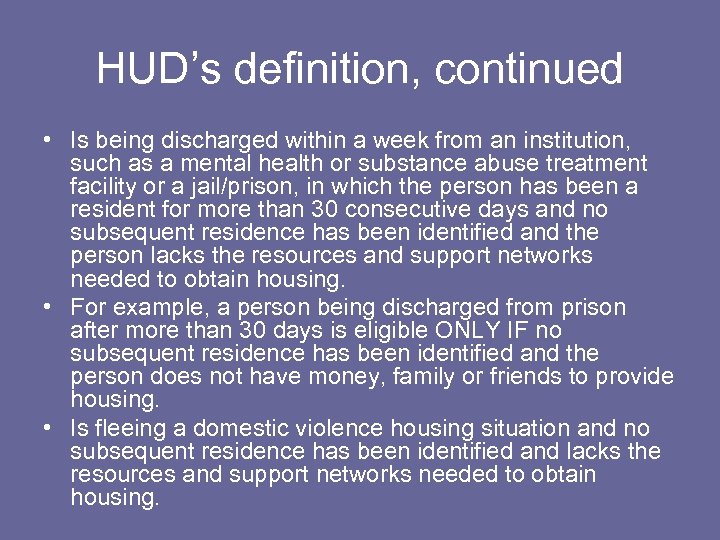 HUD’s definition, continued • Is being discharged within a week from an institution, such as a mental health or substance abuse treatment facility or a jail/prison, in which the person has been a resident for more than 30 consecutive days and no subsequent residence has been identified and the person lacks the resources and support networks needed to obtain housing. • For example, a person being discharged from prison after more than 30 days is eligible ONLY IF no subsequent residence has been identified and the person does not have money, family or friends to provide housing. • Is fleeing a domestic violence housing situation and no subsequent residence has been identified and lacks the resources and support networks needed to obtain housing.
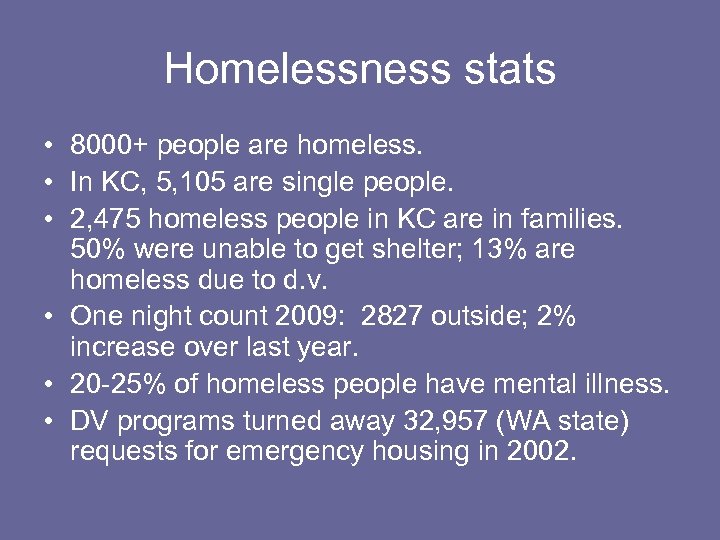 Homelessness stats • 8000+ people are homeless. • In KC, 5, 105 are single people. • 2, 475 homeless people in KC are in families. 50% were unable to get shelter; 13% are homeless due to d. v. • One night count 2009: 2827 outside; 2% increase over last year. • 20 -25% of homeless people have mental illness. • DV programs turned away 32, 957 (WA state) requests for emergency housing in 2002.
 Quiz review • Description of each program: target population, main service • Institutional, residual and asset building approaches • Basic descriptions of housing programs