 Скачать презентацию Housing Displacement in Brooklyn Preliminary Findings Aviva Zeltzer-Zubida
d035c4840a290e7e93feab08333611a1.ppt
- Количество слайдов: 12



Housing Displacement in Brooklyn Preliminary Findings Aviva Zeltzer-Zubida Department of Sociology Brooklyn College/CUNY June 2006
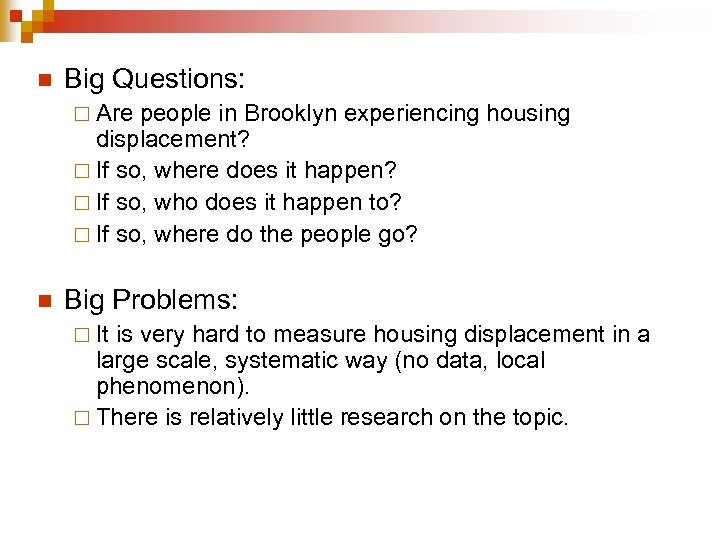
n Big Questions: ¨ Are people in Brooklyn experiencing housing displacement? ¨ If so, where does it happen? ¨ If so, who does it happen to? ¨ If so, where do the people go? n Big Problems: ¨ It is very hard to measure housing displacement in a large scale, systematic way (no data, local phenomenon). ¨ There is relatively little research on the topic.
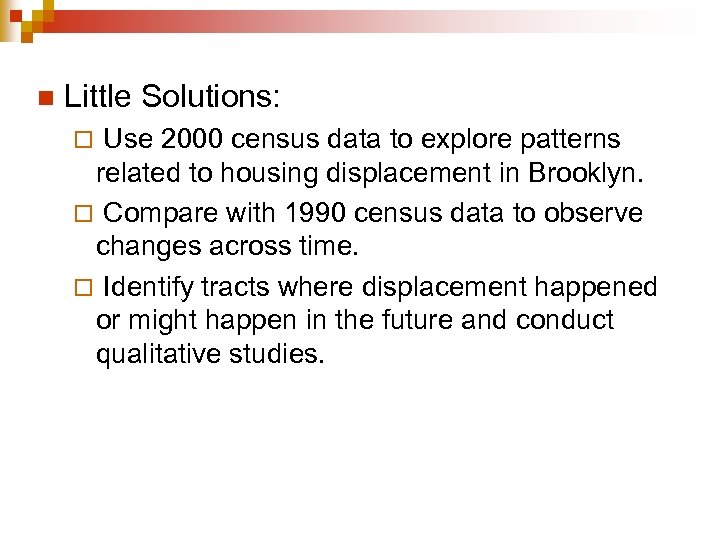
n Little Solutions: Use 2000 census data to explore patterns related to housing displacement in Brooklyn. ¨ Compare with 1990 census data to observe changes across time. ¨ Identify tracts where displacement happened or might happen in the future and conduct qualitative studies. ¨
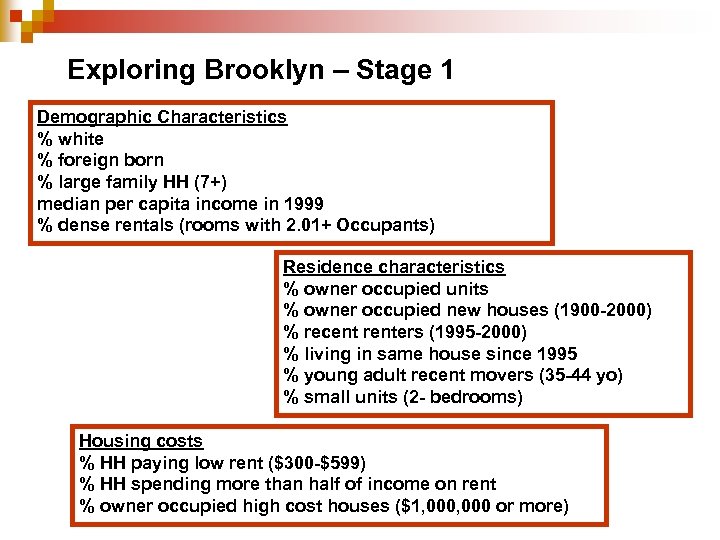
Exploring Brooklyn – Stage 1 Demographic Characteristics % white % foreign born % large family HH (7+) median per capita income in 1999 % dense rentals (rooms with 2. 01+ Occupants) Residence characteristics % owner occupied units % owner occupied new houses (1900 -2000) % recent renters (1995 -2000) % living in same house since 1995 % young adult recent movers (35 -44 yo) % small units (2 - bedrooms) Housing costs % HH paying low rent ($300 -$599) % HH spending more than half of income on rent % owner occupied high cost houses ($1, 000 or more)
Segregated Diversity n n n Preliminary data analysis of the 2000 census suggests that although, in general, Brooklyn in a diverse borough, it is segregated at the tract level. The correlation between the different characteristics of the tracts suggests that the segregation is multi-faceted. Demographic characteristics, Residence characteristics and Housing costs seem to vary simultaneously. Further analysis points to the existence of 4 major types of tracts in Brooklyn. For lack of better names, they will be called – type 1, 2, 3 and 4. Your help with names will be appreciated…
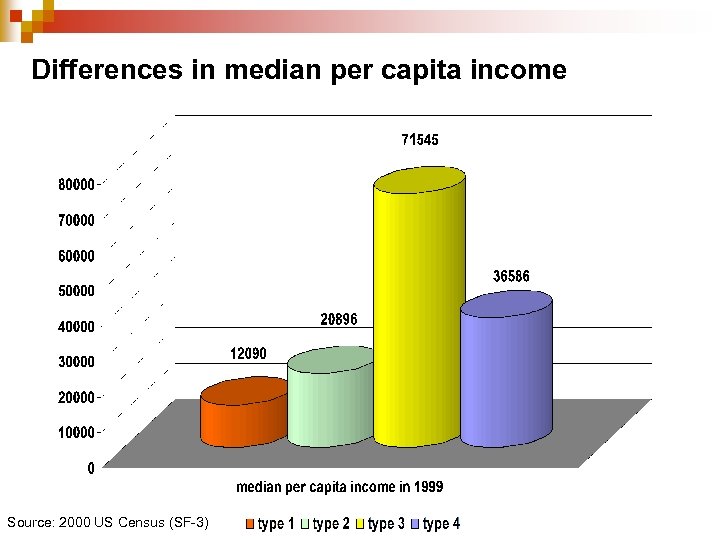
Differences in median per capita income Source: 2000 US Census (SF-3)
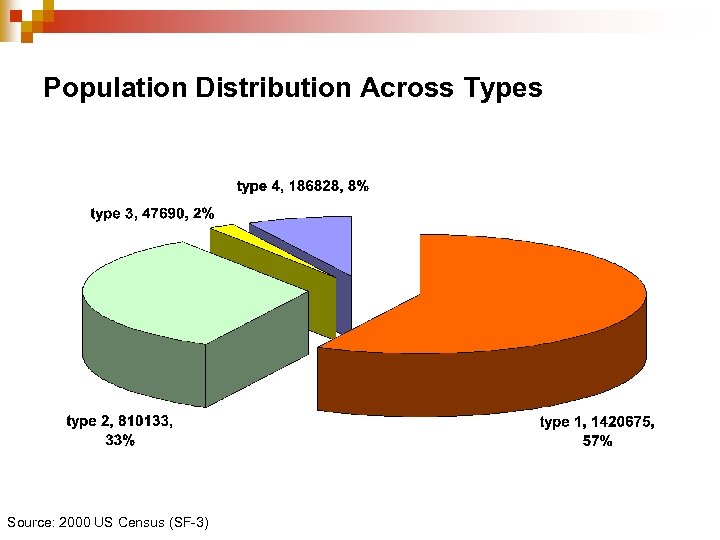
Population Distribution Across Types Source: 2000 US Census (SF-3)
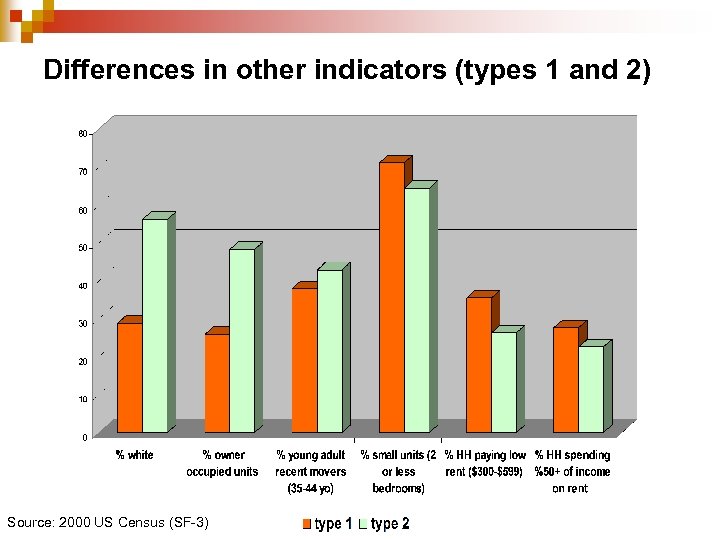
Differences in other indicators (types 1 and 2) Source: 2000 US Census (SF-3)
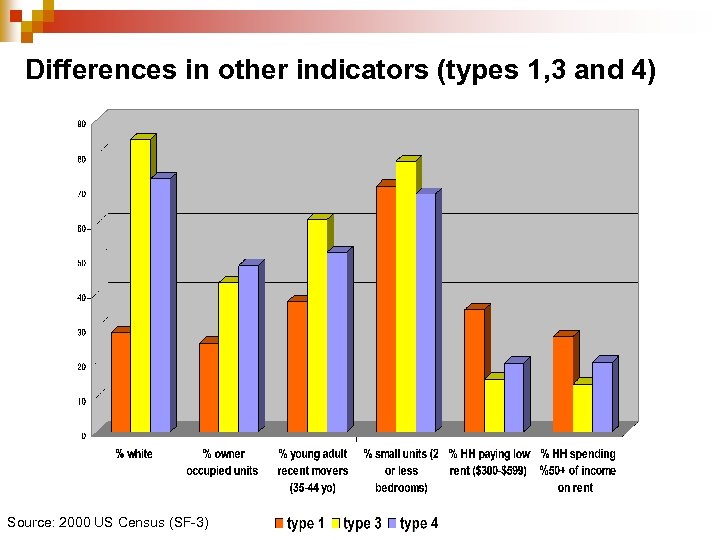
Differences in other indicators (types 1, 3 and 4) Source: 2000 US Census (SF-3)
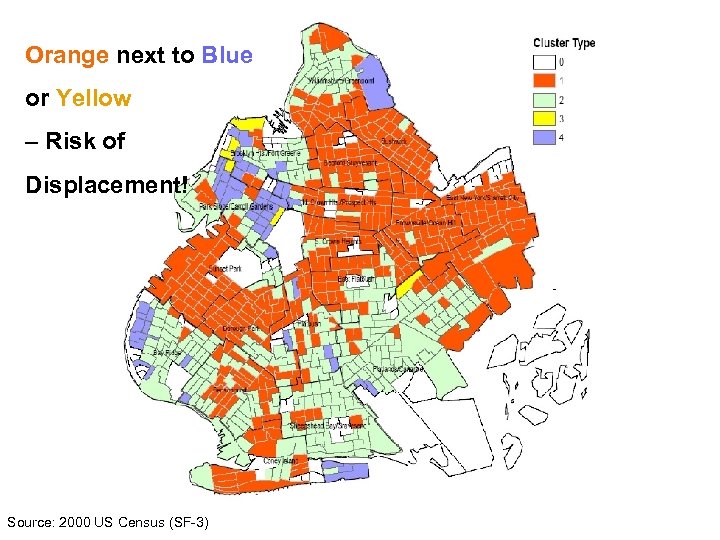
Orange next to Blue or Yellow – Risk of Displacement! Source: 2000 US Census (SF-3)
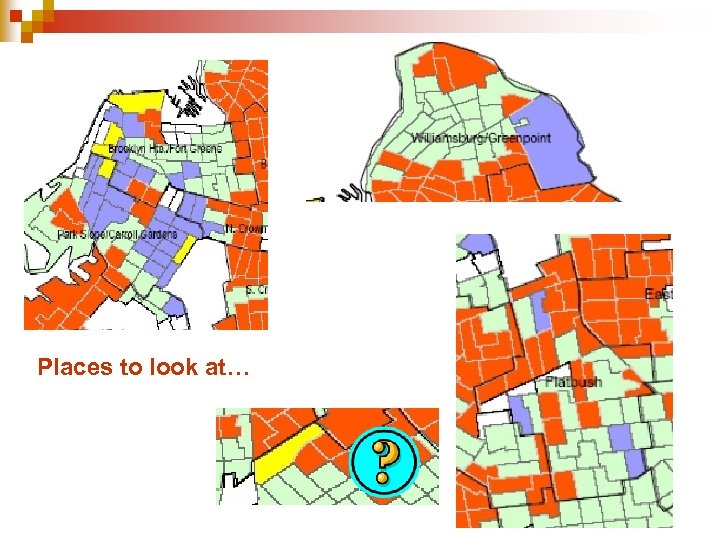
Places to look at…
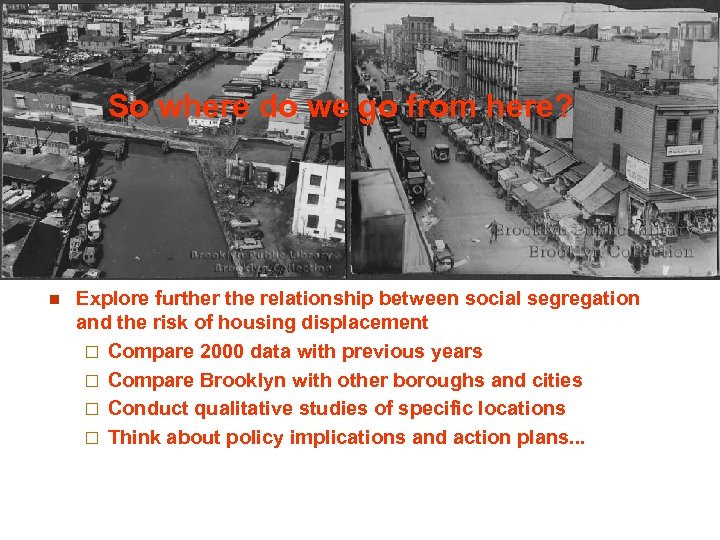
So where do we go from here? n Explore further the relationship between social segregation and the risk of housing displacement ¨ Compare 2000 data with previous years ¨ Compare Brooklyn with other boroughs and cities ¨ Conduct qualitative studies of specific locations ¨ Think about policy implications and action plans. . .
Скачать презентацию Housing Displacement in Brooklyn Preliminary Findings Aviva Zeltzer-Zubida
d035c4840a290e7e93feab08333611a1.ppt