 Скачать презентацию Housing and Construction Data from the Census Bureau
4deed43440b5b65b1f74fc00fe4359ab.ppt
- Количество слайдов: 38



Housing and Construction Data from the Census Bureau Mc. Cormick SRI: Going Deep with Census Demographic and Economic Data Dr. Arthur R Cresce Assistant Division Chief for Housing Characteristics U. S. Census Bureau 0: 00
Goals of Presentation • • • Key sources of housing data we produce Kinds of data these sources produce Strengths and limitations of these sources Some ideas for stories How to access these data 0: 46
Key Points to Keep in Mind Using Census Data Tradeoffs among: • Geographic detail • Characteristic detail • Frequency of data collection 1: 58
Key Sources of Housing Data • American Housing Survey • 2010 Census and the American Community Survey • “Other” sources of data on housing characteristics • Construction Statistics Program 2: 18

About the American Housing Survey (AHS) 2: 50
Inception of the AHS • A 1968 Presidential Commission on Housing found that there was not enough information on the dynamics and condition of the housing stock, especially between censuses • In 1971 Congress authorized the AHS - 1973 - first National AHS - 1974 - first Metro AHS • Sponsored by the Department of Housing and Urban Development (HUD) 2: 53
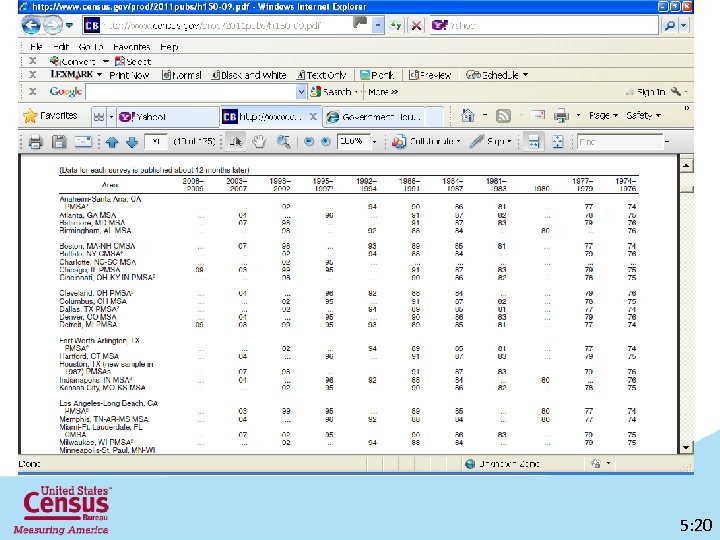
AHS Today • National survey currently conducted every two years • Largest regular national housing survey in the United States - National sample - about 50, 000 households with new construction added each survey year • Selected metropolitan areas surveyed every 4 to 6 years - almost 50 metro in sample at some time over last 30 years 4: 00
5: 20
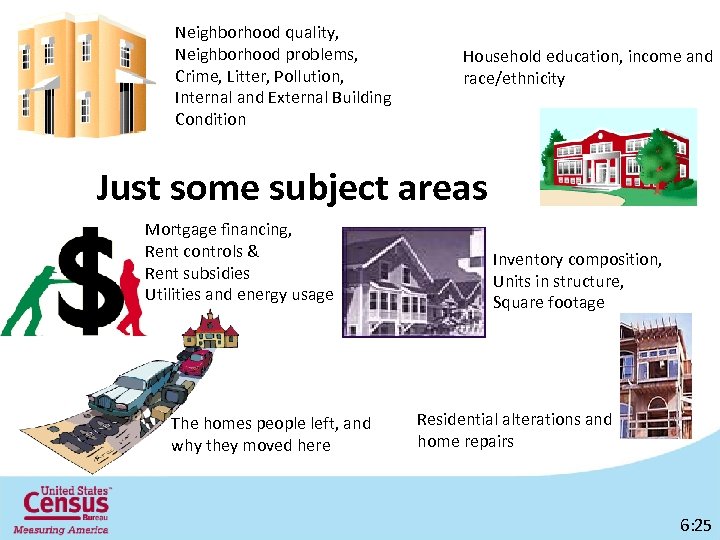
Neighborhood quality, Neighborhood problems, Crime, Litter, Pollution, Internal and External Building Condition Household education, income and race/ethnicity Just some subject areas Mortgage financing, Rent controls & Rent subsidies Utilities and energy usage The homes people left, and why they moved here Inventory composition, Units in structure, Square footage Residential alterations and home repairs 6: 25
Another Unique Feature of the AHS • The AHS has had the same panel in sample since 1985. • This allows researchers to track the same housing unit over an almost 30 year span. 10: 27
11: 10
11: 16
11: 42
12: 26
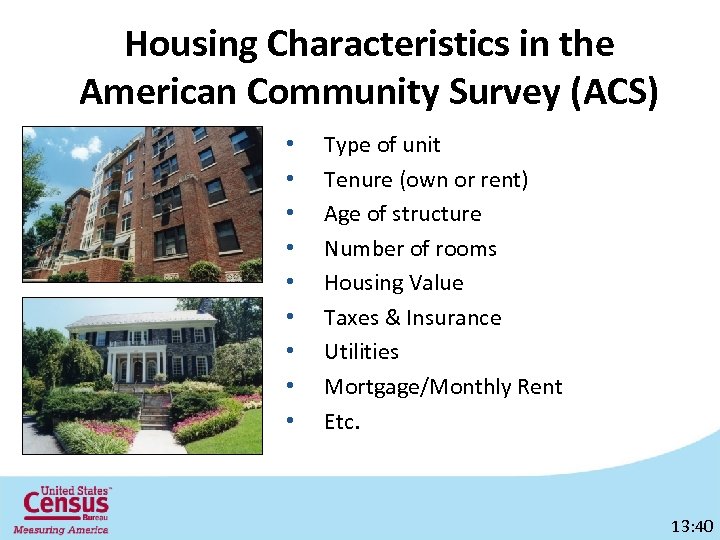
Housing Characteristics in the American Community Survey (ACS) • • • Type of unit Tenure (own or rent) Age of structure Number of rooms Housing Value Taxes & Insurance Utilities Mortgage/Monthly Rent Etc. 13: 40
Housing Characteristics in Census 2010 • Occupancy Status • Vacancy Status • Housing tenure (rented, owned) 14: 27
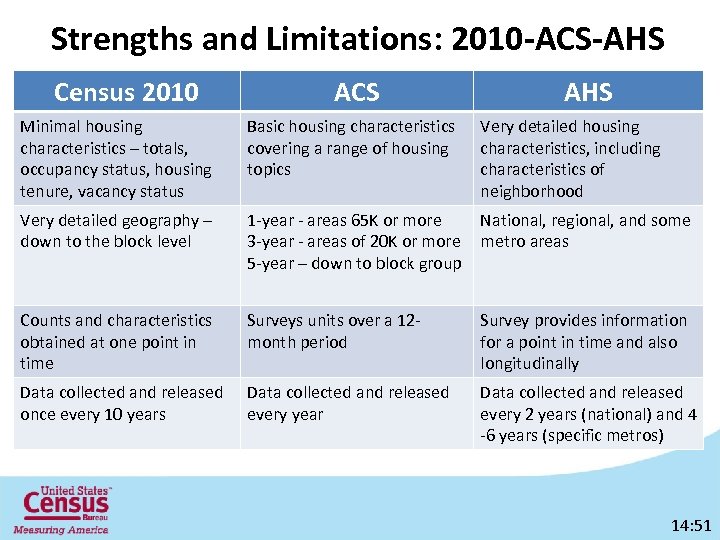
Strengths and Limitations: 2010 -ACS-AHS Census 2010 ACS AHS Minimal housing characteristics – totals, occupancy status, housing tenure, vacancy status Basic housing characteristics covering a range of housing topics Very detailed housing characteristics, including characteristics of neighborhood Very detailed geography – down to the block level 1 -year - areas 65 K or more 3 -year - areas of 20 K or more 5 -year – down to block group National, regional, and some metro areas Counts and characteristics obtained at one point in time Surveys units over a 12 month period Survey provides information for a point in time and also longitudinally Data collected and released once every 10 years Data collected and released every year Data collected and released every 2 years (national) and 4 -6 years (specific metros) 14: 51
“Other” Sources of Housing Data • Housing Vacancy Survey (Current Population Survey) • Survey of Market Absorption (SOMA) • New York City Housing and Vacancy Survey • Rental Housing Finance Survey • Survey of Income and Program Participation • Population Division Estimates Program 17: 20
Ideas for News Stories About Housing Data • Availability and affordability of housing • Quality of housing and neighborhoods • Characteristics of the home and how it may be changing over time • Amenities in the home and in the community • Types of mortgages used to finance homes 20: 17
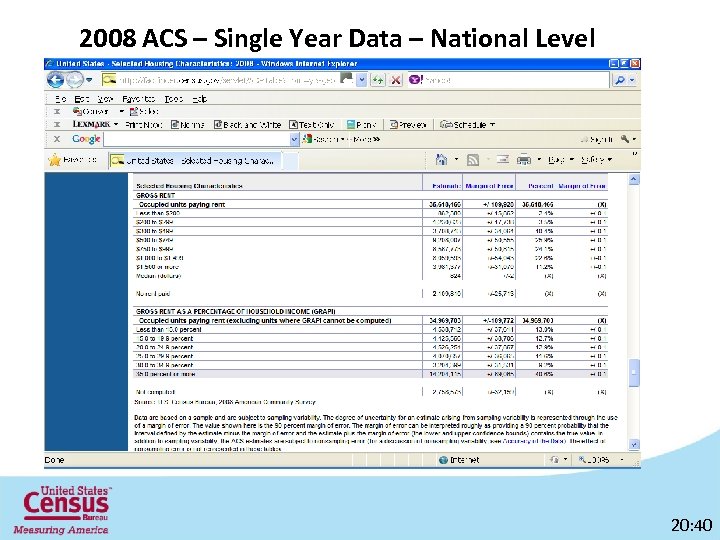
2008 ACS – Single Year Data – National Level 20: 40
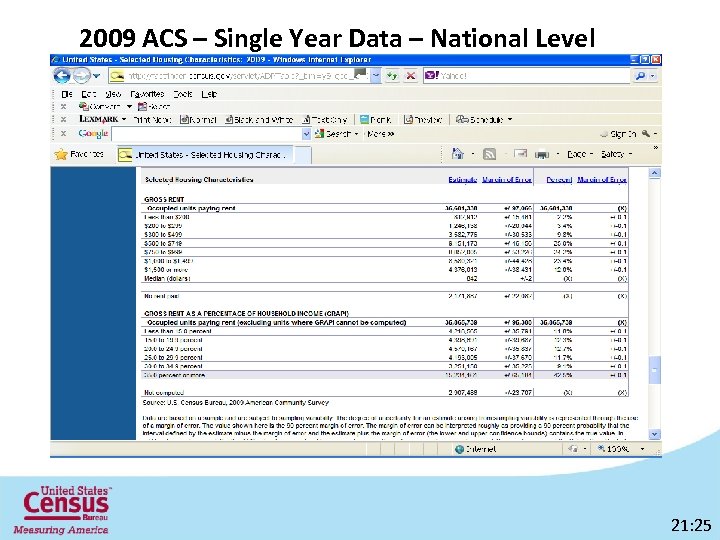
2009 ACS – Single Year Data – National Level 21: 25
The Census Bureau’s Manufacturing and Construction Division Produces a Variety of Statistics on Residential Construction • • • Residential building permits Housing starts and completions New home sales Characteristics of new housing Construction spending Manufactured home placements 22: 02
22: 29
Two Surveys are Used to Measure New Residential Construction and Sales • Building Permits Survey (BPS) Ø Voluntary monthly and annual mail surveys of the 20, 000 local permit-issuing jurisdictions in the U. S. (Internet reporting available this summer) Ø Tracks the number of new privately-owned structures authorized by building or zoning permits • Survey of Construction (SOC) Ø Voluntary monthly telephone/personal interview survey of builders/owners of selected buildings (about 1 in 50 new units are sampled) ØProvides data on housing starts, housing completions, new home sales, prices, and characteristics of new housing units 22: 55
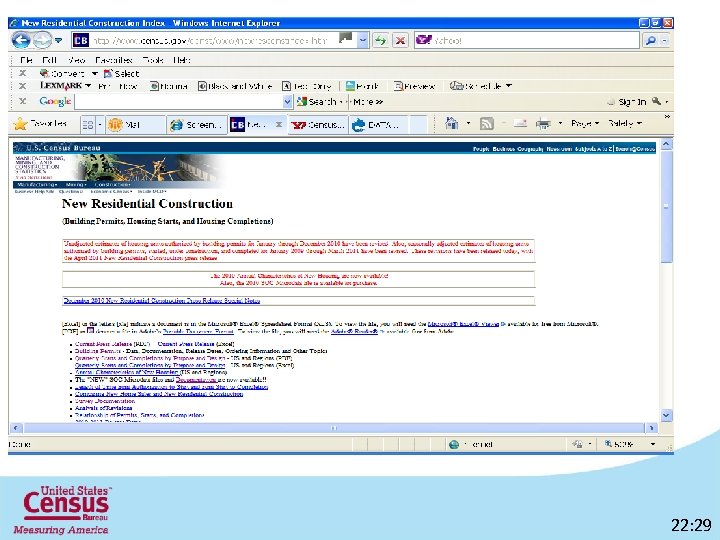
New Residential Construction • Monthly Principal Economic Indicator Release • Data for All Units and Single-family Units • Usually released on the 12 th working day of the month at 8: 30 am ET • Available at www. census. gov/starts • Monthly seasonally adjusted data on Permits, Starts, Completions, and Units under Construction • Annual revisions with April release each May • Historic data available 24: 00
New Residential Construction Strengths (Building Permits) • Are a component of the Conference Board’s U. S. Leading Economic Index, and are a leading construction indicator • Are public records and provide timely local data: Ø Data are released on the 18 th workday of the following month for States, Metro Areas, counties, and local jurisdictions Ø Have a large monthly sample, and annual data for all 20, 000 jurisdictions are released each year on May 1 st 24: 35
New Residential Construction Strengths (Survey of Construction) • Includes areas where permits are not required • Response rates are high because field enumerators collect data by observation • Provides detailed annual data on characteristics of new housing – released each year on June 1 st 25: 01
New Residential Construction – Limitations • Data other than permits are available only for the 4 Census Regions • Confidence intervals for data other than permits are very large due to the small SOC sample size • Estimates for multifamily units often show large month-tomonth fluctuations because all units in the building are counted together: Ø as authorized when the permit is issued Ø as started when excavation begins for the foundation Ø as completed when half are ready for occupancy • Single-family houses are considered completed when the finished flooring has been installed 25: 45
New Residential Sales • Monthly Principal Economic Indicator Release • Commonly called “New Home Sales” • Usually released on the 17 th working day of the month at 10: 00 am ET • Available at www. census. gov/newhomesales • Monthly seasonally adjusted data on New Houses Sold and For Sale • Median and Average Sales Prices of New Houses Sold • Annual revisions with April release each May • Data available back to 1963 27: 07
New Residential Sales Strengths • Only source of national data on sales of new homes • Based on contract signings, not closings, to provide a leading indicator Ø Data on sales of existing homes, from the National Association of Realtors (www. realtor. org) are not directly comparable because they measure closings • Response rates are high because field enumerators collect data by observation if the respondent does not participate • Price indexes of new houses sold and under construction measure inflation in home prices 27: 42
New Residential Sales – Limitations • Data available only for the 4 Census Regions • Confidence intervals are very large due to the small SOC sample size • Includes only homes where the house and land are sold as a package • Includes only single-family homes and townhouses, not condominium units • Does not capture sales cancellations • Larger revisions due to high initial imputation for houses where contracts are signed before thepermit is issued and sampled 28: 46
Many Sources are Used to Measure Total Construction Spending • Construction Progress Reporting Surveys (CPRS) Ø Mail surveys of owners of sampled construction projects Ø Data collected on: ü Privately-owned nonresidential construction projects ü Privately-owned multifamily residential buildings ü State and local construction projects (highways, schools, etc. ) ü Federal construction projects (military bases, public housing, etc. ) • Examples of Other Sources of Data: Ø Data for new single-family housing are derived from the SOC Ø Data on residential remodeling are collected in the Census Bureau’s Consumer Expenditures Survey Ø Data on railroad construction are provided by the Surface Transportation Board Ø Data on cable television construction are from industry trade association statistics 29: 35
Construction Spending • Monthly Principal Economic Indicator Release • Commonly called “Value of Construction Put in Place (VIP)” • Usually released on the 1 st working day of the month at 10: 00 am ET • Available at www. census. gov/constructionspending • Data available by type of construction • Monthly seasonally adjusted data available • Annual revisions with May release each July • Data available back to 1964 30: 38
Construction Spending. Strengths • Estimates the total amount of money spent on allconstruction in the United States • Feeds directly into the Gross Domestic Product (GDP) • Total dollar value of all construction work: Ø Residential and nonresidential Ø Buildings and non-building projects ØPrivately-financed construction ØPublicly-financed construction (Federal, state and local) Ø New construction Ø Improvements, additions, and alterations • Includes work in progress – not just completed projects 30: 52
Construction Spending– Limitations • Data available for the U. S. total only • Series for some types of construction have breaks when new classifications were introduced in 1993 • Monthly data on residential remodeling are forecast because the Consumer Expenditure Survey is quarterly, and are subject to larger revisions than other series • Remodeling data include only owner-occupied properties and exclude remodeling funded by insurance claims 31: 30
Manufactured Home Placements The Manufactured Housing Survey (MHS) collects data on new manufactured (mobile) homes, which are not included in the other construction data series: • Measures the number of manufactured homes placed on sites for residential use and in dealers’ inventories • Includes homes inspected at the factory by the Department of Housing and Urban Development (“HUD-code homes”) • A monthly voluntary phone survey of individual units shipped to dealers sampled from the factory inspection reports • Gathers data on prices and characteristics • Data available for the U. S. and the 4 Census Regions • Monthly data available seasonally adjusted • Available at www. census. gov/const/www/mhsindex. html 32: 41
Ideas for News Stories About Construction Data • News stories tend to overstate the significance ofthe change in the latest monthly estimate, which is often not statistically significant Ø A better story would look at trends over several months • The press may overstate the impact of weather on the numbers; bad weather rarely affects an entire region Ø Use local building permit data to provide a local angle • The impact of government stimulus programs or budget cuts can be seen in data on public construction spending 33: 17
For More Details on Census Bureau Housing and Construction Data: Census Bureau Public Information Office 301 -763 -3030 34: 23
Скачать презентацию Housing and Construction Data from the Census Bureau
4deed43440b5b65b1f74fc00fe4359ab.ppt