


 Скачать презентацию HOUSEHOLD LEVERAGE AND SOVEREIGN RISK Comments Juan F
69e3a25a3cf87eaa1a22e1e1111aef4d.ppt
- Количество слайдов: 22
 HOUSEHOLD LEVERAGE AND SOVEREIGN RISK Comments Juan F. Jimeno (Research Division) CONFERENCE: “Debt and Credit, Growth and Crises” Madrid 18 -19 June 2012
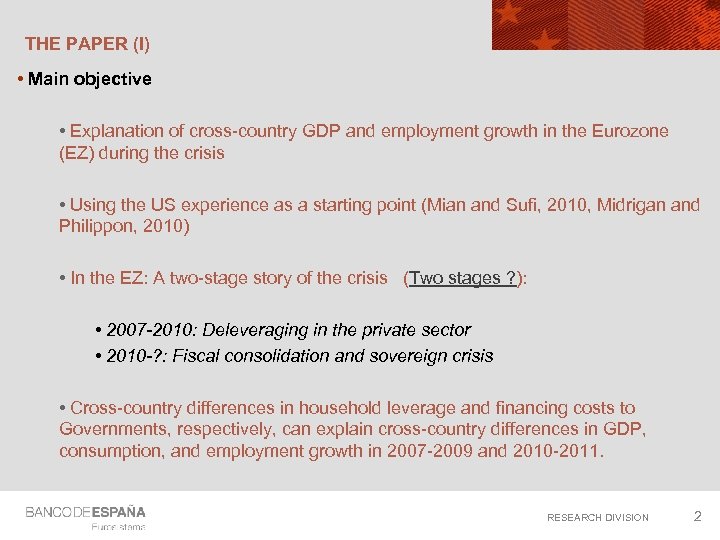 THE PAPER (I) • Main objective • Explanation of cross-country GDP and employment growth in the Eurozone (EZ) during the crisis • Using the US experience as a starting point (Mian and Sufi, 2010, Midrigan and Philippon, 2010) • In the EZ: A two-stage story of the crisis (Two stages ? ): • 2007 -2010: Deleveraging in the private sector • 2010 -? : Fiscal consolidation and sovereign crisis • Cross-country differences in household leverage and financing costs to Governments, respectively, can explain cross-country differences in GDP, consumption, and employment growth in 2007 -2009 and 2010 -2011. RESEARCH DIVISION 2
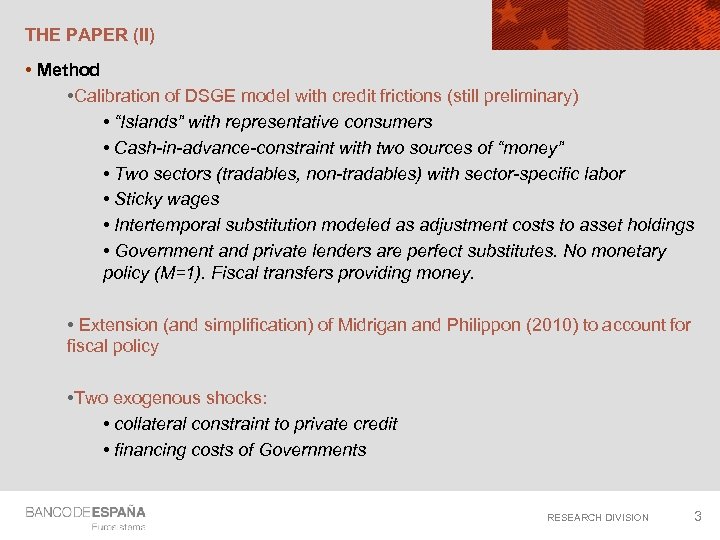 THE PAPER (II) • Method • Calibration of DSGE model with credit frictions (still preliminary) • “Islands” with representative consumers • Cash-in-advance-constraint with two sources of “money” • Two sectors (tradables, non-tradables) with sector-specific labor • Sticky wages • Intertemporal substitution modeled as adjustment costs to asset holdings • Government and private lenders are perfect substitutes. No monetary policy (M=1). Fiscal transfers providing money. • Extension (and simplification) of Midrigan and Philippon (2010) to account for fiscal policy • Two exogenous shocks: • collateral constraint to private credit • financing costs of Governments RESEARCH DIVISION 3
 MAIN QUESTION • Do the model’s assumptions fit well with the European experience to be explained? • Empirical evidence on the credit-consumption channel • The different nature of the crisis across EZ countries • Asymmetries and imbalances in the EZ • Credit boom, deleveraging and sovereign risk premia RESEARCH DIVISION 4
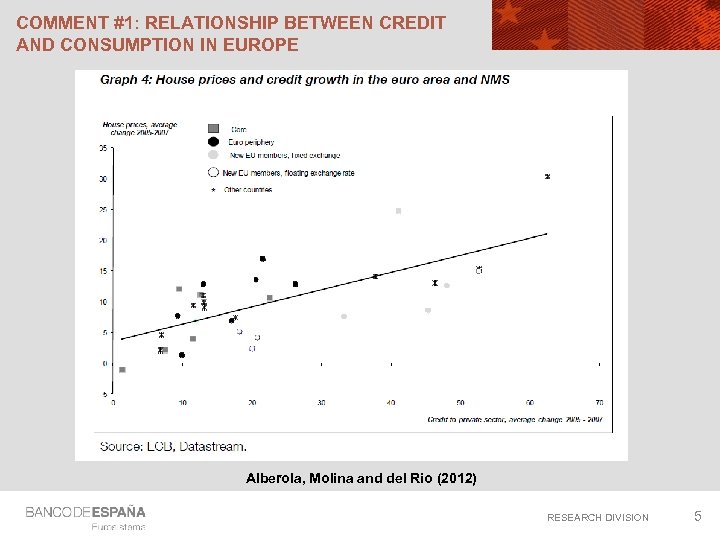 COMMENT #1: RELATIONSHIP BETWEEN CREDIT AND CONSUMPTION IN EUROPE Alberola, Molina and del Rio (2012) RESEARCH DIVISION 5
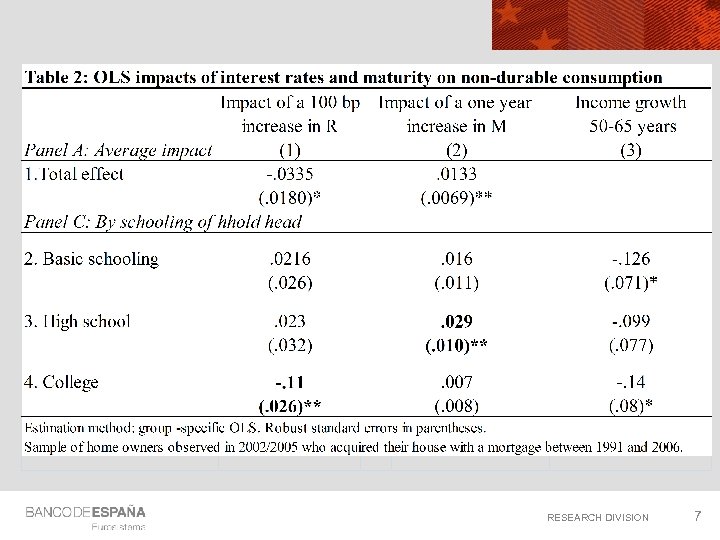
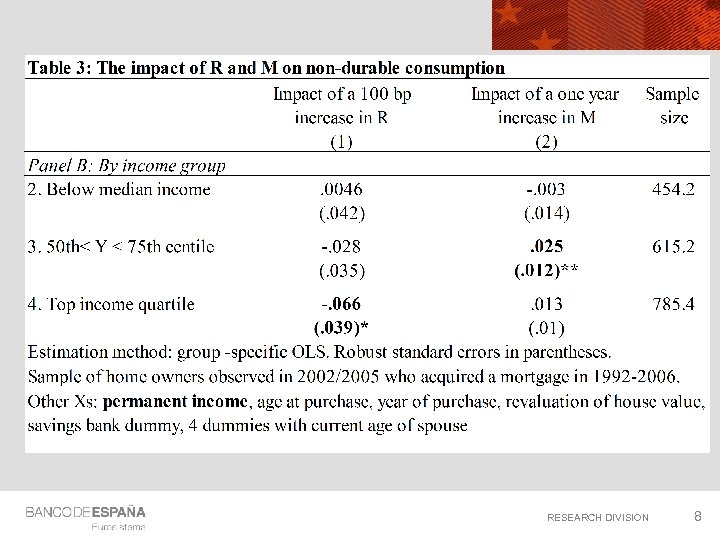
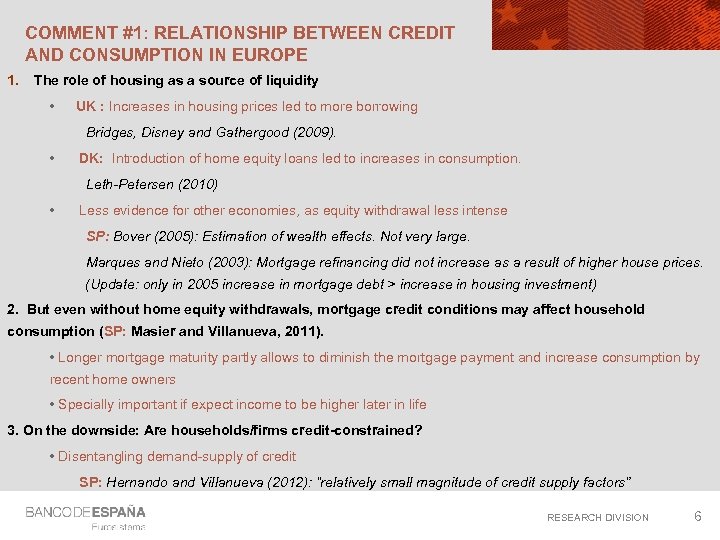 COMMENT #1: RELATIONSHIP BETWEEN CREDIT AND CONSUMPTION IN EUROPE 1. The role of housing as a source of liquidity • UK : Increases in housing prices led to more borrowing Bridges, Disney and Gathergood (2009). • DK: Introduction of home equity loans led to increases in consumption. Leth-Petersen (2010) • Less evidence for other economies, as equity withdrawal less intense SP: Bover (2005): Estimation of wealth effects. Not very large. Marques and Nieto (2003): Mortgage refinancing did not increase as a result of higher house prices. (Update: only in 2005 increase in mortgage debt > increase in housing investment) 2. But even without home equity withdrawals, mortgage credit conditions may affect household consumption (SP: Masier and Villanueva, 2011). • Longer mortgage maturity partly allows to diminish the mortgage payment and increase consumption by recent home owners • Specially important if expect income to be higher later in life 3. On the downside: Are households/firms credit-constrained? • Disentangling demand-supply of credit SP: Hernando and Villanueva (2012): “relatively small magnitude of credit supply factors” RESEARCH DIVISION 6
 RESEARCH DIVISION 7
 RESEARCH DIVISION 8
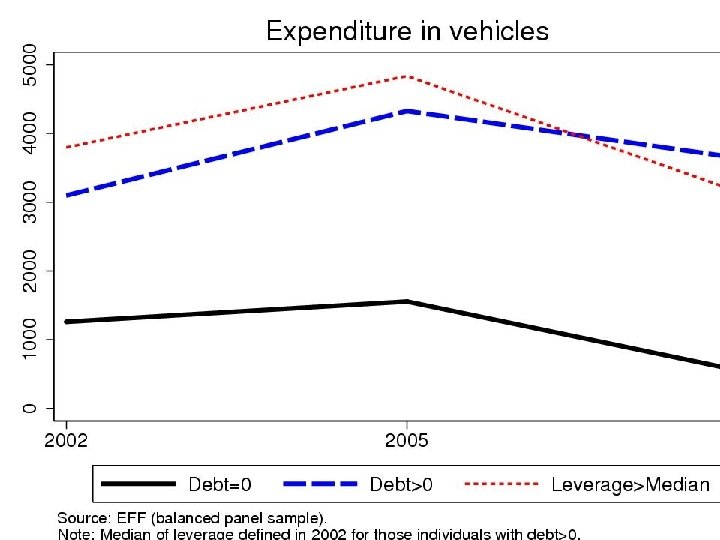
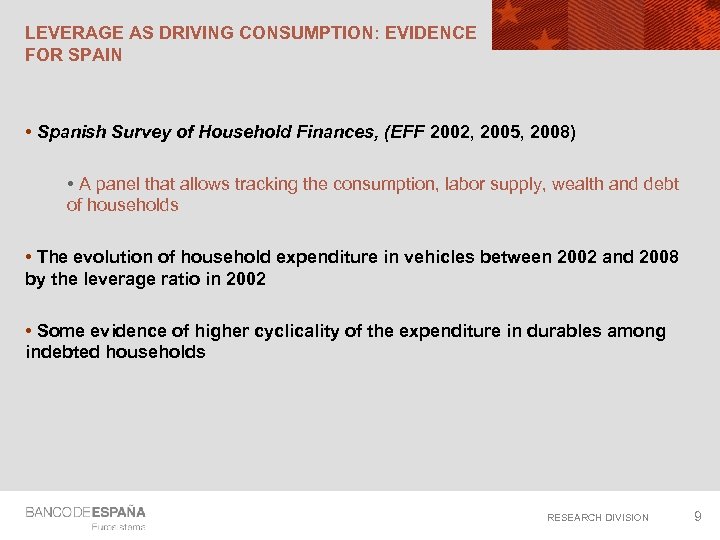 LEVERAGE AS DRIVING CONSUMPTION: EVIDENCE FOR SPAIN • Spanish Survey of Household Finances, (EFF 2002, 2005, 2008) • A panel that allows tracking the consumption, labor supply, wealth and debt of households • The evolution of household expenditure in vehicles between 2002 and 2008 by the leverage ratio in 2002 • Some evidence of higher cyclicality of the expenditure in durables among indebted households RESEARCH DIVISION 9
 RESEARCH DIVISION 10
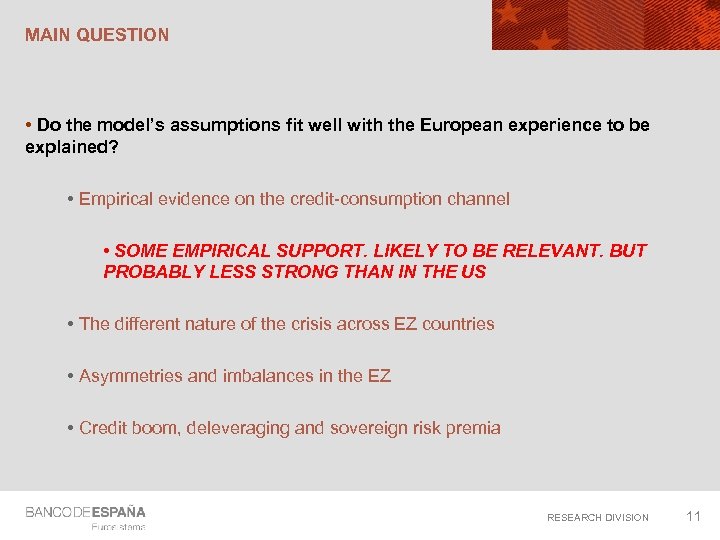 MAIN QUESTION • Do the model’s assumptions fit well with the European experience to be explained? • Empirical evidence on the credit-consumption channel • SOME EMPIRICAL SUPPORT. LIKELY TO BE RELEVANT. BUT PROBABLY LESS STRONG THAN IN THE US • The different nature of the crisis across EZ countries • Asymmetries and imbalances in the EZ • Credit boom, deleveraging and sovereign risk premia RESEARCH DIVISION 11
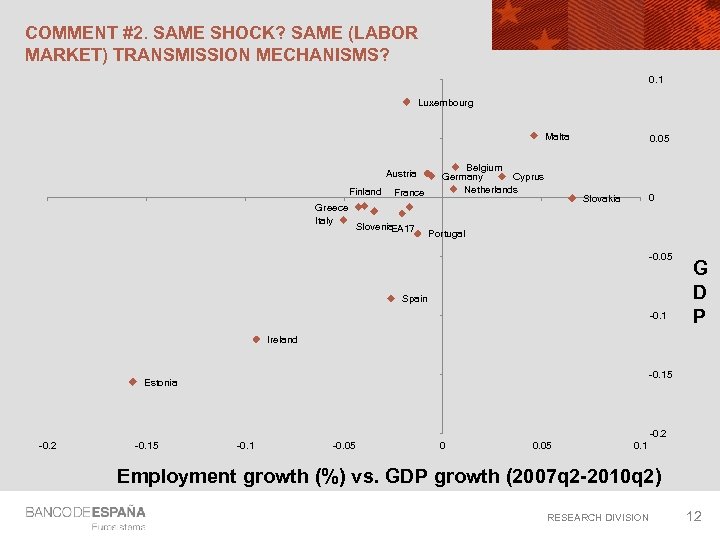 COMMENT #2. SAME SHOCK? SAME (LABOR MARKET) TRANSMISSION MECHANISMS? 0. 1 Luxembourg Malta Austria Finland Greece Italy France Slovenia EA 17 Belgium Germany Cyprus Netherlands 0. 05 0 Slovakia Portugal -0. 05 Spain -0. 1 G D P Ireland -0. 15 Estonia -0. 2 -0. 15 -0. 1 -0. 05 0. 1 Employment growth (%) vs. GDP growth (2007 q 2 -2010 q 2) RESEARCH DIVISION 12
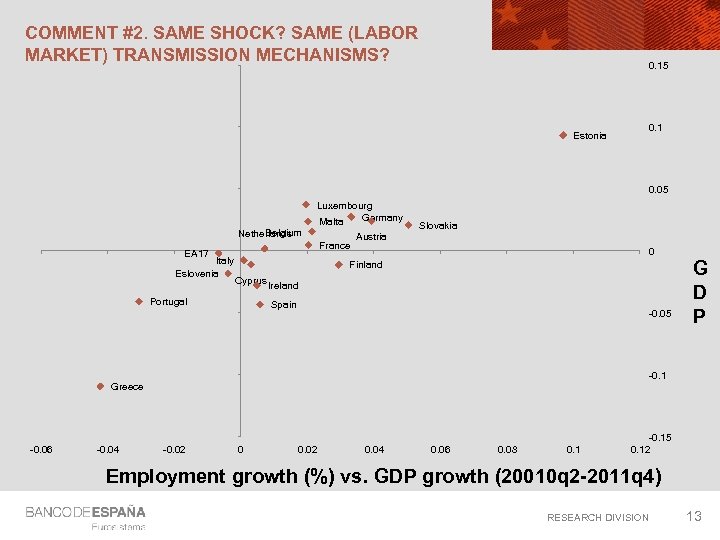 COMMENT #2. SAME SHOCK? SAME (LABOR MARKET) TRANSMISSION MECHANISMS? 0. 15 Estonia 0. 1 0. 05 Belgium Netherlands Luxembourg Germany Malta France EA 17 Italy Eslovenia Austria Slovakia 0 Finland Cyprus Portugal Ireland Spain -0. 05 G D P -0. 1 Greece -0. 06 -0. 04 -0. 02 0. 04 0. 06 0. 08 0. 1 -0. 15 0. 12 Employment growth (%) vs. GDP growth (20010 q 2 -2011 q 4) RESEARCH DIVISION 13
 MAIN QUESTION • Do the model’s assumptions fit well with the European experience to be explained? • Empirical evidence on the credit-consumption channel • The different nature of the crisis across EZ countries • DIFFERENT SHOCKS. • DIFFERENT LABOR MARKET RESPONSES DIFFICULT TO EXPLAIN WITH SAME DEGREE OF LABOR MARKET RIGIDITIES ACROSS COUNTRIES • Asymmetries and imbalances in the EZ • Credit boom, deleveraging and sovereign risk premia RESEARCH DIVISION 14
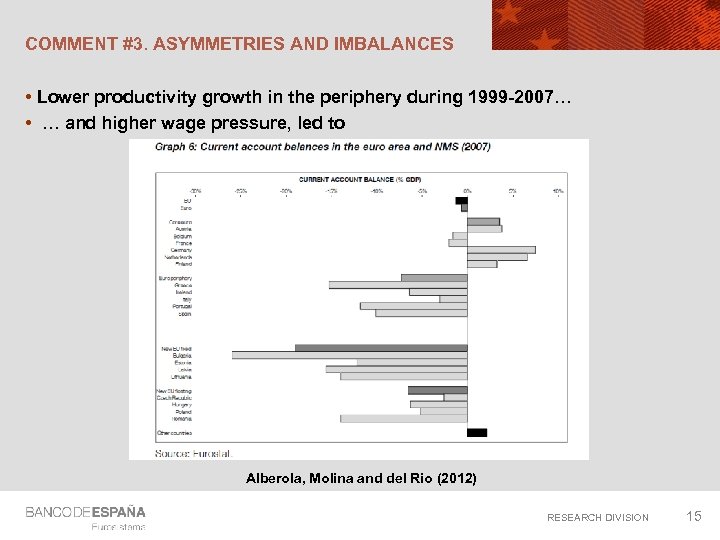 COMMENT #3. ASYMMETRIES AND IMBALANCES • Lower productivity growth in the periphery during 1999 -2007… • … and higher wage pressure, led to Alberola, Molina and del Rio (2012) RESEARCH DIVISION 15
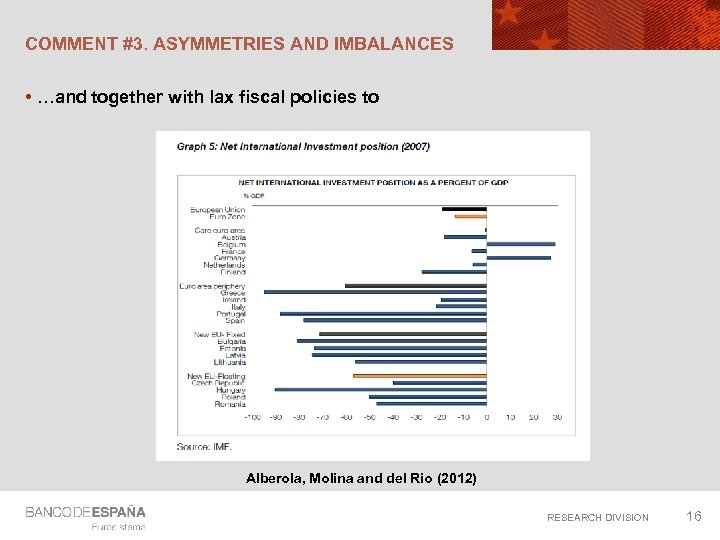 COMMENT #3. ASYMMETRIES AND IMBALANCES • …and together with lax fiscal policies to Alberola, Molina and del Rio (2012) RESEARCH DIVISION 16
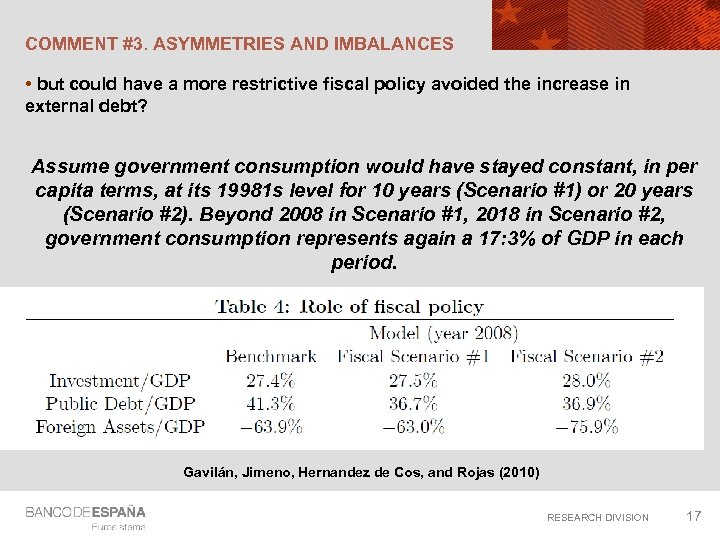 COMMENT #3. ASYMMETRIES AND IMBALANCES • but could have a more restrictive fiscal policy avoided the increase in external debt? Assume government consumption would have stayed constant, in per capita terms, at its 19981 s level for 10 years (Scenario #1) or 20 years (Scenario #2). Beyond 2008 in Scenario #1, 2018 in Scenario #2, government consumption represents again a 17: 3% of GDP in each period. Gavilán, Jimeno, Hernandez de Cos, and Rojas (2010) RESEARCH DIVISION 17
 MAIN QUESTION • Do the model’s assumptions fit well with the European experience to be explained? • Empirical evidence on the credit-consumption channel • The different nature of the crisis across EZ countries • Asymmetries and imbalances in the EZ • COMPETITIVENESS, EXTERNAL IMBALANCES ARE KEY TO UNDERSTAND EZ CRISIS • Credit boom, deleveraging and sovereign risk premia RESEARCH DIVISION 18
 COMMENT #4. SOURCES OF SHOCKS • Endogenous leverage • The role of banks (and shadow banking) at generating credit cycles • Nuño and Thomas (2012) • Martinez-Miera and Suarez (2012) • Factors behind the financing cost of EZ Governments ? • Only fiscal variables? • Contagion effects? • Interactions public-private sectors? • Other variables? RESEARCH DIVISION 19
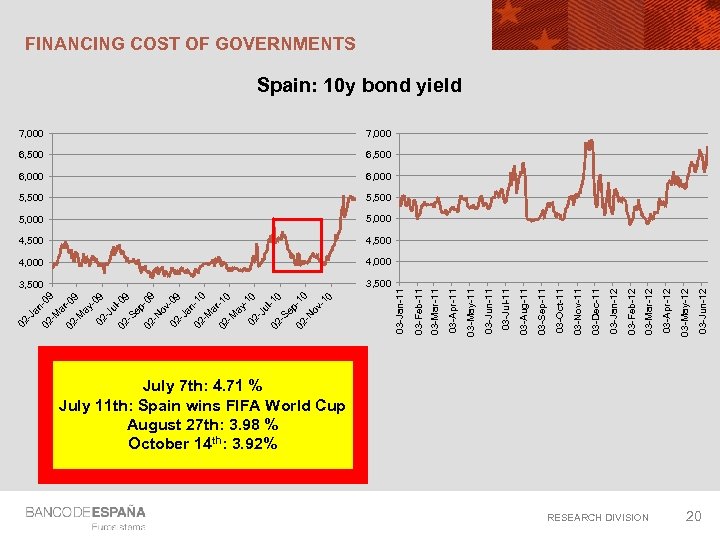 7, 000 6, 500 6, 000 5, 500 5, 000 4, 500 4, 000 3, 500 RESEARCH DIVISION 03 -Jun-12 03 -May-12 03 -Apr-12 03 -Mar-12 03 -Feb-12 03 -Jan-12 03 -Dec-11 03 -Nov-11 03 -Oct-11 03 -Sep-11 03 -Aug-11 03 -Jul-11 03 -Jun-11 03 -May-11 03 -Apr-11 03 -Mar-11 03 -Feb-11 03 -Jan-11 a 02 r-09 -M ay 02 09 -J u 02 l-09 -S ep -0 02 -N 9 ov 02 -09 -J an 02 -10 -M a 02 r-10 -M ay 02 10 -J u 02 l-10 -S ep -1 02 -N 0 ov -1 0 09 n- Ja -M 02 02 - FINANCING COST OF GOVERNMENTS Spain: 10 y bond yield July 7 th: 4. 71 % July 11 th: Spain wins FIFA World Cup August 27 th: 3. 98 % October 14 th: 3. 92% 20
 THANKS FOR YOUR ATTENTION ¡¡¡ RESEARCH DIVISION
 BACK RESEARCH DIVISION 22