 Скачать презентацию Household debt and foreign currency borrowing in new
98f27a3df2bad8a767ba728c24d6eb89.ppt
- Количество слайдов: 27



Household debt and foreign currency borrowing in new member states of the EU Ray Barrell E. Philip Davis Tatiana Fic Ali Orazgani National Institute of Economic and Social Research Brunel University National Bank of Poland
Motivation n Many new members of the EU n Poland, Hungary, Czech Republic, Slovakia, Slovenia, Estonia, Latvia, Lithuania, Bulgaria, Romania have been experiencing rapid growth of debt in the household sector n While credit growth is an essential element of the catching-up process in the NMS, excessive household indebtedness, especially if it is in foreign currency, may increase their susceptibility to a crisis and/or prolonged periods of slow economic growth as balance sheets are corrected
Objective n The objective of this paper is to identify risks related to the evolution of debt in NMS and ¨ derive implications for macroeconomic policy ¨ n Rising household debt and foreign currency borrowing – from the perspective of the 2008 global financial crisis

Outline Household indebtedness in NMS: stylised facts n Quantitative assessment of the sustainability of debt n Qualitative discussion of risks arising from borrowing in foreign currencies n Conclusions n

Household indebtedness in NMS: stylised facts
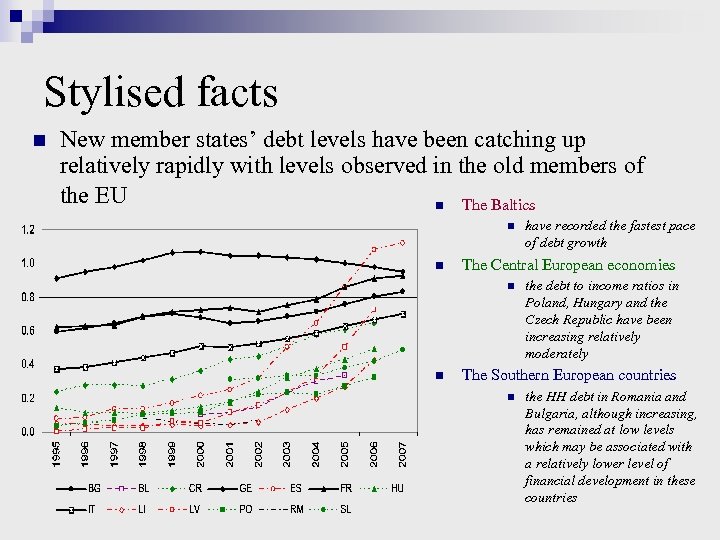
Stylised facts n New member states’ debt levels have been catching up relatively rapidly with levels observed in the old members of the EU n The Baltics n n The Central European economies n n have recorded the fastest pace of debt growth the debt to income ratios in Poland, Hungary and the Czech Republic have been increasing relatively moderately The Southern European countries n the HH debt in Romania and Bulgaria, although increasing, has remained at low levels which may be associated with a relatively lower level of financial development in these countries
Debt drivers n The expansion of household debt results from two factors: ¨ the n convergence process in which case the expanding indebtedness constitutes a necessary element of the medium-, long term macroeconomic equilibrium ¨ short n n term borrowing trends driven by the business cycle or by autonomous factors such as financial liberalisation linked to international competition or foreign ownership of the banking system. These may result in credit booms, posing risks of overheating to the economy and of financial instability in the downturn.

Quantitative assessment of sustainability of debt in NMS

Qualitative assessment of debt sustainability n 3 steps 1. Estimate a model of debt n What does the debt to income ratio depend on? 2. Detemine the equilibrium level of debt n How do you measure the equilibrium? 3. Assess excessive indebtedness of households In the short run n In the medium run n In the long run n
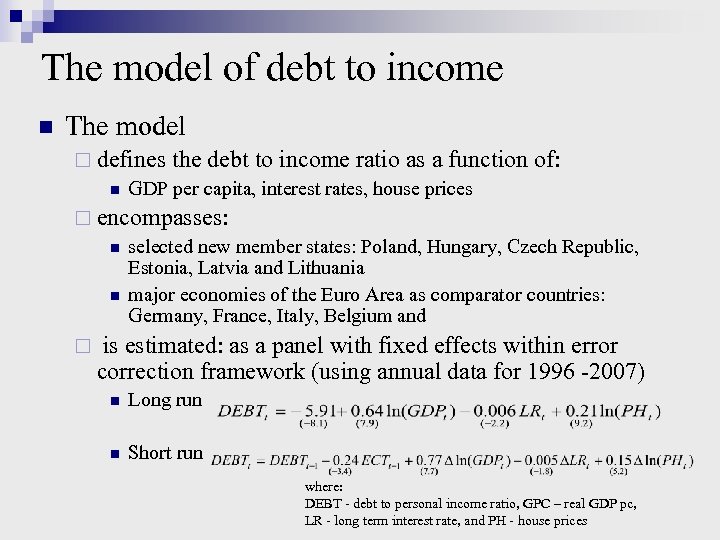
The model of debt to income n The model ¨ defines the debt to income ratio as a function n GDP per capita, interest rates, house prices of: ¨ encompasses: n selected new member states: Poland, Hungary, Czech Republic, Estonia, Latvia and Lithuania n major economies of the Euro Area as comparator countries: Germany, France, Italy, Belgium and ¨ is estimated: as a panel with fixed effects within error correction framework (using annual data for 1996 -2007) n Long run n Short run where: DEBT - debt to personal income ratio, GPC – real GDP pc, LR - long term interest rate, and PH - house prices
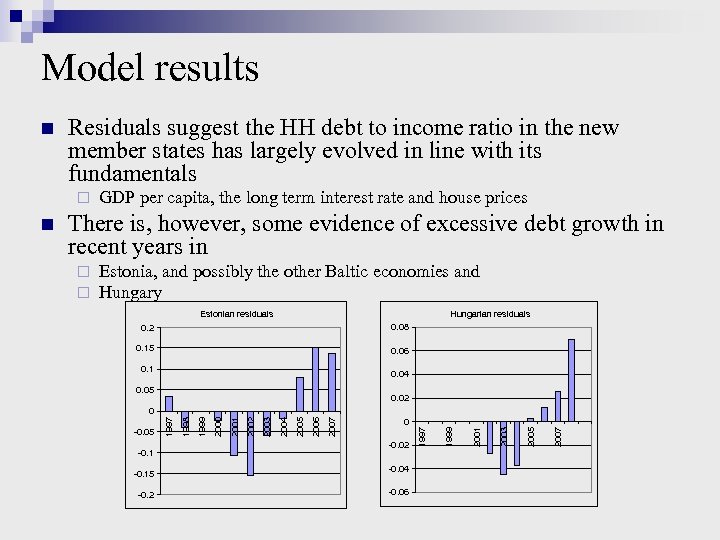
Model results Residuals suggest the HH debt to income ratio in the new member states has largely evolved in line with its fundamentals ¨ There is, however, some evidence of excessive debt growth in recent years in Estonia, and possibly the other Baltic economies and Hungary Hungarian residuals Estonian residuals 0. 2 0. 08 0. 15 0. 06 0. 1 0. 04 0. 05 0. 02 -0. 15 -0. 2 -0. 04 -0. 06 2007 2005 2003 2001 -0. 02 1999 0 1997 2006 2005 2004 2003 2002 2001 -0. 05 2000 0 1999 ¨ ¨ 1998 n GDP per capita, the long term interest rate and house prices 1997 n

What is the equlibrium level of debt? n n n The evolution of the debt to income ratio in line with its determinants - GDP per capita, interest rates and house prices does not necessarily guarantee the sustainability of the debt growth GDP per capita, interest rates, and house prices are subject to cycles and/or bubbles => We argue that the equilibrium level of debt should correspond to equilibrium levels of its determinants
Equilibrium levels of debt to income determinants n House prices ¨ n Bubbles in house prices GDP ¨ Cycles in GDP growth
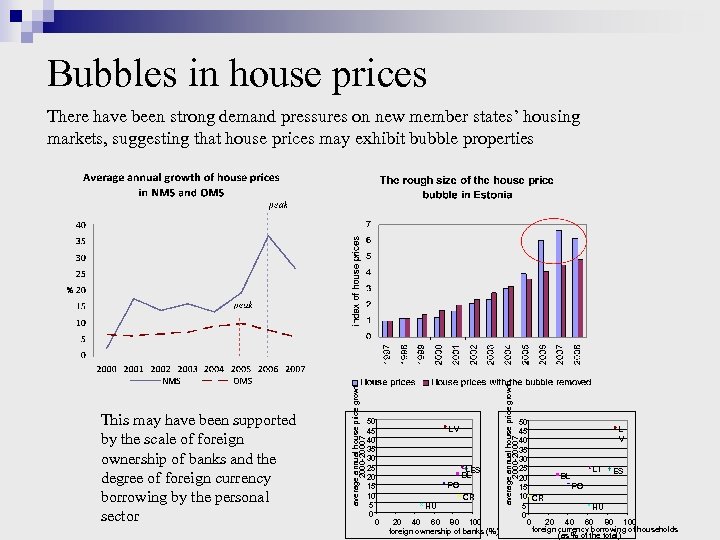
Bubbles in house prices 50 45 40 35 30 25 20 15 10 5 0 0 LV LI ES BL PO CR HU 20 40 60 80 100 foreign ownership of banks (%) average annual house price growth 2000 -20007 This may have been supported by the scale of foreign ownership of banks and the degree of foreign currency borrowing by the personal sector average annual house price growth 2000 -20007 There have been strong demand pressures on new member states’ housing markets, suggesting that house prices may exhibit bubble properties 50 L 45 V 40 35 30 25 LI ES BL 20 PO 15 10 CR 5 HU 0 0 20 40 60 80 100 foreign currency borrowing of households (as % of the total)
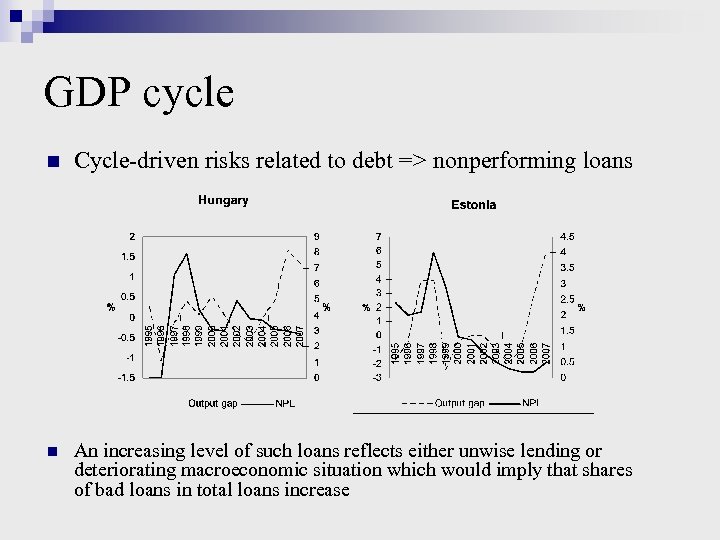
GDP cycle n Cycle-driven risks related to debt => nonperforming loans n An increasing level of such loans reflects either unwise lending or deteriorating macroeconomic situation which would imply that shares of bad loans in total loans increase
Excessive indebtedness n Estimating the model of debt to income ratio ¨ for selected NMS and ¨ major OMS n n and removing bubbles/cycles from debt determinants (defining their equilibrium levels) allows us to determine 3 types of risks related to excessive debt: ¨ Short run risks ¨ Medium run risks ¨ Long run risks
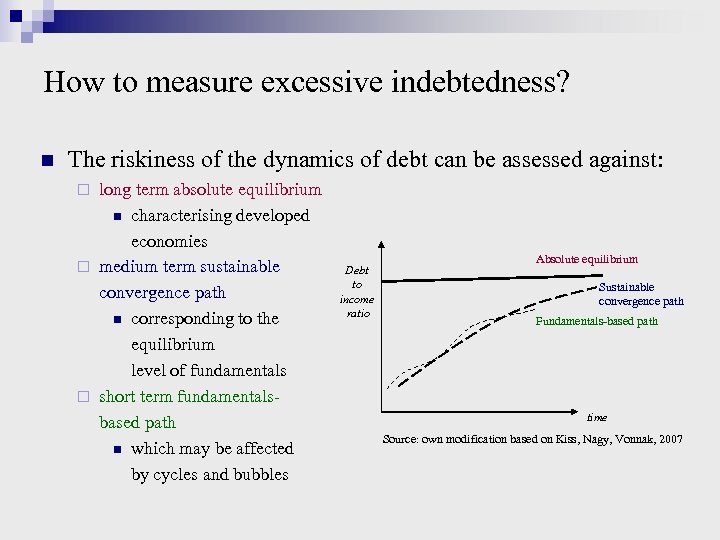
How to measure excessive indebtedness? n The riskiness of the dynamics of debt can be assessed against: long term absolute equilibrium n characterising developed economies ¨ medium term sustainable convergence path n corresponding to the equilibrium level of fundamentals ¨ short term fundamentalsbased path n which may be affected by cycles and bubbles ¨ Debt to income ratio Absolute equilibrium Sustainable convergence path Fundamentals-based path time Source: own modification based on Kiss, Nagy, Vonnak, 2007
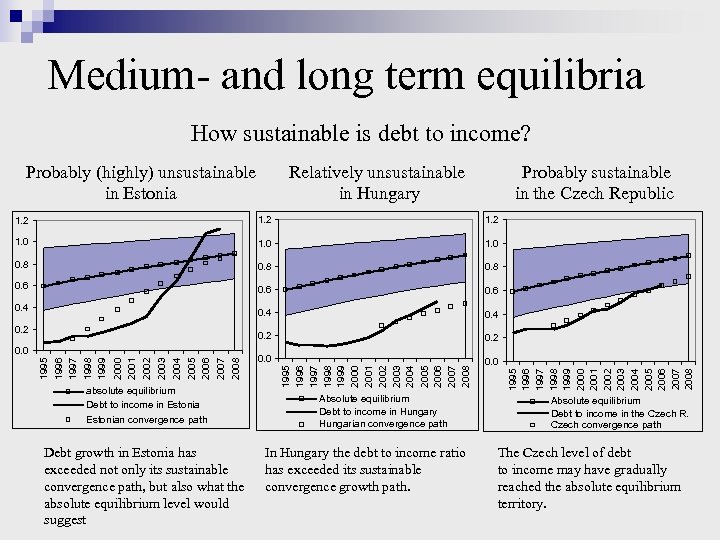
Medium- and long term equilibria How sustainable is debt to income? Probably (highly) unsustainable in Estonia Probably sustainable in the Czech Republic Relatively unsustainable in Hungary 1. 2 1. 0 0. 8 0. 6 0. 4 0. 2 0. 0 0. 4 0. 2 2004 2005 2006 2007 2008 2000 2001 2002 2003 1995 1996 1997 1998 1999 0. 0 absolute equilibrium Debt to income in Estonian convergence path Debt growth in Estonia has exceeded not only its sustainable convergence path, but also what the absolute equilibrium level would suggest Absolute equilibrium Debt to income in Hungary Hungarian convergence path In Hungary the debt to income ratio has exceeded its sustainable convergence growth path. 1995 1996 1997 1998 1999 2000 2001 2002 2003 2004 2005 2006 2007 2008 1. 2 Absolute equilibrium Debt to income in the Czech R. Czech convergence path The Czech level of debt to income may have gradually reached the absolute equilibrium territory.
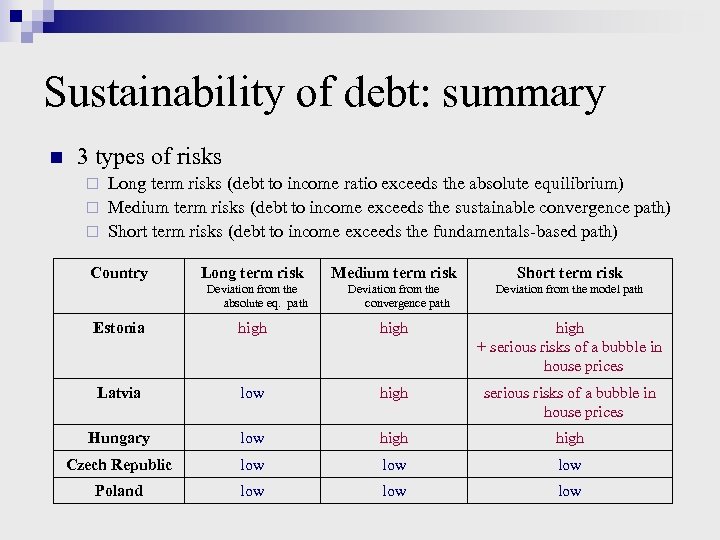
Sustainability of debt: summary n 3 types of risks Long term risks (debt to income ratio exceeds the absolute equilibrium) ¨ Medium term risks (debt to income exceeds the sustainable convergence path) ¨ Short term risks (debt to income exceeds the fundamentals-based path) ¨ Country Long term risk Deviation from the absolute eq. path Medium term risk Deviation from the convergence path Short term risk Deviation from the model path Estonia high + serious risks of a bubble in house prices Latvia low high serious risks of a bubble in house prices Hungary low high Czech Republic low low Poland low low

Qualitative discussion of risks arising from borrowing in foreign currencies
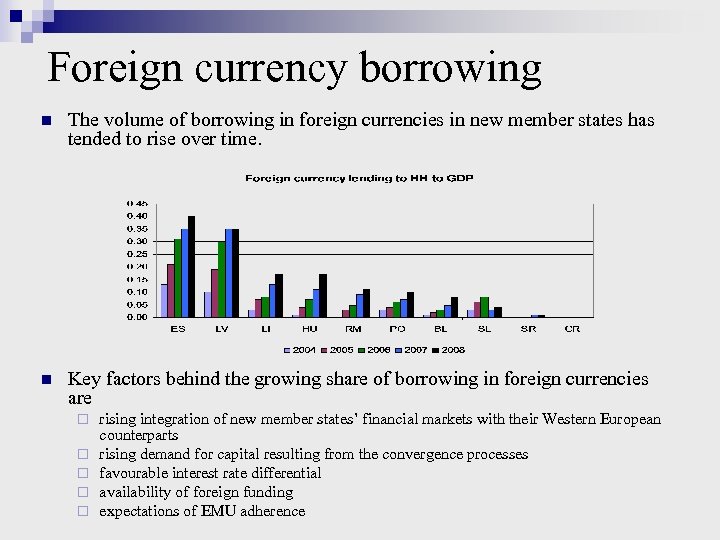
Foreign currency borrowing n The volume of borrowing in foreign currencies in new member states has tended to rise over time. n Key factors behind the growing share of borrowing in foreign currencies are ¨ ¨ ¨ rising integration of new member states’ financial markets with their Western European counterparts rising demand for capital resulting from the convergence processes favourable interest rate differential availability of foreign funding expectations of EMU adherence
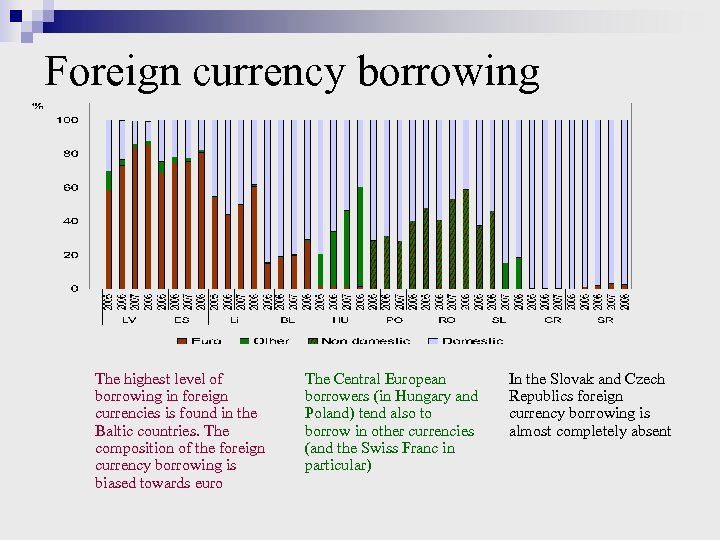
Foreign currency borrowing The highest level of borrowing in foreign currencies is found in the Baltic countries. The composition of the foreign currency borrowing is biased towards euro The Central European borrowers (in Hungary and Poland) tend also to borrow in other currencies (and the Swiss Franc in particular) In the Slovak and Czech Republics foreign currency borrowing is almost completely absent
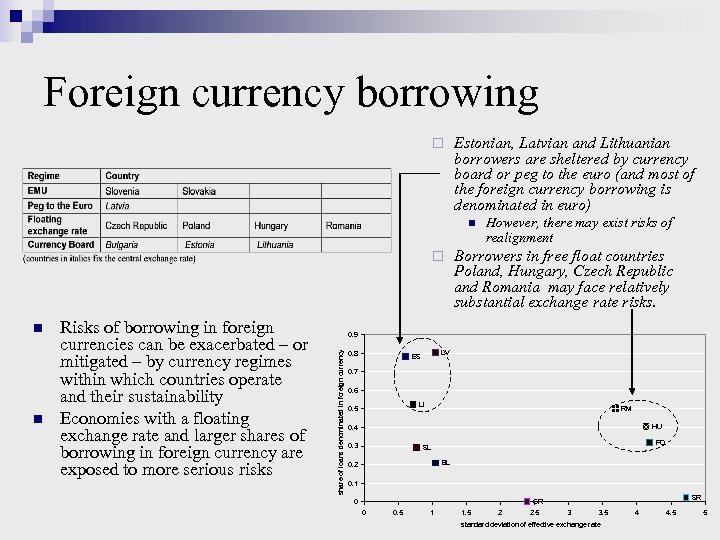
Foreign currency borrowing ¨ Estonian, Latvian and Lithuanian borrowers are sheltered by currency board or peg to the euro (and most of the foreign currency borrowing is denominated in euro) n ¨ n Risks of borrowing in foreign currencies can be exacerbated – or mitigated – by currency regimes within which countries operate and their sustainability Economies with a floating exchange rate and larger shares of borrowing in foreign currency are exposed to more serious risks Borrowers in free float countries Poland, Hungary, Czech Republic and Romania may face relatively substantial exchange rate risks. 0. 9 share of loans denominated in foreign currency n However, there may exist risks of realignment 0. 8 LV ES 0. 7 0. 6 LI 0. 5 RM HU 0. 4 0. 3 PO SL BL 0. 2 0. 1 SR CR 0 0 0. 5 1 1. 5 2 2. 5 3 3. 5 standard deviation of effective exchange rate 4 4. 5 5

Conclusions
Conclusions n We have shown that debt-income ratios in new member states of Central and Eastern Europe have evolved broadly in line with fundamentals and can be regarded as sustainable in the long term Nevertheless, there are potential risks from overindebtedness in some of these countries, notably Estonia, and possibly other Baltic economies, and Hungary (in the medium and short term) ¨ Even in other countries whose debt-income ratios appear sustainable, there remain risks related to high levels of foreign currency debt. The degree of risk links also to the exchange rate regime, and suggests particular risks for borrowers in floating-rate Hungary and possibly Romania. Devaluation of currencies pegged to the euro would put borrowers in these countries at serious risk ¨
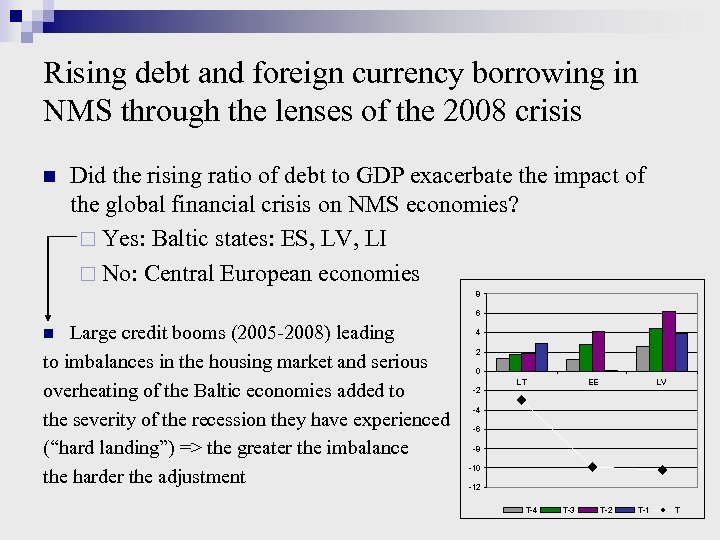
Rising debt and foreign currency borrowing in NMS through the lenses of the 2008 crisis n Did the rising ratio of debt to GDP exacerbate the impact of the global financial crisis on NMS economies? ¨ Yes: Baltic states: ES, LV, LI ¨ No: Central European economies 8 6 Large credit booms (2005 -2008) leading to imbalances in the housing market and serious overheating of the Baltic economies added to the severity of the recession they have experienced (“hard landing”) => the greater the imbalance the harder the adjustment n 4 2 0 -2 LT EE LV -4 -6 -8 -10 -12 T-4 T-3 T-2 T-1 T
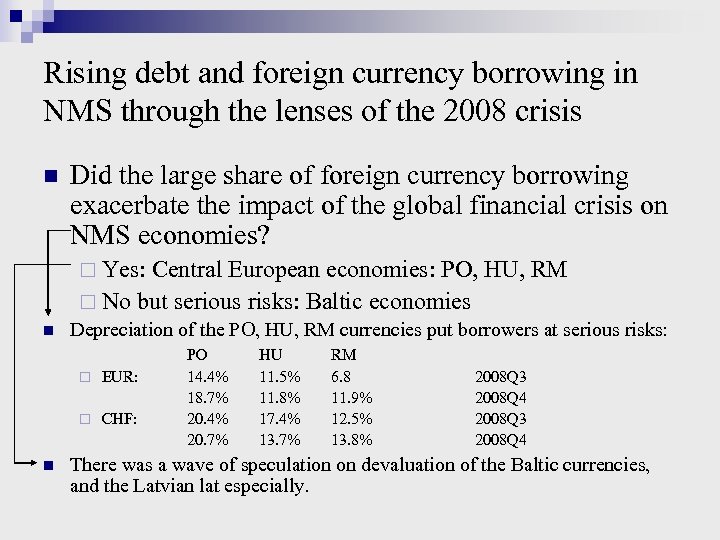
Rising debt and foreign currency borrowing in NMS through the lenses of the 2008 crisis n Did the large share of foreign currency borrowing exacerbate the impact of the global financial crisis on NMS economies? ¨ Yes: Central European economies: PO, HU, RM ¨ No but serious risks: Baltic economies n Depreciation of the PO, HU, RM currencies put borrowers at serious risks: ¨ ¨ n EUR: CHF: PO 14. 4% 18. 7% 20. 4% 20. 7% HU 11. 5% 11. 8% 17. 4% 13. 7% RM 6. 8 11. 9% 12. 5% 13. 8% 2008 Q 3 2008 Q 4 There was a wave of speculation on devaluation of the Baltic currencies, and the Latvian lat especially.
Скачать презентацию Household debt and foreign currency borrowing in new
98f27a3df2bad8a767ba728c24d6eb89.ppt