


 Скачать презентацию House of Asterion Allusions And the queen gave
5621695b91fe60ce78baa6232420ab33.ppt
- Количество слайдов: 15
 “House of Asterion” Allusions And the queen gave birth to a child who was called Asterion. Apollodorus: Bibliotheca, III, 1
 From “The Minotaur House” by Ana María Barrenechea, Buenos Aries University …It is also noteworthy that in Borges, fragments of phrases or verses are often repeated, and identical or similar themes and others arise transformed into different genres (essays, stories, poems, prologues) or by other argumentative or inventive purposes. So it has occurred to me that it would be of interest to offer this time a new way of practicing genetic criticism, a sui generis [L. “unique] way of understanding it. This would be to choose a few texts of his that dialogue with each other, as if they were mirrors faced by a history that in the case that I will relate is several times secular, bequeathed by the Mediterranean tradition: the history of the minotaur. Borges wrote about it first a short story (published in The Annals of Buenos Aires, May-June 1947, later included in El Aleph, 1947 and collected in OC I: 569). He camouflaged it in the title and in the epigraph, both under the name of "Asterión" only recognizable to some specialists in Greek literature and connoisseurs of Apolodoro, or for [those] interested in subjects of mythology.
 Tradition has represented the minotaur (for example in Greek terracotta vessels) drawn as a monstrous being, sometimes with the head of a bull and the body of a man, and in others vice versa. The myth narrates [the minotaur] as one of the fruits of the deceits of Zeus, who became a bull and emerged from the sea in Crete to fall in love with Pasifae, the wife of King Minos. From this union the monster was born, which brought about the construction of an equally strange building that Minos commissioned Daedalus to build (the "house" that would conceal dishonor, the labyrinthpalace inseparably attached to the founding myth). Borges has explained in the epilogue to El Aleph ( OC : 629): "To a Watts canvas, painted in 1896, I owe 'The House of Asterion’ and the character of the poor protagonist. " (He actually became acquainted with the reproduction of the canvas from the book of an author dear to him: GK Chesterton’s, GF Watts ). It can be affirmed that there is some truth to this because the picture presents a being with bull's head and body of man, standing on the parapet of a roof, and looking (melancholically) into the distance as he meditates on what he sees from there. And perhaps about the differences and similarities of the outside and inside: the universe and the house.
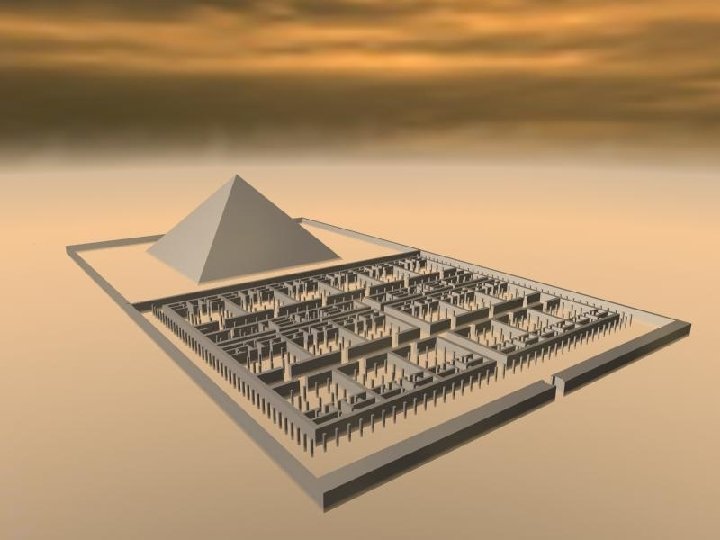
 From the middle of first paragraph of “The House of Asterion”: It is true that I never leave my house, but it is also true that its doors (whose numbers are infinite) are open day and night to men and to animals as well. Anyone may enter. He will find here no female pomp nor gallant court formality, but he will find quiet and solitude. And he will also find a house like no other on the face of this earth. (There are those who declare there is a similar one in Egypt, but they lie. ) The original says fourteen, but there is ample reason to infer that, as used by Asterion, the numeral stands for infinite. [Note that this footnote is part of Borges’ story. ]
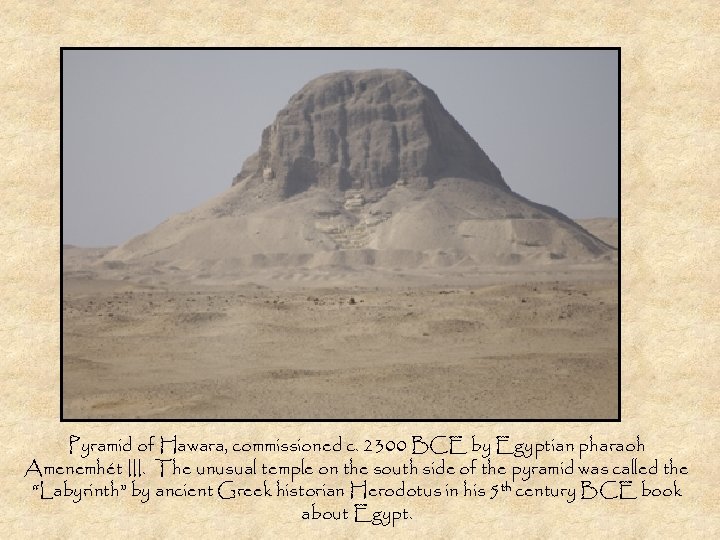 Pyramid of Hawara, commissioned c. 2300 BCE by Egyptian pharaoh Amenemhét III. The unusual temple on the south side of the pyramid was called the “Labyrinth” by ancient Greek historian Herodotus in his 5 th century BCE book about Egypt.
 From the end of first paragraph of “The House of Asterion”: Not for nothing was my mother a queen; I cannot be confused with the populace, though my modesty might so desire.
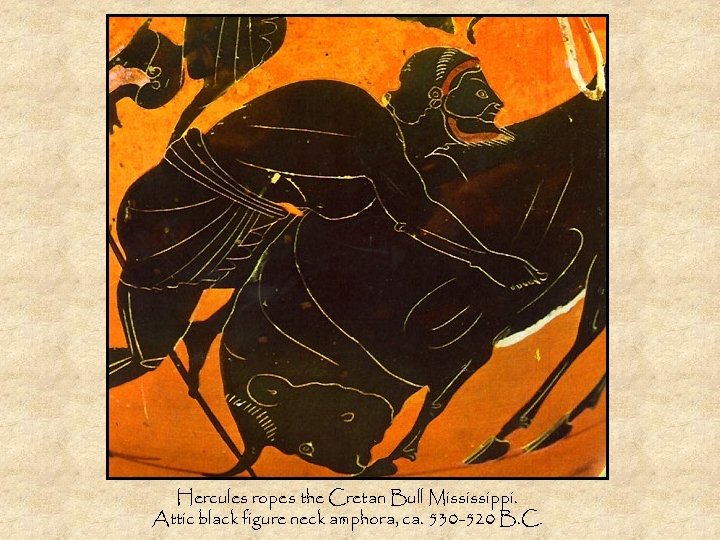 Hercules ropes the Cretan Bull Mississippi. Attic black figure neck amphora, ca. 530 -520 B. C.
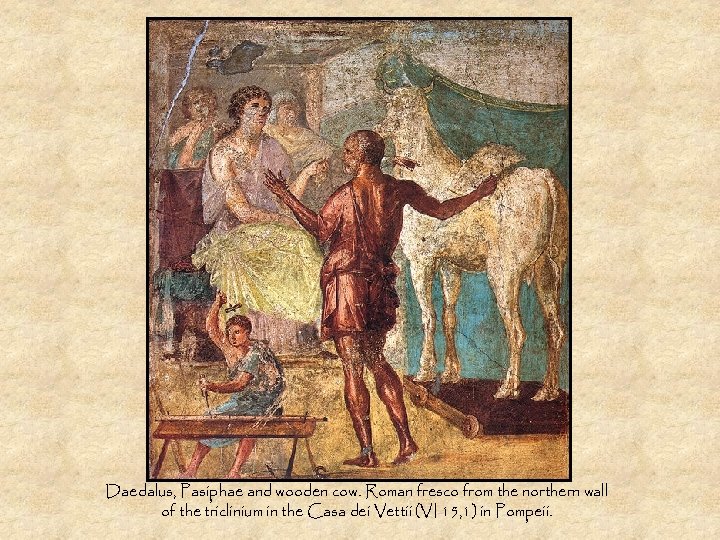 Daedalus, Pasiphae and wooden cow. Roman fresco from the northern wall of the triclinium in the Casa dei Vettii (VI 15, 1) in Pompeii.
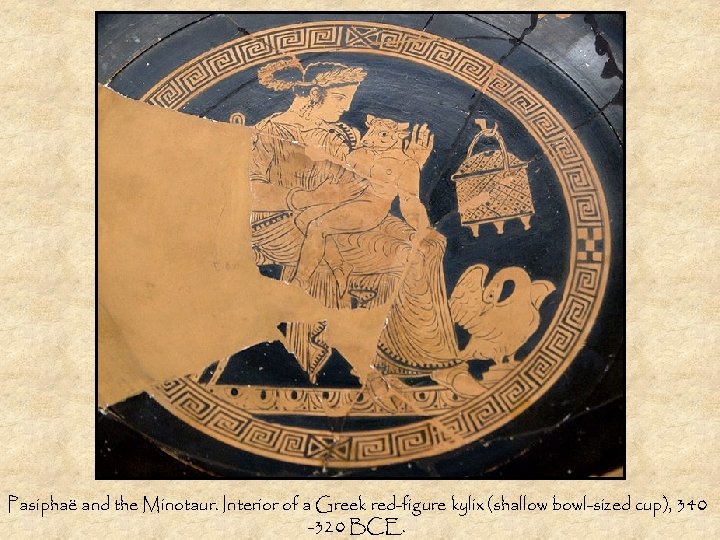 Pasiphaë and the Minotaur. Interior of a Greek red-figure kylix (shallow bowl-sized cup), 340 -320 BCE.
 The “aha” moment from the final paragraphs and dedication of “The House of Asterion”: What will my redeemer be like? I ask myself. Will he be a bull or a man? Will he perhaps be a bull with the face of a man? Or will he be like me? The morning sun reverberated from the bronze sword. There was no longer even a vestige of blood. "Would you believe it, Ariadne? " said Theseus. "The Minotaur scarcely defended himself. ” For Marta Mosquera Eastman
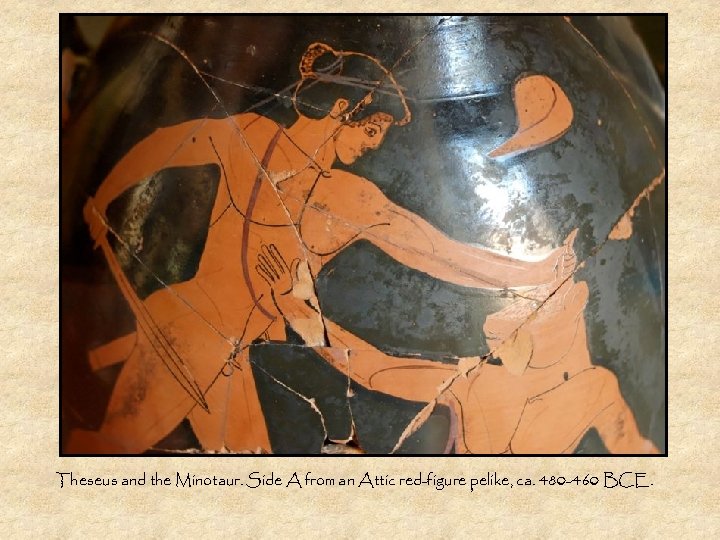 Theseus and the Minotaur. Side A from an Attic red-figure pelike, ca. 480 -460 BCE.
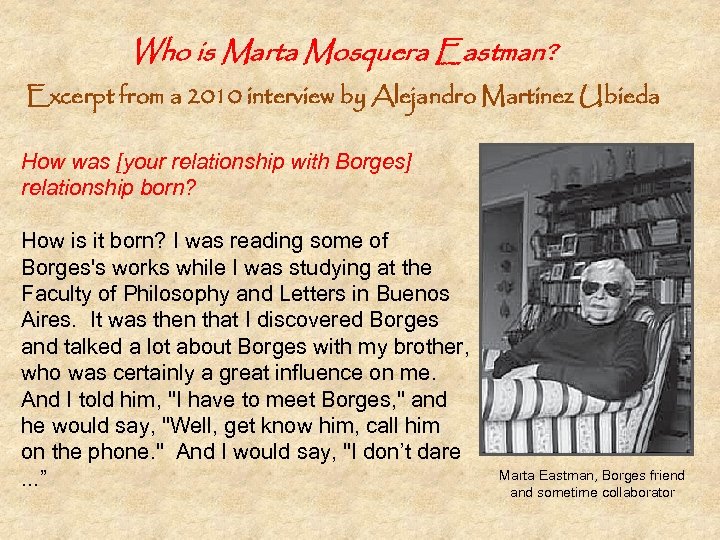 Who is Marta Mosquera Eastman? Excerpt from a 2010 interview by Alejandro Martinez Ubieda How was [your relationship with Borges] relationship born? How is it born? I was reading some of Borges's works while I was studying at the Faculty of Philosophy and Letters in Buenos Aires. It was then that I discovered Borges and talked a lot about Borges with my brother, who was certainly a great influence on me. And I told him, "I have to meet Borges, " and he would say, "Well, get know him, call him on the phone. " And I would say, "I don’t dare. . . ” Marta Eastman, Borges friend and sometime collaborator
 In what year? I think like in ‘ 45, ‘ 46. One day I was on the subway in Buenos Aires, and I saw a boy, ungainly, like a bug, who was reading the magazine Sur, reading a Borges work. And so I said to him, "Look, I don’t know you, but I want to meet Borges, the author you are reading. ” "Oh, very well, " he said, "because he is my sister's boyfriend. Give me your phone number, and I'll tell my sister to call you and to introduce you to him. “ So his sister called me. Her name was Estela Canto, and she told me “My brother Patricio told me that you want to meet Borges—or Georgie, because we call him Georgie. We go every day to Café Boston, on Florida Street. Why not come tomorrow or the day after?
 So I ran over there, and there was Borges sitting there. He wasn’t blind yet. We began to talk and he became a friend of mine. There he told me, "I'm going to call you tomorrow. ” I was so excited. He wasn’t like I expected—So he called me and we started going out almost every week. We went out two or three times to walk around the city. And on Sundays, he went with Estela to have lunch at her house. We had a precious friendship, very beautiful, and he was a very extraordinary being, very modest. And very dark too, because suddenly he would make very sinister jokes. He was like a humorist. He dedicated one of the tales in El Aleph to you. Yes, he dedicated to me "The House of Asterion, ” a beautiful story, and it occurred to me that it looked a bit like my house. Not exactly, but it was similar. Borges was a very extraordinary being. At that time he would be about 55 years old, and he began to go blind.