


 Скачать презентацию House Leadership Leadership in Congress is organized along
68970217208208cca3b8f42791617dd8.ppt
- Количество слайдов: 8
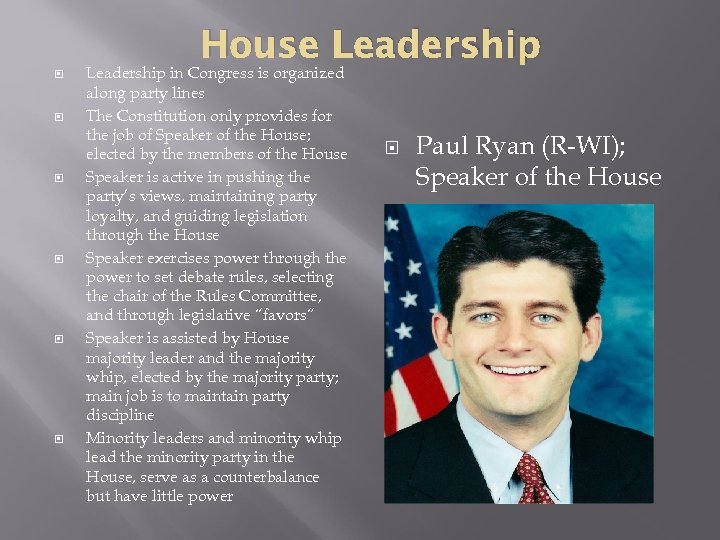 House Leadership Leadership in Congress is organized along party lines The Constitution only provides for the job of Speaker of the House; elected by the members of the House Speaker is active in pushing the party’s views, maintaining party loyalty, and guiding legislation through the House Speaker exercises power through the power to set debate rules, selecting the chair of the Rules Committee, and through legislative “favors” Speaker is assisted by House majority leader and the majority whip, elected by the majority party; main job is to maintain party discipline Minority leaders and minority whip lead the minority party in the House, serve as a counterbalance but have little power Paul Ryan (R-WI); Speaker of the House
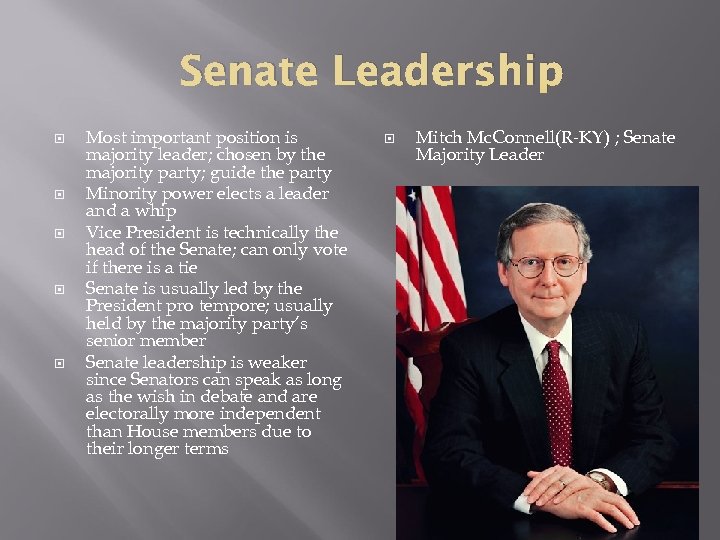 Senate Leadership Most important position is majority leader; chosen by the majority party; guide the party Minority power elects a leader and a whip Vice President is technically the head of the Senate; can only vote if there is a tie Senate is usually led by the President pro tempore; usually held by the majority party’s senior member Senate leadership is weaker since Senators can speak as long as the wish in debate and are electorally more independent than House members due to their longer terms Mitch Mc. Connell(R-KY) ; Senate Majority Leader
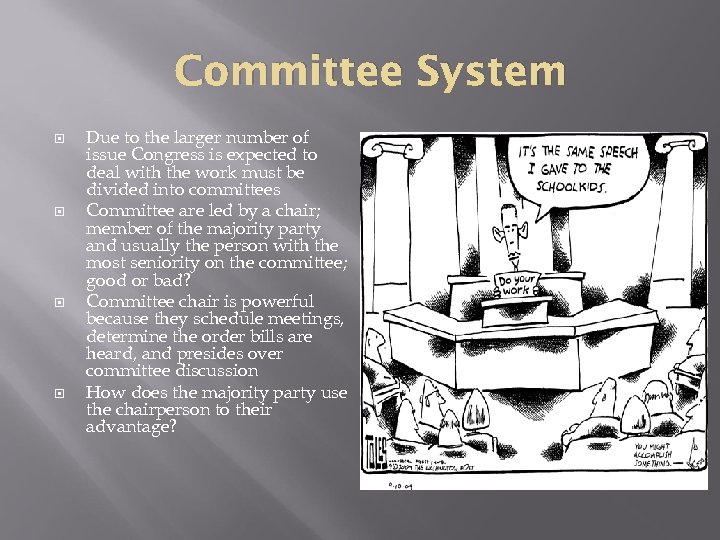 Committee System Due to the larger number of issue Congress is expected to deal with the work must be divided into committees Committee are led by a chair; member of the majority party and usually the person with the most seniority on the committee; good or bad? Committee chair is powerful because they schedule meetings, determine the order bills are heard, and presides over committee discussion How does the majority party use the chairperson to their advantage?
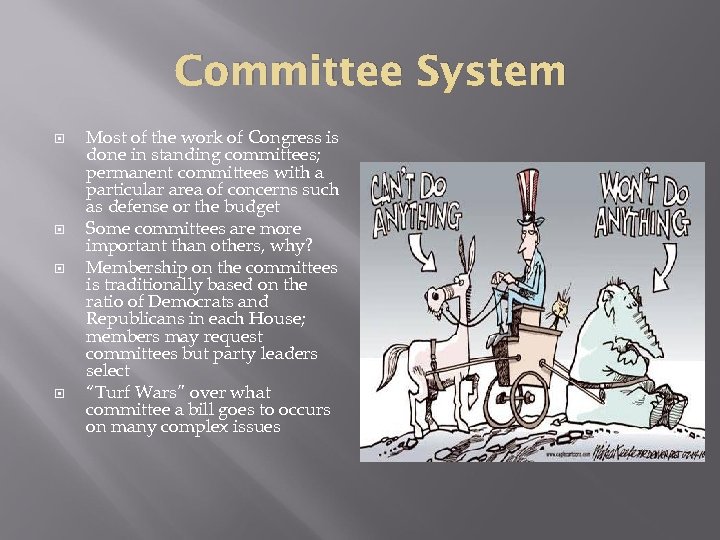 Committee System Most of the work of Congress is done in standing committees; permanent committees with a particular area of concerns such as defense or the budget Some committees are more important than others, why? Membership on the committees is traditionally based on the ratio of Democrats and Republicans in each House; members may request committees but party leaders select “Turf Wars” over what committee a bill goes to occurs on many complex issues
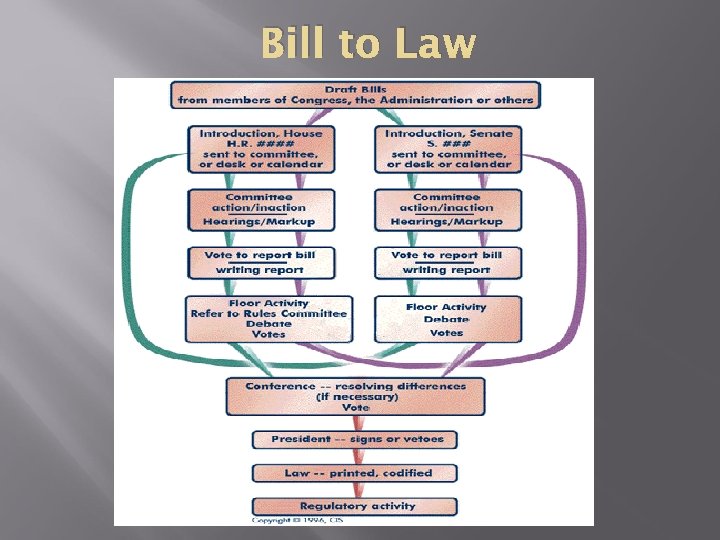 Bill to Law
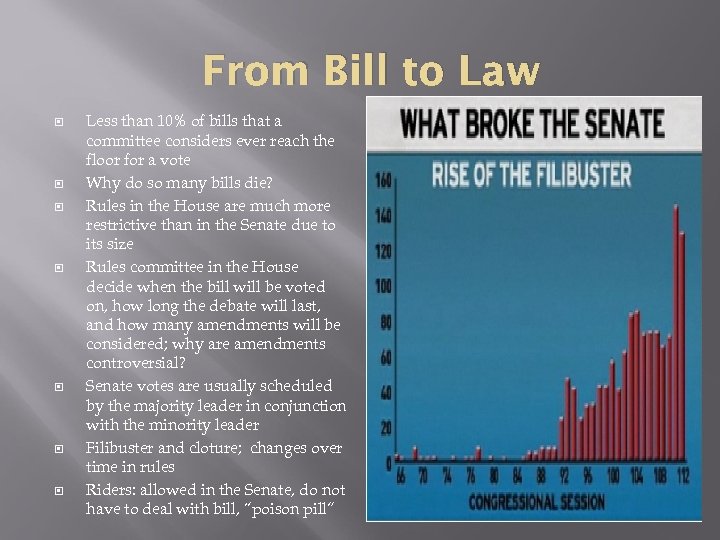 From Bill to Law Less than 10% of bills that a committee considers ever reach the floor for a vote Why do so many bills die? Rules in the House are much more restrictive than in the Senate due to its size Rules committee in the House decide when the bill will be voted on, how long the debate will last, and how many amendments will be considered; why are amendments controversial? Senate votes are usually scheduled by the majority leader in conjunction with the minority leader Filibuster and cloture; changes over time in rules Riders: allowed in the Senate, do not have to deal with bill, “poison pill”
 Roles of Congress Policymaking role: Constitution grants Congress to make laws for the national government Agreement on large issues is often difficult, why? How has fragmentation in Congress amplified Presidential power? Representation function: local need vs. national need; “all politics is local” Oversight function: supervises the President and other parts of the federal government to make sure they are working effectively and spending their money appropriately; why does Congress frequently fail in this area