 Скачать презентацию House Industrial Base Provisions An Industry Perspective July
bac925411fbde2d21c268e3df8009a4c.ppt
- Количество слайдов: 6



House Industrial Base Provisions An Industry Perspective July 1, 2003
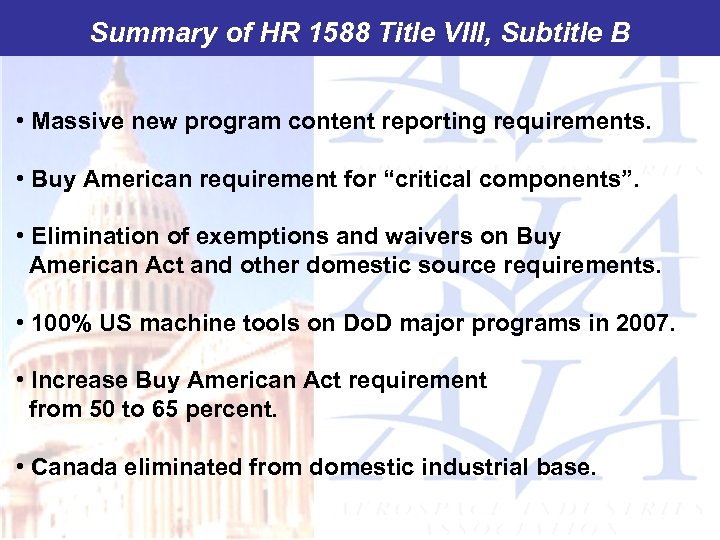
Summary of HR 1588 Title VIII, Subtitle B • Massive new program content reporting requirements. • Buy American requirement for “critical components”. • Elimination of exemptions and waivers on Buy American Act and other domestic source requirements. • 100% US machine tools on Do. D major programs in 2007. • Increase Buy American Act requirement from 50 to 65 percent. • Canada eliminated from domestic industrial base.
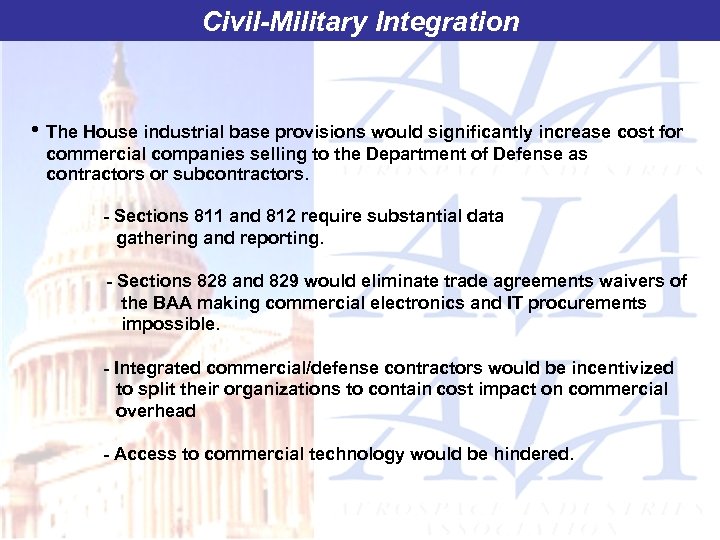
Civil-Military Integration • The House industrial base provisions would significantly increase cost for commercial companies selling to the Department of Defense as contractors or subcontractors. - Sections 811 and 812 require substantial data gathering and reporting. - Sections 828 and 829 would eliminate trade agreements waivers of the BAA making commercial electronics and IT procurements impossible. - Integrated commercial/defense contractors would be incentivized to split their organizations to contain cost impact on commercial overhead - Access to commercial technology would be hindered.
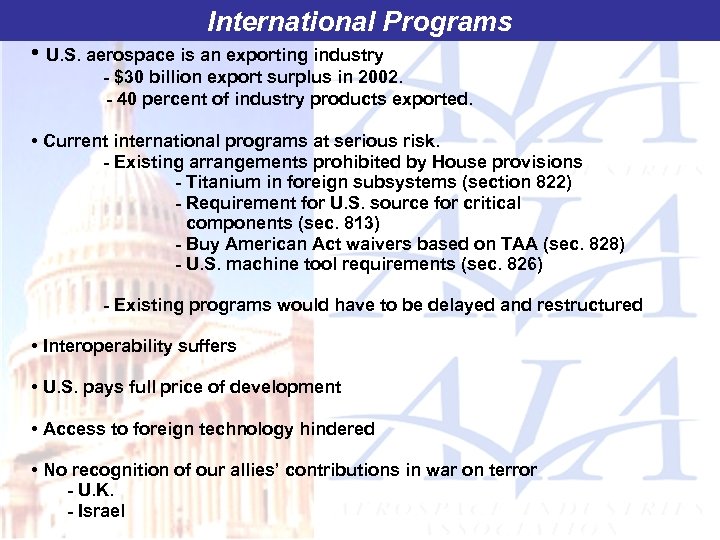
International Programs • U. S. aerospace is an exporting industry - $30 billion export surplus in 2002. - 40 percent of industry products exported. • Current international programs at serious risk. - Existing arrangements prohibited by House provisions - Titanium in foreign subsystems (section 822) - Requirement for U. S. source for critical components (sec. 813) - Buy American Act waivers based on TAA (sec. 828) - U. S. machine tool requirements (sec. 826) - Existing programs would have to be delayed and restructured • Interoperability suffers • U. S. pays full price of development • Access to foreign technology hindered • No recognition of our allies’ contributions in war on terror - U. K. - Israel
Program Costs • Higher overhead - Commercial/defense split in contractor organizations. - New reporting and compliance systems will be needed. • Less cost sharing - Less international partner sharing of development and procurement - Fewer commercial Do. D contractors • Higher unit costs. - Less foreign sales. - Less competition in the supplier base. - Prices set less by commercial market forces - Return to milspecs and regulated cost procedures - Costs associated with redesigning and restructuring existing programs to meet new domestic source requirement for critical components • Massive recapitalization costs required by machine tool provision. • Higher O&S costs as legacy systems remain in service longer.
Long Term Impacts • U. S. Foreign Policy encumbered • Significant delays and cost increases on existing programs • Transformation at risk • Fewer systems, less technology in the hands of our Warfighters • Long-term financial viability of a private sector defense industrial base at risk
Скачать презентацию House Industrial Base Provisions An Industry Perspective July
bac925411fbde2d21c268e3df8009a4c.ppt