


 Скачать презентацию House Human Services Committee 80 th Legislature Testimony
2b4ac165e453e97a377e776badd39742.ppt
- Количество слайдов: 39
 House Human Services Committee 80 th Legislature Testimony on the Integrated Eligibility System February 23, 2007 Celia Hagert, Senior Policy Analyst hagert@cppp. org (512) 320 -0222 x 100 Center for Public Policy Priorities www. cppp. org
 Overview • • • Historical challenges in the eligibility system The original Integrated Eligibility (IE) model Problems in the IE pilot The revised IE model Ongoing challenges – the symptoms of a troubled system • Recommendations to support a smooth transition to the new system Center for Public Policy Priorities www. cppp. org
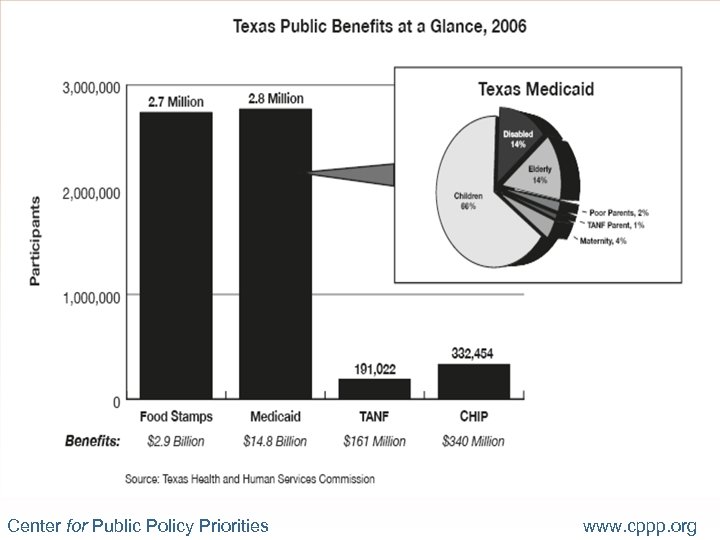 Center for Public Policy Priorities www. cppp. org
 Historical challenges • Clients are not easy to serve – majority are poor; many are elderly, have disabilities, or grapple with language barriers • Application requirements are complex • Eligibility determination is complicated & requires extensive and constant training of caseworkers • Rules vary considerably by program and within programs • Labor-intensive process is costly for states & complicated for clients Center for Public Policy Priorities www. cppp. org
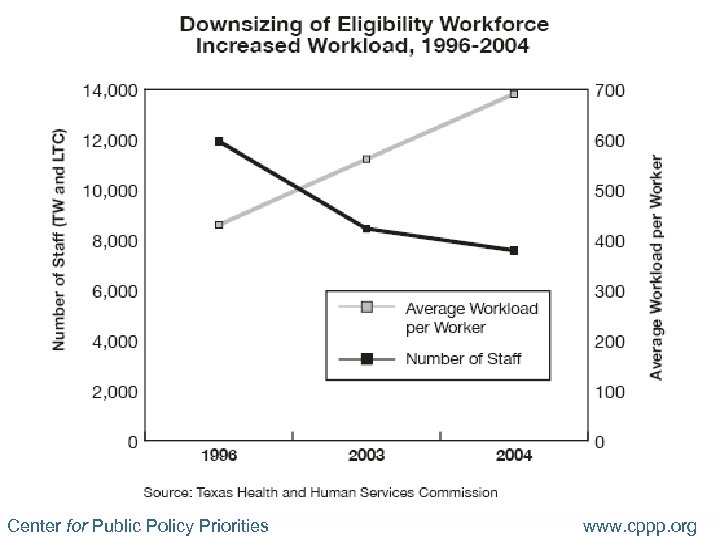
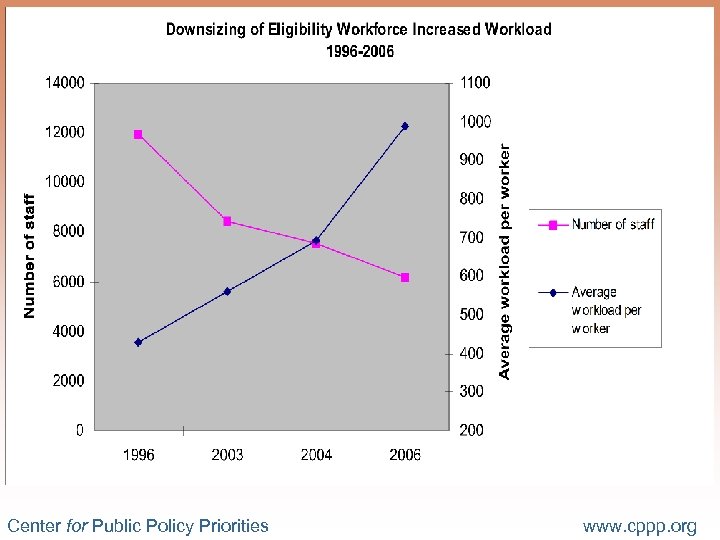
 Historical challenges • Legislature has not provided necessary staff or funding to ensure effective administration – Cut staff by 40% from 96 -04 despite increasing caseloads and workload (applications grew, work became more complex) • Out-of-date technology has lead to duplication of effort and “red tape” • Chronic underfunding exacerbates other challenges Center for Public Policy Priorities www. cppp. org
 Center for Public Policy Priorities www. cppp. org
 Historical challenges • Services to clients have suffered – Less than half of eligible households get Food Stamps – Half of uninsured kids are eligible for Medicaid/CHIP, but not enrolled – Clients frustrated, deterred • Heavy staff workload has lead to high turnover, poor customer service Center for Public Policy Priorities www. cppp. org
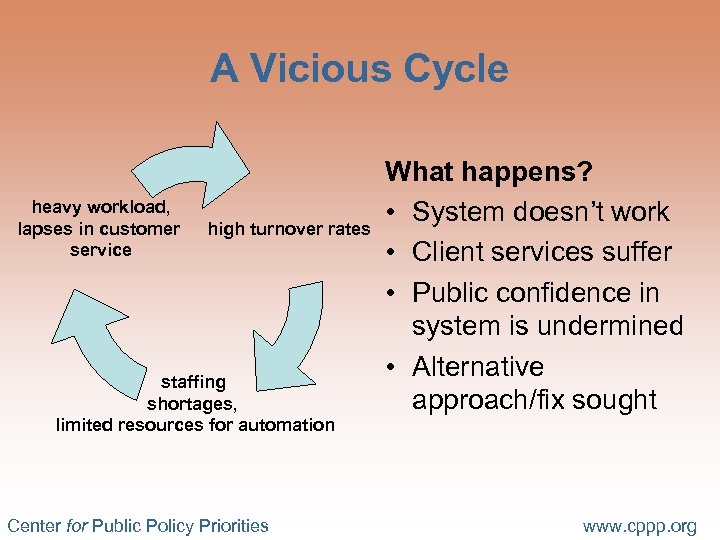 A Vicious Cycle heavy workload, lapses in customer service high turnover rates staffing shortages, limited resources for automation Center for Public Policy Priorities What happens? • System doesn’t work • Client services suffer • Public confidence in system is undermined • Alternative approach/fix sought www. cppp. org
 What is Integrated Eligibility? • Modernization of eligibility determination & enrollment: – – Better technology & greater automation Centralized & paperless computer system (TIERS) Remote application options (call centers, Internet) More partnerships with nonprofits • Privatization – “TAA” contract includes development, administration, and partial staffing of system Center for Public Policy Priorities www. cppp. org
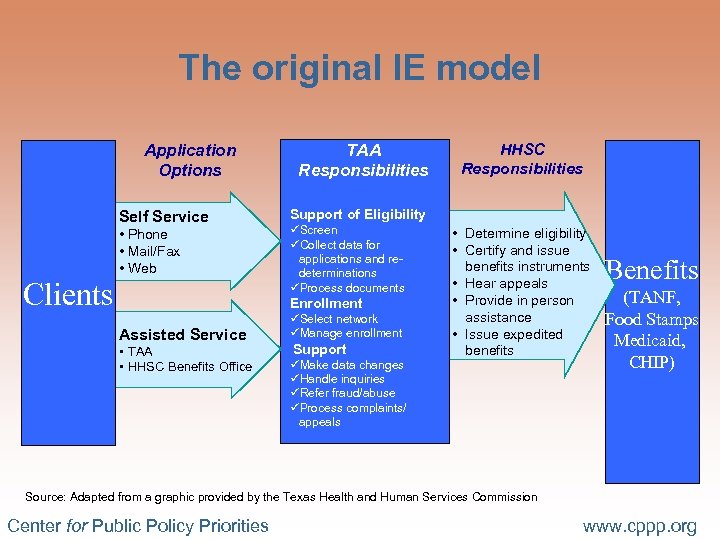 The original IE model Application Options Self Service • Phone • Mail/Fax • Web Clients TAA Responsibilities Support of Eligibility üScreen üCollect data for applications and redeterminations üProcess documents Enrollment Assisted Service • TAA • HHSC Benefits Office HHSC Responsibilities üSelect network üManage enrollment Support üMake data changes üHandle inquiries üRefer fraud/abuse üProcess complaints/ appeals • Determine eligibility • Certify and issue benefits instruments • Hear appeals • Provide in person assistance • Issue expedited benefits Benefits (TANF, Food Stamps Medicaid, CHIP) Source: Adapted from a graphic provided by the Texas Health and Human Services Commission Center for Public Policy Priorities www. cppp. org
 Assumptions in the IE Model • Better technology, smarter processes would reduce application processing time & staff workload • Technology would improve accuracy, reduce fraud & ensure better stewardship of tax dollars • Simpler process, more application options would improve access for clients • Private sector could do it better, cheaper • CBOs would support the new model by helping clients navigate the more automated system Center for Public Policy Priorities www. cppp. org
 Assumptions in the IE Model • Overall staff could be reduced • Many policy-knowledgeable state staff could be replaced with lower-skilled vendor staff • Fewer local offices would be needed • State would save $646 million over 5 years Center for Public Policy Priorities www. cppp. org
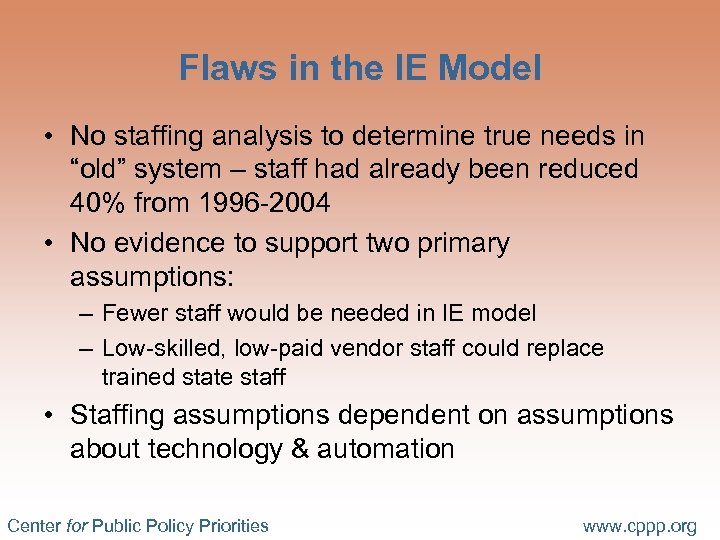 Flaws in the IE Model • No staffing analysis to determine true needs in “old” system – staff had already been reduced 40% from 1996 -2004 • No evidence to support two primary assumptions: – Fewer staff would be needed in IE model – Low-skilled, low-paid vendor staff could replace trained state staff • Staffing assumptions dependent on assumptions about technology & automation Center for Public Policy Priorities www. cppp. org
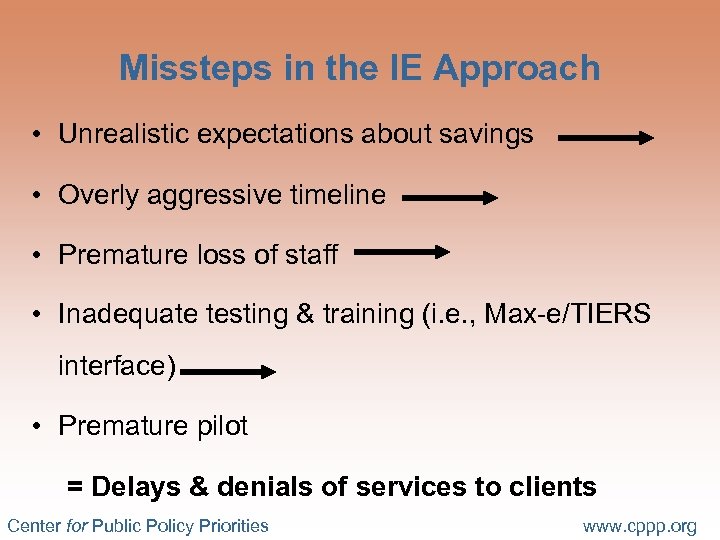 Missteps in the IE Approach • Unrealistic expectations about savings • Overly aggressive timeline • Premature loss of staff • Inadequate testing & training (i. e. , Max-e/TIERS interface) • Premature pilot = Delays & denials of services to clients Center for Public Policy Priorities www. cppp. org
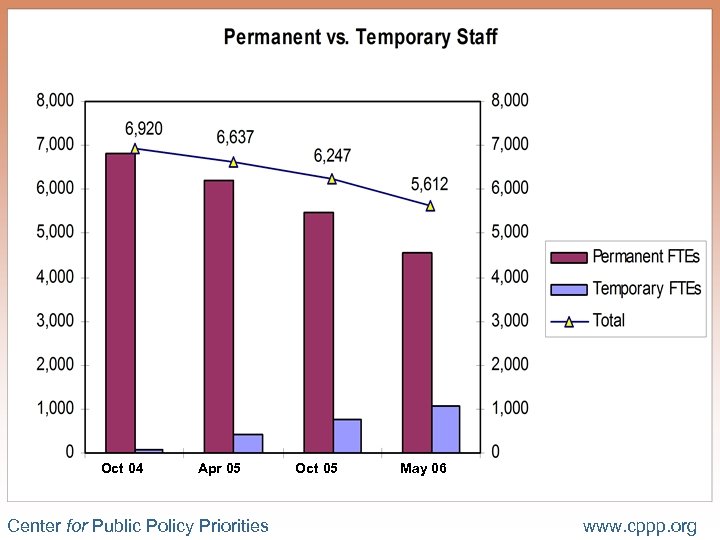 Oct 04 Apr 05 Oct 05 May 06 Center for Public Policy Priorities www. cppp. org
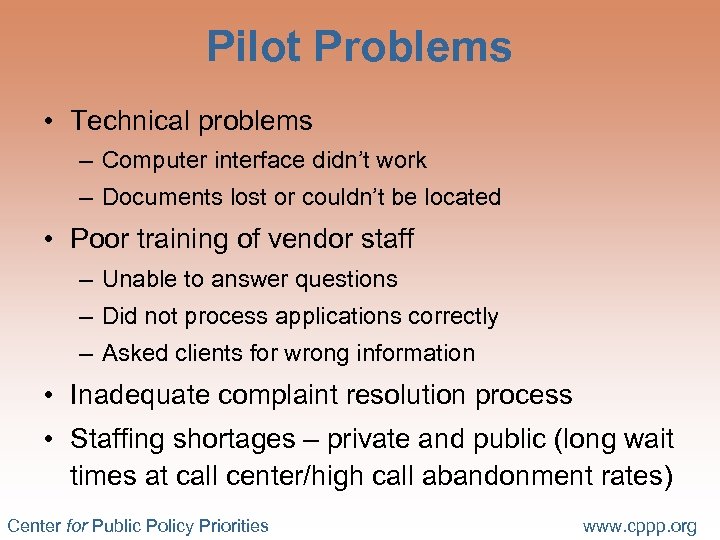 Pilot Problems • Technical problems – Computer interface didn’t work – Documents lost or couldn’t be located • Poor training of vendor staff – Unable to answer questions – Did not process applications correctly – Asked clients for wrong information • Inadequate complaint resolution process • Staffing shortages – private and public (long wait times at call center/high call abandonment rates) Center for Public Policy Priorities www. cppp. org
 Pilot Outcomes • Large backlogs in application processing lead to delays in services to thousands of families • More than 100, 000 kids lost health coverage in first four months of the pilot • Surge in missing information requests & “procedural denials” for failure to complete application process • Rise in Food Stamp error rates Center for Public Policy Priorities www. cppp. org
 Federal oversight • USDA is monitoring system’s performance • Conditioned funding & contract approval on new system’s ability to maintain program access and program integrity • Hired Booz Allen as technical consultant to monitor system readiness from a technology perspective & evaluate potential risks • Conducted two reviews of pilot in 3/06 and 9/06 Center for Public Policy Priorities www. cppp. org
 Federal oversight • USDA’s main concerns & findings • • Lack of timeliness Rise in error rates Higher denial rates Data collection problems – HHSC has not provided the data requested & needed to evaluate performance • Problems with TIERS, in particularly its ability to track overpayments (also noted by HHSC OIG) • Funding for further rollout remains conditional Center for Public Policy Priorities www. cppp. org
 Revised IE approach • Contract size & term reduced • Maintain current state staffing levels, convert many temps to permanent staff • Reduce role of vendor staff, increase role of state staff • Focus on technology • Continue with TIERS rollout • Re-launch pilot “when ready” Center for Public Policy Priorities www. cppp. org
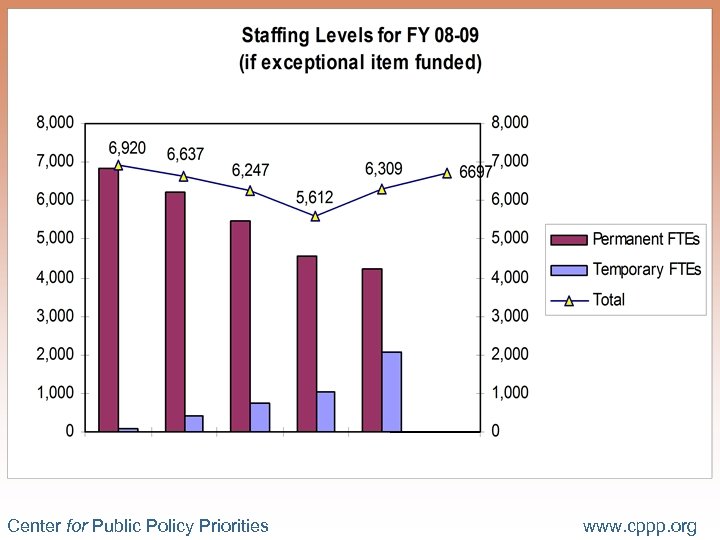 Oct 04 Apr 05 Oct 05 Center for Public Policy Priorities May 06 Oct 06 FY 08 -09 www. cppp. org
 Ongoing Challenges • Inadequate staff & heavy workload • Application delays persist - timeliness is below federal standards in most metro areas • Error rates are above national average, exposing state to potential financial penalties • These problems WON’T go away until new system rolls out AND delivers promised efficiencies Center for Public Policy Priorities www. cppp. org
 Center for Public Policy Priorities www. cppp. org
 Timeliness – Delays • Statewide, new application timeliness is well below federal standard (95% processed within 30 days for Food Stamps/45 for Medicaid) • Delays are severe in Region 3 (DFW), Region 5 (east Texas), Region 6 (Houston), Region 7 (pilot area) • Food Stamps/TANF – worst in Regions 3, 6 & 7 • Medicaid – worst in Region 3 & 7 Center for Public Policy Priorities www. cppp. org
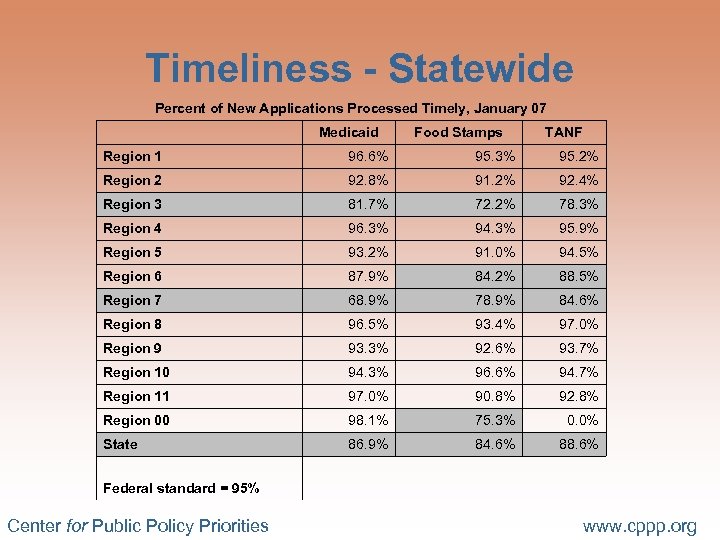 Timeliness - Statewide Percent of New Applications Processed Timely, January 07 Medicaid Food Stamps TANF Region 1 96. 6% 95. 3% 95. 2% Region 2 92. 8% 91. 2% 92. 4% Region 3 81. 7% 72. 2% 78. 3% Region 4 96. 3% 94. 3% 95. 9% Region 5 93. 2% 91. 0% 94. 5% Region 6 87. 9% 84. 2% 88. 5% Region 7 68. 9% 78. 9% 84. 6% Region 8 96. 5% 93. 4% 97. 0% Region 9 93. 3% 92. 6% 93. 7% Region 10 94. 3% 96. 6% 94. 7% Region 11 97. 0% 90. 8% 92. 8% Region 00 98. 1% 75. 3% 0. 0% State 86. 9% 84. 6% 88. 6% Federal standard = 95% Center for Public Policy Priorities www. cppp. org
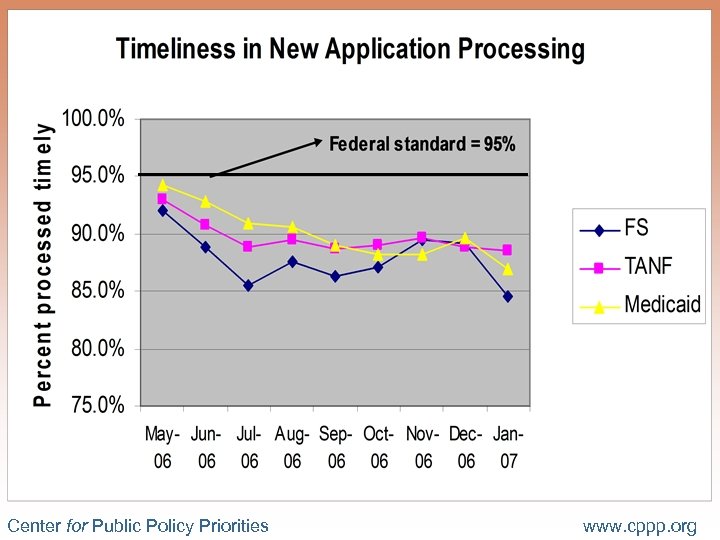 Timeliness – past 12 months Center for Public Policy Priorities www. cppp. org
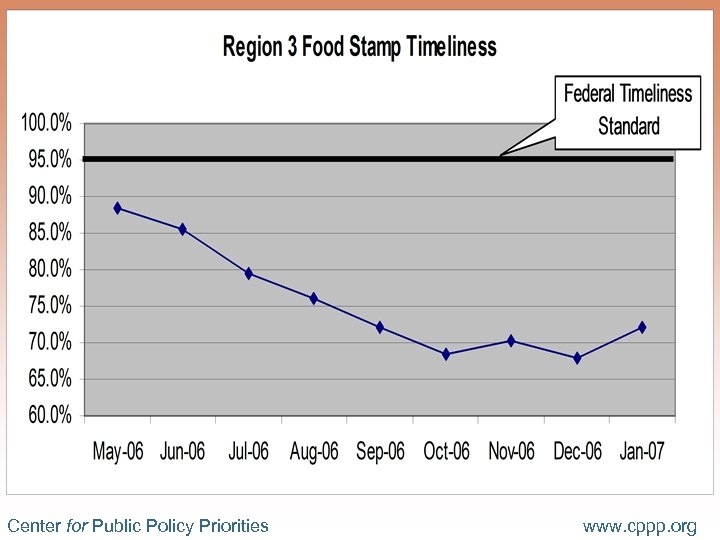 Timeliness – DFW (Region 3) Center for Public Policy Priorities www. cppp. org
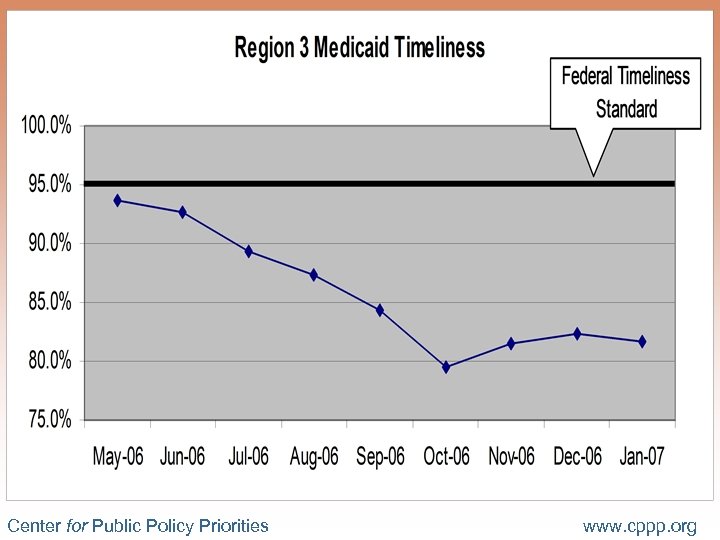 Timeliness – DFW (Region 3) Center for Public Policy Priorities www. cppp. org
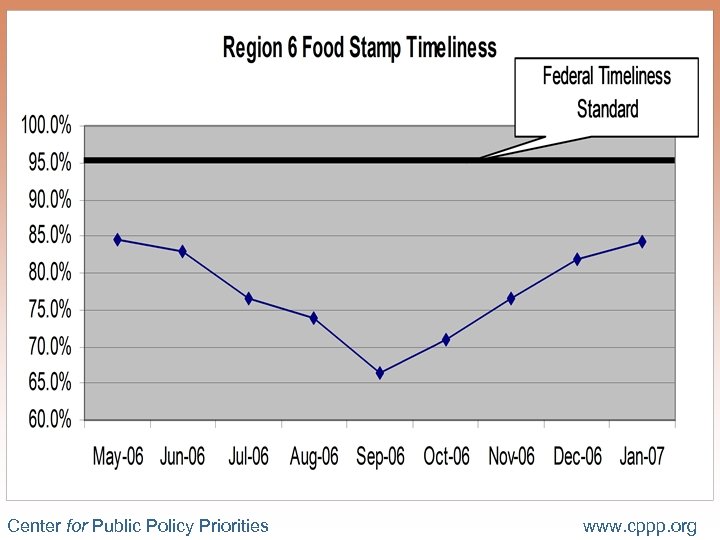 Timeliness – Houston (Region 6) Center for Public Policy Priorities www. cppp. org
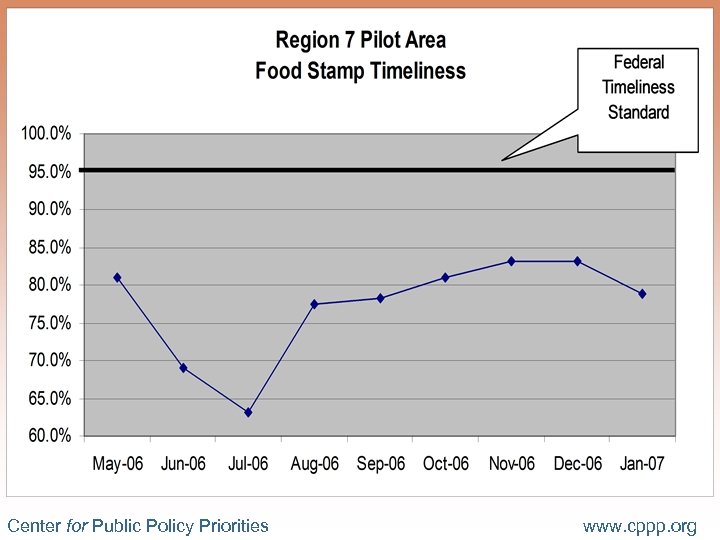 Timeliness – Pilot Area (Region 7) Center for Public Policy Priorities www. cppp. org
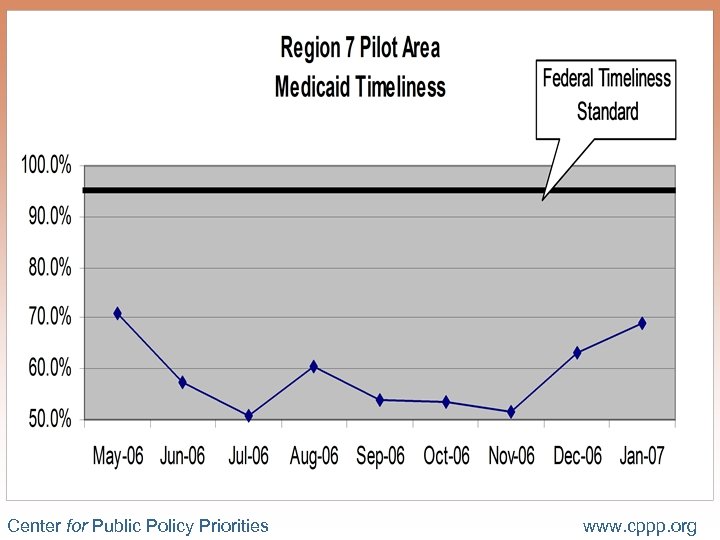 Timeliness – Pilot Area (Region 7) Center for Public Policy Priorities www. cppp. org
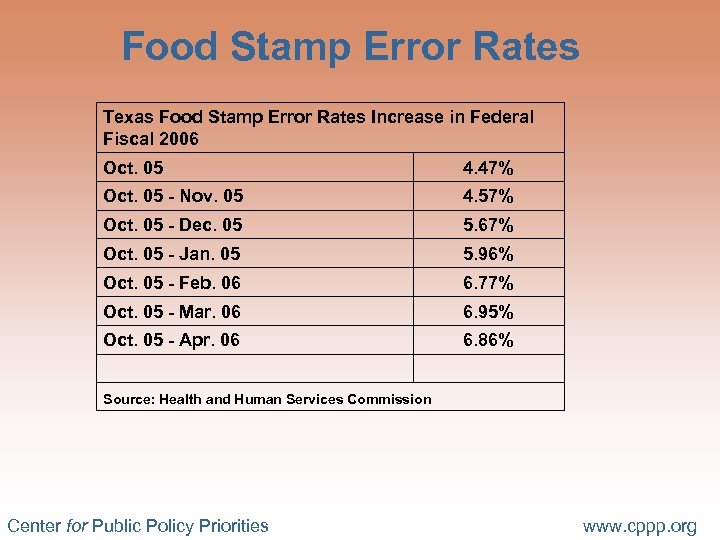 Food Stamp Error Rates Texas Food Stamp Error Rates Increase in Federal Fiscal 2006 Oct. 05 4. 47% Oct. 05 - Nov. 05 4. 57% Oct. 05 - Dec. 05 5. 67% Oct. 05 - Jan. 05 5. 96% Oct. 05 - Feb. 06 6. 77% Oct. 05 - Mar. 06 6. 95% Oct. 05 - Apr. 06 6. 86% Source: Health and Human Services Commission Center for Public Policy Priorities www. cppp. org
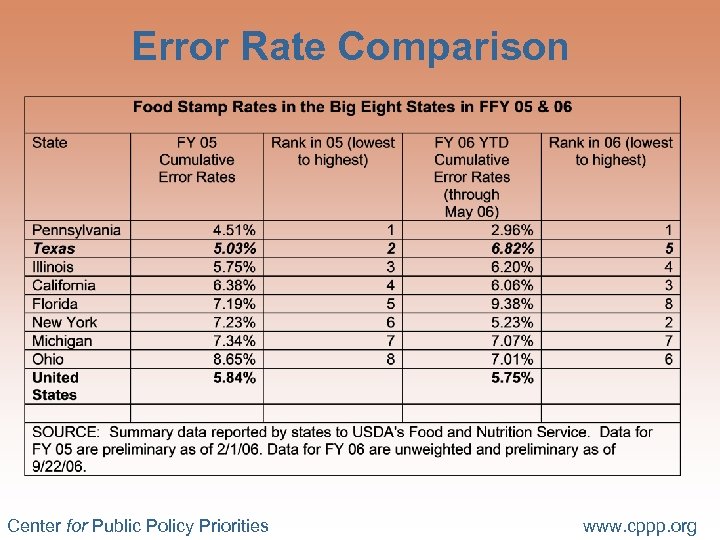 Error Rate Comparison Center for Public Policy Priorities www. cppp. org
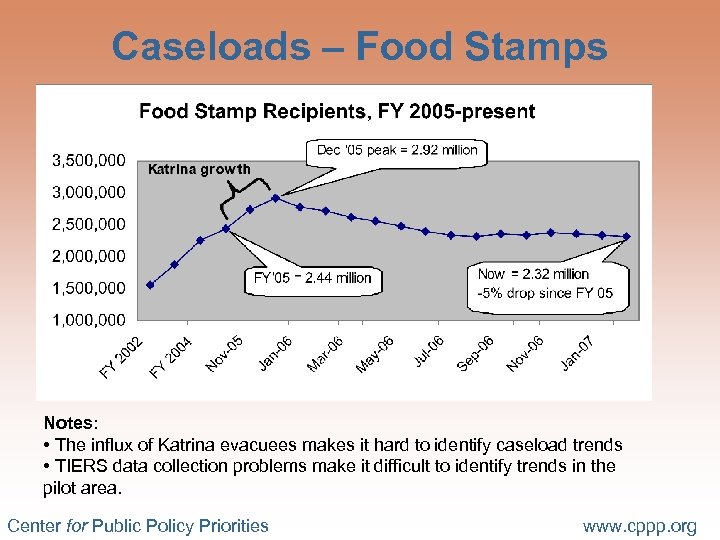 Caseloads – Food Stamps Notes: • The influx of Katrina evacuees makes it hard to identify caseload trends • TIERS data collection problems make it difficult to identify trends in the pilot area. Center for Public Policy Priorities www. cppp. org
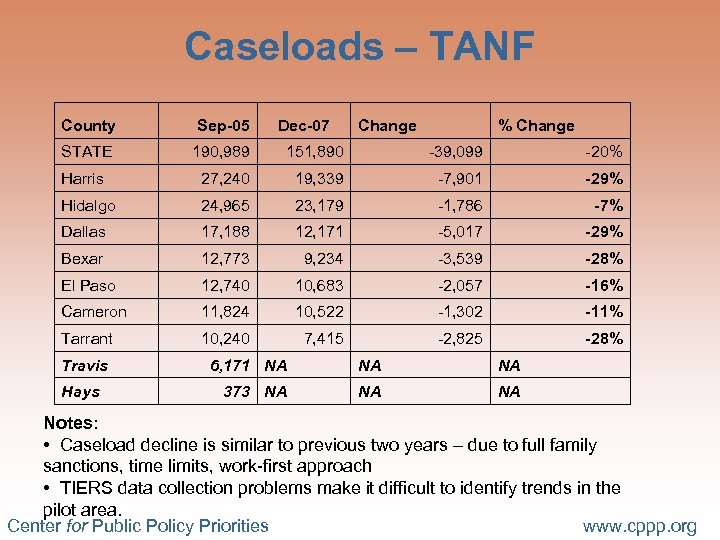 Caseloads – TANF County Sep-05 STATE 190, 989 151, 890 -39, 099 -20% Harris 27, 240 19, 339 -7, 901 -29% Hidalgo 24, 965 23, 179 -1, 786 -7% Dallas 17, 188 12, 171 -5, 017 -29% Bexar 12, 773 9, 234 -3, 539 -28% El Paso 12, 740 10, 683 -2, 057 -16% Cameron 11, 824 10, 522 -1, 302 -11% Tarrant 10, 240 7, 415 -2, 825 -28% Travis Hays Dec-07 Change % Change 6, 171 NA NA NA 373 NA NA NA Notes: • Caseload decline is similar to previous two years – due to full family sanctions, time limits, work-first approach • TIERS data collection problems make it difficult to identify trends in the pilot area. Center for Public Policy Priorities www. cppp. org
 Important questions • Technology – does it work? How much does automation reduce workload? • Are there enough state staff to support the transition? • How long will it take to roll out the new system? • How many staff will be needed in the new system? • Can vulnerable populations navigate more automated system? • Does the revised model (new business processes/workflow) work? • What is the right role for a private company? Center for Public Policy Priorities www. cppp. org
 Recommendation #1: Improve oversight Overarching goal: prevent similar problems from occurring through better oversight • Establish legislative oversight process • Establish statutory benchmarks and criteria to evaluate IE: – Timeliness at or above federal standards – Reduce procedural denials to FY 2005 levels – Rebuild child health enrollment, stabilize caseloads – Error rates at or below national average • Use these criteria to determine whether system is performing well, contractor is meeting performance measures, and IE is ready to expand Center for Public Policy Priorities www. cppp. org
 Recommendation #2: Protect the vulnerable • Evaluate impact of remote application process on vulnerable populations (i. e. , seniors, persons with disabilities, the homeless, people with language barriers) • Look at caseload & administrative data relevant to these populations • Survey CBOs that serve these populations • Conduct exit interviews with applicants • At the end of the day, the true test of a good system is its ability to serve the most vulnerable Center for Public Policy Priorities www. cppp. org
 Recommendation #3: Support contracting reforms • Improve contract writing, monitoring & enforcement by building agency capacity • Establish a means to monitor contractor performance • Strengthen conflict-of-interest provisions • Establish a sound process for making outsourcing decisions that protects clients and taxpayers Center for Public Policy Priorities www. cppp. org