


 Скачать презентацию HOUSE EAR INSTITUTE Manny Don Tôi sẽ
3000c319dbd1252430e7be53f26d500f.ppt
- Количество слайдов: 101
 HOUSE EAR INSTITUTE
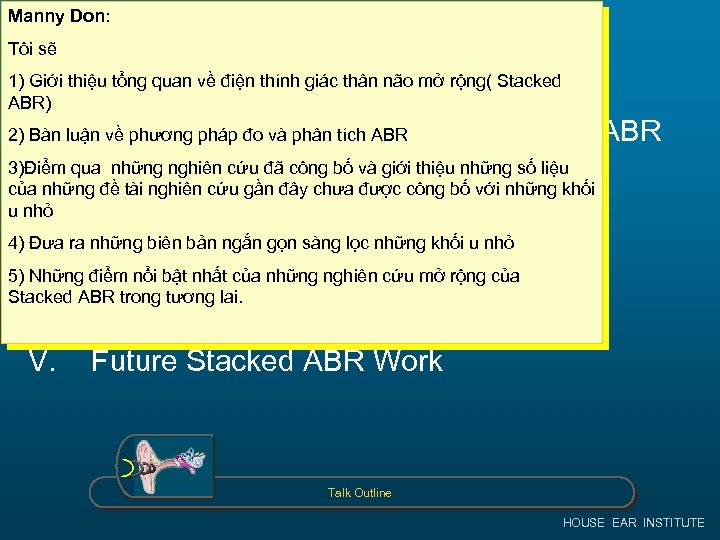 Manny Don: Tôi sẽ Talk Outline 1) Giới thiệu tổng quan về điện thính giác thân não mở rộng( Stacked ABR) I. Background: Evolution of the Stacked ABR 2) Bàn luận về phương pháp đo và phân tích ABR 3)Điểm qua những nghiên cứu đã công bố và giới thiệu những số liệu của những đề tài nghiên cứu gần đây chưa được công bố với những khối u nhỏ II. Stacked ABR: Rationale and Method III. Stacked ABR: Studies 4) Đưa ra những biên bản ngắn gọn sàng lọc những khối u nhỏ 5) Những điểm nổi bật nhất của những nghiên cứu mở rộng của Stacked ABR trong tương lai. IV. Tumor Screening Protocol V. Future Stacked ABR Work Talk Outline HOUSE EAR INSTITUTE
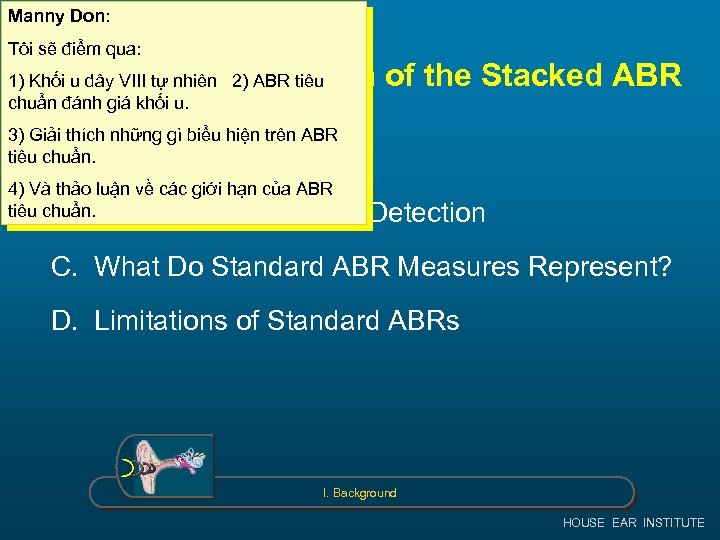 Manny Don: Tôi sẽ điểm qua: Background: Evolution of the Stacked ABR 1) Khối u dây VIII tự nhiên 2) ABR tiêu chuẩn đánh giá khối u. 3) Giải thích những gì biểu hiện trên ABR tiêu chuẩn. Eighth Nerve Tumors A. 4) Và thảo luận về các giới hạn của ABR tiêu chuẩn. B. Standard ABR Tumor Detection C. What Do Standard ABR Measures Represent? D. Limitations of Standard ABRs I. Background HOUSE EAR INSTITUTE
 Manny Don: First, a brief discussion of eighth nerve tumors Background: Evolution of the Stacked ABR A. Eighth Nerve Tumors B. Standard ABR Tumor Detection C. What Do Standard ABR Measures Represent? D. Limitations of Standard ABRs I. Background HOUSE EAR INSTITUTE
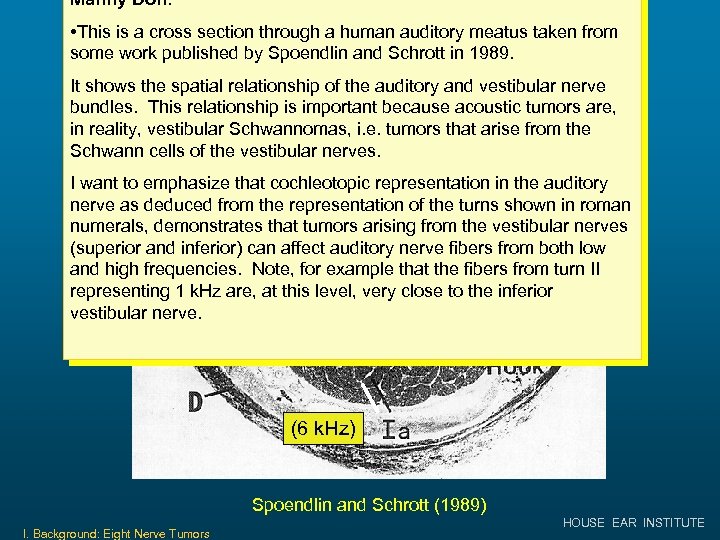 Manny Don: • This is a cross. Section: Humanauditory meatus Meatus Cross section through a human Auditory taken from some work published by Spoendlin and Schrott in 1989. It shows the spatial relationship of the auditory and vestibular nerve bundles. This relationship is important because acoustic tumors are, in reality, vestibular Schwannomas, i. e. tumors that arise from the Schwann cells of the vestibular nerves. I want to emphasize that cochleotopic representation in the auditory nerve as deduced from the representation of the turns shown in roman numerals, demonstrates that tumors arising from the vestibular nerves (superiork. Hz)inferior) can affect auditory nerve fibers from both low (2 and high frequencies. Note, for example that the fibers from turn II representing 1 k. Hz are, at this level, very close to the inferior vestibular nerve. (1 k. Hz) (6 k. Hz) Spoendlin and Schrott (1989) I. Background: Eight Nerve Tumors HOUSE EAR INSTITUTE
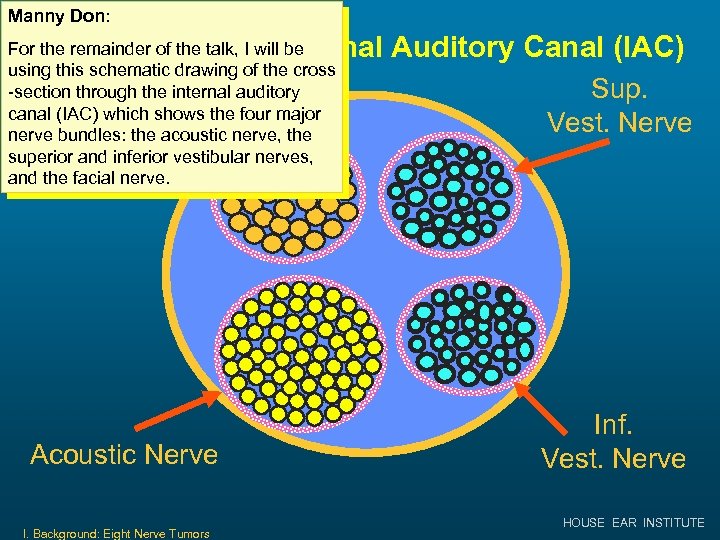 Manny Don: Cross-section of Internal Auditory Canal (IAC) For the remainder of the talk, I will be using this schematic drawing of the cross -section through the internal auditory canal (IAC) which shows the four major nerve bundles: the acoustic nerve, the Facial Nerve superior and inferior vestibular nerves, and the facial nerve. Acoustic Nerve I. Background: Eight Nerve Tumors Sup. Vest. Nerve Inf. Vest. Nerve HOUSE EAR INSTITUTE
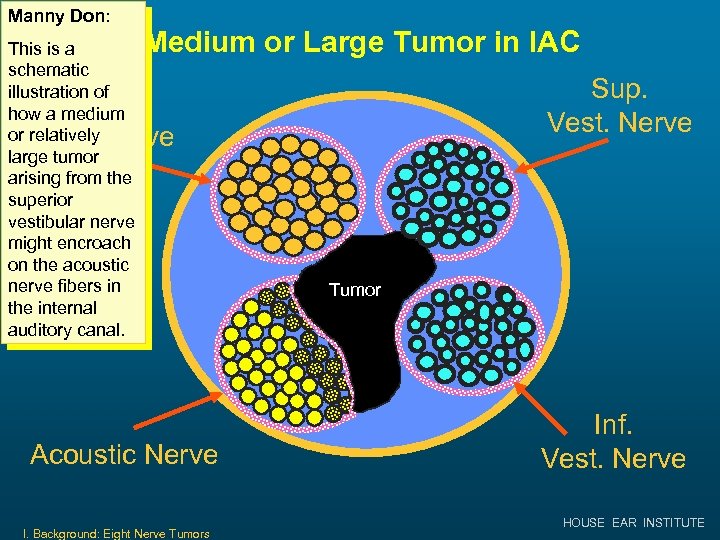 Manny Don: Medium or Large Tumor in IAC This is a schematic illustration of how a medium or relatively. Nerve Facial large tumor arising from the superior vestibular nerve might encroach on the acoustic nerve fibers in the internal auditory canal. Acoustic Nerve I. Background: Eight Nerve Tumors Sup. Vest. Nerve Tumor Inf. Vest. Nerve HOUSE EAR INSTITUTE
 Manny Don: Next, I would like to review very briefly the standard ABR measures for tumor detection. In a publication a few years ago, Dr. Bauch and his colleagues showed that the best two standard ABR measures for tumor detection was the IT 5 and the I-V delay. Background: Evolution of the Stacked ABR A. Eighth Nerve Tumors B. Standard ABR Tumor Detection C. What Do Standard ABR Measures Represent? D. Limitations of Standard ABRs I. Background: Standard ABR HOUSE EAR INSTITUTE
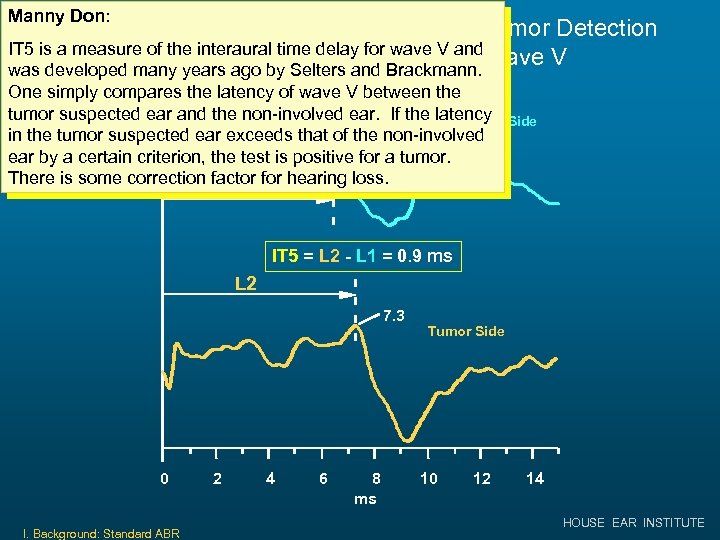 Manny Don: Standard ABR Measures for Acoustic Tumor Detection IT 5 is a measure of the interaural time delay for wave V and IT 5 = Interaural time delay for wave V was developed many years ago by Selters and Brackmann. One simply compares the latency of wave V between the 6. 4 tumor suspected ear and the non-involved ear. If the. Non-Tumor Side latency in the tumor suspected ear exceeds that of the non-involved ear by a certain criterion, the test is positive for a tumor. There is some correction factor for hearing loss. L 1 IT 5 = L 2 - L 1 = 0. 9 ms L 2 7. 3 0 I. Background: Standard ABR 2 4 6 8 ms Tumor Side 10 12 14 HOUSE EAR INSTITUTE
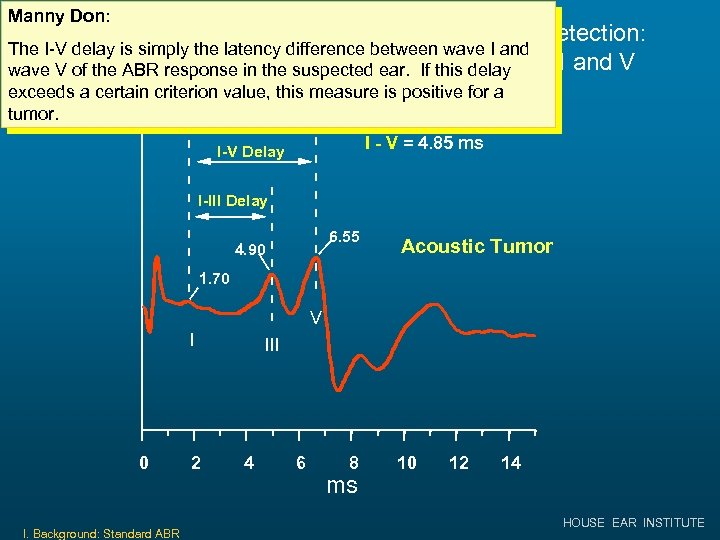 Manny Don: Standard ABR Measures for Acoustic Tumor Detection: I and V The I-V delay is simply the latency difference between wave I and I-V Delay response in the suspected ear. If this delay wave V of the ABR = Latency Difference Between Wave exceeds a certain criterion value, this measure is positive for a tumor. I - V = 4. 85 ms I-V Delay I-III Delay 6. 55 4. 90 Acoustic Tumor 1. 70 V I 0 I. Background: Standard ABR 2 III 4 6 8 ms 10 12 14 HOUSE EAR INSTITUTE
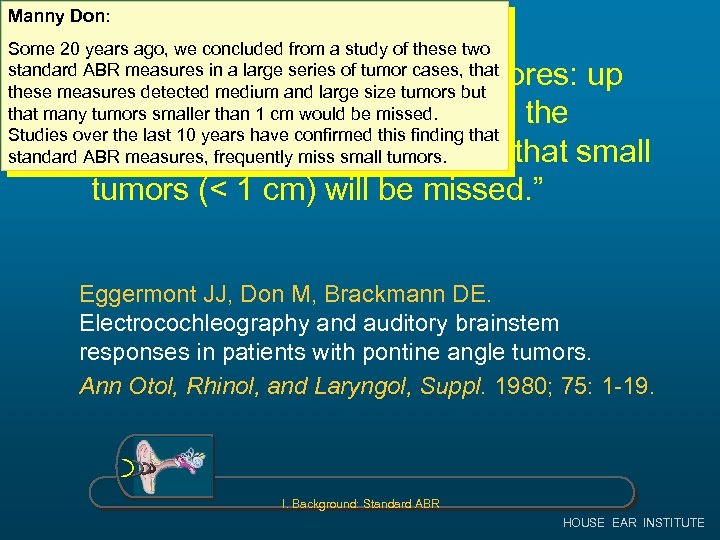 Manny Don: Some 20 years ago, we concluded from a study of these two standard ABR measures in a large series of tumor cases, that these measures detected medium and large size tumors but that many tumors smaller than 1 cm would be missed. Studies over the last 10 years have confirmed this finding that standard ABR measures, frequently miss small tumors. “ABR yields high detection scores: up to 90%. The larger the tumor, the easier its detection. It is likely that small tumors (< 1 cm) will be missed. ” Eggermont JJ, Don M, Brackmann DE. Electrocochleography and auditory brainstem responses in patients with pontine angle tumors. Ann Otol, Rhinol, and Laryngol, Suppl. 1980; 75: 1 -19. I. Background: Standard ABR HOUSE EAR INSTITUTE
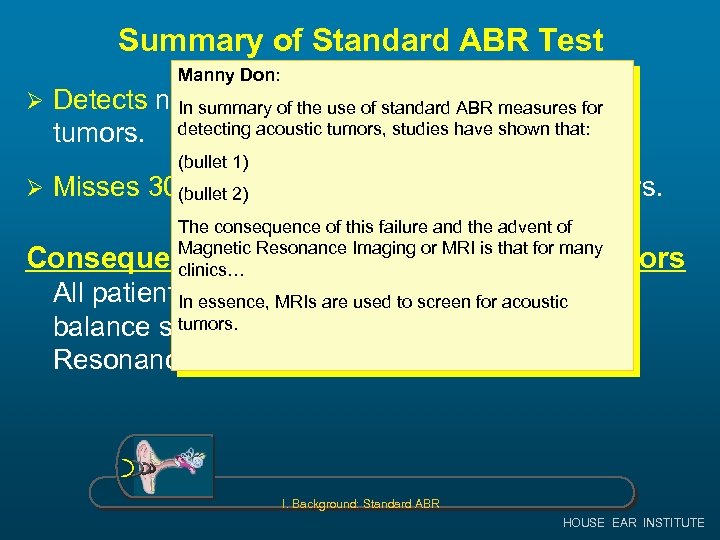 Summary of Standard ABR Test Manny Don: Ø Detects nearly all medium standard ABR measures for In summary of the use of and large acoustic tumors. detecting acoustic tumors, studies have shown that: (bullet 1) Ø Misses 30 -50% of small (<1 cm) acoustic tumors. (bullet 2) The consequence of this failure and the advent of Magnetic Resonance Imaging or MRI is that for many clinics… Consequence of failure to detect small tumors All patients with suspicious clinicalfor acoustic and In essence, MRIs are used to screen hearing tumors. balance symptoms are sent for Magnetic Resonance Imaging (MRI). I. Background: Standard ABR HOUSE EAR INSTITUTE
 Manny Don: Drawbacks of Screening with MRI However, there are some. . . Ø Relatively expensive ($2100) Ø Not available everywhere Invasive, anxiety producing, and uncomfortable test for some patients Ø Cannot be used on patients with implanted metal devices or materials Ø Ø Most patients tested do not have a tumor I. Background: Standard ABR HOUSE EAR INSTITUTE
 Why do standard ABR measures often fail to detect small tumors ? Ø The obvious reason: Small tumors exert less pressure and affect a smaller number of neural fibers than larger tumors. Ø But, these not the only factors because: 1. Many of these small tumors exert enough pressure to cause clinical symptoms. 2. Many small tumors are detected by standard ABR measures. I. Background: Standard ABR HOUSE EAR INSTITUTE
 Manny Don: Why do standard ABR measures often fail Our hypothesis is: . . . to detect small tumors ? So, the question is, … Hypothesis: Standard ABR measures often fail to detect small tumors because these measures are dominated by activity from a subset of 8 th nerve fibers that may not be affected by the small tumor. Thus, the limitation is not with ABRs per se, but with the ABR measures used. I. Background: Standard ABR HOUSE EAR INSTITUTE
 Manny Don: In order to understand the failure of the standard ABR measures, we need to understand what these measures represent. Background: Evolution of the Stacked ABR A. Eighth Nerve Tumors B. Standard ABR Tumor Detection C. What Do Standard ABR Measures Represent? D. Limitations of Standard ABRs I. Background/What Do Standard ABRs Represent? HOUSE EAR INSTITUTE
 Manny Don: (self-explanatory) The IT 5 and I-V Delay Use Wave V Latency Measures: What does the latency of the ABR wave V represent? I. Background/What Do Standard ABRs Represent? HOUSE EAR INSTITUTE
 Manny Don: To begin our discussion of what wave V latency in the ABR represents, I want to clear up. . . Two Prevalent Misconceptions About Click-evoked ABRs 1. Clicks have only high-frequency energy. 2. ABRs can only test cochlear function from 2 to 4 k. Hz. I. Background/What Do Standard ABRs Represent? HOUSE EAR INSTITUTE
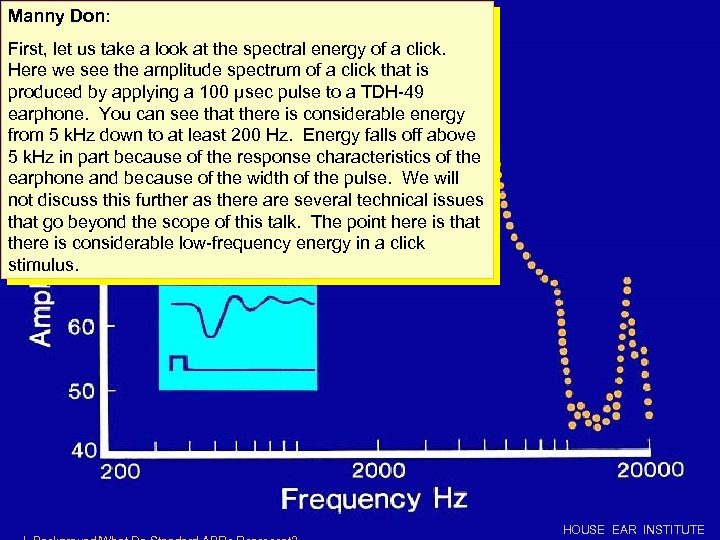 Manny Don: First, let us take a look at the spectral energy of a click. Here we see the amplitude spectrum of a click that is produced by applying a 100 µsec pulse to a TDH-49 earphone. You can see that there is considerable energy from 5 k. Hz down to at least 200 Hz. Energy falls off above 5 k. Hz in part because of the response characteristics of the earphone and because of the width of the pulse. We will not discuss this further as there are several technical issues that go beyond the scope of this talk. The point here is that there is considerable low-frequency energy in a click stimulus. HOUSE EAR INSTITUTE
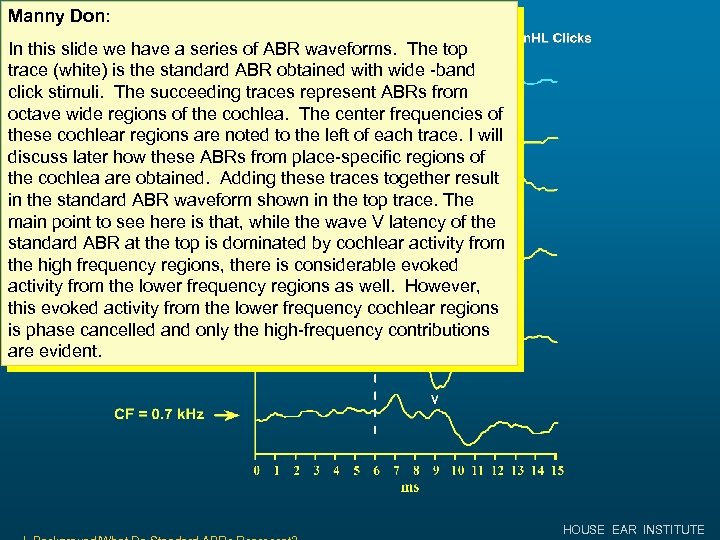 Manny Don: In this slide we have a series of ABR waveforms. The top trace (white) is the standard ABR obtained with wide -band click stimuli. The succeeding traces represent ABRs from octave wide regions of the cochlea. The center frequencies of these cochlear regions are noted to the left of each trace. I will discuss later how these ABRs from place-specific regions of the cochlea are obtained. Adding these traces together result in the standard ABR waveform shown in the top trace. The main point to see here is that, while the wave V latency of the standard ABR at the top is dominated by cochlear activity from the high frequency regions, there is considerable evoked activity from the lower frequency regions as well. However, this evoked activity from the lower frequency cochlear regions is phase cancelled and only the high-frequency contributions are evident. HOUSE EAR INSTITUTE
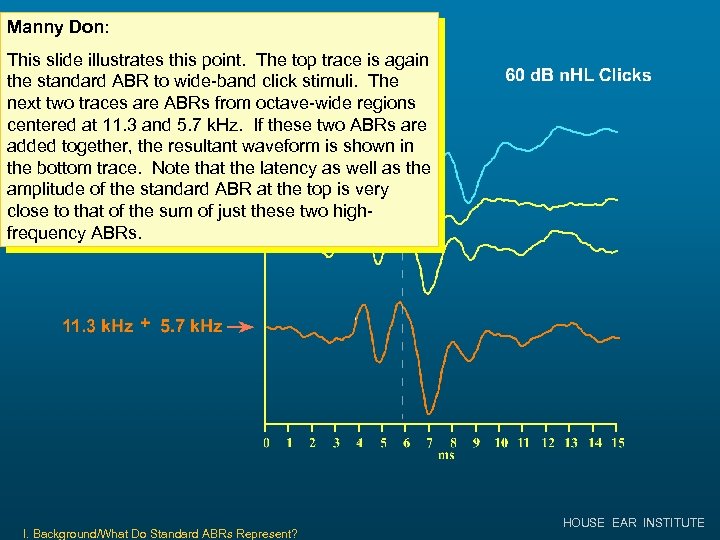 Manny Don: This slide illustrates this point. The top trace is again the standard ABR to wide-band click stimuli. The next two traces are ABRs from octave-wide regions centered at 11. 3 and 5. 7 k. Hz. If these two ABRs are added together, the resultant waveform is shown in the bottom trace. Note that the latency as well as the amplitude of the standard ABR at the top is very close to that of the sum of just these two highfrequency ABRs. I. Background/What Do Standard ABRs Represent? HOUSE EAR INSTITUTE
 Manny Don: Self-explanatory Take Home Messages Ø A click stimulus is a wideband acoustic signal with as much low-frequency energy as there is highfrequency (HF) energy. Ø The click-evoked ABR contains neural activity representing all frequency regions of the cochlea, not just the HFs. Ø In the standard ABR, wave V latency is dominated by HF regions because lower frequency contributions are phase-cancelled. I. Background/What Do Standard ABRs Represent? HOUSE EAR INSTITUTE
 Manny Don: Let us now focus on the limitations of the standard ABRs with respect to small tumor detection. Background: Evolution of the Stacked ABR A. Eighth Nerve Tumors B. Standard ABR Tumor Detection C. What Do Standard ABR Measures Represent? D. Limitations of Standard ABRs I. Background/Standard ABRs Limitations HOUSE EAR INSTITUTE
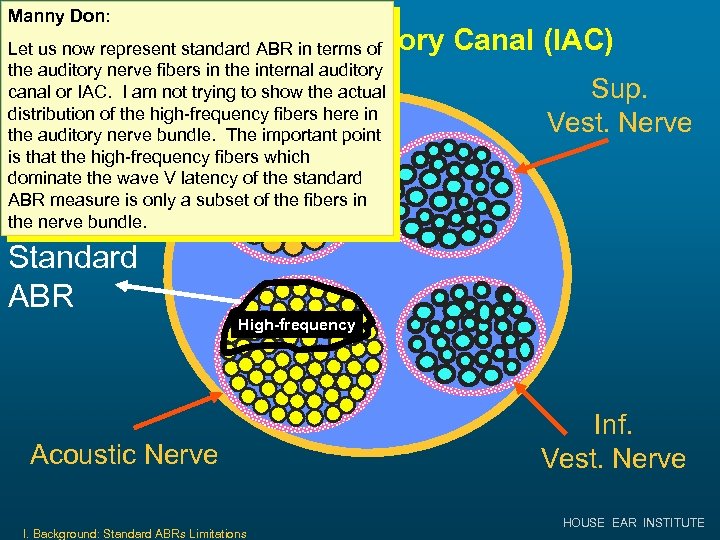 Manny Don: Normal Internal Auditory Canal (IAC) Let us now represent standard ABR in terms of the auditory nerve fibers in the internal auditory canal or IAC. I am not trying to show the actual distribution of the high-frequency fibers here in the auditory. Nerve Facial nerve bundle. The important point is that the high-frequency fibers which dominate the wave V latency of the standard ABR measure is only a subset of the fibers in the nerve bundle. Sup. Vest. Nerve Standard ABR High-frequency Acoustic Nerve I. Background: Standard ABRs Limitations Inf. Vest. Nerve HOUSE EAR INSTITUTE
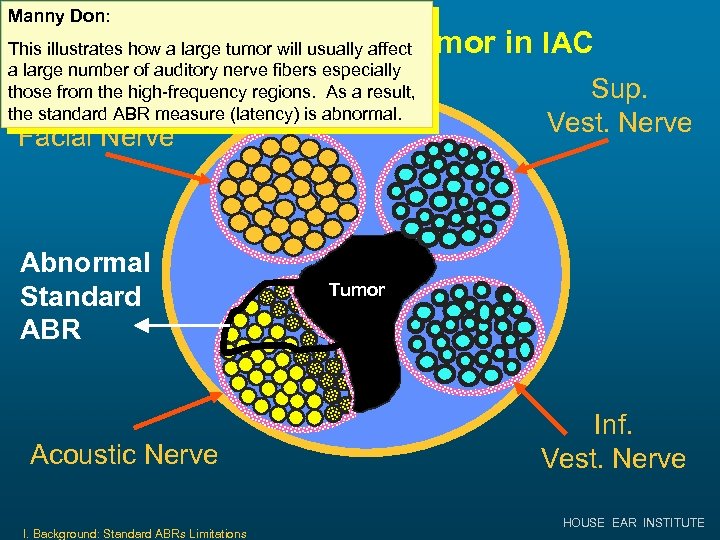 Manny Don: Medium or Large Tumor in IAC This illustrates how a large tumor will usually affect a large number of auditory nerve fibers especially those from the high-frequency regions. As a result, the standard ABR measure (latency) is abnormal. Facial Nerve Abnormal Standard ABR Acoustic Nerve I. Background: Standard ABRs Limitations Sup. Vest. Nerve Tumor Inf. Vest. Nerve HOUSE EAR INSTITUTE
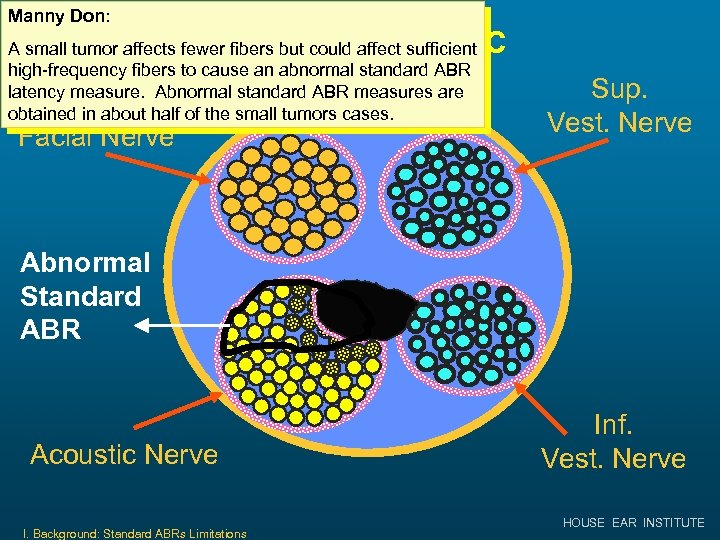 Manny Don: Small Tumor in IAC A small tumor affects fewer fibers but could affect sufficient high-frequency fibers to cause an abnormal standard ABR latency measure. Abnormal standard ABR measures are obtained in about half of the small tumors cases. Facial Nerve Sup. Vest. Nerve Abnormal Standard ABR Acoustic Nerve I. Background: Standard ABRs Limitations Inf. Vest. Nerve HOUSE EAR INSTITUTE
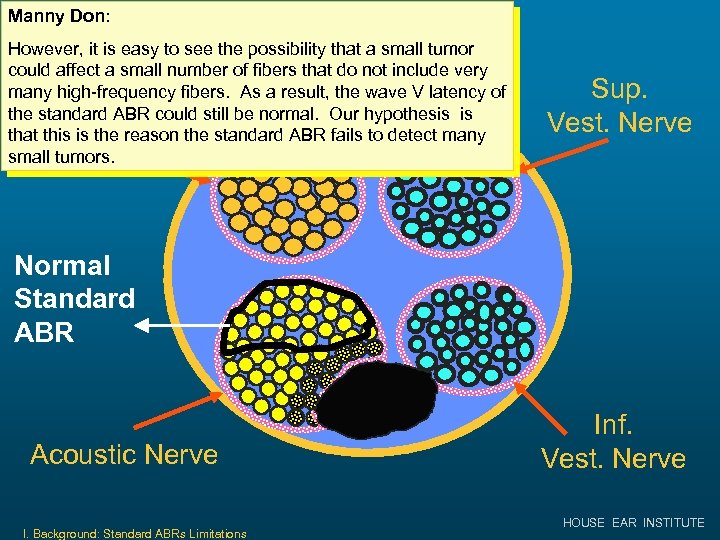 Manny Don: Small Tumor in IAC However, it is easy to see the possibility that a small tumor could affect a small number of fibers that do not include very many high-frequency fibers. As a result, the wave V latency of the standard ABR could still be normal. Our hypothesis is that this is the reason the standard ABR fails to detect many Facial Nerve small tumors. Sup. Vest. Nerve Normal Standard ABR Acoustic Nerve I. Background: Standard ABRs Limitations Inf. Vest. Nerve HOUSE EAR INSTITUTE
 Summary Ø The wave V latency used in standard ABR IT 5 and I -V delay measures is dominated by neural activity from high-frequency (HF) regions of the cochlea. Ø If the tumor does not affect these HF fibers sufficiently, the standard ABR latencies will be normal. Ø Small tumors do not always affect HF fibers, so they may be missed by standard ABR measures. I. Background/What Do Standard ABRs Represent? HOUSE EAR INSTITUTE
 Manny Don: What would be the advantages of developing an ABR measure for tumor screening instead of using the MRI test? Advantages of ABRs over MRIs The ABR is: Ø Much less expensive Ø More widely available Ø Non-invasive Ø More comfortable than MRI II. Stacked ABR: Rationale HOUSE EAR INSTITUTE
 The Challenge Can we develop an ABR test that: 1. Detects small tumors that cause symptoms, and 2. Significantly reduces the number of patients sent for MRI who do not have a tumor? II. Stacked ABR: Rationale HOUSE EAR INSTITUTE
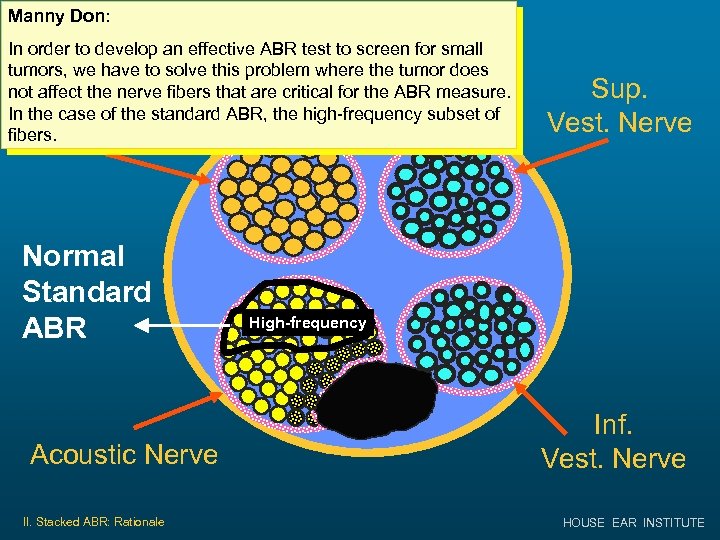 Manny Don: Small Tumor in IAC In order to develop an effective ABR test to screen for small tumors, we have to solve this problem where the tumor does not affect the nerve fibers that are critical for the ABR measure. In the case of the standard ABR, the high-frequency subset of fibers. Facial Nerve Normal Standard ABR Acoustic Nerve II. Stacked ABR: Rationale Sup. Vest. Nerve High-frequency Inf. Vest. Nerve HOUSE EAR INSTITUTE
 Ø Hypothesized that tumor detection fails with standard ABR measures because these measures are dominated by high-frequency activity and small tumors may not always affect the high-frequency fibers. Ø In order for a new ABR measure to detect small tumors, it must measure activity from essentially all fibers, not just a subset. II. Stacked ABR: Rationale HOUSE EAR INSTITUTE
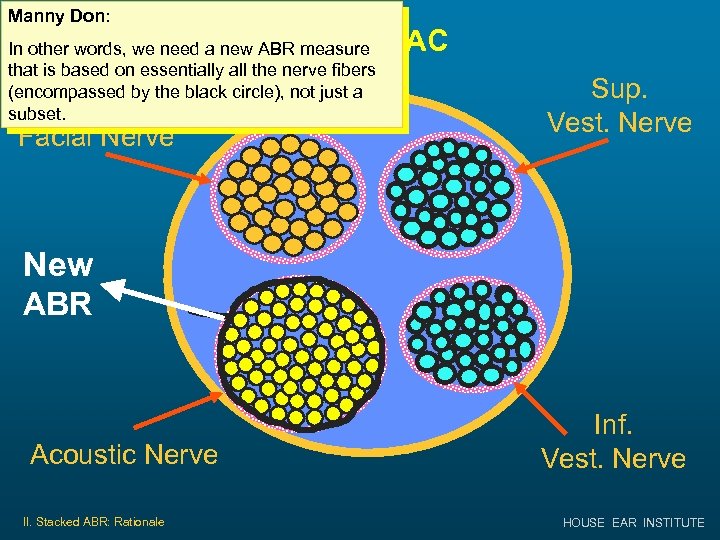 Manny Don: Normal IAC In other words, we need a new ABR measure that is based on essentially all the nerve fibers (encompassed by the black circle), not just a subset. Facial Nerve Sup. Vest. Nerve New ABR Acoustic Nerve II. Stacked ABR: Rationale Inf. Vest. Nerve HOUSE EAR INSTITUTE
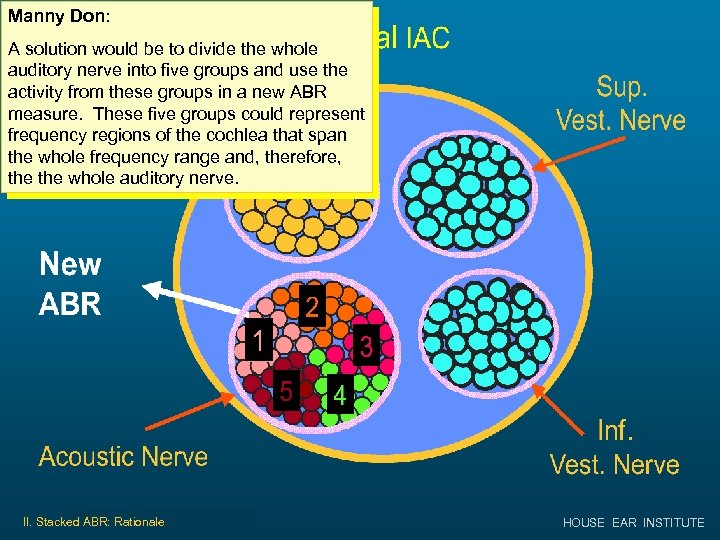 Manny Don: A solution would be to divide the whole auditory nerve into five groups and use the activity from these groups in a new ABR measure. These five groups could represent frequency regions of the cochlea that span the whole frequency range and, therefore, the whole auditory nerve. . II. Stacked ABR: Rationale HOUSE EAR INSTITUTE
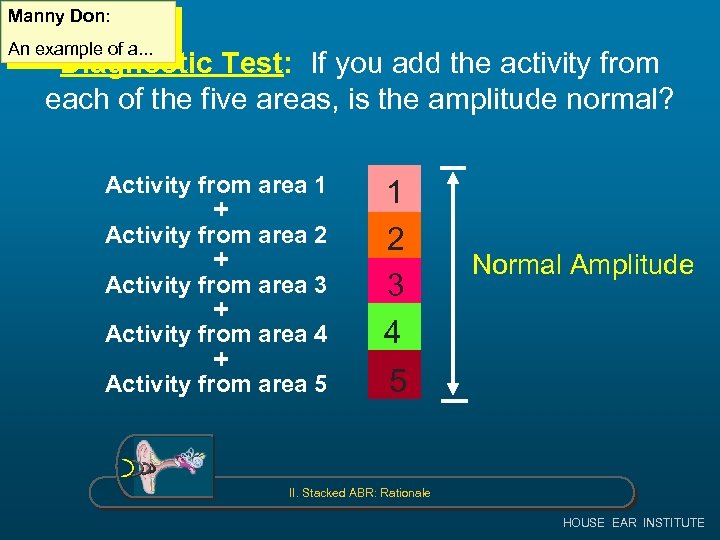 Manny Don: An example of a. . . Diagnostic Test: If you add the activity from each of the five areas, is the amplitude normal? Activity from area 1 Activity from area 4 1 2 3 4 Activity from area 5 5 + Activity from area 2 + Activity from area 3 + + Normal Amplitude II. Stacked ABR: Rationale HOUSE EAR INSTITUTE
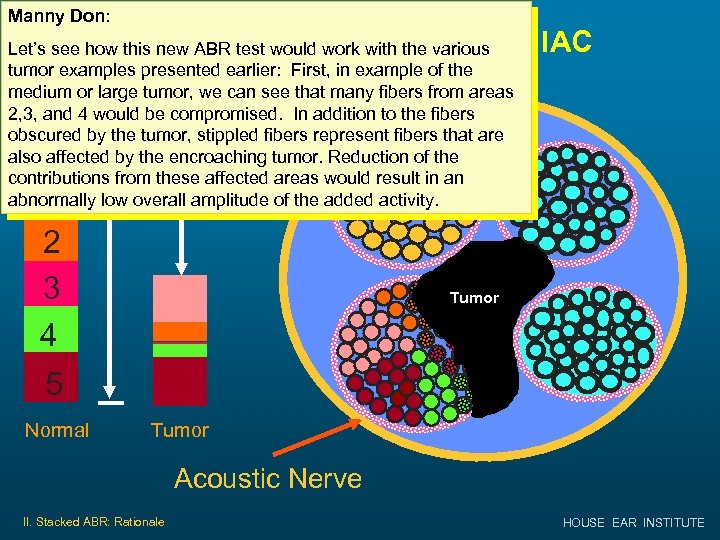 Manny Don: Medium or Large Tumor in IAC Let’s see how this new ABR test would work with the various tumor examples presented earlier: First, in example of the medium or large tumor, we can see that many fibers from areas New ABR: Abnormal 2, 3, and 4 would be compromised. In addition to the fibers obscured by the tumor, stippled fibers represent fibers that are also affected by the encroaching tumor. Reduction of the contributions from these affected areas would result in an abnormally low overall amplitude of the added activity. 1 2 3 4 Tumor 3 5 Normal Tumor Acoustic Nerve II. Stacked ABR: Rationale HOUSE EAR INSTITUTE
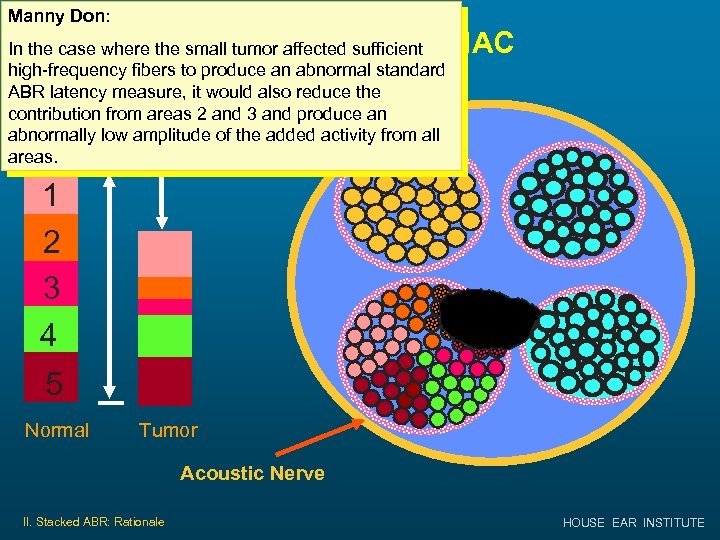 Manny Don: Small Tumor in IAC In the case where the small tumor affected sufficient high-frequency fibers to produce an abnormal standard ABR latency measure, it would also reduce the New ABR: Abnormal contribution from areas 2 and 3 and produce an abnormally low amplitude of the added activity from all areas. 1 2 3 4 5 Normal Tumor Acoustic Nerve II. Stacked ABR: Rationale HOUSE EAR INSTITUTE
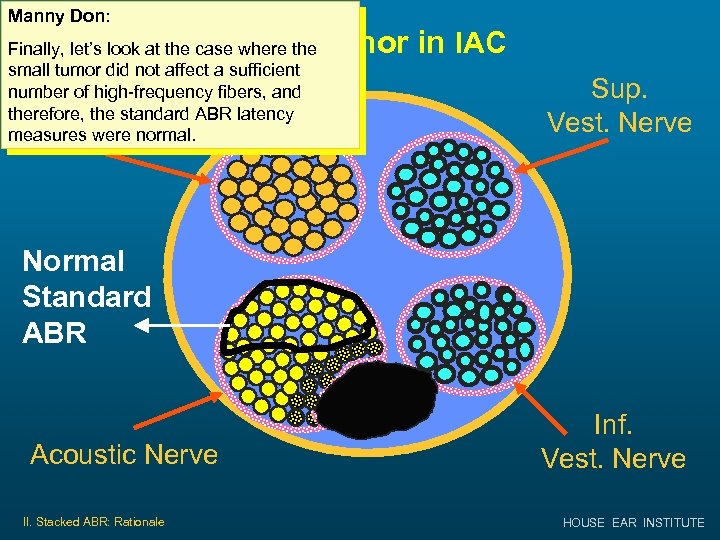 Manny Don: Small Tumor in IAC Finally, let’s look at the case where the small tumor did not affect a sufficient number of high-frequency fibers, and therefore, the standard ABR latency measures were normal. Facial Nerve Sup. Vest. Nerve Normal Standard ABR Acoustic Nerve II. Stacked ABR: Rationale Inf. Vest. Nerve HOUSE EAR INSTITUTE
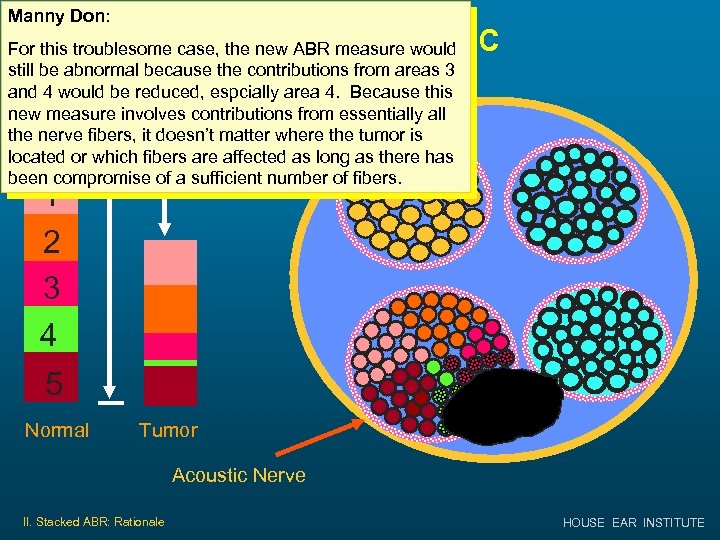 Manny Don: Small Tumor in IAC For this troublesome case, the new ABR measure would still be abnormal because the contributions from areas 3 and 4 would be reduced, espcially area 4. Because this New ABR: Abnormal new measure involves contributions from essentially all the nerve fibers, it doesn’t matter where the tumor is located or which fibers are affected as long as there has been compromise of a sufficient number of fibers. 1 2 3 4 5 Normal Tumor Acoustic Nerve II. Stacked ABR: Rationale HOUSE EAR INSTITUTE
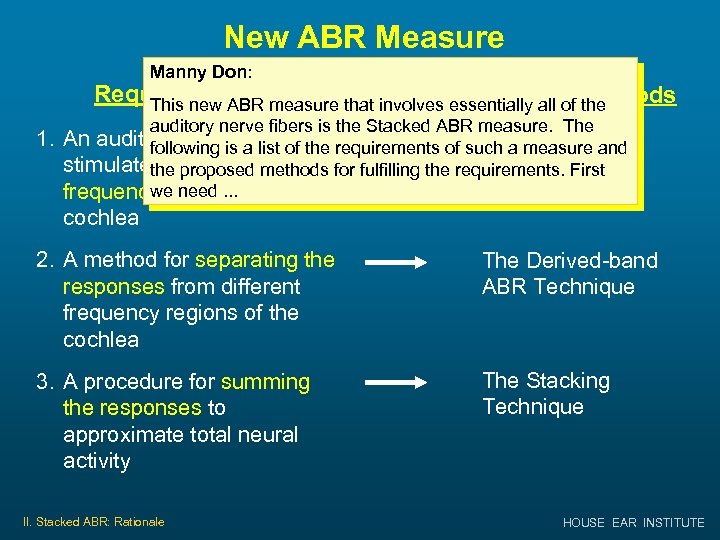 New ABR Measure Manny Don: Requirements measure that involves essentially all of Methods Proposed the This new ABR auditory nerve fibers is the Stacked ABR measure. The Wideband Click 1. An auditory signal a list of the requirements of such a measure and following is that stimulates essentially all the proposed methods for fulfilling the requirements. First we need. . . frequency regions of the cochlea 2. A method for separating the responses from different frequency regions of the cochlea The Derived-band ABR Technique 3. A procedure for summing the responses to approximate total neural activity The Stacking Technique II. Stacked ABR: Rationale HOUSE EAR INSTITUTE
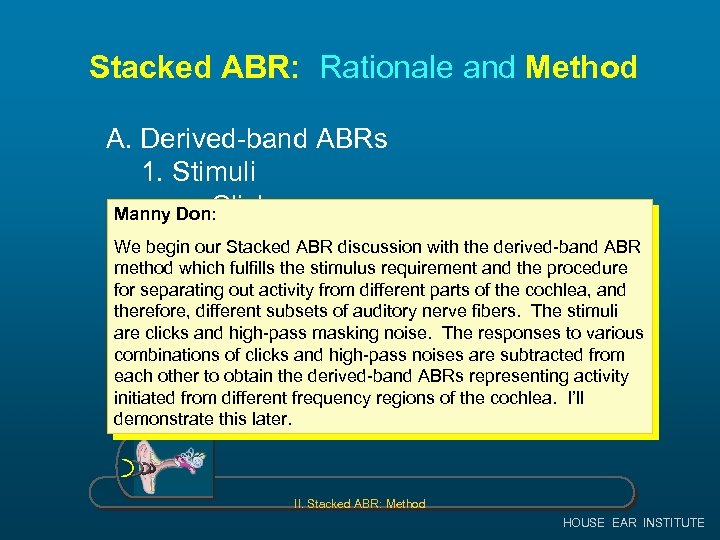 Stacked ABR: Rationale and Method A. Derived-band ABRs 1. Stimuli Manny a. Clicks Don: b. High-pass masking the derived-band ABR We begin our Stacked ABR discussion withnoise method. Response subtraction fulfills the and 2. which out activitystimulus requirementof thethe procedure for separating from different parts cochlea, and therefore, different subsets of auditory ABRs B. Stacking derived-band nerve fibers. The stimuli are clicks and high-pass masking noise. The responses to various combinations of clicks and high-pass noises are subtracted from C. ABR recordings each other to obtain the derived-band ABRs representing activity initiated from different frequency regions of the cochlea. I’ll demonstrate this later. II. Stacked ABR: Method HOUSE EAR INSTITUTE
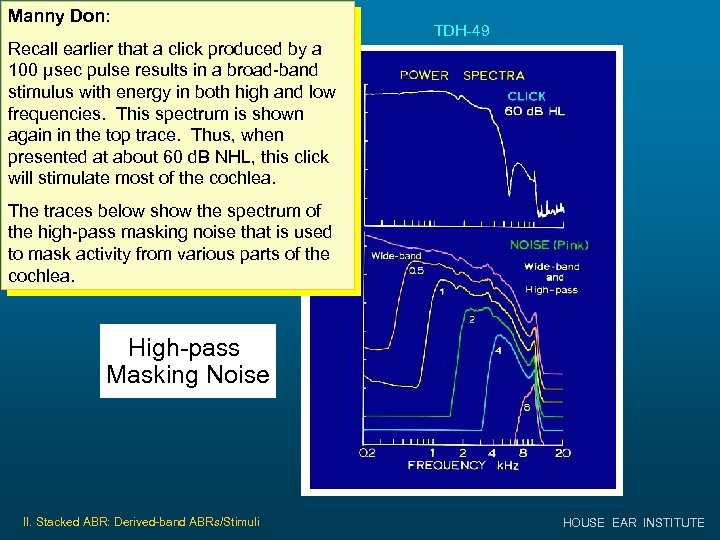 Manny Don: Recall earlier that a click produced by a 100 µsec pulse results in a broad-band stimulus with energy in both high and low frequencies. This spectrum is shown again in the top trace. Thus, when Click presented at about 60 d. B NHL, this click will stimulate most of the cochlea. TDH-49 The traces below show the spectrum of the high-pass masking noise that is used to mask activity from various parts of the cochlea. High-pass Masking Noise II. Stacked ABR: Derived-band ABRs/Stimuli HOUSE EAR INSTITUTE
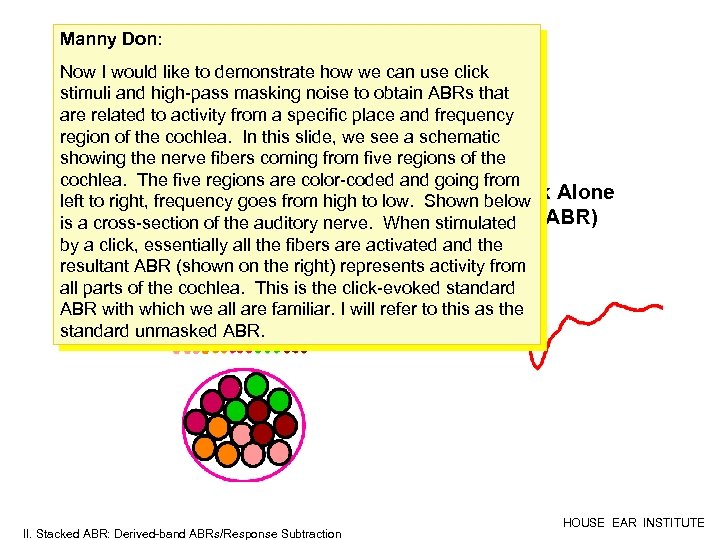 Manny Don: Now I would like to demonstrate how we can use click stimuli and high-pass masking noise to obtain ABRs that are related to activity from a specific place and frequency region of the cochlea. In this slide, we see a schematic showing the nerve fibers coming from five regions of the cochlea. The five regions are color-coded and going from left to right, frequency goes from high to low. ABR to Click Alone Shown below (Standard ABR) is a cross-section of the auditory nerve. When stimulated by a click, essentially all the fibers are activated and the resultant ABR (shown on the right) represents activity from all parts of the cochlea. This is the click-evoked standard ABR with which we all are familiar. I will refer to this as the standard unmasked ABR. II. Stacked ABR: Derived-band ABRs/Response Subtraction HOUSE EAR INSTITUTE
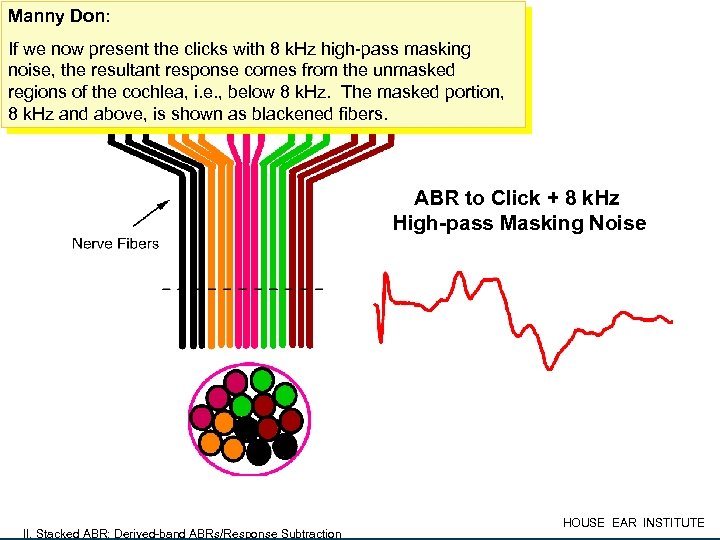 Manny Don: If we now present the clicks with 8 k. Hz high-pass masking noise, the resultant response comes from the unmasked regions of the cochlea, i. e. , below 8 k. Hz. The masked portion, 8 k. Hz and above, is shown as blackened fibers. ABR to Click + 8 k. Hz High-pass Masking Noise II. Stacked ABR: Derived-band ABRs/Response Subtraction HOUSE EAR INSTITUTE
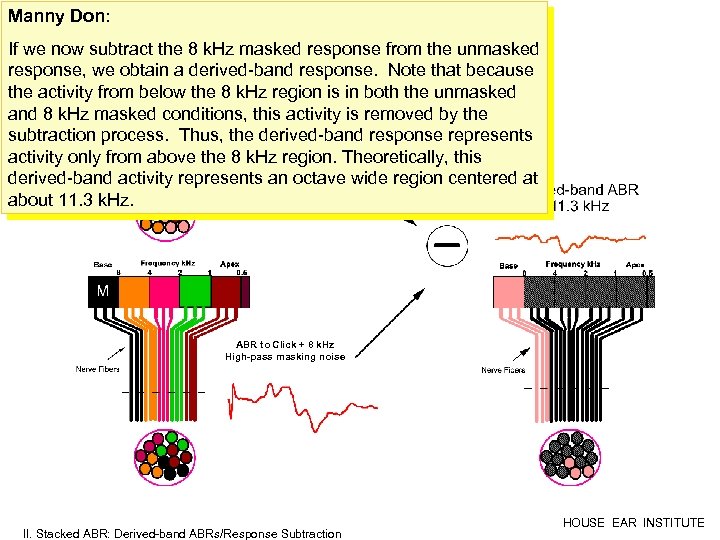 Manny Don: If we now subtract the 8 k. Hz masked response from the unmasked response, we obtain a derived-band response. Note that because the activity from below the 8 k. Hz region. Alonein both the unmasked ABR to Click is (Standard ABR) and 8 k. Hz masked conditions, this activity is removed by the subtraction process. Thus, the derived-band response represents activity only from above the 8 k. Hz region. Theoretically, this derived-band activity represents an octave wide region centered at about 11. 3 k. Hz. ABR to Click + 8 k. Hz High-pass masking noise II. Stacked ABR: Derived-band ABRs/Response Subtraction HOUSE EAR INSTITUTE
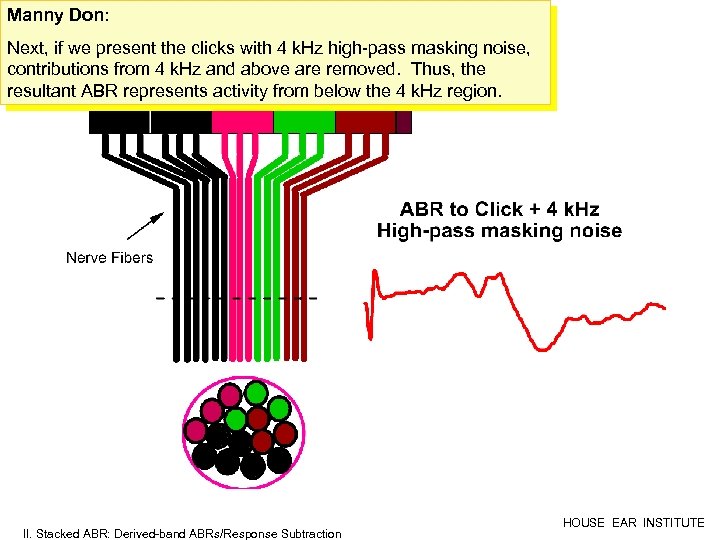 Manny Don: Next, if we present the clicks with 4 k. Hz high-pass masking noise, contributions from 4 k. Hz and above are removed. Thus, the resultant ABR represents activity from below the 4 k. Hz region. II. Stacked ABR: Derived-band ABRs/Response Subtraction HOUSE EAR INSTITUTE
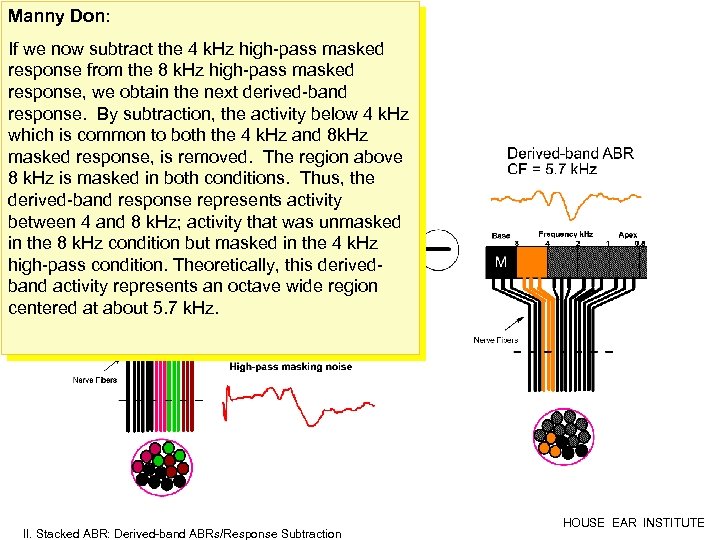 Manny Don: If we now subtract the 4 k. Hz high-pass masked response from the 8 k. Hz high-pass masked response, we obtain the next derived-band ABR to Click + 8 k. Hz response. By subtraction, the activity below 4 k. Hz High-pass masking noise which is common to both the 4 k. Hz and 8 k. Hz masked response, is removed. The region above 8 k. Hz is masked in both conditions. Thus, the derived-band response represents activity between 4 and 8 k. Hz; activity that was unmasked in the 8 k. Hz condition but masked in the 4 k. Hz high-pass condition. Theoretically, this derivedband activity represents an octave wide region centered at about 5. 7 k. Hz. II. Stacked ABR: Derived-band ABRs/Response Subtraction HOUSE EAR INSTITUTE
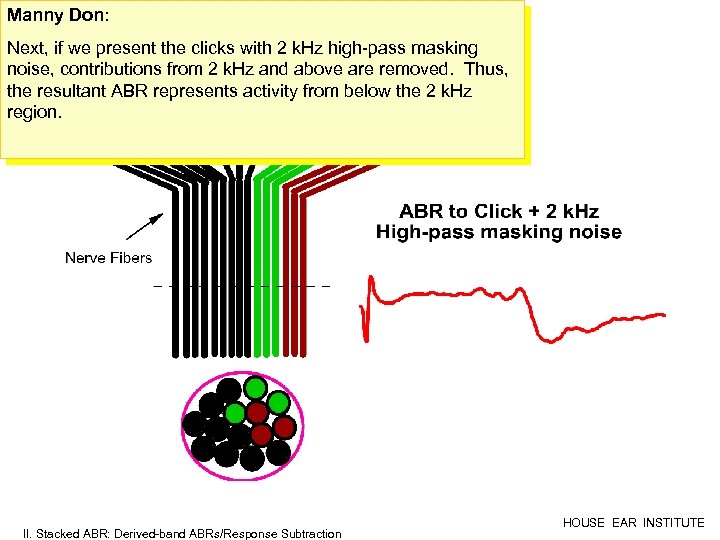 Manny Don: Next, if we present the clicks with 2 k. Hz high-pass masking noise, contributions from 2 k. Hz and above are removed. Thus, the resultant ABR represents activity from below the 2 k. Hz region. II. Stacked ABR: Derived-band ABRs/Response Subtraction HOUSE EAR INSTITUTE
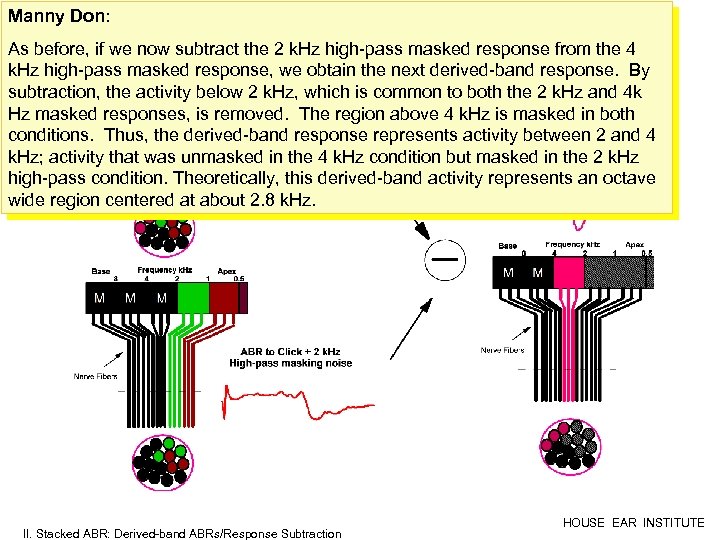 Manny Don: As before, if we now subtract the 2 k. Hz high-pass masked response from the 4 k. Hz high-pass masked response, we obtain the next derived-band response. By subtraction, the activity below 2 k. Hz, which is common to both the 2 k. Hz and 4 k Hz masked responses, is removed. The region above 4 k. Hz is masked in both conditions. Thus, the derived-band response represents activity between 2 and 4 k. Hz; activity that was unmasked in the 4 k. Hz condition but masked in the 2 k. Hz high-pass condition. Theoretically, this derived-band activity represents an octave wide region centered at about 2. 8 k. Hz. II. Stacked ABR: Derived-band ABRs/Response Subtraction HOUSE EAR INSTITUTE
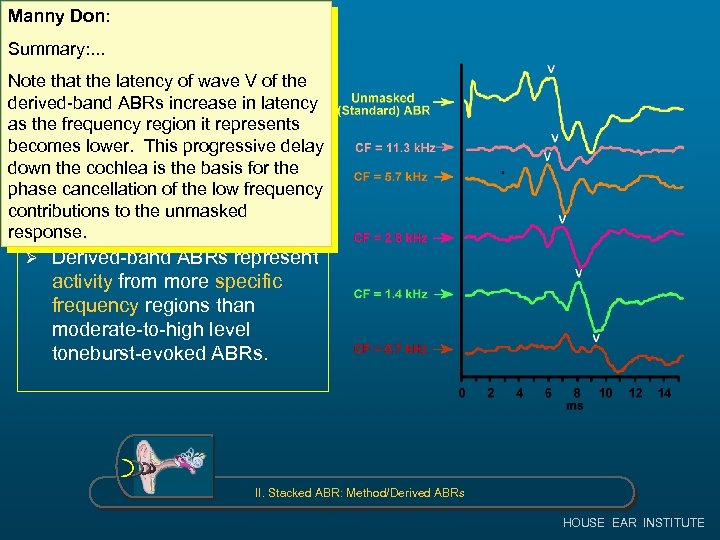 Manny Don: Summary: . . . Note that the latency of wave V of the Derived-band increase in latency derived-band ABRs ABR Summary asØ Neural contributions from the frequency region it represents becomes lower. This progressive delay different frequency regions down the cochlea is the basis for the of the cochlea can be phase cancellation of the low frequency obtained using the derivedcontributions to the unmasked band response. ABR method. Ø Derived-band ABRs represent activity from more specific frequency regions than moderate-to-high level toneburst-evoked ABRs. II. Stacked ABR: Method/Derived ABRs HOUSE EAR INSTITUTE
 Stacked ABR: Rationale and Method A. Derived-band ABRs 1. Stimuli a. Clicks b. High-pass masking noise 2. Response subtraction B. Stacking derived-band ABRs C. ABR recordings II. Stacked ABR: Method/Stacking HOUSE EAR INSTITUTE
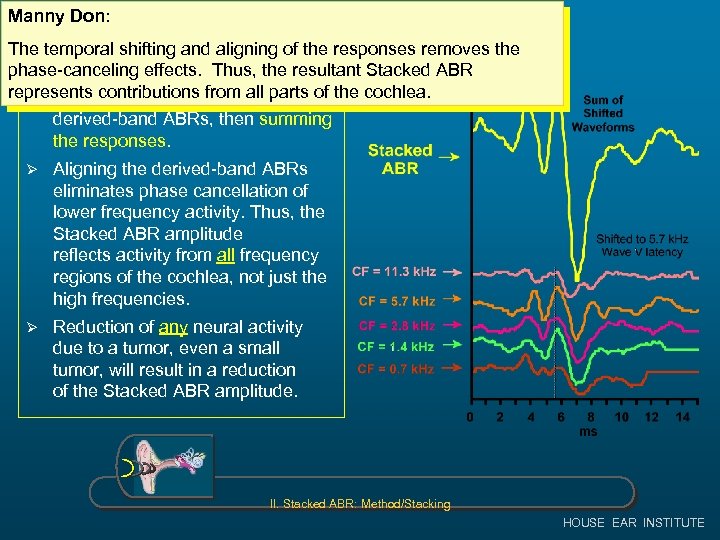 Manny Don: The Stacked ABR Technique The temporal shifting and aligning of the responses removes the phase-canceling effects. is. Thus, the resultant Stacked ABR Ø The Stacked ABR formed by first represents contributions from all parts of the cochlea. temporally aligning wave V of the derived-band ABRs, then summing the responses. Ø Aligning the derived-band ABRs eliminates phase cancellation of lower frequency activity. Thus, the Stacked ABR amplitude reflects activity from all frequency regions of the cochlea, not just the high frequencies. Ø Reduction of any neural activity due to a tumor, even a small tumor, will result in a reduction of the Stacked ABR amplitude. II. Stacked ABR: Method/Stacking HOUSE EAR INSTITUTE
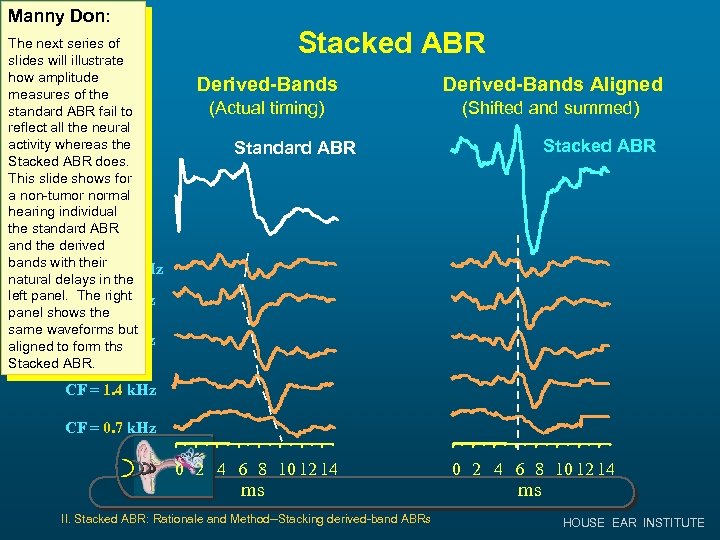 Manny Don: The next series of slides will illustrate how amplitude measures of the standard ABR fail to reflect all the neural activity whereas the Stacked ABR does. This slide shows for a non-tumor normal hearing individual the standard ABR and the derived bands with their CF = 11. 3 k. Hz natural delays in the left panel. The 5. 7 k. Hz CF = right panel shows the same waveforms but CF = ths aligned to form 2. 8 k. Hz Stacked ABR Derived-Bands Aligned (Actual timing) (Shifted and summed) Stacked ABR Standard ABR CF = 1. 4 k. Hz CF = 0. 7 k. Hz 0 2 4 6 8 10 12 14 ms II. Stacked ABR: Rationale and Method--Stacking derived-band ABRs 0 2 4 6 8 10 12 14 ms HOUSE EAR INSTITUTE
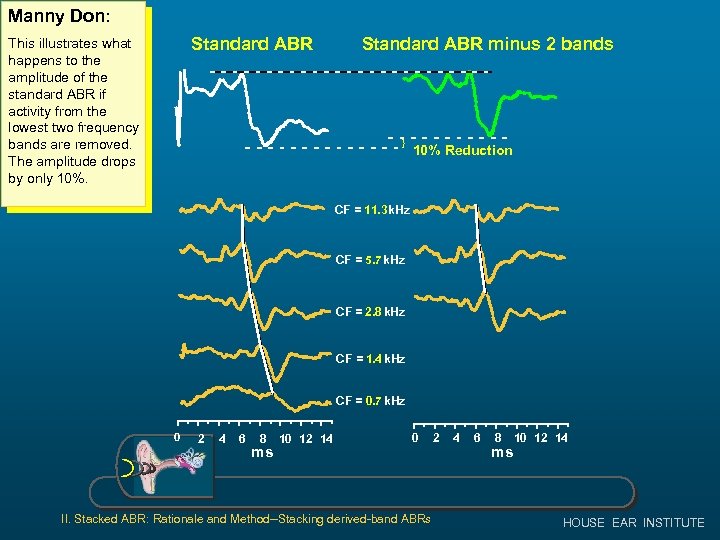 Manny Don: Example This illustrates what 1 happens to the amplitude of the standard ABR if activity from the lowest two frequency bands are removed. The amplitude drops by only 10%. Standard ABR minus 2 bands } 10% Reduction CF = 11. 3 k. Hz CF = 5. 7 k. Hz CF = 2. 8 k. Hz CF = 1. 4 k. Hz CF = 0. 7 k. Hz 0 2 4 6 8 ms 10 12 14 0 II. Stacked ABR: Rationale and Method--Stacking derived-band ABRs 2 4 6 8 ms 10 12 14 HOUSE EAR INSTITUTE
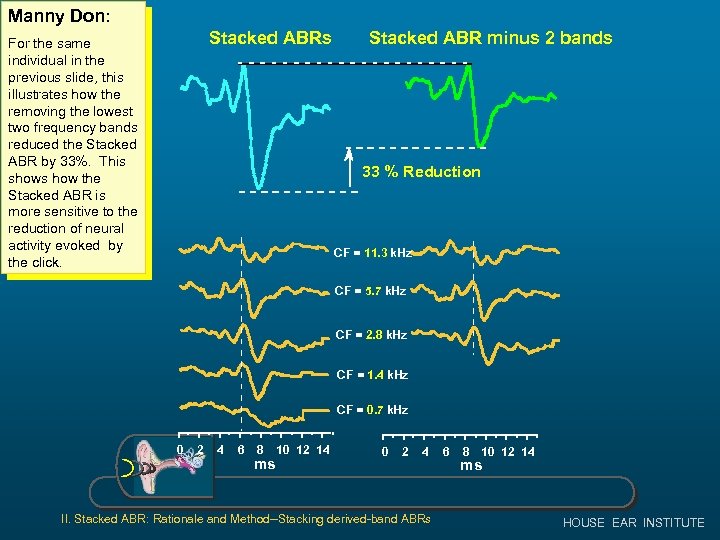 Manny Don: Example 1 For the same individual in the previous slide, this illustrates how the removing the lowest two frequency bands reduced the Stacked ABR by 33%. This shows how the Stacked ABR is more sensitive to the reduction of neural activity evoked by the click. Stacked ABRs Stacked ABR minus 2 bands 33 % Reduction CF = 11. 3 k. Hz CF = 5. 7 k. Hz CF = 2. 8 k. Hz CF = 1. 4 k. Hz CF = 0. 7 k. Hz 0 2 4 6 8 ms 10 12 14 0 2 4 II. Stacked ABR: Rationale and Method--Stacking derived-band ABRs 6 8 10 12 14 ms HOUSE EAR INSTITUTE
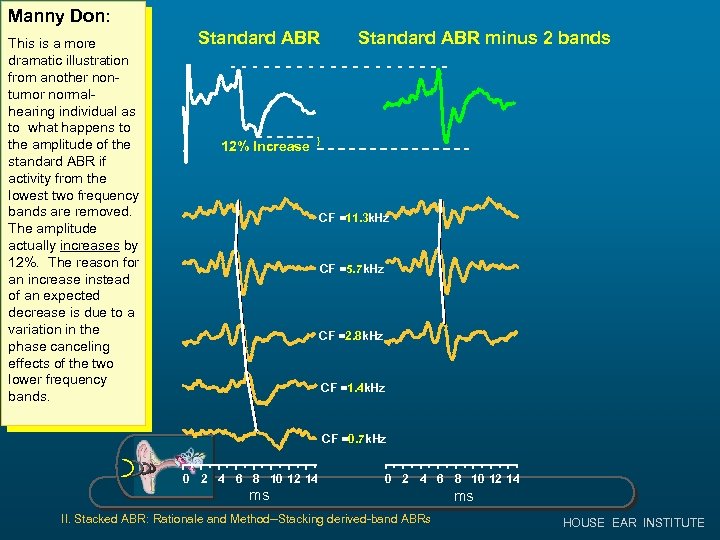 Manny Don: This is a Example 2 more dramatic illustration from another nontumor normalhearing individual as to what happens to the amplitude of the standard ABR if activity from the lowest two frequency bands are removed. The amplitude actually increases by 12%. The reason for an increase instead of an expected decrease is due to a variation in the phase canceling effects of the two lower frequency bands. Standard ABR 12% Increase Standard ABR minus 2 bands } CF =11. 3 k. Hz CF =5. 7 k. Hz CF =2. 8 k. Hz CF =1. 4 k. Hz CF =0. 7 k. Hz 0 2 4 6 8 10 12 14 ms II. Stacked ABR: Rationale and Method--Stacking derived-band ABRs ms HOUSE EAR INSTITUTE
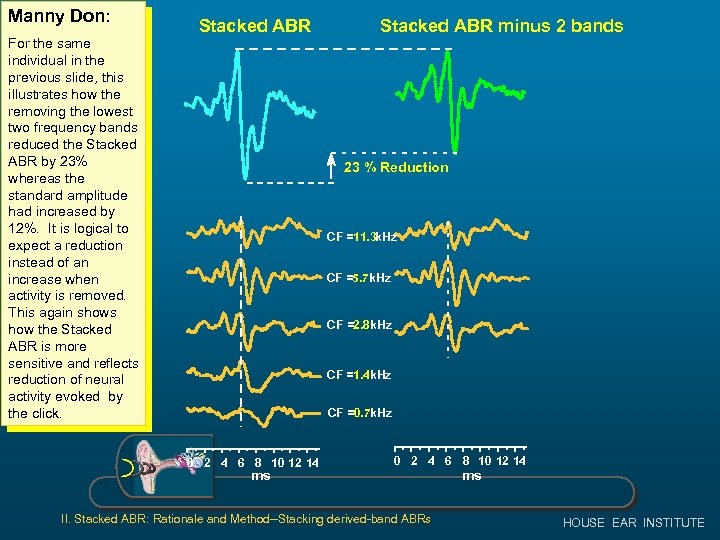 Manny. Example 2 Don: For the same individual in the previous slide, this illustrates how the removing the lowest two frequency bands reduced the Stacked ABR by 23% whereas the standard amplitude had increased by 12%. It is logical to expect a reduction instead of an increase when activity is removed. This again shows how the Stacked ABR is more sensitive and reflects reduction of neural activity evoked by the click. Stacked ABR minus 2 bands 23 % Reduction CF =11. 3 k. Hz CF =5. 7 k. Hz CF =2. 8 k. Hz CF =1. 4 k. Hz CF =0. 7 k. Hz 0 2 4 6 8 10 12 14 ms 0 2 4 6 8 10 12 14 II. Stacked ABR: Rationale and Method--Stacking derived-band ABRs ms HOUSE EAR INSTITUTE
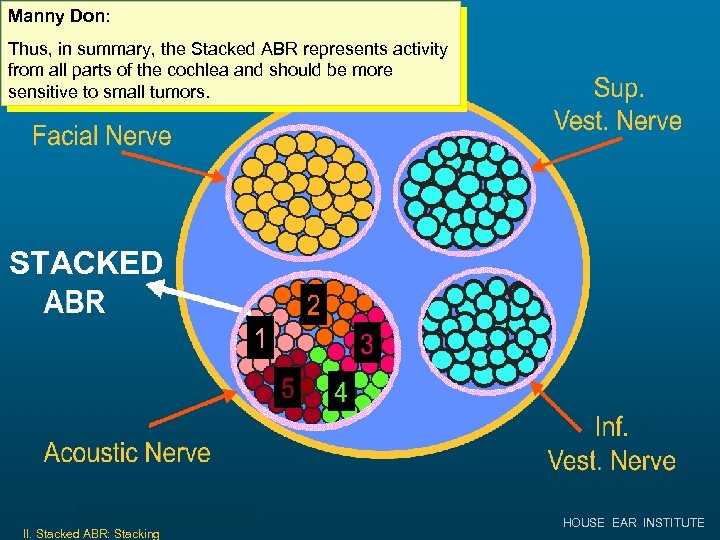 Manny Don: Thus, in summary, the Stacked ABR represents activity from all parts of the cochlea and should be more sensitive to small tumors. STACKED . II. Stacked ABR: Stacking HOUSE EAR INSTITUTE
 Manny Don: I would like to take a few moments to discuss some aspects about ABR recordings that are critical to the Stacked ABR: Rationale and Method A. Derived-band ABRs 1. Stimuli a. Clicks b. High-pass masking noise 2. Response subtraction B. Stacking derived-band ABRs C. ABR recordings II. Stacked ABR: Method/ABR Recordings HOUSE EAR INSTITUTE
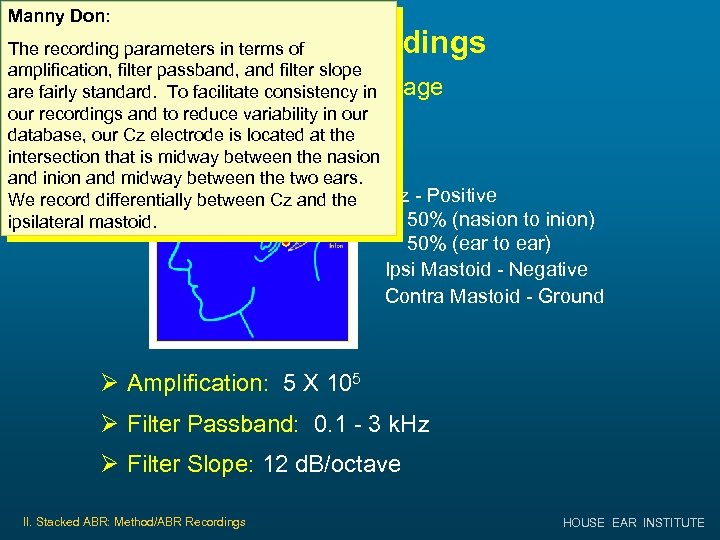 Manny Don: ABR Recordings The recording parameters in terms of amplification, filter passband, and filter slope Ø Electrode Recording Montage are fairly standard. To facilitate consistency in our recordings and to reduce variability in our database, our Cz electrode is located at the intersection that is midway between the nasion and inion and midway between the two ears. Cz - Positive We record differentially between Cz and the 50% (nasion to inion) ipsilateral mastoid. 50% (ear to ear) Ipsi Mastoid - Negative Contra Mastoid - Ground Ø Amplification: 5 X 10⁵ Ø Filter Passband: 0. 1 - 3 k. Hz Ø Filter Slope: 12 d. B/octave II. Stacked ABR: Method/ABR Recordings HOUSE EAR INSTITUTE
 Manny Don: ABR Recordings An important aspect of the Stacked ABR is to make sure that the derived-ABR responses that are “stacked” have minimal physiological noise. We want the measure to represent neural activity related to stimulation rather than background physiological noise. To accomplish this, we perform estimates of the residual noise in the ABR, perform an average that is 1. towards blocks of Unaveraged Noise weighted Estimation of sweeps that have the least (Fsp estimation) physiological background noise, and terminate the 2. Weighted Averaging (Bayesian weighting) averaging when the estimate is a low 20 n. V. Ø Minimization of Physiological Noise in ABRs 3. Termination of Averaging When Residual Noise Level is low ( 20 n. V) II. Stacked ABR: Method/ABR Recordings HOUSE EAR INSTITUTE
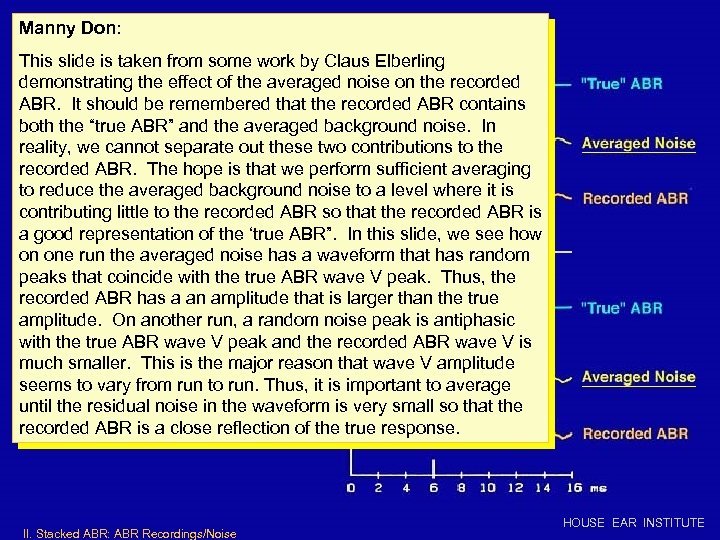 Manny Don: This slide is taken from some work by Claus Elberling demonstrating the effect of the averaged noise on the recorded ABR. It should be remembered that the recorded ABR contains both the “true ABR” and the averaged background noise. In reality, we cannot separate out these two contributions to the recorded ABR. The hope is that we perform sufficient averaging to reduce the averaged background noise to a level where it is contributing little to the recorded ABR so that the recorded ABR is a good representation of the ‘true ABR”. In this slide, we see how on one run the averaged noise has a waveform that has random peaks that coincide with the true ABR wave V peak. Thus, the recorded ABR has a an amplitude that is larger than the true amplitude. On another run, a random noise peak is antiphasic with the true ABR wave V peak and the recorded ABR wave V is much smaller. This is the major reason that wave V amplitude seems to vary from run to run. Thus, it is important to average until the residual noise in the waveform is very small so that the recorded ABR is a close reflection of the true response. II. Stacked ABR: ABR Recordings/Noise HOUSE EAR INSTITUTE
 ABR Recordings Ø Minimization of Physiological Noise in ABRs 1. Estimation of Unaveraged Noise (Fsp estimation) 2. Weighted Averaging (Bayesian weighting) 3. Termination of Averaging When Residual Noise Level is low ( 20 n. V) II. Stacked ABR: Rationale and Method--ABR recordings HOUSE EAR INSTITUTE
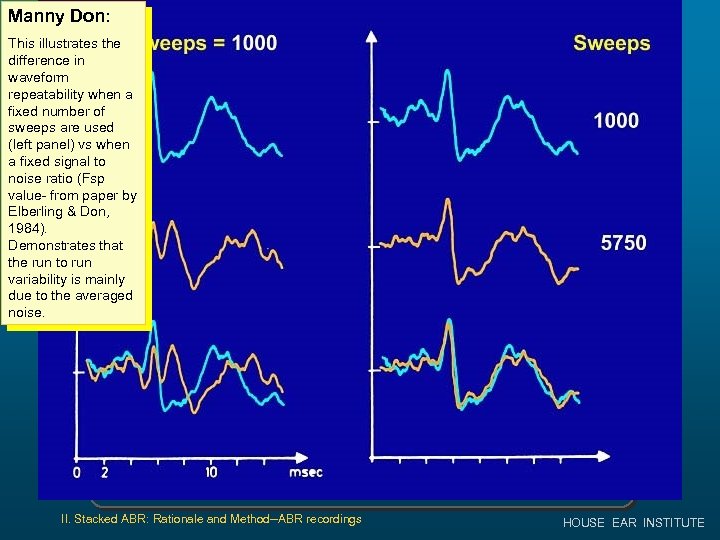 Manny Don: This illustrates the difference in waveform repeatability when a fixed number of sweeps are used (left panel) vs when a fixed signal to noise ratio (Fsp value- from paper by Elberling & Don, 1984). Demonstrates that the run to run variability is mainly due to the averaged noise. II. Stacked ABR: Rationale and Method--ABR recordings HOUSE EAR INSTITUTE
 ABR Recordings Ø Minimization of Physiological Noise in ABRs 1. Estimation of Unaveraged Noise (Fsp estimation) 2. Weighted Averaging (Bayesian weighting) 3. Termination of Averaging When Residual Noise Level is low ( 20 n. V) II. Stacked ABR: Rationale and Method--ABR recordings HOUSE EAR INSTITUTE
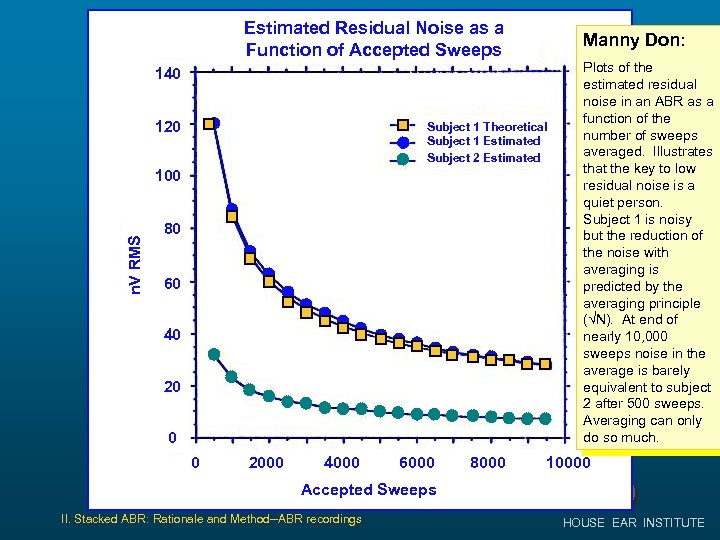 Estimated Residual Noise as a Function of Accepted Sweeps Manny Don: 140 120 Subject 1 Theoretical Subject 1 Estimated Subject 2 Estimated n. V RMS 100 80 60 40 20 0 0 2000 4000 6000 8000 Plots of the estimated residual noise in an ABR as a function of the number of sweeps averaged. Illustrates that the key to low residual noise is a quiet person. Subject 1 is noisy but the reduction of the noise with averaging is predicted by the averaging principle (√N). At end of nearly 10, 000 sweeps noise in the average is barely equivalent to subject 2 after 500 sweeps. Averaging can only do so much. 10000 Accepted Sweeps II. Stacked ABR: Rationale and Method--ABR recordings HOUSE EAR INSTITUTE
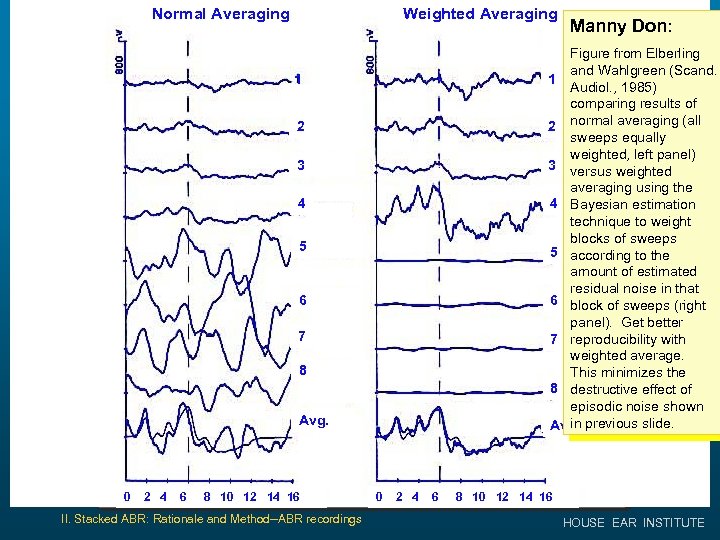 Normal Averaging Weighted Averaging 1 (0. 8) 3 Figure from Elberling and Wahlgreen (Scand. 1 (2. 03) Audiol. , 1985) comparing results of 2 normal averaging (all (1. 35) sweeps equally weighted, left panel) 3 versus weighted (1. 18) averaging using the 4 Bayesian estimation (3. 20) technique to weight blocks of sweeps 5 according to the (0. 04) amount of estimated residual noise in that 6 block of sweeps (right (0. 05) panel). Get better 7 reproducibility with (0. 07) weighted average. This minimizes the (0. 07) 8 destructive effect of episodic noise shown Avg. (X 4) in Avg. previous slide. (0. 5) 2 (1. 0) 4 (0. 3) 5 (31. 7) 6 (19. 8) 7 (17. 2) (17. 4) 8 Avg. (X 4) Avg. 0 2 4 6 8 10 12 14 16 II. Stacked ABR: Rationale and Method--ABR recordings Manny Don: 0 2 4 6 8 10 12 14 16 HOUSE EAR INSTITUTE
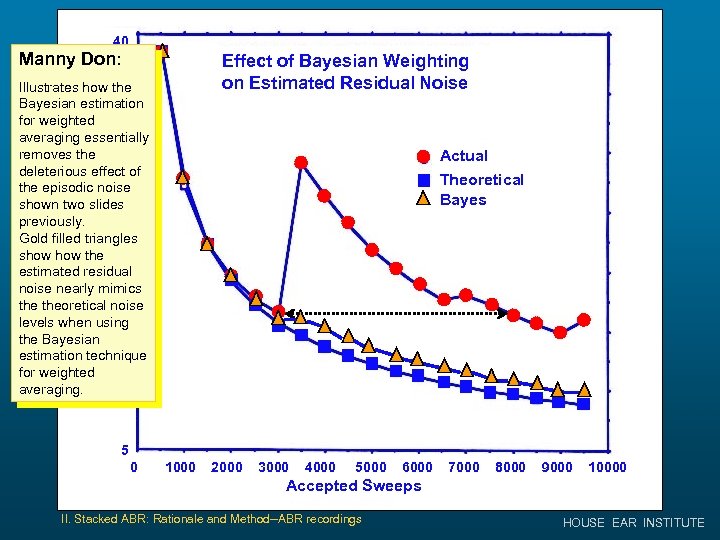 40 Manny Don: Effect of Bayesian Weighting on Estimated Residual Noise Illustrates how the 35 Bayesian estimation for weighted averaging essentially removes the 30 deleterious effect of the episodic noise shown two slides 25 previously. Gold filled triangles show the 20 estimated residual noise nearly mimics theoretical noise levels when using 15 the Bayesian estimation technique for weighted 10 averaging. n. V RMS Actual Theoretical Bayes 5 0 1000 2000 3000 4000 5000 6000 7000 8000 9000 10000 Accepted Sweeps II. Stacked ABR: Rationale and Method--ABR recordings HOUSE EAR INSTITUTE
 Summary of Noise in ABRs Ø All ABRs contain unaveraged background physiological noise (i. e. residual noise) Ø Methods for estimating the amount of noise in the ABR can be used to: 1. Give greater weight to sweeps with the lowest noise, and Determine when to stop averaging. 2. II. Stacked ABR: ABR Recordings/Noise HOUSE EAR INSTITUTE
 CAUTION! Ø Since the Stacked ABR is an amplitude measure, the amount of noise left in the response is critical. Ø For a more accurate estimate of neural activity, the residual noise level must be low. Ø If the residual noise level is high, then the Stacked ABR must be interpreted with caution. II. Stacked ABR: ABR Recordings/Noise HOUSE EAR INSTITUTE
 ABR Recordings Ø Minimization of Physiological Noise in ABRs 1. Estimation of Unaveraged Noise (Fsp estimation) 2. Weighted Averaging (Bayesian weighting) 3. Termination of Averaging When Residual Noise Level is low ( 20 n. V) II. Stacked ABR: Rationale and Method--ABR recordings HOUSE EAR INSTITUTE
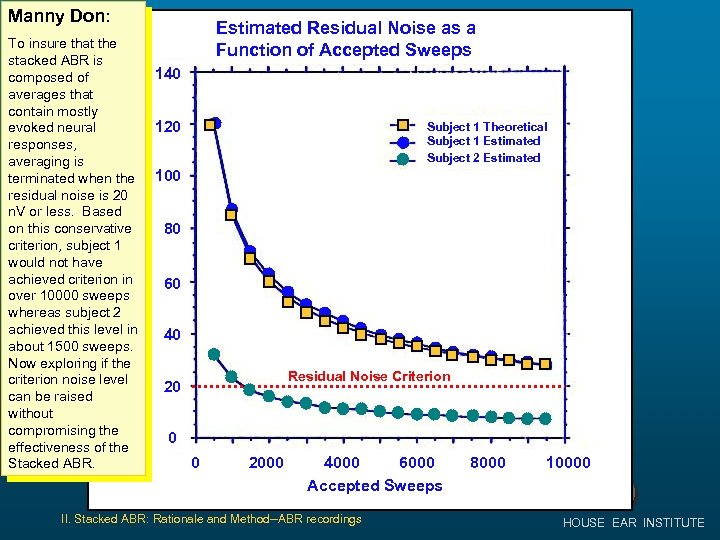 Manny Don: n. V RMS To insure that the stacked ABR is composed of averages that contain mostly evoked neural responses, averaging is terminated when the residual noise is 20 n. V or less. Based on this conservative criterion, subject 1 would not have achieved criterion in over 10000 sweeps whereas subject 2 achieved this level in about 1500 sweeps. Now exploring if the criterion noise level can be raised without compromising the effectiveness of the Stacked ABR. Estimated Residual Noise as a Function of Accepted Sweeps 140 120 Subject 1 Theoretical Subject 1 Estimated Subject 2 Estimated 100 80 60 40 Residual Noise Criterion 20 0 0 2000 4000 6000 Accepted Sweeps II. Stacked ABR: Rationale and Method--ABR recordings 8000 10000 HOUSE EAR INSTITUTE
 Clinical Judgement Ø There will be cases where the residual noise level remains high even after thousands of sweeps. Ø In these cases, make sure the patient is comfortable and as relaxed as possible before you continue. Ø If the patient remains noisy, then the Stacked ABR must be interpreted with caution. II. Stacked ABR: ABR Recordings/Noise HOUSE EAR INSTITUTE
 Take Home Message 5 Ø Residual noise levels must be low so that the Stacked ABR amplitude mostly reflects total neural activity, not noise. Ø Stacked ABRs formed from noisy recordings may be unreliable and should be interpreted with extreme caution. Questions? II. Stacked ABR: Rationale and Method--ABR recordings HOUSE EAR INSTITUTE
 Talk Outline I. Background: Evolution of the Stacked ABR II. Stacked ABR: Rationale and Method III. Stacked ABR: Studies IV. Tumor Screening Protocol V. Future Stacked ABR Work Talk Outline HOUSE EAR INSTITUTE
 Stacked ABR: Studies A. Interpretation of Results 1. Basics of Data Presentation 2. Sensitivity vs. Specificity B. Published Study C. Preliminary Work III. Stacked ABR/Interpretation of Results HOUSE EAR INSTITUTE
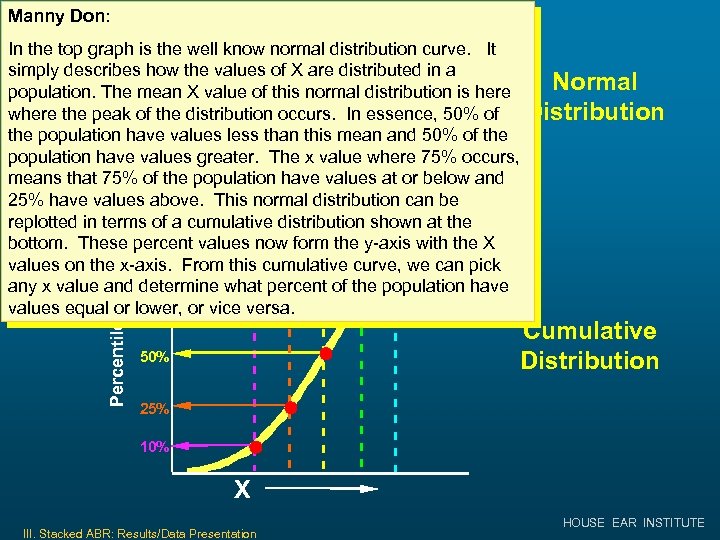 Manny Don: 50% Percentile In the top graph is the well know normal distribution curve. It simply describes how the values of X are distributed in a 25% 75% Normal population. The mean X value of this normal distribution is here 90% 10% where the peak of the distribution occurs. In essence, 50% of Distribution the population have values less than this mean and 50% of the population have values greater. The x value where 75% occurs, X means that 75% of the population have values at or below and 25% have values above. This normal distribution can be replotted in terms of a cumulative distribution shown at the bottom. These percent values now form the y-axis with the X values on the x-axis. From this cumulative curve, we can pick 90% any x value and determine what percent of the population have 75% values equal or lower, or vice versa. Cumulative Distribution 50% 25% 10% X III. Stacked ABR: Results/Data Presentation HOUSE EAR INSTITUTE
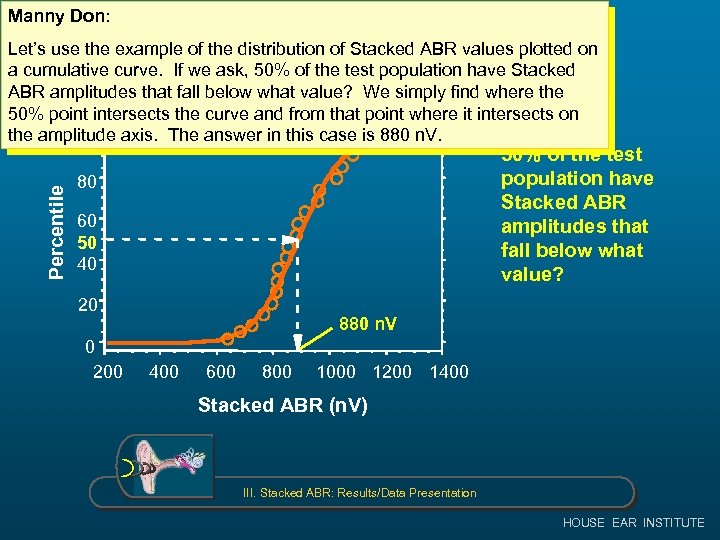 Manny Don: Cumulative Distribution Curve Percentile Let’s use the example of the distribution of Stacked ABR values plotted on a cumulative curve. If we ask, 50% of the test population have Stacked ABR amplitudes that fall below what value? We simply find where the 50% point intersects the curve and from that point where it intersects on the amplitude axis. The answer in this case is 880 n. V. 100 50% of the test population have Stacked ABR amplitudes that fall below what value? 80 60 50 40 200 880 n. V 400 600 800 1000 1200 1400 Stacked ABR (n. V) III. Stacked ABR: Results/Data Presentation HOUSE EAR INSTITUTE
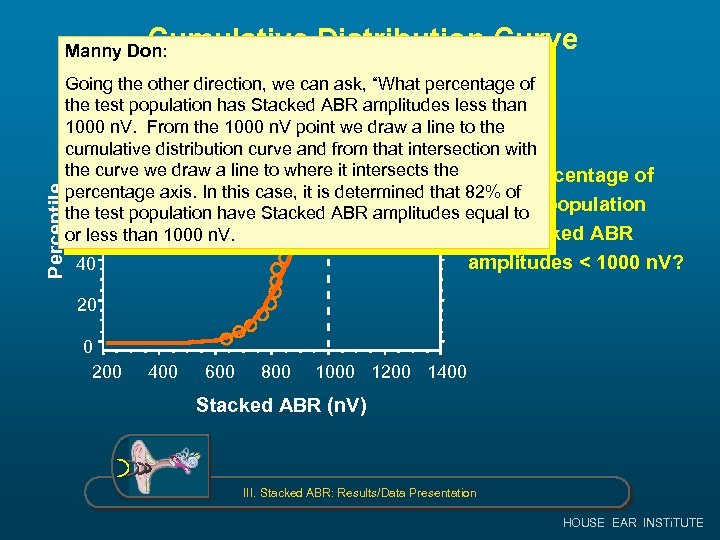 Cumulative Distribution Curve Manny Don: Percentile Going the other direction, we can ask, “What percentage of the test population has Stacked ABR amplitudes less than 1000 n. V. From the 1000 n. V point we draw a line to the 100 82 % cumulative distribution curve and from that intersection with the curve we draw a line to where it intersects the What percentage of 80 percentage axis. In this case, it is determined that 82% of the test population have Stacked ABR amplitudes equal to population 60 has Stacked ABR or less than 1000 n. V. amplitudes < 1000 n. V? 40 200 400 600 800 1000 1200 1400 Stacked ABR (n. V) III. Stacked ABR: Results/Data Presentation HOUSE EAR INSTi. TUTE
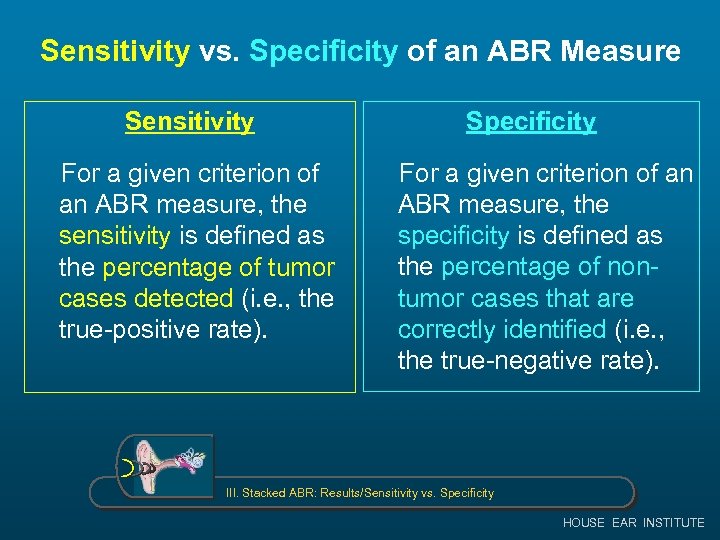 Sensitivity vs. Specificity of an ABR Measure Sensitivity For a given criterion of an ABR measure, the sensitivity is defined as the percentage of tumor cases detected (i. e. , the true-positive rate). Specificity For a given criterion of an ABR measure, the specificity is defined as the percentage of nontumor cases that are correctly identified (i. e. , the true-negative rate). III. Stacked ABR: Results/Sensitivity vs. Specificity HOUSE EAR INSTITUTE
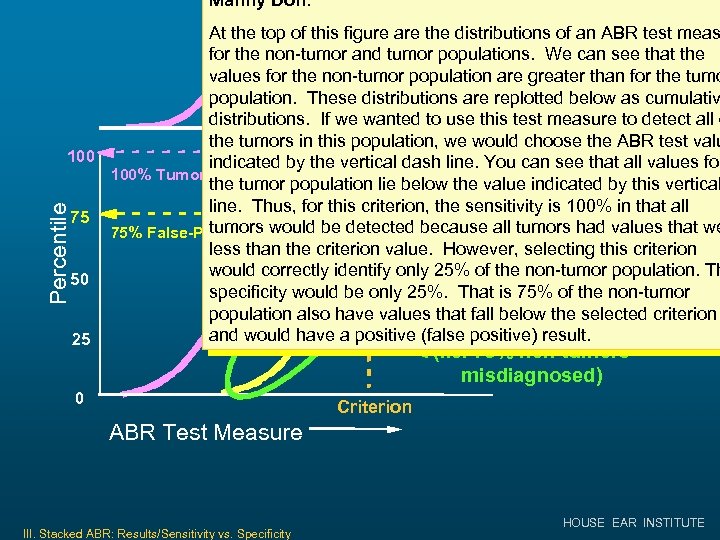 Manny Don: Percentile At the top of this figure are the distributions of an ABR test meas for the non-tumor and tumor populations. We can see that the values for the non-tumor population are greater than for the tumo Tumor Non-Tumor population. These distributions are replotted below as cumulativ distributions. If we wanted to use this test measure to detect all o the tumors in this population, we would choose the ABR test valu 100 indicated by the vertical dash line. You can see that all values for 100% Tumors Detected Criterion the tumor population lie below the value indicated by this vertical 100% Sensitivity line. Thus, for this criterion, the sensitivity is 100% in that all 75 tumors because all tumors had values 75% False-Positives would be detected (i. e. all tumors detected) that we less than the criterion value. However, selecting this criterion would correctly identify only 25% of the non-tumor population. Th 50 specificity would be only 25%. That is 75% of the non-tumor population also have values that fall below the selected criterion 25% Specificity and would have a positive (false positive) result. 25 (i. e. 75% non-tumors misdiagnosed) 0 Criterion ABR Test Measure III. Stacked ABR: Results/Sensitivity vs. Specificity HOUSE EAR INSTITUTE
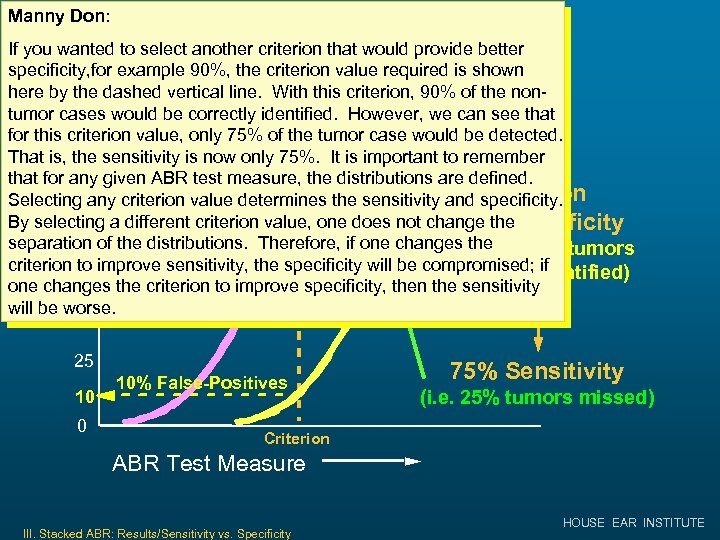 Manny Don: Percentile If you wanted to select another criterion that would provide better specificity, for example 90%, Tumor the criterion value required is shown Non-Tumor here by the dashed vertical line. With this criterion, 90% of the nontumor cases would be correctly identified. However, we can see that for this criterion value, only 75% of the tumor case would be detected. That is, 100 sensitivity is now only 75%. It is important to remember the that for any given ABR test measure, the distributions are defined. Criterion Selecting any criterion value determines the sensitivity and specificity. 75% Tumors Detected By selecting a different criterion value, one does not change the 90% Specificity 75 separation of the distributions. Therefore, if one changes the (i. e. 90% non-tumors criterion to improve sensitivity, the specificity will be compromised; identified) correctly if one changes the criterion to improve specificity, then the sensitivity 50 will be worse. 25 10 0 10% False-Positives 75% Sensitivity (i. e. 25% tumors missed) Criterion ABR Test Measure III. Stacked ABR: Results/Sensitivity vs. Specificity HOUSE EAR INSTITUTE
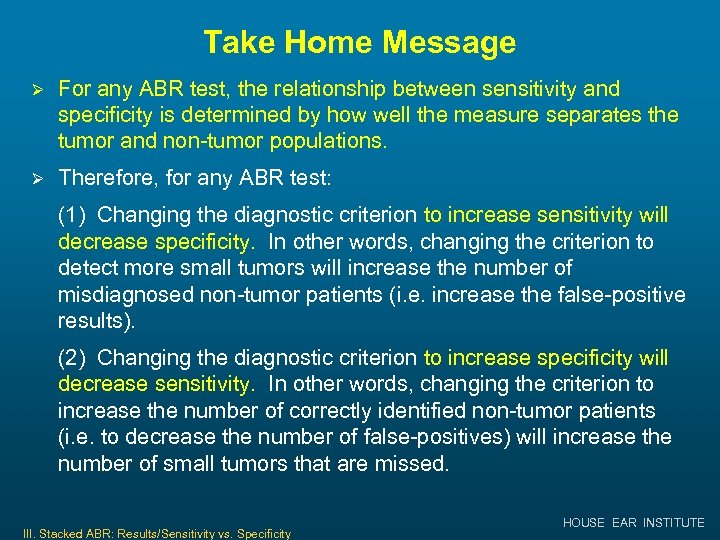 Take Home Message Ø For any ABR test, the relationship between sensitivity and specificity is determined by how well the measure separates the tumor and non-tumor populations. Ø Therefore, for any ABR test: (1) Changing the diagnostic criterion to increase sensitivity will decrease specificity. In other words, changing the criterion to detect more small tumors will increase the number of misdiagnosed non-tumor patients (i. e. increase the false-positive results). (2) Changing the diagnostic criterion to increase specificity will decrease sensitivity. In other words, changing the criterion to increase the number of correctly identified non-tumor patients (i. e. to decrease the number of false-positives) will increase the number of small tumors that are missed. III. Stacked ABR: Results/Sensitivity vs. Specificity HOUSE EAR INSTITUTE
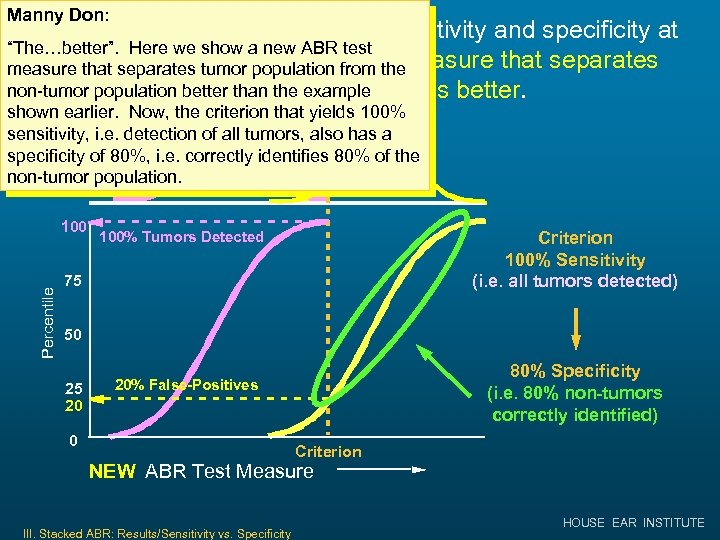 Manny Don: The only way to increase both sensitivity and specificity at “The…better”. Here we show a new ABR test the that separates is to use an from the measure same time tumor population ABR measure that separates non-tumor population better than the example the non-tumor and tumor populations better. shown earlier. Now, the criterion that yields 100% sensitivity, i. e. detection of all tumors, also has a specificity of 80%, i. e. correctly identifies 80% of the non-tumor population. Tumor Non-Tumor Percentile 100 Criterion 100% Sensitivity (i. e. all tumors detected) 100% Tumors Detected 75 50 25 20 80% Specificity (i. e. 80% non-tumors correctly identified) 20% False-Positives 0 Criterion NEW ABR Test Measure III. Stacked ABR: Results/Sensitivity vs. Specificity HOUSE EAR INSTITUTE
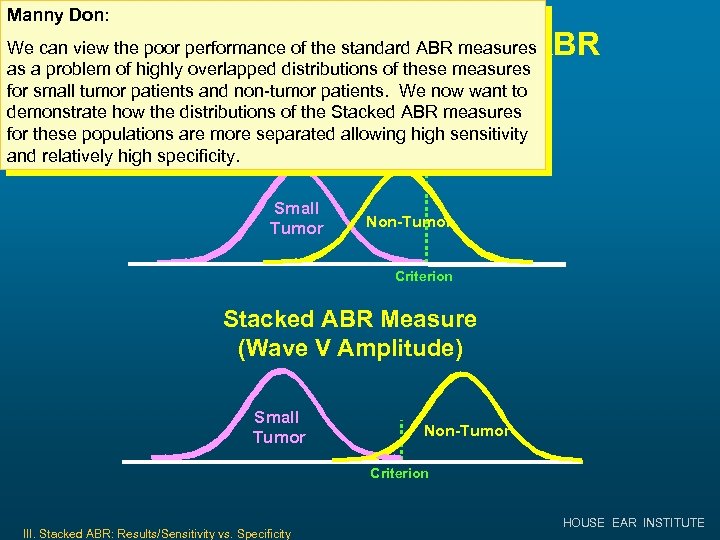 Manny Don: Standard ABR vs. Stacked ABR We can view the poor performance of the standard ABR measures as a problem of highly overlapped distributions of these measures for small tumor patients and non-tumor patients. We now want to demonstrate how the distributions of the Stacked Measure Standard ABR measures for these populations are more separated allowing high sensitivity (e. g. , IT 5 or I-V Delay) and relatively high specificity. Small Tumor Non-Tumor Criterion Stacked ABR Measure (Wave V Amplitude) Small Tumor Non-Tumor Criterion III. Stacked ABR: Results/Sensitivity vs. Specificity HOUSE EAR INSTITUTE
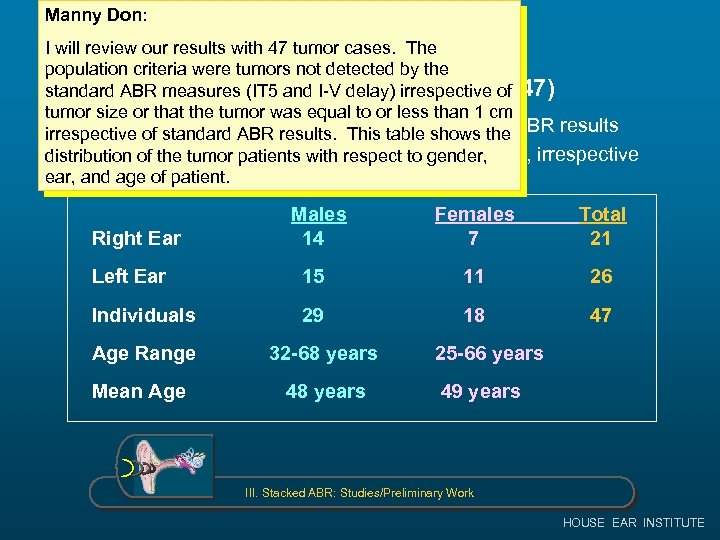 Manny Don: SUBJECTS I will review our results with 47 tumor cases. The population criteria were tumors not detected by the Acoustic and I-V delay) irrespective = standard ABR measures (IT 5 Tumor Subjects (N of 47) tumor size or that the tumor was equal to or less than 1 cm Ø Small (< 1 cm) tumors, irrespective of standard ABR results. This table shows the ABR results Ø Tumors not detected by standard ABR measures, irrespective distribution of the tumor patients with respect to gender, ear, and age of patient. of the tumor size Males 14 Females 7 Total 21 Left Ear 15 11 26 Individuals 29 18 47 Right Ear Age Range 32 -68 years Mean Age 48 years 25 -66 years 49 years III. Stacked ABR: Studies/Preliminary Work HOUSE EAR INSTITUTE
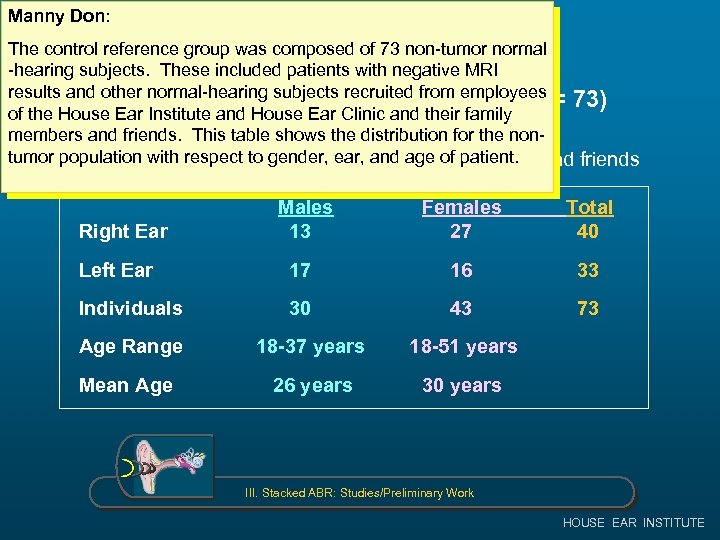 Manny Don: The control reference group was composed of 73 non-tumor normal -hearing subjects. These included patients with negative MRI results and Non-tumor Normal-hearing Subjects (N = 73) other normal-hearing subjects recruited from employees of the House Ear Institute and House Ear Clinic and their family Ø and friends. This patients with distribution for results members House Ear Clinictable shows thenegative MRI the nontumor population with respect toand Clinic employees, patient. and friends Ø House Ear Institute gender, ear, and age of families, SUBJECTS Males 13 Females 27 Total 40 Left Ear 17 16 33 Individuals 30 43 73 Right Ear Age Range 18 -37 years 18 -51 years Mean Age 26 years 30 years III. Stacked ABR: Studies/Preliminary Work HOUSE EAR INSTITUTE
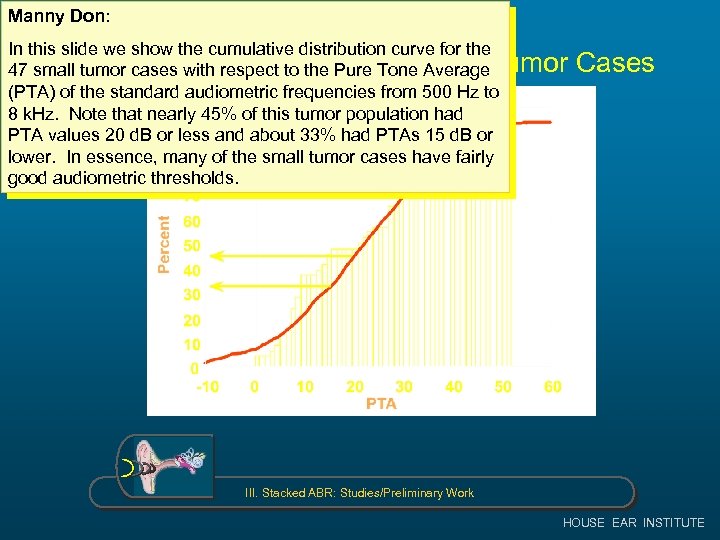 Manny Don: In this slide we show the cumulative distribution curve for the Pure Tone Averages Pure Tone Average 47 small tumor cases with respect to the for 47 Small Tumor (PTA) of the standard audiometric frequencies from 500 Hz to 8 k. Hz. Note that nearly 45% of this tumor population had PTA values 20 d. B or less and about 33% had PTAs 15 d. B or lower. In essence, many of the small tumor cases have fairly good audiometric thresholds. Cases III. Stacked ABR: Studies/Preliminary Work HOUSE EAR INSTITUTE
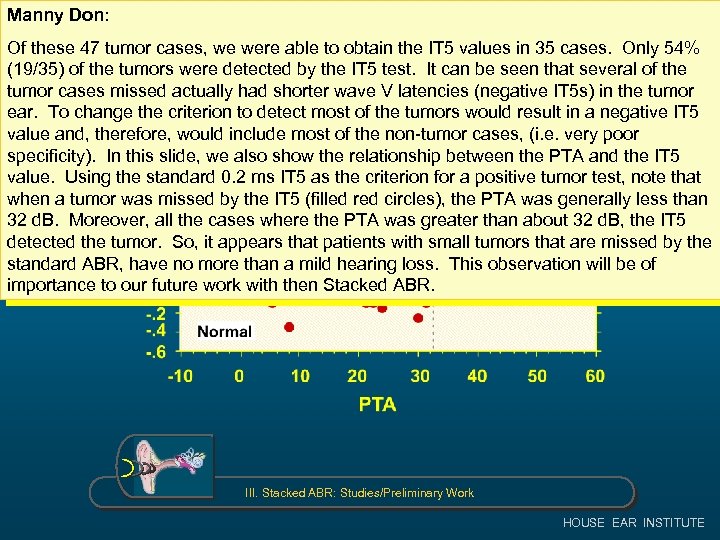 Manny Don: Of these 47 tumor cases, we were able to obtain the IT 5 values in 35 cases. Only 54% N = 35 (19/35) of the tumors were detected by the IT 5 test. It can be seen that several of the l Detected (19) tumor cases missed actually had shorter wave V latencies (negative IT 5 s) in the tumor l to detect most of the tumors would result in a negative IT 5 ear. To change the criterion. Missed (16) value and, therefore, would include most of the non-tumor cases, (i. e. very poor specificity). In this slide, we also show the relationship between the PTA and the IT 5 value. Using the standard 0. 2 ms IT 5 as the criterion for a positive tumor test, note that when a tumor was missed by the IT 5 (filled red circles), the PTA was generally less than 32 d. B. Moreover, all the cases where the PTA was greater than about 32 d. B, the IT 5 detected the tumor. So, it appears that patients with small tumors that are missed by the standard ABR, have no more than a mild hearing loss. This observation will be of importance to our future work with then Stacked ABR. III. Stacked ABR: Studies/Preliminary Work HOUSE EAR INSTITUTE
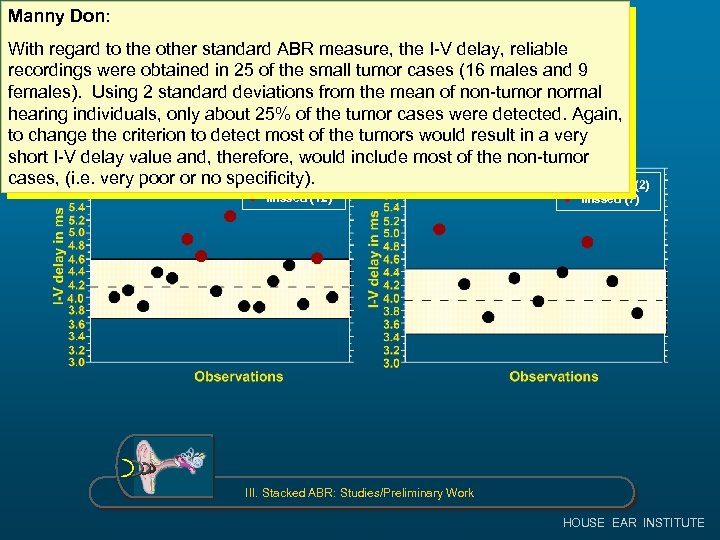 Manny Don: With regard to the other standard ABR measure, the I-V delay, reliable recordings were obtained in 25 of the I-V Delaycases (16 males and 9 small tumor females). Using 2 standard deviations from the mean of non-tumor normal hearing individuals, only about 25% of the tumor cases were detected. Again, Tumors Females Tumors - Males to change the criterion to detect most of the tumors would result in-a very N=9 N short I-V delay value and, = 16 therefore, would include most of the non-tumor cases, (i. e. very poor or no specificity). (4) l Detected (2) l Missed (12) l Missed (7) III. Stacked ABR: Studies/Preliminary Work HOUSE EAR INSTITUTE
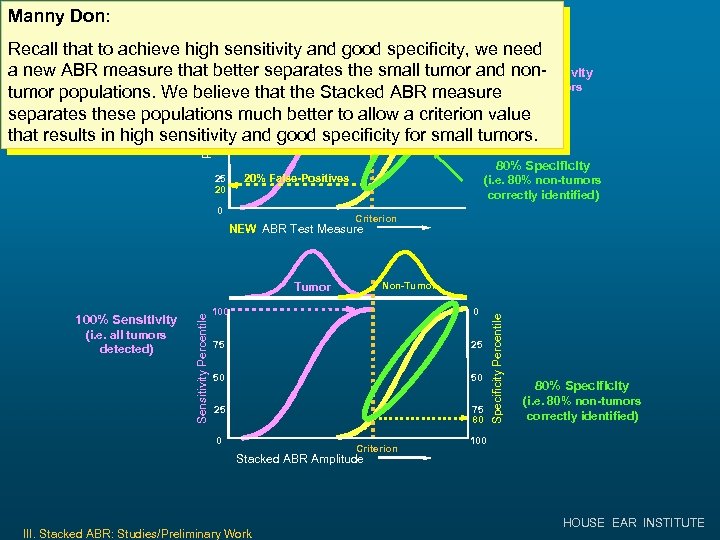 Manny Don: Percentile Recall that to achieve high sensitivity and good. Non-Tumor specificity, we need Tumor a new ABR measure that 100 better separates the small tumor and non 100% Sensitivity 100% Tumors Detected tumor populations. We believe that the Stacked ABR measure(i. e. all tumors detected) 75 separates these populations much better to allow a criterion value that results in high sensitivity and good specificity for small tumors. 50 25 20 80% Specificity 20% False-Positives 0 (i. e. 80% non-tumors correctly identified) Criterion NEW ABR Test Measure (i. e. all tumors detected) Non-Tumor 100 0 75 25 50 50 25 75 80 0 Criterion Specificity Percentile 100% Sensitivity Percentile Tumor 80% Specificity (i. e. 80% non-tumors correctly identified) 100 Stacked ABR Amplitude III. Stacked ABR: Studies/Preliminary Work HOUSE EAR INSTITUTE
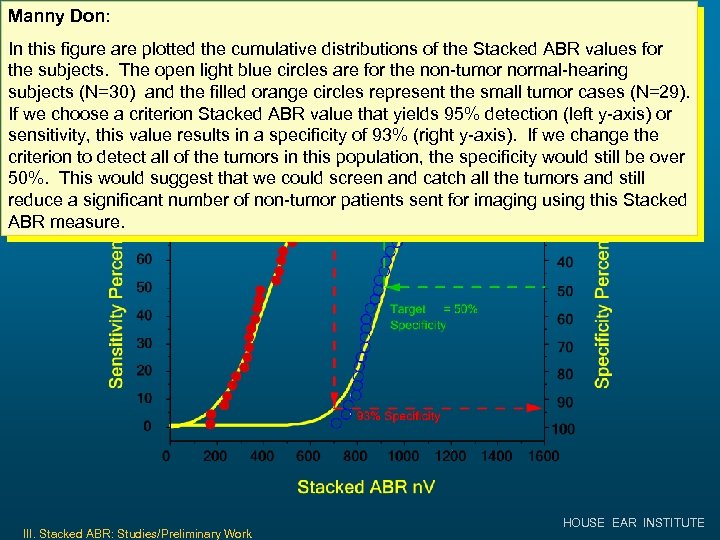 Manny Don: l Tumors In this figure are plotted the cumulative distributions of the Stacked ABR values for Normal-Hearing Males are¡for the non-tumor normal-hearing the subjects. The open light blue circles Non-Tumor subjects (N=30) and the filled orange circles represent the small tumor cases (N=29). If we choose a criterion Stacked ABR value that yields 95% detection (left y-axis) or sensitivity, this value results in a specificity of 93% (right y-axis). If we change the criterion to detect all of the tumors in this population, the specificity would still be over 50%. This would suggest that we could screen and catch all the tumors and still reduce a significant number of non-tumor patients sent for imaging using this Stacked ABR measure. III. Stacked ABR: Studies/Preliminary Work HOUSE EAR INSTITUTE
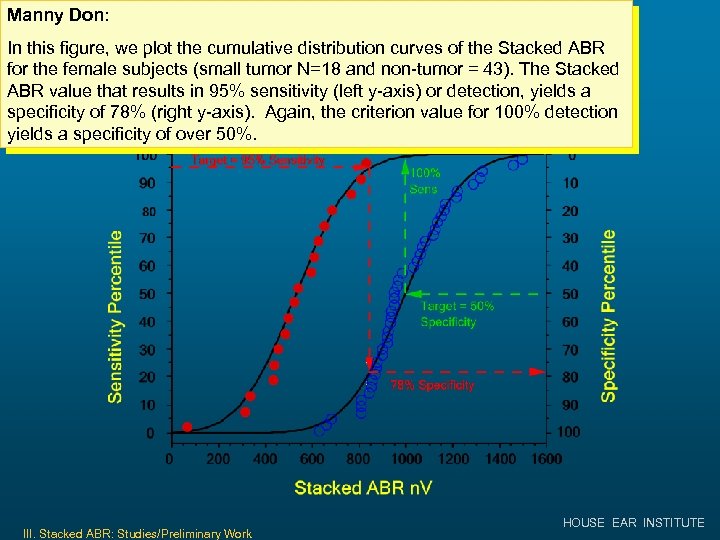 Manny Don: l Tumors In this figure, we plot the cumulative distribution curves of the Stacked ABR Females ¡ Normal-Hearing for the female subjects (small tumor N=18 and non-tumor = 43). The Stacked Non-Tumor ABR value that results in 95% sensitivity (left y-axis) or detection, yields a specificity of 78% (right y-axis). Again, the criterion value for 100% detection yields a specificity of over 50%. III. Stacked ABR: Studies/Preliminary Work HOUSE EAR INSTITUTE
 Manny Don: Self-explanatory Take Home Message The Stacked ABR appears to have better sensitivity and specificity than the Standard ABR for small (<1 cm) tumors. In other words, the Stacked ABR is better at : 1. detecting small tumors, and 2. decreasing the number of misdiagnosed non-tumor patients (i. e. decreasing the number of false-positives referred for MRI). III. Stacked ABR: Studies/Preliminary Work HOUSE EAR INSTITUTE
 Manny Don: I want to briefly outline a simple screening protocol for acoustic tumors. Talk Outline I. Background: Evolution of the Stacked ABR II. Stacked ABR: Rationale and Method III. Stacked ABR: Studies IV. Tumor Screening Protocol V. Future Stacked ABR Work Talk Outline HOUSE EAR INSTITUTE
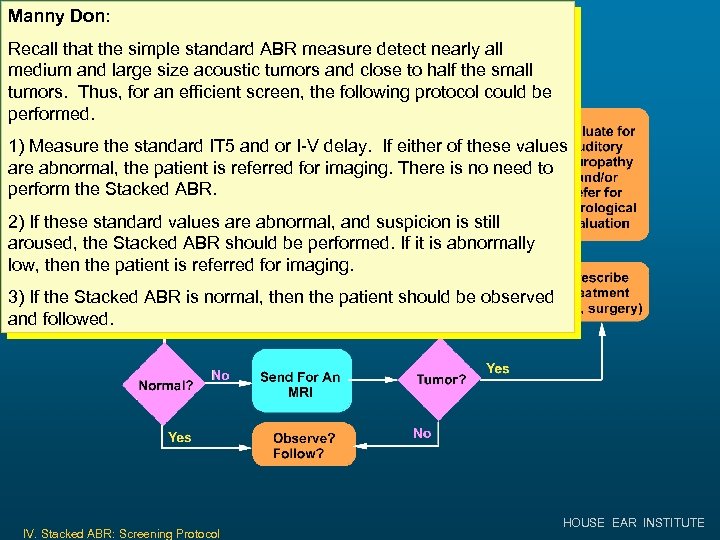 Manny Don: Recall that the simple standard ABR measure detect nearly all medium and large size acoustic tumors and close to half the small tumors. Thus, for an efficient screen, the following protocol could be performed. 1) Measure the standard IT 5 and or I-V delay. If either of these values are abnormal, the patient is referred for imaging. There is no need to perform the Stacked ABR. 2) If these standard values are abnormal, and suspicion is still aroused, the Stacked ABR should be performed. If it is abnormally low, then the patient is referred for imaging. 3) If the Stacked ABR is normal, then the patient should be observed and followed. IV. Stacked ABR: Screening Protocol HOUSE EAR INSTITUTE
 Talk Outline I. Background: Evolution of the Stacked ABR II. Stacked ABR: Rationale and Method III. Stacked ABR: Studies IV. Tumor Screening Protocol V. Future Stacked ABR Work Talk Outline HOUSE EAR INSTITUTE
 Manny Don: Future Stacked ABR Work In our NIH funded work we are investigating the following optimizations and refinements to the Stacked ABR method: 1)We believe that interaural comparisons, when obtainable, will Ø improve the sensitivity of the Stacked ABR. Optimization and Refinement of the Stacked ABR 2) We believe that specificity might be improved by taking into 1. Interaural comparisons consideration the effect of hearing loss. 2. Hearing using compensation 3) We also believe thatloss faster click rates will increase the separation between the small tumor from non-tumor populations. 3. Faster stimulus rates Ø Development of an automated clinical prototype V. Future Work HOUSE EAR INSTITUTE
 Development of an Automated Clinical Prototype Ø Bio-logic Systems Corp. : Licensed by the House Ear Institute to collaborate on development of an automated version of the Stacked ABR. Ø Multi-Center Study: For validation of the Stacked ABR method and evaluation of the automated prototype. (NIH SBIR Phase II Awarded to Bio-logic Systems Corp. ) V. Current Developments and Future Stacked ABR Work HOUSE EAR INSTITUTE
 Staff Acknowledgements Department of Electrophysiology Betty Kwong, M. S. , CCC-A Chiemi Tanaka, M. A. , CCC-A Michael Waring, Ph. D. Department of Clinical Studies Ann Masuda, M. S. , CCC-A Department of Histopathology Fred Linthicum, M. D. Physicians at the House Ear Clinic
 Support NIH/NIDCD 1 R 43 DC 04141 Raviv (PI) NIH/NIDCD 2 R 44 DC 04141 Raviv (PI) NIH/NIDCD R 01 DC 03592 Don (PI) HOUSE EAR INSTITUTE