


 Скачать презентацию HOUSE CALLS 101 Sandra Qaseem MD Goals
162911e2af8b317a6bca7a27f6797ab1.ppt
- Количество слайдов: 21
 HOUSE CALLS 101 Sandra Qaseem MD
 Goals and objectives At the end of the presentation knowledge gained will help to • Identify patients that would likely benefit from house calls • Select the equipment necessary for a basic house call • Understand how to set up and perform a house call and bill for the service • Implement house calls as part of your regular practice
 Background • Number of homebound is increasing- 11 million adults living at home are limited in their ability to perform ADL’s • Number of house calls is increasing- in 2010 (medicare data) The total number was 2, 517644 for house call codes and 2, 204, 351 for domiciliary care. This represents a 6. 5% increase for house call codes and a 9. 9% increase in domiciliary care codes from 2009. • Concept of medical home • Independence at Home • Face to face requirement for skilled homecare services (RN, PT, OT etc) http: //www. cdc. gov/prc/pdf/PRC_HA_fact_sheet_summer 2006. pd
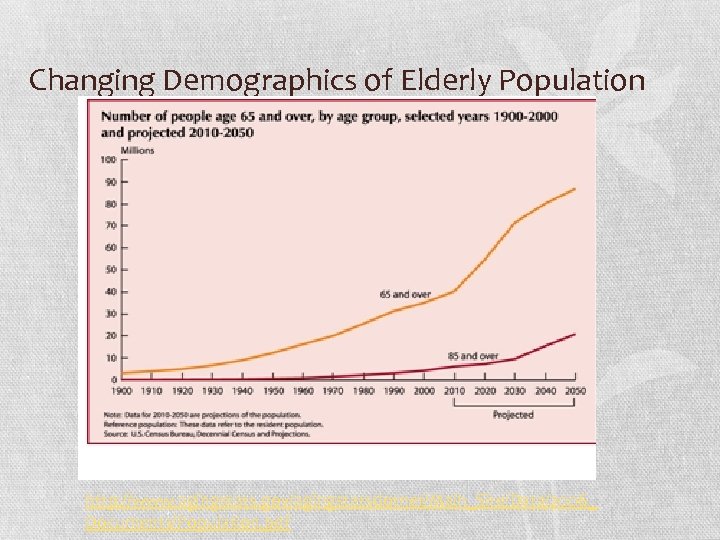 Changing Demographics of Elderly Population http: //www. agingstats. gov/agingstatsdotnet/Main_Site/Data/2006_ Documents/Population. pdf
 Where Do Our Patients Live? • At home with or without caregiver assistance • At home with Adult Day Care Services • Assisted Living Facilities • Shelter Care or Residential Care Homes • Total care community • Nursing Homes
 Why make house calls? • Patients need them and are more satisfied with treatment in the home • Patients access more regular care • Less hospitalization and use of Emergency Department translating to reduced healthcare costs • Better assessment of environmental contribution to medical problems • Evaluation of caregiver • Families are happy and caregivers less stressed • Personal satisfaction • Schedule flexibility
 Equipment- ‘The Black Bag’ • As you begin doing house calls, you will quickly customize your black bag to include those things that you find necessary and convenient. Here is a quick list of things to get you started: • Street map or GPS, • Netbook/ laptop • Stethoscope, • Blood pressure cuff (regular and large), • Pulse Oximeter • Pen light, • Tongue depressors, • Otoscope, • Prescription pad, • Phone numbers (offices, pharmacies, etc. ), • Cell phone, palm-held computer, etc. • Dictaphone/forms/progress notes, • additional pens. House Calls: Taking the Practice to the Patient James M. Giovino, MD , Fam Pract Manag. 2000 Jun; 7(6): 49 -54
 Patient Eligibility for Home Care • The visit must be “medically reasonable and necessary” • Mobility impairments • Disruptive behavior • Terminal illness • Multiple complex medical, psychiatric and social problems • Compliance issues • Not required to be as totally homebound as for skilled homecare from agency such as RN/ PT/OT
 Identify a patient (or 2) • Try to find a patient on your panel with mobility issues having great difficulty accessing care in the clinic • Ask him/ her if they would like a house call and explain the potential benefits (not everyone prefers them- for some it is a rare social event to come to the clinic!) • Set up a date and time for visit preferably at the end of the work day, if possible have a family member or caregiver present especially for the first visit
 Making the visit • If possible call the patient the day before to remind them of your visit • Print out a paper copy of the patient’s recent notes, or have electronic access to the chart on the visit, include all demographic information • At the patient’s home introduce yourself and any others with you, ask if other family members present are participating in the visit • Identify a quiet place comfortable for the patient and yourself to conduct the visit • Proceed as you would for a clinic visit, identify the presenting complaint etc.
 In addition there is much to learn • Perform a medication review, and determine whether or not patient understands their medications • Observe the patient walking and functioning in their own home • Perform a home safety assessment, with permission look at the bathroom for grab bars etc • Observe interactions between the patient and the caregiver or family • Is the home clean? • With permission look in the refrigerator- is fresh food available?
 Wrap up • Ask if there any last questions • Set up a follow up visit • Leave written instructions for the plan of care • Return all furniture to its rightful place • Thank the patient for allowing you into their home
 Back at the office • Document the visit • Follow up paperwork • Order tests as necessary- X-ray, EKG, Laboratory tests, Cardiac Echo, Doppler and overnight oximetry can all be done in the home • Phone calls • Billing
 Billing Codes • Patients own home versus assisted living/ group home facility • New patient versus established patient • Level of visit- as in clinic based on complexity, number of diagnoses, medical decision making etc as in outpatient clinic • For more in depth information the American Academy of Homecare Physicians publishes a guide Making house calls a part of your practice.
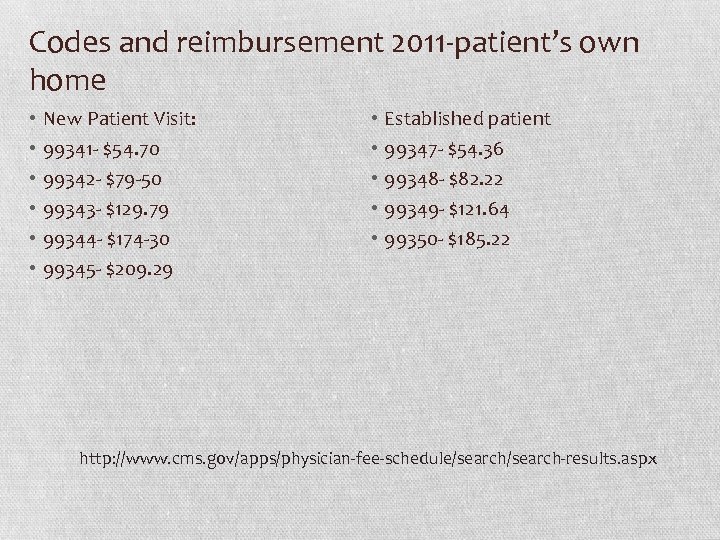 Codes and reimbursement 2011 -patient’s own home • • • New Patient Visit: 99341 - $54. 70 99342 - $79 -50 99343 - $129. 79 99344 - $174 -30 99345 - $209. 29 • • • Established patient 99347 - $54. 36 99348 - $82. 22 99349 - $121. 64 99350 - $185. 22 http: //www. cms. gov/apps/physician-fee-schedule/search-results. aspx
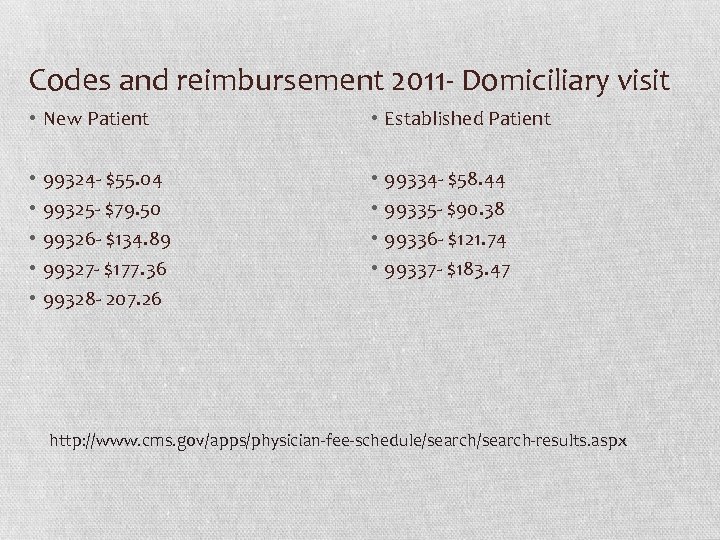 Codes and reimbursement 2011 - Domiciliary visit • New Patient • • • 99324 - $55. 04 99325 - $79. 50 99326 - $134. 89 99327 - $177. 36 99328 - 207. 26 • Established Patient • • 99334 - $58. 44 99335 - $90. 38 99336 - $121. 74 99337 - $183. 47 http: //www. cms. gov/apps/physician-fee-schedule/search-results. aspx
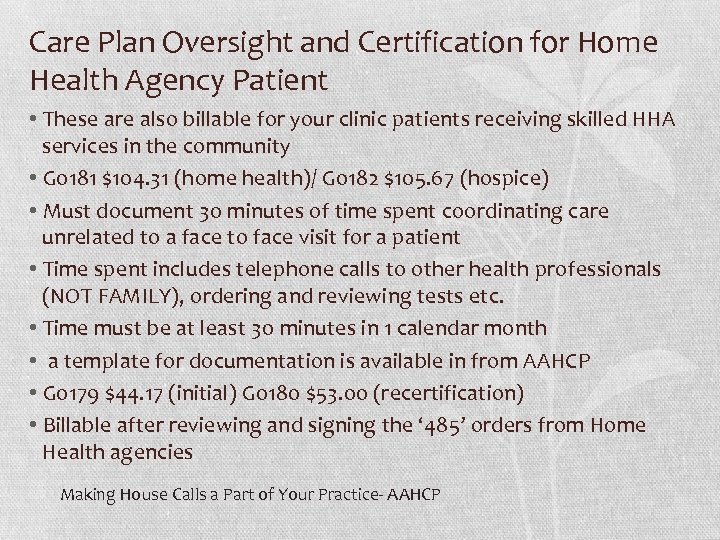 Care Plan Oversight and Certification for Home Health Agency Patient • These are also billable for your clinic patients receiving skilled HHA services in the community • G 0181 $104. 31 (home health)/ G 0182 $105. 67 (hospice) • Must document 30 minutes of time spent coordinating care unrelated to a face to face visit for a patient • Time spent includes telephone calls to other health professionals (NOT FAMILY), ordering and reviewing tests etc. • Time must be at least 30 minutes in 1 calendar month • a template for documentation is available in from AAHCP • G 0179 $44. 17 (initial) G 0180 $53. 00 (recertification) • Billable after reviewing and signing the ‘ 485’ orders from Home Health agencies Making House Calls a Part of Your Practice- AAHCP
 Collaborate with Home Health Agencies and Hospices • HHA have invaluable resources to improve health outcomes in frail elderly patients • Many homebound patients will qualify for this intermittent medicare benefit and these services may help you provide excellent quality care with these added resources
 Documentation • H&P • Progress notes • EMR • Must be complete and comprehensive in order to provide high quality patient care and communication, maximize billing, prevent potential mismanagement/ litigation
 Building up your home care practice • Gradually add another patient or 2 from a similar locality • Set aside one afternoon weekly or bimonthly as the practice grows • Typically you should be able to see 3 -4 patients in a half day at home depending on accessibility, less in rural areas • Consider building a team to help you if you have access to a Social Worker, RN case manager, pharmacist these can be invaluable members of the home care team • Many physicians now make house calls full time!
 Summary • House calls are a rewarding addition to a medical based practice • Start with one or two patients and build up • Collaborate with home health agencies • Now…. . go make a home visit!