


 Скачать презентацию Hosung Shin INCOME RELATED INEQUITY IN Dental CARE
d879d6ebfe63d7d124b17e807e4b2f4c.ppt
- Количество слайдов: 76
 Hosung Shin INCOME RELATED INEQUITY IN Dental CARE ACCESS AND DELIVERY By 11/24/2002 Hosung Shin 1
 Hosung Shin § Whenever it is felt that some characteristic if individuals (health, health care, payments for health care, etc. ) should not very with their income, concentration index of that characteristic against income is always good measure of income related inequality (Gravelle, 2001). 11/24/2002 2
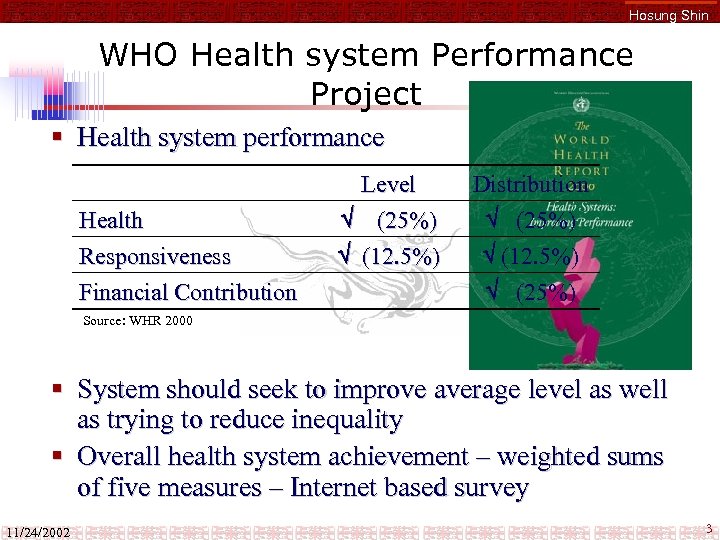 Hosung Shin WHO Health system Performance Project § Health system performance Health Responsiveness Financial Contribution Level (25%) (12. 5%) Distribution (25%) (12. 5%) (25%) Source: WHR 2000 § System should seek to improve average level as well as trying to reduce inequality § Overall health system achievement – weighted sums of five measures – Internet based survey 11/24/2002 3
 Hosung Shin 11/24/2002 4
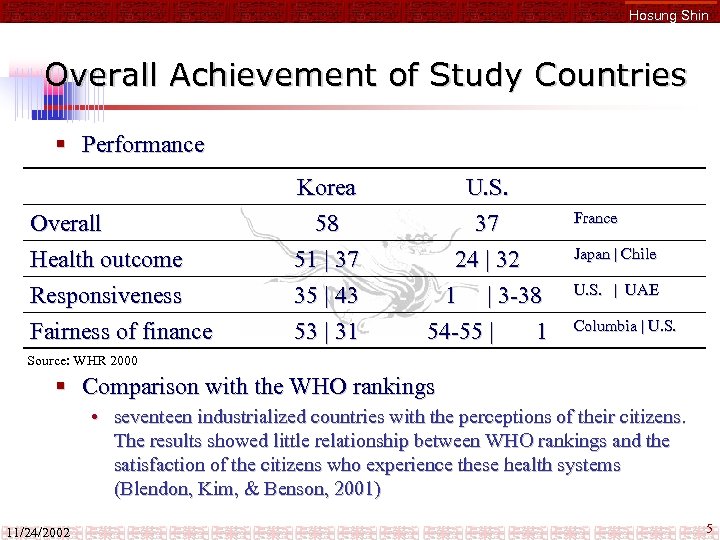 Hosung Shin Overall Achievement of Study Countries § Performance Overall Health outcome Responsiveness Korea 58 51 | 37 35 | 43 Fairness of finance 53 | 31 U. S. 37 24 | 32 1 | 3 -38 54 -55 | 1 France Japan | Chile U. S. | UAE Columbia | U. S. Source: WHR 2000 § Comparison with the WHO rankings • seventeen industrialized countries with the perceptions of their citizens. The results showed little relationship between WHO rankings and the satisfaction of the citizens who experience these health systems (Blendon, Kim, & Benson, 2001) 11/24/2002 5
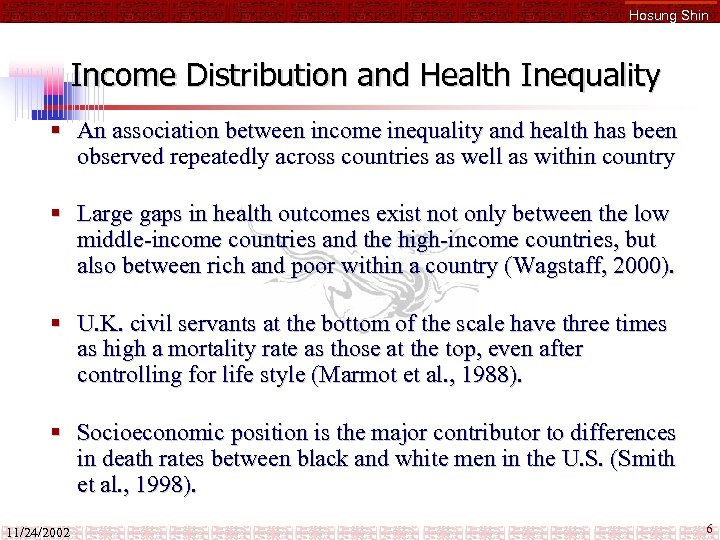 Hosung Shin Income Distribution and Health Inequality § An association between income inequality and health has been observed repeatedly across countries as well as within country § Large gaps in health outcomes exist not only between the low middle-income countries and the high-income countries, but also between rich and poor within a country (Wagstaff, 2000). § U. K. civil servants at the bottom of the scale have three times as high a mortality rate as those at the top, even after controlling for life style (Marmot et al. , 1988). § Socioeconomic position is the major contributor to differences in death rates between black and white men in the U. S. (Smith et al. , 1998). 11/24/2002 6
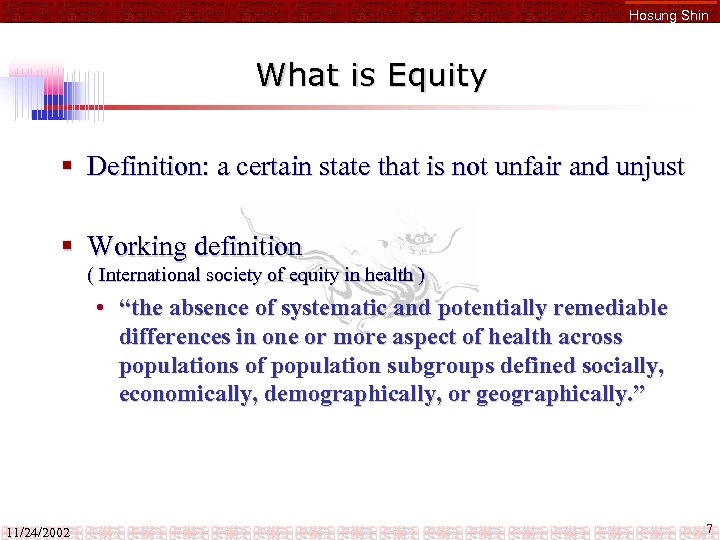 Hosung Shin What is Equity § Definition: a certain state that is not unfair and unjust § Working definition ( International society of equity in health ) • “the absence of systematic and potentially remediable differences in one or more aspect of health across populations of population subgroups defined socially, economically, demographically, or geographically. ” 11/24/2002 7
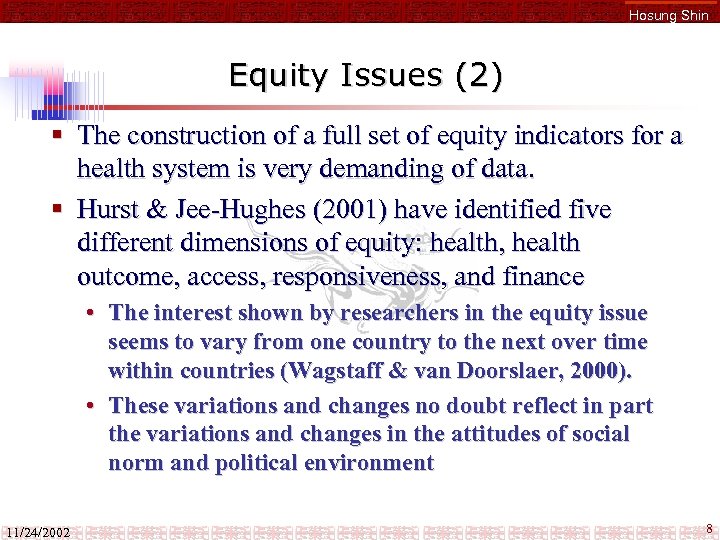 Hosung Shin Equity Issues (2) § The construction of a full set of equity indicators for a health system is very demanding of data. § Hurst & Jee-Hughes (2001) have identified five different dimensions of equity: health, health outcome, access, responsiveness, and finance • The interest shown by researchers in the equity issue seems to vary from one country to the next over time within countries (Wagstaff & van Doorslaer, 2000). • These variations and changes no doubt reflect in part the variations and changes in the attitudes of social norm and political environment 11/24/2002 8
 Hosung Shin 11/24/2002 9
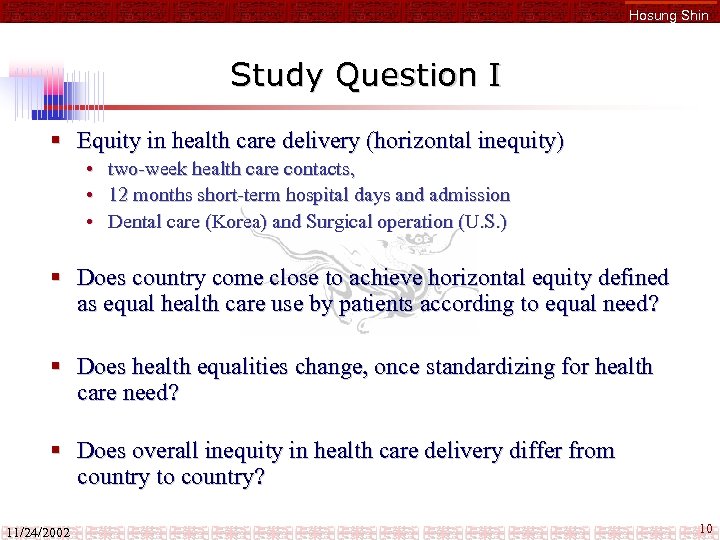 Hosung Shin Study Question I § Equity in health care delivery (horizontal inequity) • • • two-week health care contacts, 12 months short-term hospital days and admission Dental care (Korea) and Surgical operation (U. S. ) § Does country come close to achieve horizontal equity defined as equal health care use by patients according to equal need? § Does health equalities change, once standardizing for health care need? § Does overall inequity in health care delivery differ from country to country? 11/24/2002 10
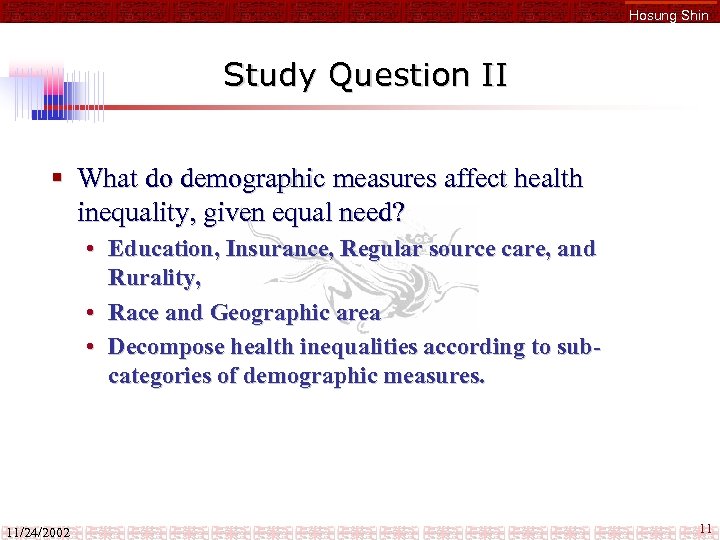 Hosung Shin Study Question II § What do demographic measures affect health inequality, given equal need? • Education, Insurance, Regular source care, and Rurality, • Race and Geographic area • Decompose health inequalities according to subcategories of demographic measures. 11/24/2002 11
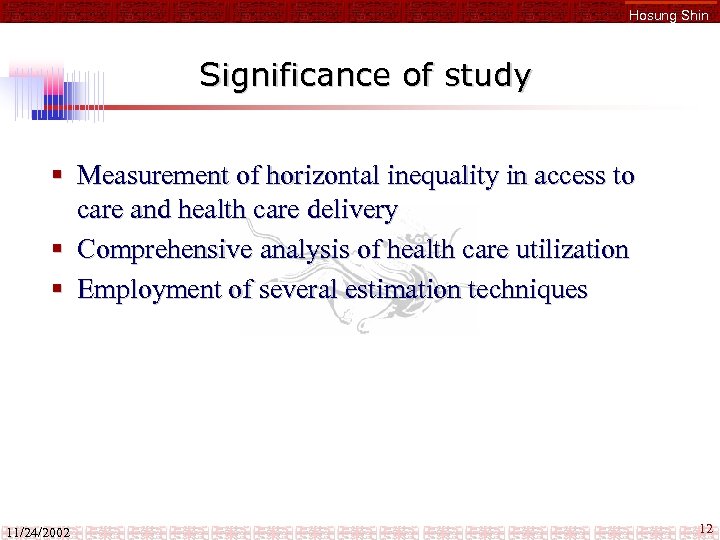 Hosung Shin Significance of study § Measurement of horizontal inequality in access to care and health care delivery § Comprehensive analysis of health care utilization § Employment of several estimation techniques 11/24/2002 12
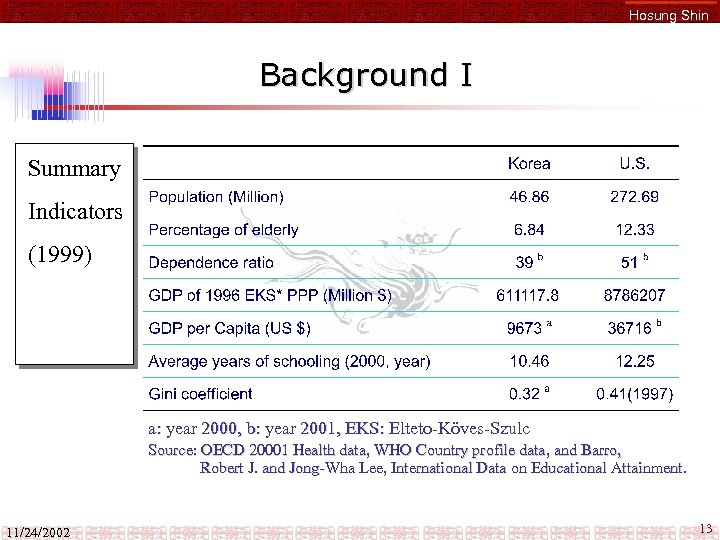 Hosung Shin Background I Summary Indicators (1999) a: year 2000, b: year 2001, EKS: Elteto-Köves-Szulc Source: OECD 20001 Health data, WHO Country profile data, and Barro, Robert J. and Jong-Wha Lee, International Data on Educational Attainment. 11/24/2002 13
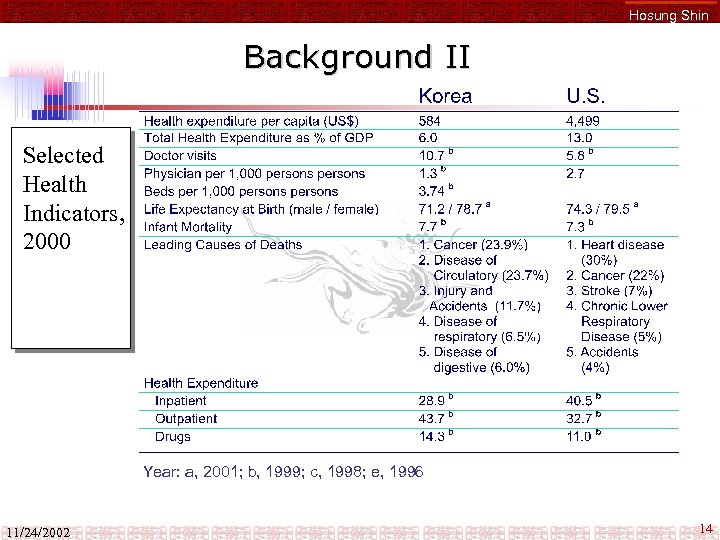 Hosung Shin Background II Selected Health Indicators, 2000 Year: a, 2001; b, 1999; c, 1998; e, 1996 11/24/2002 14
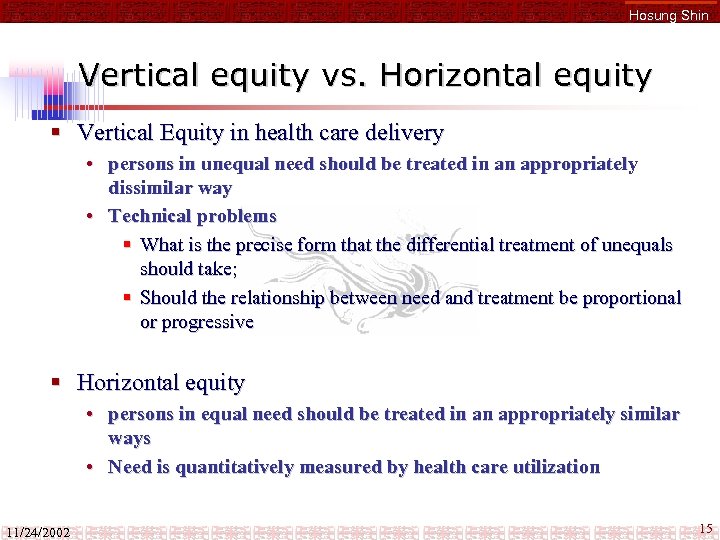 Hosung Shin Vertical equity vs. Horizontal equity § Vertical Equity in health care delivery • persons in unequal need should be treated in an appropriately dissimilar way • Technical problems § What is the precise form that the differential treatment of unequals should take; § Should the relationship between need and treatment be proportional or progressive § Horizontal equity • persons in equal need should be treated in an appropriately similar ways • Need is quantitatively measured by health care utilization 11/24/2002 15
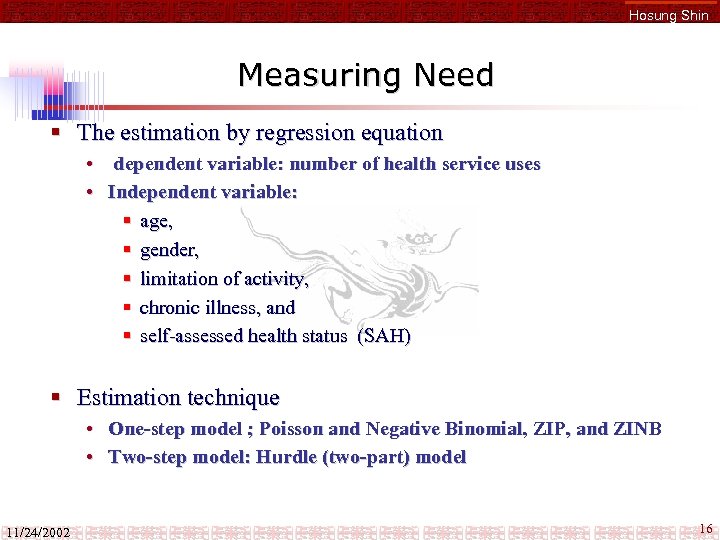 Hosung Shin Measuring Need § The estimation by regression equation • dependent variable: number of health service uses • Independent variable: § age, § gender, § limitation of activity, § chronic illness, and § self-assessed health status (SAH) § Estimation technique • One-step model ; Poisson and Negative Binomial, ZIP, and ZINB • Two-step model: Hurdle (two-part) model 11/24/2002 16
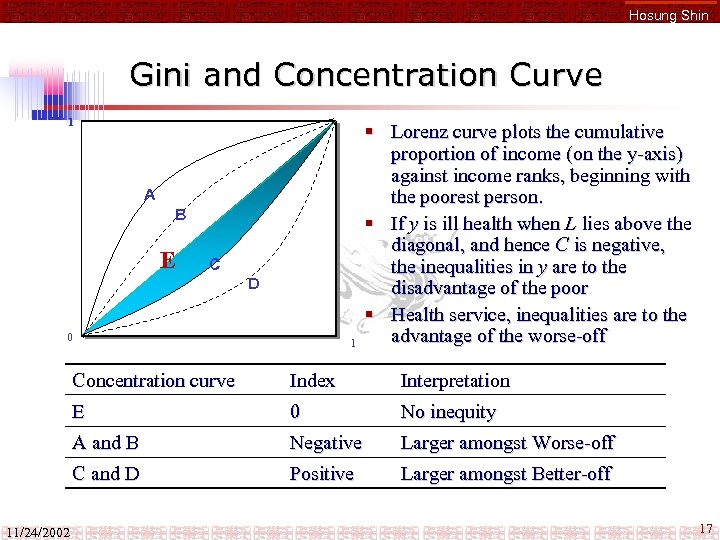 Hosung Shin Gini and Concentration Curve 1 A B E C D 0 1 § Lorenz curve plots the cumulative proportion of income (on the y-axis) against income ranks, beginning with the poorest person. § If y is ill health when L lies above the diagonal, and hence C is negative, the inequalities in y are to the disadvantage of the poor § Health service, inequalities are to the advantage of the worse-off Concentration curve Interpretation E 0 No inequity A and B Negative Larger amongst Worse-off C and D 11/24/2002 Index Positive Larger amongst Better-off 17
![Hosung Shin Concentration Index § § § Measurement of Inequalities Gini index [0, 1]](https://present5.com/presentation/d879d6ebfe63d7d124b17e807e4b2f4c/image-18.jpg "Hosung Shin Concentration Index § § § Measurement of Inequalities Gini index [0, 1]") Hosung Shin Concentration Index § § § Measurement of Inequalities Gini index [0, 1] Concentration Index [-1, 1] • To remove the effects of unavoidable factors, which are not amenable to health policy (Gravelle, 2001). § Definition , for individual-level data , for grouped data L(c) is concentration curve, R i is the relative rank of the i th income groups , ft is population share of each group. 11/24/2002 18
Hosung Shin Concentration Index § § § Measurement of Inequalities Gini index [0, 1] Concentration Index [-1, 1] • To remove the effects of unavoidable factors, which are not amenable to health policy (Gravelle, 2001). § Definition , for individual-level data , for grouped data L(c) is concentration curve, R i is the relative rank of the i th income groups , ft is population share of each group. 11/24/2002 18
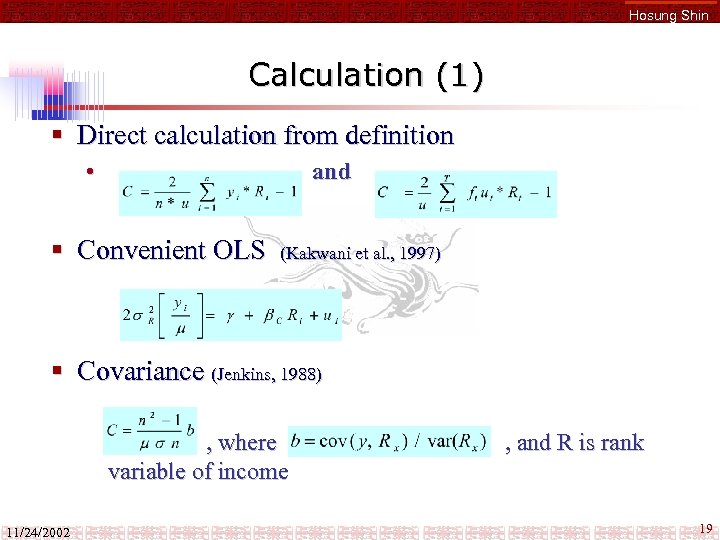 Hosung Shin Calculation (1) § Direct calculation from definition • and § Convenient OLS (Kakwani et al. , 1997) § Covariance (Jenkins, 1988) , where variable of income 11/24/2002 , and R is rank 19
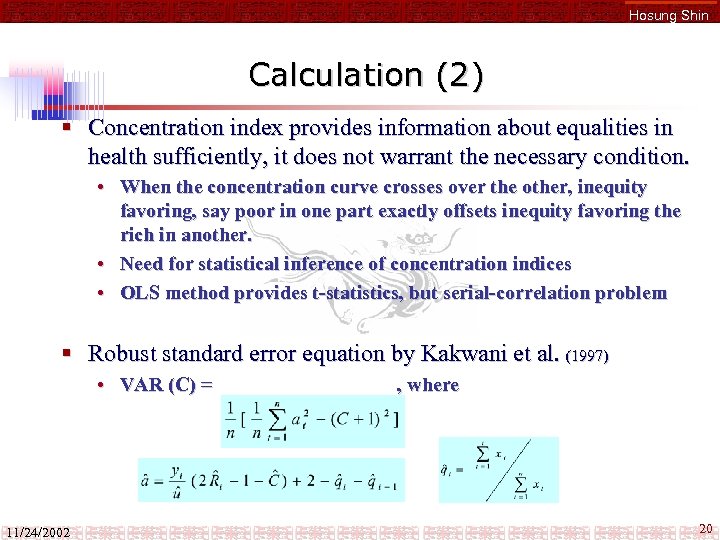 Hosung Shin Calculation (2) § Concentration index provides information about equalities in health sufficiently, it does not warrant the necessary condition. • When the concentration curve crosses over the other, inequity favoring, say poor in one part exactly offsets inequity favoring the rich in another. • Need for statistical inference of concentration indices • OLS method provides t-statistics, but serial-correlation problem § Robust standard error equation by Kakwani et al. (1997) • VAR (C) = 11/24/2002 , where 20
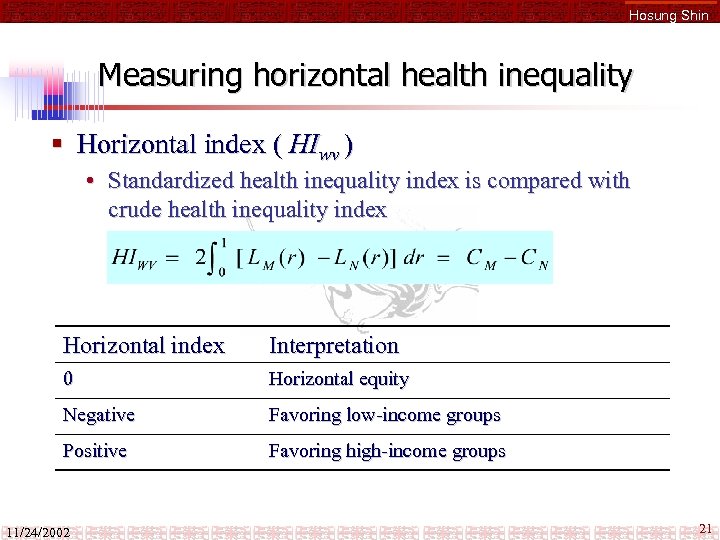 Hosung Shin Measuring horizontal health inequality § Horizontal index ( HIwv ) • Standardized health inequality index is compared with crude health inequality index Horizontal index Interpretation 0 Horizontal equity Negative Favoring low-income groups Positive Favoring high-income groups 11/24/2002 21
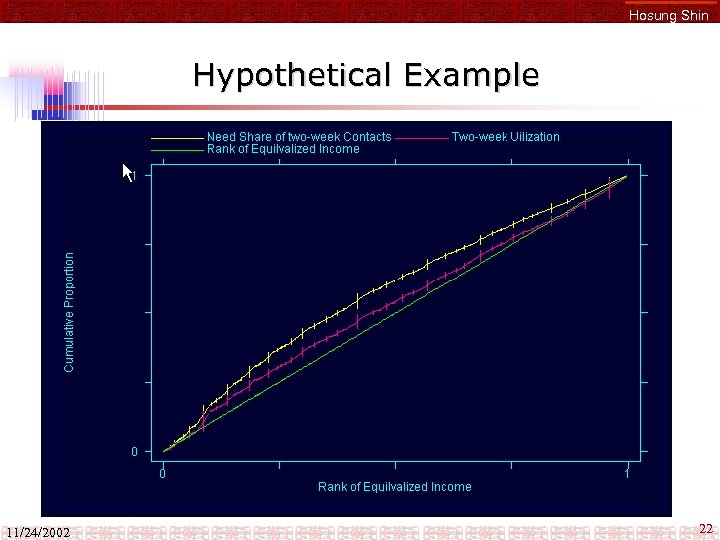 Hosung Shin Hypothetical Example 11/24/2002 22
 Hosung Shin Dealing with health utilization data § § § 11/24/2002 Count data issue Poisson Negative binomial Zero-inflated (Excess zero) model Two part hurdle 23
 Hosung Shin Theoretical Frame for Utilization Study § Grossman model • The human capital theory to explain the demand for health and health care (Folland, Goodman, & Stano, 2001) • The demand for ‘commodity good health care’ is essentially seen as the result of patients’ inter-temporal utility maximization (Grossman, 1972). • Decision on the utilization of health service is affected by the opportunity cost of alternative activities (i. e. , self-care) given health status • Utilization is primarily patient determined, though conditioned by the health-care delivery system (Fabbri & Monfardini, 2002) 11/24/2002 24
 Hosung Shin Physician Agency Model § Physician agency has been introduced to explain agency role of health and health care given an asymmetry of health information & uncertainty in health § Physician utilization function • physicians do not only follow the Hippocratic oath, but also derive utility from income and leisure trade-offs. • Therefore, when income or leisure are tailored to specific procedures and/or services, physicians will distort demand to perform more remunerative, or less time consuming procedures/services § To incorporate different decision-making processes of health service utilization • Supplier-induced demand 11/24/2002 25
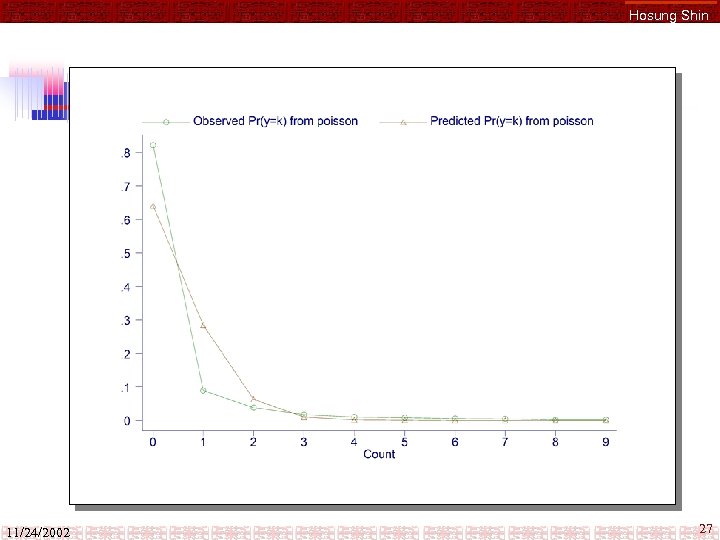
 Hosung Shin Data characteristics § Characteristics • • • Count data (Non-negative integer, y = 0, 1, 2, 3, ……. . ) Substantial probability of zero Skewed to the right with long tail § Estimation with count data • OLS (van Doorslaer et al. , 2000; Wolinsky et al. , 1989) – eliminate all zeroes • Logistic (Manski & Magder, 1998) • Ordinal logistic (Tennstedt, Brambilla, Jette, & Mc. Guire, 1994) • Tobit (Leclere, Jensen, & Biddlecom, 1994) § the approximation is likely to yield biased results if most of the observations fall into a small range (Jones, 2000) 11/24/2002 26
 Hosung Shin 11/24/2002 27
 Hosung Shin Poisson § The Poisson distribution has been widely used to avoid the approximation of count data by a continuous distribution • To describe the distribution of the number of occurrence of a rare event. • Assumption § The occurrences of some event in an interval of time are independent; § An infinite number of occurrences of an event must be possible in the interval; § In any extremely small portion of the interval, the probability of more than one occurrence of the event is approximately zero; § The mean is equal to the variance § E ( y | x ) = = Var ( y | x ) • Overdispersion (Gurmu, 1998; Mullahy, 1997; Cameron & Johansson, 1997) or underdispersion (Cameron et al. , 1997) 11/24/2002 28
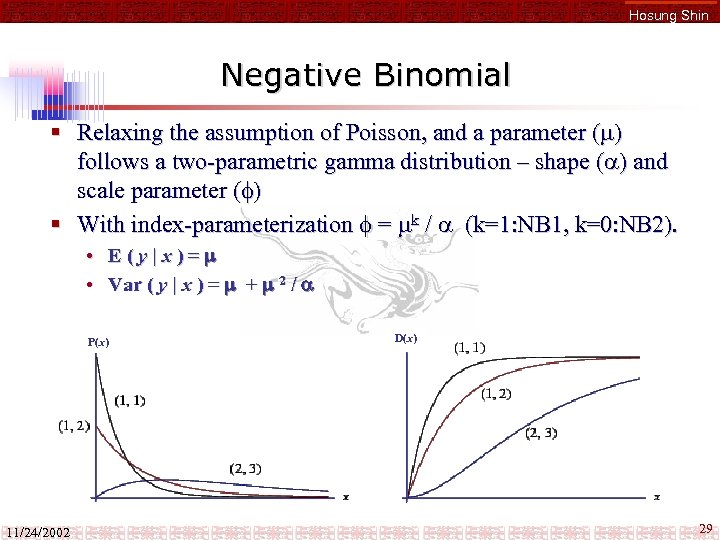 Hosung Shin Negative Binomial § Relaxing the assumption of Poisson, and a parameter ( ) follows a two-parametric gamma distribution – shape ( ) and scale parameter ( ) § With index-parameterization = k / (k=1: NB 1, k=0: NB 2). • E(y|x)= • Var ( y | x ) = + 2 / P(x) 11/24/2002 D(x) 29
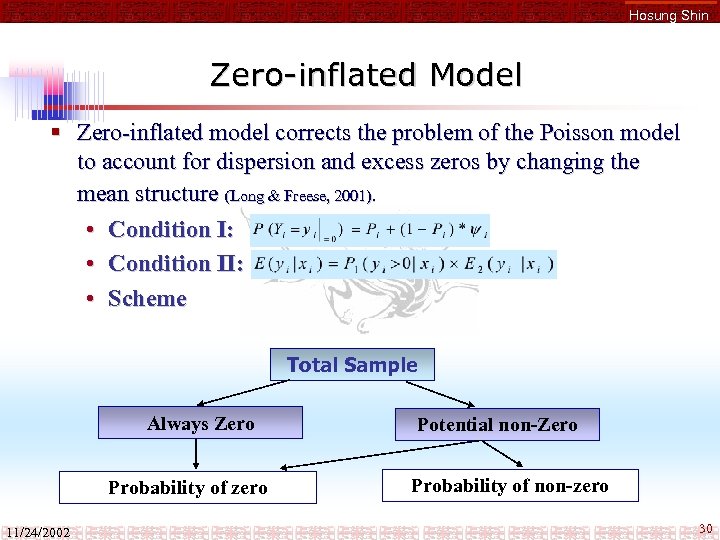 Hosung Shin Zero-inflated Model § Zero-inflated model corrects the problem of the Poisson model to account for dispersion and excess zeros by changing the mean structure (Long & Freese, 2001). • Condition I: • Condition II: • Scheme Total Sample Always Zero Probability of zero 11/24/2002 Potential non-Zero Probability of non-zero 30
 Hosung Shin Two-part and Hurdle § Utilization of health care • Skewed count data • Two-part decision depends on researcher philosophy / preference, and population § While at the first stage it is the patient who decides whether or not she needs medical attention and therefore to access a physician (contact analysis), in the second stage the health care providers together with the patient determine the intensity of the treatment (frequency analysis). § Two-part • A binary model for the decision of use, determining the probability of crossing a zero (Non-user) threshold • A truncated count data model on positive counts, explaining the extent of use conditionally to some use. 11/24/2002 31
 Hosung Shin Hurdle (2) § Log likelihood of the hurdle is the sum of two parts • Log likelihood of first part + Log likelihood of the second part § Participation decision and positive count are generated by separate probability process § Caveats • High proportion of non-users (Gurmu, 1997) • Illness spell (Pohlmeier and Urich ) • No statistical grounds to be superior to one-step model (Deb & Trivedi, 2002; Deb & Trivedi, 1997) 11/24/2002 32
 Hosung Shin Model selection § Nested model • A specific model can be derived from a more general model by removing some parameters • Difference between log-likelihood for the two model has a chi-square distribution with d. f. equal to difference in the number of parameters. • Smaller (– 2 Log-likelihood) is better § Non-nested model • Voung test 11/24/2002 33
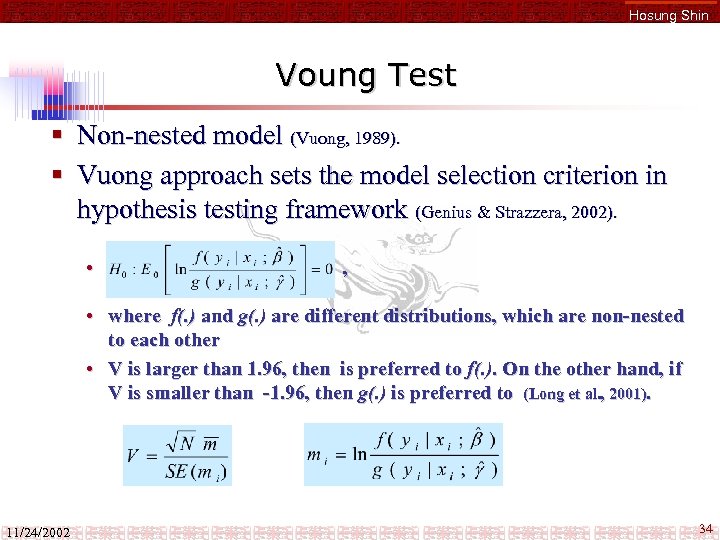 Hosung Shin Voung Test § Non-nested model (Vuong, 1989). § Vuong approach sets the model selection criterion in hypothesis testing framework (Genius & Strazzera, 2002). • , • where f(. ) and g(. ) are different distributions, which are non-nested to each other • V is larger than 1. 96, then is preferred to f(. ). On the other hand, if V is smaller than -1. 96, then g(. ) is preferred to (Long et al. , 2001). 11/24/2002 34
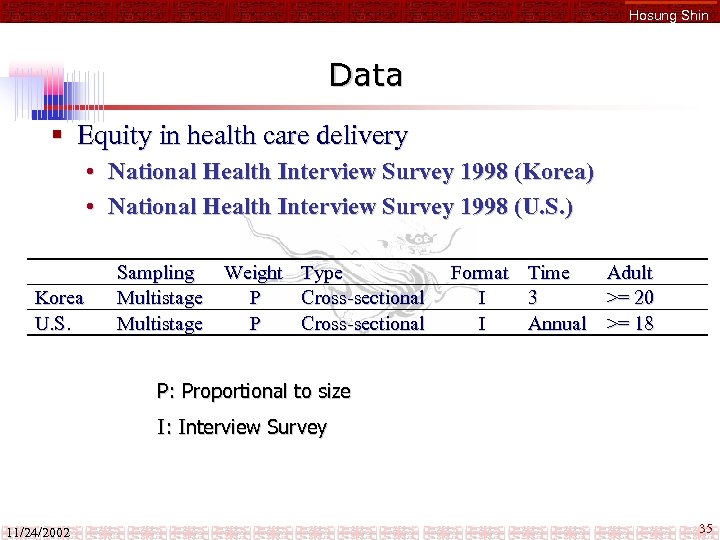 Hosung Shin Data § Equity in health care delivery • National Health Interview Survey 1998 (Korea) • National Health Interview Survey 1998 (U. S. ) Korea U. S. Sampling Multistage Weight Type P Cross-sectional Format Time Adult I 3 >= 20 I Annual >= 18 P: Proportional to size I: Interview Survey 11/24/2002 35
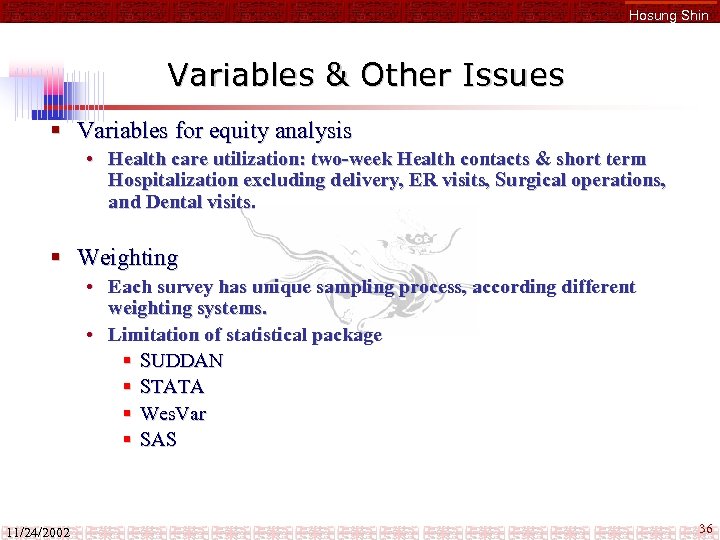 Hosung Shin Variables & Other Issues § Variables for equity analysis • Health care utilization: two-week Health contacts & short term Hospitalization excluding delivery, ER visits, Surgical operations, and Dental visits. § Weighting • Each survey has unique sampling process, according different weighting systems. • Limitation of statistical package § SUDDAN § STATA § Wes. Var § SAS 11/24/2002 36
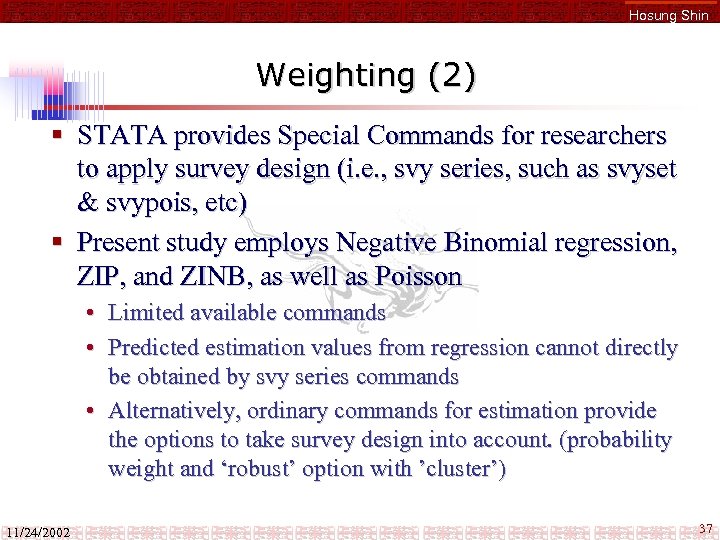 Hosung Shin Weighting (2) § STATA provides Special Commands for researchers to apply survey design (i. e. , svy series, such as svyset & svypois, etc) § Present study employs Negative Binomial regression, ZIP, and ZINB, as well as Poisson • Limited available commands • Predicted estimation values from regression cannot directly be obtained by svy series commands • Alternatively, ordinary commands for estimation provide the options to take survey design into account. (probability weight and ‘robust’ option with ’cluster’) 11/24/2002 37
 Hosung Shin Findings I. Sample Characteristics II. Health inequality • Korea • U. S. 11/24/2002 38
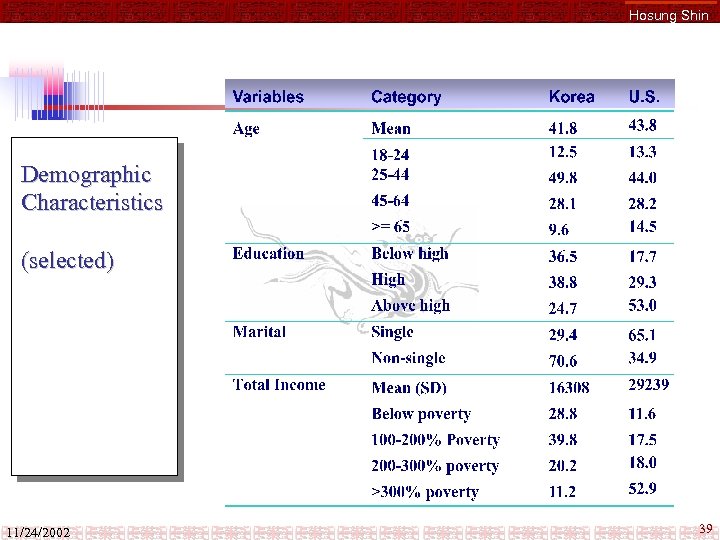 Hosung Shin Demographic Characteristics (selected) 11/24/2002 39
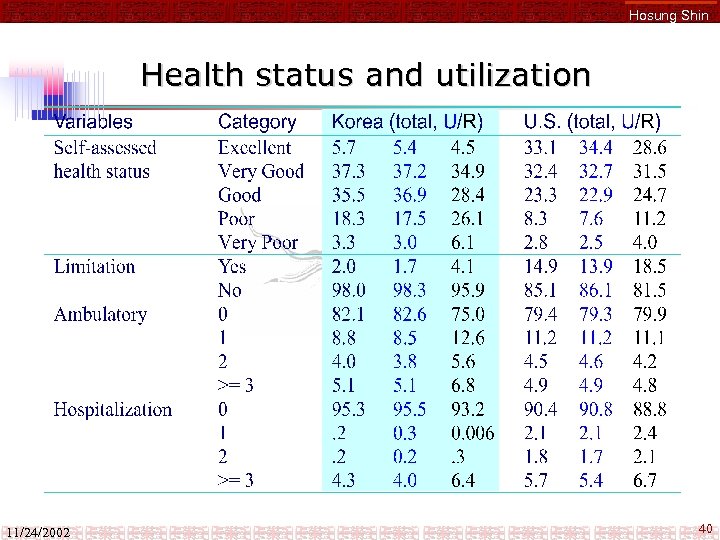 Hosung Shin Health status and utilization 11/24/2002 40
 Hosung Shin Korea Health Inequality 11/24/2002 41
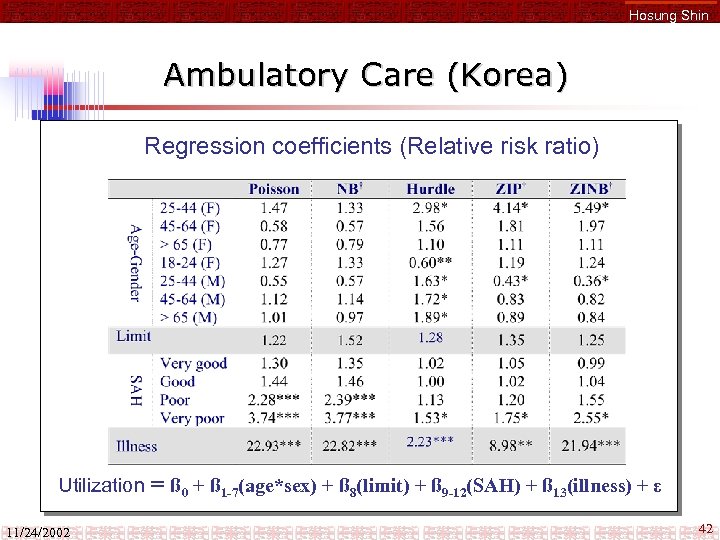 Hosung Shin Ambulatory Care (Korea) Regression coefficients (Relative risk ratio) Utilization 11/24/2002 = ß 0 + ß 1 -7(age*sex) + ß 8(limit) + ß 9 -12(SAH) + ß 13(illness) + ε 42
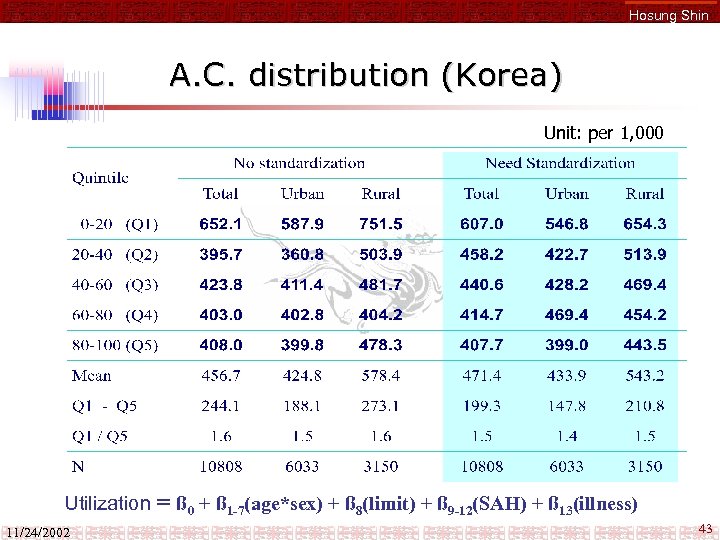 Hosung Shin A. C. distribution (Korea) Unit: per 1, 000 Utilization 11/24/2002 = ß 0 + ß 1 -7(age*sex) + ß 8(limit) + ß 9 -12(SAH) + ß 13(illness) 43
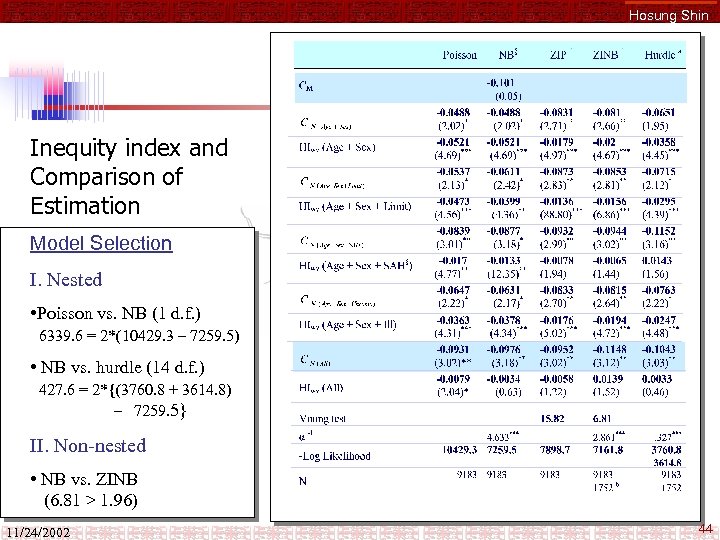 Hosung Shin Inequity index and Comparison of Estimation Model Selection I. Nested • Poisson vs. NB (1 d. f. ) 6339. 6 = 2*(10429. 3 – 7259. 5) • NB vs. hurdle (14 d. f. ) 427. 6 = 2*{(3760. 8 + 3614. 8) – 7259. 5} II. Non-nested • NB vs. ZINB (6. 81 > 1. 96) 11/24/2002 44
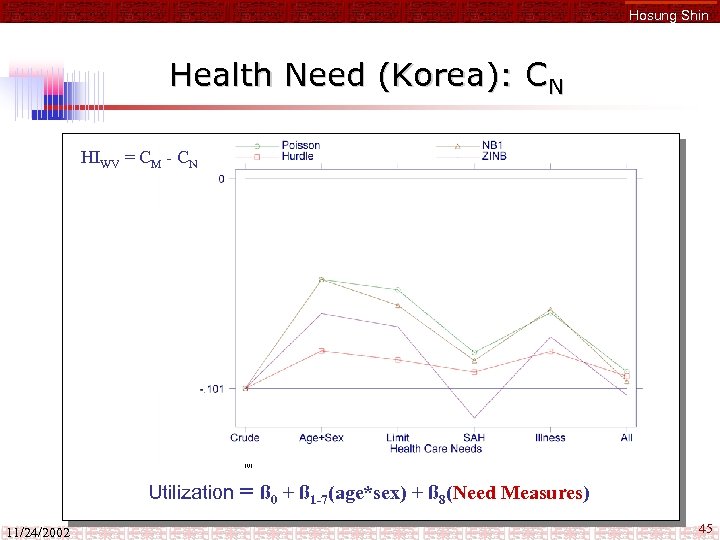 Hosung Shin Health Need (Korea): CN HIWV = CM - CN CM Utilization 11/24/2002 = ß 0 + ß 1 -7(age*sex) + ß 8(Need Measures) 45
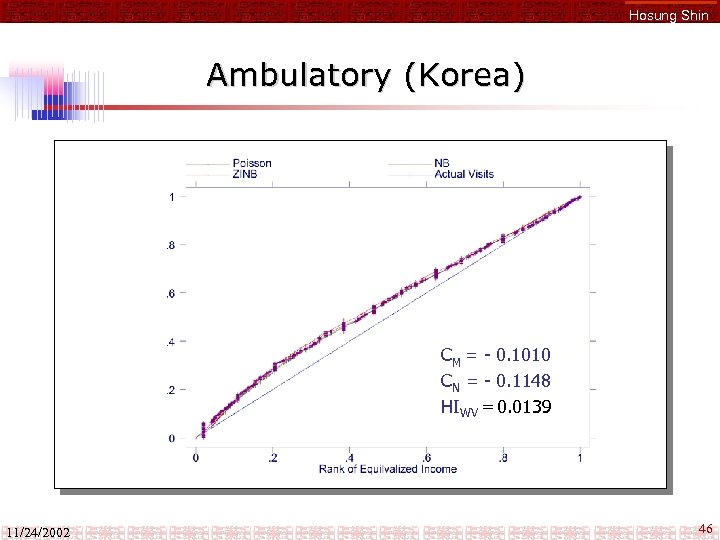 Hosung Shin Ambulatory (Korea) CM = - 0. 1010 CN = - 0. 1148 HIWV = 0. 0139 11/24/2002 46
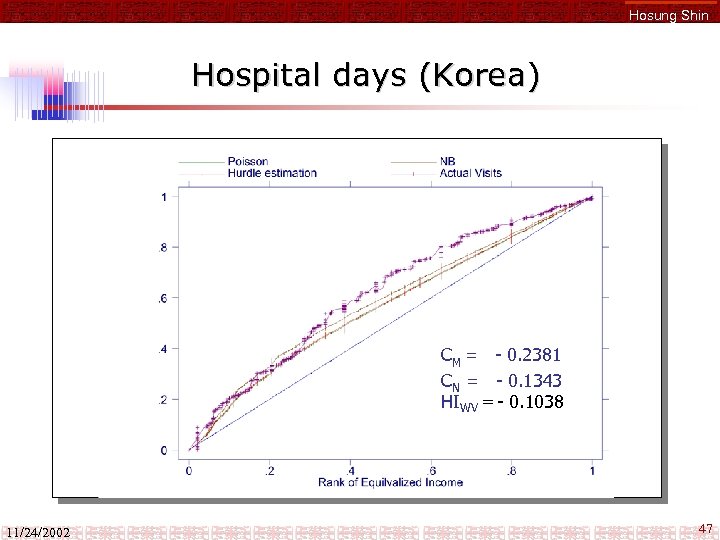 Hosung Shin Hospital days (Korea) CM = - 0. 2381 CN = - 0. 1343 HIWV = - 0. 1038 11/24/2002 47
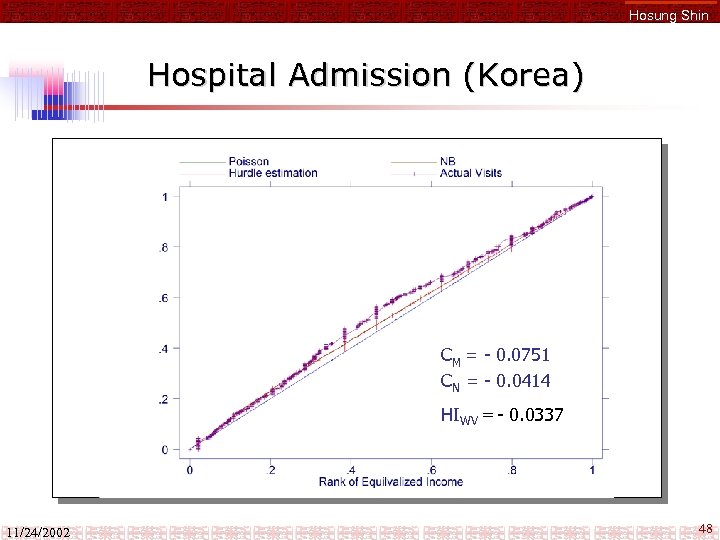 Hosung Shin Hospital Admission (Korea) CM = - 0. 0751 CN = - 0. 0414 HIWV = - 0. 0337 11/24/2002 48
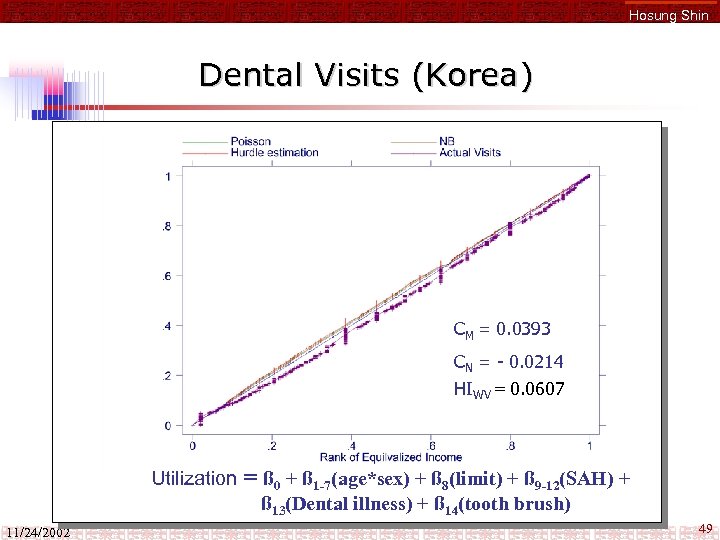 Hosung Shin Dental Visits (Korea) CM = 0. 0393 CN = - 0. 0214 HIWV = 0. 0607 Utilization = ß 0 + ß 1 -7(age*sex) + ß 8(limit) + ß 9 -12(SAH) + ß 13(Dental illness) + ß 14(tooth brush) 11/24/2002 49
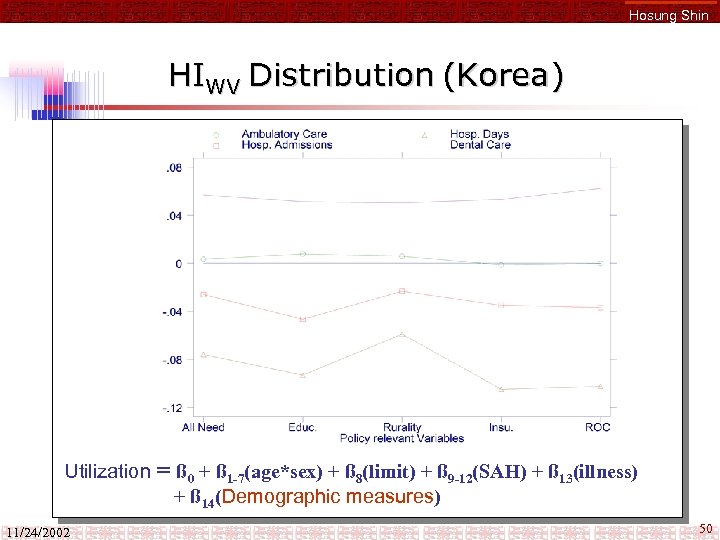 Hosung Shin HIWV Distribution (Korea) Utilization = ß 0 + ß 1 -7(age*sex) + ß 8(limit) + ß 9 -12(SAH) + ß 13(illness) + ß 14(Demographic measures) 11/24/2002 50
 Hosung Shin U. S. Health Inequality 11/24/2002 51
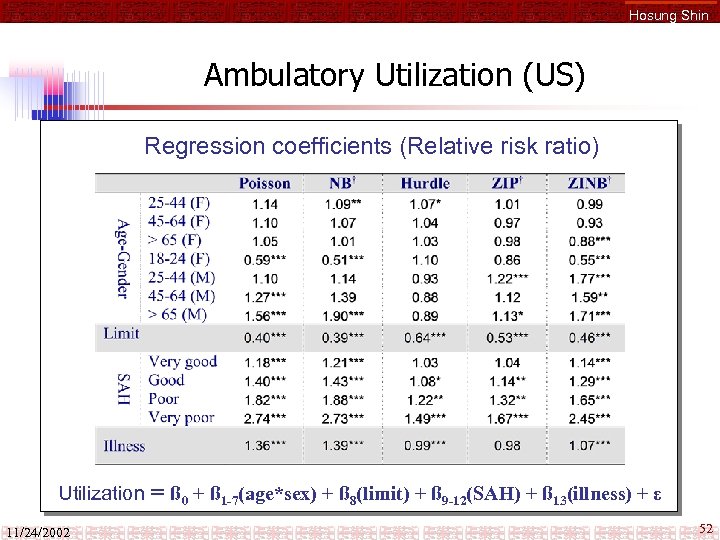 Hosung Shin Ambulatory Utilization (US) Regression coefficients (Relative risk ratio) Utilization 11/24/2002 = ß 0 + ß 1 -7(age*sex) + ß 8(limit) + ß 9 -12(SAH) + ß 13(illness) + ε 52
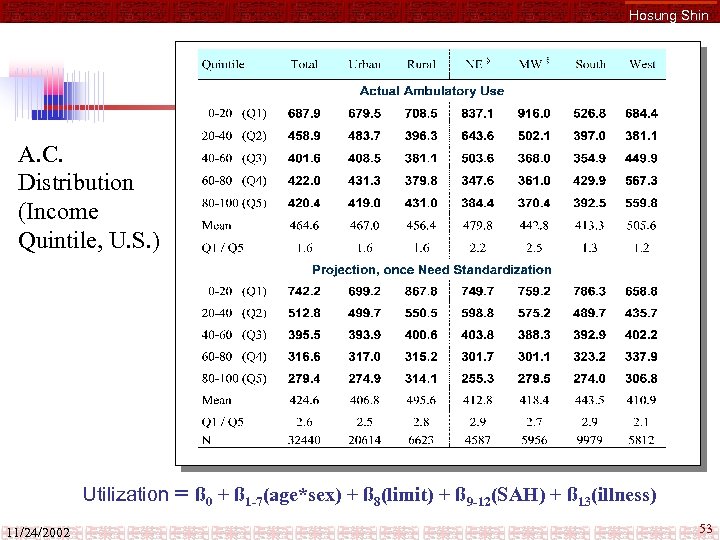 Hosung Shin A. C. Distribution (Income Quintile, U. S. ) Utilization 11/24/2002 = ß 0 + ß 1 -7(age*sex) + ß 8(limit) + ß 9 -12(SAH) + ß 13(illness) 53
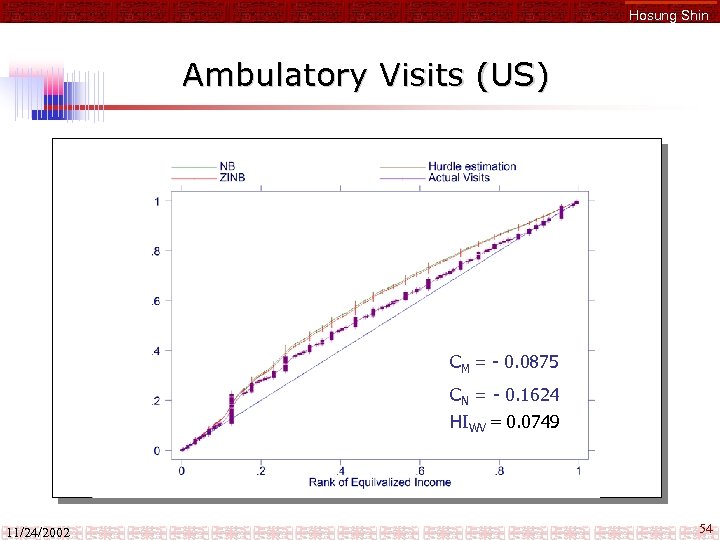 Hosung Shin Ambulatory Visits (US) CM = - 0. 0875 CN = - 0. 1624 HIWV = 0. 0749 11/24/2002 54
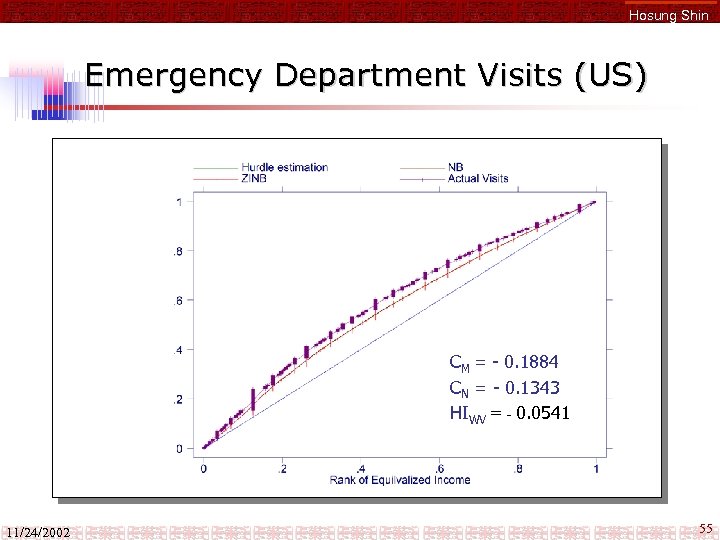 Hosung Shin Emergency Department Visits (US) CM = - 0. 1884 CN = - 0. 1343 HIWV = - 0. 0541 11/24/2002 55
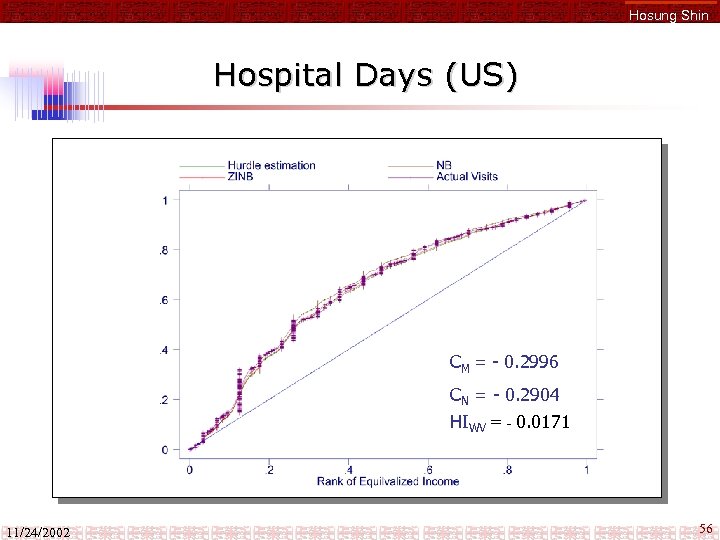 Hosung Shin Hospital Days (US) CM = - 0. 2996 CN = - 0. 2904 HIWV = - 0. 0171 11/24/2002 56
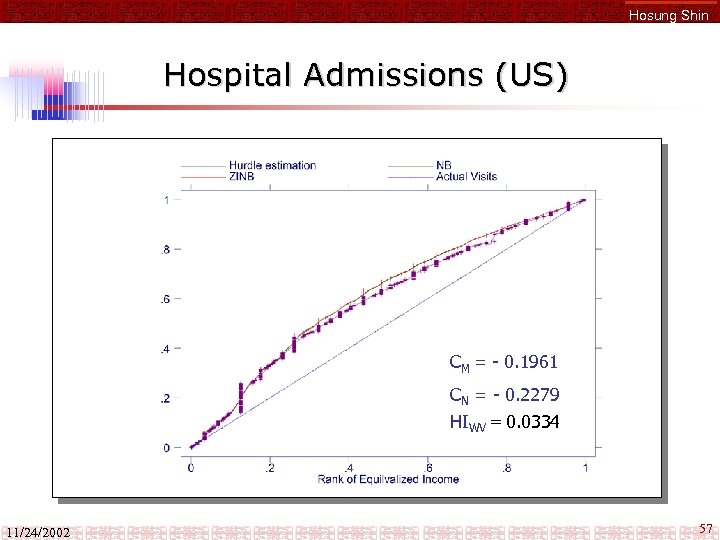 Hosung Shin Hospital Admissions (US) CM = - 0. 1961 CN = - 0. 2279 HIWV = 0. 0334 11/24/2002 57
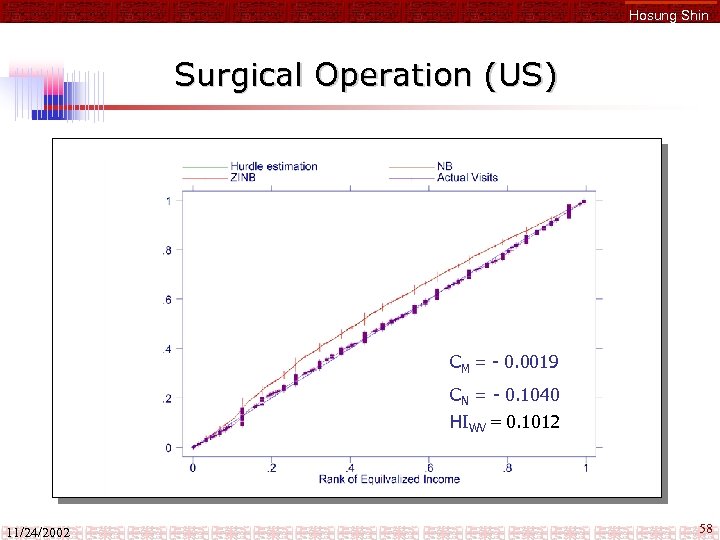 Hosung Shin Surgical Operation (US) CM = - 0. 0019 CN = - 0. 1040 HIWV = 0. 1012 11/24/2002 58
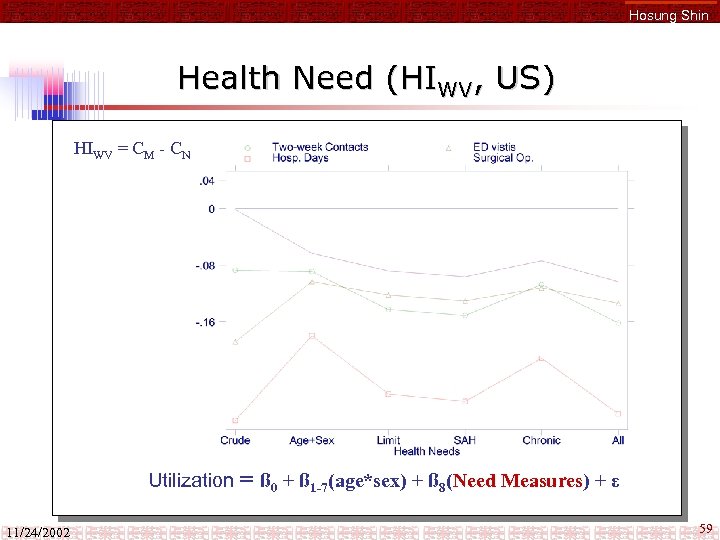 Hosung Shin Health Need (HIWV, US) HIWV = CM - CN Utilization 11/24/2002 = ß 0 + ß 1 -7(age*sex) + ß 8(Need Measures) + ε 59
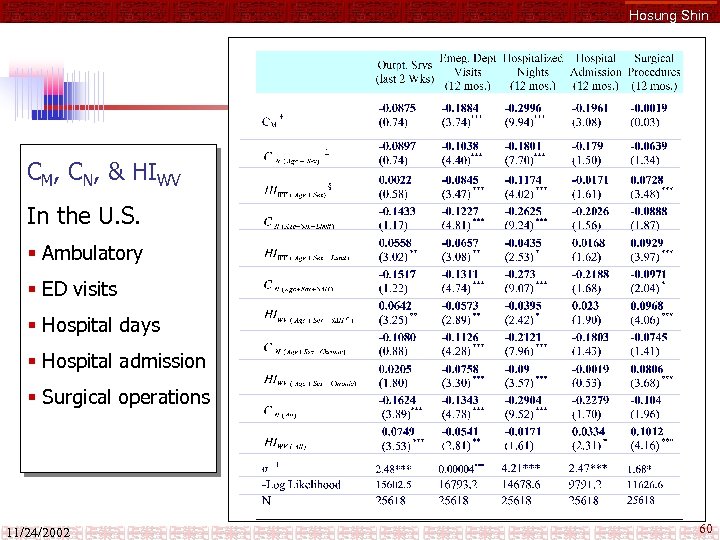 Hosung Shin CM, CN, & HIWV In the U. S. § Ambulatory § ED visits § Hospital days § Hospital admission § Surgical operations 11/24/2002 60
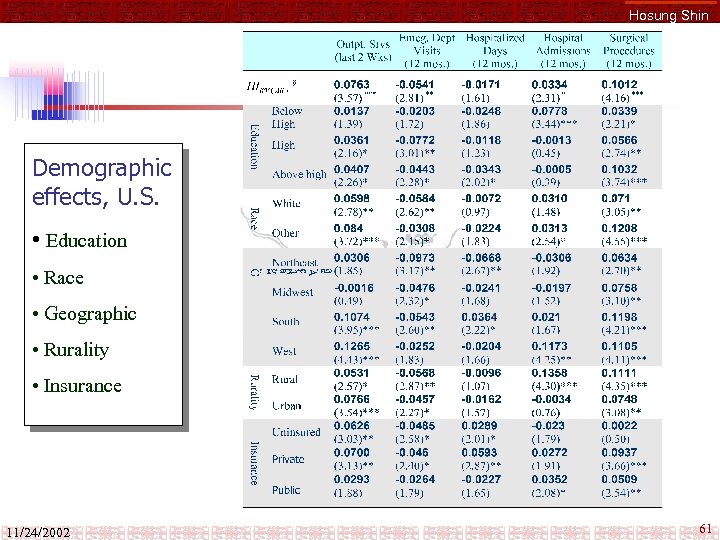 Hosung Shin Demographic effects, U. S. • Education • Race • Geographic • Rurality • Insurance 11/24/2002 61
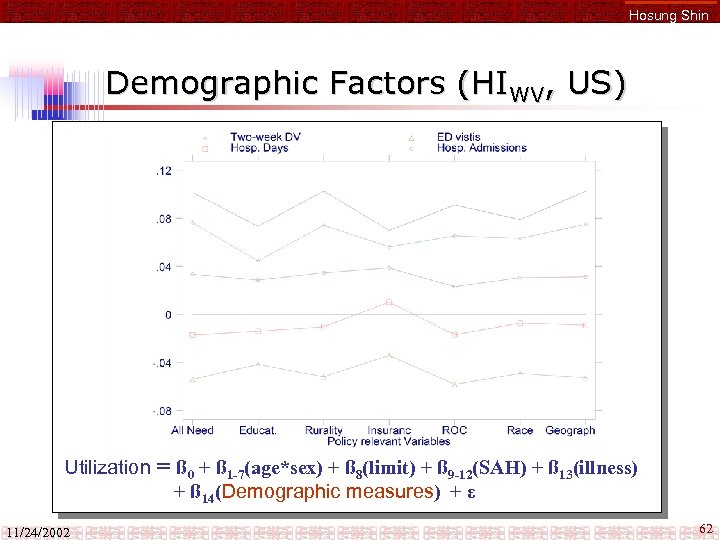 Hosung Shin Demographic Factors (HIWV, US) Utilization = ß 0 + ß 1 -7(age*sex) + ß 8(limit) + ß 9 -12(SAH) + ß 13(illness) + ß 14(Demographic measures) + ε 11/24/2002 62
 Hosung Shin Discussion § § 11/24/2002 Major findings Limitations Future study Conclusion 63
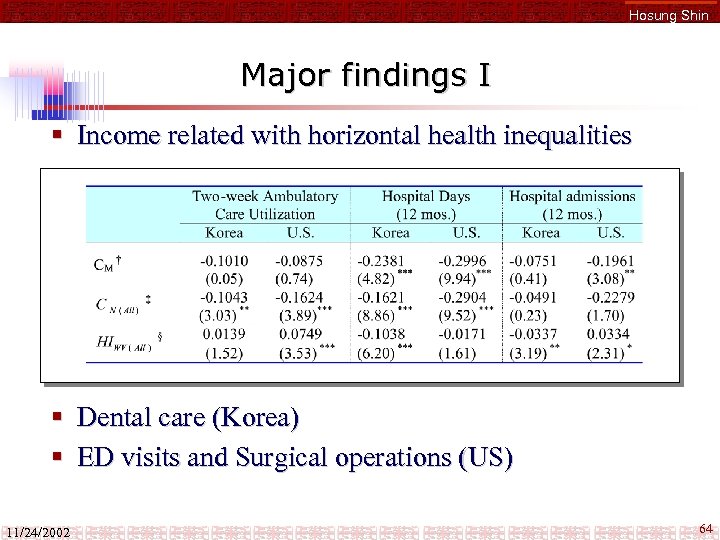 Hosung Shin Major findings I § Income related with horizontal health inequalities § Dental care (Korea) § ED visits and Surgical operations (US) 11/24/2002 64
 Hosung Shin Comparison with Previous findings I § Lower socioeconomic status is associated with lower overall health care use, even among those with health insurance (1987 NMES Fiscella et al. , 2000). § Eddy van Doorslaer et al. , • 1987 National Medical Expenditure Survey (NMES). § SAH seems to increase the values of the HIwv indices, and adding more health need variables in the estimate equation brings more power to explain the degree of difference between actual utilization and the estimates (van Doorslaer et al. , 2000). § Higher-income groups receive a lower volume of care than the worse-off, but they spend more on health. § The health inequality index of physician visits was significantly positive, while inpatient utilization was positive but it was not significant. • 1996 Medical Expenditure Panel Survey (MEPS) 11/24/2002 65
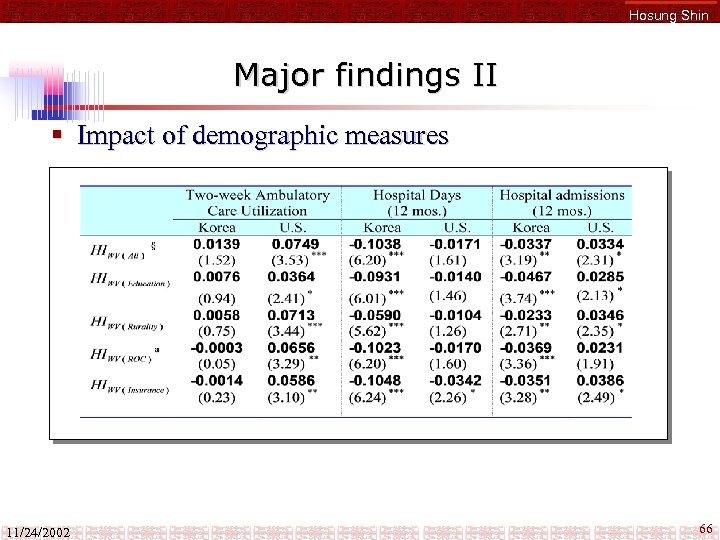 Hosung Shin Major findings II § Impact of demographic measures 11/24/2002 66
 Hosung Shin Comparison with Previous findings II § 1996 MEPS (Eddy van Doorslaer et al. , 2002) • Regional effect • Insurance § Standardizing for health insurance significantly reduces the degree of unequal distribution of ambulatory care utilizations in favor of rich people § Using Rasell and Tang’s findings (Rasell, Bernstein, & Tang, 1994), they explained the three bottoms in the U. S. income quintiles had 29%, 24%, and 13% of uninsured in 1992, respectively § Private health insurance in the U. S. is the primary source of coverage for the great majority of the population under 65, and large part of inequity seems to be due to gaps and inequalities in such coverage. 11/24/2002 67
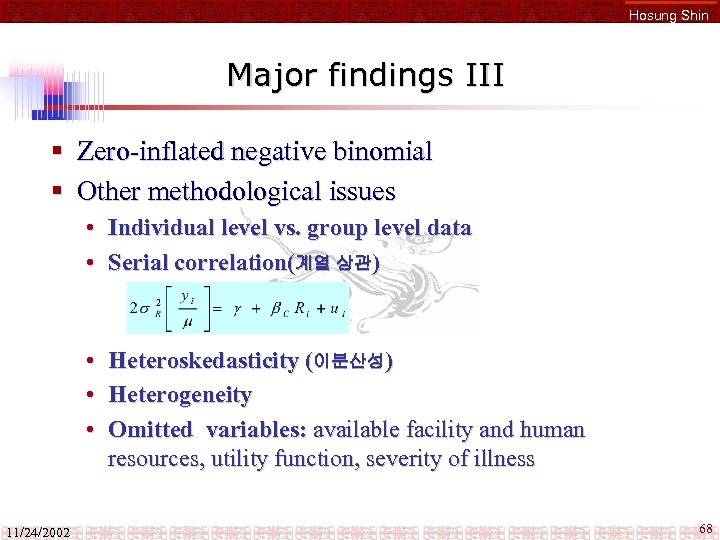 Hosung Shin Major findings III § § Zero-inflated negative binomial Other methodological issues • Individual level vs. group level data • Serial correlation(계열 상관) • • • 11/24/2002 Heteroskedasticity (이분산성) Heterogeneity Omitted variables: available facility and human resources, utility function, severity of illness 68
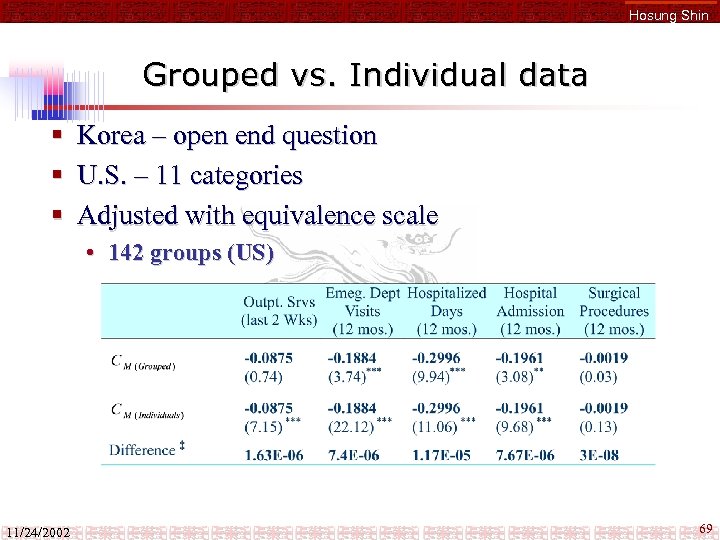 Hosung Shin Grouped vs. Individual data § § § Korea – open end question U. S. – 11 categories Adjusted with equivalence scale • 142 groups (US) 11/24/2002 69
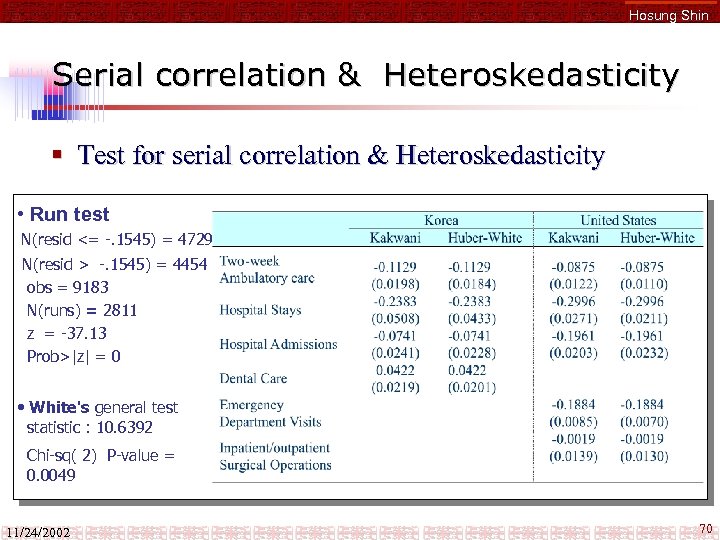 Hosung Shin Serial correlation & Heteroskedasticity § Test for serial correlation & Heteroskedasticity • Run test N(resid <= -. 1545) = 4729 N(resid > -. 1545) = 4454 obs = 9183 N(runs) = 2811 z = -37. 13 Prob>|z| = 0 • White's general test statistic : 10. 6392 Chi-sq( 2) P-value = 0. 0049 11/24/2002 70
 Hosung Shin Limitations § § § Internal & External validity Health care financing Comparability • • • Health care pattern (KTM) Health insurance Cut-point shift § Quality of care vs. concentration index 11/24/2002 71
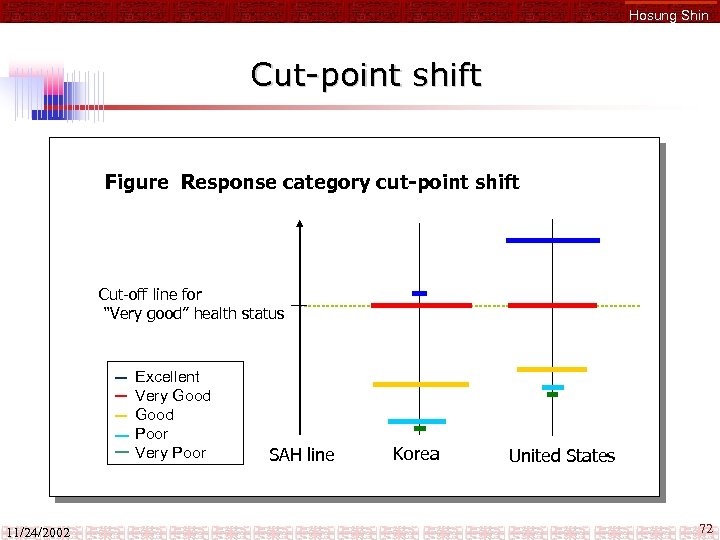 Hosung Shin Cut-point shift Figure Response category cut-point shift Cut-off line for “Very good” health status Excellent Very Good Poor Very Poor 11/24/2002 SAH line Korea United States 72
 Hosung Shin Future study I § Pooled data analysis • Inter-temporal variance § The economic boom and prosperity during 1990 s has resulted in gains in coverage for workers across the wage distribution, but it has narrowed the gap between high and low wage earners only slightly (Bilheimer & Colby, 2001). § During the 1995 -1998, Medicaid enrollment declines 13 percent, which is strongly associated with welfare reform (Kronebusch, 2001). The declines of Medicaid enrollment during 1997 to 1999 result in 0. 3 percent increase in uninsured (Zuckerman, Kenney, Dubay, Haley, & Holahan, 2001). § Between 2000 and 2001 the number of uninsured Americans increased by 1. 4 million, growing to 41 million Americans, primarily due to a decrease in employer-sponsored health insurance (compared with 2000, -1. 2% decrease) • Adjust weights 11/24/2002 73
 Hosung Shin Future study II § Finite mixture model • From the perspective of statistical inference, hurdle model is very similar to the zero-inflated model. Both essentially combine binomial probabilities with Poisson family distributions (Dalrymple, Hudson, & Ford, 2003). • The hurdle model keeps non-users from potential non-users, while in zero-inflated model, the probability of zero occurs from both non-user (perfect state) and potential non-user. • Finite mixture model tackles the problem of sharp-division of population, and takes consideration of unobserved latent characteristics of population • Proxy variables such as self-assessed health status and chronic health conditions may not fully capture population heterogeneity (Deb et al. , 2002). 11/24/2002 74
 Hosung Shin Conclusion § Horizontal equity in health care delivery • Health care ought to be distributed according to need rather than willingness or ability to pay. § Health care reform and health inequality • Social solidarity vs. micro-efficiency § Cross-sectional study findings • Low income groups tend to use higher amount of health care resources, regardless of types of health care due to poorer ill-health status • Health care delivery in Korea is closer to achieve horizontal equity than the U. S does. 11/24/2002 75
 Hosung Shin Thank You 11/24/2002 76