 Скачать презентацию Host Identity Protocol Pekka Nikander Ericsson Research Nomadiclab
79dfcc38c1ecb2be020636f1d46f6fb5.ppt
- Количество слайдов: 56



Host Identity Protocol Pekka Nikander Ericsson Research Nomadiclab and Helsinki Institute for Information Technology http: //www. hip 4 inter. net
Presentation outline • Introduction: What and why? • Background • HIP in a Nutshell • Mobility and multi-homing (multi-addressing) • HIP infrastructure: Hi • Current status • Summary 3 2
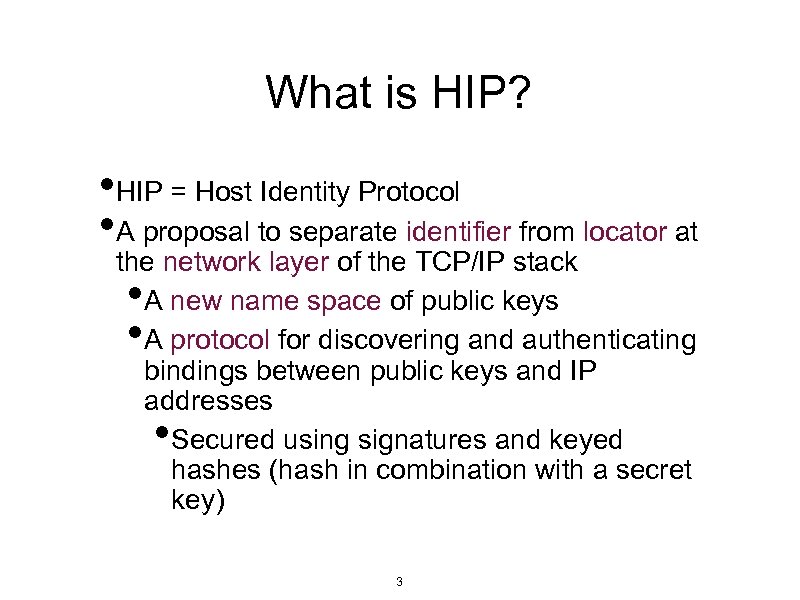
What is HIP? • HIP = Host Identity Protocol • A proposal to separate identifier from locator at the network layer of the TCP/IP stack • A new name space of public keys • A protocol for discovering and authenticating bindings between public keys and IP addresses Secured using signatures and keyed hashes (hash in combination with a secret key) • 3
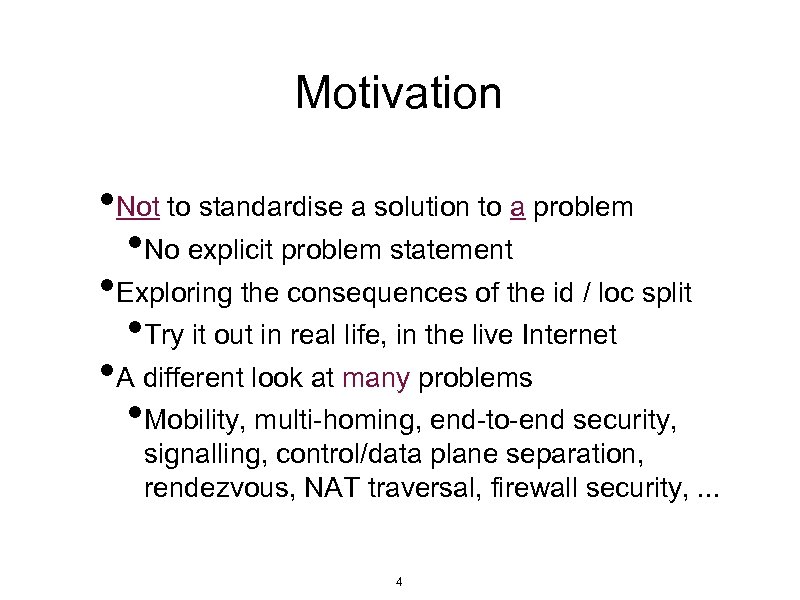
Motivation • Not to standardise a solution to a problem • No explicit problem statement • Exploring the consequences of the id / loc split • Try it out in real life, in the live Internet • A different look at many problems • Mobility, multi-homing, end-to-end security, signalling, control/data plane separation, rendezvous, NAT traversal, firewall security, . . . 4

Background • A brief history of HIP • Architectural background • Related IETF Working Groups 5
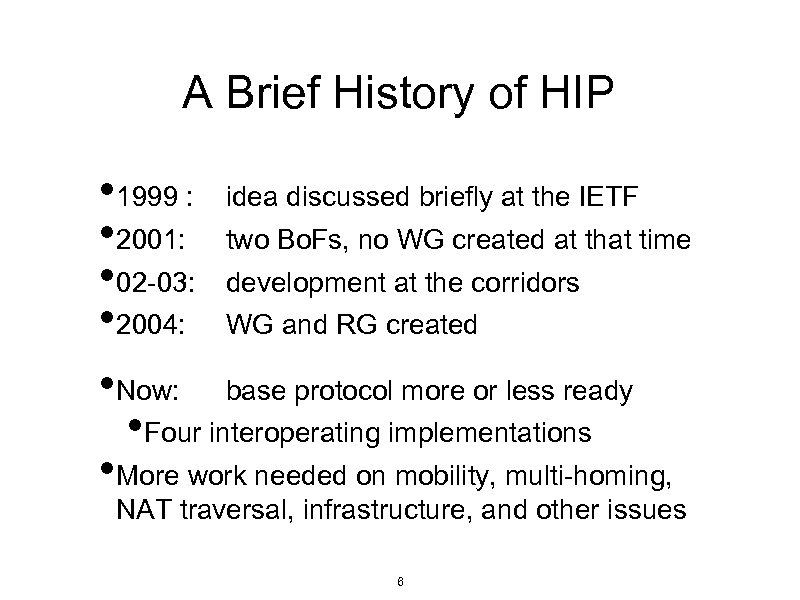
A Brief History of HIP • 1999 : idea discussed briefly at the IETF • 2001: two Bo. Fs, no WG created at that time • 02 -03: development at the corridors • 2004: WG and RG created • Now: base protocol more or less ready • Four interoperating implementations • More work needed on mobility, multi-homing, NAT traversal, infrastructure, and other issues 6
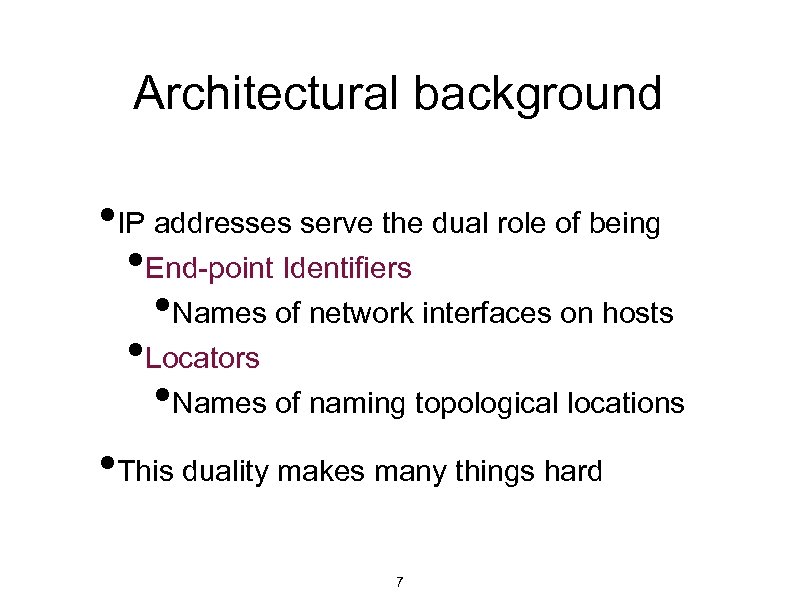
Architectural background • IP addresses serve the dual role of being • End-point Identifiers • Names of network interfaces on hosts • Locators • Names of naming topological locations • This duality makes many things hard 7
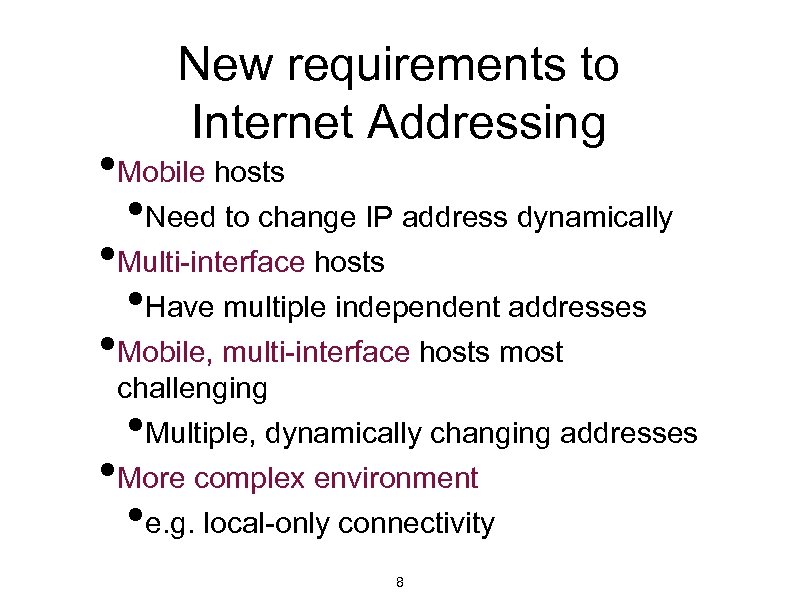
New requirements to Internet Addressing • Mobile hosts • Need to change IP address dynamically • Multi-interface hosts • Have multiple independent addresses • Mobile, multi-interface hosts most • challenging Multiple, dynamically changing addresses More complex environment e. g. local-only connectivity • • 8
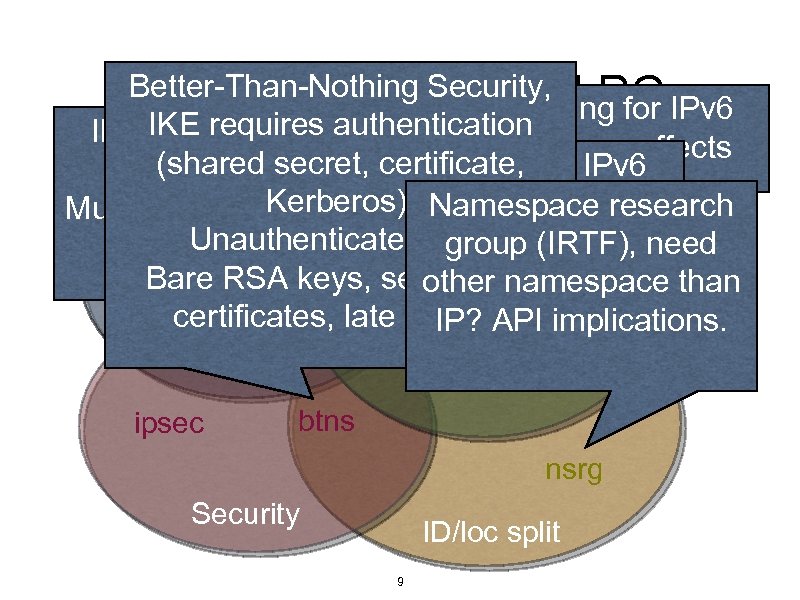
Better-Than-Nothing Security, Related IETF WGs and RGs IPv 6 Signaling and Site multihoming for IPv 6 IKE requires authentication IKEv 2 mobility and multi. Handoff Optimization minimize adverse effects Mobility. Site multihoming by IPv 6 (shared secret, certificate, homing support. Multi-homing Kerberos), Namespace research Intermediation, new shim mip 6 tsvwg Multiple/changing prefixes in mip 4 Unauthenticated IKE, group (IRTF), need (sctp) SA. layer, based on Multi 6 Bare RSA keys, self-signed mipshop other namespace than multi 6 certificates, late binding IP? API implications. shim 6 mobike hip ipsec btns nsrg Security ID/loc split 9
Presentation outline • Introduction: What and why? • Background • HIP in a Nutshell • Mobility and multi-homing (multi-addressing) • HIP infrastructure: Hi • Current status • Summary 3 10
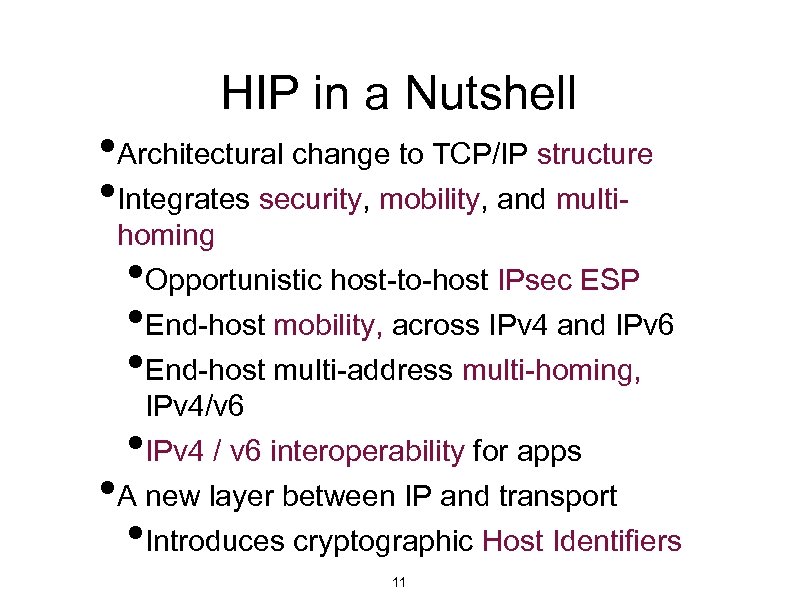
HIP in a Nutshell • Architectural change to TCP/IP structure • Integrates security, mobility, and multi- homing Opportunistic host-to-host IPsec ESP End-host mobility, across IPv 4 and IPv 6 End-host multi-address multi-homing, IPv 4/v 6 IPv 4 / v 6 interoperability for apps A new layer between IP and transport Introduces cryptographic Host Identifiers • • • 11
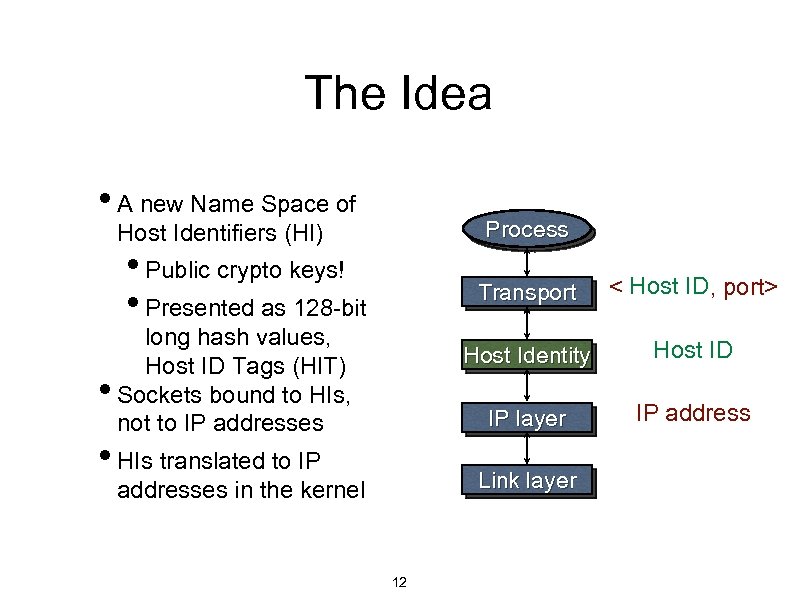
The Idea • A new Name Space of Process Host Identifiers (HI) • Public crypto keys! • Presented as 128 -bit • Transport Host Identity • HIs translated to IP Host ID IP layer long hash values, Host ID Tags (HIT) Sockets bound to HIs, not to IP addresses Host ID < , port> IP address Link layer addresses in the kernel 12
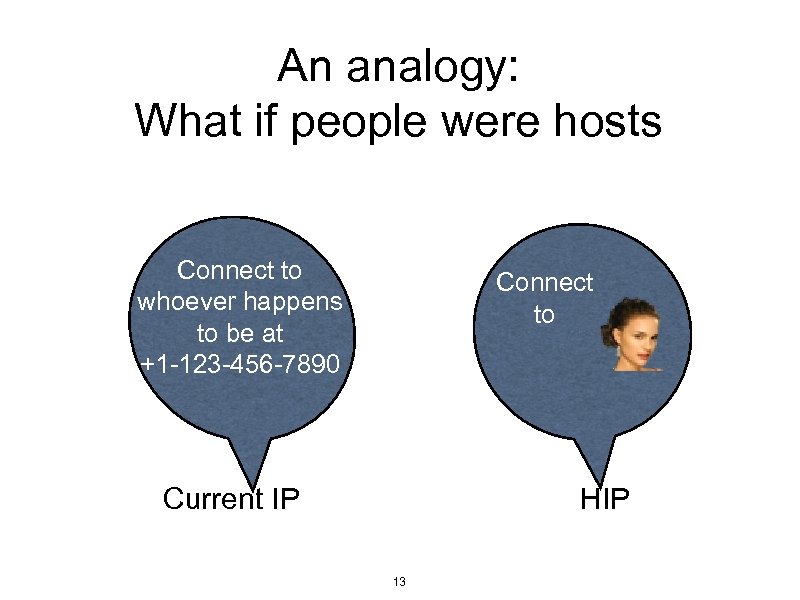
An analogy: What if people were hosts Connect to whoever happens to be at +1 -123 -456 -7890 Connect to Current IP HIP 13
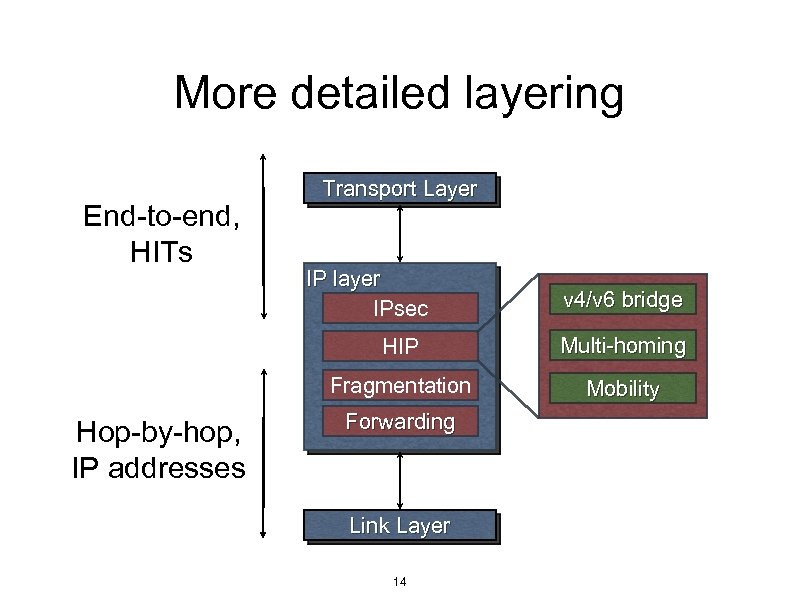
More detailed layering End-to-end, HITs Transport Layer IP layer IPsec v 4/v 6 bridge HIP Fragmentation Hop-by-hop, IP addresses Multi-homing Mobility Forwarding Link Layer 14
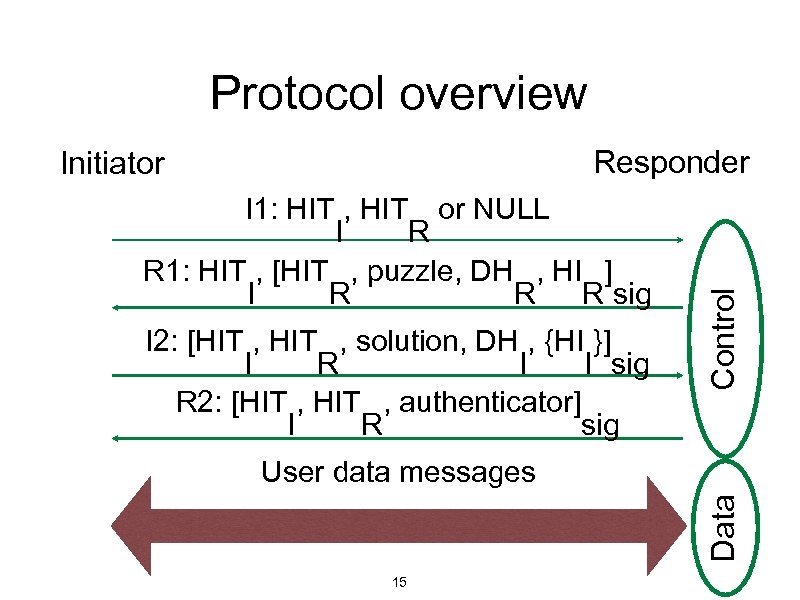
Protocol overview I 1: HIT , HIT or NULL I R R 1: HIT , [HIT , puzzle, DH , HI ] I R R R sig I 2: [HIT , solution, DH , {HI }] I R I I sig R 2: [HIT , authenticator] I R sig Control Responder Initiator Data User data messages 15
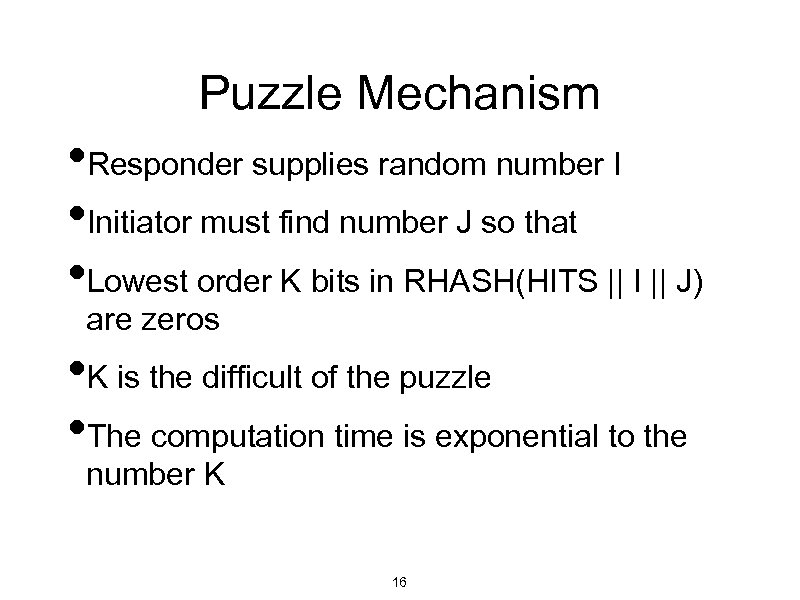
Puzzle Mechanism • Responder supplies random number I • Initiator must find number J so that • Lowest order K bits in RHASH(HITS || I || J) are zeros • K is the difficult of the puzzle • The computation time is exponential to the number K 16
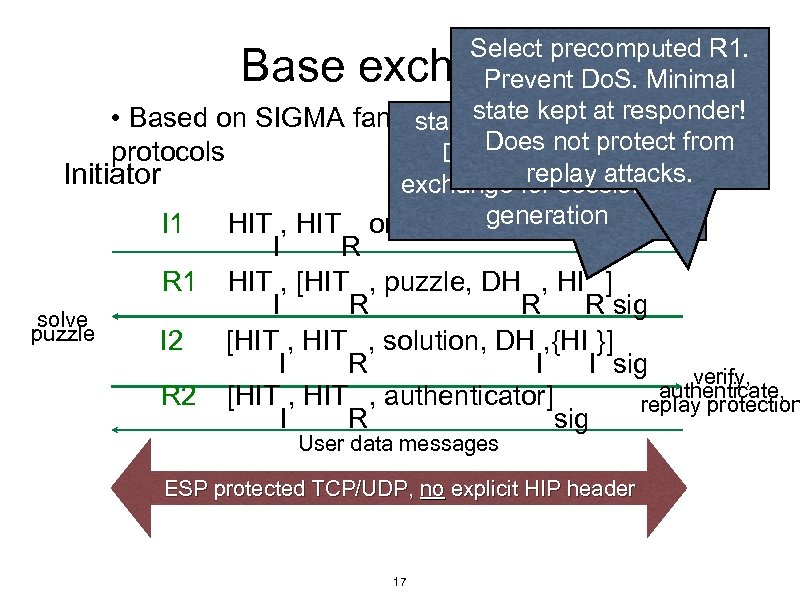
Select precomputed R 1. Prevent Do. S. Minimal state kept at responder! • Based on SIGMA family of key exchange standard authenticated Does not protect from protocols Diffie-Hellman key replay attacks. Initiator Responder exchange for session key Base exchange I 1 R 1 solve puzzle I 2 R 2 HIT , HIT or NULL generation I R HIT , [HIT , puzzle, DH , HI ] I R R R sig [HIT , solution, DH , {HI }] I R I I sig verify, authenticate, [HIT , authenticator] replay protection I R sig User data messages ESP protected TCP/UDP, no explicit HIP header 17
Other core components • Per-packet identity context • Indirectly, through SPI if ESP is used • Directly, e. g. , through an explicit shim header • A mechanism for resolving identities to addresses • DNS-based, if FQDNs used by applications • Or distributed hash tables (DHTs) based
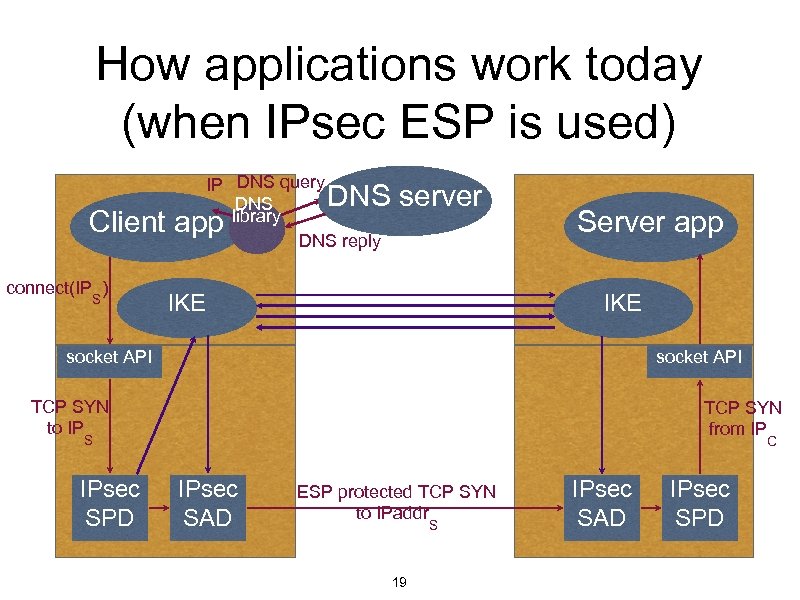
How applications work today (when IPsec ESP is used) IP DNS query DNS library DNS reply Client app connect(IP ) S DNS server IKE Server app IKE socket API TCP SYN to IP TCP SYN from IP S IPsec SPD C IPsec SAD ESP protected TCP SYN to IPaddr S 19 IPsec SAD IPsec SPD
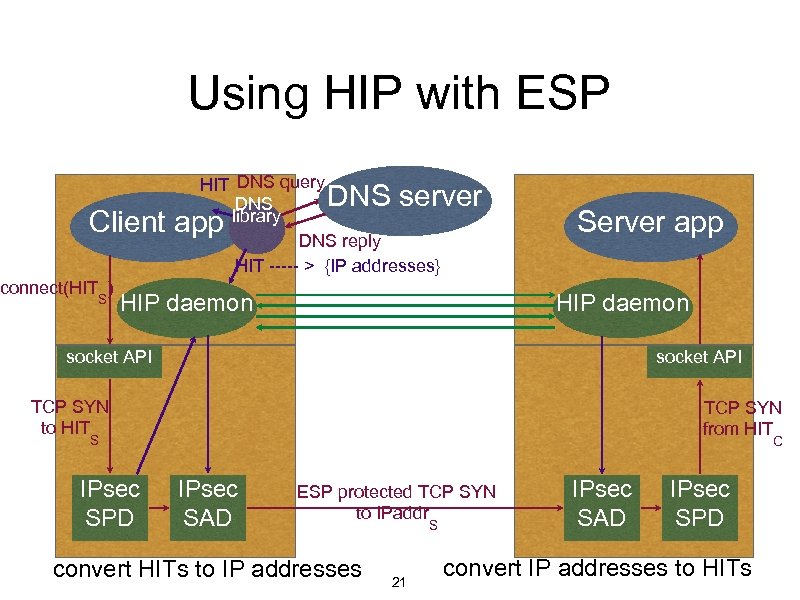
Using HIP with ESP HIT DNS query DNS library DNS reply HIT ----- > {IP addresses} Client app connect(HIT ) S DNS server HIP daemon Server app HIP daemon socket API TCP SYN to HIT TCP SYN from HIT S IPsec SPD C IPsec SAD ESP protected TCP SYN to IPaddr convert HITs to IP addresses S 21 IPsec SAD IPsec SPD convert IP addresses to HITs
Many faces • More established views: • A different IKE for simplified end-to-end ESP Super Mobile IP with v 4/v 6 interoperability and dynamic home agents A host multi-homing solution Newer views: New waist of IP stack; universal connectivity Secure carrier for signalling protocols • • • 22
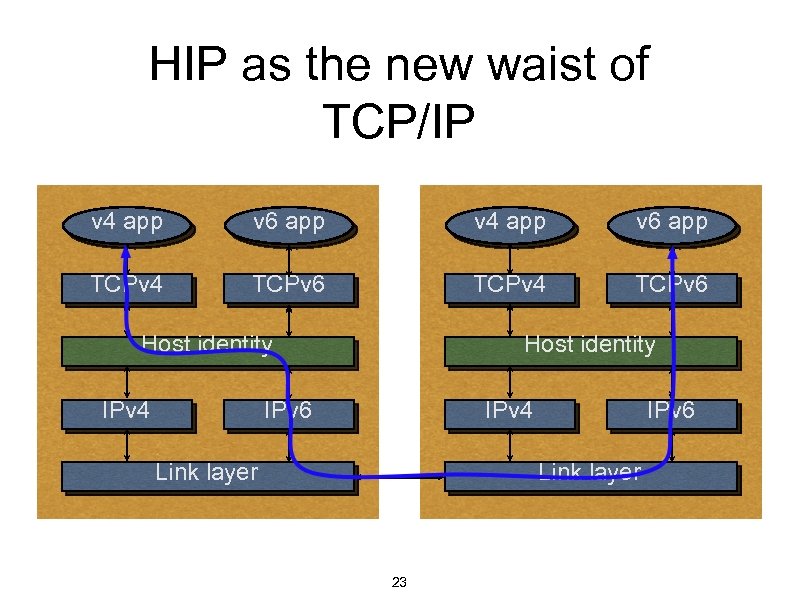
HIP as the new waist of TCP/IP v 4 app v 6 app TCPv 4 TCPv 6 Host identity IPv 4 Host identity IPv 6 IPv 4 Link layer IPv 6 Link layer 23
HIP for universal connectivity • Goal: • Lowest layer providing location • independent identifiers and end-to-end connectivity Work in progress: Support for traversing legacy NATs Firewall registration and authentication Architected middleboxes or layer 3. 5 routing Identity-based connectivity with DHTs • • 24
Signalling carrier • Originally HIP supported only ESP-based • • • user data transport (previous slides) ESP is now being split from the base protocol Base protocol is becoming a secure carrier for any kinds of signalling Support for separate signalling and data paths Implicitly present in the original design Now being made more explicit • • 25
Faces summary: Motivating architectural factors • A “reachability” solution across NATs • New “waist” for the protocol stack • Built-in security • Implicit channel bindings • connect(HIT) provides a secured connection to the identified host • Puzzle-based Do. S protection • Integrated mobility and end-host multi-homing 26
Presentation outline • Introduction: What and why? • Background • HIP in a Nutshell • Mobility and multi-homing (multi-addressing) • HIP infrastructure: Hi • Current status • Summary 3 27
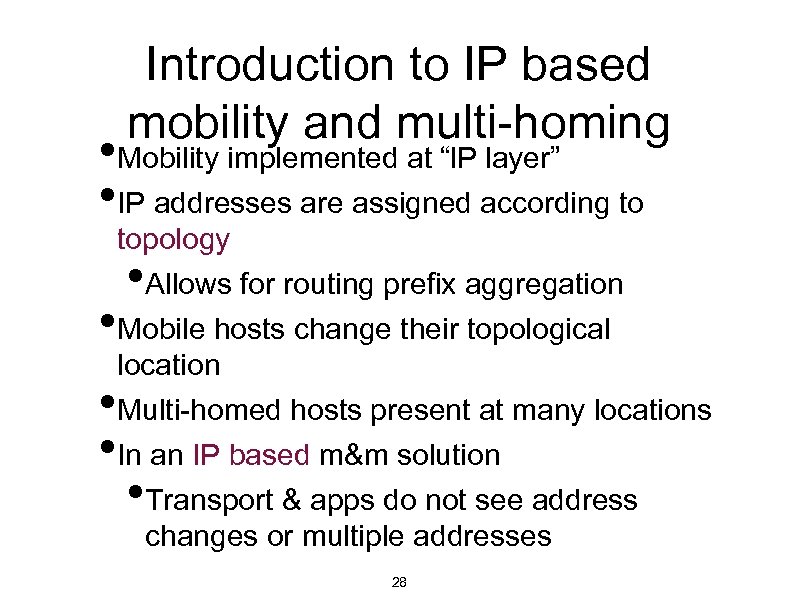
Introduction to IP based mobility and multi-homing • Mobility implemented at “l. P layer” • IP addresses are assigned according to • • • topology Allows for routing prefix aggregation Mobile hosts change their topological location Multi-homed hosts present at many locations In an IP based m&m solution Transport & apps do not see address changes or multiple addresses • • 28
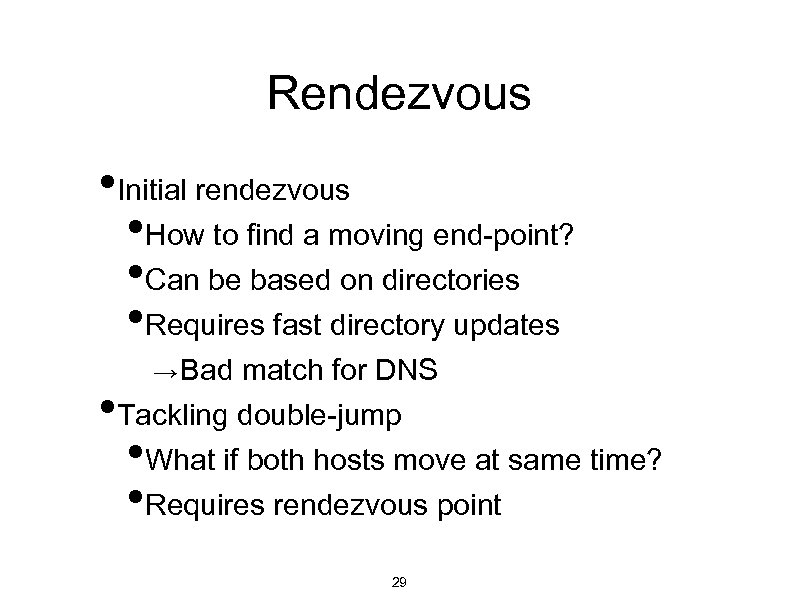
Rendezvous • Initial rendezvous • How to find a moving end-point? • Can be based on directories • Requires fast directory updates → Bad match for DNS • Tackling double-jump • What if both hosts move at same time? • Requires rendezvous point 29
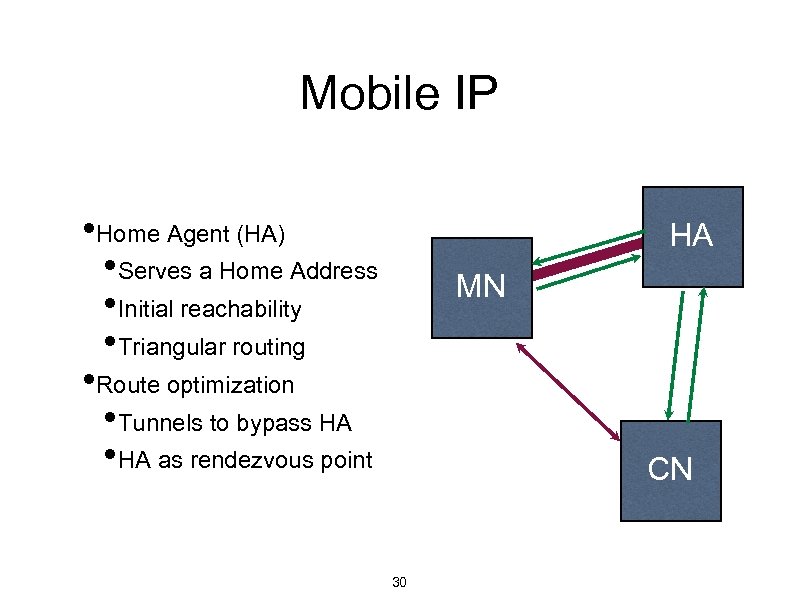
Mobile IP • Home Agent (HA) • Serves a Home Address • Initial reachability • Triangular routing • Route optimization • Tunnels to bypass HA • HA as rendezvous point HA MN CN 30
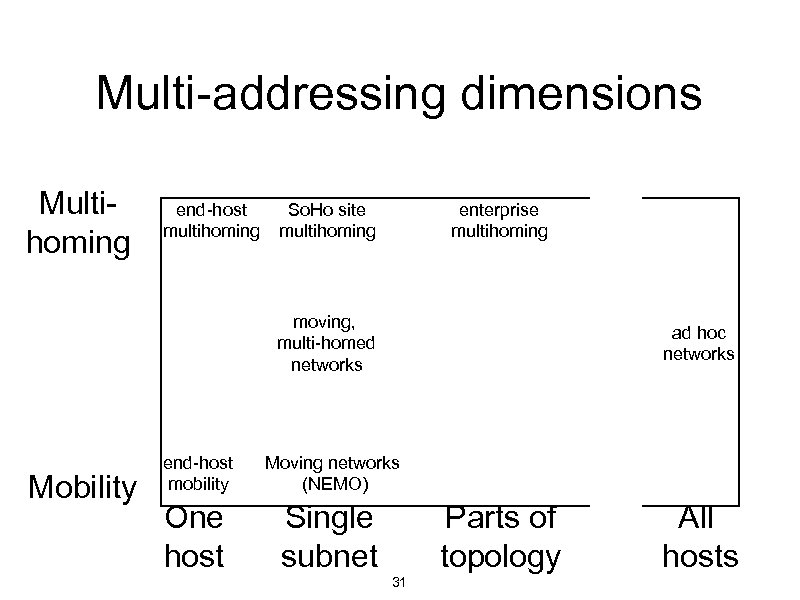
Multi-addressing dimensions Multihoming end-host multihoming So. Ho site multihoming enterprise multihoming moving, multi-homed networks Mobility end-host mobility One host ad hoc networks Moving networks (NEMO) Single subnet Parts of topology 31 All hosts
HIP Mobility & Multi-homing • Mobility and multi-homing become duals of each other • Mobile host has many addresses over time • Multi-homed host has many addresses at • the same time Leads to a Virtual Interface Model A host may have real and virtual interfaces Merges the “Home Agent” • • 32
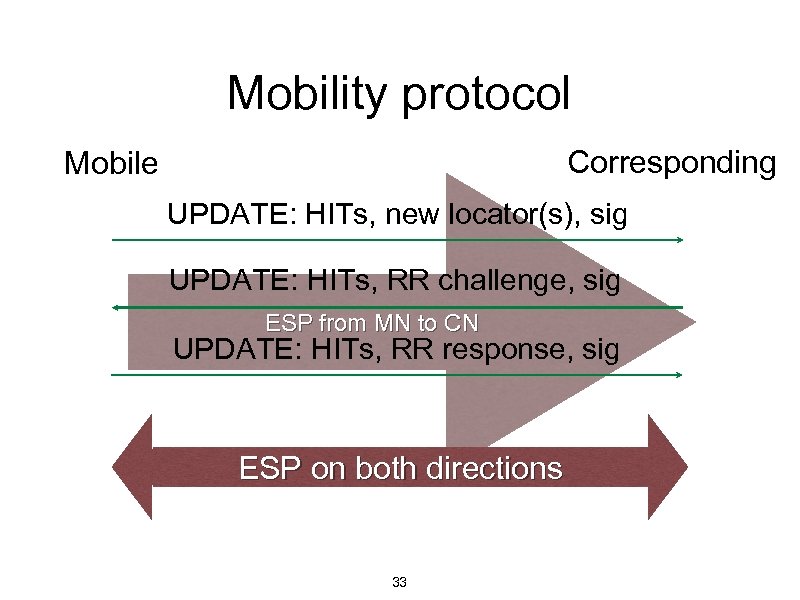
Mobility protocol Corresponding Mobile UPDATE: HITs, new locator(s), sig UPDATE: HITs, RR challenge, sig ESP from MN to CN UPDATE: HITs, RR response, sig ESP on both directions 33
Presentation outline • Introduction: What and why? • Background • HIP in a Nutshell • Mobility and multi-homing (multi-addressing) • HIP infrastructure: Hi • Current status • Summary 3 34
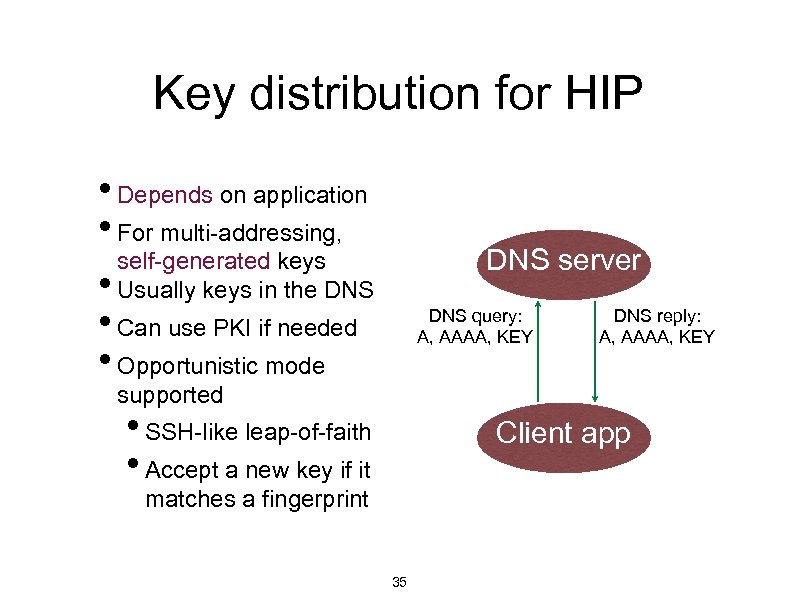
Key distribution for HIP • Depends on application • For multi-addressing, self-generated keys • Usually keys in the DNS • Can use PKI if needed • Opportunistic mode DNS server DNS query: A, AAAA, KEY DNS reply: A, AAAA, KEY supported • SSH-like leap-of-faith • Accept a new key if it Client app matches a fingerprint 35
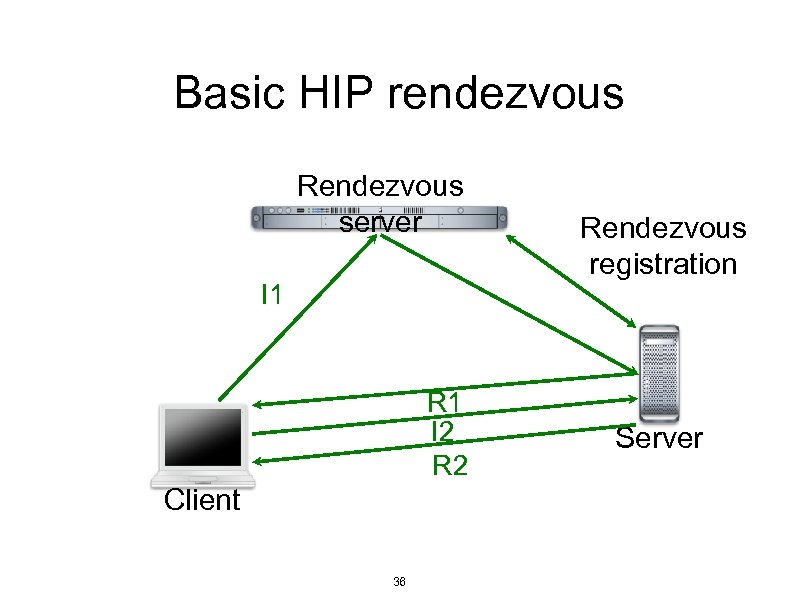
Basic HIP rendezvous Rendezvous server I 1 R 1 I 2 R 2 Client 36 Rendezvous registration Server
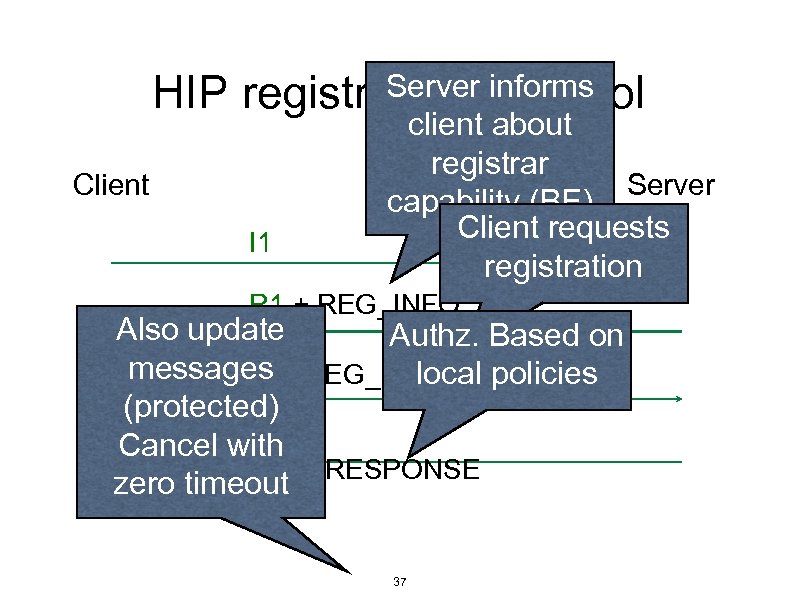
Server informs HIP registration protocol Client I 1 client about registrar Server capability (BE) Client requests registration R 1 + REG_INFO Also update Authz. Based on messages I 2 + REG_REQUEST local policies (protected) R 2 + Cancel with REG_RESPONSE zero timeout 37
The infrastructure question • HIs originally planned to be stored in the DNS Retrieved simultaneously with IP addresses Does not work if you have only a HIT Question: How to get data based on HIT only? HITs look like 128 -bit random numbers 3 Possible answer: DHT based overlay like i • • • 38
Distributed Hash Tables • Distributed directory for flat data • Several different ways to implement • Each server maintains a partial map • Overlay addresses to direct to the right • • server Resilience through parallel, unrelated mappings Used to create overlay networks 39
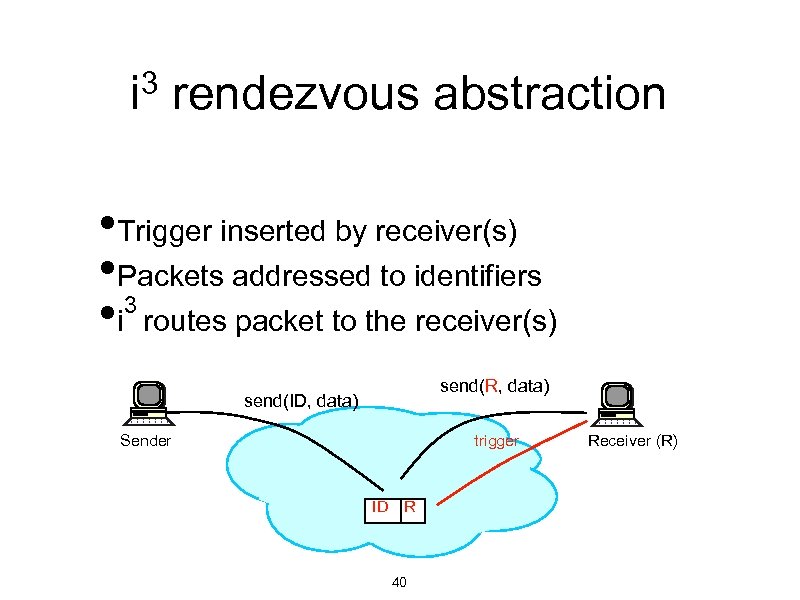
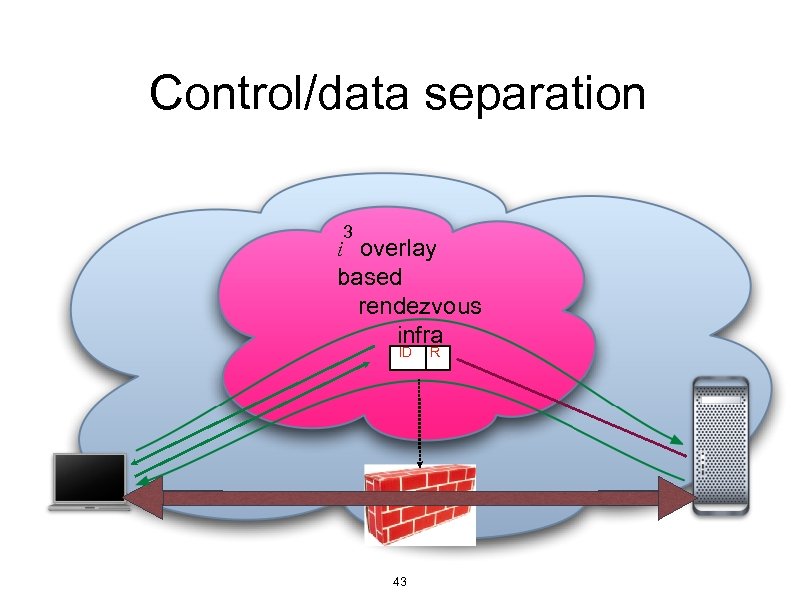
3 rendezvous abstraction i • Trigger inserted by receiver(s) • Packets addressed to identifiers 3 • i routes packet to the receiver(s) send(R, data) send(ID, data) Sender trigger ID R 40 Receiver (R)
3: combining HIP and i 3 Hi • Developed at Ericsson Research IP Networks • Uses i overlay for HIP control packets • Provides rendezvous for HIP • Data packets use plain old IP • Cryptographically protected with ESP • Only soft or optional state in the network 3 41
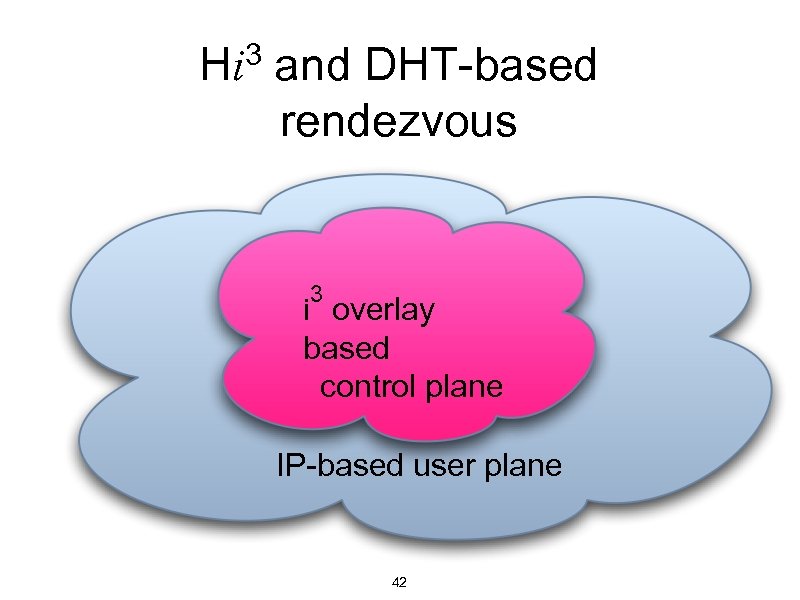
3 and DHT-based Hi rendezvous 3 i overlay based control plane IP-based user plane 42
Control/data separation 3 i overlay based rendezvous infra ID 43 R
3 Hi overlay and IPsec connectivity • i • • • 3 overlay for signalling (control plane) Routes only HIP control packets e 2 e ESP for data traffic (user plane) Firewalls/middle boxes opened dynamically Only end-to-end signalling (HIP) Middle boxes “snoop” e 2 e messages Lots of details to be filled in • • • 44
An Internet control plane? • HIP separates control and data traffic 3 • Hi routes control traffic through overlay • Control and data packets take potentially • very different paths Allows telecom-like control … … but does not require it • 45
Benefits for everyone • Operators • Control, security, resilience, revenue • Enterprises • Security, resilience, mobility • Individual users • Security, mobility, ease of use 46
Benefits to operators • More controlled network • Data requires HIP handshake first • Protection against Do. S and DDo. S • Resilience • Integrated multi-homing • No single points of failure 47
Benefits to enterprises • More secure firewalls • Integrated mobility and multi-access • Across IPv 4 and IPv 6 • No single points of failure 48
Benefits to users • Do. S and DDo. S protection • Supports home servers (NAT traversal) • Configuration free baseline security (ssh-like leap-of-faith encryption 49
Presentation outline • Introduction: What and why? • Background • HIP in a Nutshell • Mobility and multi-homing (multi-addressing) • HIP infrastructure: Hi • Current status • Summary 3 50
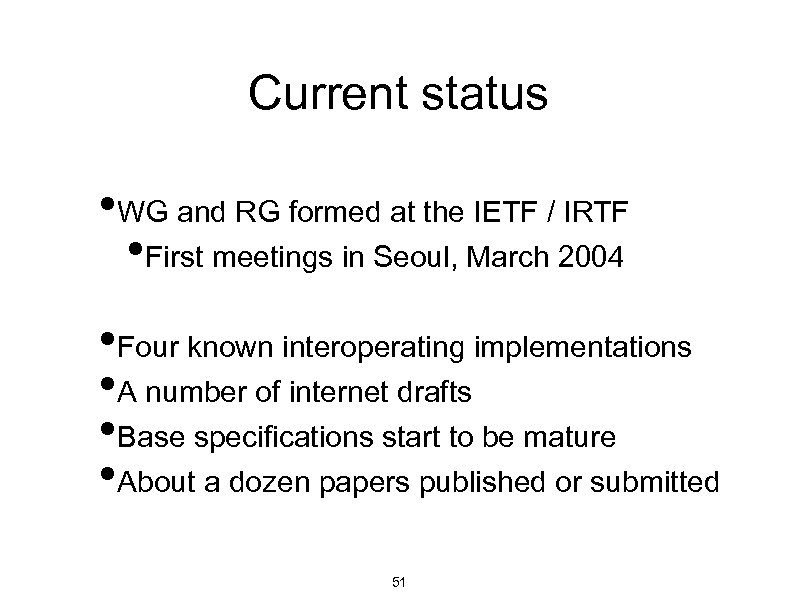
Current status • WG and RG formed at the IETF / IRTF • First meetings in Seoul, March 2004 • Four known interoperating implementations • A number of internet drafts • Base specifications start to be mature • About a dozen papers published or submitted 51
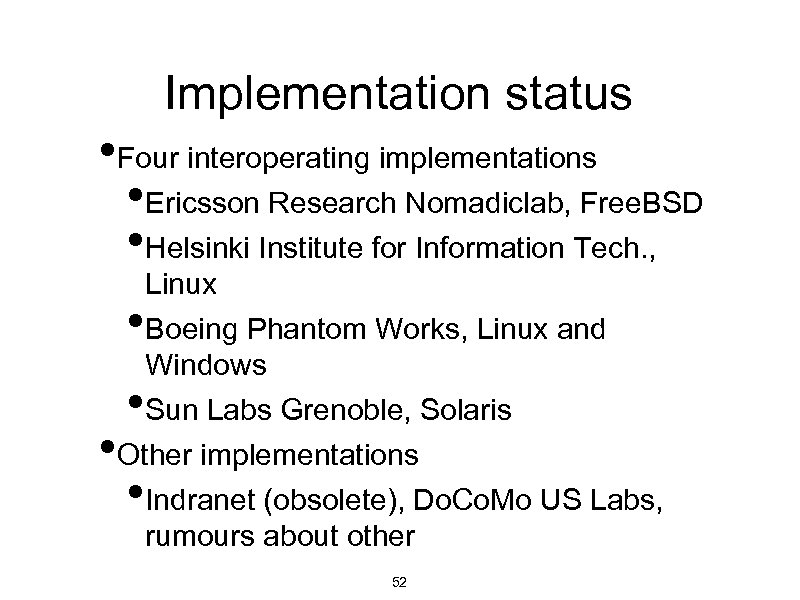
Implementation status • Four interoperating implementations • Ericsson Research Nomadiclab, Free. BSD • Helsinki Institute for Information Tech. , Linux Boeing Phantom Works, Linux and Windows Sun Labs Grenoble, Solaris Other implementations Indranet (obsolete), Do. Co. Mo US Labs, rumours about other • • 52
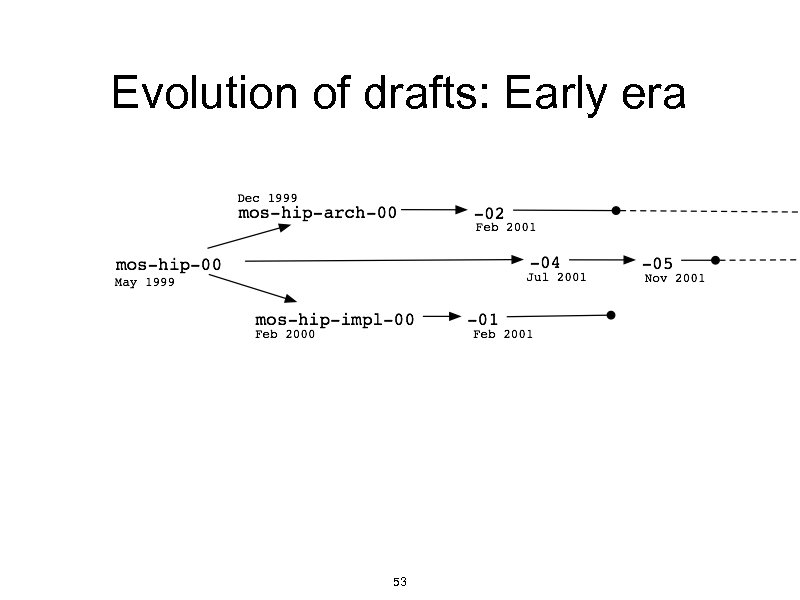
Evolution of drafts: Early era 53
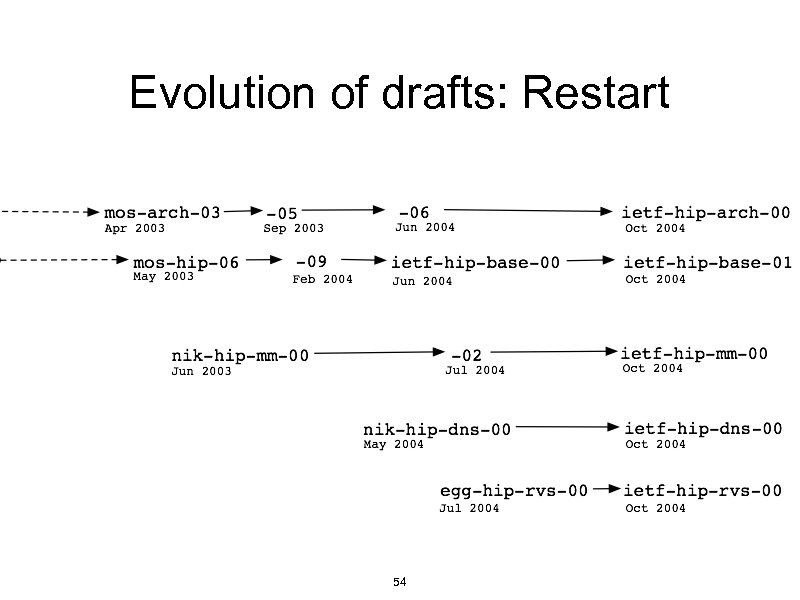
Evolution of drafts: Restart 54
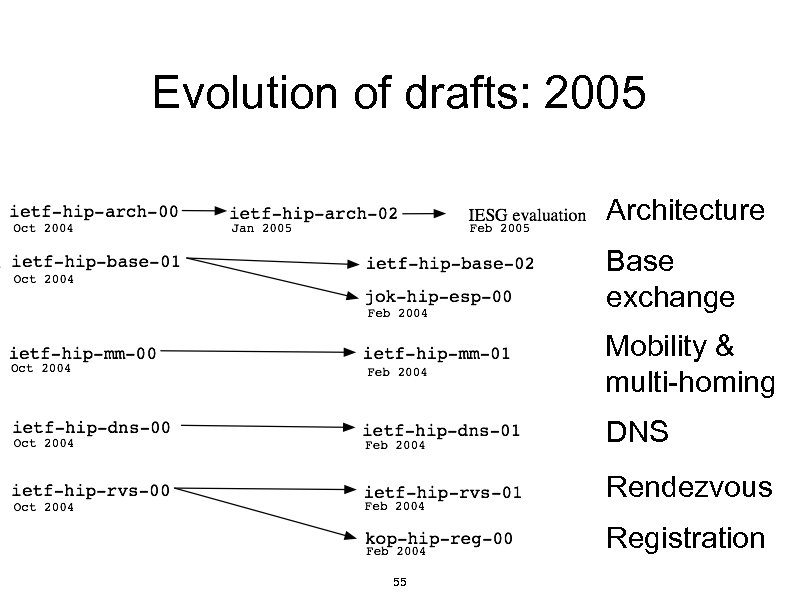
Evolution of drafts: 2005 Architecture Base exchange Mobility & multi-homing DNS Rendezvous Registration 55
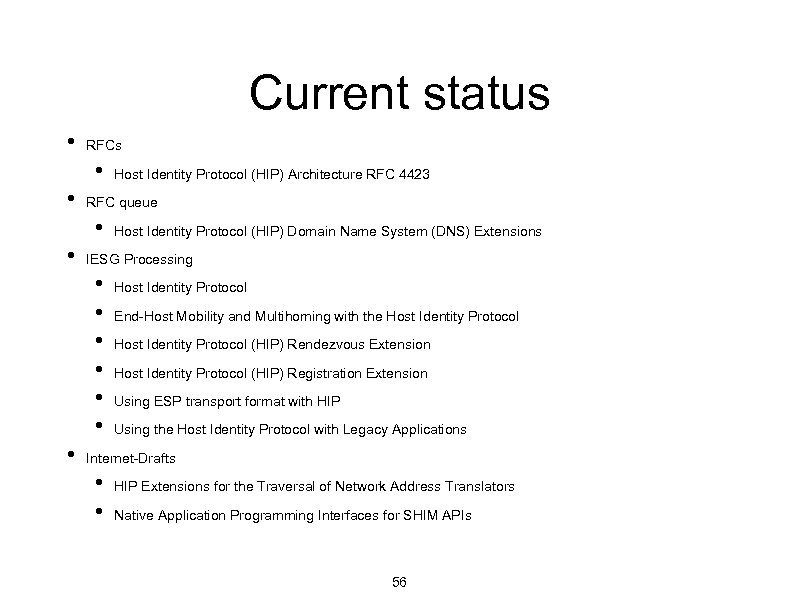
Current status • RFCs • • RFC queue • • Host Identity Protocol (HIP) Domain Name System (DNS) Extensions IESG Processing • • Host Identity Protocol (HIP) Architecture RFC 4423 Host Identity Protocol End-Host Mobility and Multihoming with the Host Identity Protocol (HIP) Rendezvous Extension Host Identity Protocol (HIP) Registration Extension Using ESP transport format with HIP Using the Host Identity Protocol with Legacy Applications Internet-Drafts • • HIP Extensions for the Traversal of Network Address Translators Native Application Programming Interfaces for SHIM APIs 56
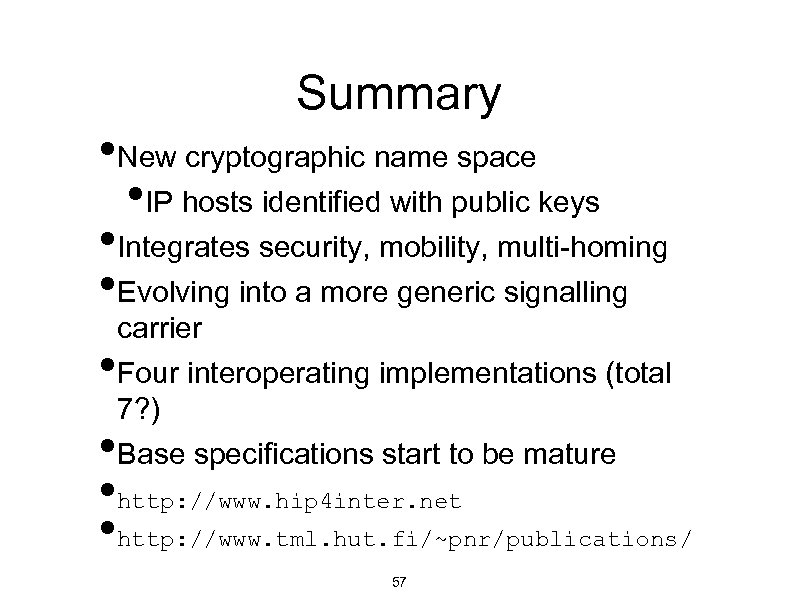
Summary • New cryptographic name space • IP hosts identified with public keys • Integrates security, mobility, multi-homing • Evolving into a more generic signalling • carrier Four interoperating implementations (total 7? ) Base specifications start to be mature • • http: //www. hip 4 inter. net • http: //www. tml. hut. fi/~pnr/publications/ 57
Скачать презентацию Host Identity Protocol Pekka Nikander Ericsson Research Nomadiclab
79dfcc38c1ecb2be020636f1d46f6fb5.ppt