


 Скачать презентацию Hospitals Origins Organization and Trends Yaseen Hayajneh RN
e4e1acbd7ec68229a27d913a9323c3c5.ppt
- Количество слайдов: 42
 Hospitals: Origins, Organization, and Trends Yaseen Hayajneh, RN, MPH, Ph. D 1
 Hospitals in 18 th. Century Pesthouses, almshouses, infirmaries. l Hospitals were for: l l Contagious sailors and shipboard victims The poor, mentally ill, and homeless Patients with family and means received health care at home. 2
 Hospitals in 19 th. Century Unsanitary conditions l Overcrowdedness l Little medical care l l Religious groups improved situations. 3
 Revolutionizing Hospital by 1900 s l Factors l l l Nursing training and care Effective anesthesia Antiseptics Sterilization By 1900 s, hospitals changed from supplying food & refuge to poor and contagious to providing skilled care to everyone. 4
 Hospitals Expansion Hospital insurance l Medical advances l Medical specialization l Federal support: l l l Hill-Burton Act Medicare & Medicaid 5
 Federal Laws l Hill-Burton Act of 1946 l l l Shortage of hospitals Provided matching grants to communities to build hospitals Involved in construction of nearly 40% of beds ( 50’s and 60’s) Especially evident in rural areas Medicare & Medicaid of 1965 l l l Coverage for 65+ Coverage for low income Provided incentive for more expansion 6
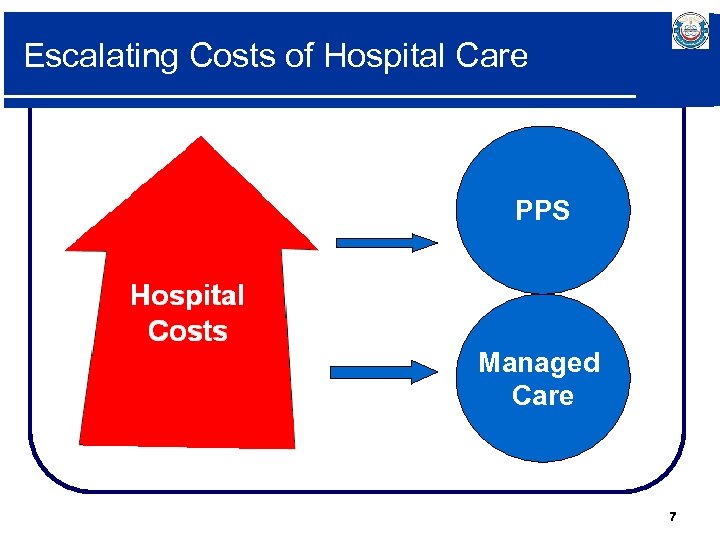 Escalating Costs of Hospital Care PPS Managed Care 7
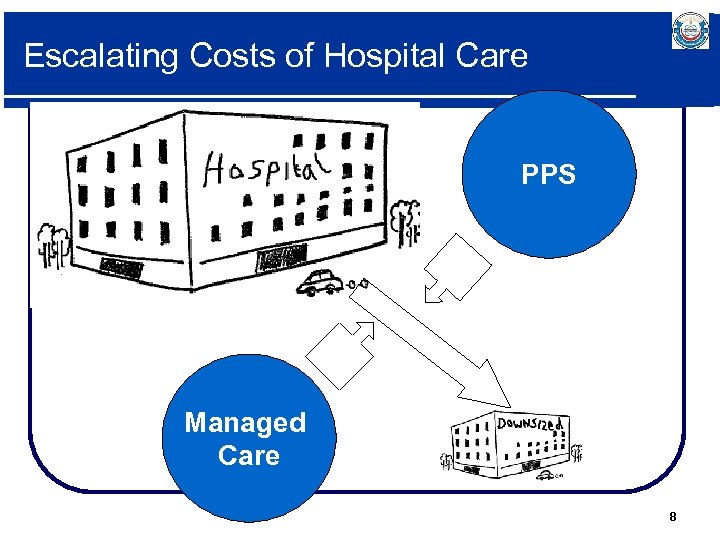 Escalating Costs of Hospital Care PPS Managed Care 8
 From Retrospective to Prospective (PPS) l Retrospective Payment System: l l A payment system in which the amount a hospital receives for treating a patient is based on the expenditures incurred. Unlimited Discouraged Frugality and efficiency “No cost was too great when it came to health care” 9
 From Retrospective to Prospective l Prospective Payment System (PPS, 1983): l l l A payment system in which the amount a hospital receives for treating a patient is fixed in advance by Medicare or an insurer. If the treatment costs more than the payment, the hospital absorbs the loss; if the treatment costs less, hospitals keep the difference. Fixed amount. Encourages frugality and efficiency 10
 Managed Care A term that applies to the integration of health care delivery and financing. Managed care plans, such as an HMO, manage or control what is spent on health care by closely monitoring how providers treat patients. l Limit referrals to costly specialists and require preauthorization for hospital care and services to keep costs down. l 11
 Hospitals Downsizing l Revenue shrinkage: l l Rising costs l l l Prospective payment System (1983) Bargaining power of Managed Care Uncompensated Care Technology, drugs, services Inflation Advanced Technology l Reduced need for admission, Outpatient services 12
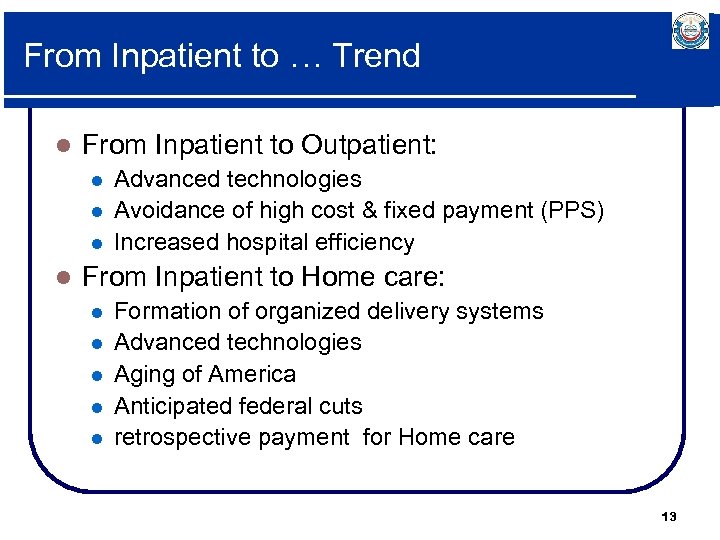 From Inpatient to … Trend l From Inpatient to Outpatient: l l Advanced technologies Avoidance of high cost & fixed payment (PPS) Increased hospital efficiency From Inpatient to Home care: l l l Formation of organized delivery systems Advanced technologies Aging of America Anticipated federal cuts retrospective payment for Home care 13
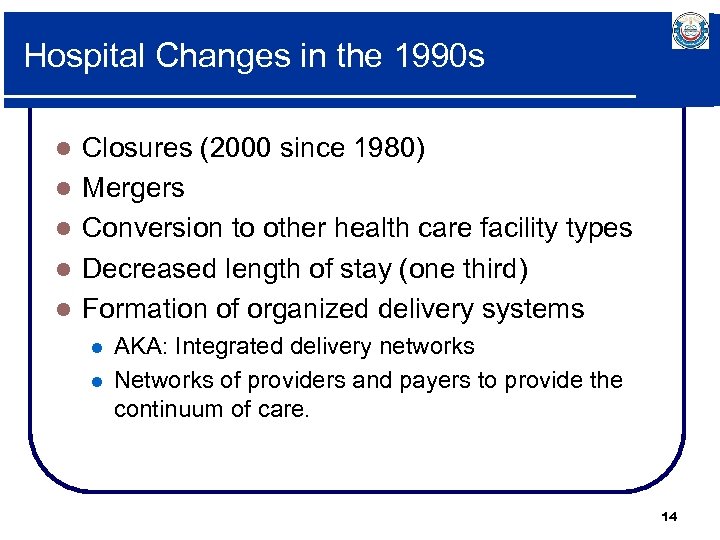 Hospital Changes in the 1990 s l l l Closures (2000 since 1980) Mergers Conversion to other health care facility types Decreased length of stay (one third) Formation of organized delivery systems l l AKA: Integrated delivery networks Networks of providers and payers to provide the continuum of care. 14
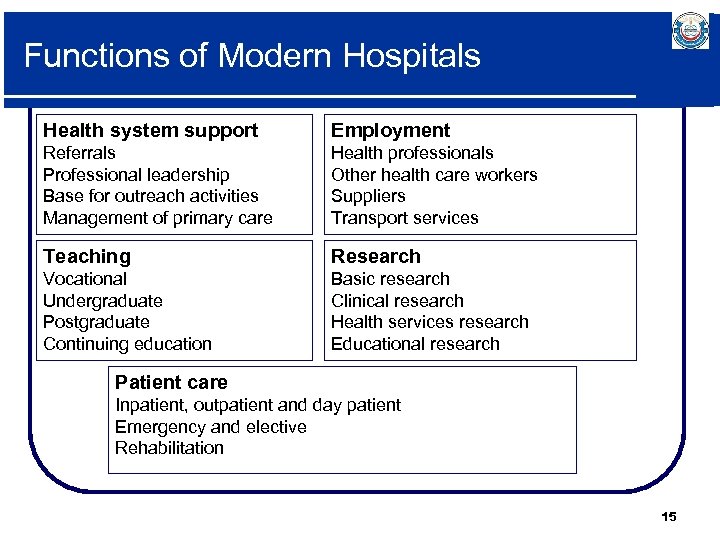 Functions of Modern Hospitals Health system support Employment Referrals Professional leadership Base for outreach activities Management of primary care Health professionals Other health care workers Suppliers Transport services Teaching Research Vocational Undergraduate Postgraduate Continuing education Basic research Clinical research Health services research Educational research Patient care Inpatient, outpatient and day patient Emergency and elective Rehabilitation 15
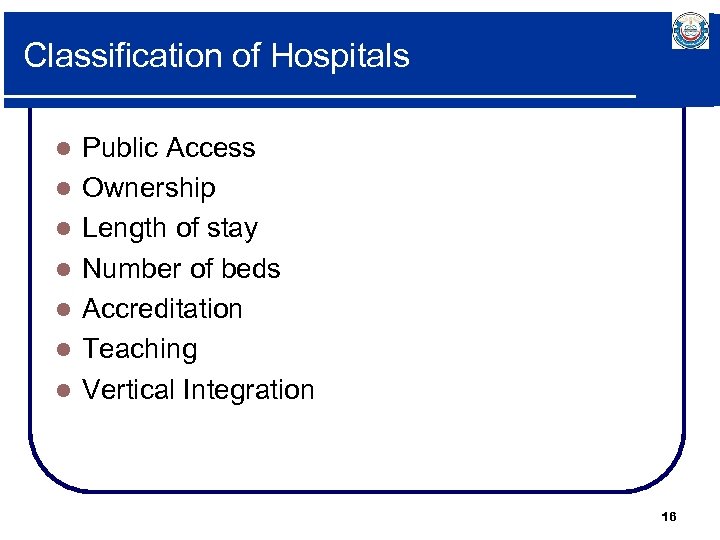 Classification of Hospitals l l l l Public Access Ownership Length of stay Number of beds Accreditation Teaching Vertical Integration 16
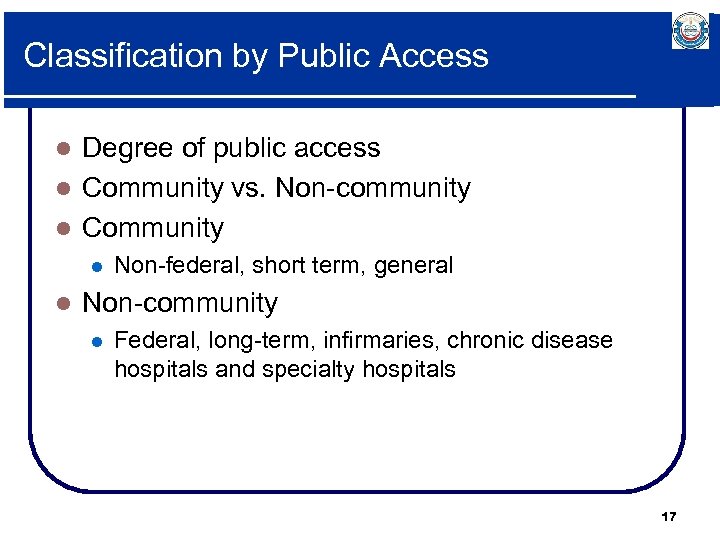 Classification by Public Access Degree of public access l Community vs. Non-community l Community l l l Non-federal, short term, general Non-community l Federal, long-term, infirmaries, chronic disease hospitals and specialty hospitals 17
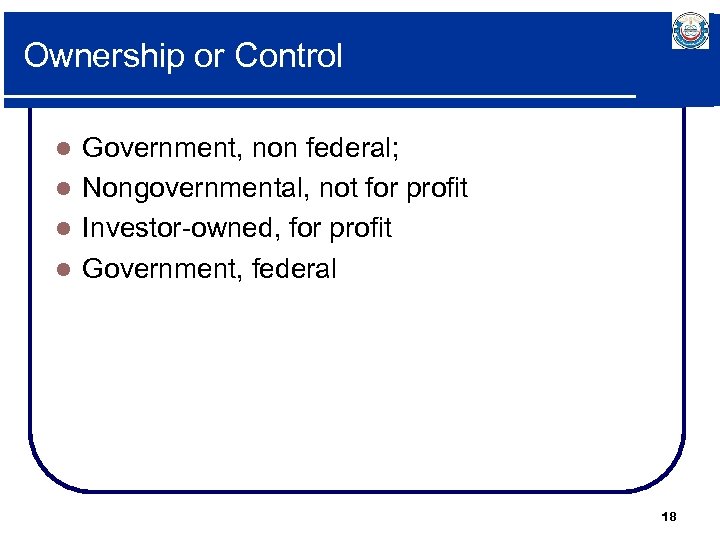 Ownership or Control Government, non federal; l Nongovernmental, not for profit l Investor-owned, for profit l Government, federal l 18
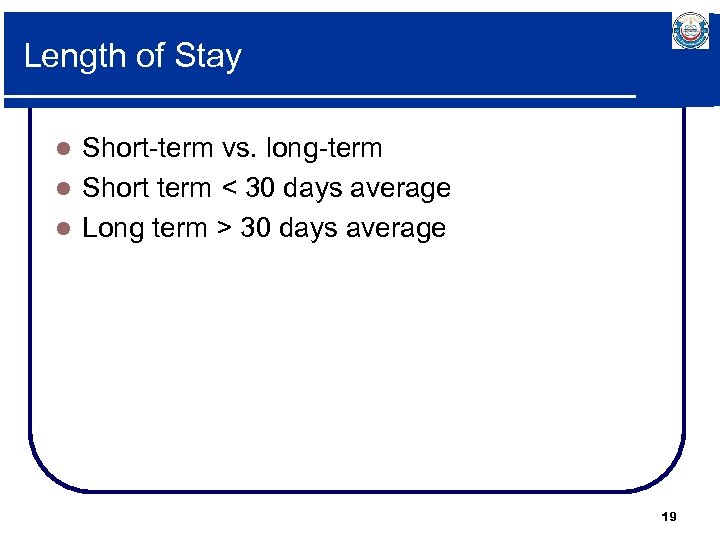 Length of Stay Short-term vs. long-term l Short term < 30 days average l Long term > 30 days average l 19
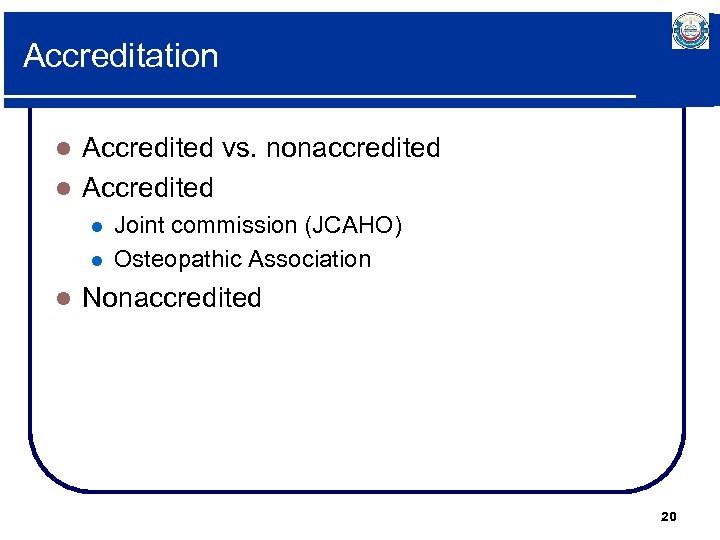 Accreditation Accredited vs. nonaccredited l Accredited l l Joint commission (JCAHO) Osteopathic Association Nonaccredited 20
 Teaching vs. Nonteaching l Teaching physicians l l l Full: offer at minimum 4 residencies Partial: offer 2 -3 of the basic residencies 21
 Vertical Integration Primary, secondary, or tertiary l Primary: offer services on outpatient basis l Secondary: more sophisticated, inpatient l Tertiary: highly specialized services requiring highly technical resources. l 22
 Hospital Organization & Structure Make sure to examine the examples of hospital organizational charts linked to from the module. 23
 Organization A systematic arrangement of two or more people or entities who fulfill formal roles & share a common purpose. l Purpose, people, and developed structure. l Examples: l l l University, shop, clinic… Small – very large. Bureaucracy: a type of organization where individual positions & clusters of positions are grouped in a hierarchy or pyramid 24
 Hospital as a bureaucracy Division of labor: specialization per task. l System of policies: formalized guidelines for actions. l Span of control: optimal # of staff a single supervisor can manage. l Unity of command: each employee reports to one and only one boss. l 25
 Hospital as a bureaucracy l Delegation: assigning decision-making power to lower levels in organizations l l Delegator always responsible Line vs. staff l l Line authority: direct authority Staff authority: advisory authority 26
 Hospital Departments and Services l l l l Medical Division Nursing Division Allied health services Diagnostic services Rehabilitation Services Nutritional Services Administrative Departments Hotel Services 27
 Medical Division Provision of medical services. l Ensuring quality of services. l Training & teaching of medical students & Trainees. l Conducting research. l 28
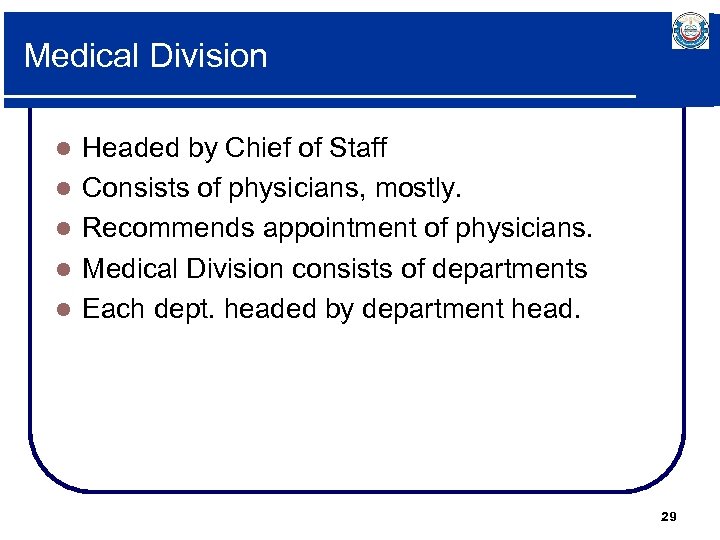 Medical Division l l l Headed by Chief of Staff Consists of physicians, mostly. Recommends appointment of physicians. Medical Division consists of departments Each dept. headed by department head. 29
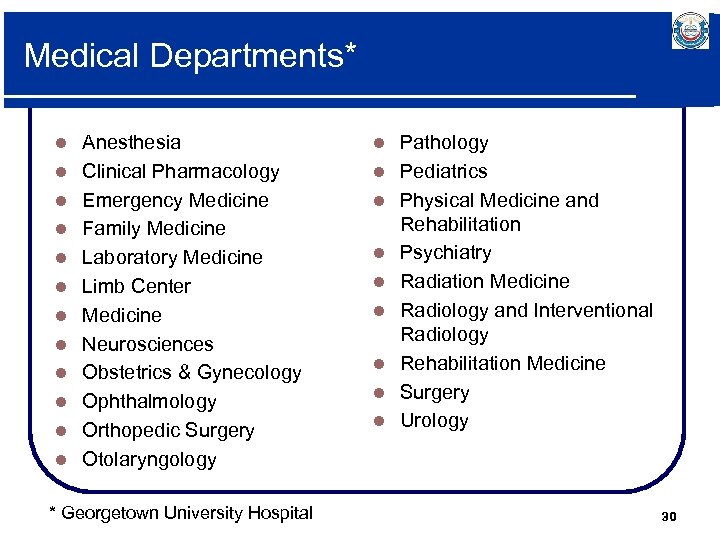 Medical Departments* l l l Anesthesia Clinical Pharmacology Emergency Medicine Family Medicine Laboratory Medicine Limb Center Medicine Neurosciences Obstetrics & Gynecology Ophthalmology Orthopedic Surgery Otolaryngology * Georgetown University Hospital l l l l Pathology Pediatrics Physical Medicine and Rehabilitation Psychiatry Radiation Medicine Radiology and Interventional Radiology Rehabilitation Medicine Surgery Urology 30
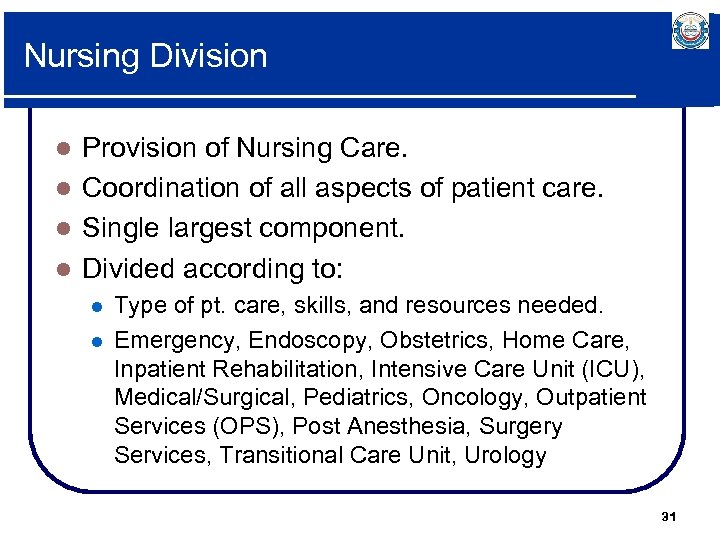 Nursing Division Provision of Nursing Care. l Coordination of all aspects of patient care. l Single largest component. l Divided according to: l l l Type of pt. care, skills, and resources needed. Emergency, Endoscopy, Obstetrics, Home Care, Inpatient Rehabilitation, Intensive Care Unit (ICU), Medical/Surgical, Pediatrics, Oncology, Outpatient Services (OPS), Post Anesthesia, Surgery Services, Transitional Care Unit, Urology 31
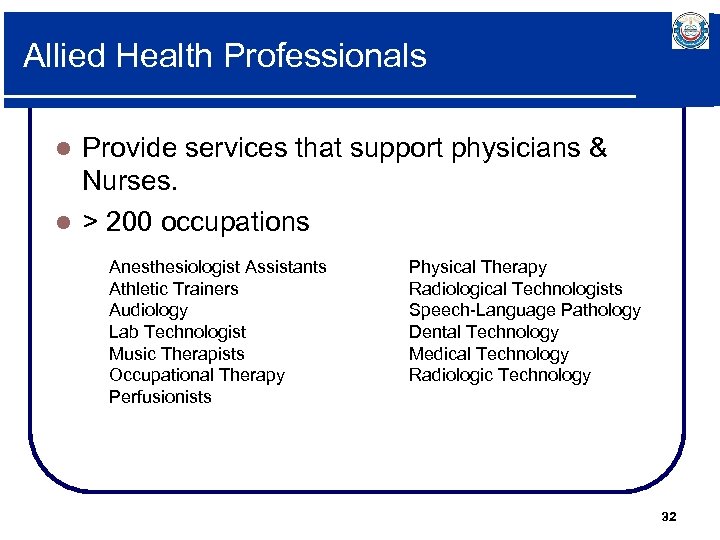 Allied Health Professionals Provide services that support physicians & Nurses. l > 200 occupations l Anesthesiologist Assistants Athletic Trainers Audiology Lab Technologist Music Therapists Occupational Therapy Perfusionists Physical Therapy Radiological Technologists Speech-Language Pathology Dental Technology Medical Technology Radiologic Technology 32
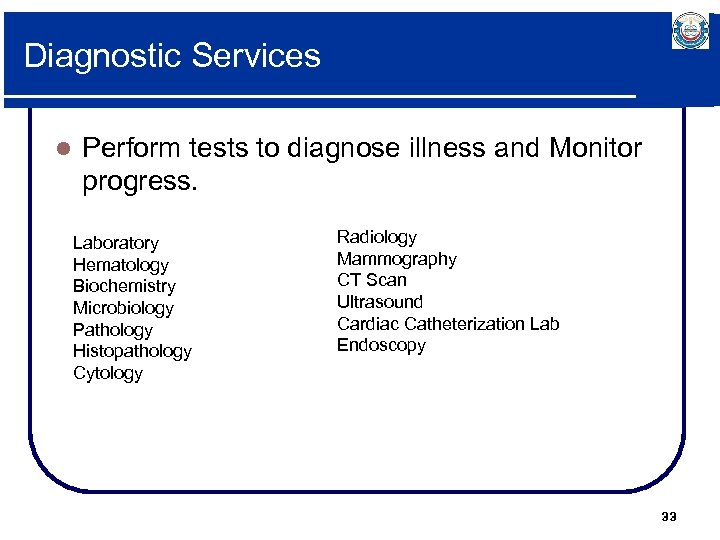 Diagnostic Services l Perform tests to diagnose illness and Monitor progress. Laboratory Hematology Biochemistry Microbiology Pathology Histopathology Cytology Radiology Mammography CT Scan Ultrasound Cardiac Catheterization Lab Endoscopy 33
 Rehabilitation Services l Specialized care to assist patients in achieving optimal functioning. l l l Physical Therapy Occupational Therapy Speech Language Therapy Sports Medicine Psychologists 34
 Other Services Pharmacy: Acquisition & dispensing of medications to inpatients & outpatients. l Social Services: Assist patients to achieve optimal social and domestic environment for recovery. l Nutritional Services: Food and dietetic services, and Nutritional education. l Hotel services: Maintenance, Security, Laundry, Telephone l 35
 Hospital Complexity l l l Number of employees. Number of different occupations. Shared power between CEO, Board of Directors and Physicians. Amount of data collected and transmitted. Possible number of pathways of data transmission. 36
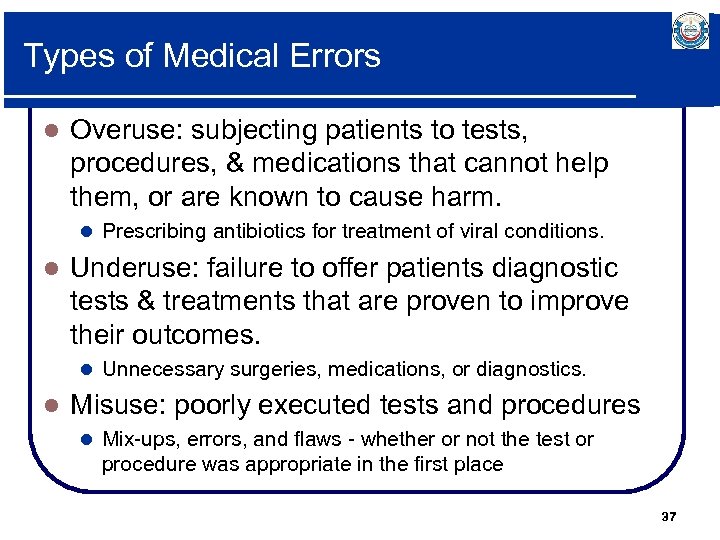 Types of Medical Errors l Overuse: subjecting patients to tests, procedures, & medications that cannot help them, or are known to cause harm. l Prescribing antibiotics for treatment of viral conditions. l Underuse: failure to offer patients diagnostic tests & treatments that are proven to improve their outcomes. l Unnecessary surgeries, medications, or diagnostics. l Misuse: poorly executed tests and procedures l Mix-ups, errors, and flaws - whether or not the test or procedure was appropriate in the first place 37
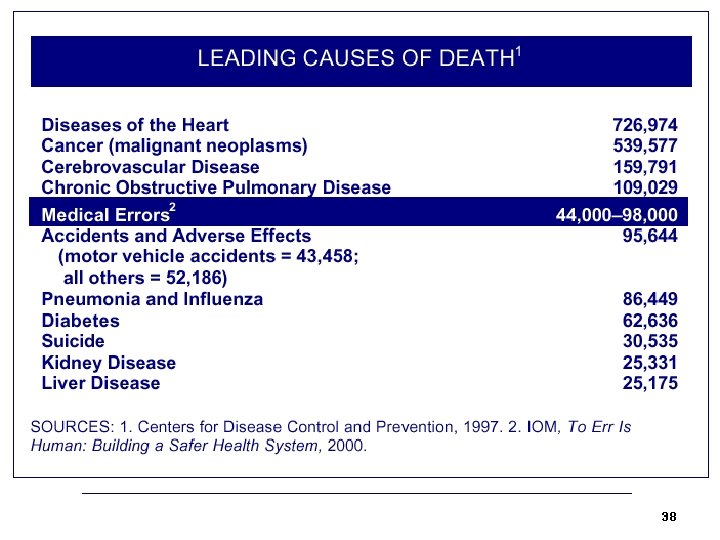 38
38
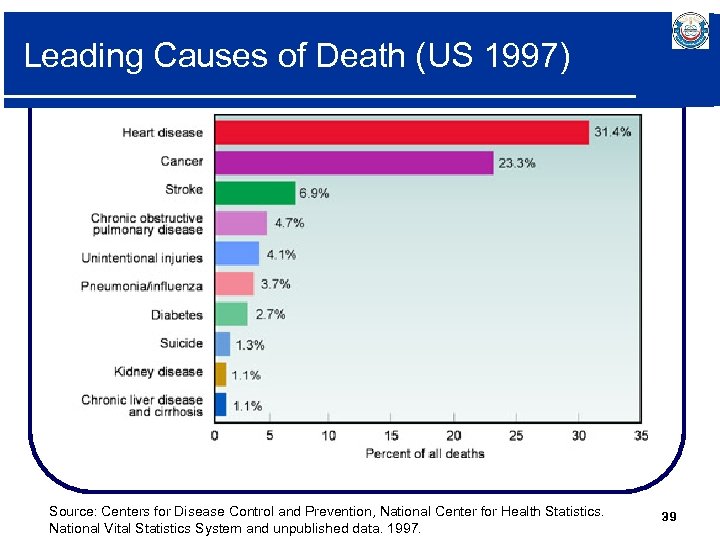 Leading Causes of Death (US 1997) Source: Centers for Disease Control and Prevention, National Center for Health Statistics. National Vital Statistics System and unpublished data. 1997. 39
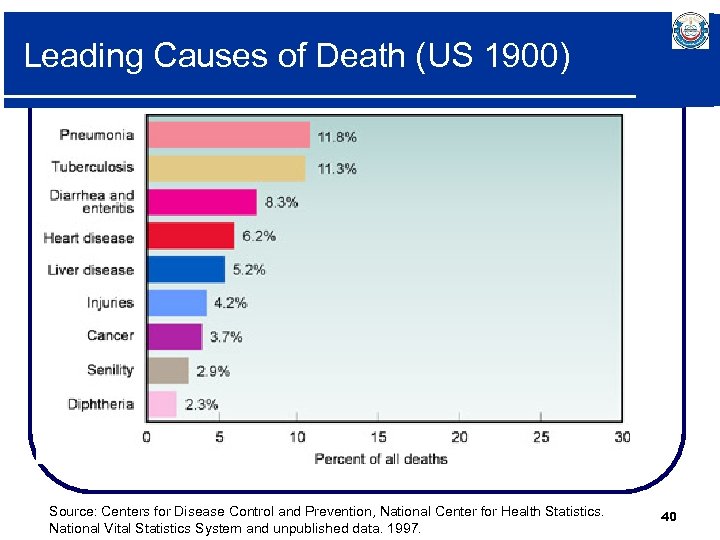 Leading Causes of Death (US 1900) Source: Centers for Disease Control and Prevention, National Center for Health Statistics. National Vital Statistics System and unpublished data. 1997. 40
 Causes of Medical Errors Majority of errors do not result from individual recklessness, but from flaws in health system organization (or lack of organization) l Failures of information management are common: l l l illegible writing in medical records lack of integration of clinical information systems inaccessibility of records lack of automated allergy and drug interaction checking 41
 Do Electronic Medical Records Make a Difference? YES. l EMRs: l l l Shorten inpatient Length of Stay Decrease adverse drug interactions Improve the consistency and content of medical records Improve continuity of care & follow-up Reduce practice variation 42