


 Скачать презентацию Hospital Patient Safety Initiatives Infection Control Michele Kala
cbaf597eb08ecea4c8e18d7aa123a30f.ppt
- Количество слайдов: 80
 Hospital Patient Safety Initiatives: Infection Control Michele Kala, MS, RN
 October 2011 -Developed by CMS • Related to three Conditions of Participation (Co. Ps) – 482. 21 Quality Assessment and Performance Improvement (HFAP Hospital Chapter 12) – 482. 42 Infection Control (HFAP Hospital Chapter 7) – 482. 43 Discharge Planning (HFAP Hospital Chapter 15)
 Worksheet Purpose • Reduce hospital acquired conditions (HAC) including hospital acquired infections (HAI) and preventable readmissions. • Designed to assist surveyors and hospital staff to identify when and where compliance is an issue.
 CMS Worksheet Development • In draft format • Currently in use by state surveyors, accredited facilities and accrediting agencies.
 CMS Worksheets: • Facilitate recording of observations by surveyors • Are a self-assessment tool
 Findings • Hospitals with higher readmission rates may be at greater risk for noncompliance with all three Co. Ps. • The tools assist facilities in focusing on key issues that impact positive patient outcomes and thereby compliance.
 Verification Methods • Interview • Observation • Topic Specific Document Review • Medical Record Review • Other Document Review
 Hospital Patient Safety Initiatives • Quality Assessment and Performance Improvement • Infection Control • Discharge Planning
 Infection Control Worksheet Five Sections 1. Infection Prevention 2. General Elements 3. Equipment Reprocessing 4. Tracer Patient 5. Special Care Environment
 1. Infection Prevention • Prevention Program • Infection Control Quality Systems • Multiple Drug Resistant Organism Prevention (MDRP) and Antibiotic Stewardship
 a. Prevention Program & Resources 1. A designated Infection Control Officer (ICO) 2. Qualifications of ICO 3. Practice and policies based on nationally recognized standards and state law 4. Infection Control Risk Assessment related to construction (Above scored at 07. 01) 5. Air exchange rates (07. 01. 02)
 Construction Risk Assessment www. ashe. org – ICRA Matrix
 Air exchange rates Airborne Infection Isolation Room (AIIR) • Existing construction 6 air exchanges per hour, OR • New construction or renovation – 12 exchanges per hour, OR • Per state licensure rules, if more stringent.
 Air exchange rates (cont’d) • Direct exhaust to the outside, or recycled through a HEPA filter • Daily monitoring of pressure with visual indicators. • Door is closed (Scored at 07. 01. 02)
 b. Hospital Quality Systems Related to Infection Prevention and Control 1. IC Problems are Identified and Addressed (07. 01. 04) 2. Non-punitive Approach to Reporting (12. 00. 21) 3. Leadership Support (07. 01. 04) 3. Infection Control Risk Assessment (NOT SCORED)
 Infection Control Risk Assessment: References • Infection Control Risk Assessment APIC 2011 -Baltimore (Web search) • http: //oregonpatientsafety. org/healthcareprofessionals/infection-preventiontoolkit/section-1 -infection-preventionprogramdevelopment/473/oregonpatientsafe ty. org/healthcare. . . /infection. . . toolkit/. . . infect ion. . . /473/
 c. Prevent MDROs and Promote Antibiotic Stewardship, Surveillance 1. Policies to minimize transmission of Multiple Drug Resistant Organism (MDROs) 2. Facility MDRO policy effectiveness: identification process preventing development and transmission of MDROs (1 & 2 NOT SCORED)
 c. Prevent MDROs and Promote Antibiotic Stewardship, Surveillance (cont’d) 3. Antibiotic Stewardship • • • Process to review Antibiotic Utilization, Susceptibility and Availability Appropriate antibiotic selection Indications for Use Documented 72 -hour review Timely IV to oral switch Resistance Pattern Notification (NOT SCORED)
 c. Prevent MDROs and Promote Antibiotic Stewardship, Surveillance (cont’d) • Colonized or Infected Patients on Admission and HEALTHCARE PERSONNEL are Identified and Isolated (07. 01. 02) • List of Current Reportable Diseases (not scored) • Reportable Diseases are Reported to local and State Health Departments (07. 01. 02
 d. Infection Control Training • Job Specific IC Training on Hire and ANNUALLY (04. 00. 11 also) • Bloodborne Pathogen Training as Appropriate • Policies on Sharps Injuries and Exposures—patient and staff • Treatment and Prophylaxis following exposure • TB Conversion Follow-up (all scored at 07. 01. 02)
 d. Infection Control Training (cont’d) • Respiratory Protection System (N 95 disposable respirator system) with polices and procedures regarding use • Annual fit testing • Employee health policies: • Reporting of illness without penalty • Staff education regarding prompt reporting of illness • Annual calculation of TB conversion rates (these questions not scored)
 d. Infection Control Training (cont’d) • Staff annual (at a minimum) IC training and competency validation and also following identification of IC issues. (also 04. 00. 12) • Corrective action and causal analysis following employee exposures (both scored at 07. 01. 04)
 d. Infection Control Training (cont’d) • Hep B Vaccinations Offered (not scored) • TB Testing Done Upon Hire (two step process) & follow-up based on the facility risk classification and state requirements (07. 01. 23) • Annual Flu Immunizations Offered to all Staff. (scored at 07. 01. 25)
 2. General Infection Control Elements • Applicable in all locations where patients are treated a. Hand Hygiene (07. 01 & 07. 01. 21 ) b. Injection Practices and Sharps Safety (07. 01. 02) c. Personal Protective Equipment (PPE) (07. 01. 02) d. Environmental Services (07. 01. 02)
 a. Hand Hygiene • Availability of hand-washing areas • Availability of alcohol-based hand rub solution • Hand hygiene is performed (even though gloves are worn): • before patient care • prior to leaving a patient environment • prior to an aseptic task • following contact with blood, body fluids or contaminated surfaces
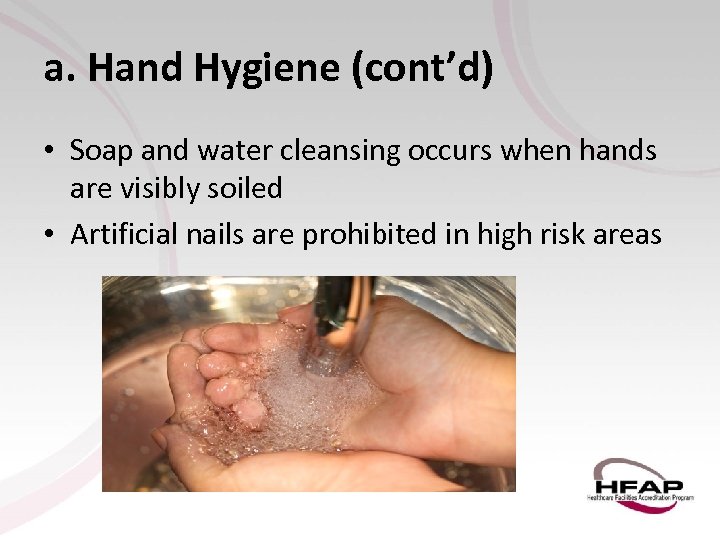 a. Hand Hygiene (cont’d) • Soap and water cleansing occurs when hands are visibly soiled • Artificial nails are prohibited in high risk areas
 b. Injection Practices and Sharps Safety • Injection preparation areas clean and free of contaminates • Single use needles • Syringes are used for only one patient, including insulin pens • Rubber stopper disinfection • Medication vial access with a clean needle ONLY • Medication vial access with a clean syringe ONLY
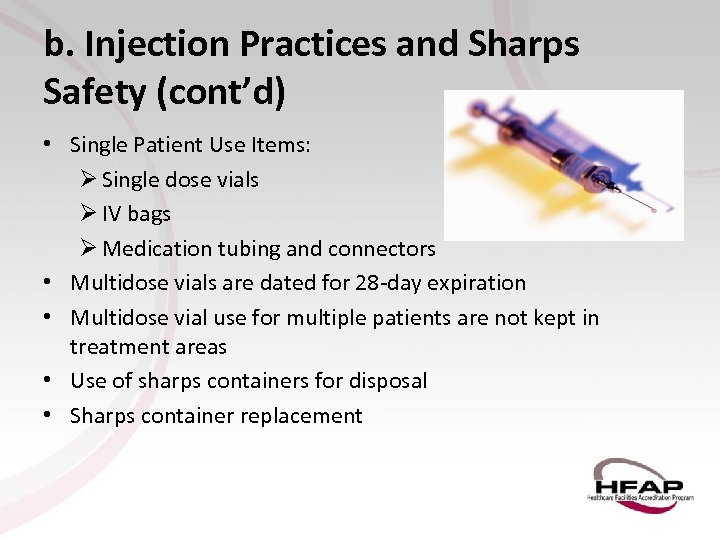 b. Injection Practices and Sharps Safety (cont’d) • Single Patient Use Items: Ø Single dose vials Ø IV bags Ø Medication tubing and connectors • Multidose vials are dated for 28 -day expiration • Multidose vial use for multiple patients are not kept in treatment areas • Use of sharps containers for disposal • Sharps container replacement
 c. Personal Protective Equipment • PPE availability at point of use • Staff glove when in contact with blood, body fluids, mucous membranes or non-intact skin • A glove change and hygiene prior to moving from a contaminated to a clean body site • Gown use • Mouth, nose, and eye protection • Surgical mask use when entering an epidural or subdural space
 d. Environmental Services • Environmental service worker PPE use (also 07. 03. 08) • Patient care area cleaning processes—high touch areas are cleaned daily • Terminal Cleaning and removal of linen • Use of cleaners and disinfectants reflect manufacturers guidelines for use • Clean cloths for each patient room/corridor (also 07. 03. 06)
 d. Environmental Services (cont’d) • Mop head and cloth cleaning daily (also 07. 03. 06) • Blood and body fluid cleaning process--spills • Equipment cleaning schedules (HVAC, eyewash stations, ice machines, refrigerators, scrub sinks and aerators on faucets)
 d. Environmental Services (cont’d) • Handling of clean and dirty laundry with no potential for cross contamination • Bagging and storage of dirty linen • Segregation of clean from dirty in laundry processing area (also 07. 04. 01 for all three)
 d. Environmental Services (cont’d) • Disinfection of non-critical reusable patient care items, using manufacturers instructions if applicable is specifically assigned by policy and staff can articulate the process • Cleaning of hydrotherapy equipment
 3. Equipment Reprocessing a. Reprocessing of Semi-Critical Equipment (Scored at 07. 01. 02) b. Reprocessing of Critical Equipment (Scored at 07. 01. 02) c. Single Use Devices (Scored at 07. 01)
 a. Processing of Semi-Critical Equipment • High Level Disinfection Policy—make sure the policy is consistent for Ultrasound, TEE probes and outpatient areas (also 07. 02. 08) • Flexible endoscope inspection and testing • Pre-cleaning processes • Use of enzymatic cleaners • Cleaning brush maintenance
 a. Processing of Semi-Critical Equipment (cont’d) • Chemicals used in high level disinfection • Automated equipment processing • Appropriate processing length of time and temperature recorded • Rinsing process following disinfection
 a. Processing of Semi-Critical Equipment (cont’d) • Drying of equipment following disinfection • Maintenance records for disinfection equipment • Equipment storage following disinfection • Logs regarding equipment use
 b. Reprocessing of Critical Equipment • Pre-cleaning process • Use of enzymatic cleaners • Cleaning brush maintenance • Wrapping/packaging process
 b. Reprocessing of Critical Equipment (cont’d) • Use of chemical indicators in all packs in every load • Use of biological indicators at least weekly and with all implants • Bowie-Dick testing in pre-vacuum steam sterilization gravity displacement vs. pre-vacuum steam sterilizers (also 07. 02. 05) • Labeling of sterile packs—sterilizer, load number and date (also 07. 02. 09)
 b. Reprocessing of Critical Equipment (cont’d) • Sterilizer logs are kept for all loads (also 07. 02. 06) • Maintenance of sterilizers is per manufacturers recommendations • Storage of sterilized items prevents contamination (also 07. 02. 04)
 b. Reprocessing of Critical Equipment (cont’d) • Inspection of processed items prior to use • Immediate Use Steam Sterilization (IUSS) previously know as flash sterilization: Ø Item must be thoroughly cleaned Ø Sterilizer cycle is appropriate for the instrument Ø All appropriate chemical and biological indicators are used Ø The facility has adequate instrumentation to meet the needs defined by surgical volume.
 b. Reprocessing of Critical Equipment (cont’d) • Immediate use of flashed equipment (also 07. 02. 01 for flash sterilization process) • Recall of sterilized equipment (also 07. 02. 10)
 c. Single-Use Devices • Disposal after use or opening OR • FDA-registered vendors used for reprocessing (also 07. 02. 03)
 Patient Tracers Policies and procedures to identify and prevent infections for the following: • • Urinary Catheter Central Venous Catheter Ventilator/Respiratory Care Spinal Injection Procedures Point of Care Devices Isolation Precautions Surgical Procedures
 Patient Tracers, Cont. • Issues identified during the survey which indicate the processes in place are not controlling and preventing infections would be scored at 07. 01 • Protocols are not required but policies and procedures and staff compliance must demonstrate effectiveness in controlling and preventing infections
 Urinary Catheter Tracer • Use of urinary catheters in a manner to minimize infection • Hospital maintains guidelines for appropriate use of urinary catheters • Hand hygiene • Before and after insertion • Placement of catheter using aseptic technique • Catheter properly secured after insertion (scored at 07. 01. 02)
 Urinary Catheter Tracer • Catheter insertion and indication are documented (10. 01. 04) • Hand hygiene before and after manipulation of catheter • Avoid irrigation • Collection bag emptied using aseptic technique • Aseptic collection of urine samples • Small amounts through needleless port • Keep urine collection bag below level of bladder at all times • Catheter tubing unobstructed with no kinking (07. 01. 02)
 Urinary Catheter Tracer • Need for catheter reviewed daily • Prompt removal when deemed unnecessary • No “convenience” (Not scored)
 Central Venous Catheter Tracer • Central venous catheters are inserted, assessed and maintained in a manner to minimize infection • Hand Hygiene performed before and after insertion • Maximal barrier precautions used for insertion • Surgical protection including full patient body drape • Use of >0. 5% chlorhexidine with alcohol used for skin antisepsis prior to insertion • Can use tincture of iodine, iodophor or 70% alcohol alternatively Dressing to cover catheter insertion site • Sterile gauze • Sterile transparent, semi-permeable dressing • Well healed and tunneled catheters may not need to be covered (07. 01. 02)
 Central Venous Catheter Tracer • Central line insertion and indication documented (10. 01. 04) • Hand hygiene performed before and after manipulating catheter • Gloves • Soiled dressings are changed promptly • All dressings changed using aseptic technique • Gloves • Access port is scrubbed with an appropriate antiseptic prior to accessing • Chlorhexidine, Povidone iodine, an iodophor, or 70% alcohol • Catheter accessed with sterile devices (07. 01. 02 & 07. 01. 19)
 Central Venous Catheter Tracer • Need to central venous catheters reviewed daily with prompt removal when not necessary (Not scored)
 Ventilator/Respiratory Therapy Tracer General Respiratory Therapy Practices for all Patients: • Hand hygiene • Gloves • Sterile water for nebulization • Single dose vials for aerosolized medications • Using manufacturer’s instructions for handling, storing and dispensing of medications
 Ventilator/Respiratory Therapy Tracer • If multi-dose vials for aerosolized medications are used for more than one patient— • Restricted to a centralized medication location • They do not enter the immediate patient treatment area (07. 01. 02 & 17. 00. 04) • Comprehensive oral hygiene program for all at risk patients • Elevated HOB for all at risk patients (ventilator or enteral tube placement) (not scored)
 Ventilator/Respiratory Therapy Tracer • Ventilator Care: • Ventilator circuit is changed if visibly soiled or mechanically malfunctioning • Sterile water is used to fill bubbling humidifiers • Condensate in tubing is periodically drained and discarded • Condensate should not drain toward the patient • Use of sterile single-use suction catheter • Multi-use closed system catheter – Only sterile fluid is used to remove secretions (07. 01. 02 & 17. 00. 04)
 Ventilator/Respiratory Therapy Tracer • Sedation is lightened daily in eligible patients • Spontaneous breathing trials are performed daily in eligible patients • “Weaning” (not scored)
 Spinal Injection Procedures • Spinal injection procedures: • Hand hygiene • Spinal injection • Aseptic technique • Surgical masks are used when placing a catheter or injecting materials into the epidural or subdural space (07. 01. 02)
 Point of Care Devices • Blood Glucose Meter • INR Monitor
 Point of Care Devices • Hand hygiene • Gloves • Used for “finger-stick” procedures • Removed after the procedure, followed by hand hygiene • Finger stick devices are used for one patient • Lancet holding device
 Point of Care Devices • Point of Care device is cleaned and disinfected after every use according to manufacturer’s instructions • Single use only if no manufacturer’s instructions for cleaning and disinfection (07. 01. 02)
 Isolation: Contact Precautions • Gloves are available and located near point of use • Signs indicating that the patient is in contact isolation • Patients in contact isolation are in single rooms • Can be cohorted based on clinical risk assessment
 Isolation: Contact Precautions • Soap and water must be used when bare hands are visibly soiled (e. g. , blood, body fluids) or after caring for a patient with known or suspected C. difficile or norovirus during an outbreak. In all other situations, ABHR is preferred.
 Isolation: Contact Precautions • Gloves and gowns • Before entering patient care environment • Removed and discarded; hand hygiene is performed before leaving the patient care environment
 Isolation: Contact Precautions • Dedicated or disposable noncritical patient- care equipment (e. g. , blood pressure cuffs) is used or if not available, then equipment is cleaned and disinfected prior to use on another patient according to manufacturer's instructions.
 Isolation: Contact Precautions • Traffic control • Into patient’s room • Patient moving out of the room to other parts of the hospital • Contact precautions outside the patient’s room • Cleaning of objects and patient care areas that are touched in patient’s isolation room • When visibly soiled • At least once a day • Terminal cleaning • All surfaces thoroughly cleaned and disinfected and all textiles are replaced with clean textiles • Cleaners and disinfectants are labeled and used in accordance with hospital policy and procedure and manufacturer’s instructions (07. 01. 02)
 Isolation: Droplet Precautions • Masks • On entering • Discarded when leaving • Signs • Patient on droplet precautions are housed in a single room or cohorted based on clinical risk assessment • Hand hygiene • Limited patient movement for droplet isolation patients • Medically necessary procedures • Patient wears surgical mask when transported • Communication of patient’s status
 Isolation: Droplet Precautions • Cleaning • Once a day per policy and manufacturer’s instruction while patient is admitted • Terminal cleaning after discharge including wiping and disinfection of all hard surfaces • Changing all textiles in the isolation room • All cleaners are used in accordance with hospital policy and procedure and manufacturer’s instructions (dilution, storage, shelf-life, contact time) (07. 01. 02)
 Isolation: Airborne precautions • Use of N-95 or higher particulate respirators • Available and near point of use • Signs indicating patient is on airborne precautions • Clear and visible • Patients on airborne isolation are housed in airborne isolation rooms • Hand hygiene before entering • And leaving • N-95 or higher particulate respirator to be worn when entering patient room for confirmed or suspected TB
 Isolation: Airborne precautions • Facility limits movement of patients on airborne isolation to medically necessary purposes • Patient wears surgical mask per hospital policy • Hospital has means to communicate patient’s status (07. 01. 02)
 Surgical procedure tracer • Surgical scrub before donning of sterile gloves for a surgical procedure in the OR • Use of either • Antimicrobial surgical scrub • FDA-approved alcohol-based antiseptic surgical hand rub • Visibly soiled hands should be washed with soap and water prior to the above procedures • After surgical scrub hands and arms are dried with a sterile towel and sterile surgical gown and gloves are donned in the OR
 Surgical procedure tracer • Surgical attire • Scrubs • Surgical caps/hoods covering all head and facial hair • Worn by all personnel in semi restricted and restricted areas • Restricted areas include • OR • Procedure rooms • Clean core • Semi restricted areas include • Peripheral support areas of the surgical suite
 Surgical procedure tracer • Masks • Properly tied and fully covering mouth and nose are worn by all personnel in restricted areas where open sterile supplies or scrubbed persons are located • Sterile drapes are used to establish the sterile field • Sterile field Items in sterile field are sterile Items introduced to the sterile field are opened, dispensed and transferred in a manner to maintain sterility • Established in a location where it will be used and as close as possible to the time of use • Movement around the sterile field is done in a manner to maintain sterility • •
 Surgical procedure tracer • Traffic in and out of the OR is kept to a minimum and is limited to essential staff • Traffic Control Policies and Procedures • Surgical masks are removed when leaving the sterile areas and are not reused when returning
 Surgical procedure tracer • Cleaners and disinfectants • Used according to hospital policy and procedure and manufacturer’s instructions
 Surgical procedure tracer • Cleaning—start of the day • Horizontal surfaces • Damp dusted with a lint-free cloth and EPA-registered hospital detergent/disinfectant • High touch surfaces cleaned and disinfected between patients • Anesthesia equipment is cleaned and disinfected between patients • Reusable noncritical items (BP cuffs, etc. ) are cleaned and disinfected between patients
 Surgical procedure tracer • Terminal cleaning of Operating Rooms • After the last procedure of the day • Including weekends! • Includes • Wet-vacuuming or moping the floor with an EPA-registered disinfectant • All surfaces • Internal components of anesthesia machine breathing circuit are cleaned according to manufacturer’s instructions
 Surgical procedure tracer • Ventilation requirements • Positive pressure, 15 air exchanges per hour—at least 3 of which are fresh air • 90% filtration • HEPA optional • Air filters are checked regularly and replaced according to hospital policies and procedures • Temperature and relative humidity are maintained at required levels • Doors are self-closing • Air vents and grill work are clean and dry (07. 01. 02 & 07. 01. 20)
 A Protective Environment (e. g. Bone Marrow patients) • Positive pressure—air flow out to the corridor from the room • 12 air exchanges per hour • Supply air is HEPA filtered • Well sealed rooms so that there are no penetration spaces in the walls, ceilings or windows • Self closing door that fully closes on all room exits • Failures are addressed and documented (07. 01. 02)
 A Protective Environment (e. g. Bone Marrow patients) • Ventilation requirements are monitored using visual methods • “Kleenex test”; flutter strips, etc. (07. 01. 04)
 QUESTIONS? Please submit questions to: info@hfap. org
 POST TEST • This presentation has been awarded 1. 5 hours of AOA Category 2 -B CME credit. To receive your CME certificate, please complete the post test at the following link: • https: //testmoz. com/359881 This should bring up “PSI Infection Control Test”. Type in your name and the passcode “PSIIC”. (those are upper case i’s, not lower case L’s) Your certificate will be submitted electronically.