 Скачать презентацию Hospital Discharge of TB Patients Collaborating with the
0f43542b2077919b5535eb979c20627f.ppt
- Количество слайдов: 55



Hospital Discharge of TB Patients: Collaborating with the Health Department Diana Nilsen, MD Bureau of Tuberculosis Control NYC Department of Health and Mental Hygiene
Today’s Presentation Ø Epidemiology of TB in NYC, 2011 Ø Discuss the rationale for discharging infectious TB patients from the hospital Ø Describe the new health code reporting requirements – Submission of hospital discharge plans – Submission of treatment plans Ø Provide an update on hospital discharge plan submissions Ø Discuss common issues related to hospital discharges
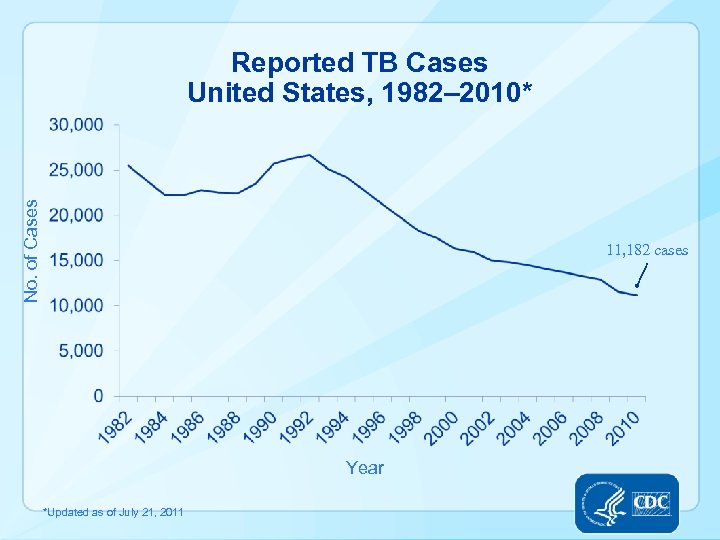
No. of Cases Reported TB Cases United States, 1982– 2010* 11, 182 cases Year *Updated as of July 21, 2011
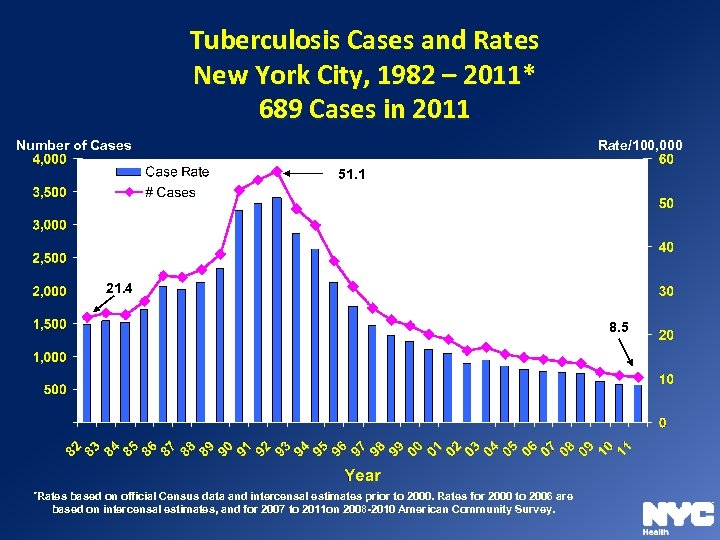
Tuberculosis Cases and Rates New York City, 1982 – 2011* 689 Cases in 2011 Number of Cases Rate/100, 000 51. 1 21. 4 8. 5 *Rates based on official Census data and intercensal estimates prior to 2000. Rates for 2000 to 2006 are based on intercensal estimates, and for 2007 to 2011 on 2008 -2010 American Community Survey.
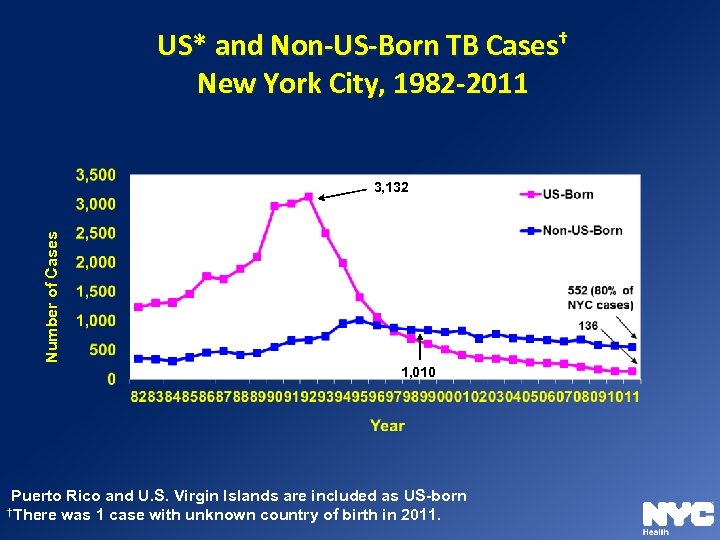
US* and Non-US-Born TB Cases† New York City, 1982 -2011 Number of Cases 3, 132 1, 010 *Puerto †There Rico and U. S. Virgin Islands are included as US-born was 1 case with unknown country of birth in 2011.
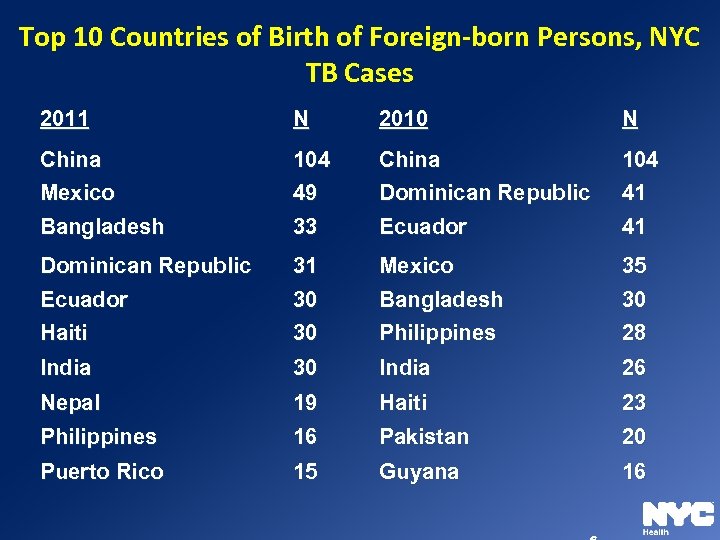
Top 10 Countries of Birth of Foreign-born Persons, NYC TB Cases 2011 N 2010 N China Mexico 104 49 China Dominican Republic 104 41 Bangladesh 33 Ecuador 41 Dominican Republic Ecuador 31 30 Mexico Bangladesh 35 30 Haiti 30 Philippines 28 India 30 India 26 Nepal 19 Haiti 23 Philippines 16 Pakistan 20 Puerto Rico 15 Guyana 16
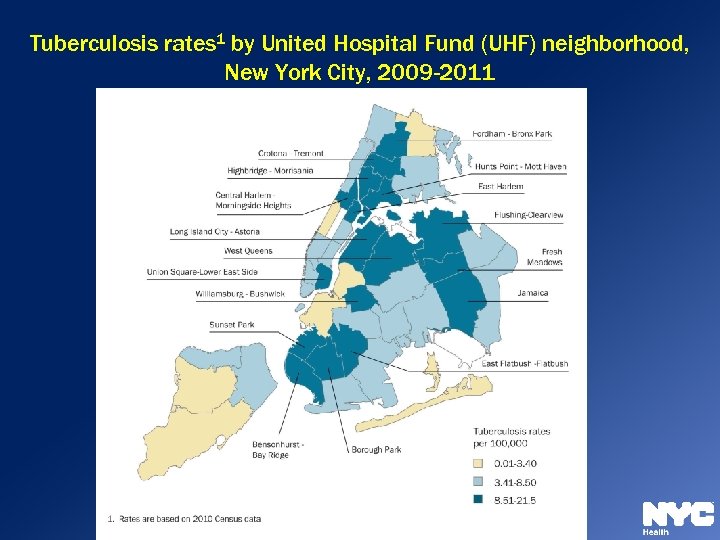
Tuberculosis rates 1 by United Hospital Fund (UHF) neighborhood, New York City, 2009 -2011
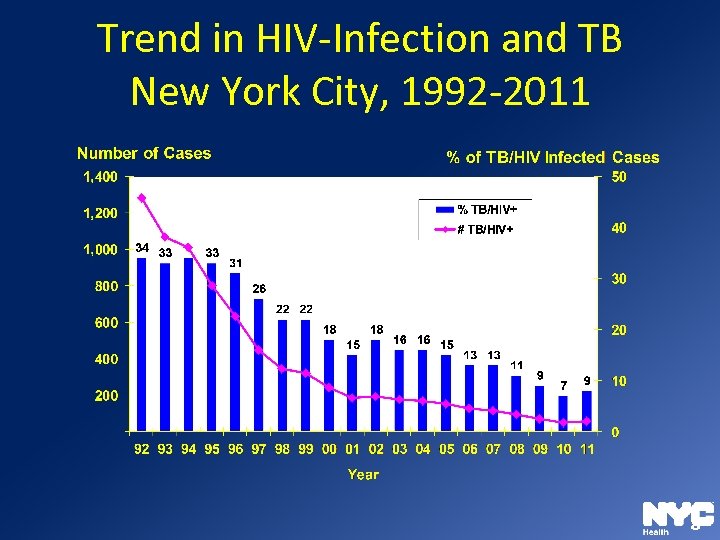
Trend in HIV-Infection and TB New York City, 1992 -2011 8
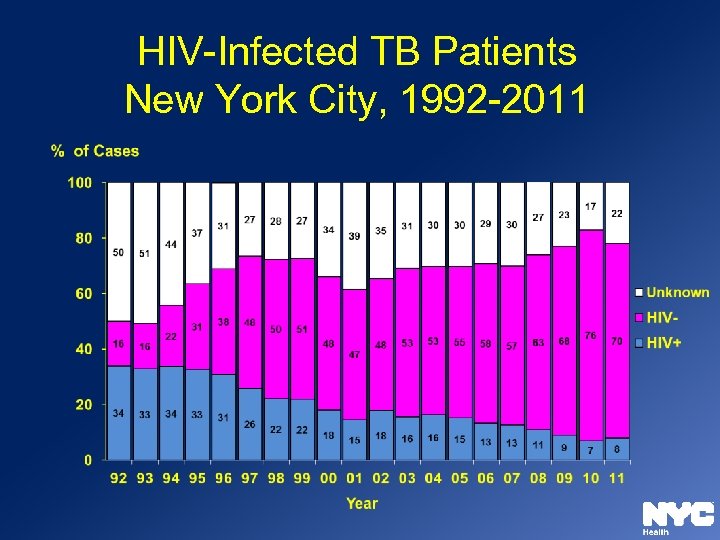
HIV-Infected TB Patients New York City, 1992 -2011
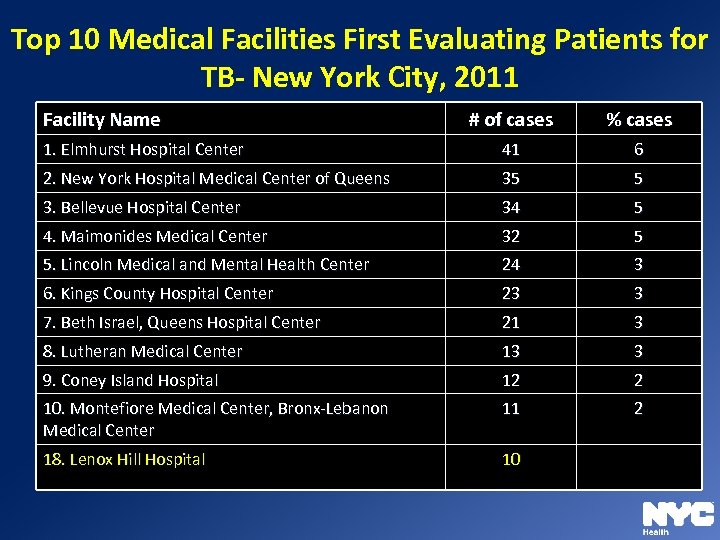
Top 10 Medical Facilities First Evaluating Patients for TB- New York City, 2011 Facility Name # of cases % cases 1. Elmhurst Hospital Center 41 6 2. New York Hospital Medical Center of Queens 35 5 3. Bellevue Hospital Center 34 5 4. Maimonides Medical Center 32 5 5. Lincoln Medical and Mental Health Center 24 3 6. Kings County Hospital Center 23 3 7. Beth Israel, Queens Hospital Center 21 3 8. Lutheran Medical Center 13 3 9. Coney Island Hospital 12 2 10. Montefiore Medical Center, Bronx-Lebanon Medical Center 11 2 18. Lenox Hill Hospital 10
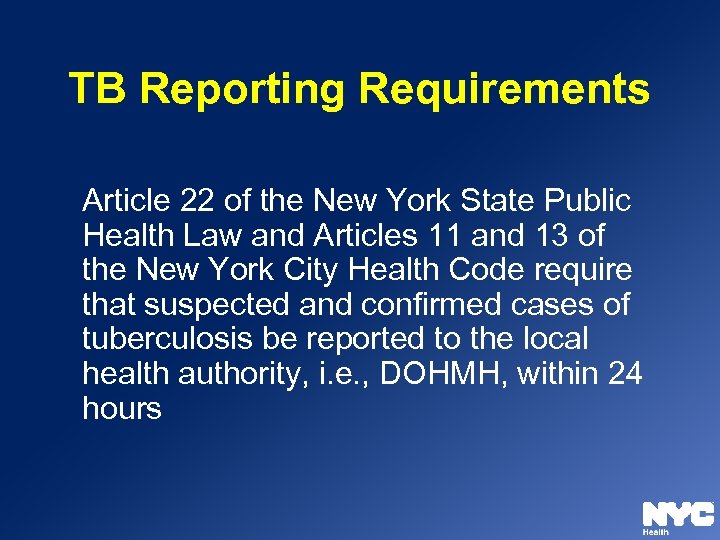
TB Reporting Requirements Article 22 of the New York State Public Health Law and Articles 11 and 13 of the New York City Health Code require that suspected and confirmed cases of tuberculosis be reported to the local health authority, i. e. , DOHMH, within 24 hours
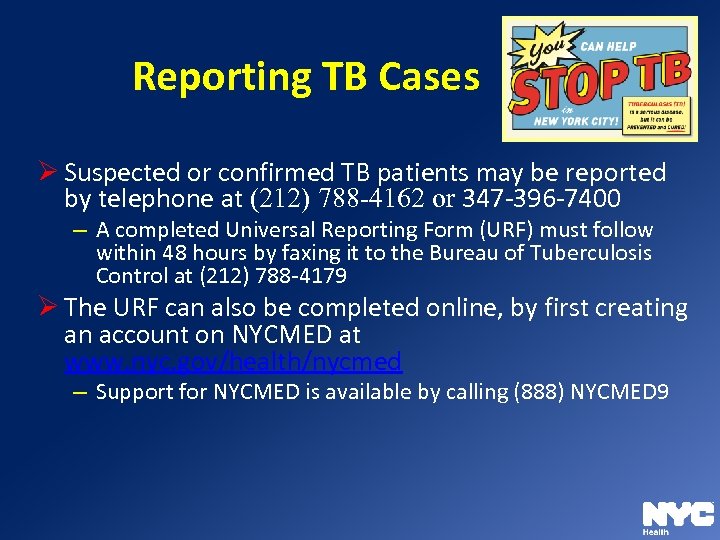
Reporting TB Cases Ø Suspected or confirmed TB patients may be reported by telephone at (212) 788 -4162 or 347 -396 -7400 – A completed Universal Reporting Form (URF) must follow within 48 hours by faxing it to the Bureau of Tuberculosis Control at (212) 788 -4179 Ø The URF can also be completed online, by first creating an account on NYCMED at www. nyc. gov/health/nycmed – Support for NYCMED is available by calling (888) NYCMED 9
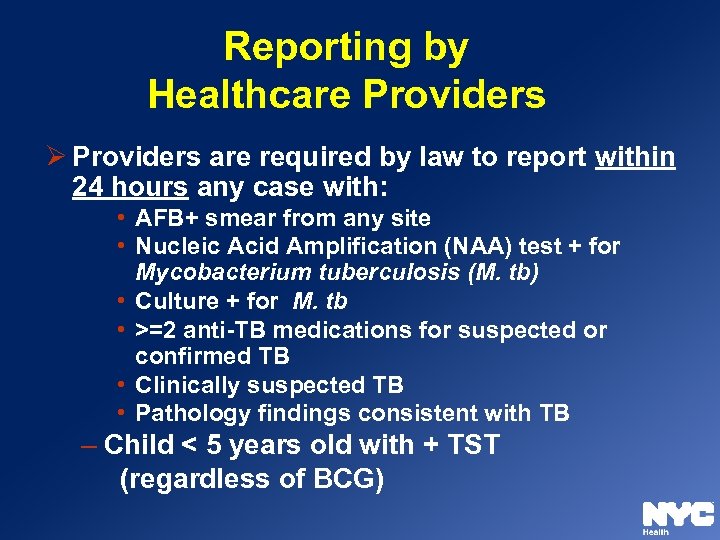
Reporting by Healthcare Providers Ø Providers are required by law to report within 24 hours any case with: • AFB+ smear from any site • Nucleic Acid Amplification (NAA) test + for Mycobacterium tuberculosis (M. tb) • Culture + for M. tb • >=2 anti-TB medications for suspected or confirmed TB • Clinically suspected TB • Pathology findings consistent with TB – Child < 5 years old with + TST (regardless of BCG)
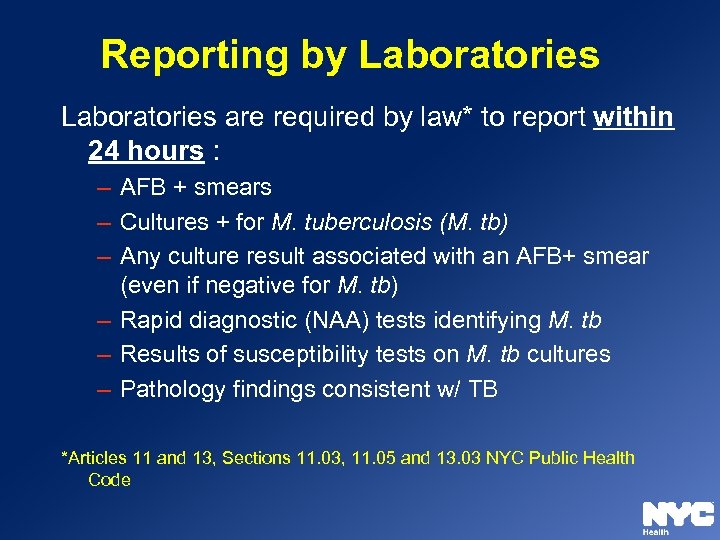
Reporting by Laboratories are required by law* to report within 24 hours : – AFB + smears – Cultures + for M. tuberculosis (M. tb) – Any culture result associated with an AFB+ smear (even if negative for M. tb) – Rapid diagnostic (NAA) tests identifying M. tb – Results of susceptibility tests on M. tb cultures – Pathology findings consistent w/ TB *Articles 11 and 13, Sections 11. 03, 11. 05 and 13. 03 NYC Public Health Code
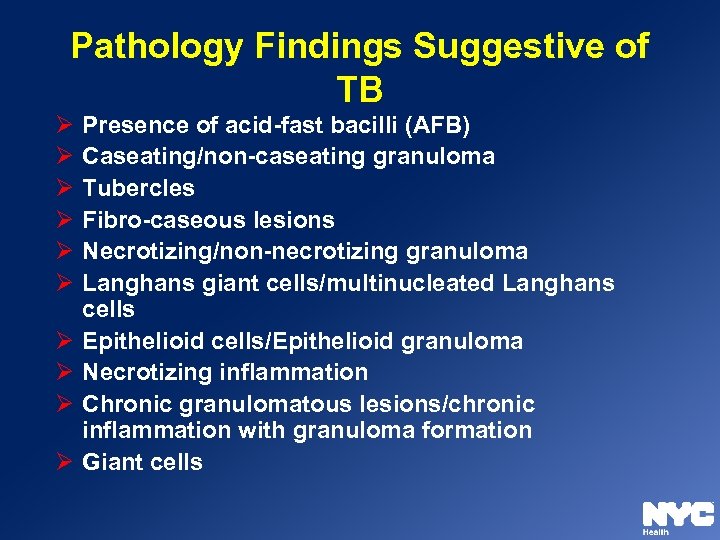
Pathology Findings Suggestive of TB Ø Ø Ø Ø Ø Presence of acid-fast bacilli (AFB) Caseating/non-caseating granuloma Tubercles Fibro-caseous lesions Necrotizing/non-necrotizing granuloma Langhans giant cells/multinucleated Langhans cells Epithelioid cells/Epithelioid granuloma Necrotizing inflammation Chronic granulomatous lesions/chronic inflammation with granuloma formation Giant cells
Background- Discharge Planning
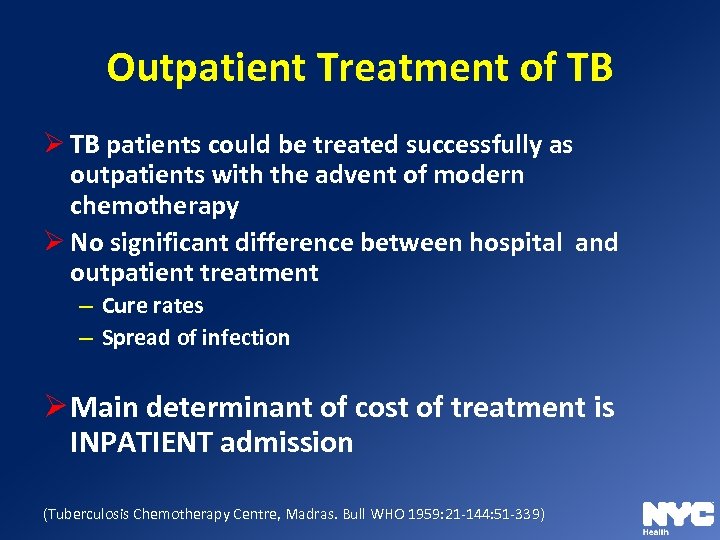
Outpatient Treatment of TB Ø TB patients could be treated successfully as outpatients with the advent of modern chemotherapy Ø No significant difference between hospital and outpatient treatment – Cure rates – Spread of infection Ø Main determinant of cost of treatment is INPATIENT admission (Tuberculosis Chemotherapy Centre, Madras. Bull WHO 1959: 21 -144: 51 -339)
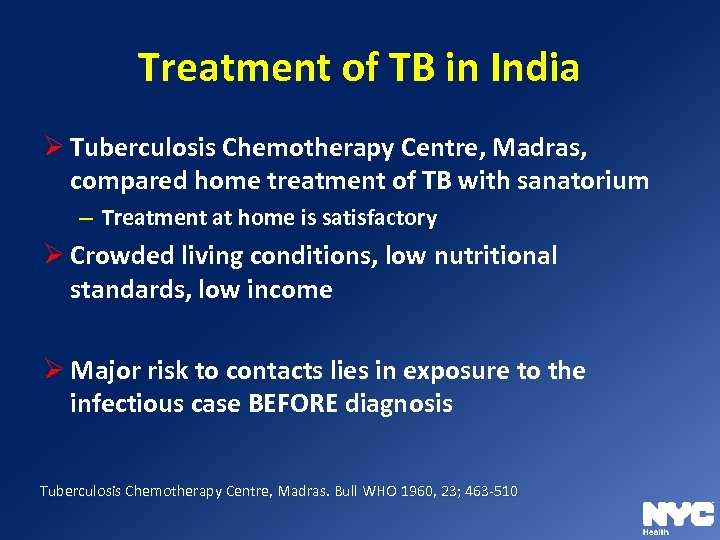
Treatment of TB in India Ø Tuberculosis Chemotherapy Centre, Madras, compared home treatment of TB with sanatorium – Treatment at home is satisfactory Ø Crowded living conditions, low nutritional standards, low income Ø Major risk to contacts lies in exposure to the infectious case BEFORE diagnosis Tuberculosis Chemotherapy Centre, Madras. Bull WHO 1960, 23; 463 -510
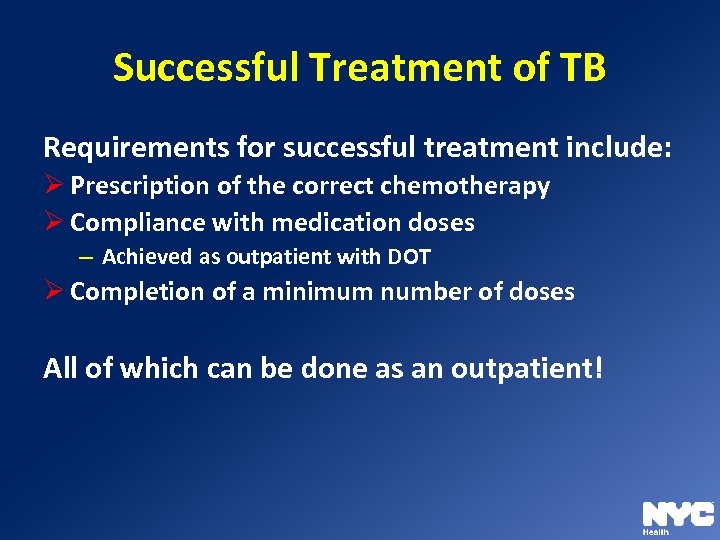
Successful Treatment of TB Requirements for successful treatment include: Ø Prescription of the correct chemotherapy Ø Compliance with medication doses – Achieved as outpatient with DOT Ø Completion of a minimum number of doses All of which can be done as an outpatient!
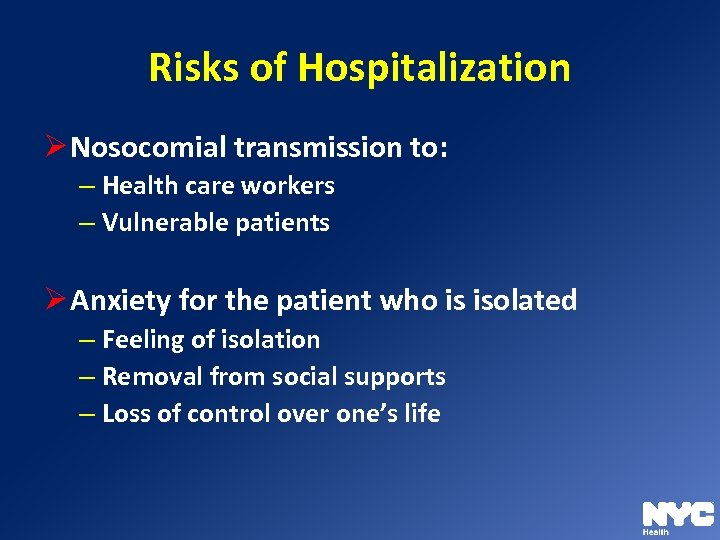
Risks of Hospitalization Ø Nosocomial transmission to: – Health care workers – Vulnerable patients Ø Anxiety for the patient who is isolated – Feeling of isolation – Removal from social supports – Loss of control over one’s life
NYC Guidelines for Hospitalization and Discharge Developed to ensure that only patients who need it are admitted and hospitalized Infectious patients could be discharged in the appropriate circumstances – TB can be dangerous for other hospitalized patients – Patients should be treated as OUTPATIENTS unless they meet certain criteria – Patients become noninfectious quickly once on treatment
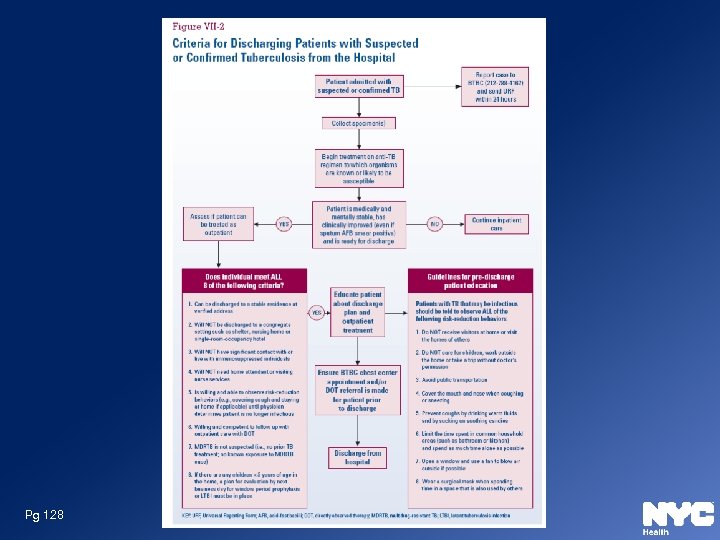
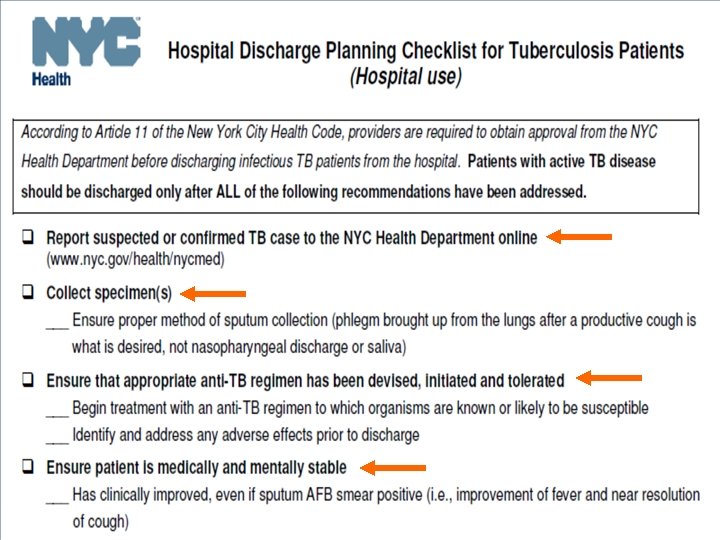
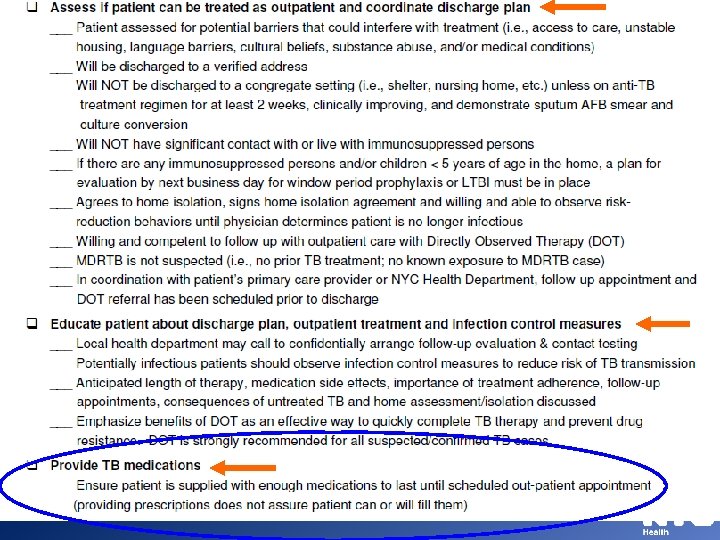
Criteria for Discharge • Clinical improvement • Tolerating anti-TB meds • Patient must be reported to DOH (212 -788 -4162 or 347 -3967400), but must be reported via URF as well • Electronic URF filled out within 24 hrs. • Patient should have sputa for AFB • CXR should be done • Involvement of DOHMH in discharge planning with submission of discharge plan to DOHMH – Referral to DOH clinic and DOT Instructions given to patient and household members if they were exposed to an infectious patient
Pg 128
NYC Health Code Amendment
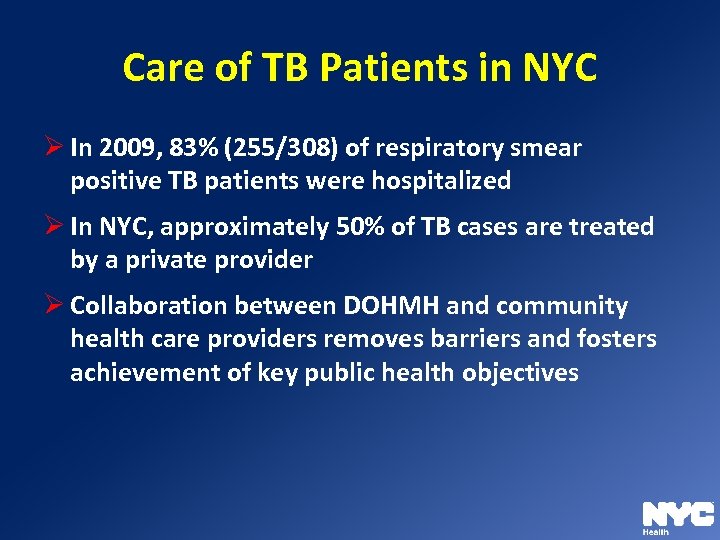
Care of TB Patients in NYC Ø In 2009, 83% (255/308) of respiratory smear positive TB patients were hospitalized Ø In NYC, approximately 50% of TB cases are treated by a private provider Ø Collaboration between DOHMH and community health care providers removes barriers and fosters achievement of key public health objectives
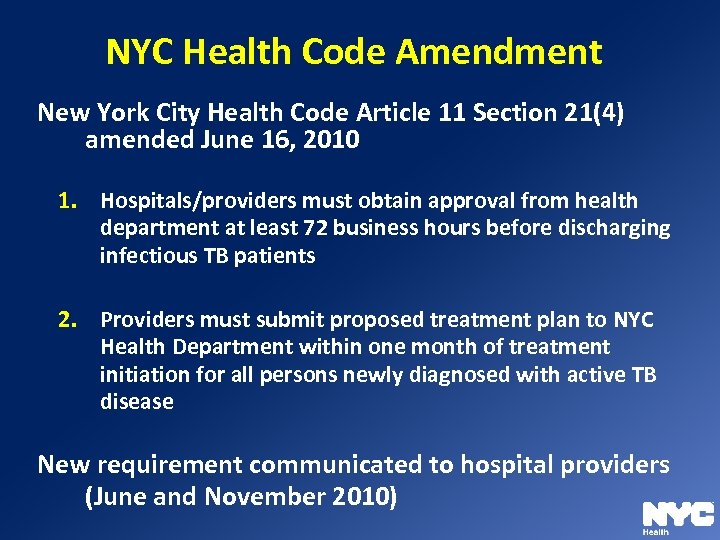
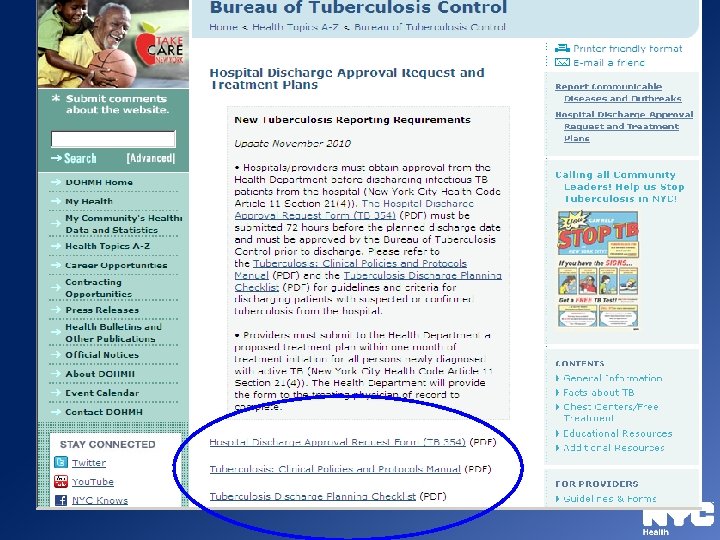
NYC Health Code Amendment New York City Health Code Article 11 Section 21(4) amended June 16, 2010 1. Hospitals/providers must obtain approval from health department at least 72 business hours before discharging infectious TB patients 2. Providers must submit proposed treatment plan to NYC Health Department within one month of treatment initiation for all persons newly diagnosed with active TB disease New requirement communicated to hospital providers (June and November 2010)
Process for Submitting Hospital Discharge Plans
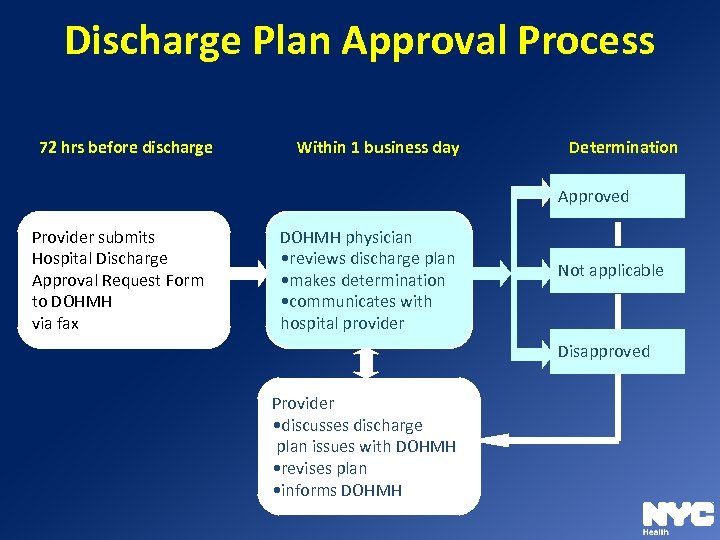
Discharge Plan Approval Process 72 hrs before discharge Within 1 business day Determination Approved Provider submits Hospital Discharge Approval Request Form to DOHMH via fax DOHMH physician • reviews discharge plan • makes determination • communicates with hospital provider Not applicable Disapproved Provider • discusses discharge plan issues with DOHMH • revises plan • informs DOHMH
Outcomes of Discharges Ø Approved: criteria for discharge met Ø Not approved: additional actions or information needed Ø Not applicable: extrapulmonary TB cases, noninfectious cases, atypical mycobacterium (NTM)
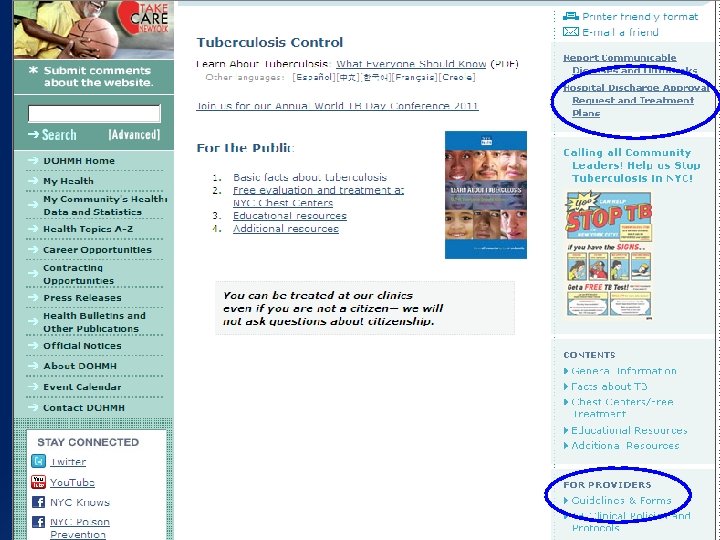
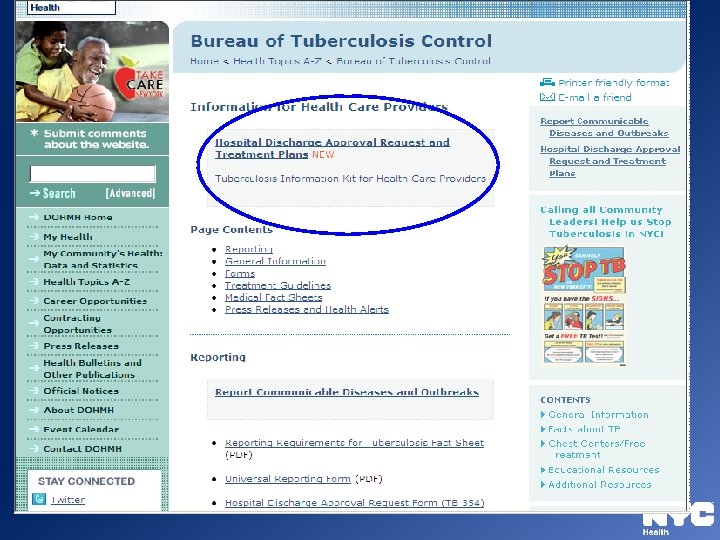
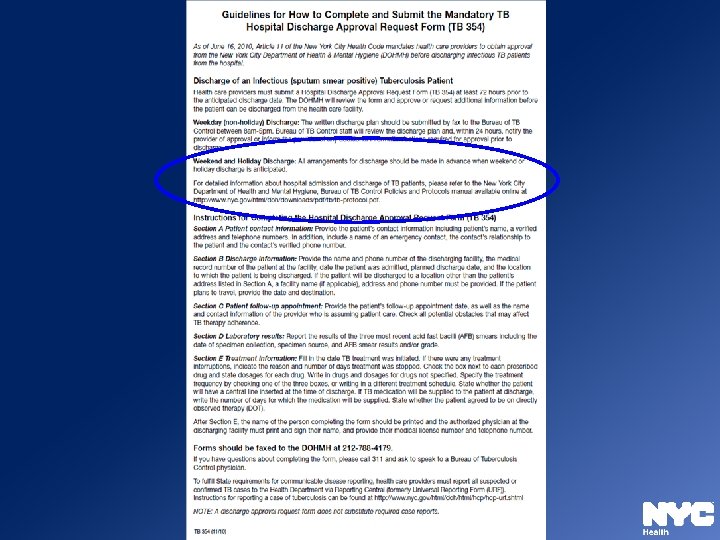
Hospital Discharge Form Ø Hospital Discharge Approval Request Form (TB 354) and Instructions Ø Hospital Discharge Planning Checklist for Tuberculosis Patients Ø Available on NYC Health Department’s website: www. nyc. gov/health/tb
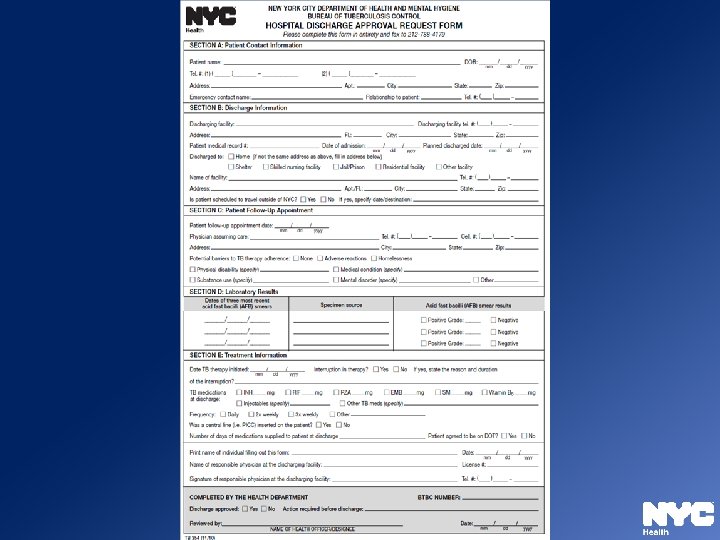
What the DOHMH Would Like From Providers Ø Complete and legible forms Ø Expected date of discharge Ø Appropriate contact information for the treating physician/attending MD Ø Notification of any issues with medications, side effects or abnormal lab values Ø Specialized nursing needs : PICC lines, injections Ø Discharge to congregate settings or home care agency referrals Ø Discharges to other jurisdictions requiring interstate notification Ø How many days of medication provided to patient Ø Follow-up appointment date –should be close to date of discharge
What Does the DOHMH Need to Do Prior to Discharge? Ø Field staff need to interview patient to elicit contacts Ø Home assessment should be done Ø Patient to agree to home isolation and DOT – Sign agreements for both Ø Follow up appointment is made
Update on Hospital Discharge Plan Submissions November 1 - March 1, 2011
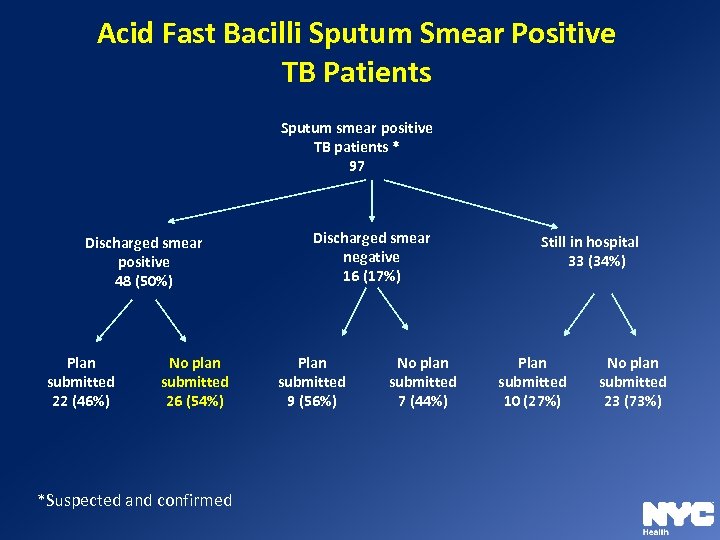
Acid Fast Bacilli Sputum Smear Positive TB Patients Sputum smear positive TB patients * 97 Discharged smear positive 48 (50%) Plan submitted 22 (46%) No plan submitted 26 (54%) *Suspected and confirmed Discharged smear negative 16 (17%) Plan submitted 9 (56%) No plan submitted 7 (44%) Still in hospital 33 (34%) Plan submitted 10 (27%) No plan submitted 23 (73%)
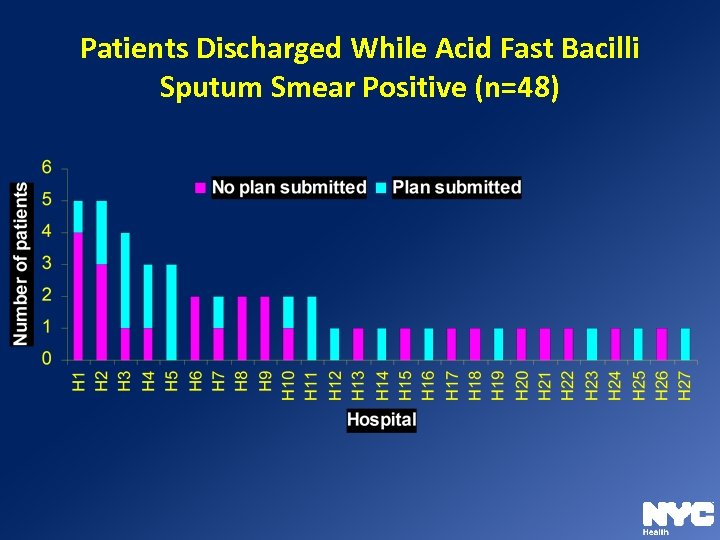
Patients Discharged While Acid Fast Bacilli Sputum Smear Positive (n=48)
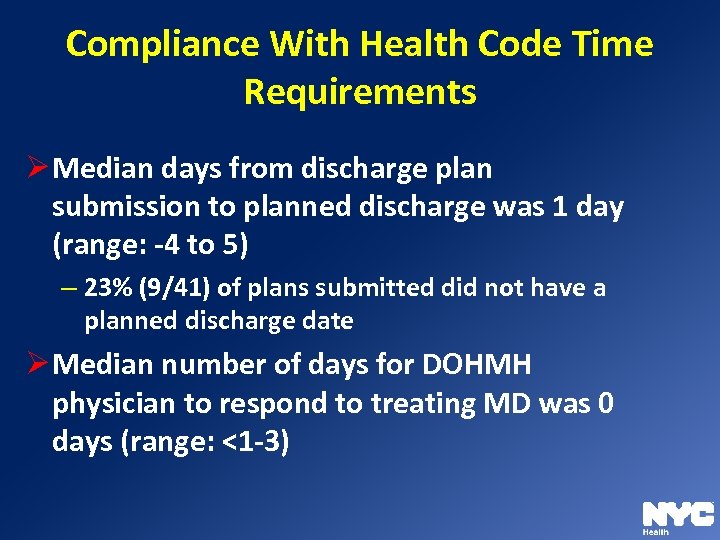
Compliance With Health Code Time Requirements Ø Median days from discharge plan submission to planned discharge was 1 day (range: -4 to 5) – 23% (9/41) of plans submitted did not have a planned discharge date Ø Median number of days for DOHMH physician to respond to treating MD was 0 days (range: <1 -3)
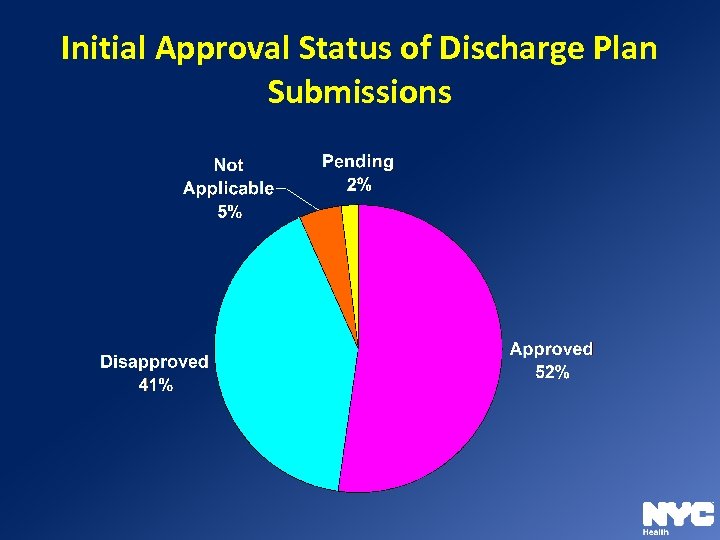
Initial Approval Status of Discharge Plan Submissions
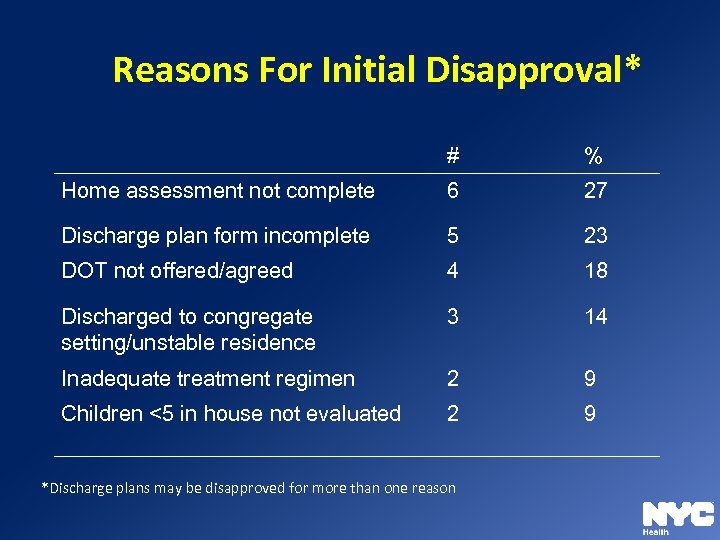
Reasons For Initial Disapproval* # % Home assessment not complete 6 27 Discharge plan form incomplete 5 23 DOT not offered/agreed 4 18 Discharged to congregate setting/unstable residence 3 14 Inadequate treatment regimen 2 9 Children <5 in house not evaluated 2 9 *Discharge plans may be disapproved for more than one reason
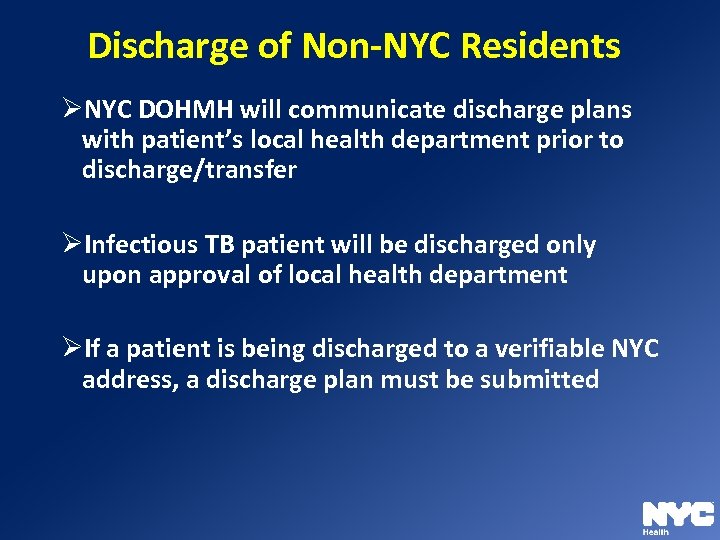
Discharge of Non-NYC Residents ØNYC DOHMH will communicate discharge plans with patient’s local health department prior to discharge/transfer ØInfectious TB patient will be discharged only upon approval of local health department ØIf a patient is being discharged to a verifiable NYC address, a discharge plan must be submitted
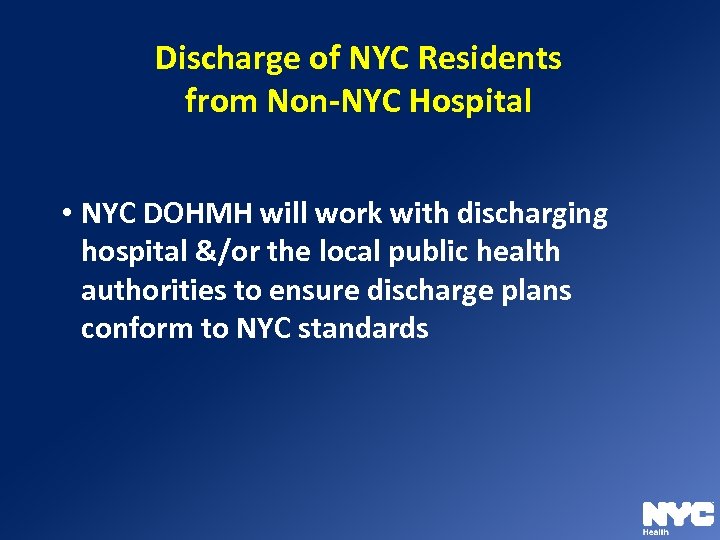
Discharge of NYC Residents from Non-NYC Hospital • NYC DOHMH will work with discharging hospital &/or the local public health authorities to ensure discharge plans conform to NYC standards
Process for Submitting Treatment Plans
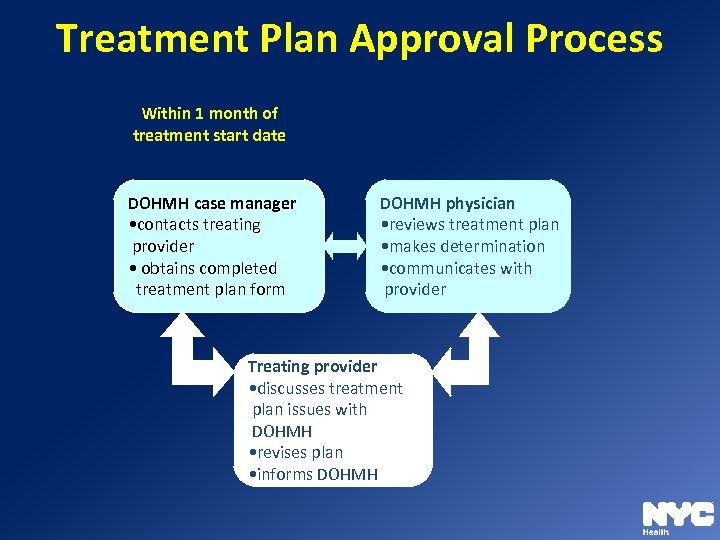
Treatment Plan Approval Process Within 1 month of treatment start date DOHMH case manager • contacts treating provider • obtains completed treatment plan form DOHMH physician • reviews treatment plan • makes determination • communicates with provider Treating provider • discusses treatment plan issues with DOHMH • revises plan • informs DOHMH
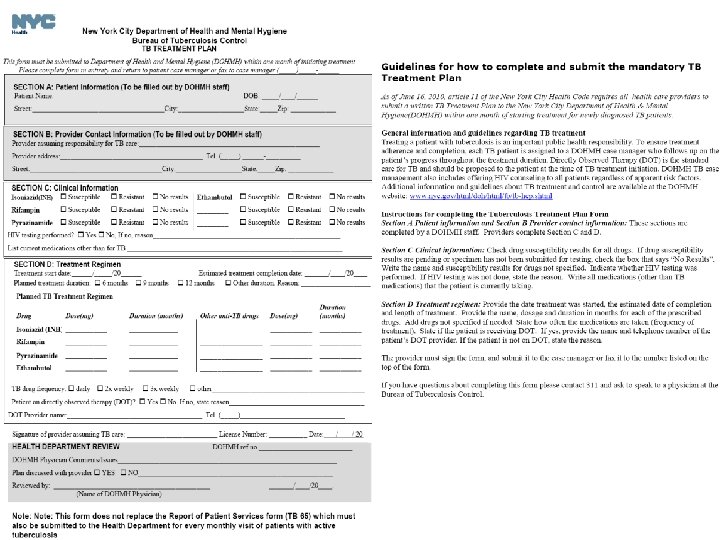
TB Treatment Plan Form Ø NYC Health Department case manager will provide the treatment plan form to treating physician for completion Ø Treatment plan form does not replace Report of Patient Services Form (TB 65)
Future Considerations • Continue collaboration with hospitals/providers • Monitor submission of hospital discharge/treatment plans • Outreach to hospitals/providers experiencing issues with plans • Continue to evaluate impact of initiative
Conclusion Ø Submit discharge plans for infectious TB patients within 72 business hours of planned discharge Ø Submit treatment plans within one month of treatment initiation Ø Ensure forms are complete/accurate Ø Refer to NYC DOHMH guidelines & resources Ø Call 311 to consult with DOHMH TB experts
Acknowledgements Ø NYC DOHMH Bureau of TB Control Provider Outreach Project Working Group Ø NYC DOHMH Bureau of TB Control Staff Ø NYC Infection Control Nurses and Practitioners
For Consultation call: 311 DOHMH TB Hotline 212 -788 -4162 www. nyc. gov/health/tb
Скачать презентацию Hospital Discharge of TB Patients Collaborating with the
0f43542b2077919b5535eb979c20627f.ppt