


 Скачать презентацию HORIZON 2020 Horizon 2020 Information and Networking Day
bb75160731eb00167c22f1ea1205325a.ppt
- Количество слайдов: 55
 HORIZON 2020 Horizon 2020 Information and Networking Day ICT 21 Advanced Digital Gaming/Gamification technologies ICT 22 -b Multimodal and Natural Computer Interaction Assisting people with disabilities Patricia Manson Head of Unit DG CONNECT/G 4
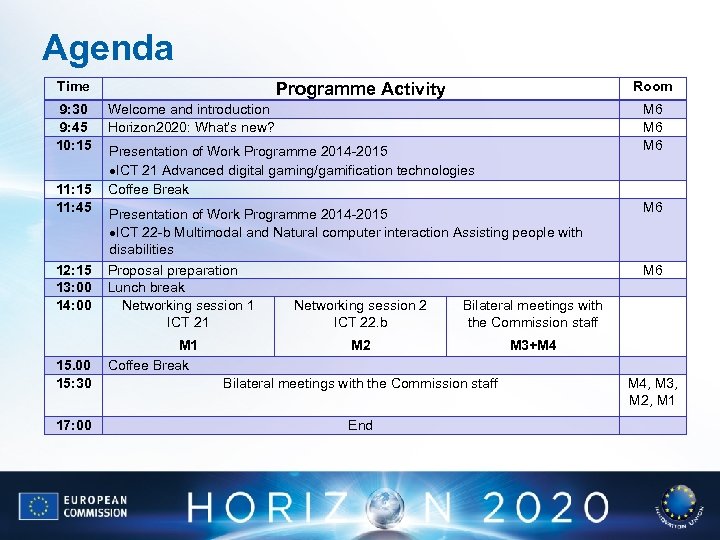 Agenda Time 9: 30 9: 45 10: 15 11: 45 12: 15 13: 00 14: 00 15: 30 17: 00 Room Programme Activity Welcome and introduction Horizon 2020: What’s new? M 6 M 6 Presentation of Work Programme 2014 -2015 ICT 21 Advanced digital gaming/gamification technologies Coffee Break Presentation of Work Programme 2014 -2015 ICT 22 -b Multimodal and Natural computer interaction Assisting people with disabilities Proposal preparation Lunch break Networking session 1 Networking session 2 Bilateral meetings with ICT 21 ICT 22. b the Commission staff M 1 Coffee Break M 2 M 6 M 3+M 4 Bilateral meetings with the Commission staff M 4, M 3, M 2, M 1 End
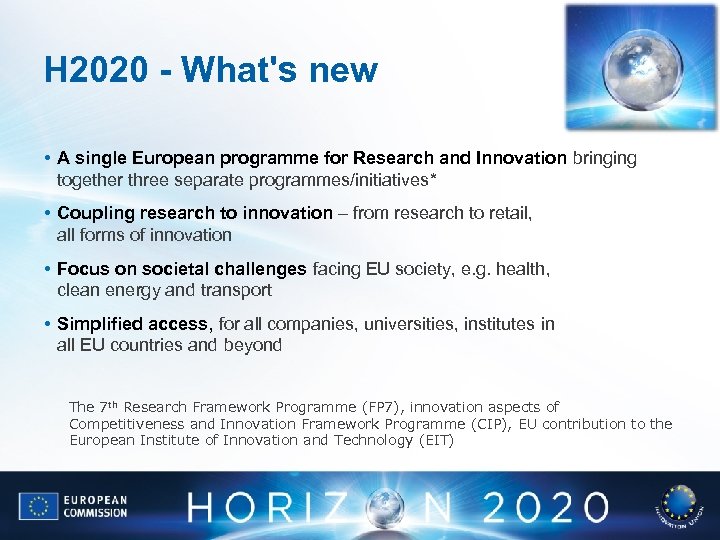 H 2020 - What's new • A single European programme for Research and Innovation bringing together three separate programmes/initiatives* • Coupling research to innovation – from research to retail, all forms of innovation • Focus on societal challenges facing EU society, e. g. health, clean energy and transport • Simplified access, for all companies, universities, institutes in all EU countries and beyond The 7 th Research Framework Programme (FP 7), innovation aspects of Competitiveness and Innovation Framework Programme (CIP), EU contribution to the European Institute of Innovation and Technology (EIT)
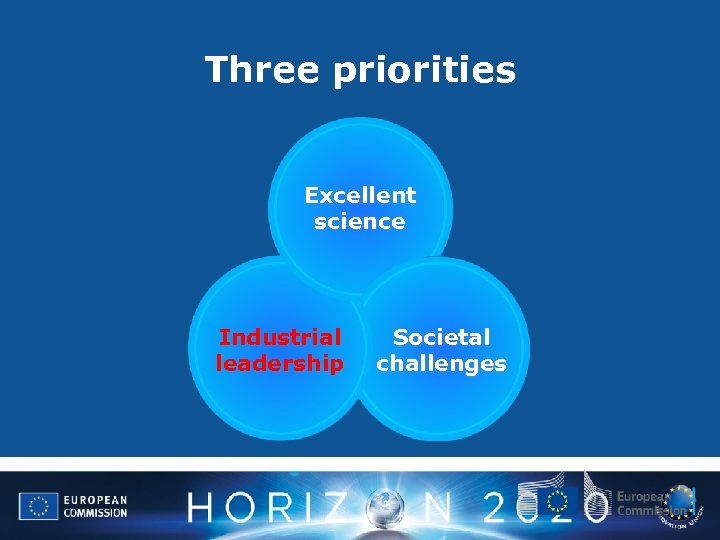 Three priorities Excellent science Industrial leadership Societal challenges
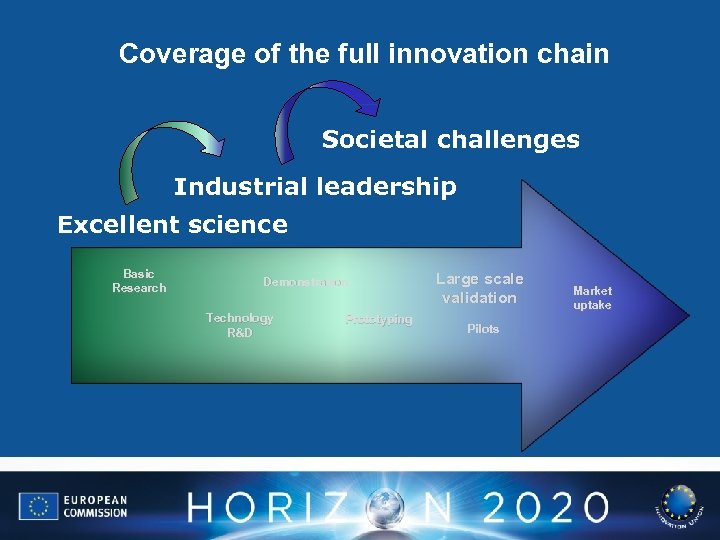 Coverage of the full innovation chain Societal challenges Industrial leadership Excellent science Basic Research Demonstration Technology R&D Prototyping Large scale validation Pilots Market uptake
 Leadership in Enabling and Industrial Technologies New and breakthrough technologies, boosting competitiveness, creating jobs and supporting growth Emphasis is on areas with a strong industrial dimension and where mastering new technological opportunities will enable and drive innovation A balanced response to the need to maintain a strong expertise in key technology value chains, and to the necessity to move quicker from research excellence to the market 20
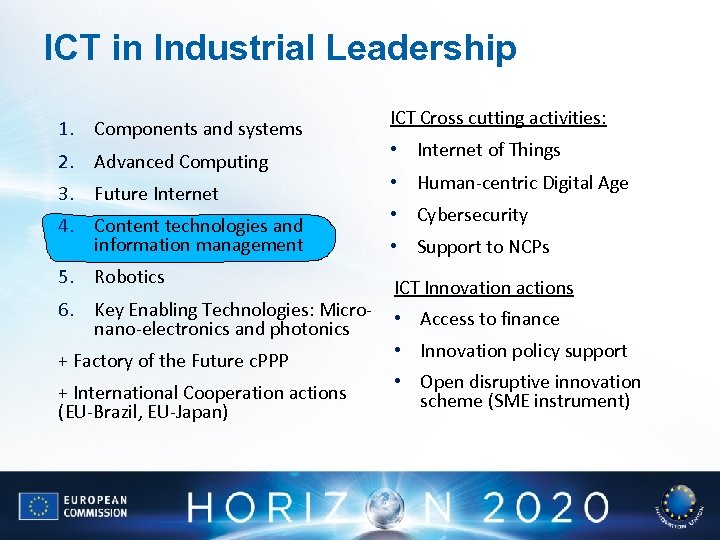 ICT in Industrial Leadership 1. Components and systems 2. Advanced Computing 3. Future Internet 4. Content technologies and information management 5. Robotics 6. Key Enabling Technologies: Micronano-electronics and photonics + Factory of the Future c. PPP + International Cooperation actions (EU-Brazil, EU-Japan) ICT Cross cutting activities: • Internet of Things • Human-centric Digital Age • Cybersecurity • Support to NCPs ICT Innovation actions • Access to finance • Innovation policy support • Open disruptive innovation scheme (SME instrument)
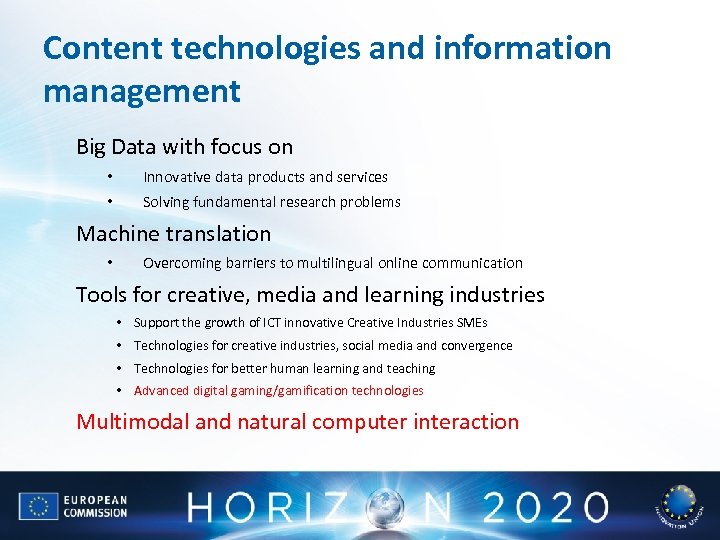 Content technologies and information management Big Data with focus on • Innovative data products and services • Solving fundamental research problems Machine translation • Overcoming barriers to multilingual online communication Tools for creative, media and learning industries • Support the growth of ICT innovative Creative Industries SMEs • Technologies for creative industries, social media and convergence • Technologies for better human learning and teaching • Advanced digital gaming/gamification technologies Multimodal and natural computer interaction
 Horizon 2020 – What is new Types of action (instruments) Research and Innovation Actions • Actions primarily consisting of activities aiming to establish new knowledge and/or to explore the feasibility of a new or improved technology, product, process, service or solution. Innovation Actions • Actions primarily consisting of activities directly aiming at producing plans and arrangements or designs for new, altered or improved products, processes or services. Coordination and Support Actions • Actions consisting primarily of accompanying measures
 Mainstreaming innovation: How? • Support Research and Innovation from lab to market • Encourage incremental and disruptive innovation • Promote a closer relationship between research and entrepreneurship • Put SMEs in the lead in delivering innovations to the market. • Use more evaluators from the business and investor domains involved in the selection process • Provide greater access to risk capital for innovative SMEs & midcaps • Ensure a clear emphasis on innovation in the selection of projects
 'Research & innovation' actions Projects selected for funding… • Will establish new knowledge ("that has innovation potential") and/or • Will explore the feasibility of a new or improved technology, product, process, service or solution. • May include basic and applied research, technology development and integration, testing and validation on a small-scale prototype in a laboratory or simulated environment. • May contain closely connected but limited demonstration or pilot activities aiming to show technical feasibility in a near to operational environment. • Will be funded at 100% ü Type of activity is specified in WP ü Bulk of activity expected to be in "innovation-aware" mid-term R&D ü Small-scale innovation-type activities are expected
 'Innovation' actions Projects selected for funding… • will primarily consist of activities directly aiming at producing plans and arrangements or designs for new, altered or improved products, processes or services. • may include prototyping, testing, demonstrating, piloting, large-scale product validation and market replication. • are expected to demonstrate that innovations they develop meet the needs of European and global markets; and, • address the delivery of such innovations to the markets • may include limited research and development activities. • will be funded at 70% (except for non-profit orgs)
 Horizon 2020 – What is new Types of projects in terms of contribution - Expressed in terms of indicative budget (requested funding) - Cut-off point € 4 -5 million – Large Contribution v. Small Contribution - The distinction does not correspond to the old distinction IP v. STRe. P - The Work Programme may call for either large or small projects or both – important to check
 Horizon 2020 – What is new Horizon 2020 funding rates Research and Innovation Actions + Coordination and Support Actions up to 100 % Innovation Actions up to 70% up to 100% (non-profit entities) Indirect Costs – 25% of eligible direct costs less subcontracting
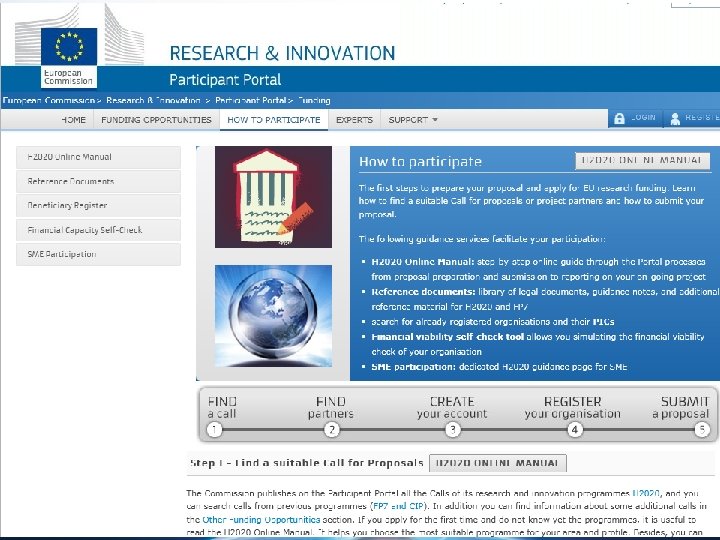
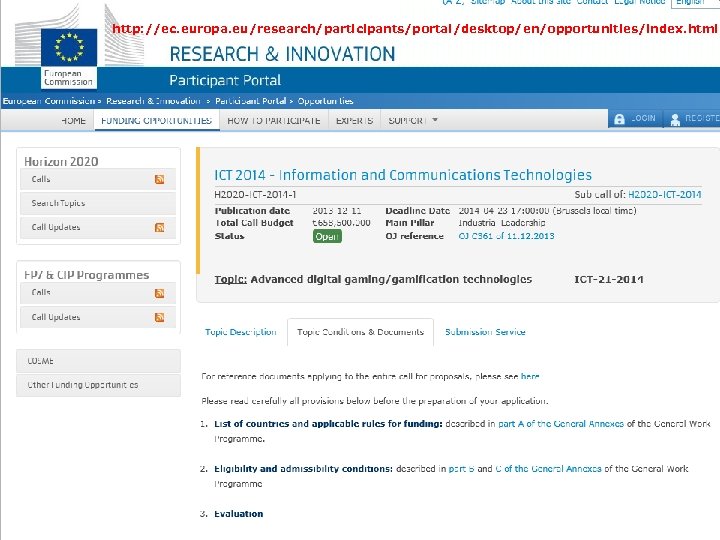 http: //ec. europa. eu/research/participants/portal/desktop/en/opportunities/index. html
 Q&A time ….
 Advanced digital gaming/gamification technologies
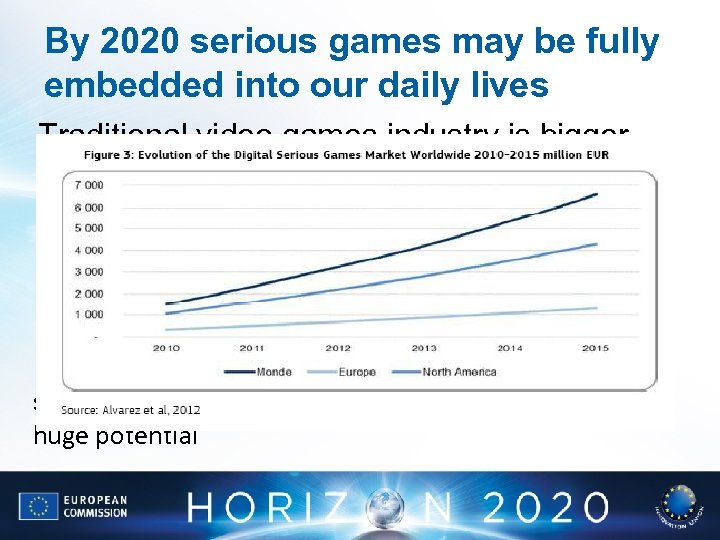 By 2020 serious games may be fully embedded into our daily lives Traditional video games industry is bigger than movie and music industry – $82 bn in 2015 PWC (2009) There are 100 million active gamers in the Europe playing on average 13 hours per week (China 200 m, USA 180 m, India 105 m, Russia 10 m) IDATE (2012) estimates the current global market of serious games at 2. 35 bn Euros, with steady growth and huge potential
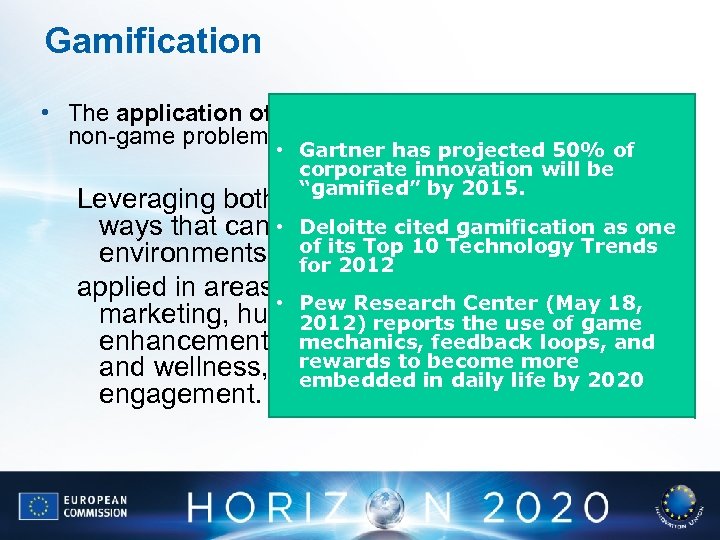 Gamification • The application of digital game design techniques to non-game problems • Gartner has projected 50% of corporate innovation will be “gamified” by 2015. Leveraging both psychology and technology, in • Deloitte cited gamification as one ways that can be applied outside the of its Top 10 Technology environments of games themselves Trends for 2012 applied in areas such as education, training, • Pew Research Center (May 18, marketing, human resources, productivity 2012) reports the use of game mechanics, feedback loops, and enhancement, sustainability, training, health rewards to become more and wellness, innovation, and customer embedded in daily life by 2020 engagement.
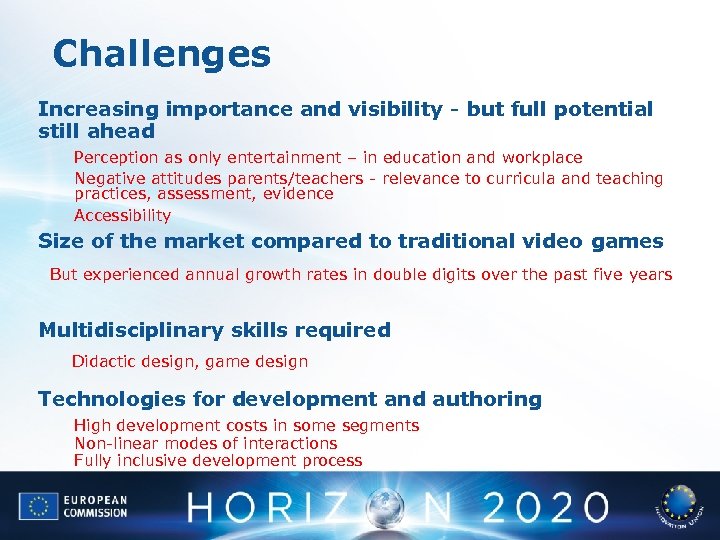 Challenges Increasing importance and visibility - but full potential still ahead Perception as only entertainment – in education and workplace Negative attitudes parents/teachers - relevance to curricula and teaching practices, assessment, evidence Accessibility Size of the market compared to traditional video games But experienced annual growth rates in double digits over the past five years Multidisciplinary skills required Didactic design, game design Technologies for development and authoring High development costs in some segments Non-linear modes of interactions Fully inclusive development process
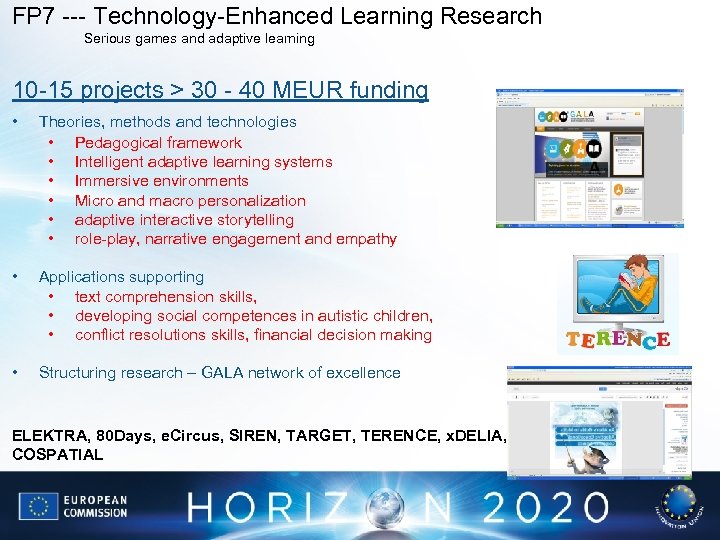 FP 7 --- Technology-Enhanced Learning Research Serious games and adaptive learning 10 -15 projects > 30 - 40 MEUR funding • Theories, methods and technologies • Pedagogical framework • Intelligent adaptive learning systems • Immersive environments • Micro and macro personalization • adaptive interactive storytelling • role-play, narrative engagement and empathy • Applications supporting • text comprehension skills, • developing social competences in autistic children, • conflict resolutions skills, financial decision making • Structuring research – GALA network of excellence ELEKTRA, 80 Days, e. Circus, SIREN, TARGET, TERENCE, x. DELIA, ALICE, Im. REAL, e. Cute COSPATIAL
 WP 2014 -2015 Support R&I on digital games applied in non-leisure contexts for the emergence of a prospering market • New methodologies and tools to produce, apply and use digital games and gamification techniques in non-leisure contexts; • Building scientific evidence on their benefits - for governments, enterprises and individuals
 Scope Multidisciplinary research and collaboration digital gaming technologies and components applied to non-leisure contexts Technology transfer underpinning new market developments through small scale experiments
 Research and Innovation Action 1/3 • Multidisciplinary R&I on advanced digital gaming technologies and components applied to non-leisure contexts game engines, emergent narrative, virtual characters, interaction systems and alternative human-machine interfaces, 3 D, textures, models for simulations, game design, learner profiles, emotional models, etc.
 Few remarks …. • "Traditional video game industry" means all (small and big) players developing entertainment games (for leisure); • Industrial involvement is crucial – as is the collaboration with academia • Multidisciplinary is key to ensure effective applications in non –leisure contexts
 Research and Innovation Action 2/3 • Leading to a repository of core reusable, open components to enable publishers and game producers as well as user organisations and individual programmers to build specific games.
 Few remarks …. • Open may not necessarily be free • "Must lead to the creation of a repository" may not necessarily mean building it from scratch
 Research and Innovation Action 3/3 • Application scenarios: Learning and skills acquisition in formal and informal education, in workplace learning, in policy making and collective social and public processes.
 Few remarks …. • The call focuses explicitly on "learning and skills acquisition processes" Fostering awareness and behavioural changes might not be enough to be in scope
 Innovation action 1/2 • Stimulate technology transfer and new non-leisure applications by SMEs traditionally working on digital games • Through coordinating and incubating small scale experiments
 Few remarks …. • Innovation activities may include limited research actions • SME involvement is key – but they do not necessarily need to lead the action • Technology transfer is primarily targeting the transfer of digital gaming technologies from LEISURE to NON-LEISURE contexts It may however include technology transfer from academia to industry
 Innovation action 2/2 • Leading to new market developments for learning and skills acquisition; empowerment and social inclusion • But also producing scientific evidence of effectiveness for specific target groups or problems
 Few remarks …. • Empowerment and social inclusion can be addressed as a single scenario: where "digital games" is the tool to support socio-economic inclusion of people at risk of exclusion • The technology transfer mechanism is based on "Small scale experiments" the action coordinates them you either identify the experiments or the scenarios to select them
 Digital Games for Empowerment & Inclusion • Growth and jobs: attracting, rewarding and sustaining innovation; • Inclusion and culture: users' empowerment and social inclusion; • Public service effectiveness: provision of public services, such as education, health and social welfare. http: //is. jrc. europa. eu/pages/EAP/e. Inclusion/games. html
 Expected Impact • Increase collaboration between traditional digital game industry players and a broader research community, intermediaries and users from a wide area of application contexts • Increase the effectiveness of digital games for professionals and researchers, intermediaries and social actors dealing with people with disabilities or at risk of exclusion socially, physically or technologically disadvantaged groups those who consider themselves unsuited for education.
 Budget Multidisciplinary research experimentations and collaboration 9 MEUR – proposals requesting large contribution Technology transfer and new non-leisure applications 8 MEUR - – proposals requesting small contribution
 Q&A time ….
 Multimodal and Natural computer interaction Assisting people with disabilities
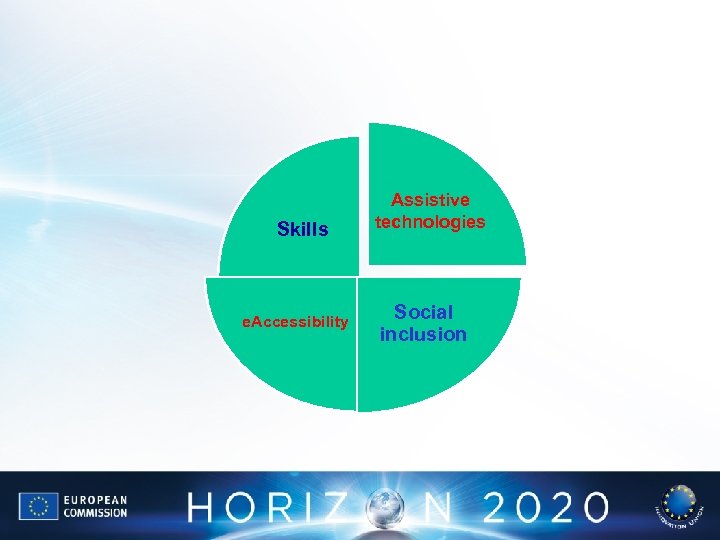 Skills e. Accessibility Assistive technologies Social inclusion
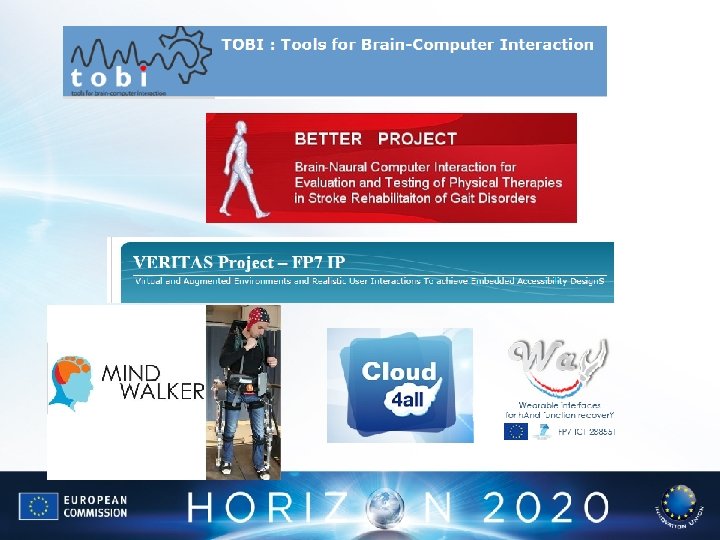
 Challenge Develop novel multi-modal, adaptive interfaces, including Brain Computer Interfaces, assisting people with disabilities
 Research and Innovation Action • Users interaction and cooperation with (intelligent) systems - User modelling (abilities) for different functions and environments • Detecting behaviours, emotions and intentions • Sensing and understanding the environment/contexts • Multimodal (including nonverbal) interaction in ambient environments Activities may cover also interoperability standards and interaction machine intelligence (in environments) and human intelligence
 Few remarks • Interfaces, environments and people with disabilities: a holistic approach to technologies around us and their influences on perception, experiences and behaviour • Multidisciplinary research is key
 Expected Impact Advancing the capacity of human-machine interaction technologies for people with disability and elderly to fully participate in society • R&I Actions • Small project proposals are expected • Budget
 Q&A …. .
 H 2020 Proposal submission
 Horizon 2020 – Proposal submission Points to note: • Page limit for technical content in Part B (excluding partner descriptions) 70 pages (50 pp for Coordination Actions) pages exceeding the limit will not be evaluated • Much shorter time to grant – work in advance and be ready if you are selected! 10
 Horizon 2020 – Proposal submission Points to note when preparing the proposal: • • • Demonstrate your operational capability – competence and availability of resources Thoroughly describe ethical issues and how they are dealt with Impact section of primary importance Check the proposal template on the Participant Portal for more information Self-check of SME status – financial viability: do it carefully as might be very critical at a later stage
 Horizon 2020 – Proposal submission • • A proposal has to be close to a final project work plan, not a sales brochure The maturity, specificity and completeness of the work plan will be taken into account at the evaluation stage and weaknesses will be penalised Lay out specific, well-defined and challenging yet realistic objectives and how they will be reached Great idea not enough – credible work plan essential
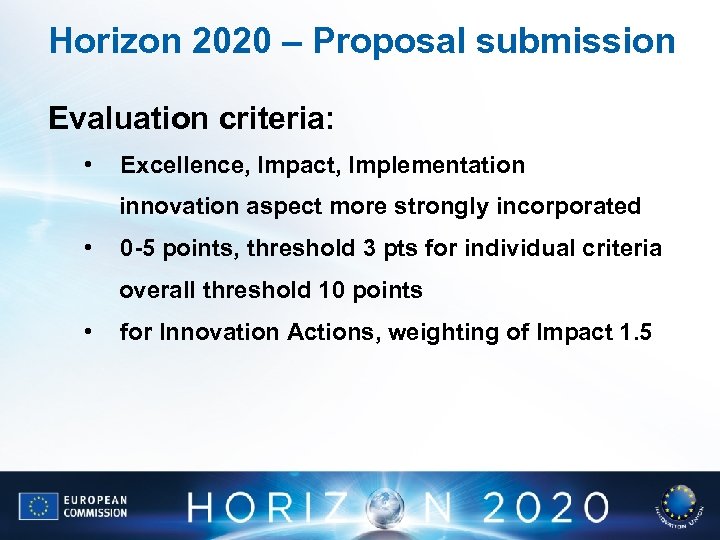 Horizon 2020 – Proposal submission Evaluation criteria: • Excellence, Impact, Implementation innovation aspect more strongly incorporated • 0 -5 points, threshold 3 pts for individual criteria overall threshold 10 points • for Innovation Actions, weighting of Impact 1. 5
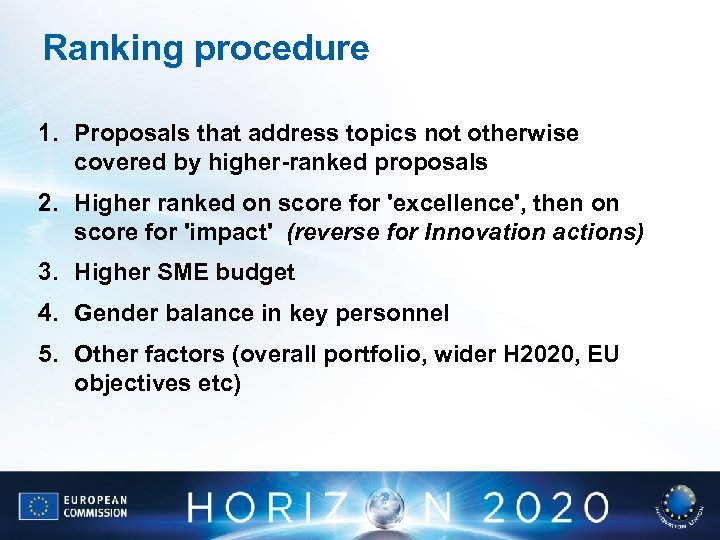 Ranking procedure 1. Proposals that address topics not otherwise covered by higher-ranked proposals 2. Higher ranked on score for 'excellence', then on score for 'impact' (reverse for Innovation actions) 3. Higher SME budget 4. Gender balance in key personnel 5. Other factors (overall portfolio, wider H 2020, EU objectives etc)
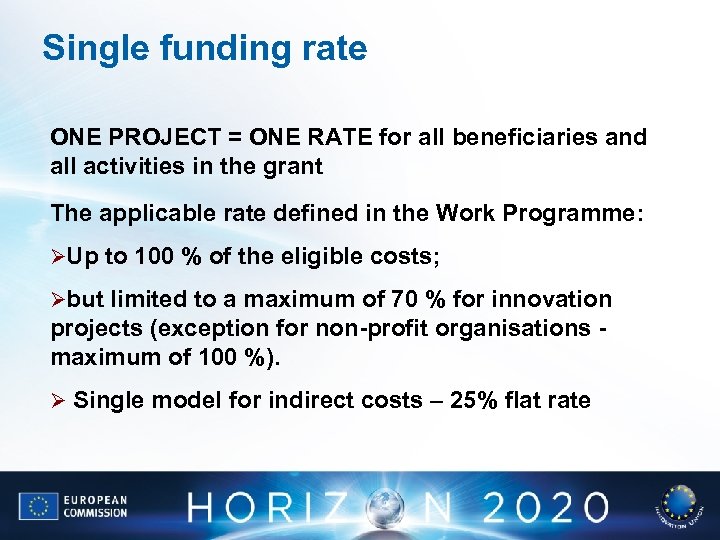 Single funding rate ONE PROJECT = ONE RATE for all beneficiaries and all activities in the grant The applicable rate defined in the Work Programme: ØUp to 100 % of the eligible costs; Øbut limited to a maximum of 70 % for innovation projects (exception for non-profit organisations - maximum of 100 %). Ø Single model for indirect costs – 25% flat rate
 Q&A time ….
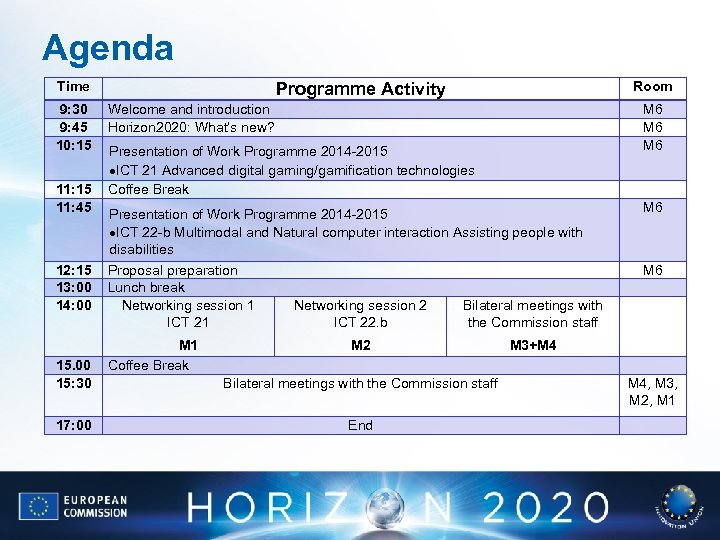 Agenda Time 9: 30 9: 45 10: 15 11: 45 12: 15 13: 00 14: 00 15: 30 17: 00 Room Programme Activity Welcome and introduction Horizon 2020: What’s new? M 6 M 6 Presentation of Work Programme 2014 -2015 ICT 21 Advanced digital gaming/gamification technologies Coffee Break Presentation of Work Programme 2014 -2015 ICT 22 -b Multimodal and Natural computer interaction Assisting people with disabilities Proposal preparation Lunch break Networking session 1 Networking session 2 Bilateral meetings with ICT 21 ICT 22. b the Commission staff M 1 Coffee Break M 2 M 6 M 3+M 4 Bilateral meetings with the Commission staff M 4, M 3, M 2, M 1 End