


 Скачать презентацию Hopi saying does this talk grow corn
3bf2f65b7ea397c5d128d2e588b44d7d.ppt
- Количество слайдов: 22
 Hopi saying: does this talk grow corn?
 Reality Check: Education, Research and Development 3/17/2018 2
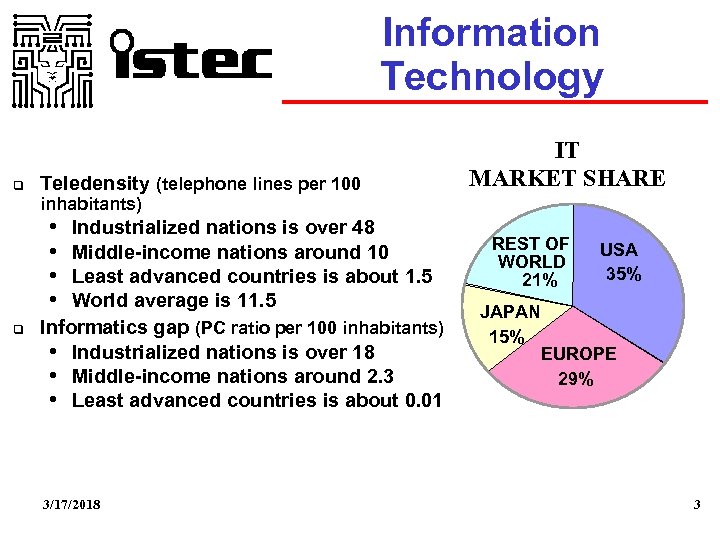 Information Technology Teledensity (telephone lines per 100 IT MARKET SHARE inhabitants) • • Industrialized nations is over 48 Middle-income nations around 10 Least advanced countries is about 1. 5 World average is 11. 5 Informatics gap (PC ratio per 100 inhabitants) • Industrialized nations is over 18 • Middle-income nations around 2. 3 • Least advanced countries is about 0. 01 3/17/2018 REST OF WORLD 21% USA 35% JAPAN 15% EUROPE 29% 3
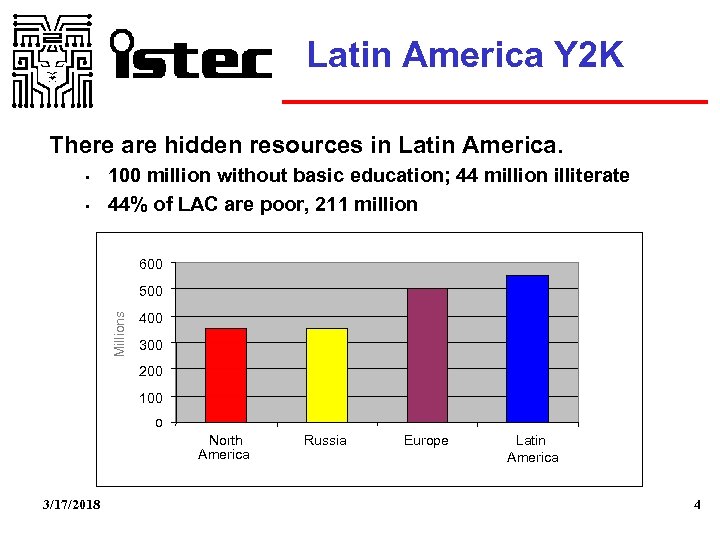 Latin America Y 2 K There are hidden resources in Latin America. • • 100 million without basic education; 44 million illiterate 44% of LAC are poor, 211 million 600 Population Growth By Y 2 K Millions 500 400 300 200 100 0 North America 3/17/2018 Russia Europe Latin America 4
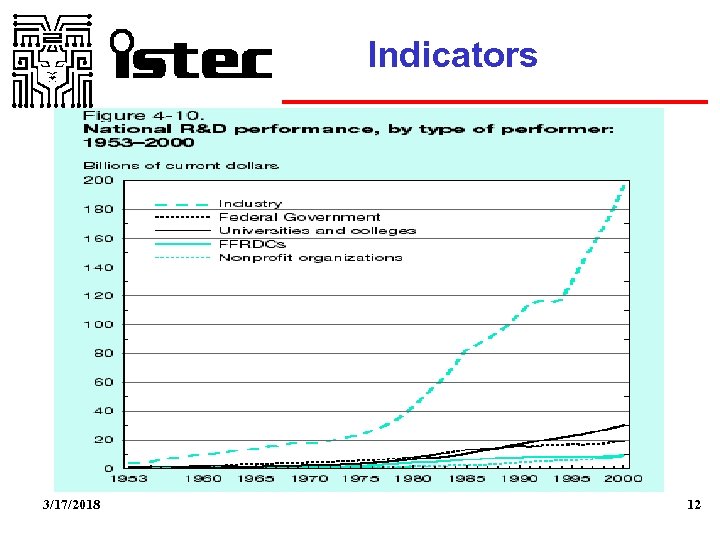
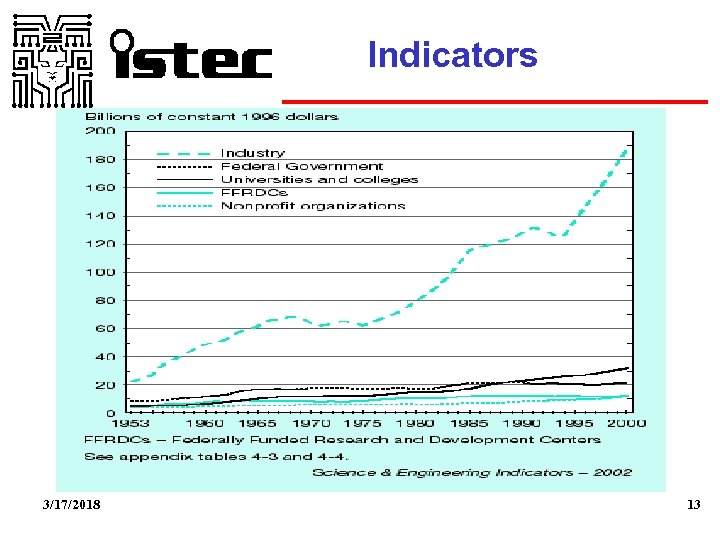
 Who does S&T? G-7 nations: • industry does 50 -70% of S&T • resources for S&T come from government and industry • majority of resources are spent in industry USA: • basic R&D sponsored primarily by the government • applied R&D sponsored primarily by industry and government • universities perform basic R&D Latin America: • R&D primarily sponsored by the government 3/17/2018 5
 Who does S&T? Brazil, Costa Rica, Chile, and Cuba are the only countries in Latin America with greater than 1% investment of GDP in R&D. • • 3/17/2018 Japan 2. 7% Germany 2. 4% United States 2. 4% Brazil 1. 3 % Canada 1. 6% Spain 0. 9% Russia Less than 0. 5% Latin American average is 0. 5% 6
 Who does S&T? Expenditure in S&T • • • USA $265 billion (68% industry) Canada $11 billion Brazil $5 billion Spain $5. 4 billion Mexico $1. 7 billion Argentina $1. 5 billion Human Resources in S&T • • • 3/17/2018 USA researchers 1 million Latin American researchers 126 k (Brazil 50 k, Arg 29 k, Mex 15 k) Spain and Portugal 63 k Canada 100 k Rest under 10 k 7
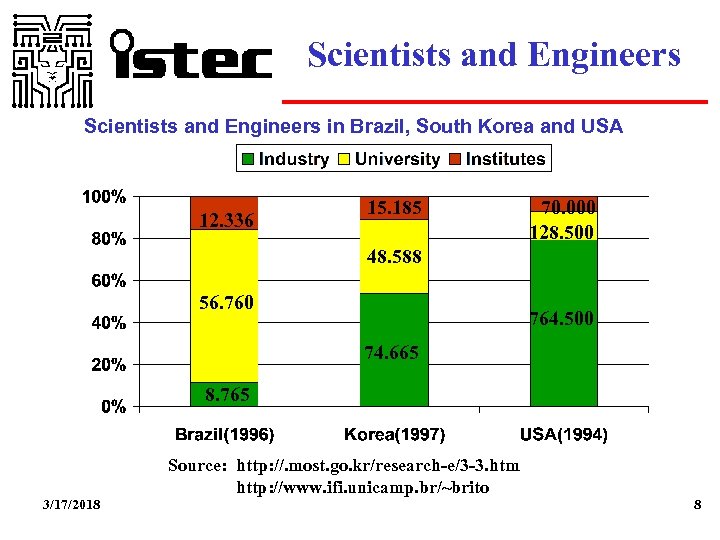 Scientists and Engineers in Brazil, South Korea and USA 12. 336 15. 185 70. 000 128. 500 48. 588 56. 760 764. 500 74. 665 8. 765 3/17/2018 Source: http: //. most. go. kr/research-e/3 -3. htm http: //www. ifi. unicamp. br/~brito 8
 Indicators 3/17/2018 9
 Indicators 3/17/2018 10
 Indicators 3/17/2018 11
 Indicators 3/17/2018 12
 Indicators 3/17/2018 13
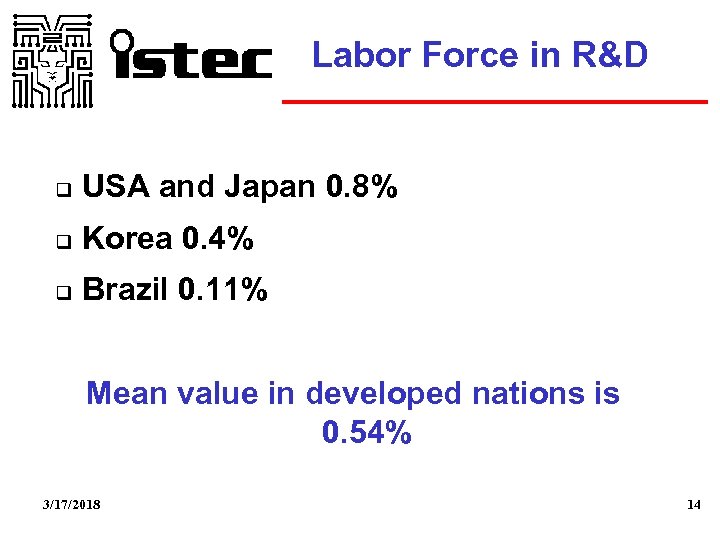 Labor Force in R&D USA and Japan 0. 8% Korea 0. 4% Brazil 0. 11% Mean value in developed nations is 0. 54% 3/17/2018 14
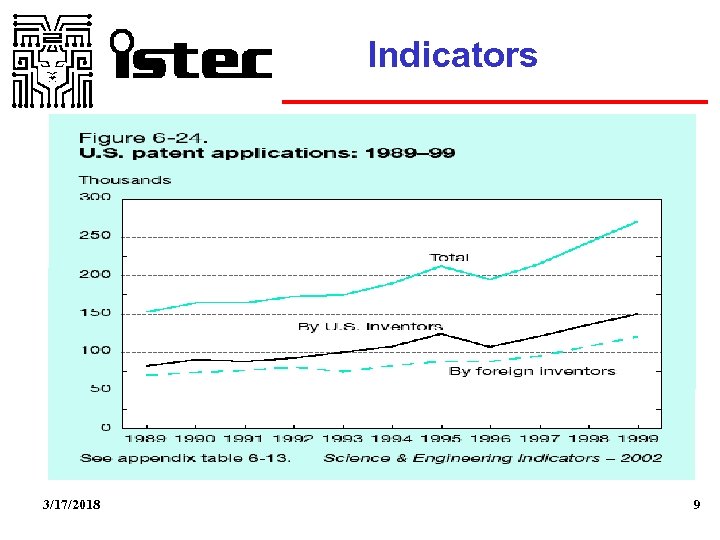
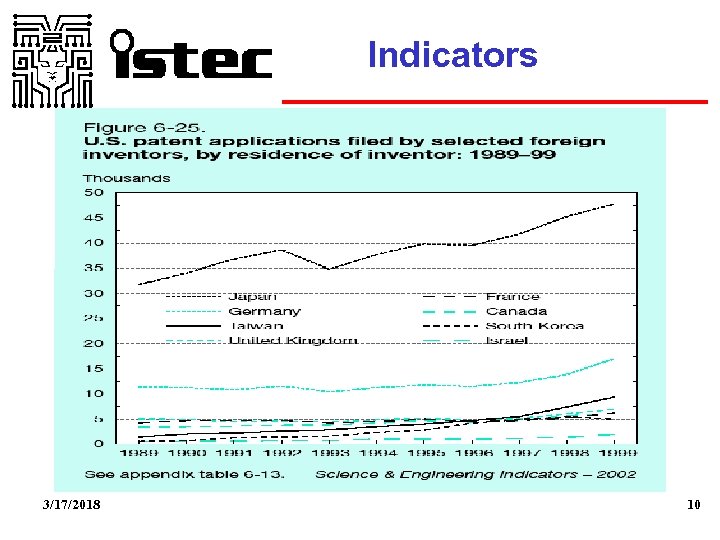
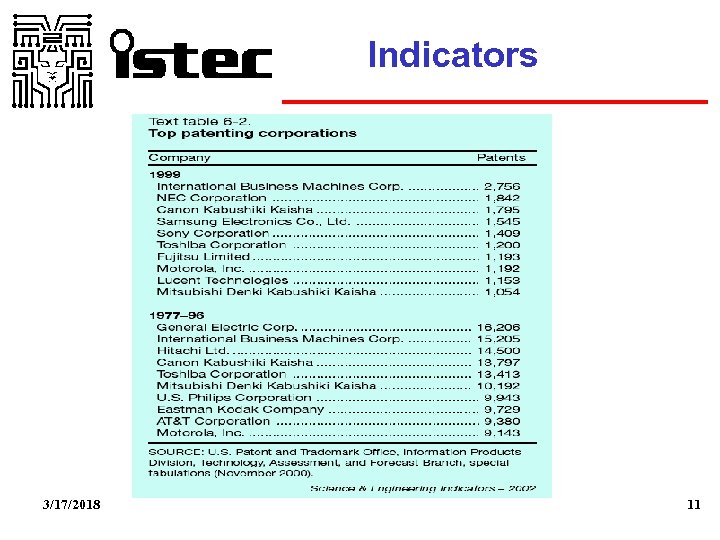
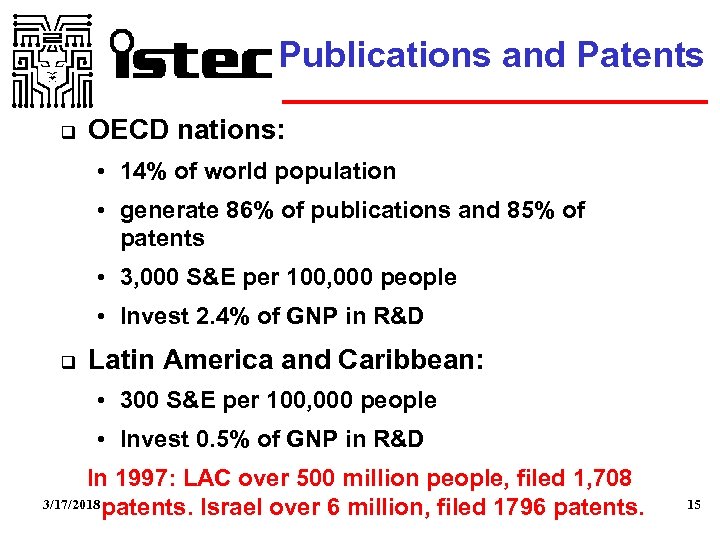 Publications and Patents OECD nations: • 14% of world population • generate 86% of publications and 85% of patents • 3, 000 S&E per 100, 000 people • Invest 2. 4% of GNP in R&D Latin America and Caribbean: • 300 S&E per 100, 000 people • Invest 0. 5% of GNP in R&D In 1997: LAC over 500 million people, filed 1, 708 3/17/2018 patents. Israel over 6 million, filed 1796 patents. 15
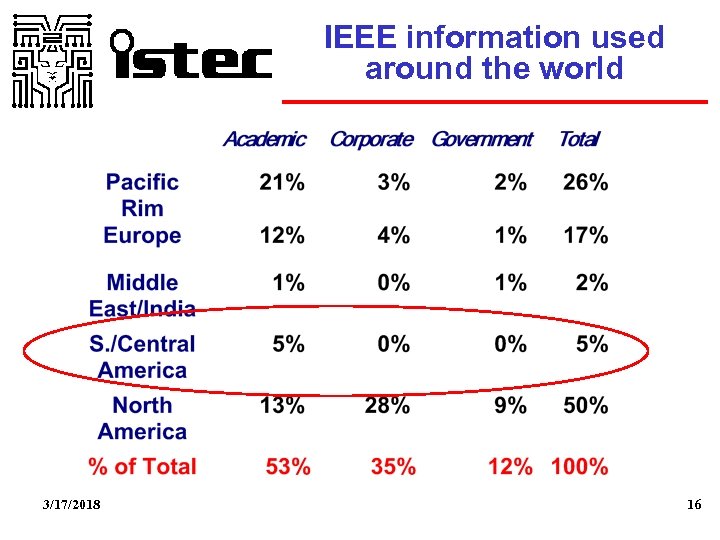 IEEE information used around the world 3/17/2018 16
 Higher Education LAC: 20% population • For every 100 individuals 35 finish OECD: 81% population Asia: 28% • Korea: 36% 3/17/2018 17
 Higher Education LAC: 1, 963 Ph. D programs, 269 institutions, in 14 countries. Concentrated in Brazil, Mexico, Cuba, Argentina, and Venezuela. Brazil, Cuba, Mexico: 80% of Ph. D programs. Limited offer: Chile, Colombia, Peru, Costa Rica and Uruguay Extremely low offer: Bolivia, Ecuador, Honduras and Panama. No offer: El Salvador, Guatemala, Nicaragua, Paraguay, and Dominican 3/17/2018 Republic. 18
 Higher Education 36% of institutions offer one (1) Ph. D program 70% of institutions offer 1 -5 Ph. D programs 13% of 2000 institutions in LAC can offer a Ph. D program 50% of Ph. D programs are offered by 7. 4% of the total number of institutions that offer at least 1 program Majority of Ph. D programs are concentrated in 1% of the total number of institutions 3/17/2018 19
 Higher Education Ph. D programs: • Humanities and Social Sciences – 31% • Natural and Exact Sciences – 27% • Medicine – 14% • Technology and Engineering – 14% • Agro Sciences – 9% • Earth Sciences and Space – 4. 3% 3/17/2018 20
 References La Oferta de Formación Doctoral en América Latina • Jesús Sebastián • Centro de Información y Documentación Científica (CINDOC) • Consejo Superior de Investigaciones Científicas (CSIC), Madrid, España NSF Science and Engineering Indicators, 2002 EE Times, October 2000 Informe sobre necesidades de empleo y formacion en las Nuevas Tecnologias de la Informacion y las Comunicaciones, Madrid, Marzo 6 -7, 2001 Oportunidades y desafíos tecnológicos: La brecha digital y la revolución biotecnológica. Quindi Franco y Nelson Viloria, CAF. 3/17/2018 21
 References Universidade Pública e Desenvolvimento • Carlos H. de Brito Cruz, Reitor UNICAMP A Universidade, a Empresa e a Pesquisa que o País Precisa • Carlos H. de Brito Cruz, Reitor UNICAMP ISTEC Publications 1990 -2001 IEEE presentation to ISTEC Board of Directors, Dr. Raymond D. Findlay 3/17/2018 22