 Скачать презентацию Hoosher s as the boatsmen term them
748a2a193a55ea373cff6e91b13d2cab.ppt
- Количество слайдов: 13



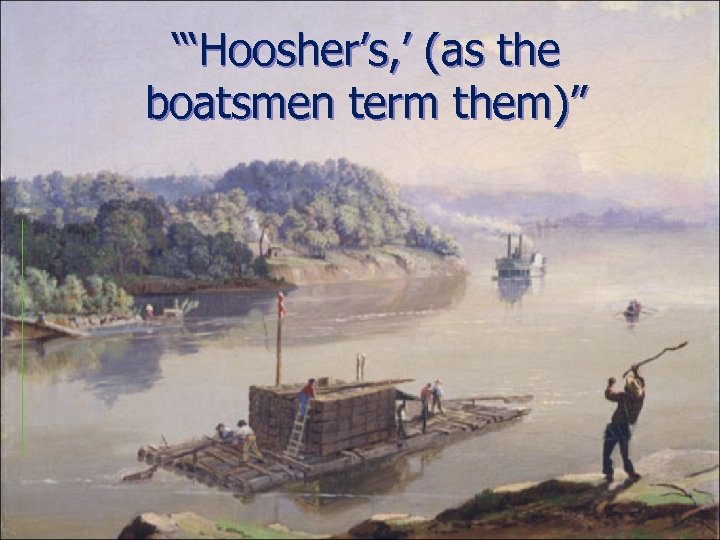
“‘Hoosher’s, ’ (as the boatsmen term them)”
![Current OED Entry: Hoosier [Origin unknown. ] a. A nickname for a native](https://present5.com/presentation/748a2a193a55ea373cff6e91b13d2cab/image-2.jpg "Current OED Entry: Hoosier [Origin unknown. ] a. A nickname for a native")
Current OED Entry: Hoosier [Origin unknown. ] a. A nickname for a native or inhabitant of the state of Indiana. 1826 in Chicago Tribune (1949) 2 June 20/3 The Indiana hoosiers that came out last fall is settled from 2 to 4 milds of us. 1834 Knickerbocker III. 441 They smiled at my inquiry, and said it was among the ‘hoosiers’ of Indiana. 1835 J. H. INGRAHAM South-West I. ix. 105 The primitive navies. . manned. . by ‘real Kentucks’‘Buck eyes’‘Hooshers’ and ‘Snorters’. 1860 EMERSON Cond. Life ii. 58 These Hoosiers and Suckers are really better than the snivelling opposition. 1885 Outing (U. S. ) Nov. 152/2 Oh, say, papa. Did you notice that young Hoosier and his bride who sat opposite me at breakfast? 1947 Harper's Mag. Jan. 67/2 Other Hoosiers ridicule them as hillbillies. 1958 Economist 1 Nov. 417/2 Indiana, whose inhabitants go by the obscure name of Hoosiers, is a deeply conservative state.
Current Graf website: (first page) The best evidence, however, suggests that "Hoosier" was a term of contempt and opprobrium common in the upland South and used to denote a rustic, a bumpkin, a countryman, a roughneck, a hick or an awkward, uncouth or unskilled fellow. Although the word's derogatory meaning has faded, it can still be heard in its original sense, albeit less frequently than its cousins "Cracker" and "Redneck. " (about 12 pages in) Several sources, including the State Library, cite a letter (in the Indiana State Library Manuscript Section) that G. L. Murdock wrote on Feb. 11, 1831 to Gen. John Tipton in which he says, "Our Boat will [be] named the Indiana Hoosier. " Dunn had always hoped that earlier references to the word would turn up, but the Murdock letter seems to be the first verifiable instance of its use. In spite of much searching, no one, apparently, has found previous written evidence of the term.
Conventional Wisdom (Dunn) • ”Hoosier” was term of contempt, meaning bumpkin or roughneck, common in the south pre-1800. • It migrated more or less as people did, out of the south into southern Indiana, and was applied by others to the relatively unsophisticated settlers there. • It gradually lost its sting as insult and was adopted by all as the state nickname. • It was probably derived from the Saxon word “hoo, ” for hill. • (By implication) letters and documents should begin to appear helping us trace this development backward through time. (The 1949 discovery of the “ 1826” letter was hailed by the Chicago Tribune as a good first step in this process. )
The Earliest Known Explanations • ”The people of Indiana are called ‘Hooshers’—a name which is said to have originated with an Indiana ruffian, who having severely flogged a Kentucky boatman of superior size, ‘jumped up’ and exclaimed, ‘I am a hoosher. ’” --Virtulon Rich, Western Life in the Stirrups, probably written in early 1833. • “The word Hooshier is indebted for its existence to that. . . Class of mortals called the Ohio Boatmen. —In its original acceptation, it was equivalent to ‘Ripstaver, ’ ‘Scrouger, ’ ‘Screamer, ’ ‘Bulger, ’ ‘Ring tail-roarer, ’ and a hundred others, equally expressive, but which have never attained to such a respectable standing as itself. ” --The Cincinnati Republican, October 14, 1833
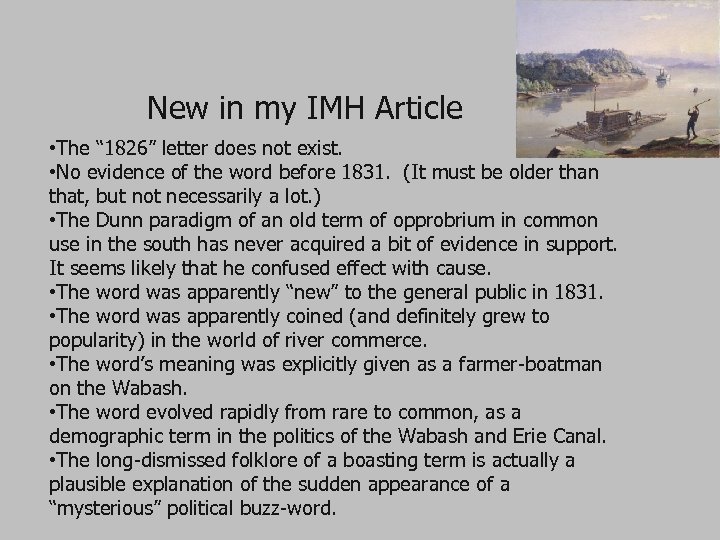
New in my IMH Article • The “ 1826” letter does not exist. • No evidence of the word before 1831. (It must be older than that, but not necessarily a lot. ) • The Dunn paradigm of an old term of opprobrium in common use in the south has never acquired a bit of evidence in support. It seems likely that he confused effect with cause. • The word was apparently “new” to the general public in 1831. • The word was apparently coined (and definitely grew to popularity) in the world of river commerce. • The word’s meaning was explicitly given as a farmer-boatman on the Wabash. • The word evolved rapidly from rare to common, as a demographic term in the politics of the Wabash and Erie Canal. • The long-dismissed folklore of a boasting term is actually a plausible explanation of the sudden appearance of a “mysterious” political buzz-word.
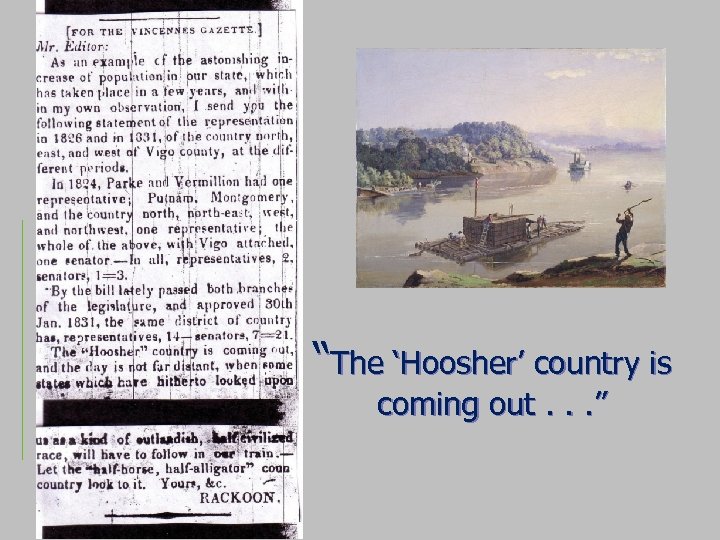
“The ‘Hoosher’ country is coming out. . . ”
Observations on the “Rackoon” item: • Localized to Wabash Valley, consistent with other newspaper items in 1831. • The word is tied to explosive growth in the previously unsettled part of the state, suggesting why a newly “completed” Indiana, a few years later, might justifiably be called a “Hoosier” state. • My relating the spread of the word’s use to the politics of the canal, while not incorrect, is perhaps too narrow; the entire phenomenon of immigration to the Wabash Valley must be considered. • The word is explicitly introduced in a “fighting, ” or “boasting, ” context, anticipating the two explanations of 1833, and using the exact phrasing (“half-horse, half-alligator” as a reference to Kentucky boasters) used in later recorded memories of both Jere Smith (1860) and Aaron Wood (1883).
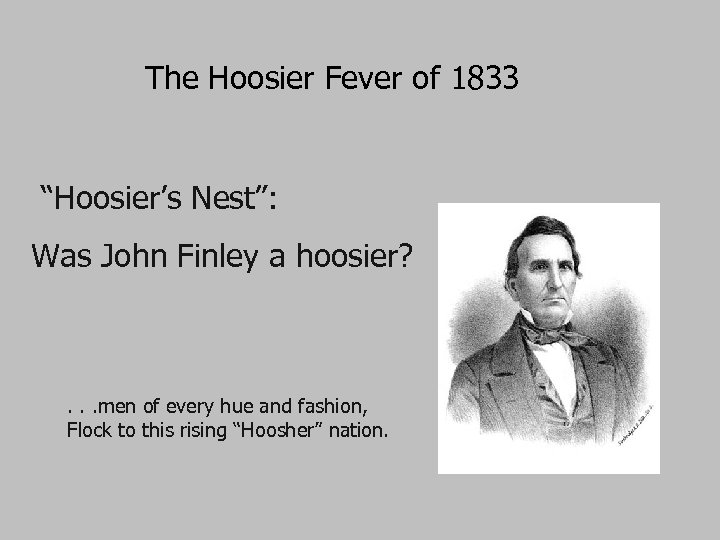
The Hoosier Fever of 1833 “Hoosier’s Nest”: Was John Finley a hoosier? . . . men of every hue and fashion, Flock to this rising “Hoosher” nation.
![1823 1835 [a toast to] “The Hooshier State of Indiana. ” --John W. Davis](https://present5.com/presentation/748a2a193a55ea373cff6e91b13d2cab/image-10.jpg "1823 1835 [a toast to] “The Hooshier State of Indiana. ” --John W. Davis")
1823 1835 [a toast to] “The Hooshier State of Indiana. ” --John W. Davis (Sullivan County) Jefferson-Jackson Dinner January 8, 1833 1846
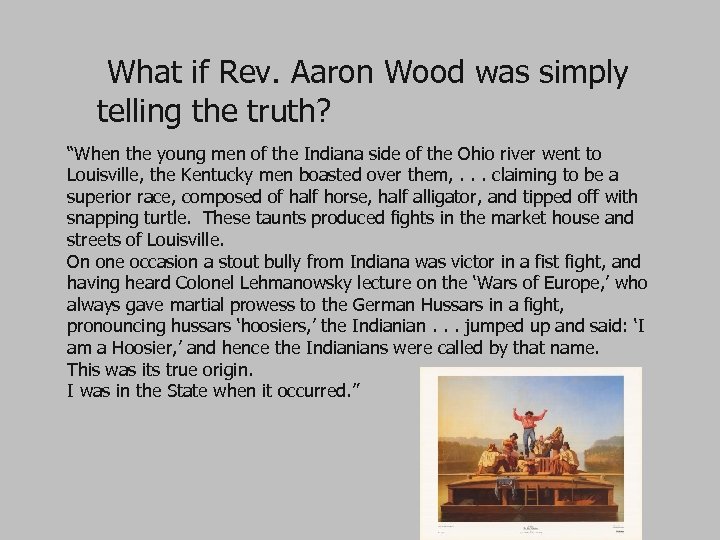
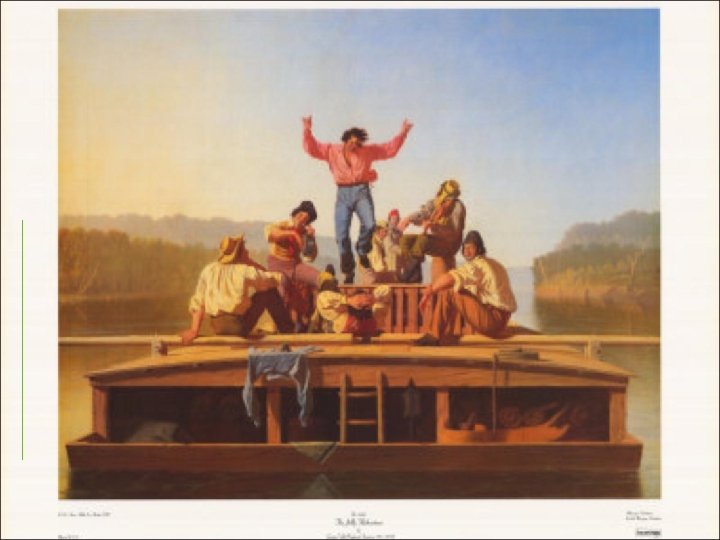
What if Rev. Aaron Wood was simply telling the truth? “When the young men of the Indiana side of the Ohio river went to Louisville, the Kentucky men boasted over them, . . . claiming to be a superior race, composed of half horse, half alligator, and tipped off with snapping turtle. These taunts produced fights in the market house and streets of Louisville. On one occasion a stout bully from Indiana was victor in a fist fight, and having heard Colonel Lehmanowsky lecture on the ‘Wars of Europe, ’ who always gave martial prowess to the German Hussars in a fight, pronouncing hussars ‘hoosiers, ’ the Indianian. . . jumped up and said: ‘I am a Hoosier, ’ and hence the Indianians were called by that name. This was its true origin. I was in the State when it occurred. ”
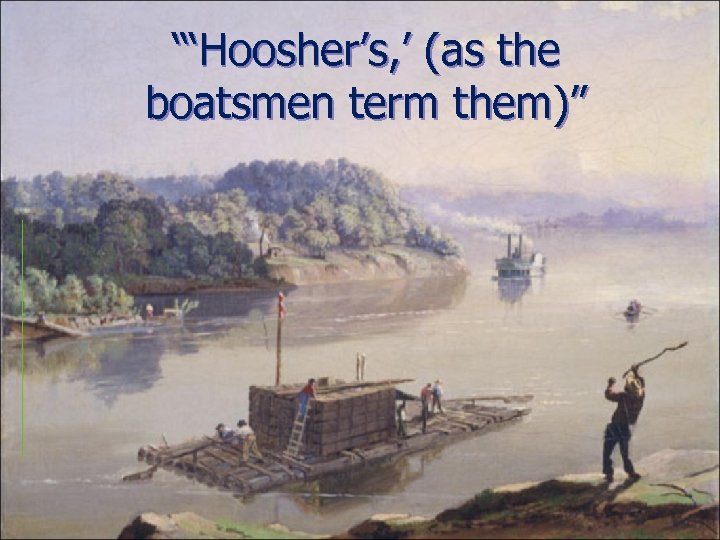
“‘Hoosher’s, ’ (as the boatsmen term them)”
Скачать презентацию Hoosher s as the boatsmen term them
748a2a193a55ea373cff6e91b13d2cab.ppt