


 Скачать презентацию Honoring Patients Wishes for Advanced Illness Care The
62d941a98496a622d3eda3117e66c3c7.ppt
- Количество слайдов: 10
 Honoring Patients’ Wishes for Advanced Illness Care: The Evolution of State POLST Programs Charlie Sabatino - ABA Commission on Law & Aging Naomi Karp - Consumer Financial Protection Bureau (formerly AARP Public Policy Institute) February 16, 2012
 Components • Exploratory survey in 2010 of key informants in 12 states that ostensibly recognize POLST statewide. • Maryland included as an outlier state • 52 telephone interviews: all open-ended questions. Ranged from 3 to 7 per state • Analysis of themes and experience in establishing & implementing POLST • Legislative/regulatory review.
 Legislative/Regulatory Comparison • Research analyzed and compared all statutes/regulations • Report includes statutory chart with 17 elements
 Survey Preliminary Findings • The Survey content can be organized by: 1. Strengths or facilitating elements that supported efforts. 2. Barriers and Issues in establishing and implementing. 3. Training and Educational Matters. 4. Monitoring & Evaluation Matters. 5. Comments on ensuring quality of POLST conversations. • Establishing vs. implementing stages were not distinct. • Caveat: Because issues and factors that respondents identified were in response to open-ended questions, any frequencies we provide should be taken with a grain of salt.
 Strengths or Facilitating Elements Most commonly identified: • • Core group of physician champions Deliberately incremental strategy Well-established statewide organization that effectively brings together statewide coalition Availability of financial support in cash or in kind. Unique chemistry? Of 24 “strengths” identified, 19 were mentioned in only 1 or 2 states.
 Barriers and Salient Issues Most commonly identified: • Nature of consent required (signature - mandatory or optional) • Form content issues • Confusion between ADs and POLST • Registries and EHR (looking forward) Next most: • Surrogate ID and authority • Changing institutional policies & procedures • Perception: POLST too cumbersome/timeconsuming • Cross cultural issues
 Training & Education Themes The most important implementation issue. Biggest barrier: Lack of or minimal funding. Success requires: • Ability to organize regular ongoing trainings, • Extensive web-based clearinghouse of resources, curricula, guides, media, etc • Ability to reach physicians
 Monitoring & Evaluation Themes • Majority (8) lack any formal monitoring/evaluation • What works: expert work group/committee (periodically solicits & reviews feedback from stakeholders). • One challenge: getting DOH to focus on POLST in compliance monitoring • Ideal: rigorous published evaluation over time
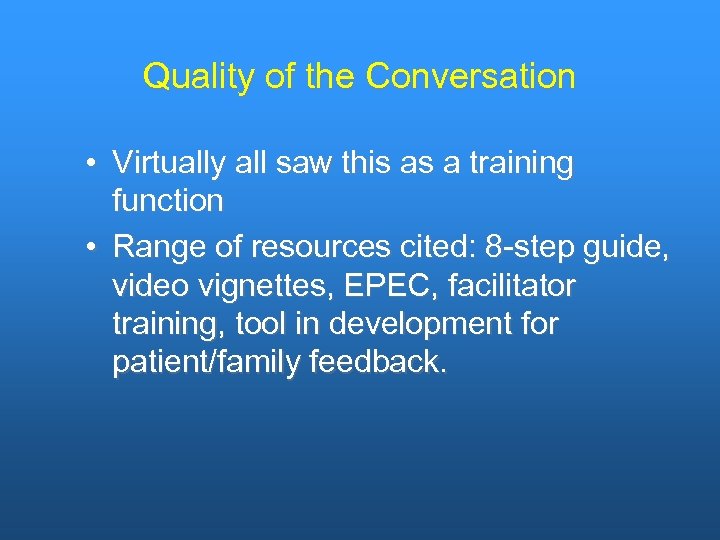 Quality of the Conversation • Virtually all saw this as a training function • Range of resources cited: 8 -step guide, video vignettes, EPEC, facilitator training, tool in development for patient/family feedback.
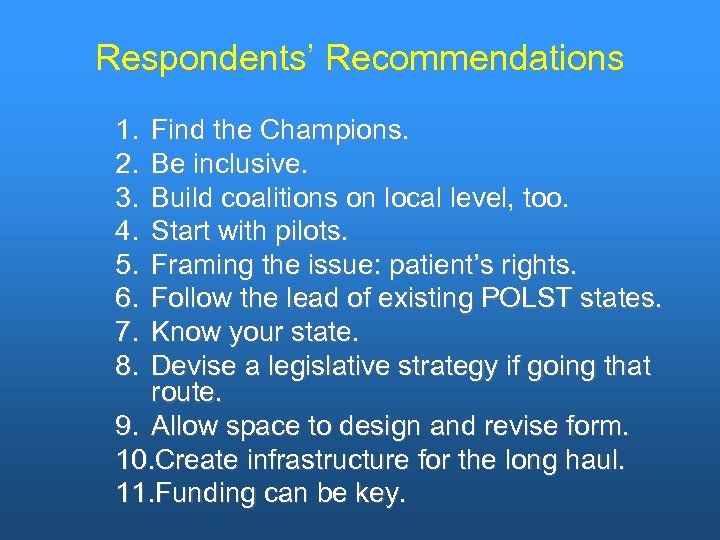 Respondents’ Recommendations 1. 2. 3. 4. 5. 6. 7. 8. Find the Champions. Be inclusive. Build coalitions on local level, too. Start with pilots. Framing the issue: patient’s rights. Follow the lead of existing POLST states. Know your state. Devise a legislative strategy if going that route. 9. Allow space to design and revise form. 10. Create infrastructure for the long haul. 11. Funding can be key.