 Скачать презентацию Hong Kong Investment Opportunities Conducting Business and
c8169a13f9a2e1192a602c831c21b0a6.ppt
- Количество слайдов: 57



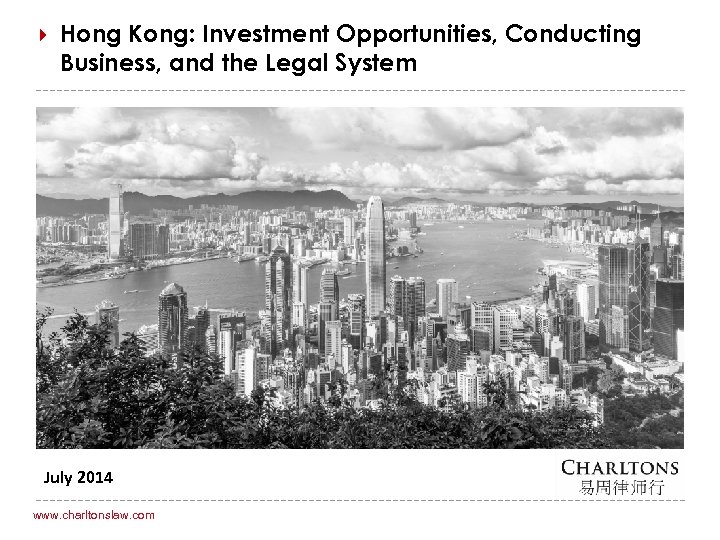
Hong Kong: Investment Opportunities, Conducting Business, and the Legal System July 2014 www. charltonslaw. com 0
Business Opportunities: Why Hong Kong? Reasons: One of the world’s leading financial and business centres Open and business-friendly environment Major centre for businesses e. g. 2 nd largest market in Asia after the Mainland Physical and political proximity to China Low tax regime; lower-tariff structure Modern infrastructure Internationally accepted and transparent legal system
How Hong Kong Scores in World Business Rankings: Most successful economy to attract foreign direct investment in 2011 – 2012 FDI Flows, UNCTAD 3 rd most competitive advanced economy in the world – IMD World Competitiveness Yearbook 2013 Most tax-friendly economy in Asia Pacific and ranked the fourth in the world – 2013 Paying Taxes Easiest place to raise capital in the world – Global Capital Access Index 2013 Asia’s top financial city and 3 rd in the world – Global Financial Centers Index 13 World’s freest economy – 2013 Index of Economic Freedom 3 rd in ease of doing business – Doing Business 2013 Highest level of globalisation in the world – 2012 Globalisation Index Source: Invest HK, IMD, UNCTAD, Pw. C, Heritage Foundation, IFC, World Bank
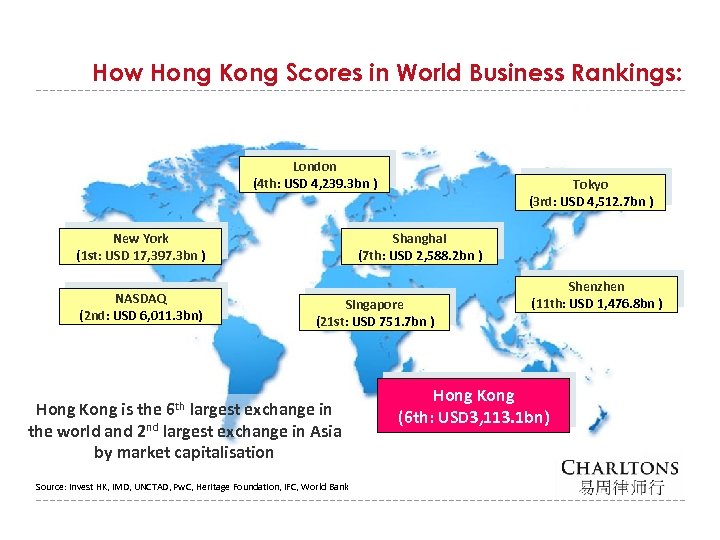
How Hong Kong Scores in World Business Rankings: London (4 th: USD 4, 239. 3 bn ) New York (1 st: USD 17, 397. 3 bn ) NASDAQ (2 nd: USD 6, 011. 3 bn) Tokyo (3 rd: USD 4, 512. 7 bn ) Shanghai (7 th: USD 2, 588. 2 bn ) Singapore (21 st: USD 751. 7 bn ) Hong Kong is the 6 th largest exchange in the world and 2 nd largest exchange in Asia by market capitalisation Source: Invest HK, IMD, UNCTAD, Pw. C, Heritage Foundation, IFC, World Bank Shenzhen (11 th: USD 1, 476. 8 bn ) Hong Kong (6 th: USD 3, 113. 1 bn)
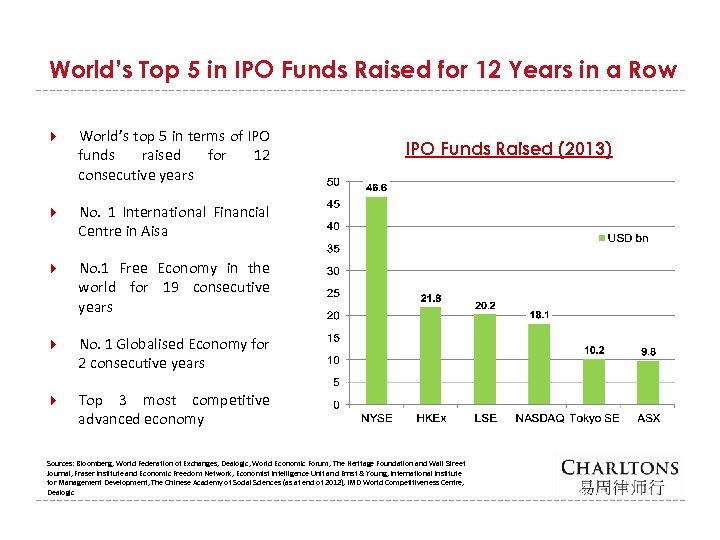
World’s Top 5 in IPO Funds Raised for 12 Years in a Row World’s top 5 in terms of IPO funds raised for 12 consecutive years No. 1 International Financial Centre in Aisa No. 1 Free Economy in the world for 19 consecutive years No. 1 Globalised Economy for 2 consecutive years Top 3 most competitive advanced economy IPO Funds Raised (2013) Sources: Bloomberg, World Federation of Exchanges, Dealogic, World Economic Forum, The Heritage Foundation and Wall Street Journal, Fraser Institute and Economic Freedom Network, Economist Intelligence Unit and Ernst & Young, International Institute for Management Development, The Chinese Academy of Social Sciences (as at end of 2012), IMD World Competitiveness Centre, Dealogic
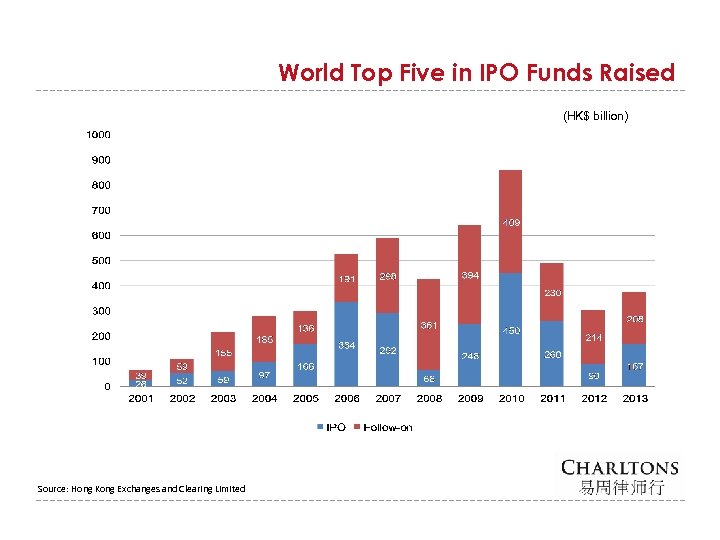
World Top Five in IPO Funds Raised (HK$ billion) Source: Hong Kong Exchanges and Clearing Limited
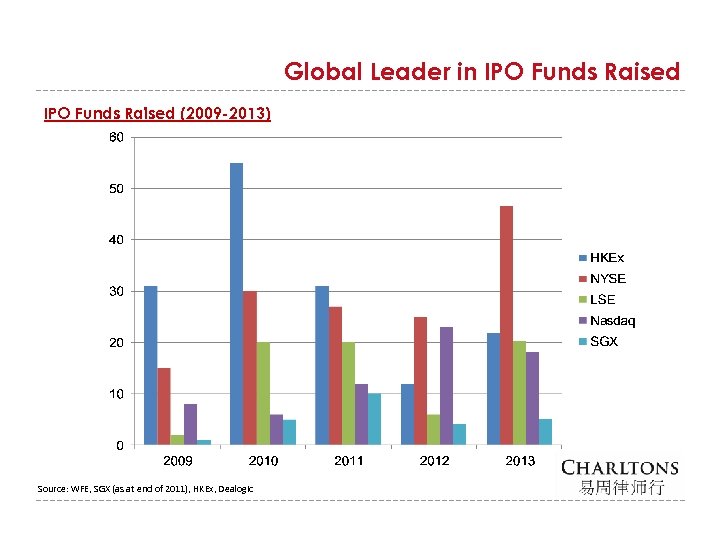
Global Leader in IPO Funds Raised (2009 -2013) Source: WFE, SGX (as at end of 2011), HKEx, Dealogic
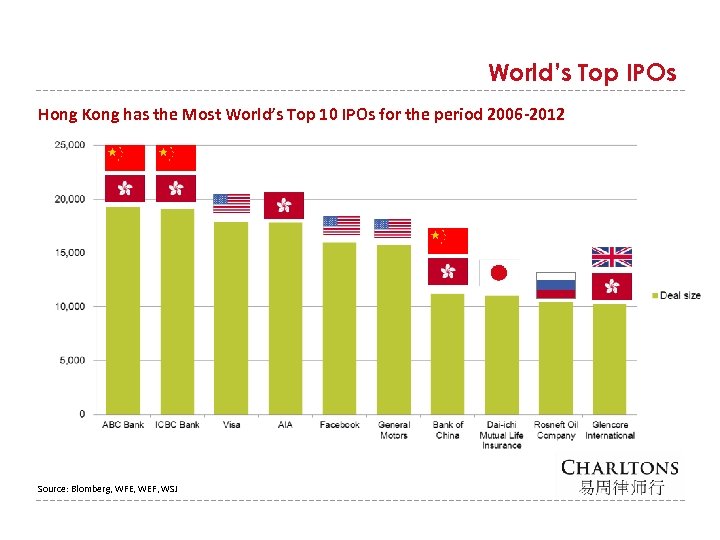
World’s Top IPOs Hong Kong has the Most World’s Top 10 IPOs for the period 2006 -2012 Source: Blomberg, WFE, WEF, WSJ
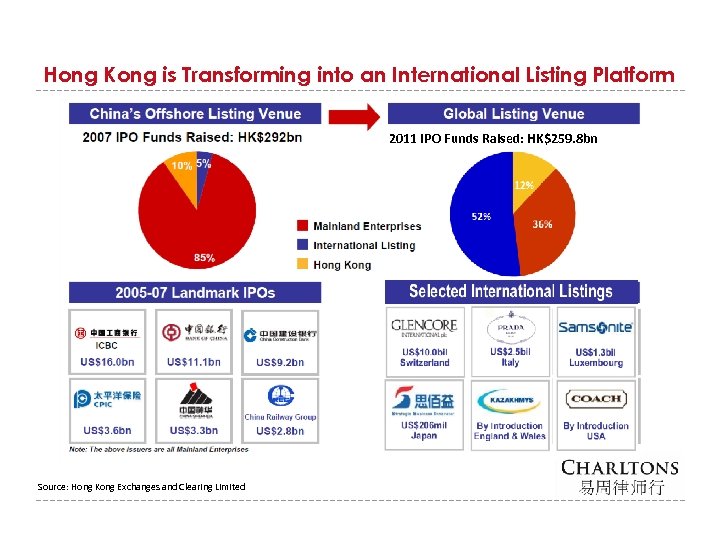
Hong Kong is Transforming into an International Listing Platform 2011 IPO Funds Raised: HK$259. 8 bn Source: Hong Kong Exchanges and Clearing Limited
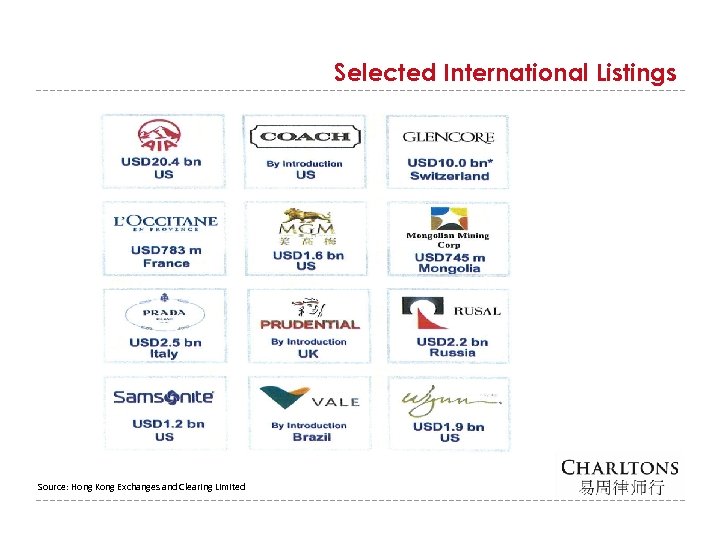
Selected International Listings Source: Hong Kong Exchanges and Clearing Limited
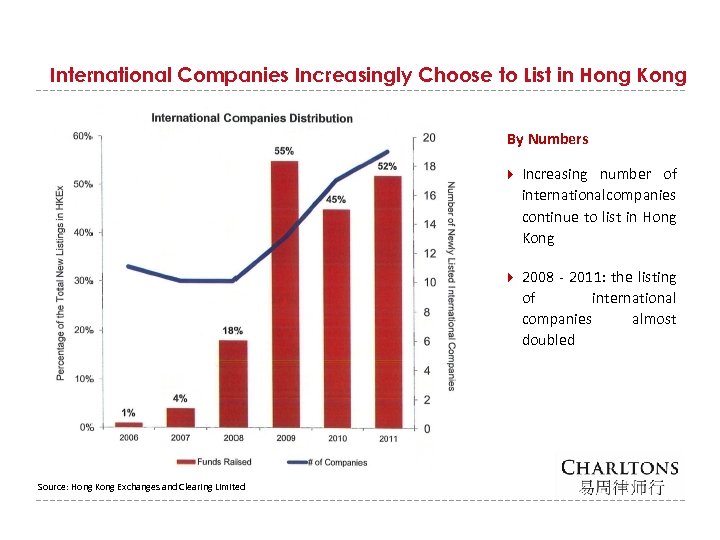
International Companies Increasingly Choose to List in Hong Kong By Numbers Source: Hong Kong Exchanges and Clearing Limited Increasing number of international companies continue to list in Hong Kong 2008 - 2011: the listing of international companies almost doubled
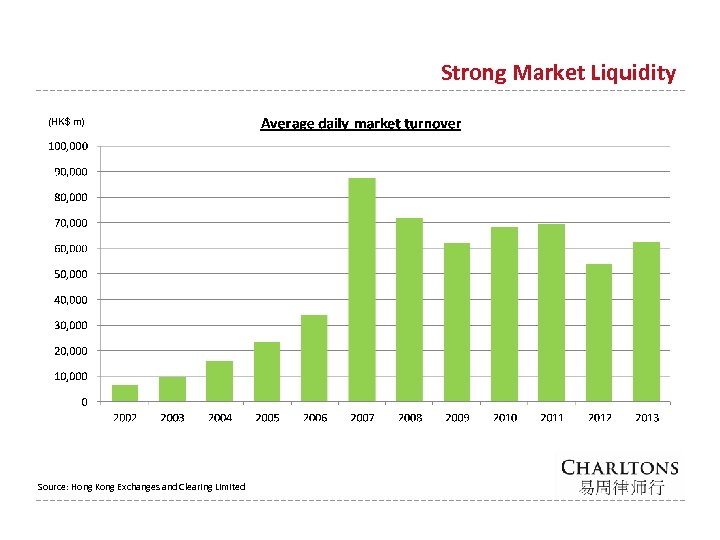
Strong Market Liquidity (HK$ m) Source: Hong Kong Exchanges and Clearing Limited
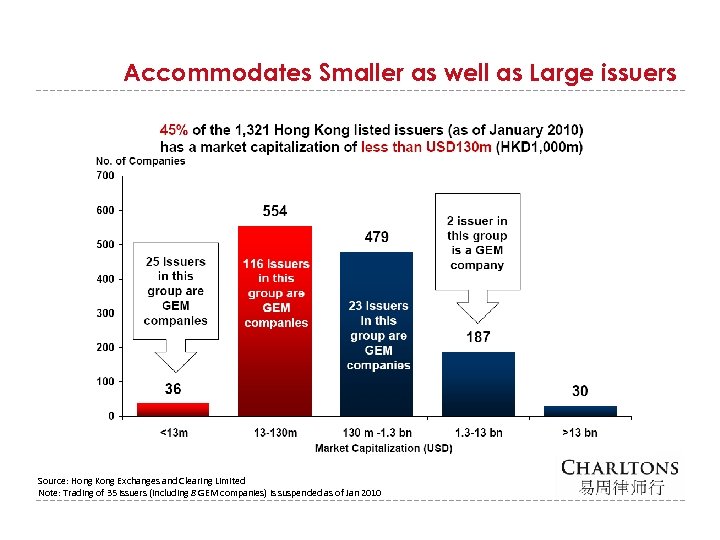
Accommodates Smaller as well as Large issuers Source: Hong Kong Exchanges and Clearing Limited Note: Trading of 35 issuers (including 8 GEM companies) is suspended as of Jan 2010
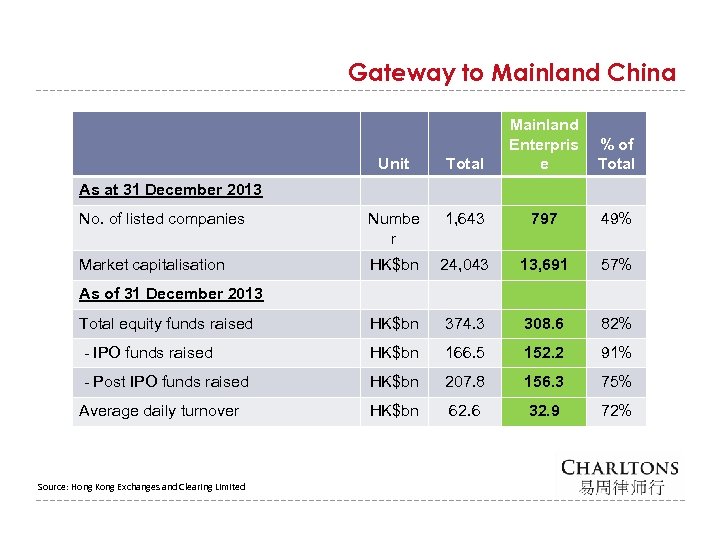
Gateway to Mainland China Unit Total Mainland Enterpris e No. of listed companies Numbe r 1, 643 797 49% Market capitalisation HK$bn 24, 043 13, 691 57% Total equity funds raised HK$bn 374. 3 308. 6 82% - IPO funds raised HK$bn 166. 5 152. 2 91% - Post IPO funds raised HK$bn 207. 8 156. 3 75% Average daily turnover HK$bn 62. 6 32. 9 72% % of Total As at 31 December 2013 As of 31 December 2013 Source: Hong Kong Exchanges and Clearing Limited
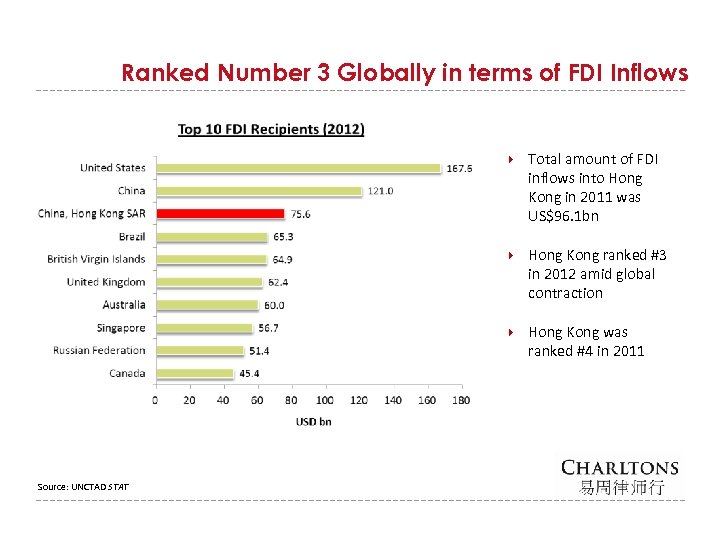
Ranked Number 3 Globally in terms of FDI Inflows Hong Kong ranked #3 in 2012 amid global contraction Source: UNCTAD STAT Total amount of FDI inflows into Hong Kong in 2011 was US$96. 1 bn Hong Kong was ranked #4 in 2011
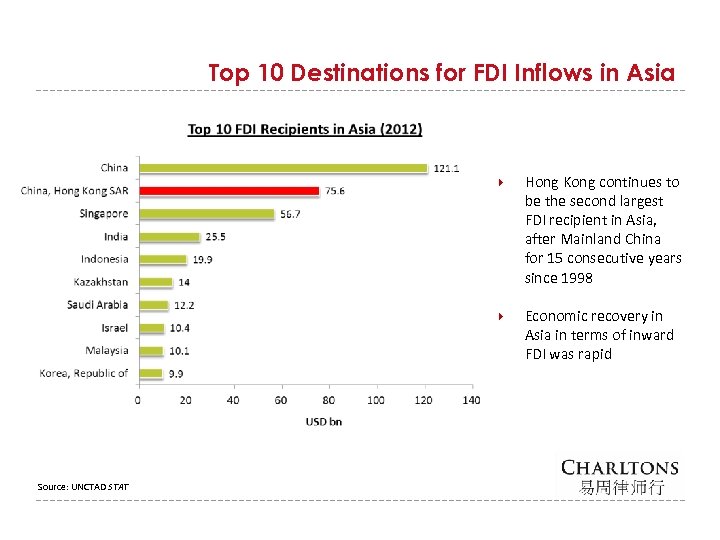
Top 10 Destinations for FDI Inflows in Asia Source: UNCTAD STAT Hong Kong continues to be the second largest FDI recipient in Asia, after Mainland China for 15 consecutive years since 1998 Economic recovery in Asia in terms of inward FDI was rapid
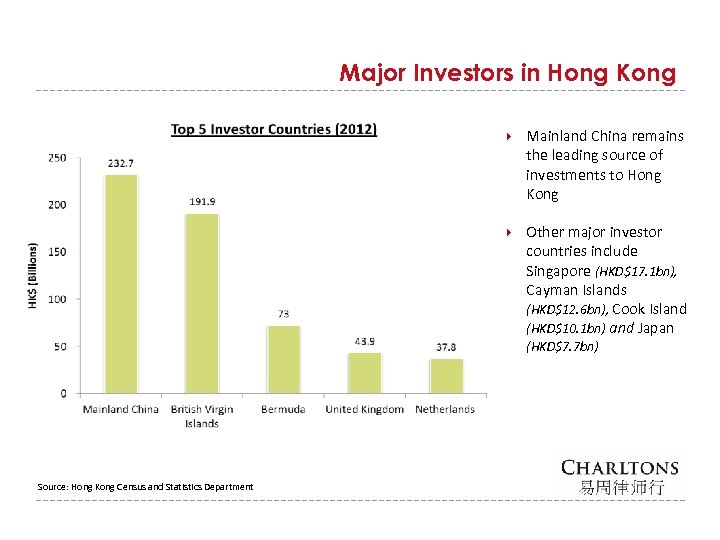
Major Investors in Hong Kong Mainland China remains the leading source of investments to Hong Kong Other major investor countries include Singapore (HKD$17. 1 bn), Cayman Islands (HKD$12. 6 bn), Cook Island (HKD$10. 1 bn) and Japan (HKD$7. 7 bn) Source: Hong Kong Census and Statistics Department
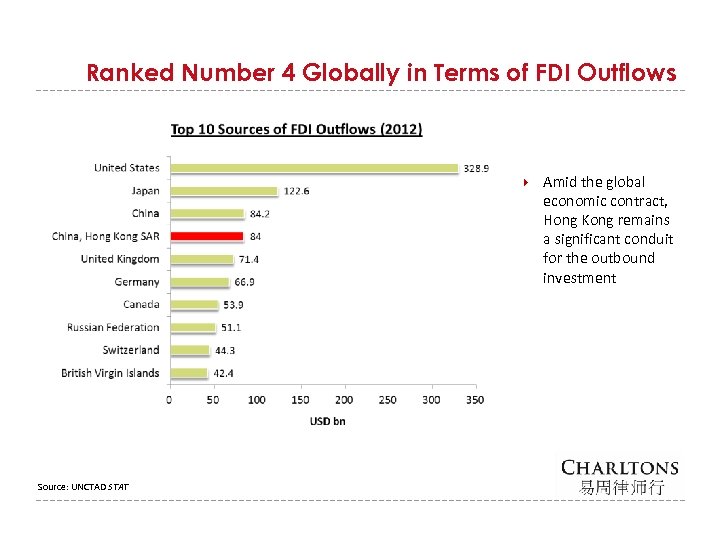
Ranked Number 4 Globally in Terms of FDI Outflows Source: UNCTAD STAT Amid the global economic contract, Hong Kong remains a significant conduit for the outbound investment
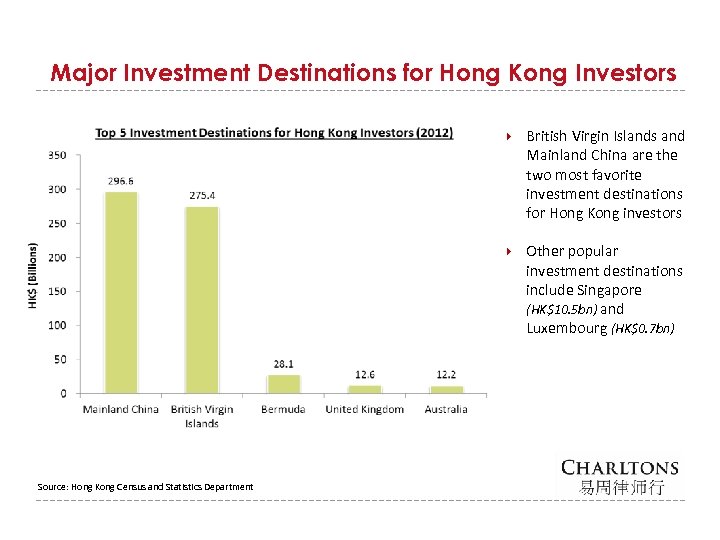
Major Investment Destinations for Hong Kong Investors Source: Hong Kong Census and Statistics Department British Virgin Islands and Mainland China are the two most favorite investment destinations for Hong Kong investors Other popular investment destinations include Singapore (HK$10. 5 bn) and Luxembourg (HK$0. 7 bn)
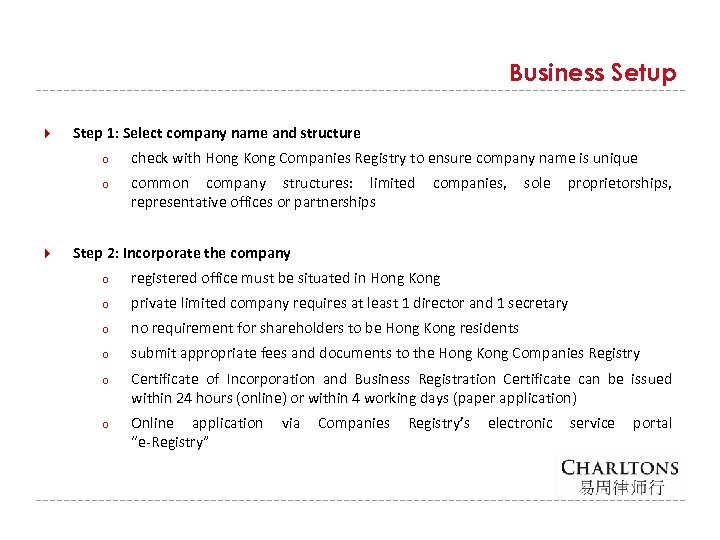
Business Setup Step 1: Select company name and structure o o check with Hong Kong Companies Registry to ensure company name is unique common company structures: limited companies, sole proprietorships, representative offices or partnerships Step 2: Incorporate the company o registered office must be situated in Hong Kong o private limited company requires at least 1 director and 1 secretary o no requirement for shareholders to be Hong Kong residents o submit appropriate fees and documents to the Hong Kong Companies Registry o Certificate of Incorporation and Business Registration Certificate can be issued within 24 hours (online) or within 4 working days (paper application) o Online application via Companies Registry’s electronic service portal “e-Registry”
Business Setup Step 3: Register business with the Business Registration Office of the Inland Revenue Department o o all businesses must register within 1 month of commencing business Business Registration Certificate must be displayed at the place of business Step 4: Open business bank account o must have business registration and company incorporation completed beforehand o banks normally require a minimum deposit of approx. HK$2, 000 (US$260) o banks will have Know-Your-Customer guidelines and collect information to verify and confirm identity before opening bank accounts
Business Setup Step 5: Select business premises o a wide variety of business premises are available within a small radius of the central business district on Hong Kong Island Step 6: Hire staff and apply for visa where necessary o visa-free entry for residents from over 170 countries for trips ranging from 7 -180 days o foreign nationals must obtain a visa before coming to Hong Kong to live, work or invest o different types of visa: employment, investment or dependent visa o every adult who enters and is permitted to stay in Hong Kong for more than 180 days must apply with the Immigration Department for a Hong Kong Identity Card within 30 days of arrival o Employment Ordinance (Cap. 57) sets out the employment regulations Source: Invest. HK website <http: //www. investhk. gov. hk/static/setup/setting-up-business-in-hong-kongcompany-incorporation-business registration-business-licences en. html>
Sector Opportunities - Legal Services 812 local solicitor firms and 70 foreign law firms More than half of the Global 50 law firms have a presence in Hong Kong 2 factors leading to continual demand for legal services: (i) Hong Kong has the highest number of corporate headquarters in the region, and (ii) Hong Kong is Asia’s leading financial services centre Opportunities: o Growing demand for services related to IPOs o Growing demand for local legal advice o Growing demand foreign legal advice o Mainland companies’ overseas investments grow rapidly, leading to high demand for expert advice for wide range of issues relating to M&A, commercial litigation, international arbitration, corporate law, intellectual property rights, etc.
More about the Legal System in Hong Kong I. Introduction Under the principle of “One Country, Two Systems” enshrined in the Basic Law, Hong Kong enjoys high degree of autonomy from the Mainland China The Basic Law (“BL”) is Hong Kong’s mini-constitution: o The BL took effect on 1 July 1997 on the establishment of the HKSAR o Nature of the BL o ensures that all the laws previously in force in Hong Kong shall be maintained except for any that contravene the Basic Law and subject to any amendment by the HKSAR legislature o National laws of the People’s Republic of China shall not be applied in the HKSAR except for laws relating to defence and foreign affairs
More about the Legal System in Hong Kong (cont’d) Relationship between the Central Authorities and HKSAR o o HKSAR is authorized to conduct relevant external affairs on its own in accordance with the BL o HKSAR enjoys executive, legislative and independent judicial power, including that of final adjudication HKSAR is authorized to maintain public order in accordance with its government Fundamental rights protected by the BL o Right to equality before the law; freedom of speech; freedom of the press and of publication; freedom of association; freedom of assembly; freedom of procession and of demonstration; right and freedom to form and join trade unions; freedom to strike; freedom of movement; freedom of conscience; freedom of religious belief, etc. o BL guarantees that the provisions of the International Covenant on Civil and Political Rights, the International Covenant on Economic, Social and Cultural Rights, and the International Labour Conventions as applied to Hong Kong will remain in force
More about the Legal System in Hong Kong (cont’d) Political structure of the HKSAR o Chief Executive (“CE”) is the head of the HKSAR and is accountable to the Central People’s Government and the HKSAR o The CE is assisted by members of the Executive Council o HKSAR’s legislature is the Legislative Council
More about the Legal System in Hong Kong (cont’d) II. How Does the Legal System in Hong Kong Work? Common law o Statute law enacted in Hong Kong o Vast majority of statute law in force is made locally and contained in the Laws of Hong Kong Some aspects of Chinese customary law also apply o Hong Kong is a common law jurisdiction so common law and rules of equity are to be found primarily in judgments E. g. in relation to land in the New Territories International law o Over 200 international treaties and agreements have been applied in Hong Kong o However, a treaty does not constitute part of Hong Kong’s domestic law until given effect by legislation o May be resorted to interpretation by the courts
More about the Legal System in Hong Kong (cont’d) II. How Does the Legal System in Hong Kong Work? (cont’d) Criminal law o o Secretary for Justice responsible for conduct of criminal prosecutions; HKSAR Government against individuals Jury system for most serious criminal offences e. g. murder, manslaughter, rape, armed robbery and certain drug offences etc. Civil law o HKSAR Government against individuals; or more commonly individuals against individuals o Burden of proof is easier to discharge, i. e. standard of proof being one based on the balance of probabilities Source: Department of Justice website <http: //www. doj. gov. hk/eng/legal/>
More about the Legal System in Hong Kong (cont’d) III. The Judiciary (i) The Courts Court of Final Appeal (“CFA”) o o Under provisions of the BL and the Hong Kong Court of Final Appeal Ordinance (Cap. 484), judges of the CFA are appointed by the CE 3 permanent judges and 1 non-permanent Hong Kong judge or 1 judge from another common law jurisdiction hear an appeal High Court (i. e. Court of Appeal (“CA”) and Court of First Instance (“CFI”)) o CA hears appeals on all matters including civil and criminal from the CFI and DC, as well as appeals from the Lands Tribunal o CA also makes rulings on questions of law referred to by the lower courts o CFI has unlimited jurisdiction in criminal and civil matters o CFI also hears appeals from the MC, Labour Tribunal, Small Claims Tribunal and the Obscene Articles Tribunal
More about the Legal System in Hong Kong (cont’d) III. The Judiciary (cont’d) (i) The Courts District Court (“DC”) o o Civil matter- cannot hear monetary claims over HK$1, 000 o DC has limited jurisdiction in criminal and civil matters Criminal matter- may try more serious cases except murder, manslaughter and rape; max term of imprisonment it can impose is 7 years Magistrates’ Courts (“MC”) o MC hear a wide range of criminal offences, usually minor offences o All criminal matters appear initially in MC o The normal maximum sentence is 2 years' imprisonment and a fine of $100, 000 o Some securities-related offences are also heard in MC
More about the Legal System in Hong Kong (cont’d) III. The Judiciary (cont’d) (i) The Courts Coroner’s Court o Inquires into deaths which occur as a result of accident, violence or suspected circumstances Juvenile Court o Hear charges against children (aged under 14) and young persons (aged between 14 and 16) o Cannot hear homicide o Children under age of 10 are deemed not to have reached age of criminal responsibility
More about the Legal System in Hong Kong (cont’d) III. The Judiciary (cont’d) (i) The Courts Lands Tribunal o o Determine building management disputes; appeals from decisions of the Commissioner of Rating and Valuation, and appeals against assessment of the prevailing market value of property made by Director of Housing o Determine sums payable by the Government and others for compensation to persons whose land is compulsorily resumed or the value of which is reduced because of public or private developments Determine matters under Landlord and Tenant (Consolidated) Ordinance (Cap. 7) Labour Tribunal o Provides a quick, inexpensive and informal method of settling disputes between employers and employees o No legal representation
More about the Legal System in Hong Kong (cont’d) III. The Judiciary (cont’d) (i) The Courts Small Claims Tribunal o o Hears minor monetary claims not exceeding HK$50, 000 o Informal hearing No legal representation Obscene Articles Tribunal o Determine whether an article referred to it by a court or a magistrate is an obscene or indecent article under the Control of Obscene and Indecent Articles Ordinance (Cap. 390) o Classify whether an article falls under Class I (neither obscene nor indecent) or Class II (indecent) or Class III (obscene)
More about the Legal System in Hong Kong (cont’d) III. The Judiciary (cont’d) (ii) Role of the Secretary for Justice Appointed by the Central People’s Government after being nominated by the CE Must be a legal practitioner; Chinese citizen and permanent resident with no right of abode in any foreign country and have resided in Hong Kong for continuous period of not less than 15 years A member of the Executive Council The plaintiff in criminal proceedings on behalf of the HKSAR Government Also the defendant in civil actions brought against the HKSAR Government Other general duties and responsibilities
More about the Legal System in Hong Kong (cont’d) III. The Judiciary (cont’d) (iii) The Department of Justice (“DOJ”) Secretary of Justice is the head of the DOJ comprises of 6 divisions: 1. Civil- provides legal advice on civil law to all government bureaus and departments. Represents the Government as solicitors and barristers in all civil litigations including arbitrations 2. International law- provides advice on public international law to the government and negotiates, or provides legal advisers on negotiations for bilateral agreements 3. Law drafting- responsible for drafting all government legislation of the HKSAR 4. Legal policy- advises the Government departments and bureaus on whether proposed legislation or policy is consistent with the BL, international human rights standards etc.
More about the Legal System in Hong Kong (cont’d) III. The Judiciary (cont’d) (iii) The Department of Justice (“DOJ”) DOJ comprises of 6 divisions: (cont’d) 5. Prosecutions- conduct prosecution in majority of CFI and DC trials 6. Administration and development- responsible for reporting to the Legislative Council on finances of Department of Justice. Deals with the running of a major government department including administrative, financial, accounting and management services, etc.
More about the Legal System in Hong Kong (cont’d) IV. The Legal Profession Unlike in the US, the legal profession in Hong Kong is divided into 2 distinct branches: (i) Barristers (a. k. a. “counsel”): - Over 1, 200 practising barristers - All members of the Hong Kong Bar Association - Barristers can only accept instructions from a firm of solicitors or members of professional bodies recognized by the Bar Association - Practise as sole-proprietors - Usually practise in a set of chambers (ii) Solicitors: - Over 7, 500 practising solicitors - Members of the Law Society - Some 374 solicitors are admitted to practise as notaries public
More about the Legal System in Hong Kong (cont’d) IV. The Legal Profession (cont’d) Hong Kong is the most liberal Asian jurisdiction in terms of permitting foreign lawyers to practice; no entry barriers foreign law firms or foreign lawyers Home to 812 local solicitor firms and 70 foreign law firms Examples of US law firms in Hong Kong: Debevoise & Plimpton LLP; Cadwalader, Wickersham & Taft LLP, Maples and Calder, Harney Westwood & Riegels etc. 40% of international lawyers in Asia are based in Hong Kong
More about the Legal System in Hong Kong (cont’d) V. Arbitration and Mediation Hong Kong is Asia’s leading international arbitration centre Arbitration has been a popular method of dispute resolution in Hong Kong o Resolving successfully each year hundreds of major business disputes involving trade, construction, joint ventures, shipping etc. Governed by the Arbitration Ordinance (Cap. 341), which is based on the UNCITRAL Model law The Hong Kong Arbitration Centre (HKIAC) was established in 1985 to act as an independent and impartial focus Number of cases involving the HKIAC has substantially increased in recent years and is anticipated to further increase because of increased popularity of arbitration and mediation as a means of dispute resolution Similarly, mediation is a dispute resolution process conducted in confidence in which a neutral third party (i. e. mediator) is engaged to facilitate the parties in arriving at a negotiated settlement
Securities Regulation in Hong Kong I. The Securities Market: A General Overview In terms of market capitalisation, Hong Kong has the world’s 7 th largest securities market and the second largest in Asia after Tokyo The Hong Kong Stock Exchange and the Futures Exchange were merged into Hong Kong Exchanges and Clearing (HKEx) as of March 2000 Influx of Mainland China issuers into Hong Kong, boosted by economic reforms, has accelerated growth of the Hong Kong market Hong Kong is the most liquid overseas market for Mainland enterprises
Securities Regulation in Hong Kong (cont’d) II. Securities Regulation: Regulatory Structure The securities market in Hong Kong is regulated by the Securities and Futures Commission (“SFC”) o SFC was founded in 1989 o It is an independent statutory body with licensing and supervisory powers over the securities sector including securities, futures and financial investment industries o It has power to take appropriate action to protect Hong Kong’s securities markets and to prosecute individuals who violate securities market ordinances and codes o Securities and Futures Ordinance (Cap. 571) came into force on 1 st April 2003 § to detect and deter manipulation and to improve investor protection o The Companies Ordinance (Cap. 622) and the Companies (Winding Up and Miscellaneous Provisions) Ordinance also came into force in 3 March 2014 o These pieces of legislation form the backbone of securities market regulation
Securities Regulation in Hong Kong (cont’d) II. Securities Regulation: Regulatory Structure (cont’d) The Hong Kong Exchanges and Clearing Limited (“HKEx”) performs a self-regulatory function and its rules are subject to the SFC approval SFC’s regulatory objectives include: o To maintain and promote the fairness, efficiency, competitiveness, transparency and orderliness of the securities and futures industry; o To promote understanding by the public of the operation and functioning of the securities and futures industry; o To provide protection for members of the public investing in or holding financial products; o To reduce systemic risks in the securities and futures industry; and o To assist the Financial Secretary in maintaining the financial stability of Hong Kong by taking appropriate steps in relation to the securities and futures industry
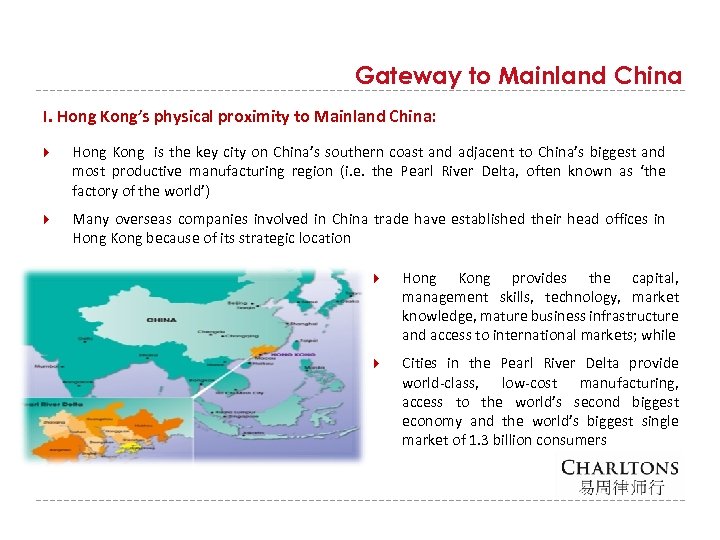
Gateway to Mainland China I. Hong Kong’s physical proximity to Mainland China: Hong Kong is the key city on China’s southern coast and adjacent to China’s biggest and most productive manufacturing region (i. e. the Pearl River Delta, often known as ‘the factory of the world’) Many overseas companies involved in China trade have established their head offices in Hong Kong because of its strategic location Hong Kong provides the capital, management skills, technology, market knowledge, mature business infrastructure and access to international markets; while Cities in the Pearl River Delta provide world-class, low-cost manufacturing, access to the world’s second biggest economy and the world’s biggest single market of 1. 3 billion consumers
Gateway to Mainland China (cont’d) II. The Mainland Hong Kong Closer Economic Partnership Arrangement (CEPA): A free trade agreement which grants easier access to Mainland China markets for Hong Kong-made products and Hong Kong-based service companies Trade in goods o Duty-free export to Mainland China for Hong Kong-made products; over 1, 500 categories of ‘Made in Hong Kong’ products may be exported to the Mainland tariff-free, subject to certain criteria being met Trade in services o Easier market entry for Hong Kong-based service providers o CEPA currently covers 42 service sectors
Gateway to Mainland China (cont’d) II. The Mainland Hong Kong CEPA (cont’d): Trade and investment facilitation o Hong Kong and Mainland China have agreed to cooperate in various areas to facilitate trade and investment, e. g. : § Cooperation of small and medium-sized enterprises (SMEs) § Trade & investment promotion § Transparency in laws and regulations § Protection of intellectual property
Potential business opportunities in PRC Investment in certain industries requires approval by central government authorities Whereas approval for smaller foreign-invested enterprises (with a total investment of less than US$30 million) has been delegated to provincial, regional and municipal governments I. Forms of investment vehicles: 1. Assembling and Processing Contracts (APC) 2. Sino-Foreign Equity Joint Ventures (EJV) 3. Cooperative Joint Ventures (CJV) 4. Wholly Foreign-Owned Enterprises (WFOE or WOFE) 5. PRC Holding Companies 6. Representative Offices (RO) 7. Branches
Potential business opportunities in PRC (cont’d) I. Forms of investment vehicles: (cont’d) 1. Assembling and Processing Contracts (APC) o simplest form o foreign company supplies raw materials or parts on a consignment basis to a local entity in PRC o a fee is paid to the PRC entity for its work o processed goods then returned to the foreign company will have to supply necessary production technology, equipment and supervision o the foreign investor is not allowed to sell any of the goods produced on the domestic market without approval of PRC authorities
Potential business opportunities in PRC (cont’d) I. Forms of investment vehicles: (cont’d) 2. Sino-Foreign Equity Joint Ventures (EJV) o established in accordance with PRC’s Sino-Foreign Equity Joint Venture Law and associated implementation regulations o limited liability companies with Joint PRC and foreign ownership o set up for a specific purpose o foreign partner provides capital investment, technical expertise and management skills and arranges for technology transfer o PRC entity makes available land, buildings and labour o the two parties’ equity contributions determine their share of the results
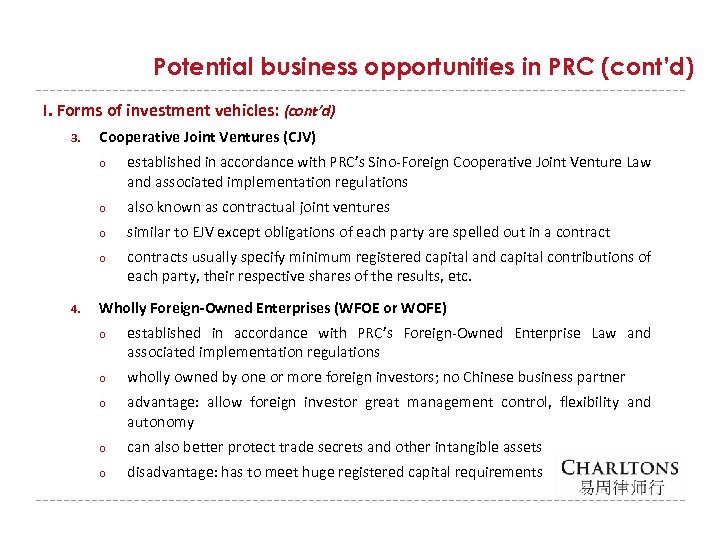
Potential business opportunities in PRC (cont’d) I. Forms of investment vehicles: (cont’d) 3. Cooperative Joint Ventures (CJV) o o also known as contractual joint ventures o similar to EJV except obligations of each party are spelled out in a contract o 4. established in accordance with PRC’s Sino-Foreign Cooperative Joint Venture Law and associated implementation regulations contracts usually specify minimum registered capital and capital contributions of each party, their respective shares of the results, etc. Wholly Foreign-Owned Enterprises (WFOE or WOFE) o established in accordance with PRC’s Foreign-Owned Enterprise Law and associated implementation regulations o wholly owned by one or more foreign investors; no Chinese business partner o advantage: allow foreign investor great management control, flexibility and autonomy o can also better protect trade secrets and other intangible assets o disadvantage: has to meet huge registered capital requirements
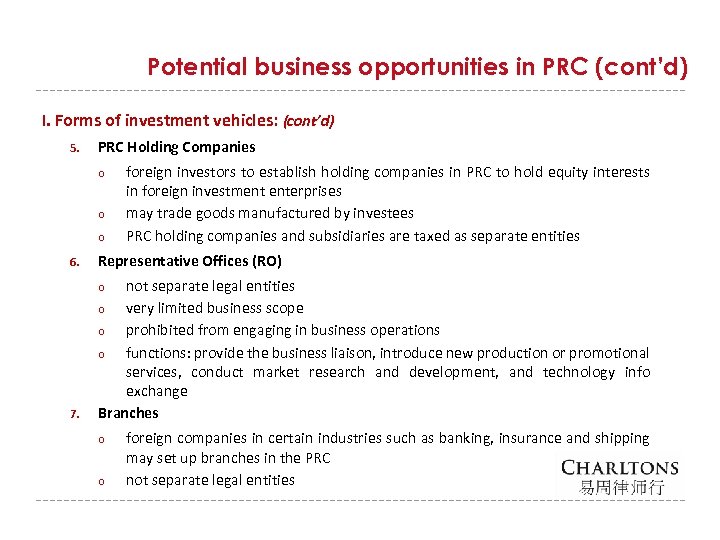
Potential business opportunities in PRC (cont’d) I. Forms of investment vehicles: (cont’d) 5. PRC Holding Companies o o o 6. foreign investors to establish holding companies in PRC to hold equity interests in foreign investment enterprises may trade goods manufactured by investees PRC holding companies and subsidiaries are taxed as separate entities Representative Offices (RO) not separate legal entities o very limited business scope o prohibited from engaging in business operations o functions: provide the business liaison, introduce new production or promotional services, conduct market research and development, and technology info exchange Branches o 7. o o foreign companies in certain industries such as banking, insurance and shipping may set up branches in the PRC not separate legal entities
Potential business opportunities in PRC (cont’d) II. Procedures for establishing a Foreign Investment Enterprise (including EJV, CJV, WFOE/WOFE): (i) provide documents to the Ministry of Commerce or provincial commerce departments: ο Application form ο Feasibility research report compiled by all parties ο Bank credit certificates ο Audit report ο Evaluation report ο Name list of members of board of directors ο Notice of pre-approval of enterprise name ο Certificate documents for the use of land
Potential business opportunities in PRC (cont’d) II. Procedures for establishing a Foreign Investment Enterprise (including EJV, CJV, WFOE/WOFE): - (cont’d) (ii) application will be approved or dismissed within 3 months as of date of receipt of documents (iii) within 1 month after receiving certificate of approval, investor must go through the registration formalities III. Resolving commercial disputes in PRC: Consultation o facilitated by third party if parties agree o result can be legally binding if properly recorded in an agreement
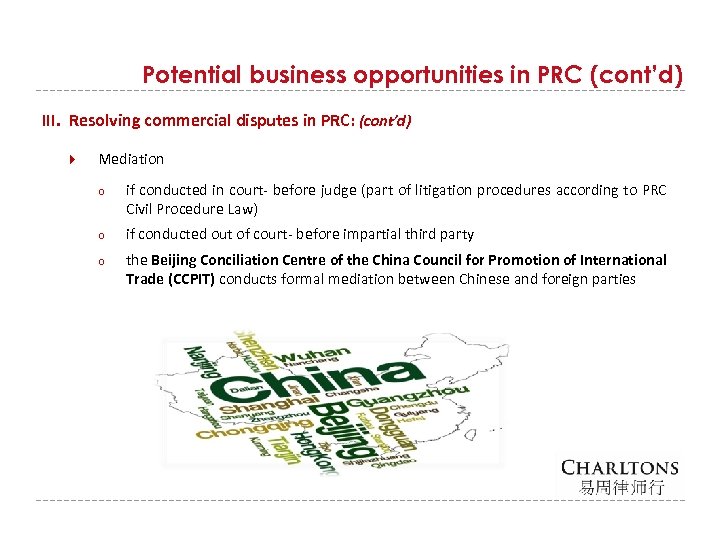
Potential business opportunities in PRC (cont’d) III. Resolving commercial disputes in PRC: (cont’d) Mediation o if conducted in court- before judge (part of litigation procedures according to PRC Civil Procedure Law) o if conducted out of court- before impartial third party o the Beijing Conciliation Centre of the China Council for Promotion of International Trade (CCPIT) conducts formal mediation between Chinese and foreign parties
Potential business opportunities in PRC (cont’d) III. Resolving commercial disputes in PRC: (cont’d) Arbitration o conducted by the China International Economic and Trade Arbitration Commission (CIETAC) in Beijing, Shanghai or Shenzhen in accordance with its own Arbitration Rules and subject to the PRC Arbitration Law and other relevant laws o foreign investors may prefer international arbitration where arbitrators with expertise at international level can be appointed and the local favouritism of the courts in Mainland China can be avoided o so it is important to have a well-drafted arbitration clause in the contract to ensure international arbitration is the choice
Potential business opportunities in PRC (cont’d) III. Resolving commercial disputes in PRC: (cont’d) Litigation o basic framework for civil litigation in PRC as laid down in the PRC Civil Procedure Law o other relevant sources of authority: various judicial interpretations by the Supreme People’s Court or the Supreme Procurate; the PRC Contract Law; the laws and regulations that govern foreign investment enterprises, and the Foreign Investment Enterprise Winding Up Measures
Contact us Hong Kong Office 12 th Floor Dominion Centre 43 – 59 Queen’s Road East Hong Kong Telephone: Fax: Email: Website: (852) 2905 7888 (852) 2854 9596 enquiries@charltonslaw. com http: //www. charltonslaw. com
Other Locations China In association with: Beijing Representative Office Shanghai Representative Office 3 -1703, Vantone Centre A 6# Chaowai Avenue Chaoyang District Beijing People's Republic of China 100020 Room 2006, 20 th Floor Fortune Times 1438 North Shanxi Road Shanghai People's Republic of China 200060 Telephone: (86) 10 5907 3299 Facsimile: (86) 10 5907 3299 enquiries. beijing@charltonslaw. com Telephone: (86) 21 6277 9899 Facsimile: (86) 21 6277 7899 enquiries. shanghai@charltonslaw. com Myanmar Yangon Office of Charltons Legal Consulting Ltd 161, 50 th Street Yangon Myanmar enquiries. myanmar@charltonslaw. com Networked with:
Скачать презентацию Hong Kong Investment Opportunities Conducting Business and
c8169a13f9a2e1192a602c831c21b0a6.ppt