 Скачать презентацию Honeypots Honeynets Bots and Botenets Source The Honey
01dd43e35870655fc752ade18683e1d6.ppt
- Количество слайдов: 57



Honeypots, Honeynets, Bots and Botenets Source: The Honey. Net Project http: //www. honeynet. org/
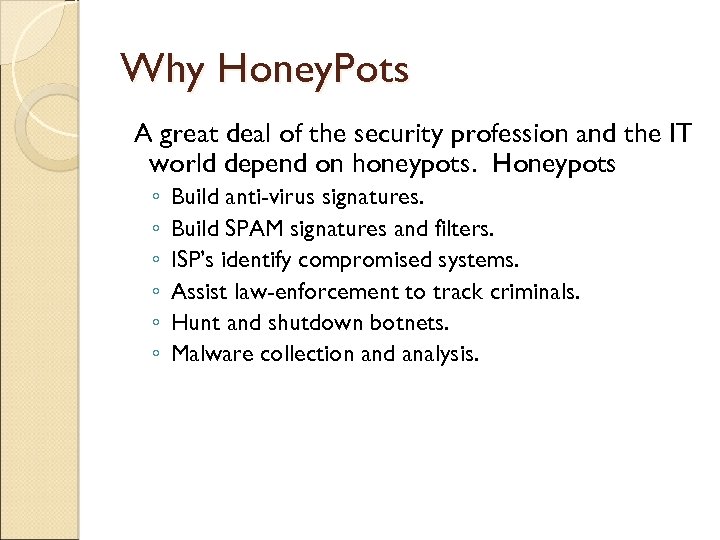
Why Honey. Pots A great deal of the security profession and the IT world depend on honeypots. Honeypots ◦ ◦ ◦ Build anti-virus signatures. Build SPAM signatures and filters. ISP’s identify compromised systems. Assist law-enforcement to track criminals. Hunt and shutdown botnets. Malware collection and analysis.
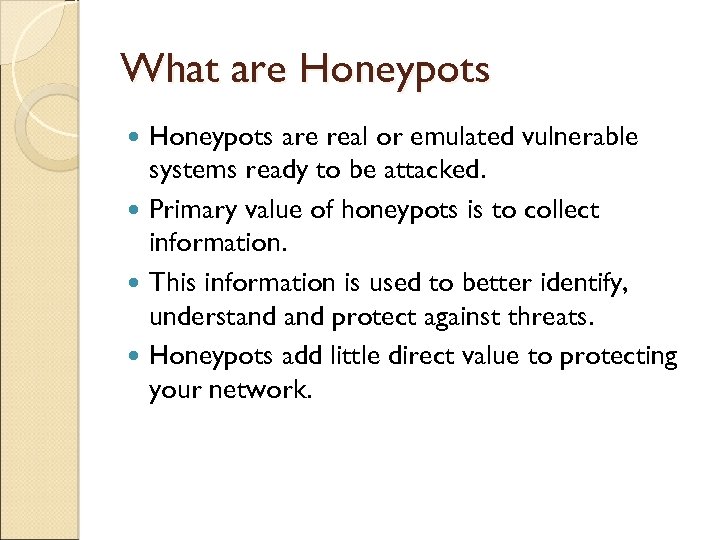
What are Honeypots are real or emulated vulnerable systems ready to be attacked. Primary value of honeypots is to collect information. This information is used to better identify, understand protect against threats. Honeypots add little direct value to protecting your network.
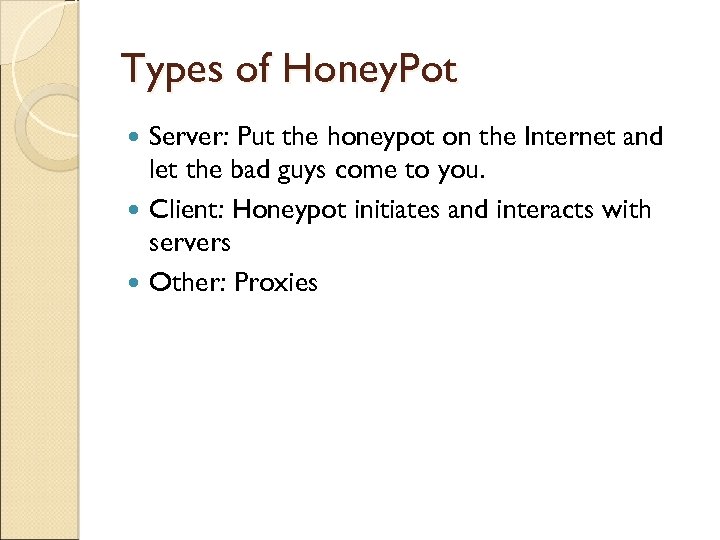
Types of Honey. Pot Server: Put the honeypot on the Internet and let the bad guys come to you. Client: Honeypot initiates and interacts with servers Other: Proxies
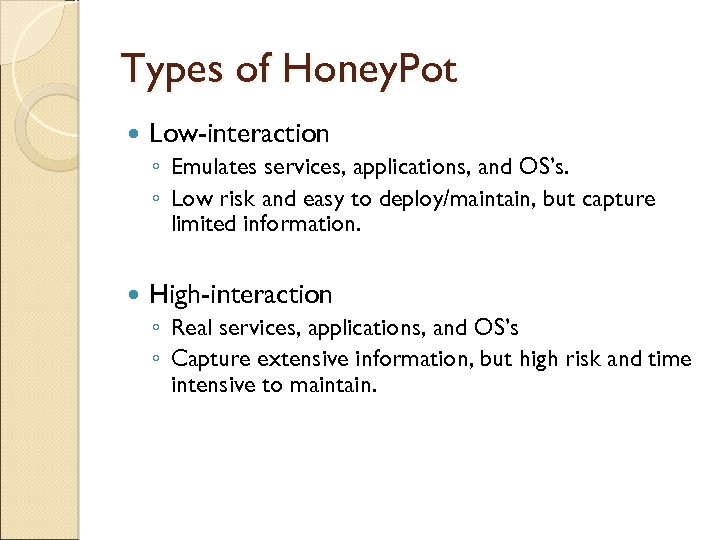
Types of Honey. Pot Low-interaction ◦ Emulates services, applications, and OS’s. ◦ Low risk and easy to deploy/maintain, but capture limited information. High-interaction ◦ Real services, applications, and OS’s ◦ Capture extensive information, but high risk and time intensive to maintain.
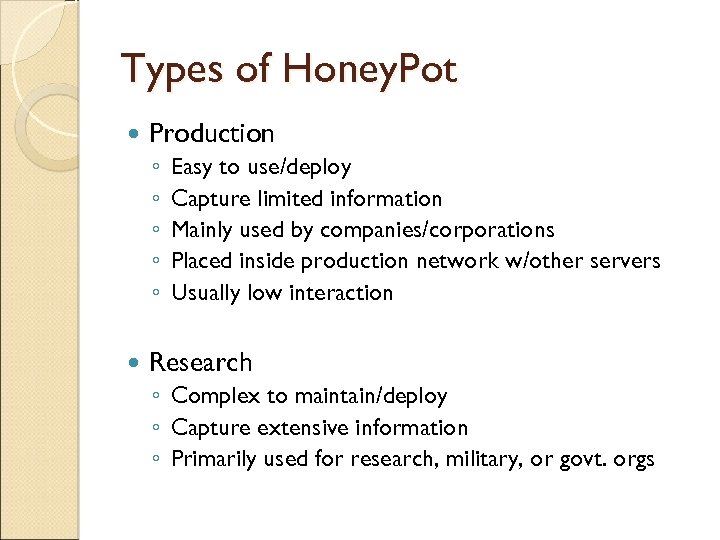
Types of Honey. Pot Production ◦ ◦ ◦ Easy to use/deploy Capture limited information Mainly used by companies/corporations Placed inside production network w/other servers Usually low interaction Research ◦ Complex to maintain/deploy ◦ Capture extensive information ◦ Primarily used for research, military, or govt. orgs
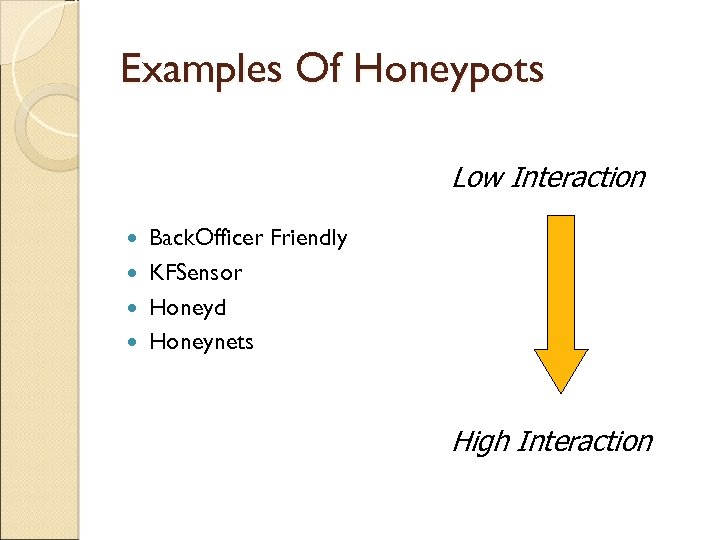
Examples Of Honeypots Low Interaction Back. Officer Friendly KFSensor Honeyd Honeynets High Interaction
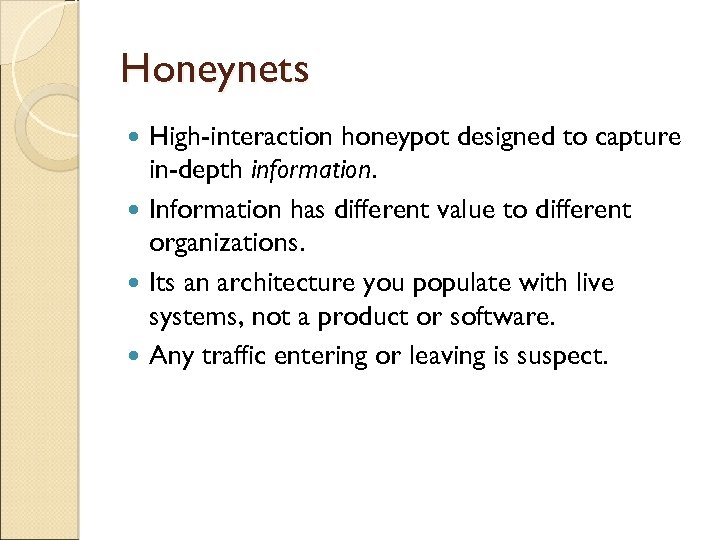
Honeynets High-interaction honeypot designed to capture in-depth information. Information has different value to different organizations. Its an architecture you populate with live systems, not a product or software. Any traffic entering or leaving is suspect.
How It Works A highly controlled network where every packet entering or leaving is monitored, captured, and analyzed. ◦ Data Control ◦ Data Capture ◦ Data Analysis
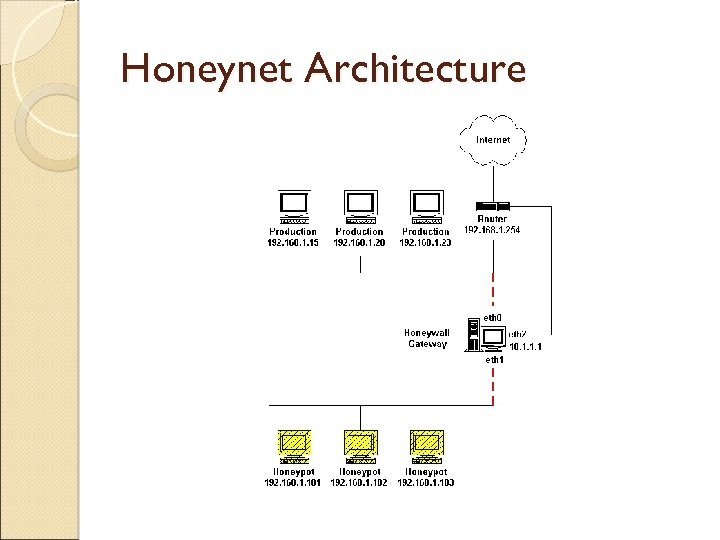
Honeynet Architecture
Data Control Mitigate risk of honeynet being used to harm non-honeynet systems. • Count outbound connections. • IPS (Snort-Inline) • Bandwidth Throttling •
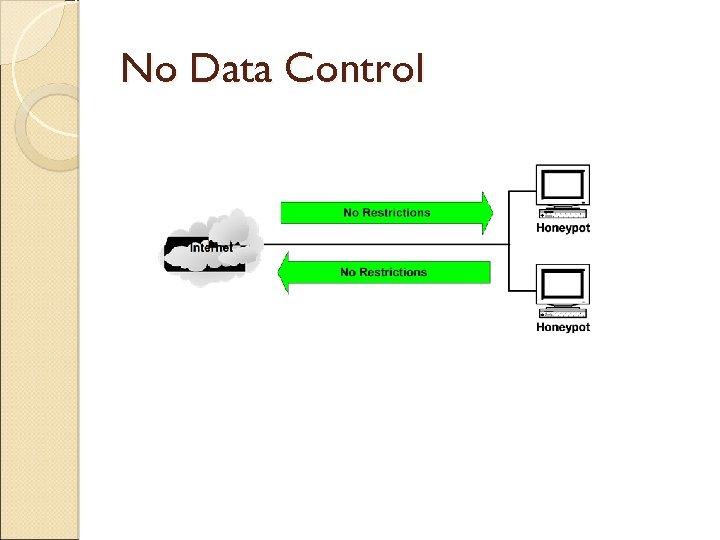
No Data Control
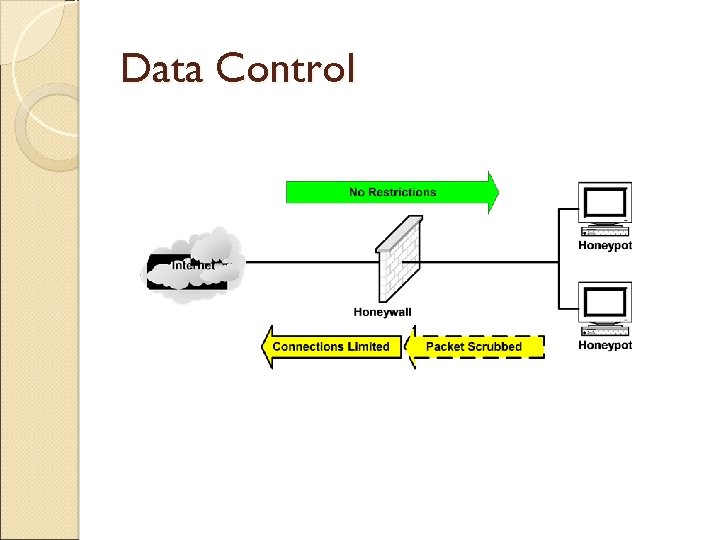
Data Control
Data Capture all activity at a variety of levels. Network activity. Application activity. System activity.
Sebek Hidden kernel module that captures all host activity Dumps activity to the network. Attacker cannot sniff any traffic based on magic number and dst port.
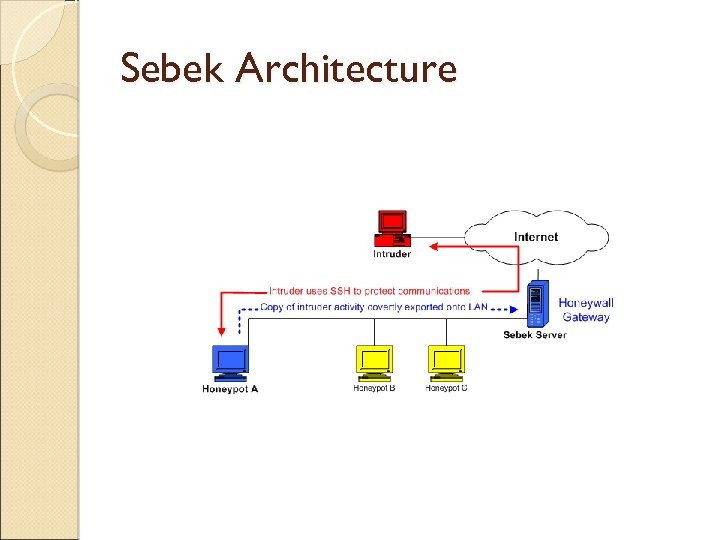
Sebek Architecture
Honeywall CDROM Attempt to combine all requirements of a Honeywall onto a single, bootable CDROM. May, 2003 - Released Eeyore May, 2005 - Released Roo
Roo Honeywall CDROM Based on Fedora Core 3 Vastly improved hardware and international support. Automated, headless installation New Walleye interface for web based administration and data analysis. Automated system updating.
Installation Just insert CDROM and boot, it installs to local hard drive. After it reboots for the first time, it runs a hardening script based on NIST and CIS security standards. Following installation, you get a command prompt and system is ready to configure.
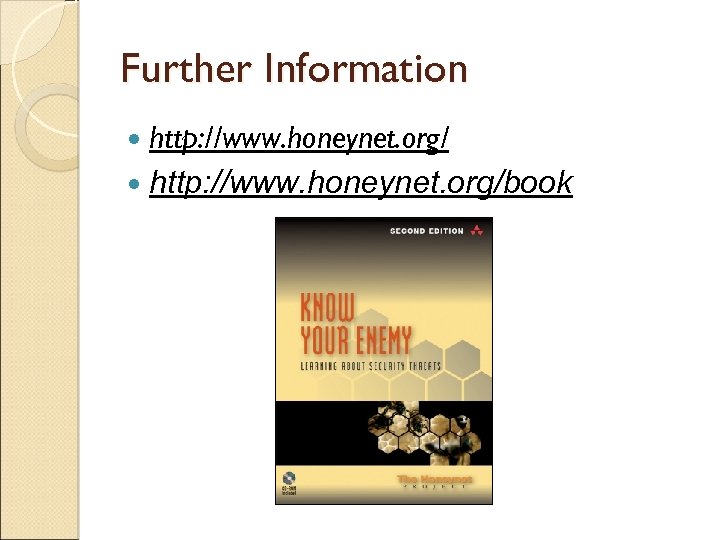
Further Information http: //www. honeynet. org/book
Network Telescope Also known as a darknet, internet motion sensor or black hole Allows one to observe different large-scale events taking place on the Internet. The basic idea is to observe traffic targeting the dark (unused) address-space of the network. Since all traffic to these addresses is suspicious, one can gain information about possible network attacks ◦ random scanning worms, and DDo. S backscatter As well as other misconfigurations by observing it.
Honeytoken honeytokens are honeypots that are not computer systems. Their value lies not in their use, but in their abuse. As such, they are a generalization of such ideas as the honeypot and the canary values often used in stack protection schemes. Honeytokens can exist in almost any form, ◦ from a dead, fake account to a ◦ database entry that would only be selected by malicious queries, ◦ making the concept ideally suited to ensuring data integrity—any use of them is inherently suspicious if not necessarily malicious.
Honeytoken In general, they don't necessarily prevent any tampering with the data, ◦ but instead give the administrator a further measure of confidence in the data integrity. An example of a honeytoken is a fake email address used to track if a mailing list has been stolen
Honeymonkey Honey. Monkey, ◦ short for Strider Honey. Monkey Exploit Detection System, is a Microsoft Research honeypot. The implementation uses a network of computers ◦ to crawl the World Wide Web searching for websites that use browser exploits to install malware on the Honey. Monkey computer. ◦ A snapshot of the memory, executables and registry of the honeypot computer is recorded before crawling a site. ◦ After visiting the site, the state of memory, executables, and registry is compared to the previous snapshot. ◦ The changes are analyzed to determine whether the visited site installed malware onto the honeypot computer.
Honeymonkey Honey. Monkey is based on the honeypot concept, with the difference that it actively seeks websites that try to exploit it. The term was coined by Microsoft Research in 2005. With honeymonkeys it is possible to find open security holes that aren't yet publicly known but are exploited by attackers.
Tarpit A tarpit (also known as Teergrube, the German word for tarpit) is a service on a computer system (usually a server) that delays incoming connections for as long as possible. The technique was developed as a defense against a computer worm, and the idea is that network abuses such as spamming or broad scanning are less effective if they take too long. The name is analogous with a tar pit, in which animals can get bogged down and slowly sink under the surface.
Botnets by Mohammad M. Masud
Botnets Introduction History How to they spread? What do they do? Why care about them? Detection and Prevention
Bot The term 'bot' comes from 'robot'. In computing paradigm, 'bot' usually refers to an automated process. There are good bots and bad bots. Example of good bots: ◦ Google bot ◦ Game bot Example of bad bots: ◦ Malicious software that steals information
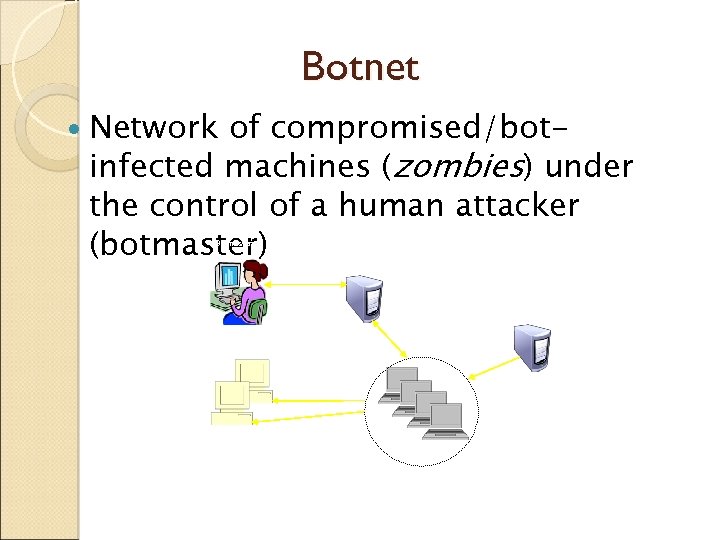
Botnet Network of compromised/botinfected machines (zombies) under the control of a human attacker (botmaster) Botmaster IRC Server IRC channel Code Server IRC channel C&C traffic Updates Attack Vulnerable machines Bot. Net
History In the beginning, there were only good bots. ◦ ex: google bot, game bot etc. Later, bad people thought of creating bad bots so that they may ◦ Send Spam and Phishing emails ◦ Control others pc ◦ Launch attacks to servers (DDOS) Many malicious bots were created ◦ SDBot/Agobot/Phatbot etc. Botnets started to emerge
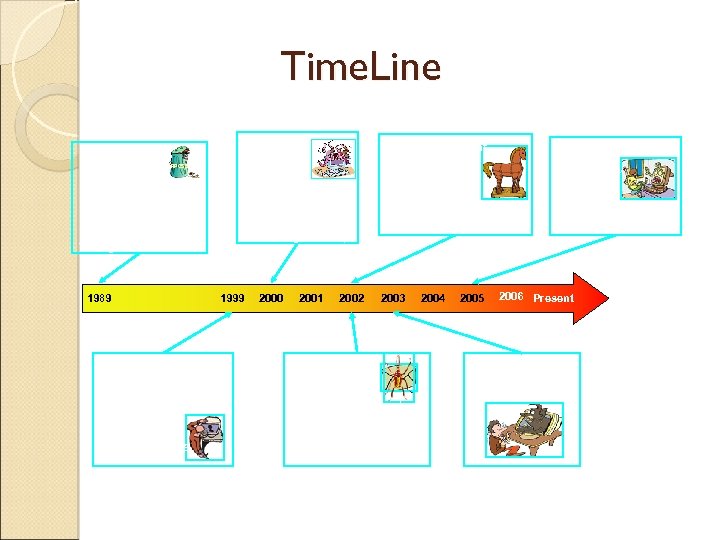
Time. Line GM (by Greg, Operator) recognized as first IRC bot. Entertained clients with games RPCSS 1989 W 32/Pretty. Park 1 st worm to use IRC as C&C. DDo. S capable GT bots combined m. IRC client, hacking scripts & tools (port scanning, DDos) 1999 2000 2001 2002 W 32/Agobot family added modular design and significant functionality 2003 W 32/Sdbot First family of bots developed as a single binary Russian named sd 2004 2005 W 32/Mytob hybrid bot, major e-mail outbreak 2006 Present W 32/Spybot family emerged
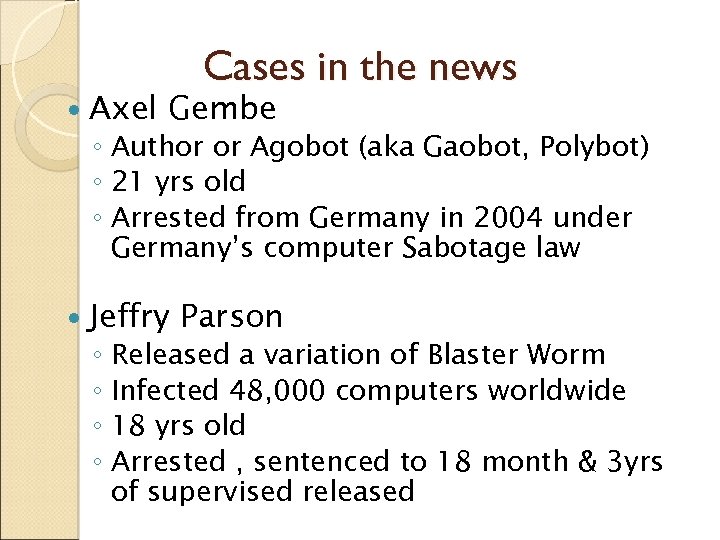
Axel Cases in the news Gembe ◦ Author or Agobot (aka Gaobot, Polybot) ◦ 21 yrs old ◦ Arrested from Germany in 2004 under Germany’s computer Sabotage law Jeffry Parson ◦ Released a variation of Blaster Worm ◦ Infected 48, 000 computers worldwide ◦ 18 yrs old ◦ Arrested , sentenced to 18 month & 3 yrs of supervised released
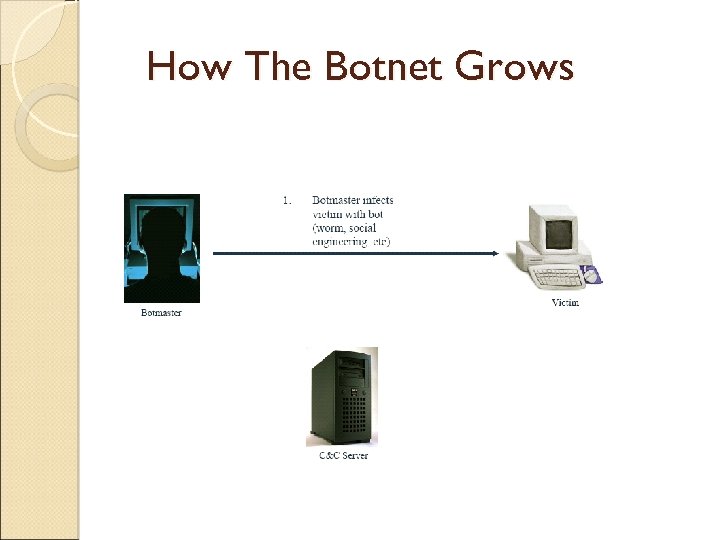
How The Botnet Grows
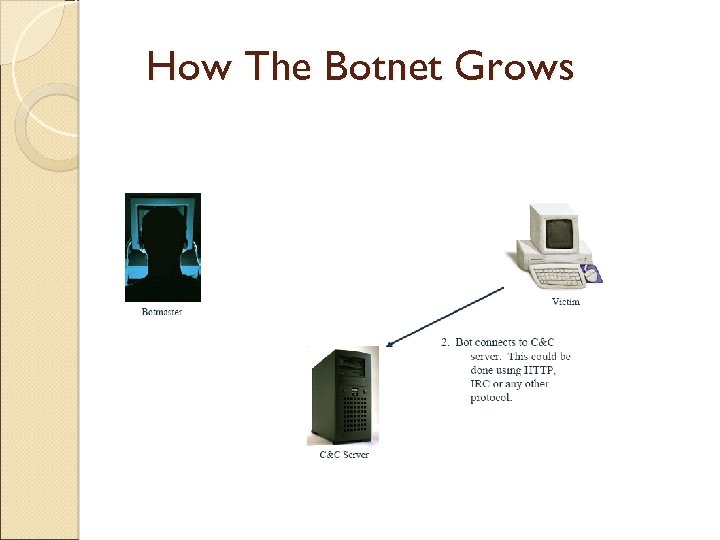
How The Botnet Grows
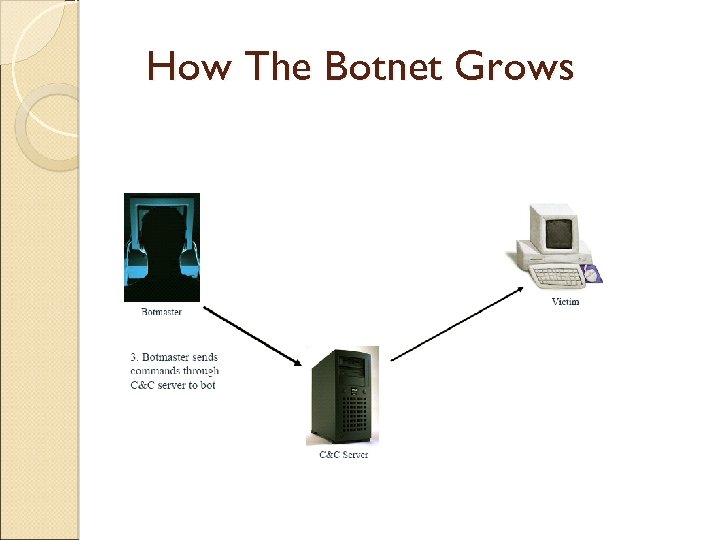
How The Botnet Grows
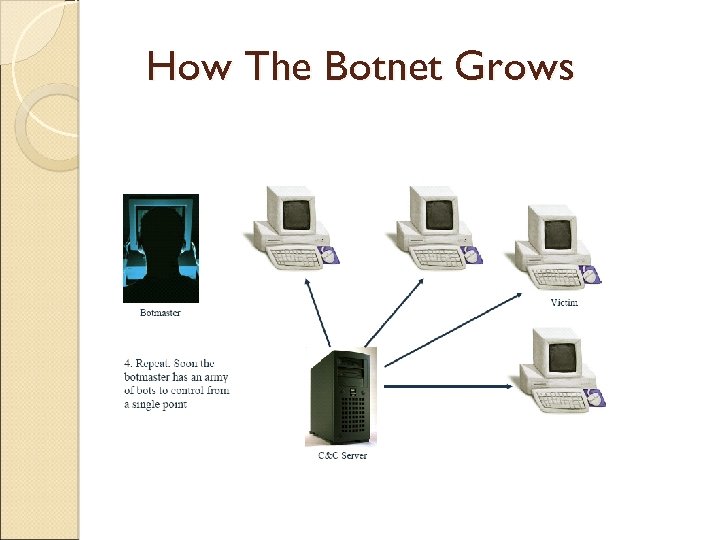
How The Botnet Grows
Recruiting New Machines Exploit a vulnerability to execute a short program (exploits) on victim’s machine ◦ Buffer overflows, email viruses, Trojans etc. Exploit downloads and installs actual bot Bot disables firewall and A/V software Bot locates IRC server, connects, joins ◦ Typically need DNS to find out server’s IP address ◦ Authentication password often stored in bot binary Botmaster issues commands
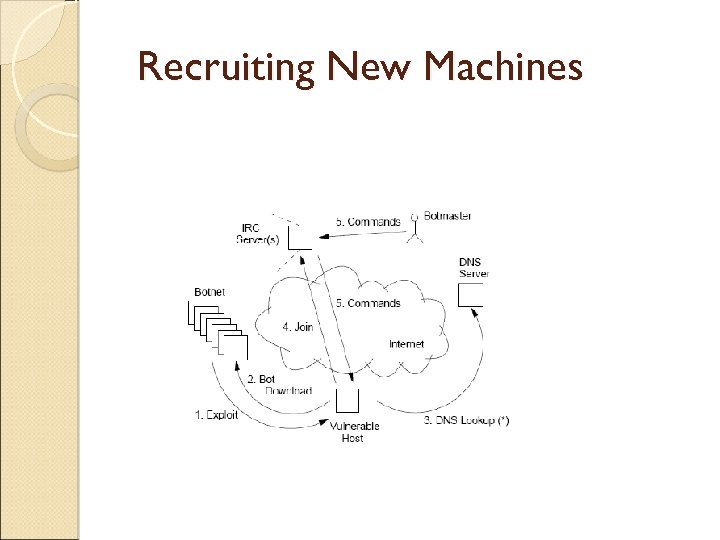
Recruiting New Machines
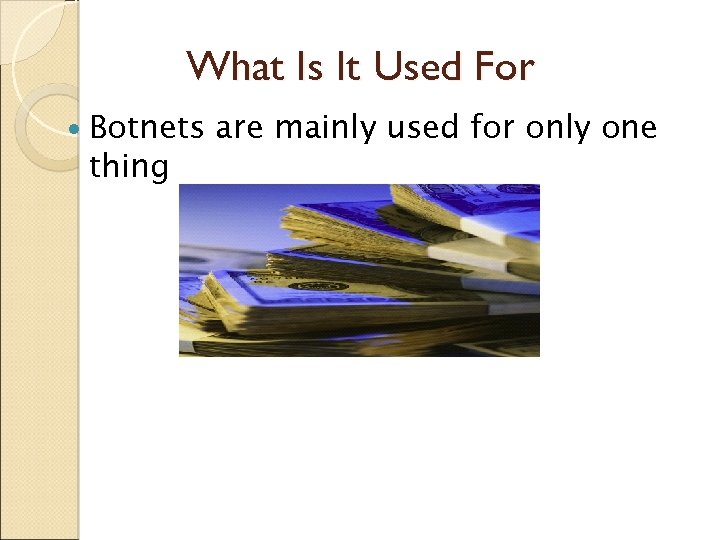
What Is It Used For Botnets thing are mainly used for only one
How Are They Used Distributed Denial of Service (DDo. S) attacks Sending Spams Phishing (fake websites) Addware (Trojan horse) Spyware (keylogging, information harvesting) Storing pirated materials
Example : SDBot Open-source Malware Aliases ◦ Mcafee: IRC-SDBot, Symantec: Backdoor. Sdbot Infection ◦ Mostly through network shares ◦ Try to connect using password guessing (exploits weak passwords) Signs of Compromise ◦ SDBot copies itself to System folder - Known filenames: Aim 95. exe, Syscfg 32. exe etc. . ◦ Registry entries modified ◦ Unexpected traffic : port 6667 or 7000 ◦ Known IRC channels: Zxcvbnmas. i 989. net etc. .
Example : RBot First of the Bot families to use encryption Aliases ◦ Mcafee: W 32/SDbot. worm. gen. g, Symantec: W 32. Spybot. worm Infection ◦ Network shares, exploiting weak passwords ◦ Known s/w vulnerabilities in windows (e. g. : lsass buffer overflow vulnerability) Signs of Compromise ◦ copies itself to System folder - Known filenames: wuamgrd. exe, or random names ◦ Registry entries modified ◦ Terminate A/V processes ◦ Unexpected traffic: 113 or other open ports
Example : Agobot Modular Functionality ◦ Rather than infecting a system at once, it proceeds through three stages (3 modules) infect a client with the bot & open backdoor shut down A/V tools block access to A/V and security related sites ◦ After successful completion of one stage, the code for the next stage is downloaded Advantage? ◦ developer can update or modify one portion/module without having to rewrite or recompile entire code
Example : Agobot Aliases ◦ Mcafee: W 32/Gaobot. worm, Symantec: W 32. HLLW. Gaobot. gen Infection ◦ Network shares, password guessing ◦ P 2 P systems: Kazaa etc. . ◦ Protocol: WASTE Signs of Compromise ◦ System folder: svshost. exe, sysmgr. exe etc. . ◦ Registry entries modification ◦ Terminate A/V processes ◦ Modify %Systemdriversetchosts file Symantec/ Mcafee’s live update sites are redirected to 127. 0. 0. 1
Example : Agobot Signs of Compromise (contd. . ) ◦ Theft of information: seek and steal CD keys for popular games like “Half-Life”, “NFS” etc. . ◦ Unexpected Traffic: open ports to IRC server etc. . ◦ Scanning: Windows, SQL server etc. .
DDos Attack Goal: overwhelm victim machine and deny service to its legitimate clients Do. S often exploits networking protocols ◦ Smurf: ICMP echo request to broadcast address with spoofed victim’s address as source ◦ Ping of death: ICMP packets with payloads greater than 64 K crash older versions of Windows ◦ SYN flood: “open TCP connection” request from a spoofed address ◦ UDP flood: exhaust bandwidth by sending thousands of bogus UDP packets
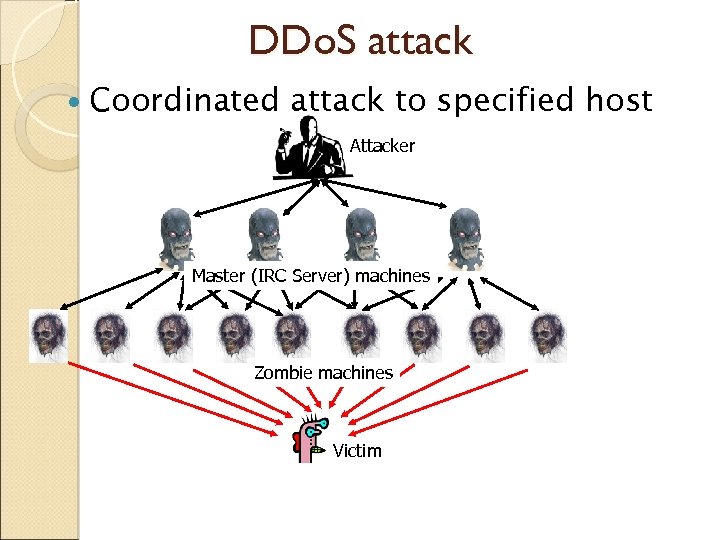
DDo. S attack Coordinated attack to specified host Attacker Master (IRC Server) machines Zombie machines Victim
Why DDo. S attack? Extortion ◦ Take down systems until they pay ◦ Works sometimes too! Example: 180 Solutions – Aug 2005 ◦ Botmaster used bots to distribute 180 solutions addware ◦ 180 solution shutdown botmaster ◦ Botmaster threatened to take down 180 solutions if not paid ◦ When not paid, botmaster use DDo. S ◦ 180 Solutions filed Civil Lawsuit against hackers
Botnet Detection Host Based Intrusion Detection Systems (IDS) Anomaly Detection IRC Nicknames Honey. Pot and Honey. Net
Host-based detection Virus scanning Watching for Symptoms Modification of windows hosts file Random unexplained popups Machine slowness Antivirus not working Watching for Suspicious network traffic Since IRC is not commonly used, any IRC traffic is suspicious. Sniff these IRC traffic Check if the host is trying to communicate to any Command Control (C&C) Center Through firewall logs, denied connections
Network Intrusion Detection Systems Example Systems: Snort and Bro Sniff network packets, looks for specific patterns (called signatures) If any pattern matches that of a malicious binary, then block that traffic and raise alert These systems can efficiently detect virus/worms having known signatures Can't detect any malware whose signature is unknown (i. e. , zero day attack)
Anomaly Detection Normal traffic has some patterns Bandwidth/Port usage Byte-level characteristics (histograms) Protocol analysis – gather statistics about TCP/UDP src, dest address Start/end of flow, Byte count DNS lookup First learn normal traffic pattern Then detect any anomaly in that pattern Example systems: SNMP, Net. Flow Problems: Poisoning Stealth
IRC Nicknames Bots use weird nicknames But they have certain pattern (really!) If we can learn that pattern, we can detect bots & botnets Example nicknames: USA|016887436 or DE|028509327 Country | Random number (9 digit) RBOT|XP|48124 Bot type | Machine Type | Random number Problem: May be defeated by changing the nickname randomly
Honey. Pot and Honey. Net Honey. Pot is a vulnerable machine, ready to be attacked Example: unpatched windows 2000 or windows XP Once attacked, the malware is caught inside The malware is analyzed, its activity is monitored When it connects to the C&C server, the server’s identity is revealed
Honey. Pot and Honey. Net Thus many information about the bot is obtained C&C server address, master commands Channel, Nickname, Password Now Do the following make a fake bot join the same IRC channel with the same nickname/password Monitor who else are in the channel, thus observer the botnet Collect statistics – how many bots Collect sensitive information – who is being attacked, when etc. .
Honey. Pot and Honey. Net Finally, take down the botnet Honey. Net: a network of honeypots (see the ‘Honey. Net Project’) Very effective, worked in many cases They also pose great security risk If not maintained properly - Hacker may use them to attack others Must be monitored cautiously
Скачать презентацию Honeypots Honeynets Bots and Botenets Source The Honey
01dd43e35870655fc752ade18683e1d6.ppt