 Скачать презентацию Homeostasis Skin Temperature Control Learning Objectives
07fc9eda48c4e89c97f4f6457361e1d6.ppt
- Количество слайдов: 65



Homeostasis Skin & Temperature Control
Learning Objectives 12. 1 Principles of Homeostasis o o a) Define homeostasis (b) Explain the basic principles of homeostasis in terms of stimulus resulting from a change in the internal environment, a corrective mechanism and a negative feedback
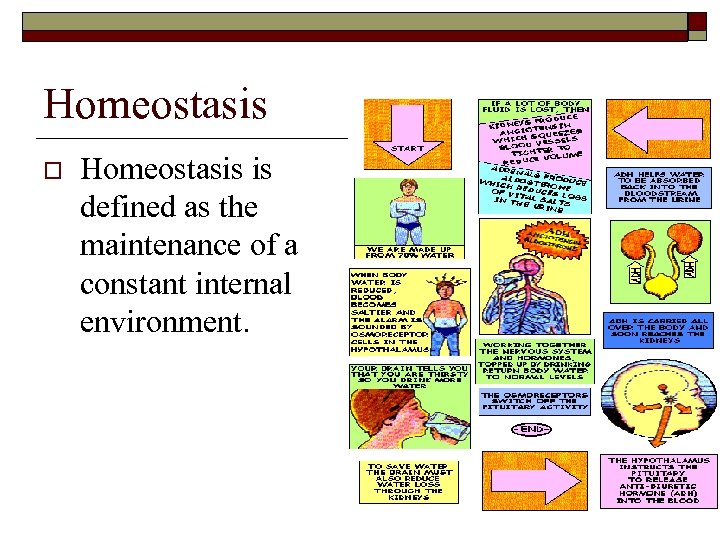
Homeostasis o Homeostasis is defined as the maintenance of a constant internal environment.
o o o Changes in body temperature may result in enzyme inactivation or denaturation. Any drastic changes in our blood and the surrounding tissues fluid will affect chemical reactions in the tissue cells and will harm the body. Cells must be bathed in tissue fluid of the correct p. H and water potential. Enzyme reaction will be affected.
Negative Feedback Control o o o The internal environment of our bodies MUST have certain conditions within tolerable limits to continue the healthy functioning. Done by NEGATIVE FEEDBACK control. Used to control blood sugar concentration, water concentration & temperature of the blood.
Negative Feedback o o A stimulus, which is the change in the internal environment A receptor that can detect the stimulus A self-regulatory corrective mechanism A negative feedback to the receptor
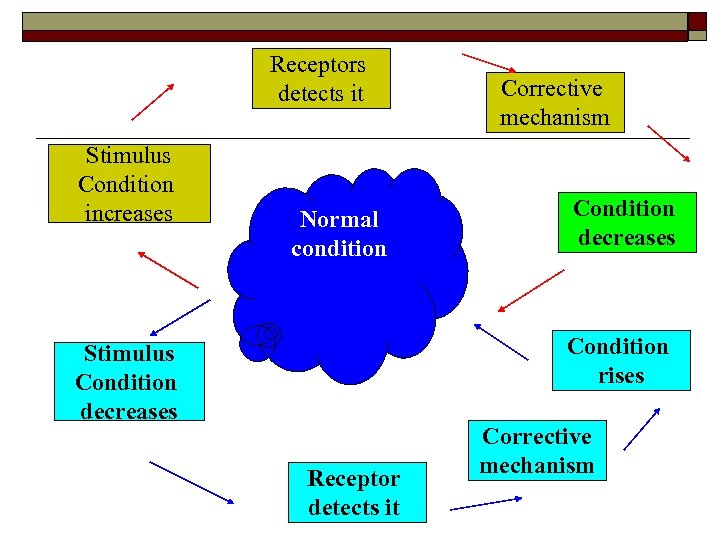
Receptors detects it Stimulus Condition increases Normal condition Corrective mechanism Condition decreases Condition rises Stimulus Condition decreases Receptor detects it Corrective mechanism
Organs involved in Homeostasis 1. 2. 3. 4. Skin (helps in temperature regulation) Kidneys (helps in the water concentration of the body) Brain (MASTERMIND) Pancreas (produces insulin that helps in the control of sugar concentration in the blood)
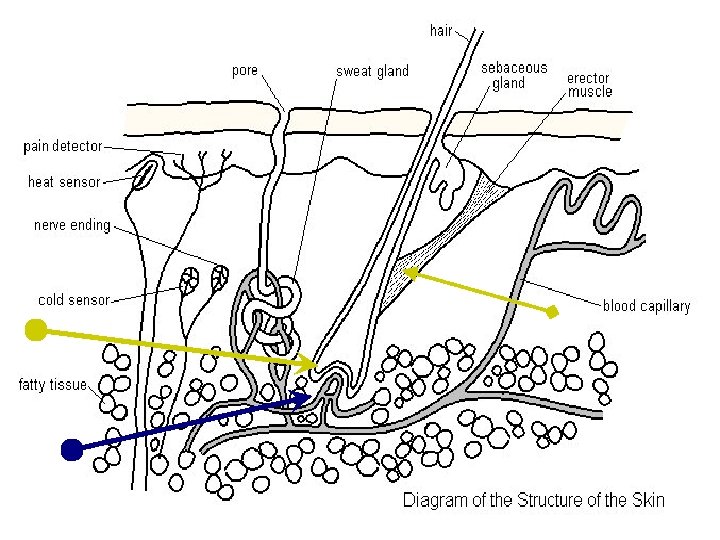
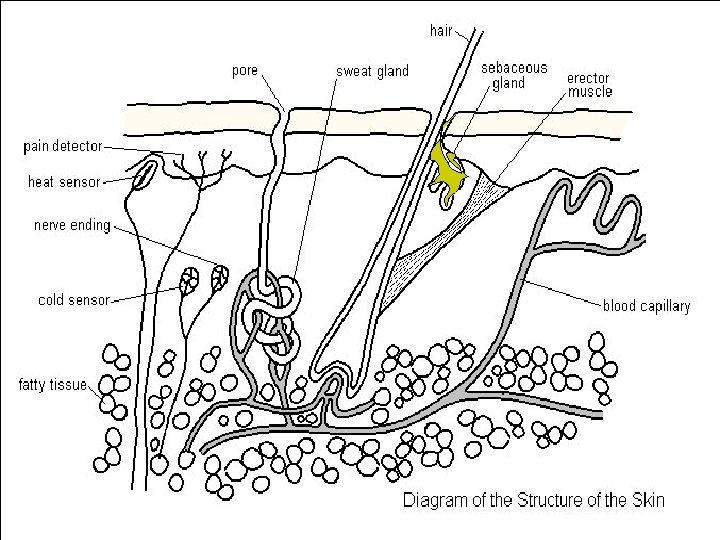
Learning Objectives o o o 12. 2 Structure and function of the skin (c) Identify on a diagram of the skin: hairs, sweat glands, temperature receptors, blood vessels and fatty tissue (d) Describe the maintenance of a constant body temperature in humans in terms of insulation and the role of: temperature receptors in the skin, sweating, shivering, blood vessels near the skin surface and the co-ordinating role of the brain
Skin o o Largest organ of the human body. An important sense organ Barrier between the body and the external environment Organ that regulates our body temperature.
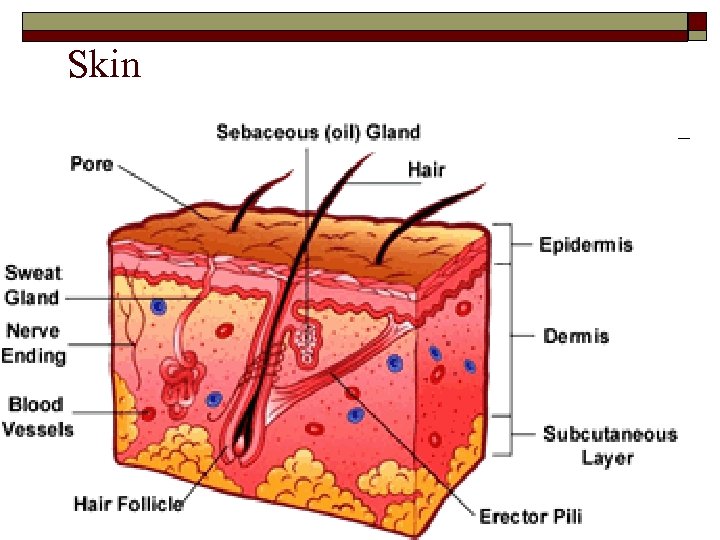
Skin
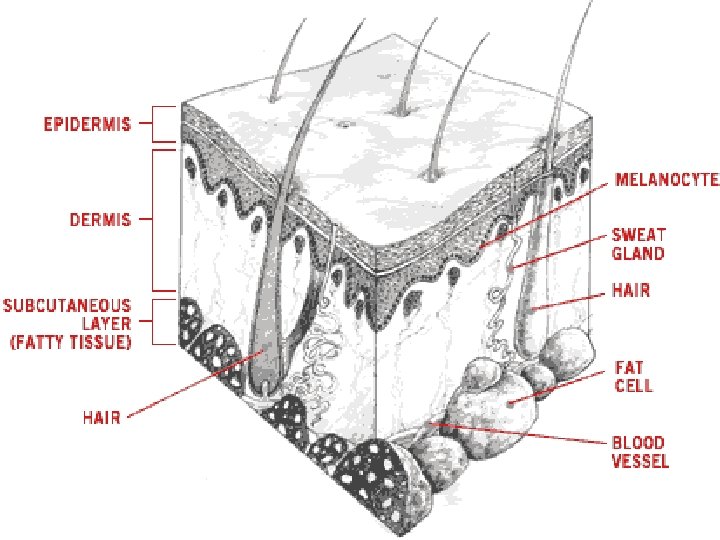
Epidermis outer layer of the skin : a. Cornified layer (dead cells) Protects the body from water loss, invasion of microbes & mechanical, thermal & chemical damage. b. Granular layer New cells undergo cell division c. Malpighian layer to replace dead cells from the cornified layer pigmented cells (melanin) protects our skin against harmful UV light of the sun
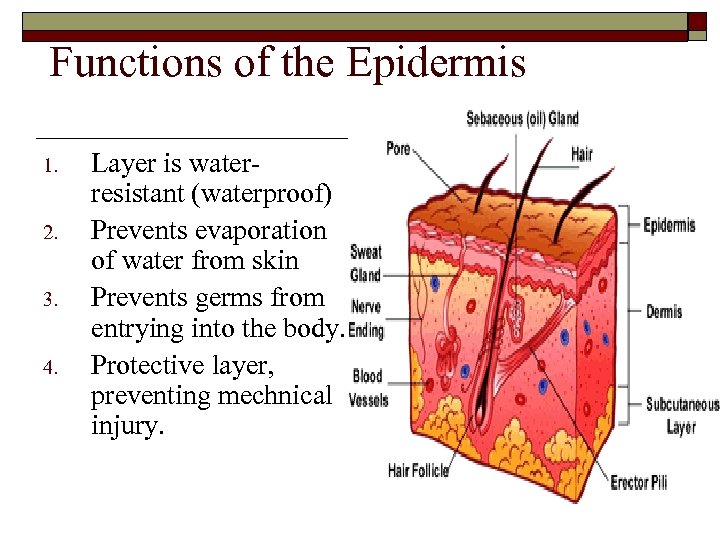
Functions of the Epidermis 1. 2. 3. 4. Layer is waterresistant (waterproof) Prevents evaporation of water from skin Prevents germs from entrying into the body. Protective layer, preventing mechnical injury.
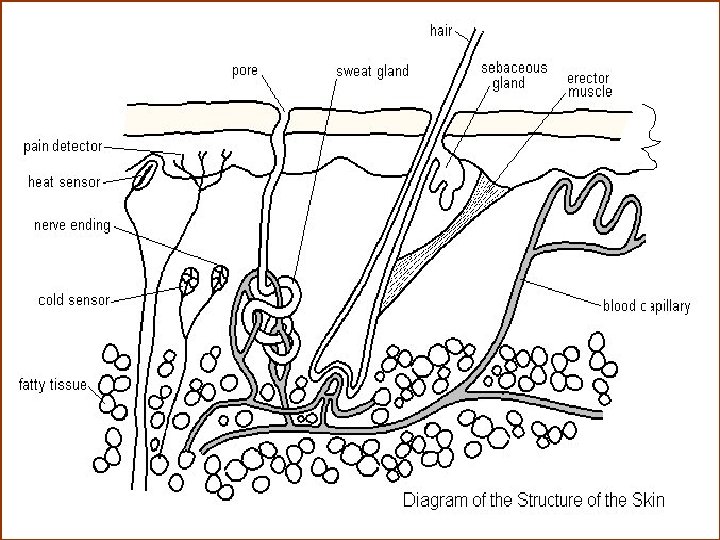
Dermis o (a) Consists mainly of fibrous tissue and many other structures: Blood vessels numerous blood vessels Arterioles that carry blood are controlled by vasometer nerves. Nerves bring about contraction & dilation of the arteries. Arterioles dilate (vasodilation) --> more blood is sent to the skin. Arterioles contract (vasoconstriction) --> less blood is sent to the skin.
Dermis (b) Hair Common feature of mammals. Grow inside the hair follicle At the base of the follicle is a mass of tissue containing blood capillaries. Attached to the hair follicles are the “hair erector” muscles. (contract --> causes the hair to stand)
Dermis (c ) Sweat glands sweat is secreted in the sweat glands. Sweat glands ---> sweat duct ---> sweat pore surface of skin. Sweat = urea + water + salt (sodium chloride)
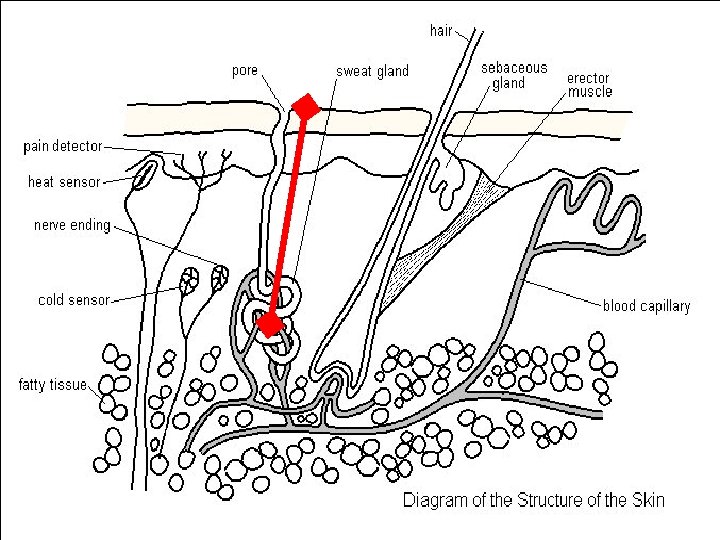
Dermis (d) Temperature receptors nerve endings are found in the epidermis and dermis. Form sense organs Enable us to sense pain, pressure and temperature changes in the external environment.
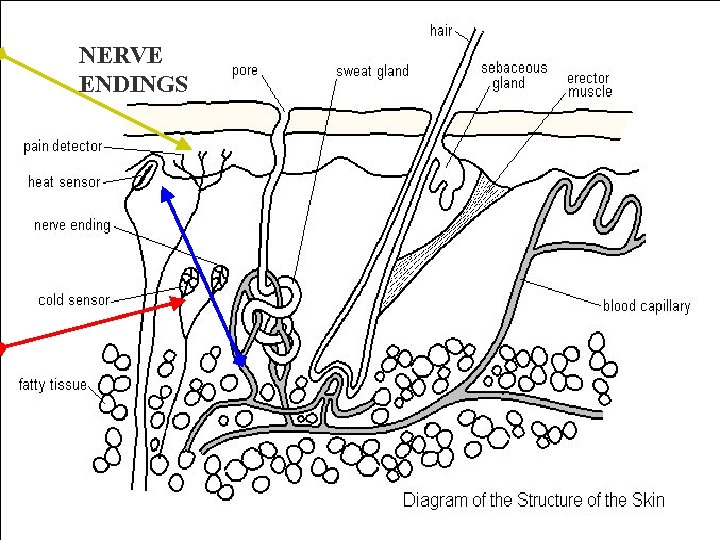
NERVE ENDINGS
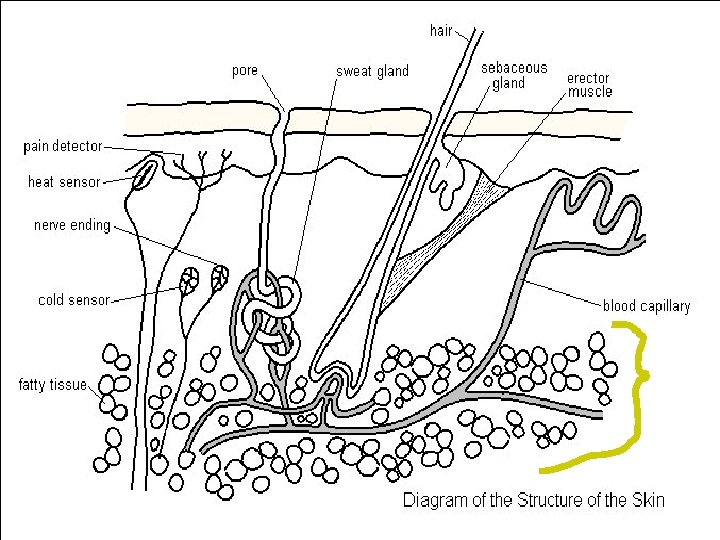
Dermis (e) Fatty Tissue --> Fat cells are present where fat is stored.
Dermis (f) Sebaceous glands 2 glands open into each hair follicle. Secreting an oily substance (sebum) into hair follicle. Sebum lubricates the hair and keeps the skin soft and smooth. Prevents dehydration of the skin. Has an antiseptic action.
Control of body temperature
Skin o o Able to detect temperature change in the external environment. A change in atmospheric temperature --> detected by temperature receptors on the skin --> start some mechanisms to control the temperature.
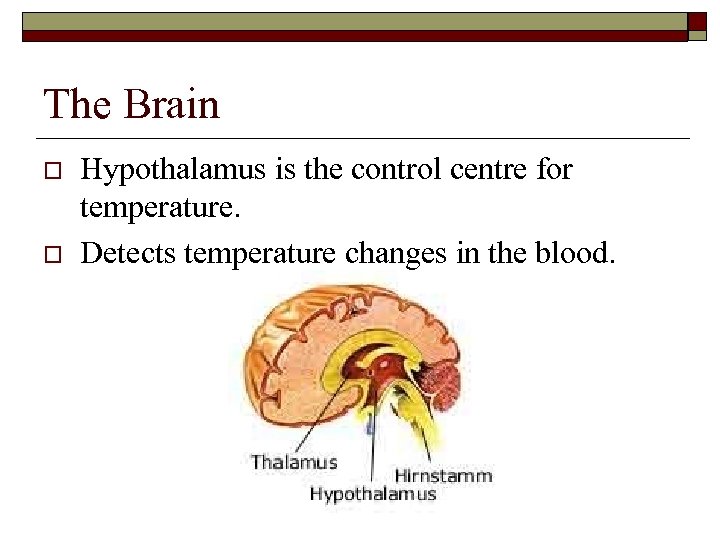
The Brain o o Hypothalamus is the control centre for temperature. Detects temperature changes in the blood.
What happens when temperature rises? Hypothalamus triggers off the following: 1. Decreased metabolic rate of the cells, resulting in less heat being produced. 2. Relaxation of skeletal muscles to reduce heat production. Causes the hair to lie flat 3. Vasodilation causing arterioles to increase blood supply to the skin. More heat can be lost through the skin. 4. More sweat is produced. As sweat is removed more latent heat is removed.
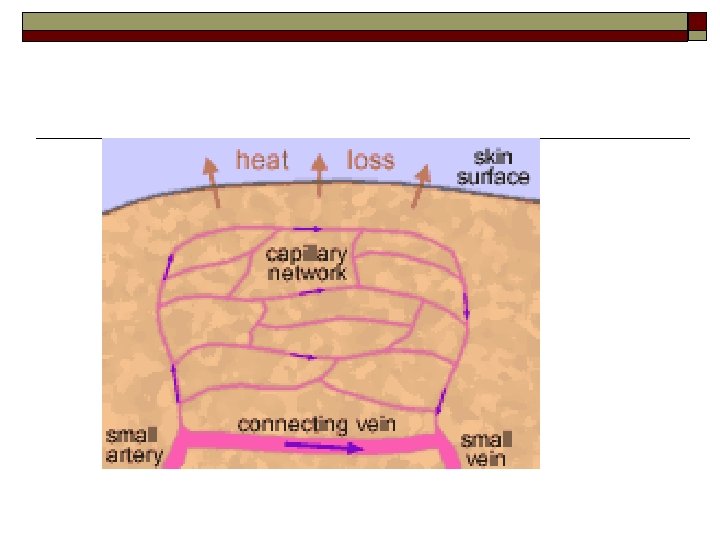
What happens when temperature falls? (a) (b) (c) (d) (e) Increased metabolic rate, resulting in more heat being produced. Shivering due to the contraction of skeletal muscles. (increases heat production) Causes hair to stand. Vasoconstriction causing arterioles in the skin to constrict. Blood is diverted from the skin to reduce heat loss.
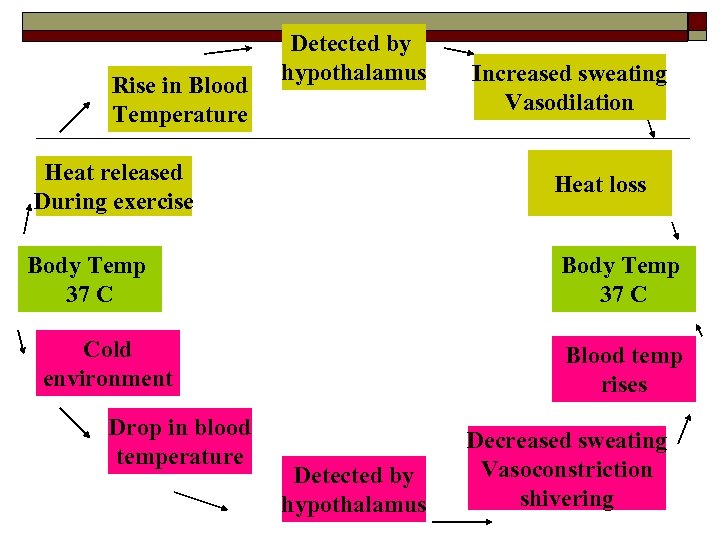
Rise in Blood Temperature Detected by hypothalamus Heat released During exercise Heat loss Body Temp 37 C Cold environment Drop in blood temperature Increased sweating Vasodilation Blood temp rises Detected by hypothalamus Decreased sweating Vasoconstriction shivering
Regulating Body Temperature - on a Hot Day 3/15/2018
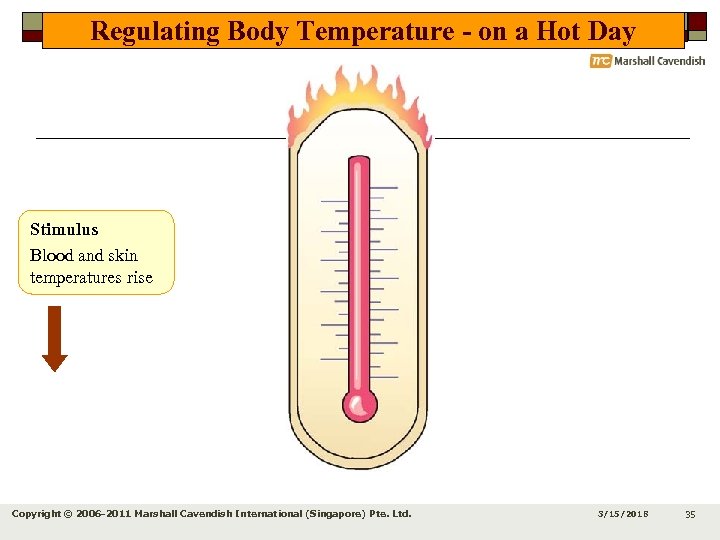
Regulating Body Temperature - on a Hot Day Stimulus Blood and skin temperatures rise Copyright © 2006 -2011 Marshall Cavendish International (Singapore) Pte. Ltd. 3/15/2018 35
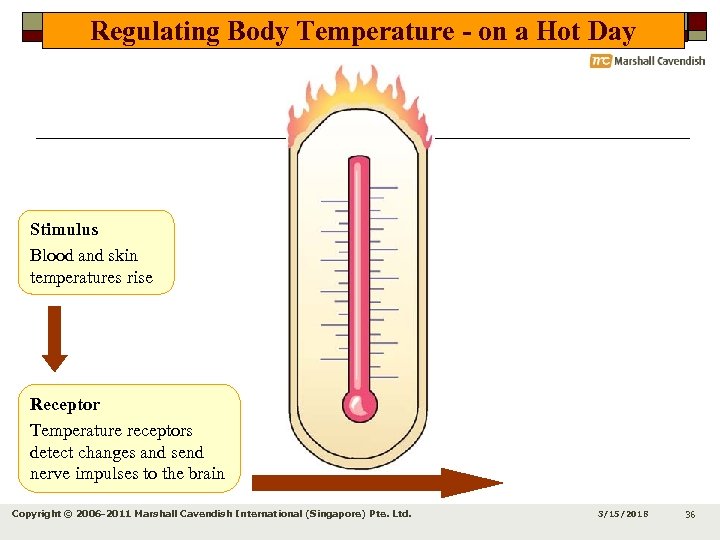
Regulating Body Temperature - on a Hot Day Stimulus Blood and skin temperatures rise Receptor Temperature receptors detect changes and send nerve impulses to the brain Copyright © 2006 -2011 Marshall Cavendish International (Singapore) Pte. Ltd. 3/15/2018 36
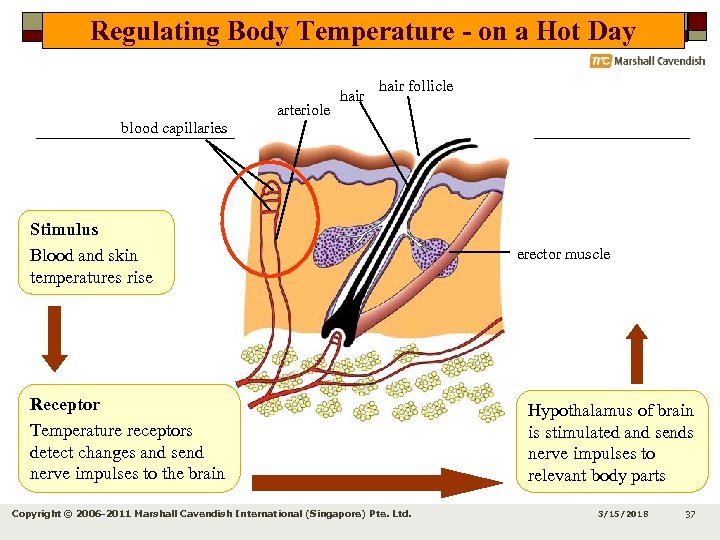
Regulating Body Temperature - on a Hot Day arteriole hair follicle blood capillaries Stimulus Blood and skin temperatures rise Receptor Temperature receptors detect changes and send nerve impulses to the brain Copyright © 2006 -2011 Marshall Cavendish International (Singapore) Pte. Ltd. erector muscle Hypothalamus of brain is stimulated and sends nerve impulses to relevant body parts 3/15/2018 37
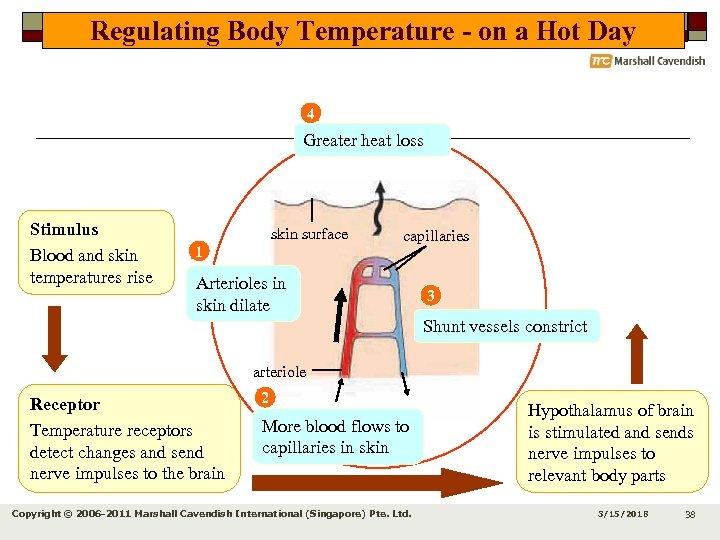
Regulating Body Temperature - on a Hot Day 4 Greater heat loss Stimulus Blood and skin temperatures rise skin surface 1 capillaries Arterioles in skin dilate 3 Shunt vessels constrict arteriole Receptor Temperature receptors detect changes and send nerve impulses to the brain 2 More blood flows to capillaries in skin Copyright © 2006 -2011 Marshall Cavendish International (Singapore) Pte. Ltd. Hypothalamus of brain is stimulated and sends nerve impulses to relevant body parts 3/15/2018 38
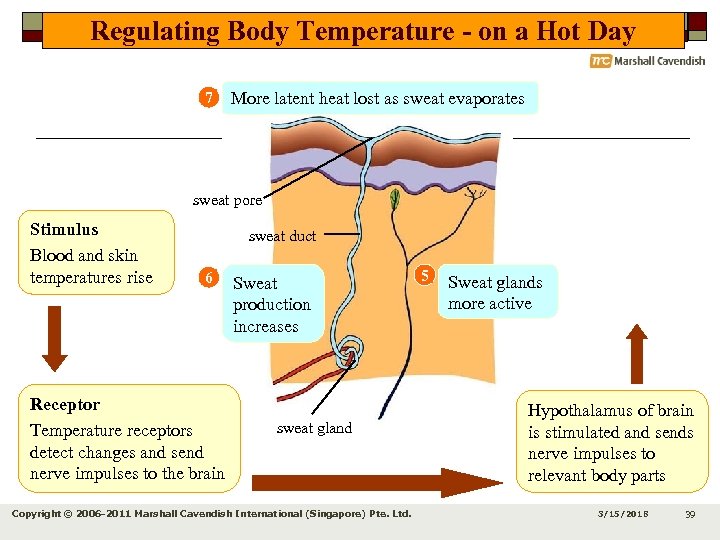
Regulating Body Temperature - on a Hot Day 7 More latent heat lost as sweat evaporates sweat pore Stimulus Blood and skin temperatures rise sweat duct 6 Receptor Temperature receptors detect changes and send nerve impulses to the brain Sweat production increases sweat gland Copyright © 2006 -2011 Marshall Cavendish International (Singapore) Pte. Ltd. 5 Sweat glands more active Hypothalamus of brain is stimulated and sends nerve impulses to relevant body parts 3/15/2018 39
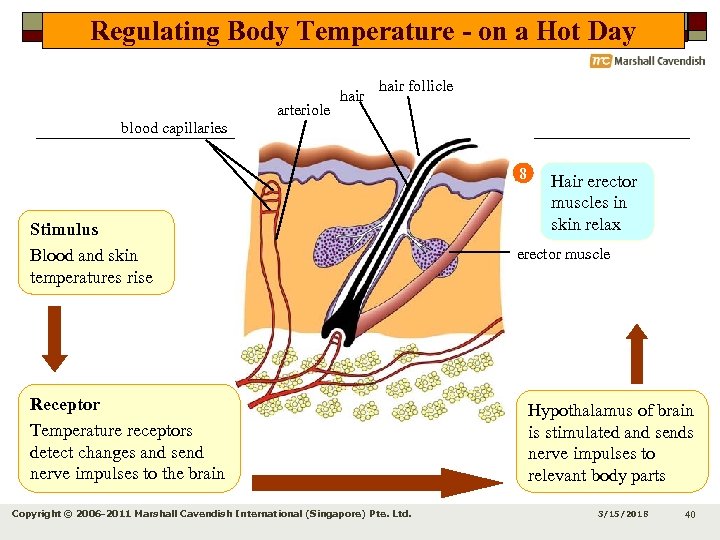
Regulating Body Temperature - on a Hot Day arteriole hair follicle blood capillaries 8 Stimulus Blood and skin temperatures rise Receptor Temperature receptors detect changes and send nerve impulses to the brain Copyright © 2006 -2011 Marshall Cavendish International (Singapore) Pte. Ltd. Hair erector muscles in skin relax erector muscle Hypothalamus of brain is stimulated and sends nerve impulses to relevant body parts 3/15/2018 40
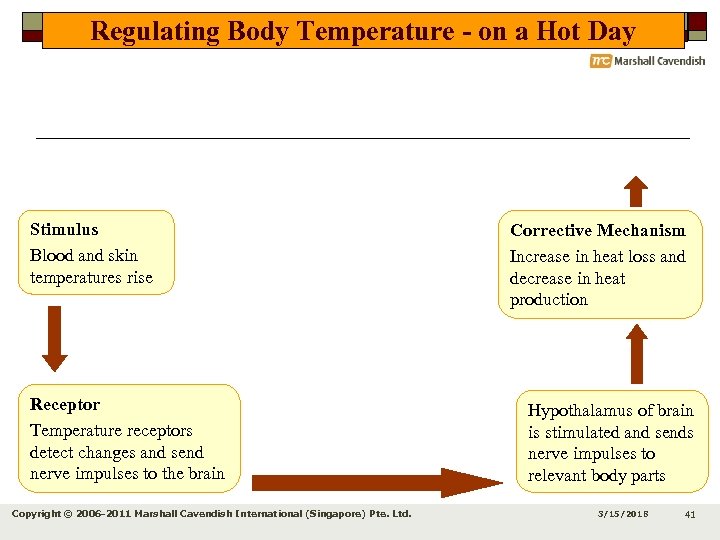
Regulating Body Temperature - on a Hot Day Stimulus Blood and skin temperatures rise Receptor Temperature receptors detect changes and send nerve impulses to the brain Copyright © 2006 -2011 Marshall Cavendish International (Singapore) Pte. Ltd. Corrective Mechanism Increase in heat loss and decrease in heat production Hypothalamus of brain is stimulated and sends nerve impulses to relevant body parts 3/15/2018 41
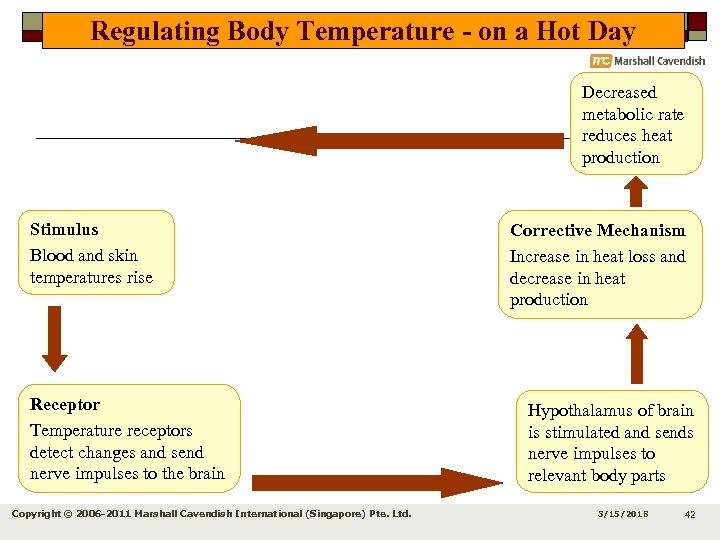
Regulating Body Temperature - on a Hot Day Decreased metabolic rate reduces heat production Stimulus Blood and skin temperatures rise Receptor Temperature receptors detect changes and send nerve impulses to the brain Copyright © 2006 -2011 Marshall Cavendish International (Singapore) Pte. Ltd. Corrective Mechanism Increase in heat loss and decrease in heat production Hypothalamus of brain is stimulated and sends nerve impulses to relevant body parts 3/15/2018 42
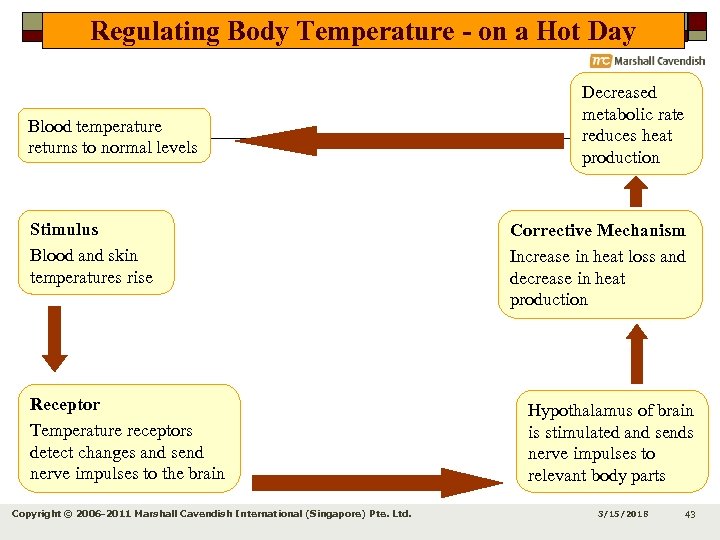
Regulating Body Temperature - on a Hot Day Blood temperature returns to normal levels Stimulus Blood and skin temperatures rise Receptor Temperature receptors detect changes and send nerve impulses to the brain Copyright © 2006 -2011 Marshall Cavendish International (Singapore) Pte. Ltd. Decreased metabolic rate reduces heat production Corrective Mechanism Increase in heat loss and decrease in heat production Hypothalamus of brain is stimulated and sends nerve impulses to relevant body parts 3/15/2018 43
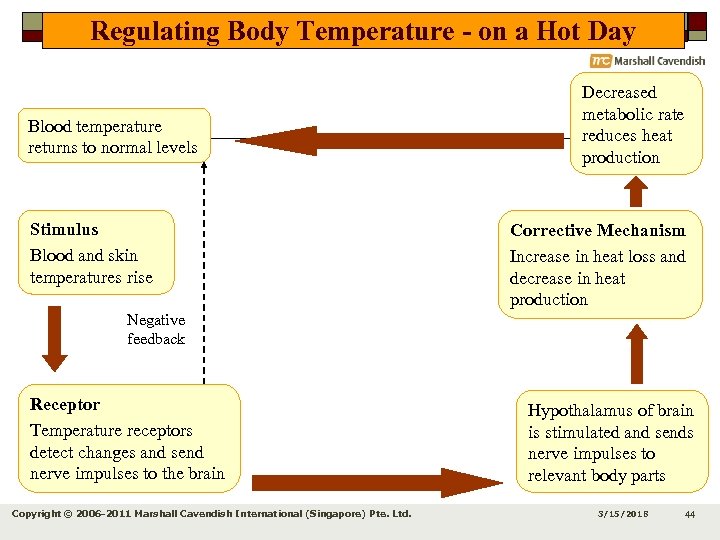
Regulating Body Temperature - on a Hot Day Blood temperature returns to normal levels Stimulus Blood and skin temperatures rise Decreased metabolic rate reduces heat production Corrective Mechanism Increase in heat loss and decrease in heat production Negative feedback Receptor Temperature receptors detect changes and send nerve impulses to the brain Copyright © 2006 -2011 Marshall Cavendish International (Singapore) Pte. Ltd. Hypothalamus of brain is stimulated and sends nerve impulses to relevant body parts 3/15/2018 44
Regulating Body Temperature - on a Cold Day 3/15/2018
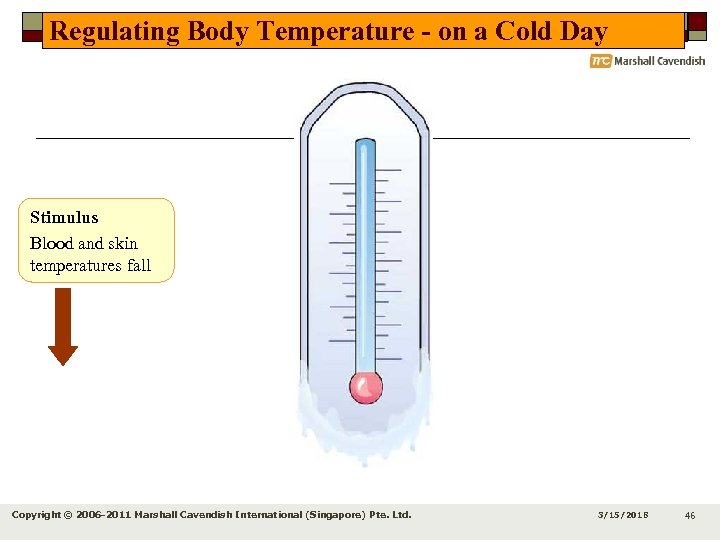
Regulating Body Temperature - on a Cold Day Stimulus Blood and skin temperatures fall Copyright © 2006 -2011 Marshall Cavendish International (Singapore) Pte. Ltd. 3/15/2018 46
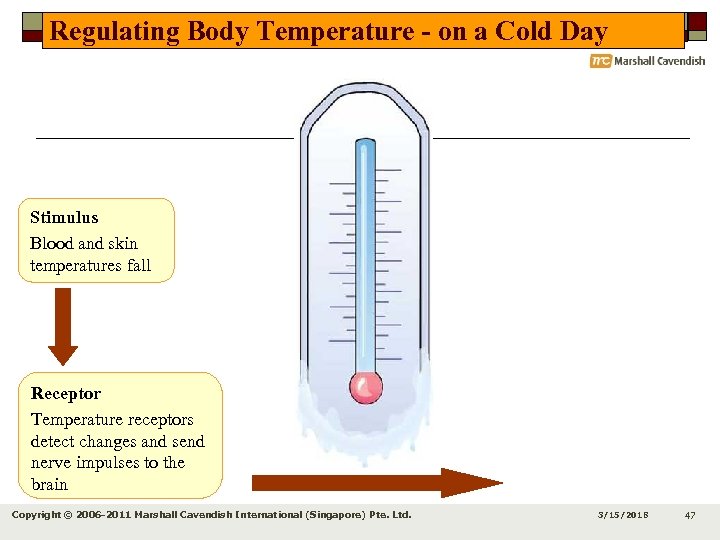
Regulating Body Temperature - on a Cold Day Stimulus Blood and skin temperatures fall Receptor Temperature receptors detect changes and send nerve impulses to the brain Copyright © 2006 -2011 Marshall Cavendish International (Singapore) Pte. Ltd. 3/15/2018 47
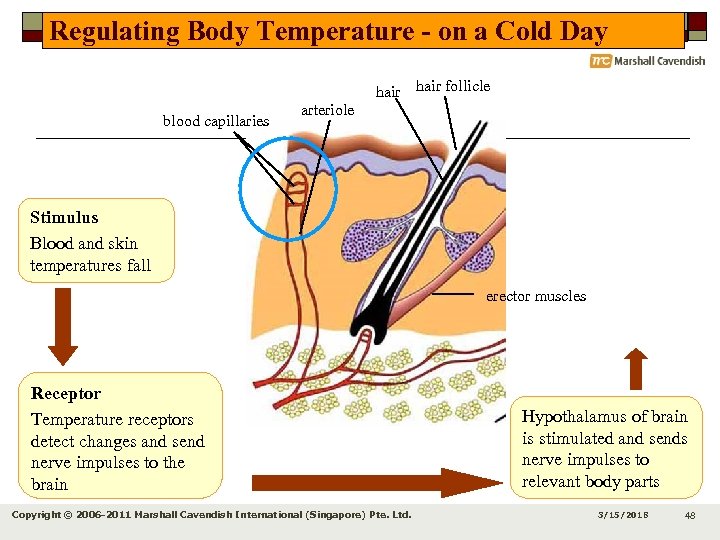
Regulating Body Temperature - on a Cold Day hair follicle blood capillaries arteriole Stimulus Blood and skin temperatures fall erector muscles Receptor Temperature receptors detect changes and send nerve impulses to the brain Copyright © 2006 -2011 Marshall Cavendish International (Singapore) Pte. Ltd. Hypothalamus of brain is stimulated and sends nerve impulses to relevant body parts 3/15/2018 48
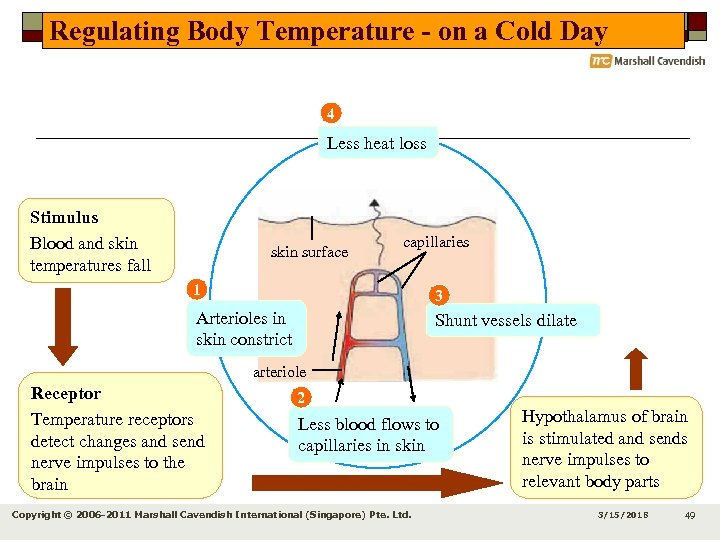
Regulating Body Temperature - on a Cold Day 4 Less heat loss Stimulus Blood and skin temperatures fall skin surface capillaries 1 3 Arterioles in skin constrict Shunt vessels dilate arteriole Receptor Temperature receptors detect changes and send nerve impulses to the brain 2 Less blood flows to capillaries in skin Copyright © 2006 -2011 Marshall Cavendish International (Singapore) Pte. Ltd. Hypothalamus of brain is stimulated and sends nerve impulses to relevant body parts 3/15/2018 49
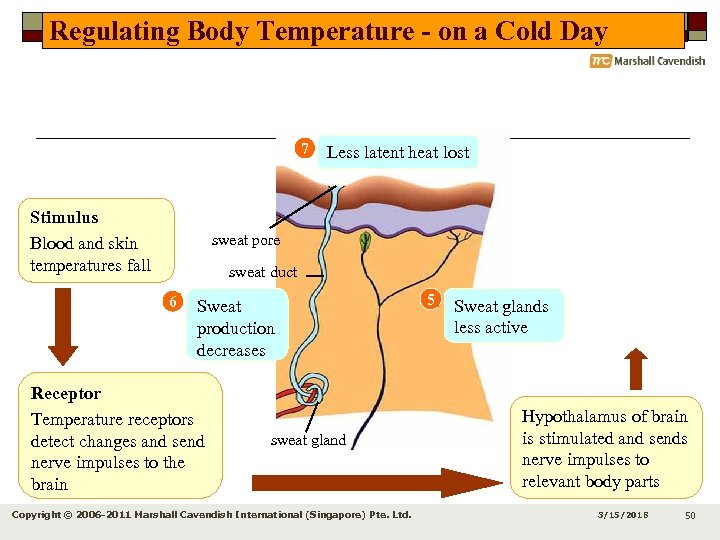
Regulating Body Temperature - on a Cold Day 7 Stimulus Blood and skin temperatures fall Less latent heat lost sweat pore sweat duct 6 Sweat production decreases Receptor Temperature receptors detect changes and send nerve impulses to the brain sweat gland Copyright © 2006 -2011 Marshall Cavendish International (Singapore) Pte. Ltd. 5 Sweat glands less active Hypothalamus of brain is stimulated and sends nerve impulses to relevant body parts 3/15/2018 50
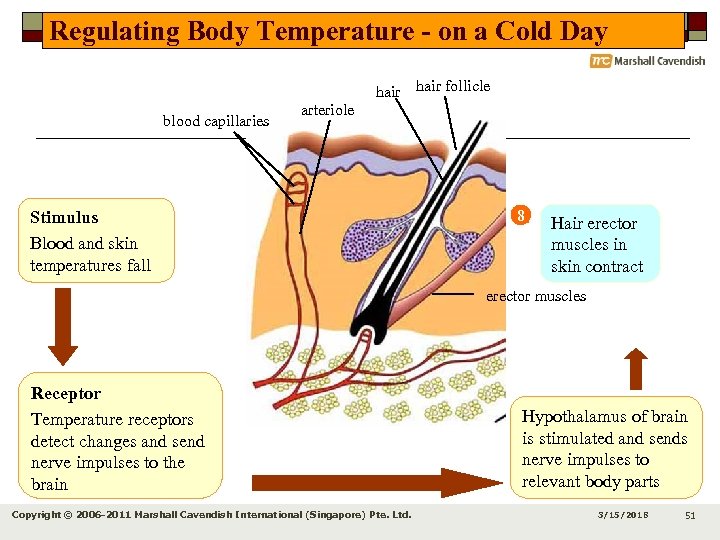
Regulating Body Temperature - on a Cold Day hair follicle blood capillaries arteriole Stimulus Blood and skin temperatures fall 8 Hair erector muscles in skin contract erector muscles Receptor Temperature receptors detect changes and send nerve impulses to the brain Copyright © 2006 -2011 Marshall Cavendish International (Singapore) Pte. Ltd. Hypothalamus of brain is stimulated and sends nerve impulses to relevant body parts 3/15/2018 51
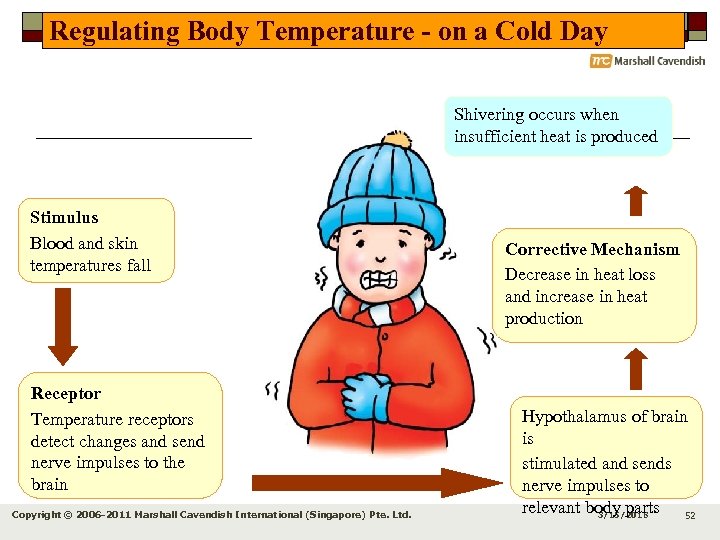
Regulating Body Temperature - on a Cold Day Shivering occurs when insufficient heat is produced Stimulus Blood and skin temperatures fall Receptor Temperature receptors detect changes and send nerve impulses to the brain Copyright © 2006 -2011 Marshall Cavendish International (Singapore) Pte. Ltd. Corrective Mechanism Decrease in heat loss and increase in heat production Hypothalamus of brain is stimulated and sends nerve impulses to relevant body parts 52 3/15/2018
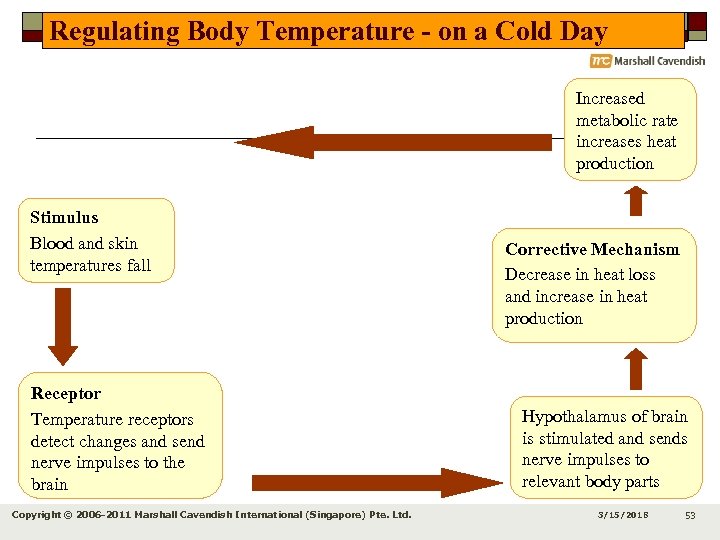
Regulating Body Temperature - on a Cold Day Increased metabolic rate increases heat production Stimulus Blood and skin temperatures fall Receptor Temperature receptors detect changes and send nerve impulses to the brain Copyright © 2006 -2011 Marshall Cavendish International (Singapore) Pte. Ltd. Corrective Mechanism Decrease in heat loss and increase in heat production Hypothalamus of brain is stimulated and sends nerve impulses to relevant body parts 3/15/2018 53
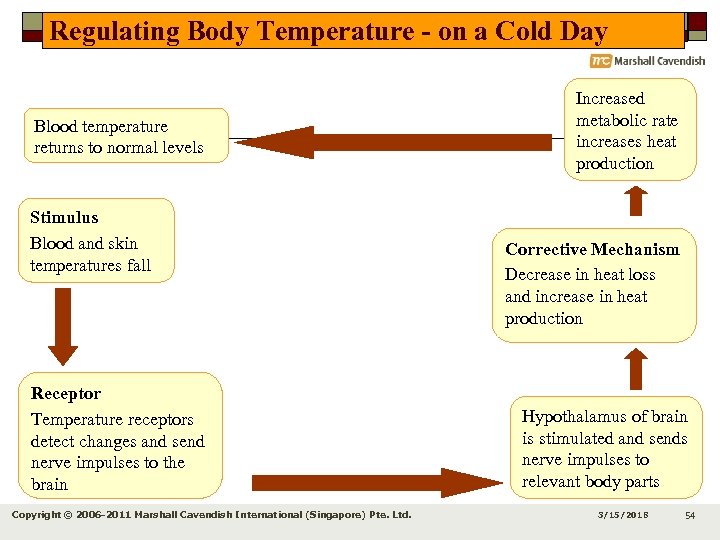
Regulating Body Temperature - on a Cold Day Blood temperature returns to normal levels Stimulus Blood and skin temperatures fall Receptor Temperature receptors detect changes and send nerve impulses to the brain Copyright © 2006 -2011 Marshall Cavendish International (Singapore) Pte. Ltd. Increased metabolic rate increases heat production Corrective Mechanism Decrease in heat loss and increase in heat production Hypothalamus of brain is stimulated and sends nerve impulses to relevant body parts 3/15/2018 54
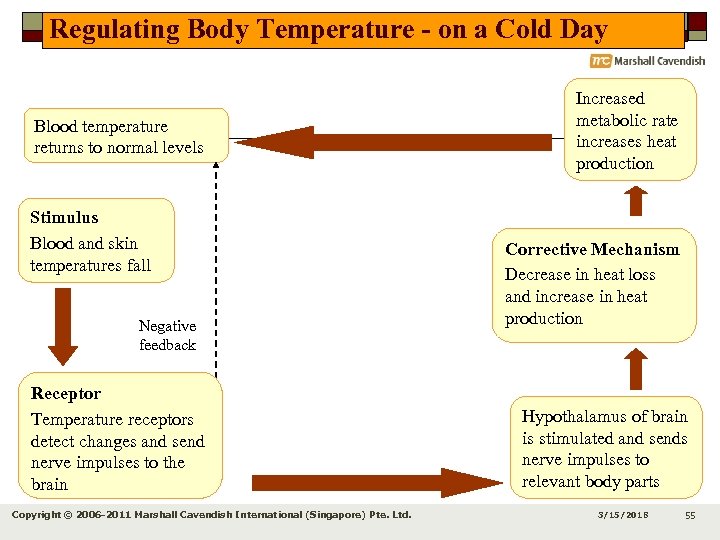
Regulating Body Temperature - on a Cold Day Blood temperature returns to normal levels Stimulus Blood and skin temperatures fall Negative feedback Receptor Temperature receptors detect changes and send nerve impulses to the brain Copyright © 2006 -2011 Marshall Cavendish International (Singapore) Pte. Ltd. Increased metabolic rate increases heat production Corrective Mechanism Decrease in heat loss and increase in heat production Hypothalamus of brain is stimulated and sends nerve impulses to relevant body parts 3/15/2018 55

Homeostasis (Concept Map) 3/15/2018
HOMEOSTASIS The maintenance of a constant internal environment Copyright © 2006 -2011 Marshall Cavendish International (Singapore) Pte. Ltd. 3/15/2018 57
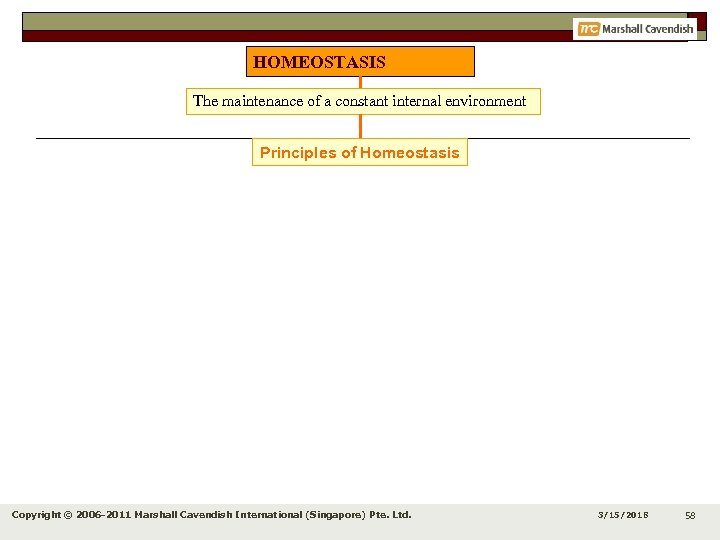
HOMEOSTASIS The maintenance of a constant internal environment Principles of Homeostasis Copyright © 2006 -2011 Marshall Cavendish International (Singapore) Pte. Ltd. 3/15/2018 58
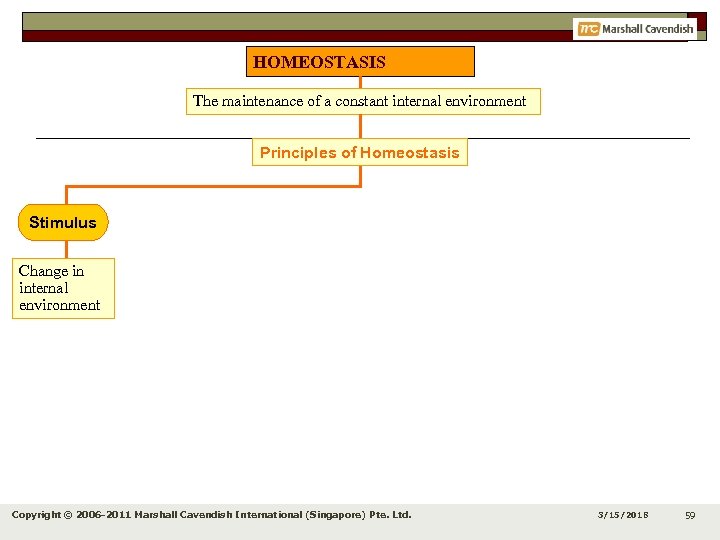
HOMEOSTASIS The maintenance of a constant internal environment Principles of Homeostasis Stimulus Change in internal environment Copyright © 2006 -2011 Marshall Cavendish International (Singapore) Pte. Ltd. 3/15/2018 59
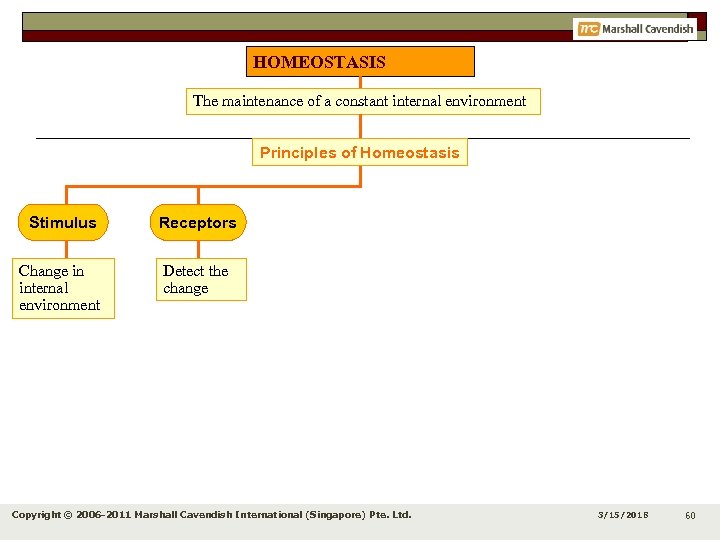
HOMEOSTASIS The maintenance of a constant internal environment Principles of Homeostasis Stimulus Receptors Change in internal environment Detect the change Copyright © 2006 -2011 Marshall Cavendish International (Singapore) Pte. Ltd. 3/15/2018 60
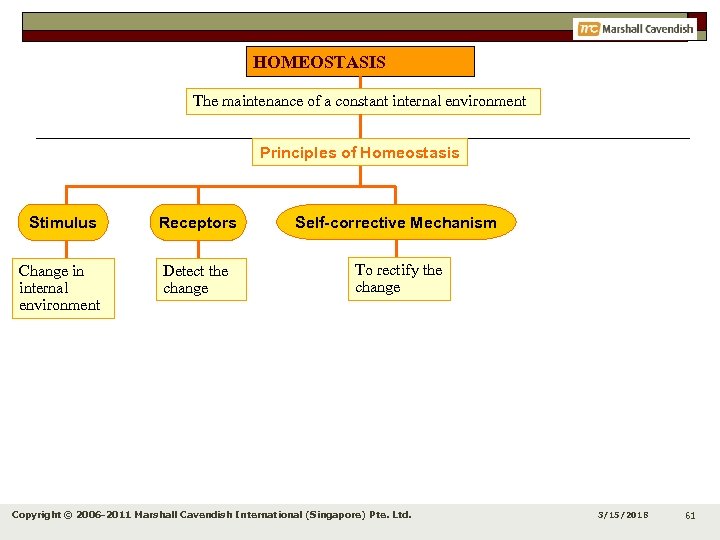
HOMEOSTASIS The maintenance of a constant internal environment Principles of Homeostasis Stimulus Receptors Self-corrective Mechanism Change in internal environment Detect the change To rectify the change Copyright © 2006 -2011 Marshall Cavendish International (Singapore) Pte. Ltd. 3/15/2018 61
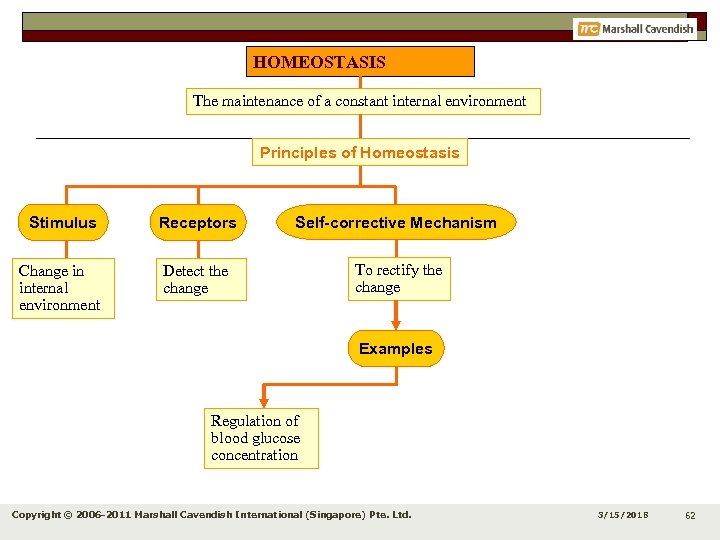
HOMEOSTASIS The maintenance of a constant internal environment Principles of Homeostasis Stimulus Receptors Self-corrective Mechanism Change in internal environment Detect the change To rectify the change Examples Regulation of blood glucose concentration Copyright © 2006 -2011 Marshall Cavendish International (Singapore) Pte. Ltd. 3/15/2018 62
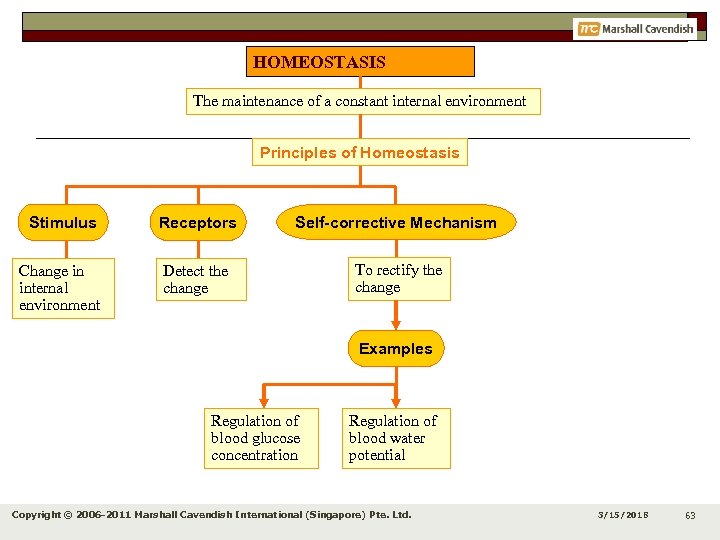
HOMEOSTASIS The maintenance of a constant internal environment Principles of Homeostasis Stimulus Receptors Self-corrective Mechanism Change in internal environment Detect the change To rectify the change Examples Regulation of blood glucose concentration Regulation of blood water potential Copyright © 2006 -2011 Marshall Cavendish International (Singapore) Pte. Ltd. 3/15/2018 63
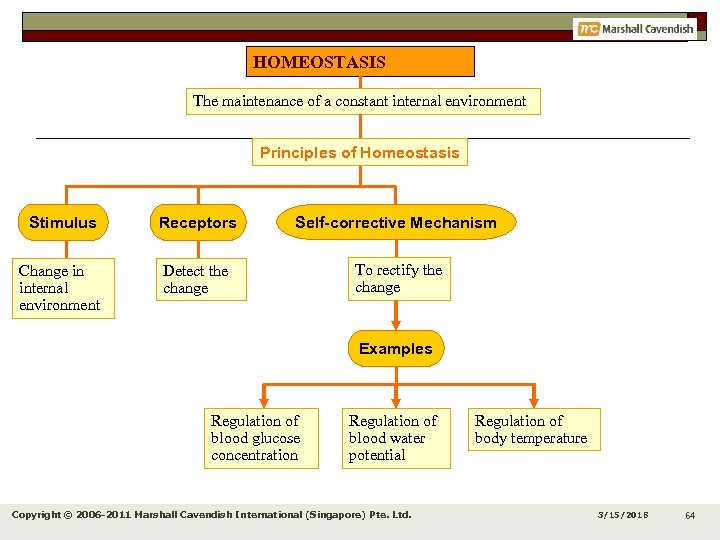
HOMEOSTASIS The maintenance of a constant internal environment Principles of Homeostasis Stimulus Receptors Self-corrective Mechanism Change in internal environment Detect the change To rectify the change Examples Regulation of blood glucose concentration Regulation of blood water potential Copyright © 2006 -2011 Marshall Cavendish International (Singapore) Pte. Ltd. Regulation of body temperature 3/15/2018 64
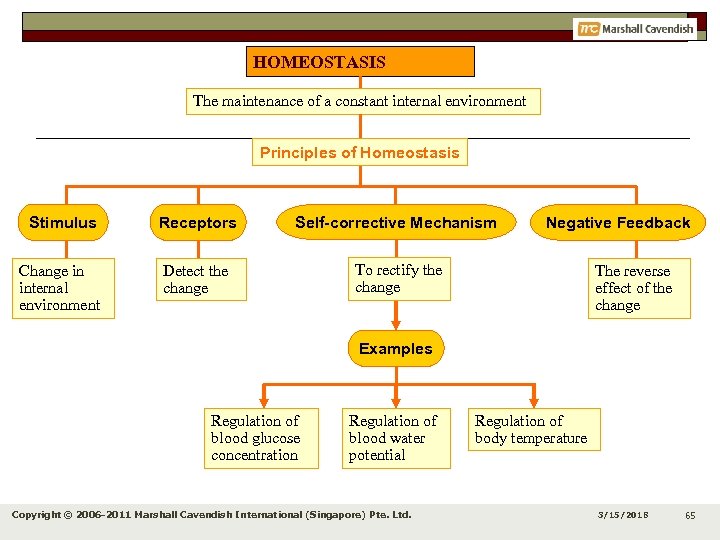
HOMEOSTASIS The maintenance of a constant internal environment Principles of Homeostasis Stimulus Receptors Self-corrective Mechanism Change in internal environment Detect the change To rectify the change Negative Feedback The reverse effect of the change Examples Regulation of blood glucose concentration Regulation of blood water potential Copyright © 2006 -2011 Marshall Cavendish International (Singapore) Pte. Ltd. Regulation of body temperature 3/15/2018 65
Скачать презентацию Homeostasis Skin Temperature Control Learning Objectives
07fc9eda48c4e89c97f4f6457361e1d6.ppt