


 Скачать презентацию Home Visits A Partnership for Improved Health Care
bee804f9d188c531d7c1ef19e46819ba.ppt
- Количество слайдов: 40
 Home Visits: A Partnership for Improved Health Care and Education Roger A Shewmake, Ph. D, LN Professor Director, Section of Nutrition University of South Dakota School of Medicine Department of Family Medicine and Sioux Falls Family Practice Residency 1
 The changing demographics of the population have presented challenges in the training of physicians in geriatrics, palliative care, and primary care. n Most encounters medical students have with patients are within the doctor-centered arena of the clinic or long-term care facility. n J of Am Geriatrics Society 53: 336 -342, 2005 2
 A home visit by a medical student or resident provides the opportunity to see the patient in their home and observe the environment from which they come from. n The opportunity is there for improving ambulatory medicine, geriatrics and sensitizing the students to the needs of the patient and care giver n 3
 n A broader view of the patient provides the opportunity to better understand functional status and limitations, socioeconomic, and psychological issue of the family and patient, environmental limitations, and hazards. J of Am Geriatrics Society 53: 336 -342, 2005 4
 n n “A patient population of adequate size and representing a broad spectrum of problems, various ages, and both sexes should be attended in the hospital, in the FPC, at home, and in institutions for long-term care or rehabilitation”. Nutrition is also part of the required Family Practice Core Requirements and believed to be an important adjunct to providing overall and comprehensive healthcare. Program Requirements for Residency Education in Family Practice 5
 The exposure to the patient in the home care setting provides an opportunity for more effective teaching of core geriatric principles, palliative care, and functional environmental assessments. Home Care Periodicals February 16 2006 6
 With an emphasis on home care in medical school and post-graduate training, it is felt that physicians are more likely to actively engage in that area of medical care because they are more familiar with it and have experienced it in their training. n Physicians are unlikely to actively engage in areas of medical care that is unfamiliar or uncomfortable to them n Caring p 27 August 2005 7
 n A fifty percent reduction in rehospitalization was seen in a perspective randomized controlled trial in which educational interventions featuring short-term home care was provided. JAMA September 3, 2003 -Vol 290, No. 9 n Other studies of home care indicated a reduction in falls, a more stabilized function, and better medication management. Caring August 2005 8
 Home Visit and Health Assessment Cooperative Project South Dakota Department of Social Services Office of Adult Services and Aging (OASA) and USDSM are working together to decrease the recidivism rate of individuals released from nursing homes, being readmitted to the facilities, and decrease the number of individuals released from hospitals who are admitted to nursing homes shortly after discharge. 9
 Home Visit and Health Assessment Cooperative Project n The focus of the assessments are health, nutrition, and home safety issues. n Medical students, family practice residents, nutritionists and social workers help conduct the home visit and assessment. 10
 Many of our students and residents not only experience the home visit with the trained social worker of the Department of Adult Services and Aging, but also with their Family Medicine preceptor who is in the practice of making home visit with patients. Thus, the student sees two vital aspects of home care. 11
 Home Visits The image of a physician delivering care to a sick patient at home is one of the essential and enduring images in the collective consciousness of medicine 50 years ago, house calls accounted for 40% of all physician visits n 1980 house calls accounted for 0. 6% n 15
 Home Visits Home care has always had to prove its “worth” n People die for lack of access to care n n Home care can provide access 17
 Home Visits Maintaining independent status is at the center of geriatric care and must consider the patient’s social and economic milieu as well as physical, functional, and cognitive abilities. 19
 Home Visits n Studies suggest home visits: Lead to improved medical care through the discovery of unmet health care needs n Elderly patients with relatively good health status and function resulted in detection of an average of four new medical problems and up to eight new intervention recommendation per patient n These problems had not been expected based on information obtained from outpatient clinic encounters n 28
 MSIV Home Visit Report Friday, February 24, 2006 “Dave was very engaging and received willing and positive responses from the individuals he met. ” n “He detected a problem with heart rhythm of one of the individuals he interviewed. This was reported to the patient’s daughter and a doctor appointment was made for her mother. ” n “There has been a change in medications. ” n 29
 Home Visits Longitudinal exposure in training appears to be important for the development of positive attitudes toward home visits n In 1994, only 66 of 123 medical schools offered specific instruction in the role and conduct of home visits n 83% offered students the opportunity to participate in home visits n Only three of the 123 required students to make five or more such visits n 31
 Home Visits n The assessment home visit can also be described as an investigational visit during which the role of the home environment in the patient’s health status is evaluated n Evaluation of the home environment of the “atrisk” patient can reveal evidence of abuse, neglect or social isolation 32
 Home Visits n Patients and family member trying to cope with chronic problems may benefit from this evaluation n Joint assessment home visit facilitates coordination of the efforts of home health care agencies and the physician 33
 Home Visits n Nutrition: n Assess patient’s current state of nutrition, eating behaviors and food preferences n Permission to look in the refrigerator or cupboard can be obtained by asking open-ended but directed questions 34
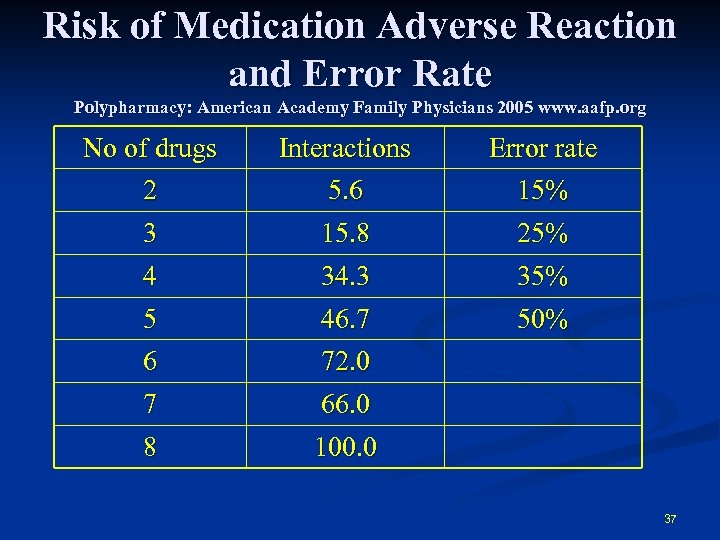 Risk of Medication Adverse Reaction and Error Rate Polypharmacy: American Academy Family Physicians 2005 www. aafp. org No of drugs 2 Interactions 5. 6 Error rate 15% 3 4 15. 8 34. 3 25% 35% 5 6 46. 7 72. 0 50% 7 8 66. 0 100. 0 37
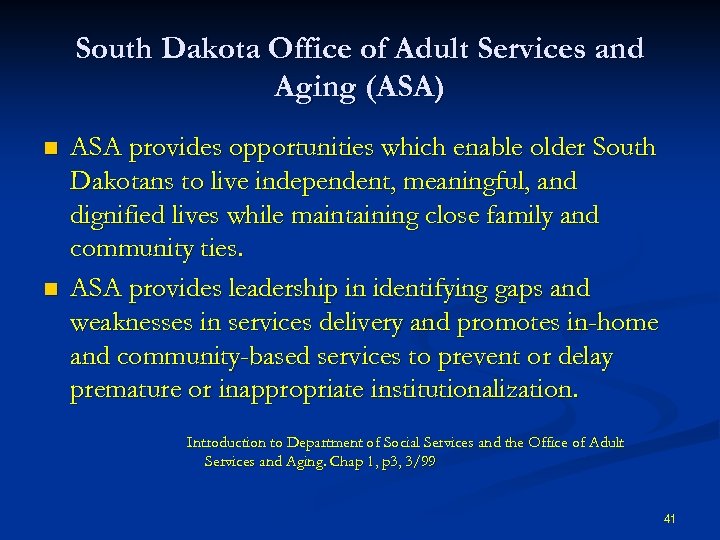 South Dakota Office of Adult Services and Aging (ASA) n n ASA provides opportunities which enable older South Dakotans to live independent, meaningful, and dignified lives while maintaining close family and community ties. ASA provides leadership in identifying gaps and weaknesses in services delivery and promotes in-home and community-based services to prevent or delay premature or inappropriate institutionalization. Introduction to Department of Social Services and the Office of Adult Services and Aging. Chap 1, p 3, 3/99 41
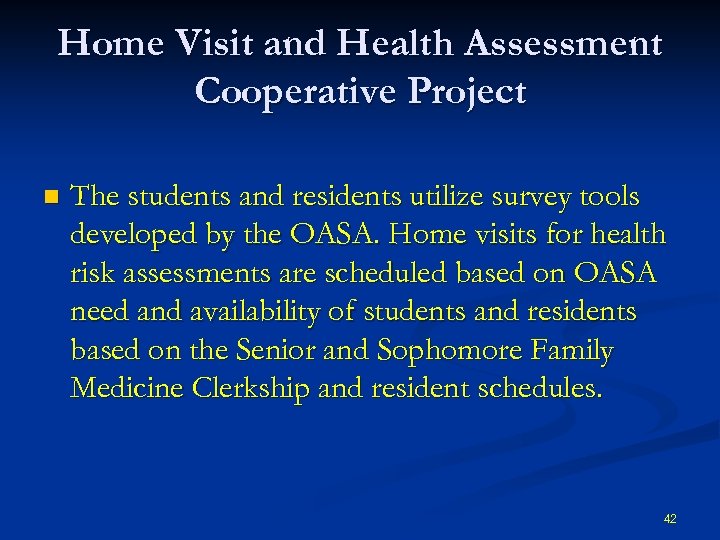 Home Visit and Health Assessment Cooperative Project n The students and residents utilize survey tools developed by the OASA. Home visits for health risk assessments are scheduled based on OASA need and availability of students and residents based on the Senior and Sophomore Family Medicine Clerkship and resident schedules. 42
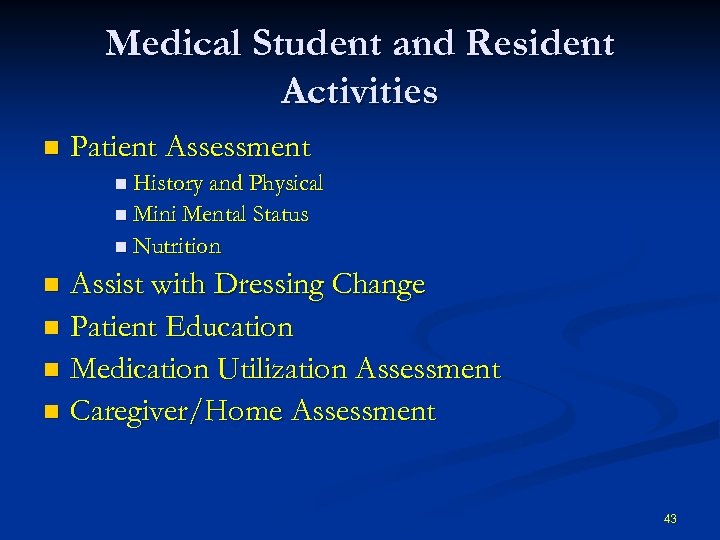 Medical Student and Resident Activities n Patient Assessment n History and Physical n Mini Mental Status n Nutrition Assist with Dressing Change n Patient Education n Medication Utilization Assessment n Caregiver/Home Assessment n 43
 Home Visit and Health Assessment Cooperative Project n Medical student and resident assignment Read Home Visits and Health Assessments Overview n Review actual Adult Services and Aging Assessment n Complete a Home Visit Report n Complete Home Visit Checklist n 45
 Home Visit and Health Assessment Cooperative Project n Home Visit Report Current health/nutrition status n Emotional well-being/behavior/cognition n Activities of daily living (ADL) n Instrumental activity of daily living (IADL) n Home/environment/ mental problems n Social support/caregiver status n Outcomes/suggestions/your involvement n 46
 Home Visit and Health Assessment Cooperative Project n SUMMARY MSII STUDENT VISITS Required of all second year medical students. n For the year 2005, a minimum of 30 students made one or more visits (59 visits) in 23 communities during their Sophomore Family Medicine Preceptorship. The overall theme is very positive from the students and if they did not know much about home visits, they now feel like they are more experienced and understand the importance of these visits and home care. n 47
 Home Visit and Health Assessment Cooperative Project n SUMMARY OF MSIV STUDENT VISITS All seniors at the School of Medicine are required to take the Senior Family Medicine Clerkship, which is a rural experience in South Dakota. n It is designed to provide a model for the provision of quality family medical care in rural community’s and to provide a model for the provision for the comprehensive and continuous care in the context of family and community. n 48
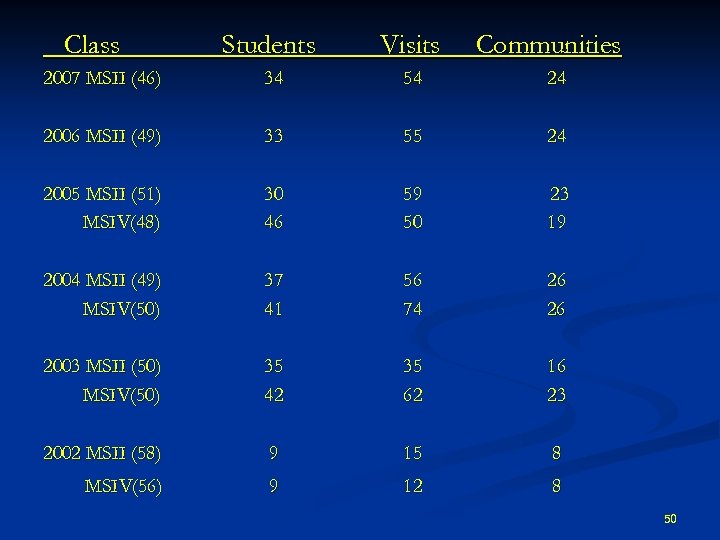 Class Students Visits Communities 2007 MSII (46) 34 54 24 2006 MSII (49) 33 55 24 2005 MSII (51) MSIV(48) 30 46 59 50 23 19 2004 MSII (49) MSIV(50) 37 41 56 74 26 26 2003 MSII (50) MSIV(50) 35 42 35 62 16 23 2002 MSII (58) 9 15 8 MSIV(56) 9 12 8 50
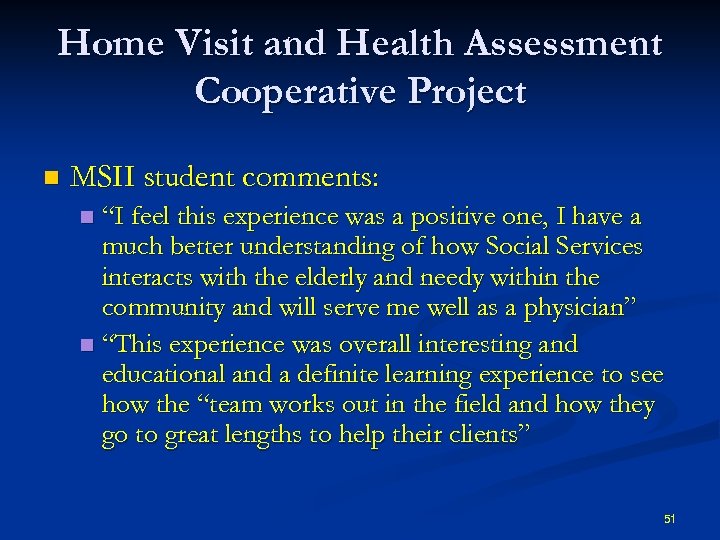 Home Visit and Health Assessment Cooperative Project n MSII student comments: “I feel this experience was a positive one, I have a much better understanding of how Social Services interacts with the elderly and needy within the community and will serve me well as a physician” n “This experience was overall interesting and educational and a definite learning experience to see how the “team works out in the field and how they go to great lengths to help their clients” n 51
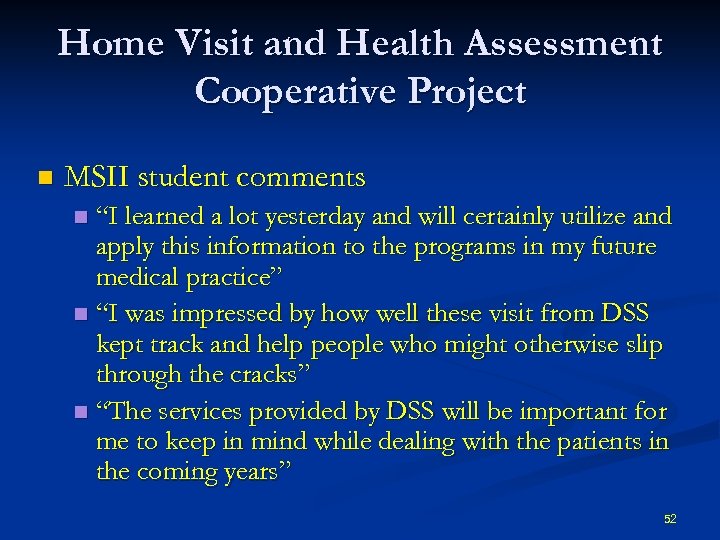 Home Visit and Health Assessment Cooperative Project n MSII student comments “I learned a lot yesterday and will certainly utilize and apply this information to the programs in my future medical practice” n “I was impressed by how well these visit from DSS kept track and help people who might otherwise slip through the cracks” n “The services provided by DSS will be important for me to keep in mind while dealing with the patients in the coming years” n 52
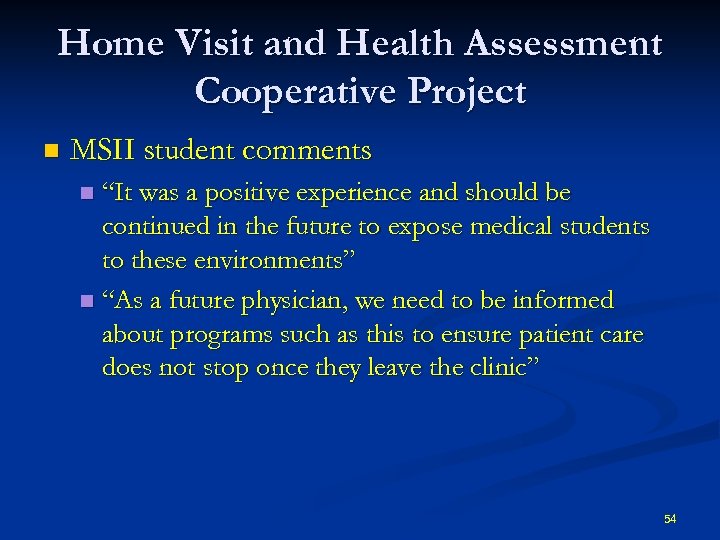 Home Visit and Health Assessment Cooperative Project n MSII student comments “It was a positive experience and should be continued in the future to expose medical students to these environments” n “As a future physician, we need to be informed about programs such as this to ensure patient care does not stop once they leave the clinic” n 54
 Home Visit and Health Assessment Cooperative Project n MSIV student comments: “We completed three evaluations and I was encouraged by how personal the care was and how closely the offered services were followed. This was a valuable day spent in Webster, SD” n “The opportunity to see community services at work was very informative and has helped me to realize what is available for the population that I will be working with in the future” n 55
 Home Visit and Health Assessment Cooperative Project n MSIV student comments: n “It was an interesting experience to see patients in their home surroundings, since I only get a chance to see them in the clinic. I understand respect the work of the social worker better. In a day where home doctor visits are almost nonexistent, it is good that somebody is still going into the homes of these folks to insure that they are doing alright” 56
 Home Visit and Health Assessment Cooperative Project n “I would like to say that although we had to do a similar visit during the Internal Medicine rotation for the End-of-Life seminar, I was not looking forward to doing another on this rotation; however, I ended up having a great experience and learned a lot, especially about falls in older persons. I felt really privileged to have an active role in the home visit assessment. Thank you for providing us the experience to have an encounter such as this. ” 57
 Home care visits may improve reflective learning processes not possible in the inpatient or outpatient setting. n Being outside of the medical center or clinical practice, including that time reviewing the patient, traveling to the patient’s home, and visiting with the patient may provide a neutral and possibly a fertile space for better reflection. n Home Care Curriculum for Medical Students vol. 72 No 5) 59
 It is believed that the home care visit increases trust and empathy between care giver and patient thus exposing medical students to a type of care that may help them foster more interpersonal skills between them and their future patients. Home Care Curriculum for Medical Students vol. 72 No 5 60
 Home Visits: Conclusions Family physicians who conduct home visits report a higher level of practice satisfaction than those who do not offer this service n Physicians with more positive attitudes about home visits are more likely to have conducted house calls during training n 61
 Conclusion Home visits and direct conversations with caregivers often provide a different picture of the ability to care for the patient as reported in the office visit. n The majority of residents and medical students have commented about their added understanding of a patient’s health and healthcare plan after seeing the patient in the home environment as well as talking with care givers and looking at the total environment of the patient. n 62
 Conclusion It is believed these experiences will enhance resident and medical student education in nutrition, preventive medicine, geriatrics, and interdisciplinary care. n Conducting the assessment in the home setting will also demonstrate to students what can be learned about patients and the environment in which they live and how this can affect their overall health and functional capacity. n 63