


 Скачать презентацию Home-grown Crypto aka Taking a Shiv to a
0eec9a3cb75889e6401ac3b8d3f3bc42.ppt
- Количество слайдов: 87
 Home-grown Crypto (aka Taking a Shiv to a Gun Fight) Hank Leininger Klayton Monroe OWASP App. Sec Seattle Cofounders, Kore. Logic hlein@korelogic. com 410 -867 -9103 F 980 A 584 5175 1996 DD 7 E C 47 B 1 A 71 105 C CB 44 CBF 8 Oct 2006 The OWASP Foundation http: //www. owasp. org/
 Agenda Intro Case Studies - Home Grown Crypto Wall of Shame Prehash Analysis Recommendations and Closing Remarks OWASP App. Sec Seattle 2006 2
 Intro We are not crypto-mathematicians, we're just hackers. We regularly see bad crypto. So will you. . . If we can break it, crypto-mathematicians can break it before breakfast. We keep seeing these mistakes, so the message bears repeating. OWASP App. Sec Seattle 2006 3
 Intro (2) What kinds of things do we see? Horrible home-grown “encryption algorithms” Giving away the key: For free For a bag of Cheetos For a few bucks Using good, industry-standard algorithms incorrectly Incorrect assumptions about the work factor required to attack the system OWASP App. Sec Seattle 2006 4
 Intro (3) “Home grown crypto is bad crypto. . Every programmer tries to build their own encryption algorithm at some point. In one word: Don't. ” Brian Hatch, 2003 -01 -23 Has everybody heard “Security through obscurity is no security? ” And yet, most of the bad crypto we see boils down to security through obscurity, at best. OWASP App. Sec Seattle 2006 5
 Intro (4) What uses of encryption are we talking about? We're not picking on industry-standard algorithms or protocols such as 3 DES, AES, or SSL per se. . . But we will show you cases where we broke implementations protected by them. We're talking about using encryption for protecting private data, securing communications, generating session IDs, etc. OWASP App. Sec Seattle 2006 6
 Agenda Intro Case Studies - Home Grown Crypto Wall of Shame Prehash Analysis Recommendations and Closing Remarks OWASP App. Sec Seattle 2006 7
 Case Study Format Description of system or application tested Description of flaw or flaws found May include screen shots, graphics, code, etc. How we discovered, broke, or reversed it How the flaw could have been prevented and/or how we recommended fixing it But only if “fixing it” was a viable option OWASP App. Sec Seattle 2006 8
 Obfuscation Gone Bad Online Banking Application (Skip) OWASP App. Sec Seattle 2006 9
 Obfuscation Gone Bad (1) Online Banking Application Awarded a seal of approval from a security company that “certifies” security Encrypted account numbers were used to Access account information Download bank statements and cancelled checks Unfortunately, the account numbers weren't really encrypted – they were merely obfuscated with a simple substitution cipher. OWASP App. Sec Seattle 2006 10
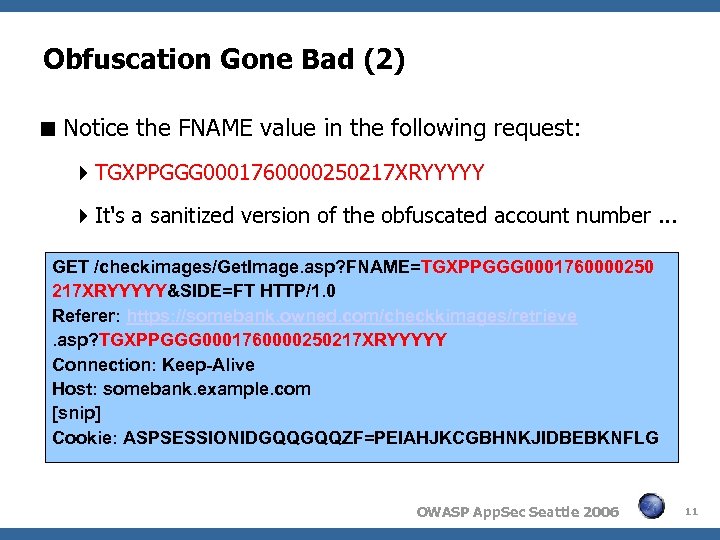 Obfuscation Gone Bad (2) Notice the FNAME value in the following request: TGXPPGGG 0001760000250217 XRYYYYY It's a sanitized version of the obfuscated account number. . . GET /checkimages/Get. Image. asp? FNAME=TGXPPGGG 0001760000250 217 XRYYYYY&SIDE=FT HTTP/1. 0 Referer: https: //somebank. owned. com/checkkimages/retrieve. asp? TGXPPGGG 0001760000250217 XRYYYYY Connection: Keep-Alive Host: somebank. example. com [snip] Cookie: ASPSESSIONIDGQQGQQZF=PEIAHJKCGBHNKJIDBEBKNFLG OWASP App. Sec Seattle 2006 11
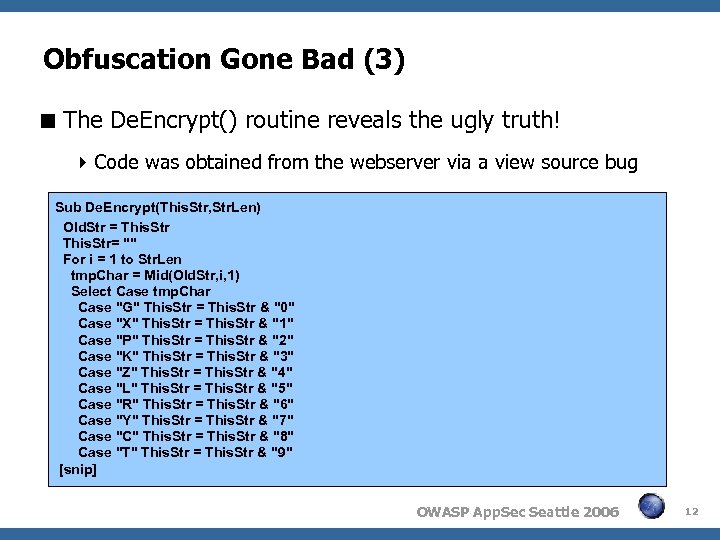 Obfuscation Gone Bad (3) The De. Encrypt() routine reveals the ugly truth! Code was obtained from the webserver via a view source bug Sub De. Encrypt(This. Str, Str. Len) Old. Str = This. Str= "" For i = 1 to Str. Len tmp. Char = Mid(Old. Str, i, 1) Select Case tmp. Char Case "G" This. Str = This. Str & "0" Case "X" This. Str = This. Str & "1" Case "P" This. Str = This. Str & "2" Case "K" This. Str = This. Str & "3" Case "Z" This. Str = This. Str & "4" Case "L" This. Str = This. Str & "5" Case "R" This. Str = This. Str & "6" Case "Y" This. Str = This. Str & "7" Case "C" This. Str = This. Str & "8" Case "T" This. Str = This. Str & "9" [snip] OWASP App. Sec Seattle 2006 12
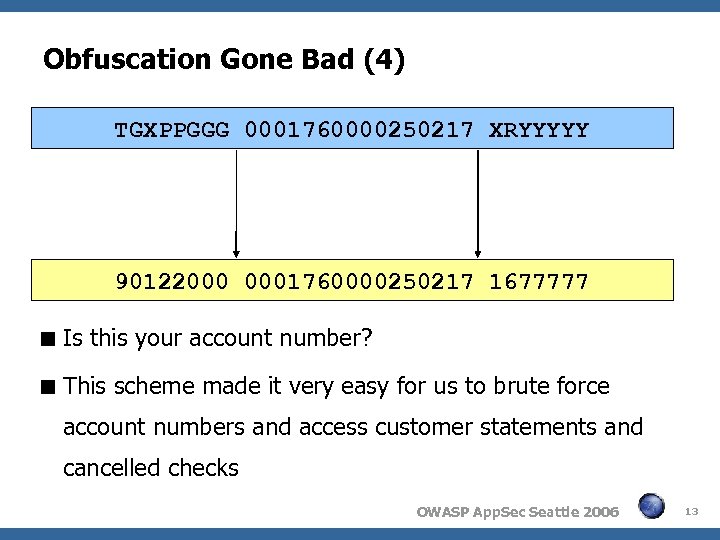 Obfuscation Gone Bad (4) TGXPPGGG 0001760000250217 XRYYYYY 90122000 0001760000250217 1677777 Is this your account number? This scheme made it very easy for us to brute force account numbers and access customer statements and cancelled checks OWASP App. Sec Seattle 2006 13
 Keys? We Don't Need No Stinking Keys Home-grown Single Sign On (SSO) Application (Back) (Skip) OWASP App. Sec Seattle 2006 14
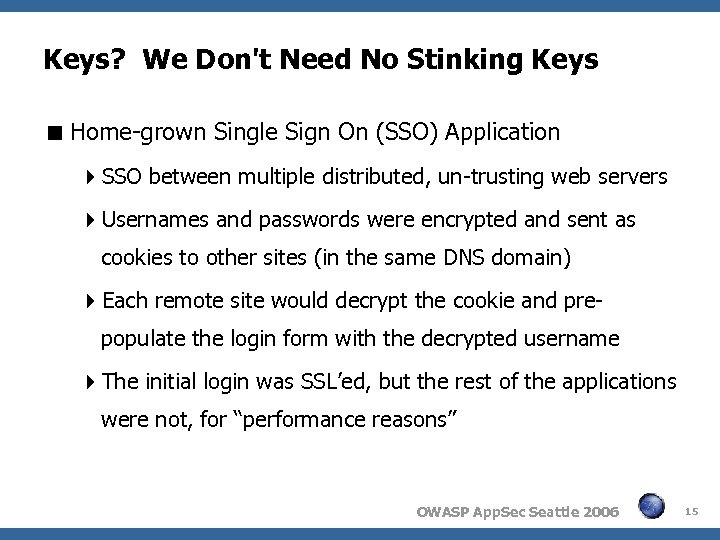 Keys? We Don't Need No Stinking Keys Home-grown Single Sign On (SSO) Application SSO between multiple distributed, un-trusting web servers Usernames and passwords were encrypted and sent as cookies to other sites (in the same DNS domain) Each remote site would decrypt the cookie and prepopulate the login form with the decrypted username The initial login was SSL’ed, but the rest of the applications were not, for “performance reasons” OWASP App. Sec Seattle 2006 15
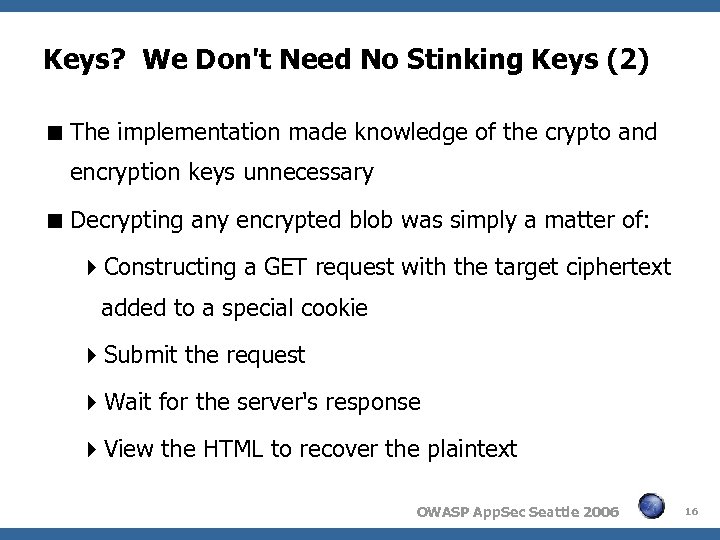 Keys? We Don't Need No Stinking Keys (2) The implementation made knowledge of the crypto and encryption keys unnecessary Decrypting any encrypted blob was simply a matter of: Constructing a GET request with the target ciphertext added to a special cookie Submit the request Wait for the server's response View the HTML to recover the plaintext OWASP App. Sec Seattle 2006 16
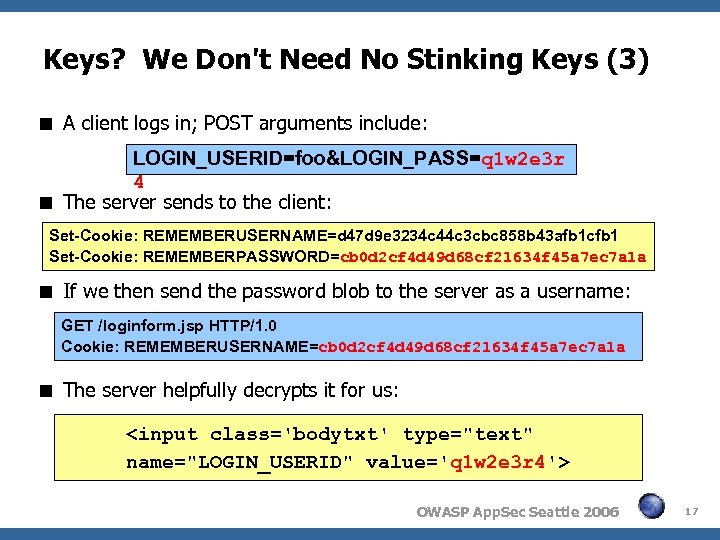 Keys? We Don't Need No Stinking Keys (3) A client logs in; POST arguments include: LOGIN_USERID=foo&LOGIN_PASS=q 1 w 2 e 3 r 4 The server sends to the client: Set-Cookie: REMEMBERUSERNAME=d 47 d 9 e 3234 c 44 c 3 cbc 858 b 43 afb 1 cfb 1 Set-Cookie: REMEMBERPASSWORD=cb 0 d 2 cf 4 d 49 d 68 cf 21634 f 45 a 7 ec 7 a 1 a If we then send the password blob to the server as a username: GET /loginform. jsp HTTP/1. 0 Cookie: REMEMBERUSERNAME=cb 0 d 2 cf 4 d 49 d 68 cf 21634 f 45 a 7 ec 7 a 1 a The server helpfully decrypts it for us: OWASP App. Sec Seattle 2006 17
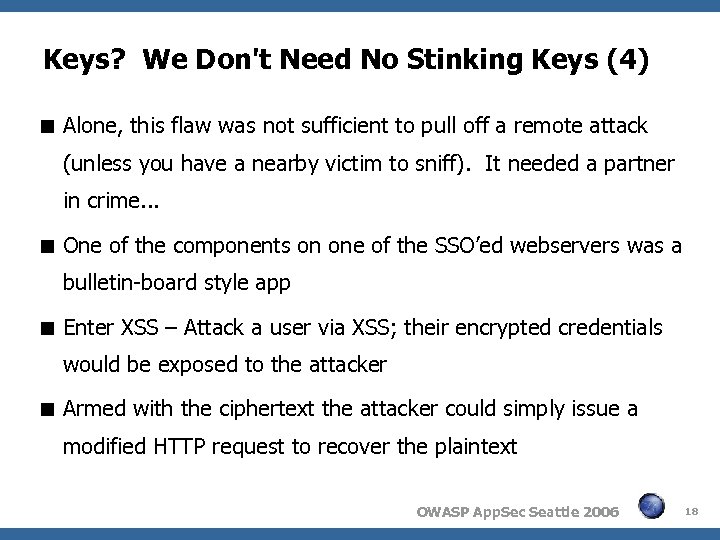 Keys? We Don't Need No Stinking Keys (4) Alone, this flaw was not sufficient to pull off a remote attack (unless you have a nearby victim to sniff). It needed a partner in crime. . . One of the components on one of the SSO’ed webservers was a bulletin-board style app Enter XSS – Attack a user via XSS; their encrypted credentials would be exposed to the attacker Armed with the ciphertext the attacker could simply issue a modified HTTP request to recover the plaintext OWASP App. Sec Seattle 2006 18
 We Don’t Need Logic, We’ve Got Crypto! A Web Services application with a Java client (Back) (Skip) OWASP App. Sec Seattle 2006 19
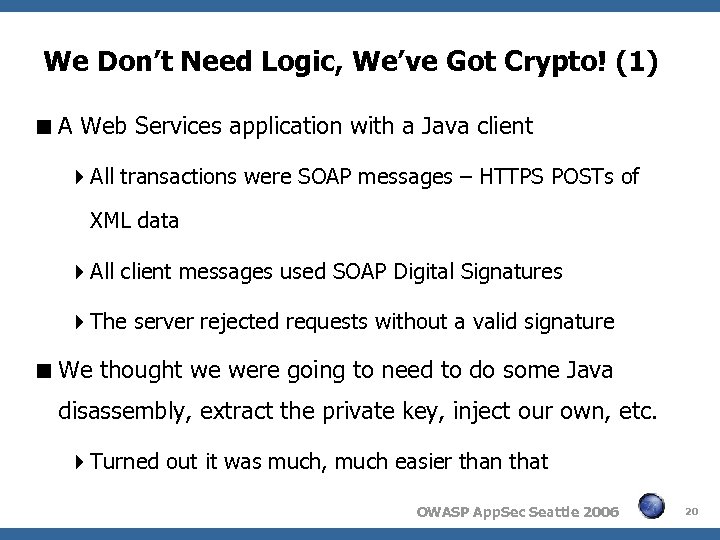 We Don’t Need Logic, We’ve Got Crypto! (1) A Web Services application with a Java client All transactions were SOAP messages – HTTPS POSTs of XML data All client messages used SOAP Digital Signatures The server rejected requests without a valid signature We thought we were going to need to do some Java disassembly, extract the private key, inject our own, etc. Turned out it was much, much easier than that OWASP App. Sec Seattle 2006 20
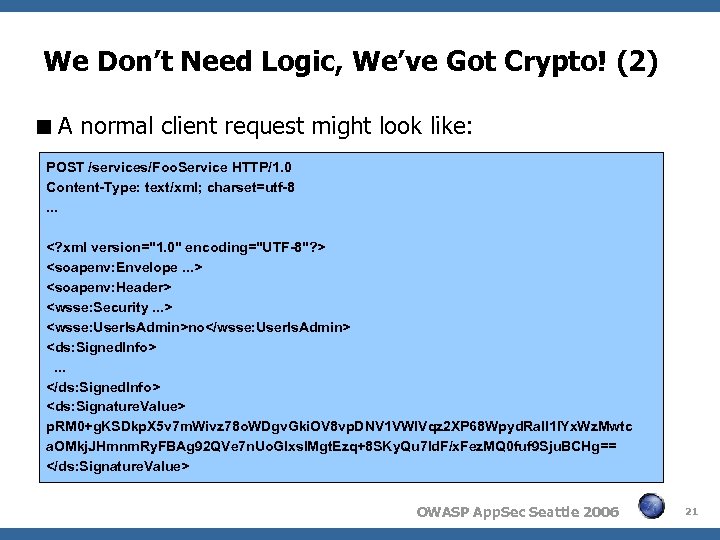 We Don’t Need Logic, We’ve Got Crypto! (2) A normal client request might look like: POST /services/Foo. Service HTTP/1. 0 Content-Type: text/xml; charset=utf-8. . .
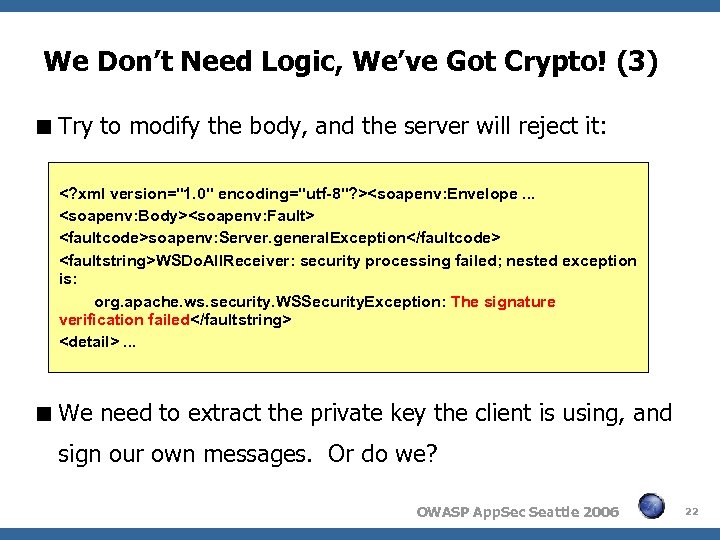 We Don’t Need Logic, We’ve Got Crypto! (3) Try to modify the body, and the server will reject it:
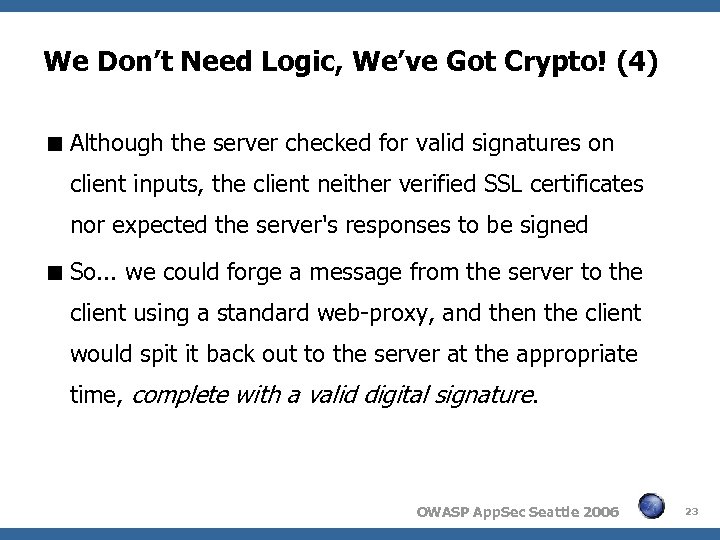 We Don’t Need Logic, We’ve Got Crypto! (4) Although the server checked for valid signatures on client inputs, the client neither verified SSL certificates nor expected the server's responses to be signed So. . . we could forge a message from the server to the client using a standard web-proxy, and then the client would spit it back out to the server at the appropriate time, complete with a valid digital signature. OWASP App. Sec Seattle 2006 23
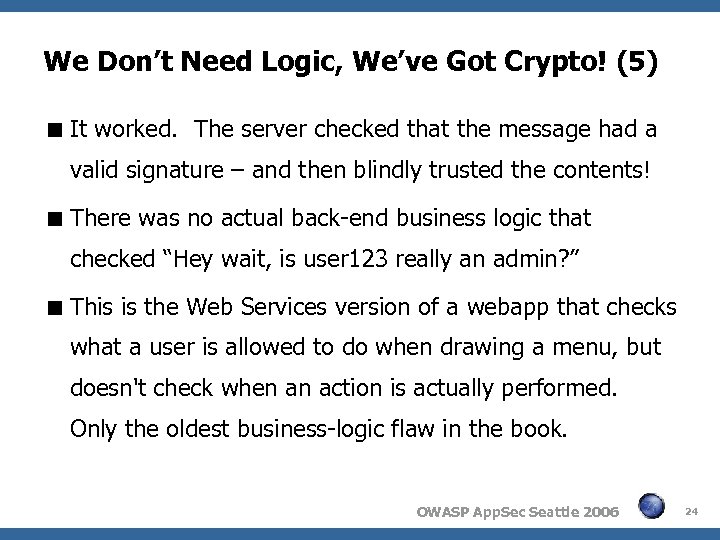 We Don’t Need Logic, We’ve Got Crypto! (5) It worked. The server checked that the message had a valid signature – and then blindly trusted the contents! There was no actual back-end business logic that checked “Hey wait, is user 123 really an admin? ” This is the Web Services version of a webapp that checks what a user is allowed to do when drawing a menu, but doesn't check when an action is actually performed. Only the oldest business-logic flaw in the book. OWASP App. Sec Seattle 2006 24
 “No Worries, We're Using 3 DES” Network-health monitoring appliance (Back) (Skip) OWASP App. Sec Seattle 2006 25
 “No Worries, We're Using 3 DES” (1) Network-health monitoring appliance Globally distributed and located in customers' internal networks “Phones home” to vendor to upload data Documentation claimed that sensitive client information was protected through the use of 3 DES encryption The vendor wanted us to QC their work – kudos to them! Unfortunately, the 3 DES encrypted keys were being given away OWASP App. Sec Seattle 2006 26
 “No Worries, We're Using 3 DES” (2) We took a forensic approach: Cracked open the appliance, imaged the hard drive Used FTimes (ftimes. sourceforge. net) to scour the image for clues (credentials, keys, code, DB accounts, etc. ) A captured transmission revealed that: HTTP version 1. 0 and ftp were used to POST data to a vendor site The body of the upload contained binary (3 DES? ) data that had been encoded as ASCII So far so good, right? OWASP App. Sec Seattle 2006 27
 “No Worries, We're Using 3 DES” (3) We thought so too. . . until we found the tool that did the encryption: The key was passed in on the command-line We traced backwards to find how the key had been generated Then, we traced forwards to see how the binary data was generated And that's when we saw the key being stuffed in the payload too! (skip example) OWASP App. Sec Seattle 2006 28
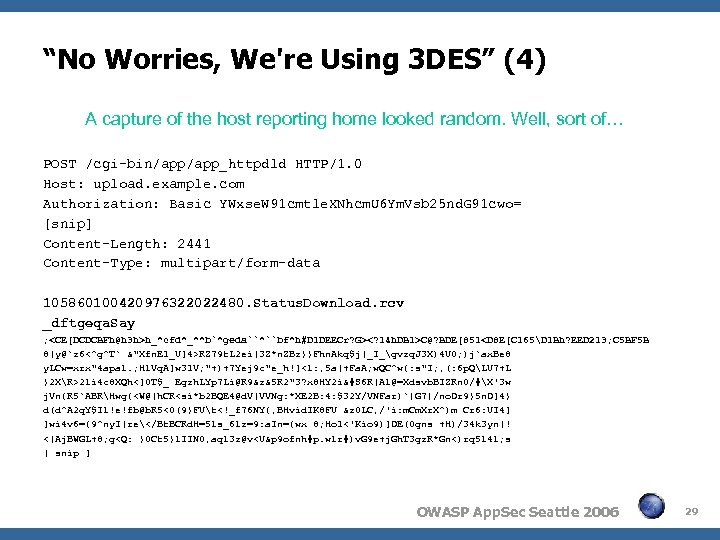 “No Worries, We're Using 3 DES” (4) A capture of the host reporting home looked random. Well, sort of… POST /cgi-bin/app_httpdld HTTP/1. 0 Host: upload. example. com Authorization: Basic YWxse. W 91 cmtle. XNhcm. U 6 Ym. Vsb 25 nd. G 91 cwo= [snip] Content-Length: 2441 Content-Type: multipart/form-data 105860100420976322022480. Status. Download. rcv _dftgeqa. Say ;
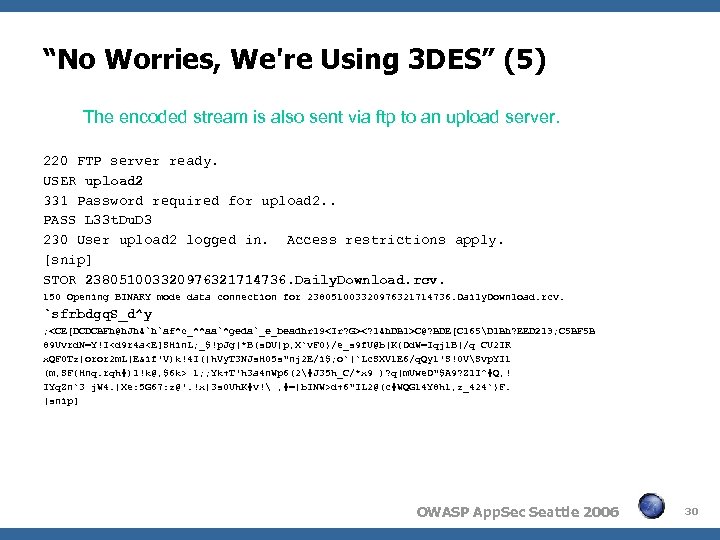 “No Worries, We're Using 3 DES” (5) The encoded stream is also sent via ftp to an upload server. 220 FTP server ready. USER upload 2 331 Password required for upload 2. . PASS L 33 t. Du. D 3 230 User upload 2 logged in. Access restrictions apply. [snip] STOR 238051003320976321714736. Daily. Download. rcv. 150 Opening BINARY mode data connection for 238051003320976321714736. Daily. Download. rcv. `sfrbdgq. S_d^y ;
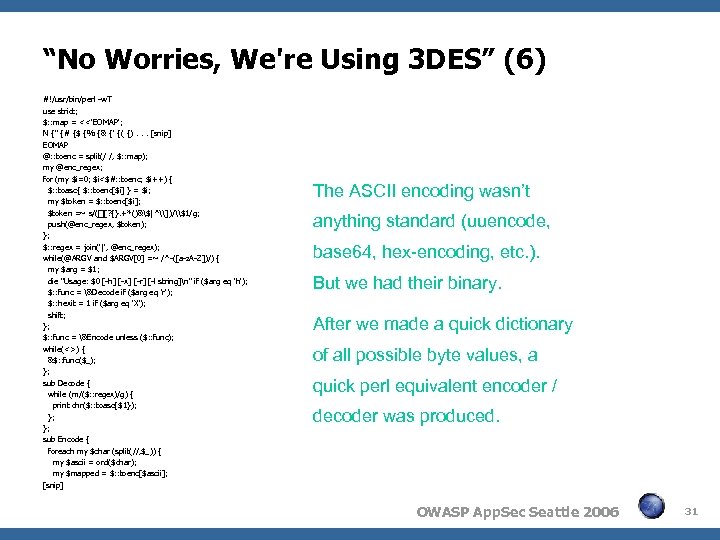 “No Worries, We're Using 3 DES” (6) #!/usr/bin/perl -w. T use strict; $: : map = <<'EOMAP'; N {" {# {$ {% {& {' {( {). . . [snip] EOMAP @: : toenc = split(/ /, $: : map); my @enc_regex; for (my $i=0; $i<$#: : toenc; $i++) { $: : toasc{ $: : toenc[$i] } = $i; my $token = $: : toenc[$i]; $token =~ s/([][? {}. +*()&$|^\])/\$1/g; push(@enc_regex, $token); }; $: : regex = join('|', @enc_regex); while(@ARGV and $ARGV[0] =~ /^-([a-z. A-Z])/) { my $arg = $1; die "Usage: $0 [-h] [-x] [-r] [-l string]n" if ($arg eq 'h'); $: : func = &Decode if ($arg eq 'r'); $: : hexit = 1 if ($arg eq 'X'); shift; }; $: : func = &Encode unless ($: : func); while(<>) { &$: : func($_); }; sub Decode { while (m/($: : regex)/g) { print chr($: : toasc{$1}); }; }; sub Encode { foreach my $char (split(//, $_)) { my $ascii = ord($char); my $mapped = $: : toenc[$ascii]; [snip] The ASCII encoding wasn’t anything standard (uuencode, base 64, hex-encoding, etc. ). But we had their binary. After we made a quick dictionary of all possible byte values, a quick perl equivalent encoder / decoder was produced. OWASP App. Sec Seattle 2006 31
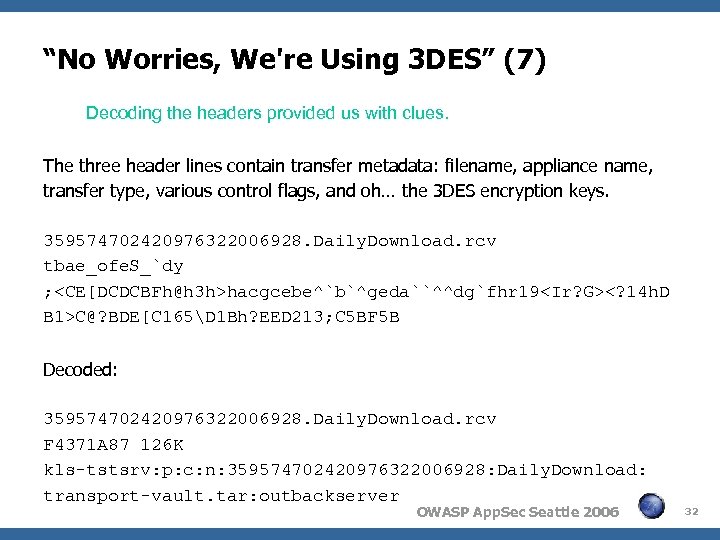 “No Worries, We're Using 3 DES” (7) Decoding the headers provided us with clues. The three header lines contain transfer metadata: filename, appliance name, transfer type, various control flags, and oh… the 3 DES encryption keys. 359574702420976322006928. Daily. Download. rcv tbae_ofe. S_`dy ;
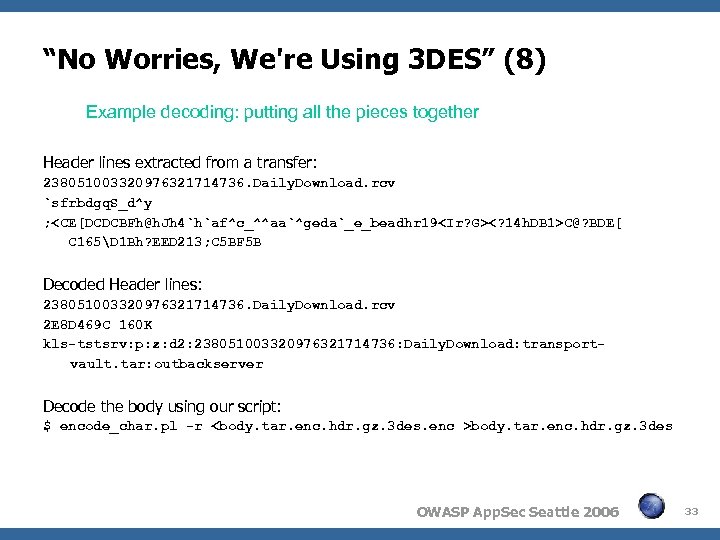 “No Worries, We're Using 3 DES” (8) Example decoding: putting all the pieces together Header lines extracted from a transfer: 238051003320976321714736. Daily. Download. rcv `sfrbdgq. S_d^y ;
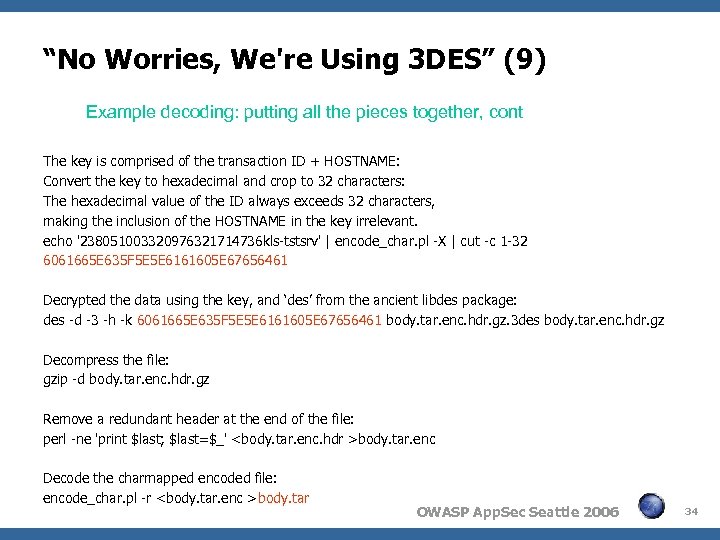 “No Worries, We're Using 3 DES” (9) Example decoding: putting all the pieces together, cont The key is comprised of the transaction ID + HOSTNAME: Convert the key to hexadecimal and crop to 32 characters: The hexadecimal value of the ID always exceeds 32 characters, making the inclusion of the HOSTNAME in the key irrelevant. echo '238051003320976321714736 kls-tstsrv' | encode_char. pl -X | cut -c 1 -32 6061665 E 635 F 5 E 5 E 6161605 E 67656461 Decrypted the data using the key, and ‘des’ from the ancient libdes package: des -d -3 -h -k 6061665 E 635 F 5 E 5 E 6161605 E 67656461 body. tar. enc. hdr. gz. 3 des body. tar. enc. hdr. gz Decompress the file: gzip -d body. tar. enc. hdr. gz Remove a redundant header at the end of the file: perl -ne 'print $last; $last=$_'
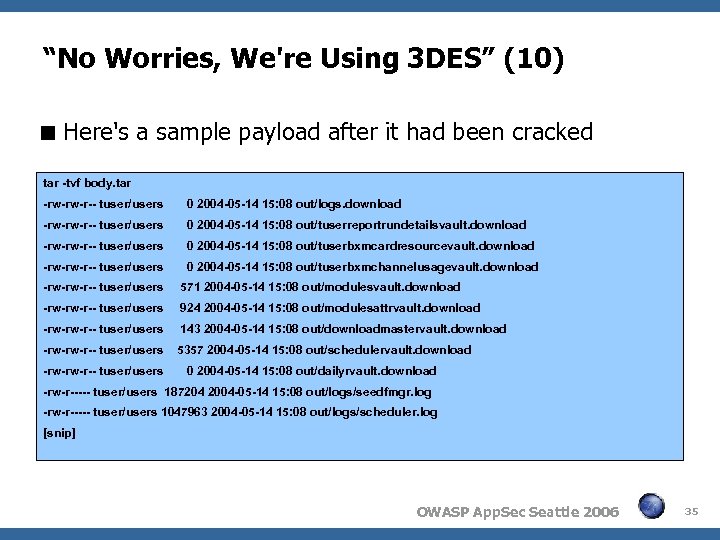 “No Worries, We're Using 3 DES” (10) Here's a sample payload after it had been cracked tar -tvf body. tar -rw-rw-r-- tuser/users 0 2004 -05 -14 15: 08 out/logs. download -rw-rw-r-- tuser/users 0 2004 -05 -14 15: 08 out/tuserreportrundetailsvault. download -rw-rw-r-- tuser/users 0 2004 -05 -14 15: 08 out/tuserbxmcardresourcevault. download -rw-rw-r-- tuser/users 0 2004 -05 -14 15: 08 out/tuserbxmchannelusagevault. download -rw-rw-r-- tuser/users 571 2004 -05 -14 15: 08 out/modulesvault. download -rw-rw-r-- tuser/users 924 2004 -05 -14 15: 08 out/modulesattrvault. download -rw-rw-r-- tuser/users 143 2004 -05 -14 15: 08 out/downloadmastervault. download -rw-rw-r-- tuser/users 5357 2004 -05 -14 15: 08 out/schedulervault. download -rw-rw-r-- tuser/users 0 2004 -05 -14 15: 08 out/dailyrvault. download -rw-r----- tuser/users 187204 2004 -05 -14 15: 08 out/logs/seedfmgr. log -rw-r----- tuser/users 1047963 2004 -05 -14 15: 08 out/logs/scheduler. log [snip] OWASP App. Sec Seattle 2006 35
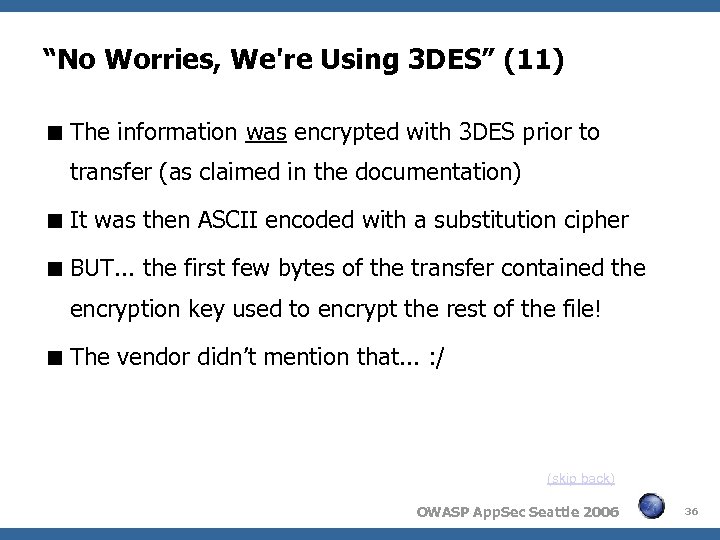 “No Worries, We're Using 3 DES” (11) The information was encrypted with 3 DES prior to transfer (as claimed in the documentation) It was then ASCII encoded with a substitution cipher BUT. . . the first few bytes of the transfer contained the encryption key used to encrypt the rest of the file! The vendor didn’t mention that. . . : / (skip back) OWASP App. Sec Seattle 2006 36
 We Have Both Kinds: AES and XOR “Convergent technologies” application (Back) (Skip) OWASP App. Sec Seattle 2006 37
 We Have Both Kinds: AES and XOR (1) “Convergent technologies” application Fat MS Windows client Clients for both x 86 W 2 K, and Win. CE Mixture of web-based and proprietary communications AES encryption used in some places and XOR encoding used in others Both had problems. . . OWASP App. Sec Seattle 2006 38
 We Have Both Kinds: AES and XOR (2) Initially, we found the secret AES key in a DLL using traditional reversing techniques Strings, hex dumps, static disassembly of subtle routines like: Encrypt() and Decrypt() Umm, great key guys: “ 1234567890 abcdef” Later, we used FTimes in dig mode to search all files for the observed key pattern: Dig. String. Reg. Exp=x 00[0 -9 A-Fa-f]{16}x 00 This often reveals additional keys, but not this time OWASP App. Sec Seattle 2006 39
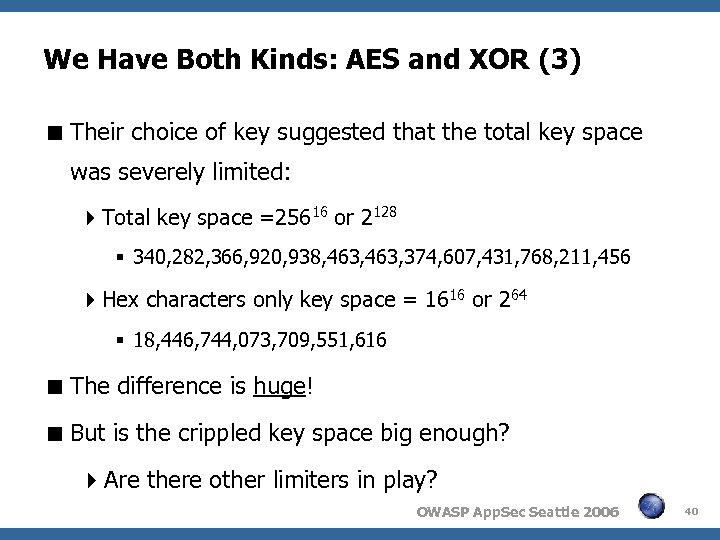 We Have Both Kinds: AES and XOR (3) Their choice of key suggested that the total key space was severely limited: Total key space =25616 or 2128 340, 282, 366, 920, 938, 463, 374, 607, 431, 768, 211, 456 Hex characters only key space = 1616 or 264 18, 446, 744, 073, 709, 551, 616 The difference is huge! But is the crippled key space big enough? Are there other limiters in play? OWASP App. Sec Seattle 2006 40
 We Have Both Kinds: AES and XOR (4) Initially, our plan was to use the recovered key and an alternate AES implementation to handle our encryption/decryption needs But the exported encrypt/decrypt routines were too enticing, so we chose to abuse them instead Eliminated potential implementation gotchas Required disassembly to determine call setup But the results were worth the effort. . . OWASP App. Sec Seattle 2006 41
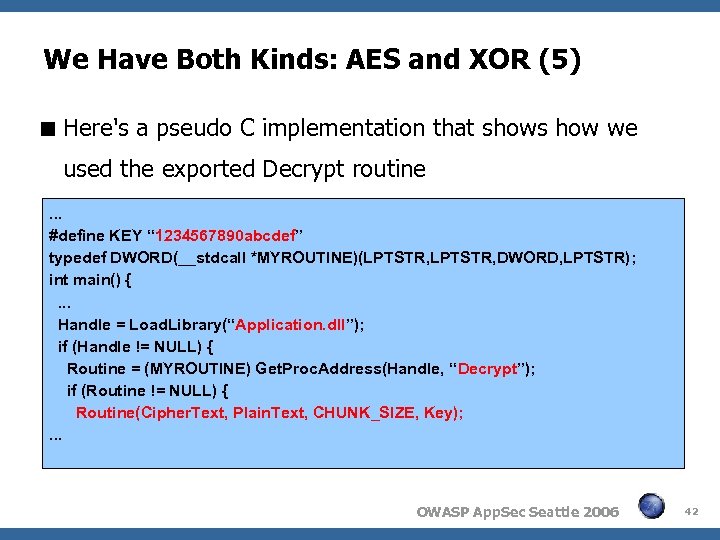 We Have Both Kinds: AES and XOR (5) Here's a pseudo C implementation that shows how we used the exported Decrypt routine. . . #define KEY “ 1234567890 abcdef” typedef DWORD(__stdcall *MYROUTINE)(LPTSTR, DWORD, LPTSTR); int main() {. . . Handle = Load. Library(“Application. dll”); if (Handle != NULL) { Routine = (MYROUTINE) Get. Proc. Address(Handle, “Decrypt”); if (Routine != NULL) { Routine(Cipher. Text, Plain. Text, CHUNK_SIZE, Key); . . . OWASP App. Sec Seattle 2006 42
 We Have Both Kinds: AES and XOR (6) Now we could encrypt and/or decrypt Local files (e. g. , user profile) Messages transmitted to/from the server This allowed us to craft custom files and messages It also revealed a new problem: The implementation used ECB instead of CBC ECB – Electronic Code Book CBC – Cipher Block Chaining ECB was not a good choice in this case. . . (skip example) OWASP App. Sec Seattle 2006 43
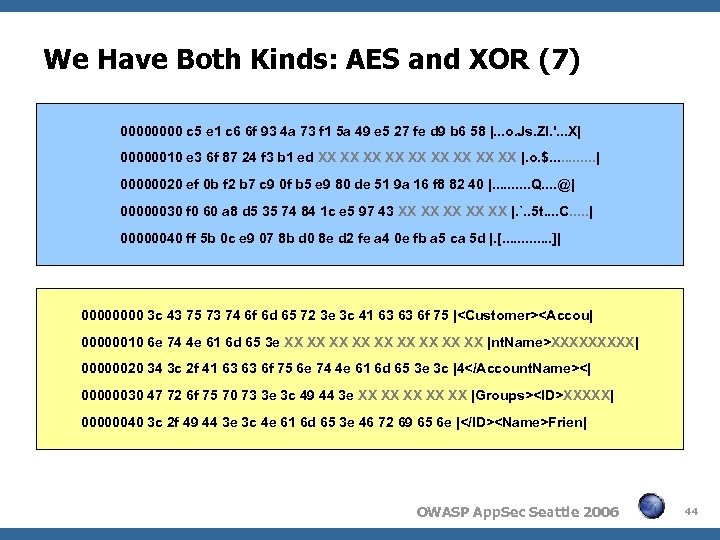 We Have Both Kinds: AES and XOR (7) 0000 c 5 e 1 c 6 6 f 93 4 a 73 f 1 5 a 49 e 5 27 fe d 9 b 6 58 |. . . o. Js. ZI. '. . . X| 00000010 e 3 6 f 87 24 f 3 b 1 ed XX XX XX |. o. $. . . | 00000020 ef 0 b f 2 b 7 c 9 0 f b 5 e 9 80 de 51 9 a 16 f 8 82 40 |. . Q. . @| 00000030 f 0 60 a 8 d 5 35 74 84 1 c e 5 97 43 XX XX XX |. `. . 5 t. . C. . . | 00000040 ff 5 b 0 c e 9 07 8 b d 0 8 e d 2 fe a 4 0 e fb a 5 ca 5 d |. [. . . ]| 0000 3 c 43 75 73 74 6 f 6 d 65 72 3 e 3 c 41 63 63 6 f 75 |
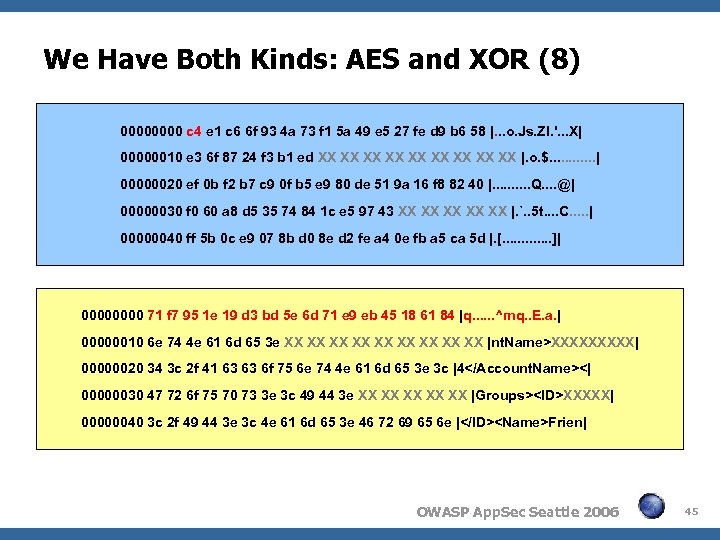 We Have Both Kinds: AES and XOR (8) 0000 c 4 e 1 c 6 6 f 93 4 a 73 f 1 5 a 49 e 5 27 fe d 9 b 6 58 |. . . o. Js. ZI. '. . . X| 00000010 e 3 6 f 87 24 f 3 b 1 ed XX XX XX |. o. $. . . | 00000020 ef 0 b f 2 b 7 c 9 0 f b 5 e 9 80 de 51 9 a 16 f 8 82 40 |. . Q. . @| 00000030 f 0 60 a 8 d 5 35 74 84 1 c e 5 97 43 XX XX XX |. `. . 5 t. . C. . . | 00000040 ff 5 b 0 c e 9 07 8 b d 0 8 e d 2 fe a 4 0 e fb a 5 ca 5 d |. [. . . ]| 0000 71 f 7 95 1 e 19 d 3 bd 5 e 6 d 71 e 9 eb 45 18 61 84 |q. . . ^mq. . E. a. | 00000010 6 e 74 4 e 61 6 d 65 3 e XX XX XX |nt. Name>XXXXX| 00000020 34 3 c 2 f 41 63 63 6 f 75 6 e 74 4 e 61 6 d 65 3 e 3 c |4<| 00000030 47 72 6 f 75 70 73 3 e 3 c 49 44 3 e XX XX XX |Groups>
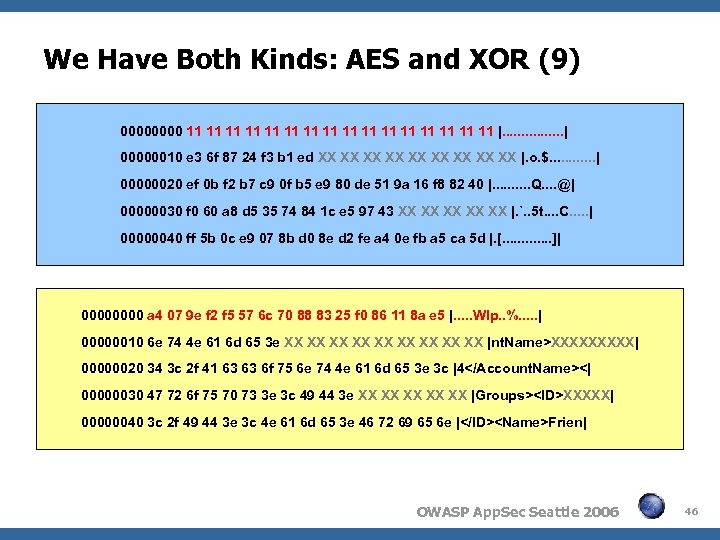 We Have Both Kinds: AES and XOR (9) 0000 11 11 11 11 |. . . . | 00000010 e 3 6 f 87 24 f 3 b 1 ed XX XX XX |. o. $. . . | 00000020 ef 0 b f 2 b 7 c 9 0 f b 5 e 9 80 de 51 9 a 16 f 8 82 40 |. . Q. . @| 00000030 f 0 60 a 8 d 5 35 74 84 1 c e 5 97 43 XX XX XX |. `. . 5 t. . C. . . | 00000040 ff 5 b 0 c e 9 07 8 b d 0 8 e d 2 fe a 4 0 e fb a 5 ca 5 d |. [. . . ]| 0000 a 4 07 9 e f 2 f 5 57 6 c 70 88 83 25 f 0 86 11 8 a e 5 |. . . Wlp. . %. . . | 00000010 6 e 74 4 e 61 6 d 65 3 e XX XX XX |nt. Name>XXXXX| 00000020 34 3 c 2 f 41 63 63 6 f 75 6 e 74 4 e 61 6 d 65 3 e 3 c |4<| 00000030 47 72 6 f 75 70 73 3 e 3 c 49 44 3 e XX XX XX |Groups>
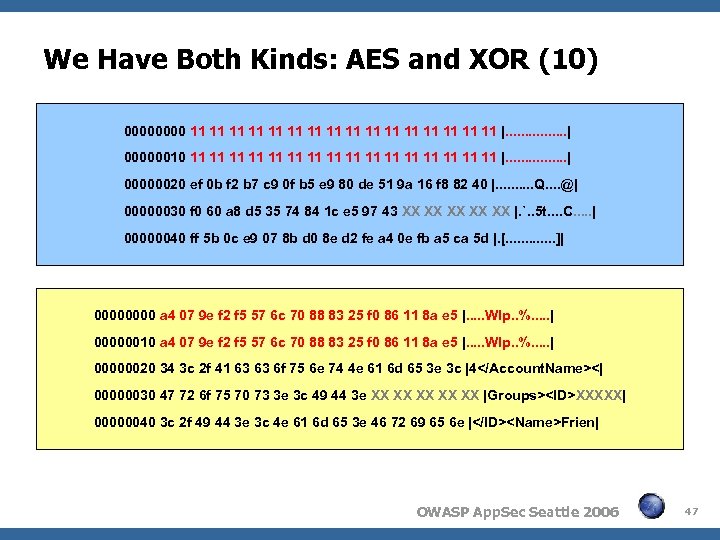 We Have Both Kinds: AES and XOR (10) 0000 11 11 11 11 |. . . . | 00000010 11 11 11 11 |. . . . | 00000020 ef 0 b f 2 b 7 c 9 0 f b 5 e 9 80 de 51 9 a 16 f 8 82 40 |. . Q. . @| 00000030 f 0 60 a 8 d 5 35 74 84 1 c e 5 97 43 XX XX XX |. `. . 5 t. . C. . . | 00000040 ff 5 b 0 c e 9 07 8 b d 0 8 e d 2 fe a 4 0 e fb a 5 ca 5 d |. [. . . ]| 0000 a 4 07 9 e f 2 f 5 57 6 c 70 88 83 25 f 0 86 11 8 a e 5 |. . . Wlp. . %. . . | 00000010 a 4 07 9 e f 2 f 5 57 6 c 70 88 83 25 f 0 86 11 8 a e 5 |. . . Wlp. . %. . . | 00000020 34 3 c 2 f 41 63 63 6 f 75 6 e 74 4 e 61 6 d 65 3 e 3 c |4<| 00000030 47 72 6 f 75 70 73 3 e 3 c 49 44 3 e XX XX XX |Groups>
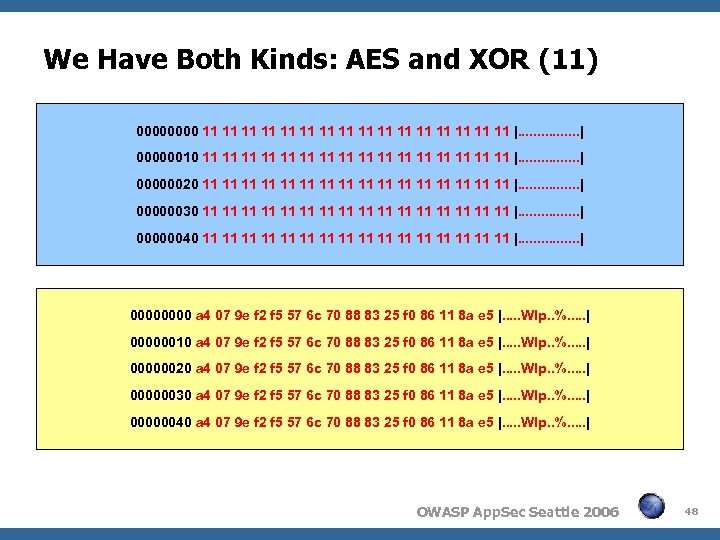 We Have Both Kinds: AES and XOR (11) 0000 11 11 11 11 |. . . . | 00000010 11 11 11 11 |. . . . | 00000020 11 11 11 11 |. . . . | 00000030 11 11 11 11 |. . . . | 00000040 11 11 11 11 |. . . . | 0000 a 4 07 9 e f 2 f 5 57 6 c 70 88 83 25 f 0 86 11 8 a e 5 |. . . Wlp. . %. . . | 00000010 a 4 07 9 e f 2 f 5 57 6 c 70 88 83 25 f 0 86 11 8 a e 5 |. . . Wlp. . %. . . | 00000020 a 4 07 9 e f 2 f 5 57 6 c 70 88 83 25 f 0 86 11 8 a e 5 |. . . Wlp. . %. . . | 00000030 a 4 07 9 e f 2 f 5 57 6 c 70 88 83 25 f 0 86 11 8 a e 5 |. . . Wlp. . %. . . | 00000040 a 4 07 9 e f 2 f 5 57 6 c 70 88 83 25 f 0 86 11 8 a e 5 |. . . Wlp. . %. . . | OWASP App. Sec Seattle 2006 48
 We Have Both Kinds: AES and XOR (12) Did we mention that the DLL in question was deployed on both client and server components? This implied that any vulnerabilities in the DLL could potentially be leveraged on the server Buffer overflows in the client-server traffic Also, this gives an attacker an advantage since s/he has plenty of time to analyze the DLL offline (Skip back) OWASP App. Sec Seattle 2006 49
 We Have Both Kinds: AES and XOR (13) And now, the other problem: XOR The application allowed user credentials to be “remembered” Stored in the Registry Obscured with a position based XOR Trivial to reverse What were they thinking? We've been down that road before. . .
 The House Always… Loses? Online gambling application (Back) (Skip) OWASP App. Sec Seattle 2006 51
 The House Always… Loses? (1) Online gambling application Fat MS Windows client Used a combination of web-based and home-grown protocols Login credentials were hashed/obfuscated and stored in a local INF file Unfortunately, the credentials were not completely obfuscated and the scheme was cracked OWASP App. Sec Seattle 2006 52
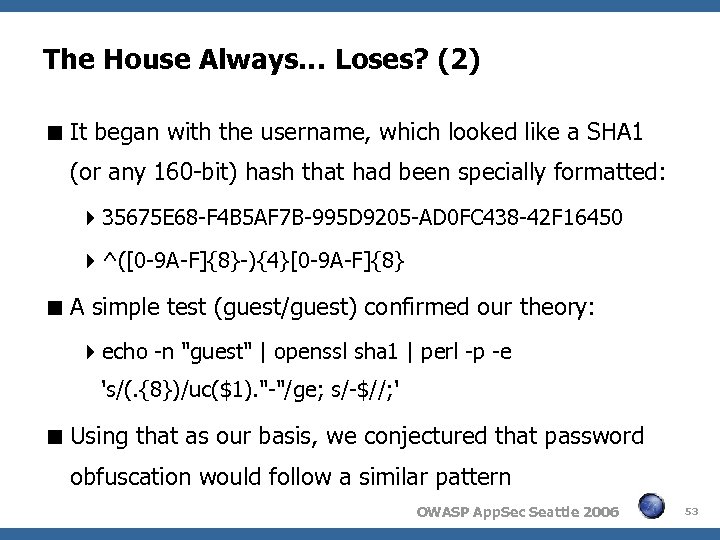 The House Always… Loses? (2) It began with the username, which looked like a SHA 1 (or any 160 -bit) hash that had been specially formatted: 35675 E 68 -F 4 B 5 AF 7 B-995 D 9205 -AD 0 FC 438 -42 F 16450 ^([0 -9 A-F]{8}-){4}[0 -9 A-F]{8} A simple test (guest/guest) confirmed our theory: echo -n "guest" | openssl sha 1 | perl -p -e 's/(. {8})/uc($1). "-"/ge; s/-$//; ' Using that as our basis, we conjectured that password obfuscation would follow a similar pattern OWASP App. Sec Seattle 2006 53
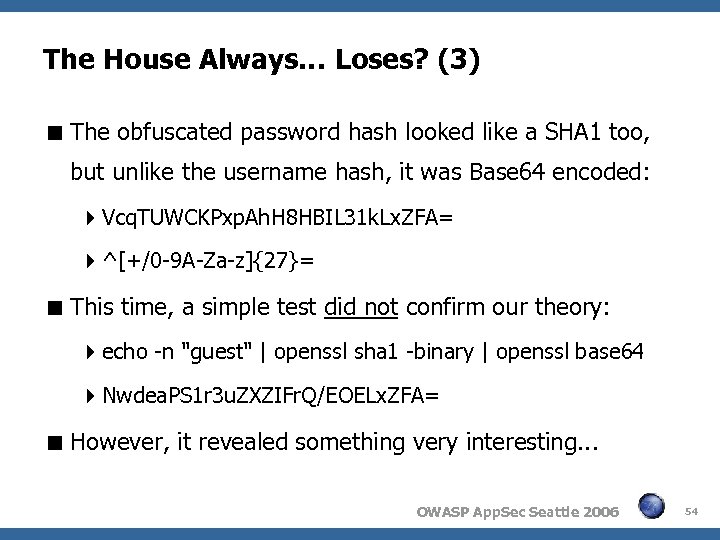 The House Always… Loses? (3) The obfuscated password hash looked like a SHA 1 too, but unlike the username hash, it was Base 64 encoded: Vcq. TUWCKPxp. Ah. H 8 HBIL 31 k. Lx. ZFA= ^[+/0 -9 A-Za-z]{27}= This time, a simple test did not confirm our theory: echo -n "guest" | openssl sha 1 -binary | openssl base 64 Nwdea. PS 1 r 3 u. ZXZIFr. Q/EOELx. ZFA= However, it revealed something very interesting. . . OWASP App. Sec Seattle 2006 54
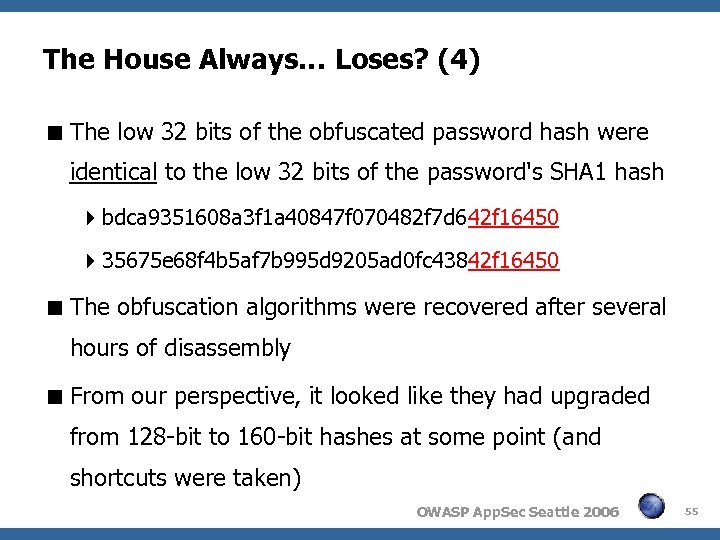 The House Always… Loses? (4) The low 32 bits of the obfuscated password hash were identical to the low 32 bits of the password's SHA 1 hash bdca 9351608 a 3 f 1 a 40847 f 070482 f 7 d 642 f 16450 35675 e 68 f 4 b 5 af 7 b 995 d 9205 ad 0 fc 43842 f 16450 The obfuscation algorithms were recovered after several hours of disassembly From our perspective, it looked like they had upgraded from 128 -bit to 160 -bit hashes at some point (and shortcuts were taken) OWASP App. Sec Seattle 2006 55
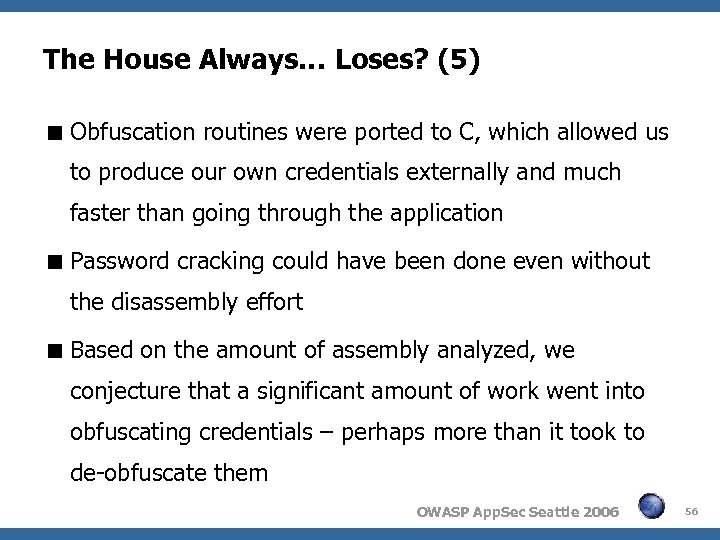 The House Always… Loses? (5) Obfuscation routines were ported to C, which allowed us to produce our own credentials externally and much faster than going through the application Password cracking could have been done even without the disassembly effort Based on the amount of assembly analyzed, we conjecture that a significant amount of work went into obfuscating credentials – perhaps more than it took to de-obfuscate them OWASP App. Sec Seattle 2006 56
 Can't Crack SSL? Just Talk Plaintext! A mobile application (Back) (Skip) OWASP App. Sec Seattle 2006 57
 Can't Crack SSL? Just Talk Plaintext! (1) A mobile application Fat BREW client that communicates via HTTPS Strong/Encrypted authentication discouraged MITM attacks and eliminated visibility between handsets and servers The provided handset was in test mode, so the application could be tweaked NOTE: BREW applications are digitally signed, so this line of attack is normally cut off Suppose BREW protections could be bypassed. . . OWASP App. Sec Seattle 2006 58
 Can't Crack SSL? Just Talk Plaintext! (2) We decided to find out how the system would react if the binary was modified to speak HTTP rather than HTTPS Trivial binary edit – no assembly required The results were interesting The handset happily spoke HTTP The servers accepted the unencrypted traffic, and, most importantly, certificate authentication was gone! OWASP App. Sec Seattle 2006 59
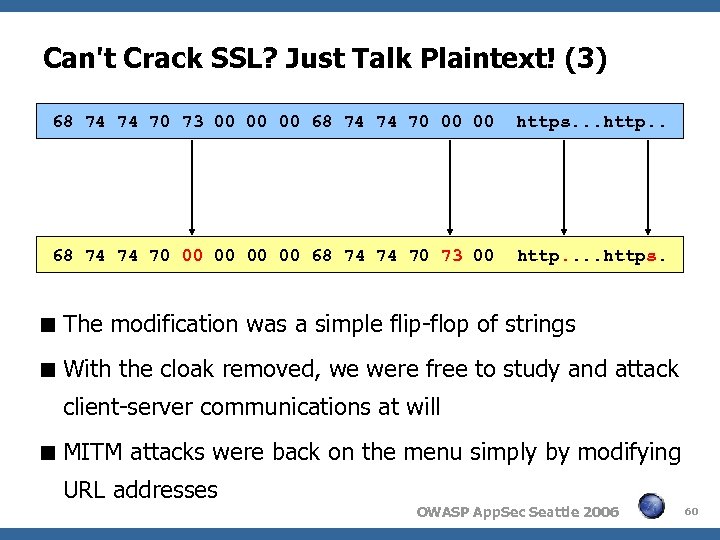 Can't Crack SSL? Just Talk Plaintext! (3) 68 74 74 70 73 00 00 00 68 74 74 70 00 00 https. . . http. . 68 74 74 70 00 00 68 74 74 70 73 00 http. . https. The modification was a simple flip-flop of strings With the cloak removed, we were free to study and attack client-server communications at will MITM attacks were back on the menu simply by modifying URL addresses OWASP App. Sec Seattle 2006 60
 Can't Crack SSL? Just Talk Plaintext! (4) The primary flaw, in our opinion, was the belief that the devices couldn’t be hacked Designers should assume that all components of a system will be known by or become visible to the attacker sooner or later Designers should use every layer of protection to their advantage, but they should not assume that any one layer will suffice Try to design each layer as if it were the only layer OWASP App. Sec Seattle 2006 61
 Can't Crack SSL? Just Talk Plaintext! (5) If a production system doesn't require unencrypted communications, don't deploy production binaries and services that support unencrypted communications If a mixed HTTP/HTTPS webserver starts getting queries in plaintext that ought to be SSL-only… maybe that’s a clue! OWASP App. Sec Seattle 2006 62
 “Take my data. Please!” A compartmentalized manufacturing application (Back) (Skip) OWASP App. Sec Seattle 2006 63
 “Take my data. Please!” (1) A compartmentalized manufacturing application Fat MS Windows client Proxy account built into the client issues an SQL query to authenticate the user's login credentials and obtain the user's encrypted database credentials Database traffic was not encrypted, but some of the individual fields were Unfortunately, this application used hard-coded keys, weak obfuscation techniques, and it leaked other users' encrypted credentials! OWASP App. Sec Seattle 2006 64
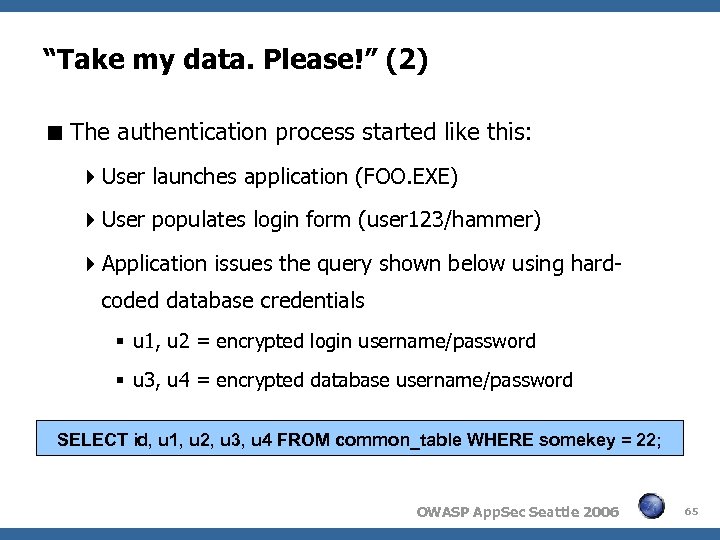 “Take my data. Please!” (2) The authentication process started like this: User launches application (FOO. EXE) User populates login form (user 123/hammer) Application issues the query shown below using hardcoded database credentials u 1, u 2 = encrypted login username/password u 3, u 4 = encrypted database username/password SELECT id, u 1, u 2, u 3, u 4 FROM common_table WHERE somekey = 22; OWASP App. Sec Seattle 2006 65
 “Take my data. Please!” (3) Next, the authentication process did this: Decrypt u 1 of each record until a match is found for the current user (user 123) Decrypt u 2 to determine if password matches the one supplied by the current user (hammer) If both u 1 and u 2 checks pass, decrypt u 3 and u 4 to obtain database credentials At this point, the user could work on the project All of these checks are done locally, in the client! OWASP App. Sec Seattle 2006 66
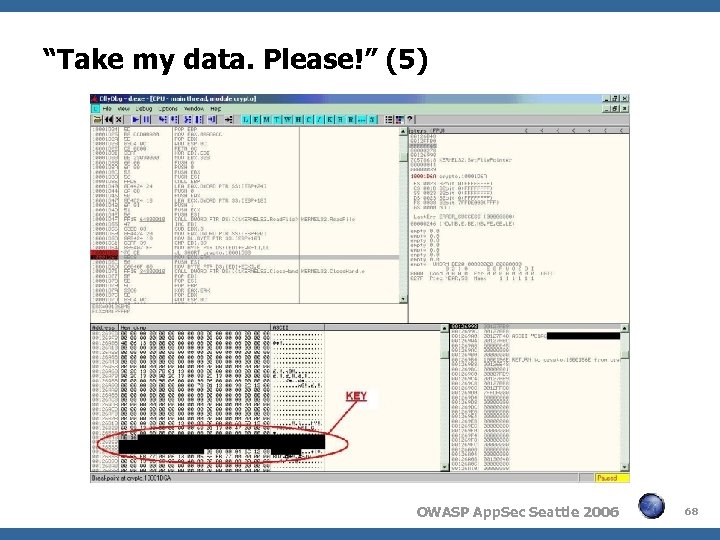
 “Take my data. Please!” (4) We could sniff the results of the query and could tell that the fields were encrypted We used Olly. Dbg to help us analyze the application The encryption/decryption key was stored in a local file: “query. key” 1536 bytes of binary data After some custom code, DLL abuse, and disassembly, we found the key, but it was only 57 bytes long So why was “query. key” so much bigger? OWASP App. Sec Seattle 2006 67
 “Take my data. Please!” (5) OWASP App. Sec Seattle 2006 68
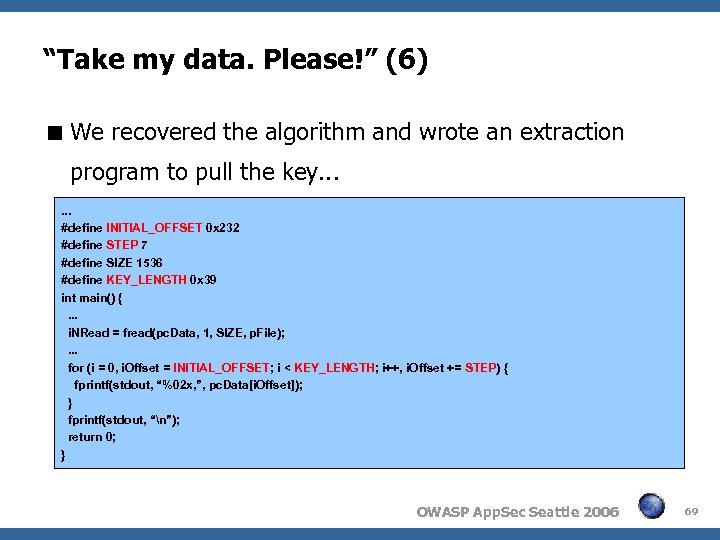 “Take my data. Please!” (6) We recovered the algorithm and wrote an extraction program to pull the key. . . #define INITIAL_OFFSET 0 x 232 #define STEP 7 #define SIZE 1536 #define KEY_LENGTH 0 x 39 int main() {. . . i. NRead = fread(pc. Data, 1, SIZE, p. File); . . . for (i = 0, i. Offset = INITIAL_OFFSET; i < KEY_LENGTH; i++, i. Offset += STEP) { fprintf(stdout, “%02 x, ”, pc. Data[i. Offset]); } fprintf(stdout, “n”); return 0; } OWASP App. Sec Seattle 2006 69
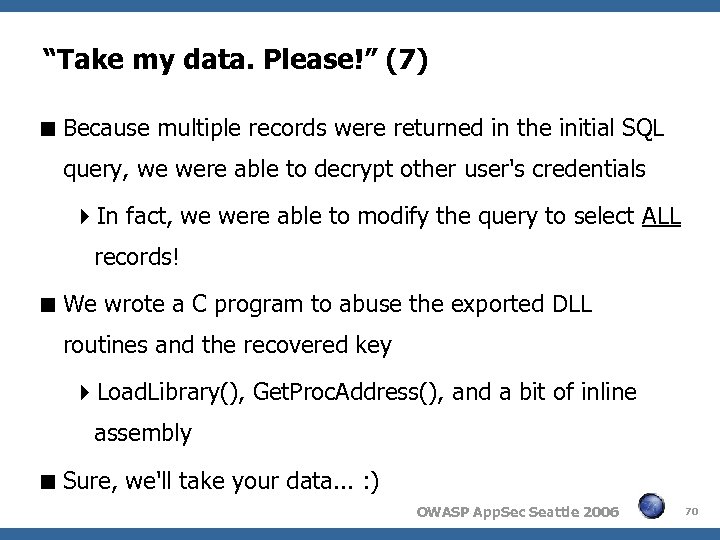 “Take my data. Please!” (7) Because multiple records were returned in the initial SQL query, we were able to decrypt other user's credentials In fact, we were able to modify the query to select ALL records! We wrote a C program to abuse the exported DLL routines and the recovered key Load. Library(), Get. Proc. Address(), and a bit of inline assembly Sure, we'll take your data. . . : ) OWASP App. Sec Seattle 2006 70
 Agenda Intro Case Studies - Home Grown Crypto Wall of Shame Prehash Analysis Recommendations and Closing Remarks (Skip) OWASP App. Sec Seattle 2006 71
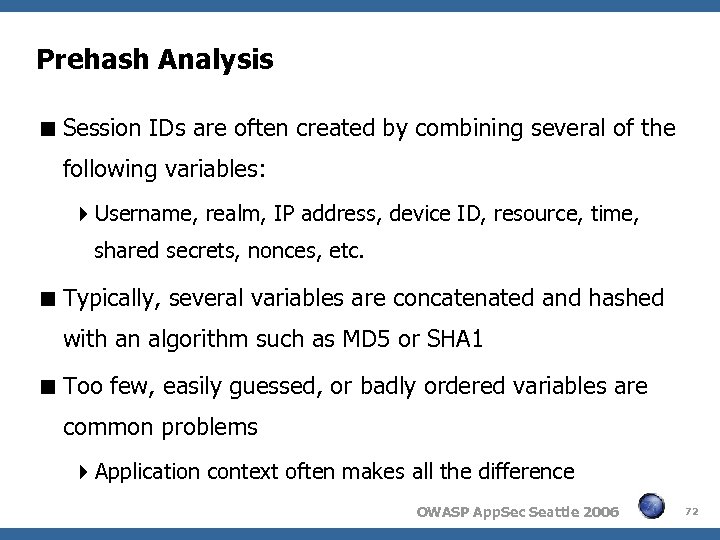 Prehash Analysis Session IDs are often created by combining several of the following variables: Username, realm, IP address, device ID, resource, time, shared secrets, nonces, etc. Typically, several variables are concatenated and hashed with an algorithm such as MD 5 or SHA 1 Too few, easily guessed, or badly ordered variables are common problems Application context often makes all the difference OWASP App. Sec Seattle 2006 72
 Prehash Analysis (2) Sometimes, an appropriate number of variables are chosen, but they're ordered in a way that makes the scheme weak Our MD 5 prehash analysis confirmed that weak schemes could be attacked faster The idea was to find a way to decrease the amount of time required to brute force a particular scheme In particular, we focused on a class of IDs that combine two types of variables: fixed prefix and variable suffix OWASP App. Sec Seattle 2006 73
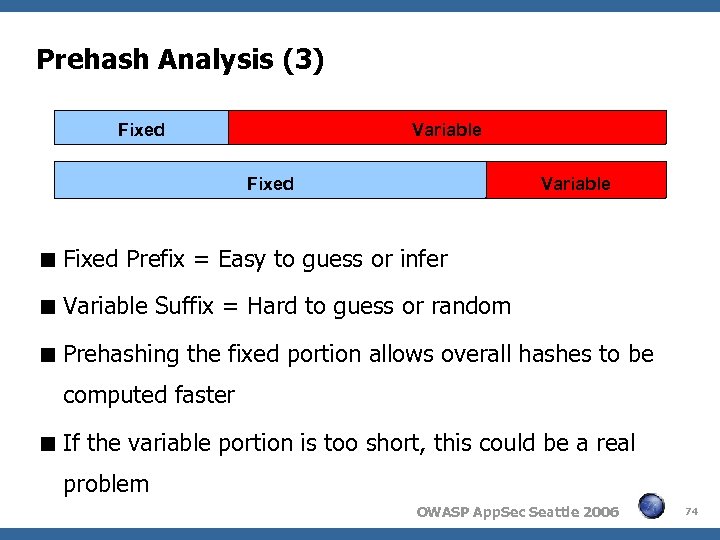 Prehash Analysis (3) Fixed Variable Fixed Prefix = Easy to guess or infer Variable Suffix = Hard to guess or random Prehashing the fixed portion allows overall hashes to be computed faster If the variable portion is too short, this could be a real problem OWASP App. Sec Seattle 2006 74
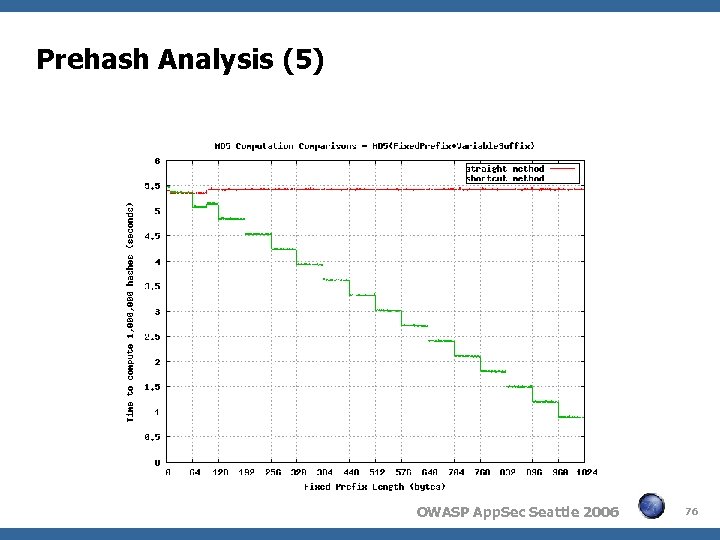
 Prehash Analysis (4) There is a significant advantage to prehashing if the hard-toguess variable(s) are at the end of the string and the total string length is longer than 64 bytes At 512 bytes, the performance gain is roughly 2: 1; at 1024, bytes the gain is roughly 6: 1 (see graph) The results of our analysis are documented here: www. korelogic. com/Resources/Papers/md 5 -analysis-prehash. txt Rainbow-table techniques should be applicable in some cases, for the same reason, making fixed-prefixes even worse OWASP App. Sec Seattle 2006 75
 Prehash Analysis (5) OWASP App. Sec Seattle 2006 76
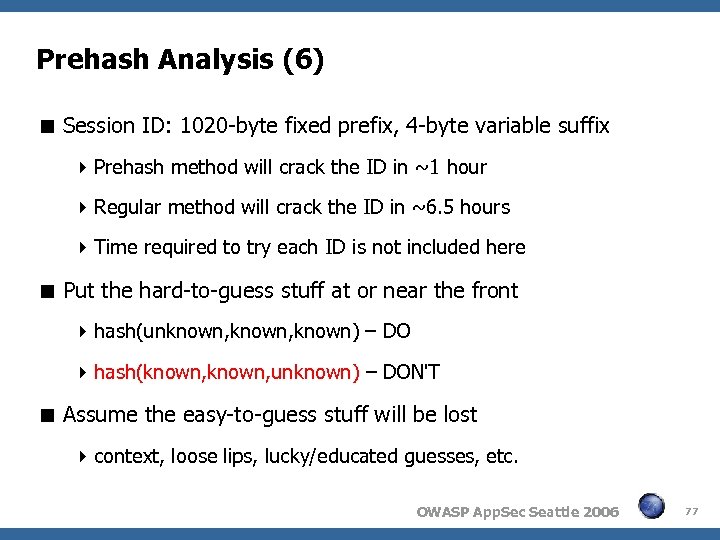 Prehash Analysis (6) Session ID: 1020 -byte fixed prefix, 4 -byte variable suffix Prehash method will crack the ID in ~1 hour Regular method will crack the ID in ~6. 5 hours Time required to try each ID is not included here Put the hard-to-guess stuff at or near the front hash(unknown, known) – DO hash(known, unknown) – DON'T Assume the easy-to-guess stuff will be lost context, loose lips, lucky/educated guesses, etc. OWASP App. Sec Seattle 2006 77
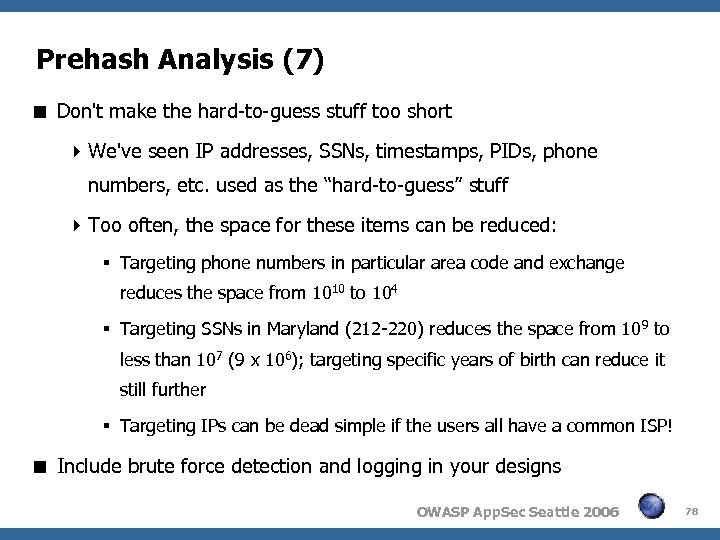 Prehash Analysis (7) Don't make the hard-to-guess stuff too short We've seen IP addresses, SSNs, timestamps, PIDs, phone numbers, etc. used as the “hard-to-guess” stuff Too often, the space for these items can be reduced: Targeting phone numbers in particular area code and exchange reduces the space from 1010 to 104 Targeting SSNs in Maryland (212 -220) reduces the space from 10 9 to less than 107 (9 x 10⁶); targeting specific years of birth can reduce it still further Targeting IPs can be dead simple if the users all have a common ISP! Include brute force detection and logging in your designs OWASP App. Sec Seattle 2006 78
 Agenda Intro Case Studies - Home Grown Crypto Wall of Shame Prehash Analysis Recommendations and Closing Remarks OWASP App. Sec Seattle 2006 79
 Don't Grow Your Own Crypto Unless you are a crypto mathematician and your job is to build crypto algorithms There are many ways to get it wrong. . . New algorithms require years of analysis by many experts to be verified and accepted Proprietary algorithms won't get the level scrutiny that open algorithms will Just because you can't break it, doesn't mean that someone else can't break it OWASP App. Sec Seattle 2006 80
 Don't Assume Too Much “That'll never happen. . . ” (epidemic) Plan on multiple protection mechanisms failing or being bypassed rather than assuming they'll just work “Don't underestimate the power of the dark side. . . ” Software disassembly techniques and tools are getting better all the time If your secrets are important enough, someone will attempt to get them OWASP App. Sec Seattle 2006 81
 Don't Rely On Obfuscation It's very difficult to prevent algorithm recovery when the attacker has full access to the client software, device, or whatever. . . Your time is better spent hardening server-side components and placing zero trust in client-side components that are out of your control Assume that any obfuscation you use is transparent Don't hide keys where they can be recovered – even if you think they can't be recovered OWASP App. Sec Seattle 2006 82
 Design From Your Data Out Design security around your data and work outwards from there – not the other way 'round Use layers of protection whenever possible Assume that each layer will be broken Add detection and logging at every layer Keep protection mechanisms simple and modular Compartmentalize your data Design such that a breach of one compartment does not automatically imply a breach of all OWASP App. Sec Seattle 2006 83
 Design For Agility Crypto Agility Hashes, key lengths, algorithms, and RNGs Protocol Agility How will your application handle protocol flaws? Error Agility Does your application handle unexpected errors gracefully? Application Agility How do you plan to upgrade all those clients? OWASP App. Sec Seattle 2006 84
 Use Care When Implementing Crypto Know how and why you are using it Use standard libraries that have already worked out most of the kinks Use previously stated guiding principles Don't grow your own crypto Don't assume too much Don't rely on obfuscation Design from your data out Design for agility OWASP App. Sec Seattle 2006 85
 Hardware Trumps Software Generally, it costs more to reverse crypto and/or protection mechanisms implemented in hardware (if done well) NOTE: We're not talking about appliances built around general purpose computers But don't get complacent. . . Hardware reversing is just a matter of time and money What is the life expectancy of your product (e. g. , client software, mobile devices, appliances)? How much time and money do you want the attackers to spend attacking your product? OWASP App. Sec Seattle 2006 86
 That's All Folks. . . Thanks! www. korelogic. com Extra credit: Why did the fly dance on the jar? OWASP App. Sec Seattle 2006 87