


 Скачать презентацию Home Games What s in it for the teams
5970ec226e1d3be1d2bdefe36168d9c0.ppt
- Количество слайдов: 21
 Home Games What’s in it for the teams?
 Why I hate the Dodgers n Not first team to move n n Left Brooklyn after 1957 season Braves, Browns, & A’s moved earlier Ended “Golden Era” of baseball n 1903 -53: Absolute stability n n Dodgers different n n Most profitable team in MLB Alone accounted for 47% of NL’s profits
 Key Lesson of Dodgers’ Move n n No city “safe” Starts involvement of cities n n n Some cities now say “no” n n Newark Some still say “yes!” n n Before 1950 – only 1 stadium publicly built By 1980 – almost all were Memphis Some say “no – I mean, yes!” n Charlotte
 What Power do Teams Have? Three factors play in teams’ favor n Monopoly Power n All-or-Nothing Demand Curve n Winner’s Curse n Will examine each in turn n
 Monopoly Power: Limit Output n Leagues slow to expand n By 1953: U. S. demographics had changed n n Los Angeles had no baseball teams – St. Louis had 2 Baseball & Football moved rather than expand n NFL did absorb 5 teams from rival leagues n n MLB expanded (1961 -62) n n n Browns, Colts, 49 ers, and Cardinals remain Prevent new league (NY, Houston) Avert Congressional intervention (Senators) NFL expansion tied to AFL n n First expanded (1960) to try to kill it Next expanded (1966) to merge with it
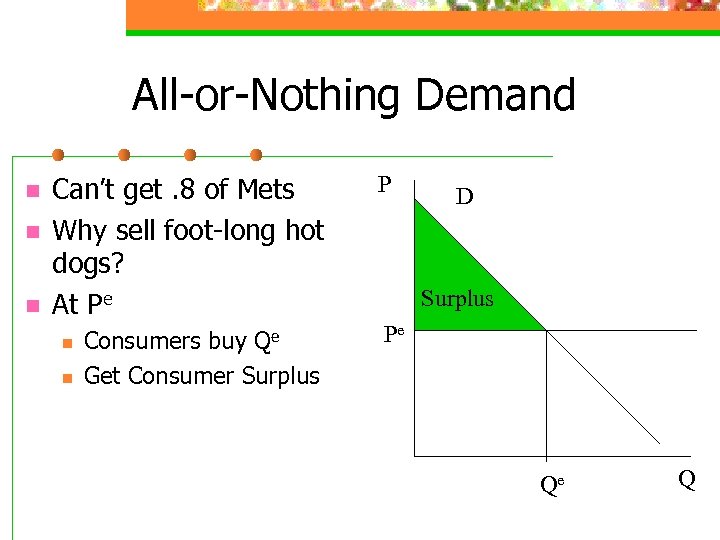 All-or-Nothing Demand n n n Can’t get. 8 of Mets Why sell foot-long hot dogs? At Pe n n Qe Consumers buy Get Consumer Surplus P D Surplus Pe Qe Q
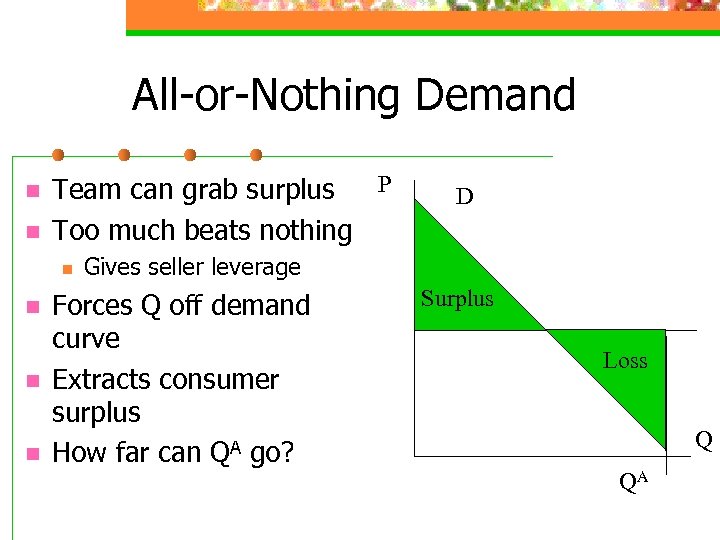 All-or-Nothing Demand n n P Team can grab surplus Too much beats nothing n n D Gives seller leverage Forces Q off demand curve Extracts consumer surplus How far can QA go? Surplus Loss Q QA
 Case in Point: The Olympics n 1976: Montreal Summer Olympics n n Spends C$1. 6 Billion; Debt ~C$1. 0 Billion Stakes raised after 1984 LA Olympics n n n Only city to bid on 1984 Summer Olympics Proved profitable 2004: Athens n n Spends almost $10 Billion 2008 Beijing n Spending about $35 Billion
 Winner’s Curse n n Buyer pays more than product is worth The setting: auction with an uncertain payoff n n Winner expects greatest payoff – could be: n n Who wins? Best suited to exploit opportunity Most optimistic Most intent on winning per se Olympic “competition” for host site
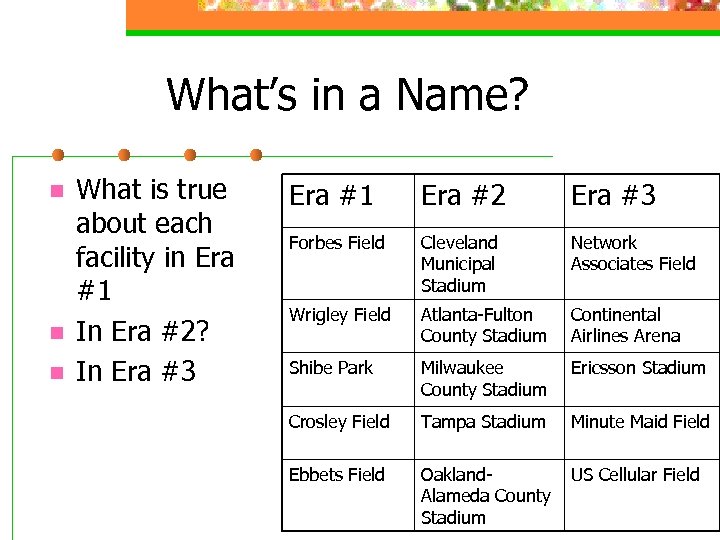 What’s in a Name? n n n What is true about each facility in Era #1 In Era #2? In Era #3 Era #1 Era #2 Era #3 Forbes Field Cleveland Municipal Stadium Network Associates Field Wrigley Field Atlanta-Fulton County Stadium Continental Airlines Arena Shibe Park Milwaukee County Stadium Ericsson Stadium Crosley Field Tampa Stadium Minute Maid Field Ebbets Field Oakland. Alameda County Stadium US Cellular Field
 Era #1 n All have “Park” or “Field” in name n n n Cites origin of baseball Trivia: What was first “stadium”? All have name of builder/team owner n n Exception – sort of – Wrigley Field Originally “Weeghman” Field (Federal League) n n Team and stadium later bought by Wrigley All are OLD n Most not there any more
 Era #2 n 4 of 5 built after 1950 n Lone exception: Municipal Stadium n n 3 of 5 built after 1960 n n Built to attract Olympics to Cleveland Exception built to lure Braves to Milwaukee Name reflects change of funding source n n Municipally built Leased to teams
 Era #3 n “Naming rights” sold by team n n Not necessarily privately built n n n Typically ~$2 Million/year Most have extensive public funding What do firms get from naming rights? Is it worth it? n n PSINet & Enron in Chapter 11 Pro. Player no longer exists 3 Com stopping rights deal The embarrassment of corporate mergers n The Core States/First Union/Wachovia Center
 Size Matters n Saw that baseball teams seldom sell out n Best: Giants, Red Sox & Cubs n n n Have new – or very old – ballparks Why? Optimal size for baseball stadium 30 -40, 000 Why was Veterans Stadium 60, 000+? Football has larger optimal size n Used to rent space from baseball teams in off-season n Took baseball names too n n NY Giants; Chicago Bears; Detroit Lions Municipal stadia built when football took off
 Shape Matters, Too Municipal “Cookie Cutters” n Designed by committee n n n No one happy Lose unique shapes Shibe Park built to fit in city grid n Polo Grounds built to fit between tracks & lot n n n 250’ shot heard round the world 450’ fly out
 Location, Location: The Urban Ballpark n New breed of ballparks n n Retro look Retro location? n Municipal stadia often not even in home city n n n Irving Cowboys vs East Rutherford Giants Left decaying stadia in decaying neighborhoods Old ballparks not built downtown n n Yankee Stadium built in “Goatville” Shibe Park on site of hospital for Contagious Diseases
 Location, Location: Cars and Costs n Fans have moved to suburbs n n Urban neighborhoods decay Need place to leave cars Result: “a sea of asphalt” n Stadium is “space intensive” n n n Creates problems for a downtown location Space costs money
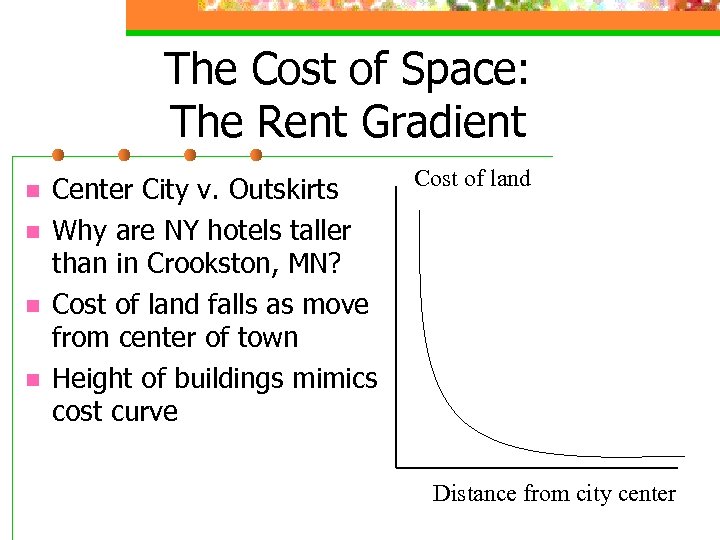 The Cost of Space: The Rent Gradient n n Center City v. Outskirts Why are NY hotels taller than in Crookston, MN? Cost of land falls as move from center of town Height of buildings mimics cost curve Cost of land Distance from city center
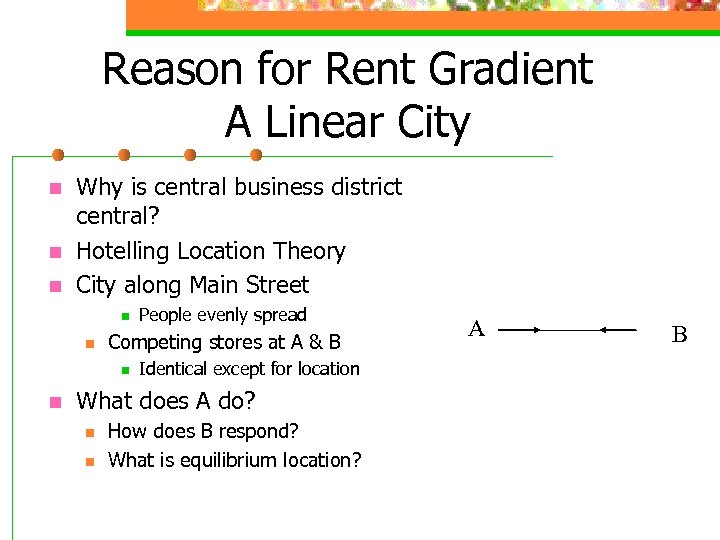 Reason for Rent Gradient A Linear City n n n Why is central business district central? Hotelling Location Theory City along Main Street n n Competing stores at A & B n n People evenly spread Identical except for location What does A do? n n How does B respond? What is equilibrium location? A B
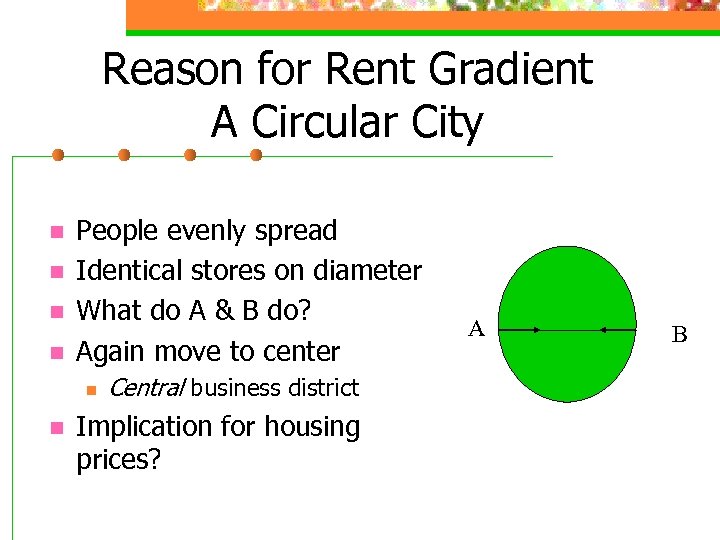 Reason for Rent Gradient A Circular City n n People evenly spread Identical stores on diameter What do A & B do? Again move to center n n Central business district Implication for housing prices? A B
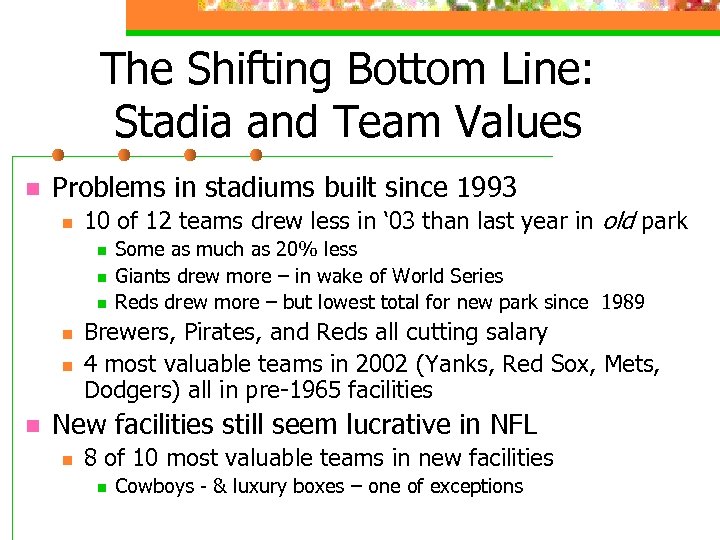 The Shifting Bottom Line: Stadia and Team Values n Problems in stadiums built since 1993 n 10 of 12 teams drew less in ‘ 03 than last year in old park n n n Some as much as 20% less Giants drew more – in wake of World Series Reds drew more – but lowest total for new park since 1989 Brewers, Pirates, and Reds all cutting salary 4 most valuable teams in 2002 (Yanks, Red Sox, Mets, Dodgers) all in pre-1965 facilities New facilities still seem lucrative in NFL n 8 of 10 most valuable teams in new facilities n Cowboys - & luxury boxes – one of exceptions