


 Скачать презентацию Home Food Safety Academy of Nutrition and
Power Point edited 1_16_14.pptx
- Количество слайдов: 16
 Home Food Safety • Academy of Nutrition and Dietetics (formerly the American Dietetic Association) Made by O. Shkinder 1
 Home Food Safety Why Food Safety Is Important • According to estimates from the Centers for Disease Control and Prevention: • 48 million people (1 in 6 Americans) get foodborne illness each year • 128, 000 people are hospitalized each year • 3, 000 deaths each year 2
 Home Food Safety Consumers and Food Safety • In 2011, 89% use different plates for handling raw meat and cooked meat, compared to 85% in 2002 • In 2011, 20% use a food thermometer to check the doneness for read meat, pork or poultry, compared to 25% in 2002 • In 2011, 91% wash utensils used to handle raw food before they are used for cooked food, compared to 82% in 2002 3
 Home Food Safety Common Foodborne Illnesses Illness Potential Sources Salmonella and Campylobacter Poultry Meat Eggs Unpasteurized milk/dairy products Raw produce Listeria Raw milk Soft cheese Luncheon meats/hot dogs Raw produce E. Coli Raw/undercooked meat Raw produce Unpasteurized milk 4
 Home Food Safety Infections and its Symptoms How does foodborne illness occur? • Contaminated foods carry microbes into the body • Some microbes can overcome the body’s defenses and cause infections What are its typical primary symptoms? • Nausea • Vomiting • Abdominal cramps • Diarrhea 5
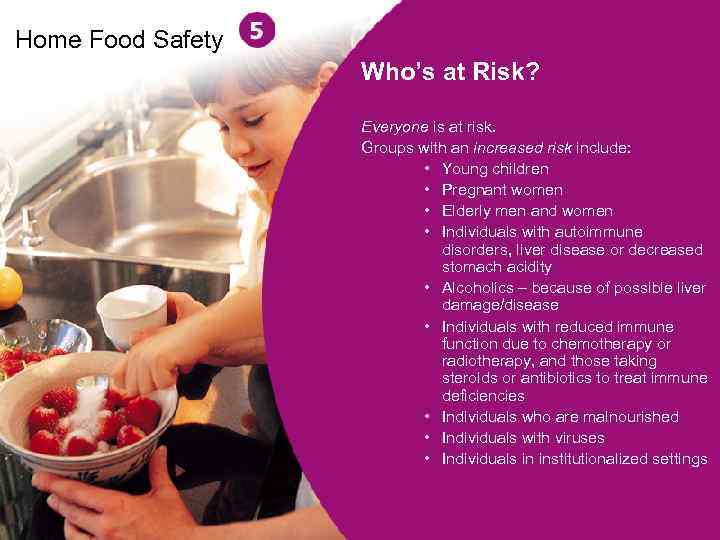 Home Food Safety Who’s at Risk? Everyone is at risk. Groups with an increased risk include: • Young children • Pregnant women • Elderly men and women • Individuals with autoimmune disorders, liver disease or decreased stomach acidity • Alcoholics – because of possible liver damage/disease • Individuals with reduced immune function due to chemotherapy or radiotherapy, and those taking steroids or antibiotics to treat immune deficiencies • Individuals who are malnourished • Individuals with viruses • Individuals in institutionalized settings 6
 Home Food Safety Risks You Can Control • • • Improper refrigeration and storage Poor personal hygiene Cross-contamination Contaminated food sources Undercooking Other time and temperature mistakes 7
 Home Food Safety Ensuring Food at Home Safety • Wash hands often • Wash produce before cutting, cooking or eating • Wash utensils and cutting boards after each use • Keep kitchen surfaces clean • Keep raw meat and ready-to-eat foods separate • Cook food to proper temperatures and use a food thermometer • Refrigerate food promptly to below 40°F • Pay close attention to use-by dates when in doubt, throw it out! 8
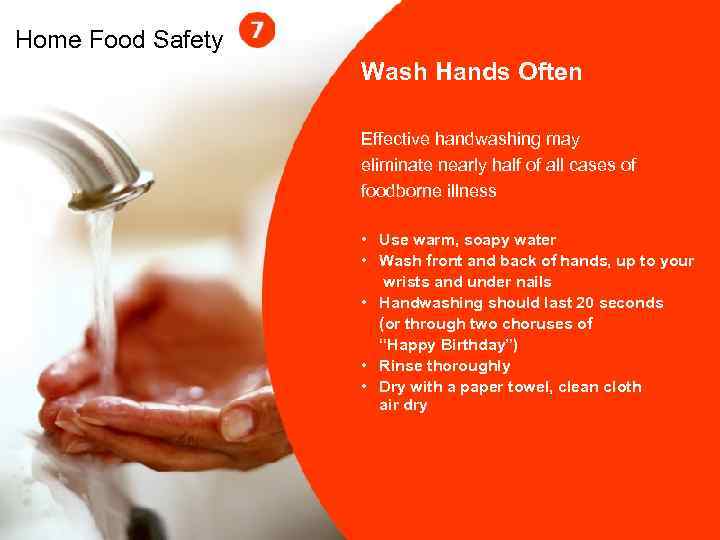 Home Food Safety Wash Hands Often Effective handwashing may eliminate nearly half of all cases of foodborne illness • Use warm, soapy water • Wash front and back of hands, up to your wrists and under nails • Handwashing should last 20 seconds (or through two choruses of “Happy Birthday”) • Rinse thoroughly • Dry with a paper towel, clean cloth air dry 9
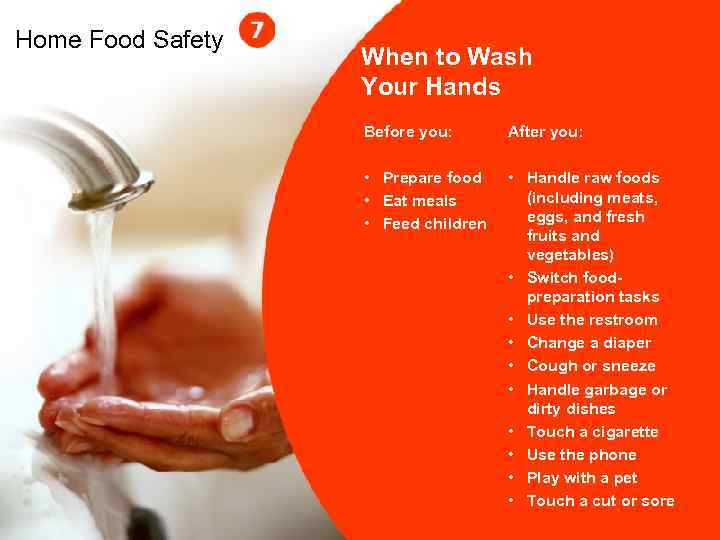 Home Food Safety When to Wash Your Hands Before you: After you: • Prepare food • Eat meals • Feed children • Handle raw foods (including meats, eggs, and fresh fruits and vegetables) • Switch foodpreparation tasks • Use the restroom • Change a diaper • Cough or sneeze • Handle garbage or dirty dishes • Touch a cigarette • Use the phone • Play with a pet • Touch a cut or sore 10
 Home Food Safety Kitchen Surface Safety • Clean kitchen surfaces, appliances and tools with hot, soapy water • Wash dishcloths and towels in the washing machine hot cycle • Sanitize sponges in bleach solution • Replace sponges frequently • Do not use dish towels for multiple jobs • Wash reusable grocery bags 11
 Home Food Safety Keep Raw Meat and Readyto-Eat Foods Separate • What is cross-contamination? • Keep raw and ready-to-eat foods separate to prevent the spread of bacteria 12
 Home Food Safety Prevent Cross-Contamination • Store raw meat on bottom shelf of refrigerator • Wash all produce, even pre- packaged/pre-washed • Store washed produce in clean container • Wash plates between uses or use separate plates • Use one utensil to taste and another to stir food • Use clean scissors to open bags • Wear disposable gloves if you have a cut or sore 13
 Home Food Safety Use Cutting Boards Safely • Use two cutting boards – one for raw meat , poultry, and seafood and one for ready-to-eat foods • Wash boards thoroughly in hot, soapy water or place in dishwasher • Rinse • After cutting raw meat, poultry and seafood, wash, rinse and sanitize boards • Discard boards with cracks, crevices or scars 14
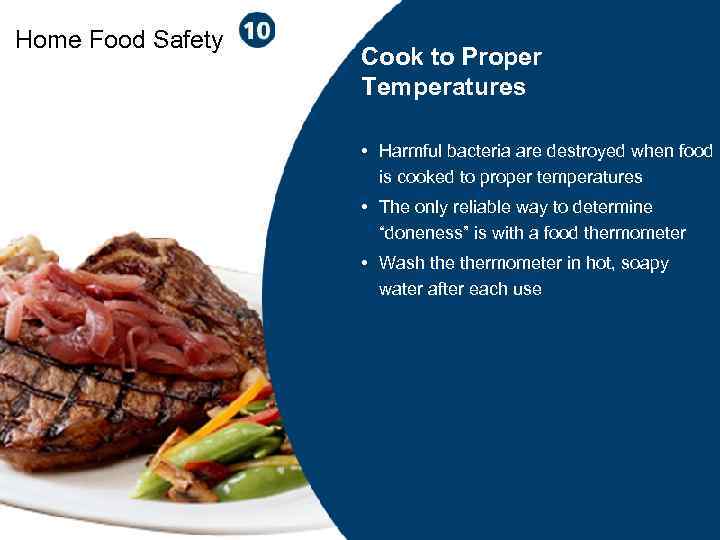 Home Food Safety Cook to Proper Temperatures • Harmful bacteria are destroyed when food is cooked to proper temperatures • The only reliable way to determine “doneness” is with a food thermometer • Wash thermometer in hot, soapy water after each use 15
 Home Food Safety Recommended Storage Time for Leftovers Cooked beef, pork, poultry 3 -5 days Fried chicken 3 -4 days Egg dishes 3 -4 days Fresh eggs in shells 3 -5 weeks Sliced deli meats 3 -5 days Milk 7 days Pizza 3 -4 days Salsa 3 days after open Cheesecake 7 days 16