 Скачать презентацию Home Back Forward Yorkshire Coast College Welcome Terminology
ad036c4c91a192f4593cb098741e3a42.ppt
- Количество слайдов: 23



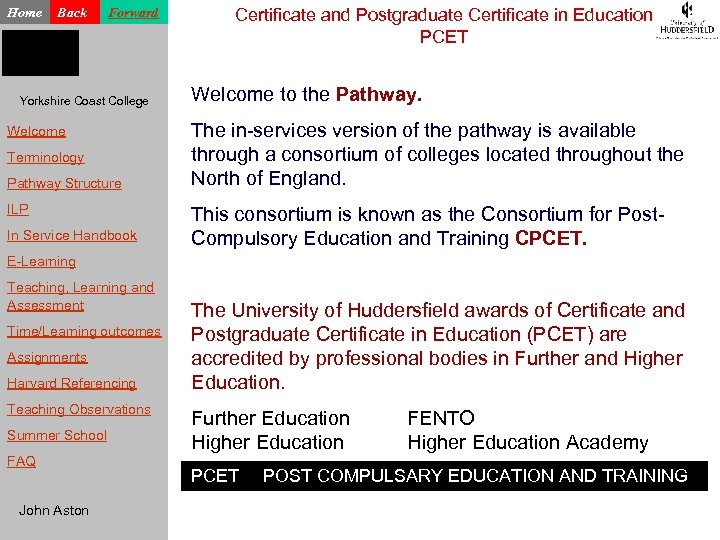
Home Back Forward Yorkshire Coast College Welcome Terminology Pathway Structure ILP In Service Handbook Certificate and Postgraduate Certificate in Education PCET Welcome to the Pathway. The in-services version of the pathway is available through a consortium of colleges located throughout the North of England. This consortium is known as the Consortium for Post. Compulsory Education and Training CPCET. E-Learning Teaching, Learning and Assessment Time/Learning outcomes Assignments Harvard Referencing Teaching Observations Summer School FAQ John Aston The University of Huddersfield awards of Certificate and Postgraduate Certificate in Education (PCET) are accredited by professional bodies in Further and Higher Education. Further Education Higher Education PCET FENTO Higher Education Academy POST COMPULSARY EDUCATION AND TRAINING
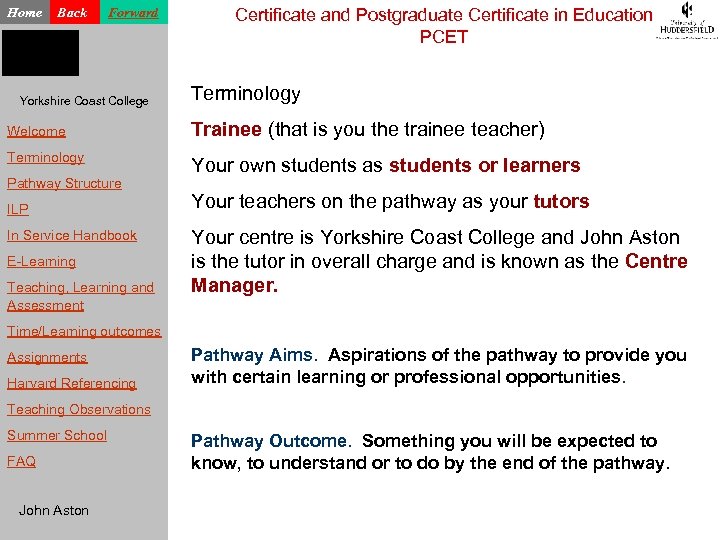
Home Back Forward Yorkshire Coast College Certificate and Postgraduate Certificate in Education PCET Terminology Welcome Trainee (that is you the trainee teacher) Terminology Your own students as students or learners Pathway Structure ILP In Service Handbook E-Learning Teaching, Learning and Assessment Your teachers on the pathway as your tutors Your centre is Yorkshire Coast College and John Aston is the tutor in overall charge and is known as the Centre Manager. Time/Learning outcomes Assignments Harvard Referencing Pathway Aims. Aspirations of the pathway to provide you with certain learning or professional opportunities. Teaching Observations Summer School FAQ John Aston Pathway Outcome. Something you will be expected to know, to understand or to do by the end of the pathway.
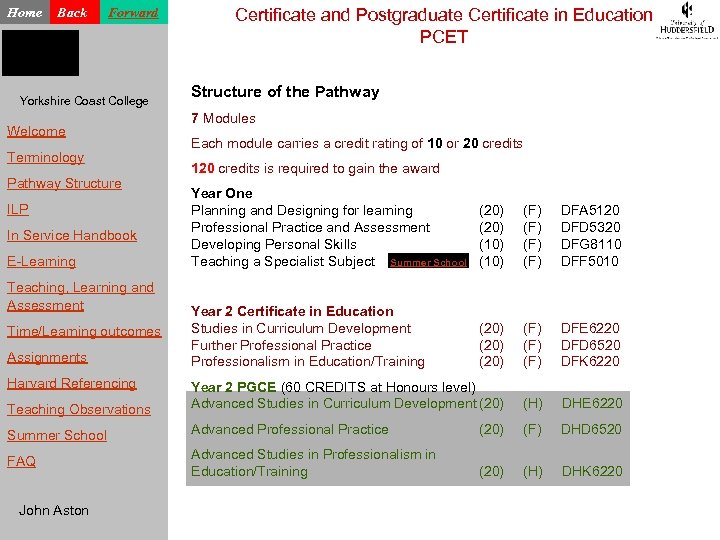
Home Back Forward Yorkshire Coast College Welcome Terminology Pathway Structure ILP In Service Handbook E-Learning Teaching, Learning and Assessment Time/Learning outcomes Assignments Harvard Referencing Certificate and Postgraduate Certificate in Education PCET Structure of the Pathway 7 Modules Each module carries a credit rating of 10 or 20 credits 120 credits is required to gain the award Year One Planning and Designing for learning Professional Practice and Assessment Developing Personal Skills Teaching a Specialist Subject Summer School (20) (F) DFA 5120 (20) (F) DFD 5320 (10) (F) DFG 8110 (10) (F) DFF 5010 Year 2 Certificate in Education Studies in Curriculum Development Further Professional Practice Professionalism in Education/Training (20) (F) DFE 6220 (20) (F) DFD 6520 (20) (F) DFK 6220 Teaching Observations Year 2 PGCE (60 CREDITS at Honours level) Advanced Studies in Curriculum Development (20) (H) DHE 6220 Summer School Advanced Professional Practice FAQ Advanced Studies in Professionalism in Education/Training John Aston (20) (F) DHD 6520 (20) (H) DHK 6220
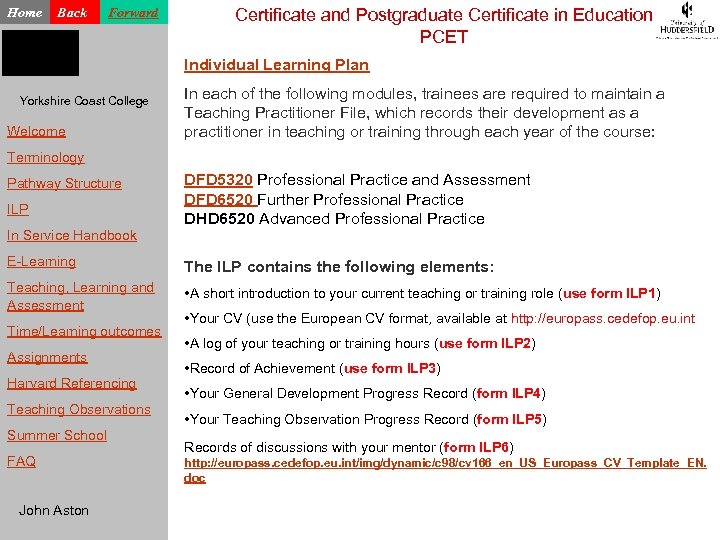
Home Back Forward Certificate and Postgraduate Certificate in Education PCET Individual Learning Plan Yorkshire Coast College Welcome Terminology Pathway Structure ILP In each of the following modules, trainees are required to maintain a Teaching Practitioner File, which records their development as a practitioner in teaching or training through each year of the course: DFD 5320 Professional Practice and Assessment DFD 6520 Further Professional Practice DHD 6520 Advanced Professional Practice In Service Handbook E-Learning The ILP contains the following elements: Teaching, Learning and Assessment • A short introduction to your current teaching or training role (use form ILP 1) Time/Learning outcomes Assignments Harvard Referencing Teaching Observations Summer School FAQ John Aston • Your CV (use the European CV format, available at http: //europass. cedefop. eu. int • A log of your teaching or training hours (use form ILP 2) • Record of Achievement (use form ILP 3) • Your General Development Progress Record (form ILP 4) • Your Teaching Observation Progress Record (form ILP 5) Records of discussions with your mentor (form ILP 6) http: //europass. cedefop. eu. int/img/dynamic/c 98/cv 166_en_US_Europass_CV_Template_EN. doc
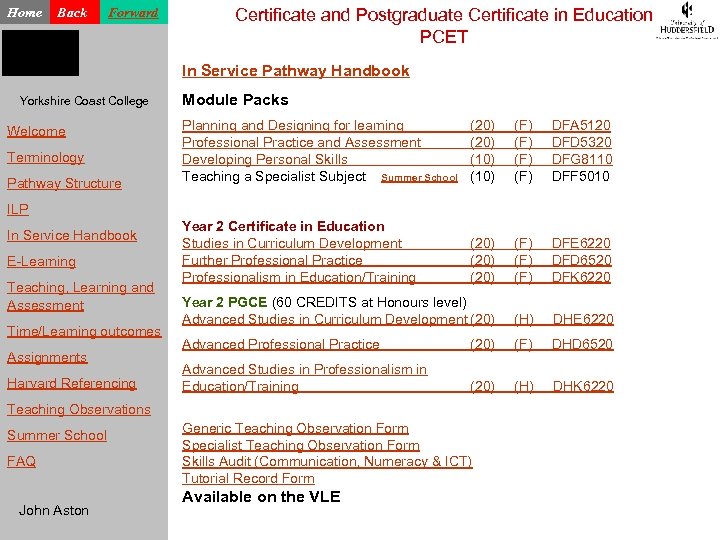
Home Back Forward Certificate and Postgraduate Certificate in Education PCET In Service Pathway Handbook Yorkshire Coast College Welcome Terminology Pathway Structure Module Packs Planning and Designing for learning Professional Practice and Assessment Developing Personal Skills Teaching a Specialist Subject Summer School (20) (F) DFA 5120 (20) (F) DFD 5320 (10) (F) DFG 8110 (10) (F) DFF 5010 Year 2 Certificate in Education Studies in Curriculum Development Further Professional Practice Professionalism in Education/Training (20) (F) DFE 6220 (20) (F) DFD 6520 (20) (F) DFK 6220 ILP In Service Handbook E-Learning Teaching, Learning and Assessment Time/Learning outcomes Assignments Harvard Referencing Year 2 PGCE (60 CREDITS at Honours level) Advanced Studies in Curriculum Development (20) (H) DHE 6220 Advanced Professional Practice Advanced Studies in Professionalism in Education/Training (20) (F) DHD 6520 (20) (H) DHK 6220 Teaching Observations Summer School FAQ John Aston Generic Teaching Observation Form Specialist Teaching Observation Form Skills Audit (Communication, Numeracy & ICT) Tutorial Record Form Available on the VLE
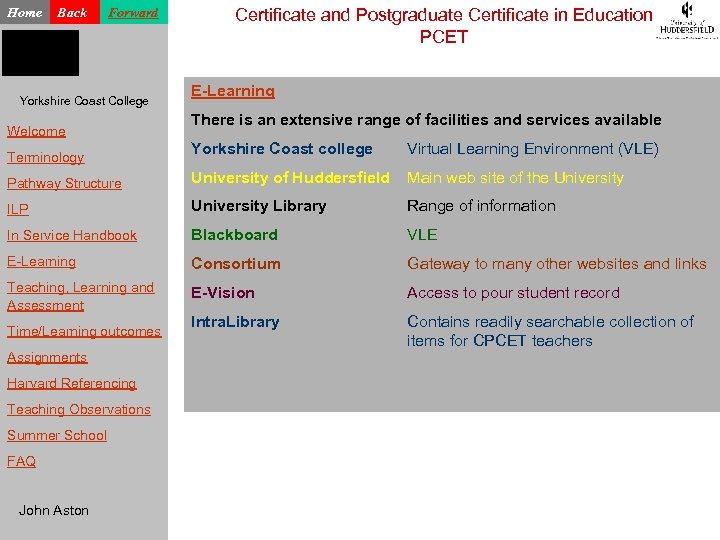
Home Back Forward Yorkshire Coast College Welcome Certificate and Postgraduate Certificate in Education PCET E-Learning There is an extensive range of facilities and services available Yorkshire Coast college Virtual Learning Environment (VLE) Pathway Structure University of Huddersfield Main web site of the University ILP University Library Range of information In Service Handbook Blackboard VLE E-Learning Consortium Gateway to many other websites and links Teaching, Learning and Assessment E-Vision Access to pour student record Intra. Library Contains readily searchable collection of items for CPCET teachers Terminology Time/Learning outcomes Assignments Harvard Referencing Teaching Observations Summer School FAQ John Aston
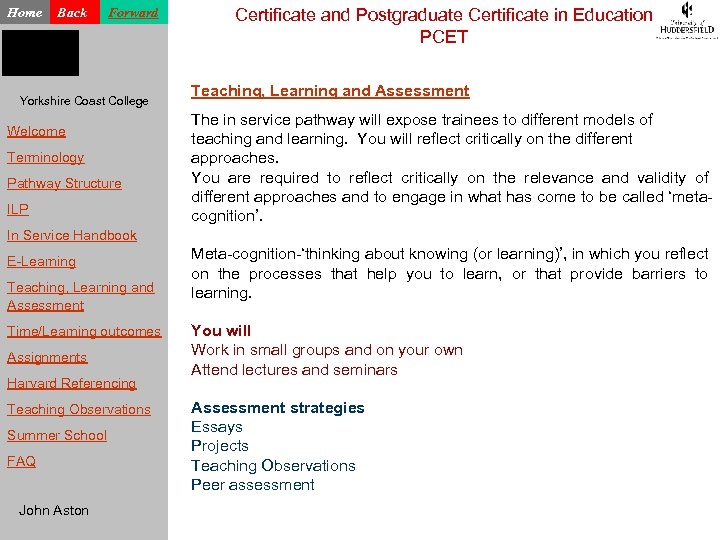
Home Back Forward Yorkshire Coast College Welcome Terminology Pathway Structure ILP Certificate and Postgraduate Certificate in Education PCET Teaching, Learning and Assessment The in service pathway will expose trainees to different models of teaching and learning. You will reflect critically on the different approaches. You are required to reflect critically on the relevance and validity of different approaches and to engage in what has come to be called ‘metacognition’. In Service Handbook E-Learning Teaching, Learning and Assessment Time/Learning outcomes Assignments Harvard Referencing Teaching Observations Summer School FAQ John Aston Meta-cognition-‘thinking about knowing (or learning)’, in which you reflect on the processes that help you to learn, or that provide barriers to learning. You will Work in small groups and on your own Attend lectures and seminars Assessment strategies Essays Projects Teaching Observations Peer assessment
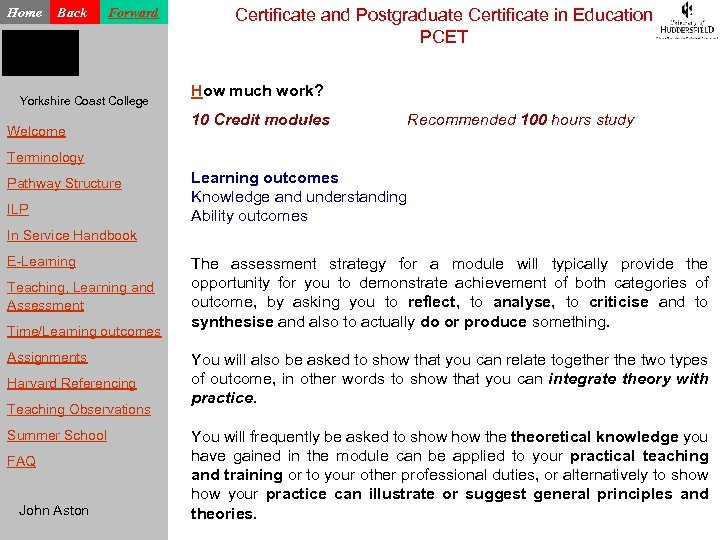
Home Back Forward Yorkshire Coast College Welcome Certificate and Postgraduate Certificate in Education PCET How much work? 10 Credit modules Recommended 100 hours study Terminology Pathway Structure ILP Learning outcomes Knowledge and understanding Ability outcomes In Service Handbook E-Learning Teaching, Learning and Assessment Time/Learning outcomes Assignments Harvard Referencing Teaching Observations Summer School FAQ John Aston The assessment strategy for a module will typically provide the opportunity for you to demonstrate achievement of both categories of outcome, by asking you to reflect, to analyse, to criticise and to synthesise and also to actually do or produce something. You will also be asked to show that you can relate together the two types of outcome, in other words to show that you can integrate theory with practice. You will frequently be asked to show the theoretical knowledge you have gained in the module can be applied to your practical teaching and training or to your other professional duties, or alternatively to show your practice can illustrate or suggest general principles and theories.
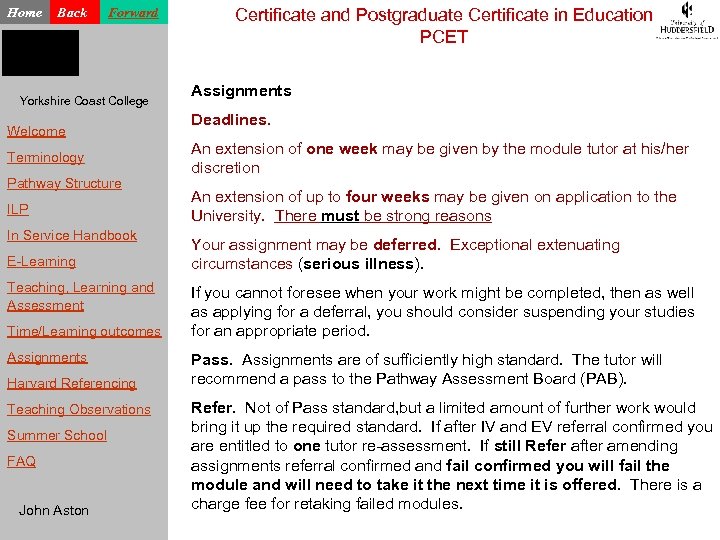
Home Back Forward Yorkshire Coast College Welcome Terminology Pathway Structure ILP In Service Handbook E-Learning Teaching, Learning and Assessment Time/Learning outcomes Assignments Harvard Referencing Teaching Observations Summer School FAQ John Aston Certificate and Postgraduate Certificate in Education PCET Assignments Deadlines. An extension of one week may be given by the module tutor at his/her discretion An extension of up to four weeks may be given on application to the University. There must be strong reasons Your assignment may be deferred. Exceptional extenuating circumstances (serious illness). If you cannot foresee when your work might be completed, then as well as applying for a deferral, you should consider suspending your studies for an appropriate period. Pass. Assignments are of sufficiently high standard. The tutor will recommend a pass to the Pathway Assessment Board (PAB). Refer. Not of Pass standard, but a limited amount of further work would bring it up the required standard. If after IV and EV referral confirmed you are entitled to one tutor re-assessment. If still Refer after amending assignments referral confirmed and fail confirmed you will fail the module and will need to take it the next time it is offered. There is a charge fee for retaking failed modules.
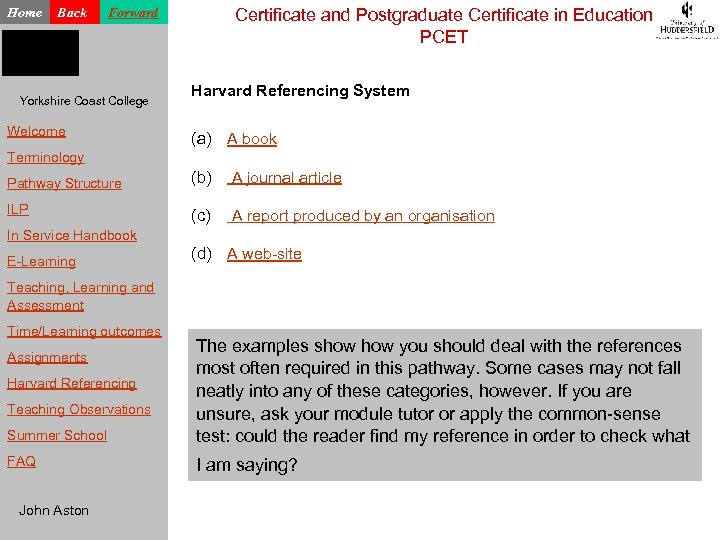
Home Back Forward Yorkshire Coast College Welcome Certificate and Postgraduate Certificate in Education PCET Harvard Referencing System (a) A book Terminology Pathway Structure (b) A journal article ILP (c) A report produced by an organisation In Service Handbook E-Learning (d) A web-site Teaching, Learning and Assessment Time/Learning outcomes Assignments Harvard Referencing Teaching Observations Summer School FAQ John Aston The examples show you should deal with the references most often required in this pathway. Some cases may not fall neatly into any of these categories, however. If you are unsure, ask your module tutor or apply the common-sense test: could the reader find my reference in order to check what I am saying?
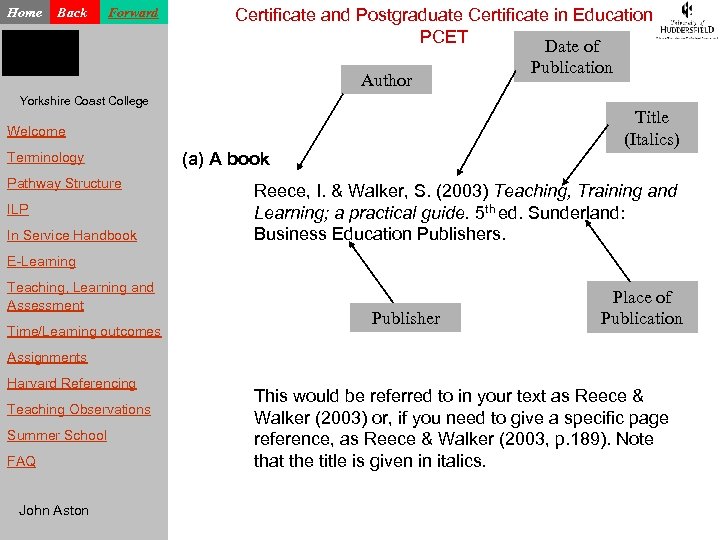
Home Back Forward Certificate and Postgraduate Certificate in Education PCET Date of Publication Author Yorkshire Coast College Title (Italics) Welcome Terminology Pathway Structure ILP In Service Handbook (a) A book Reece, I. & Walker, S. (2003) Teaching, Training and Learning; a practical guide. 5 th ed. Sunderland: Business Education Publishers. E-Learning Teaching, Learning and Assessment Time/Learning outcomes Publisher Place of Publication Assignments Harvard Referencing Teaching Observations Summer School FAQ John Aston This would be referred to in your text as Reece & Walker (2003) or, if you need to give a specific page reference, as Reece & Walker (2003, p. 189). Note that the title is given in italics.
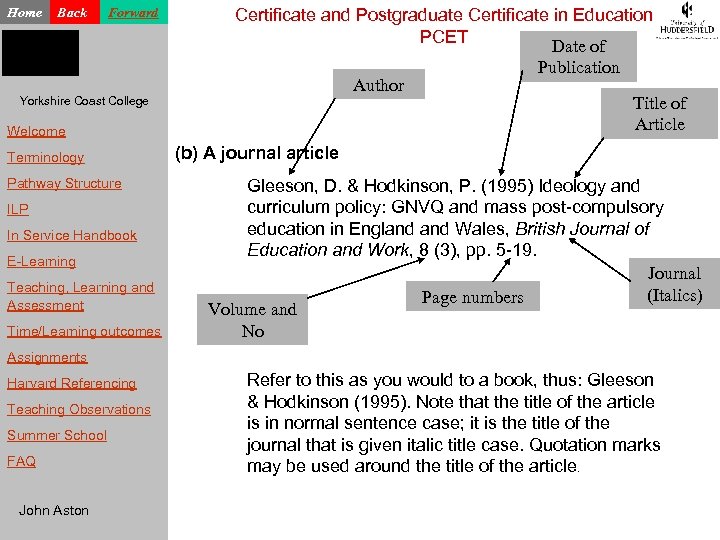
Home Back Forward Yorkshire Coast College Welcome Terminology Pathway Structure ILP In Service Handbook E-Learning Teaching, Learning and Assessment Time/Learning outcomes Certificate and Postgraduate Certificate in Education PCET Date of Publication Author Title of Article (b) A journal article Gleeson, D. & Hodkinson, P. (1995) Ideology and curriculum policy: GNVQ and mass post-compulsory education in England Wales, British Journal of Education and Work, 8 (3), pp. 5 -19. Journal (Italics) Page numbers Volume and No Assignments Harvard Referencing Teaching Observations Summer School FAQ John Aston Refer to this as you would to a book, thus: Gleeson & Hodkinson (1995). Note that the title of the article is in normal sentence case; it is the title of the journal that is given italic title case. Quotation marks may be used around the title of the article.
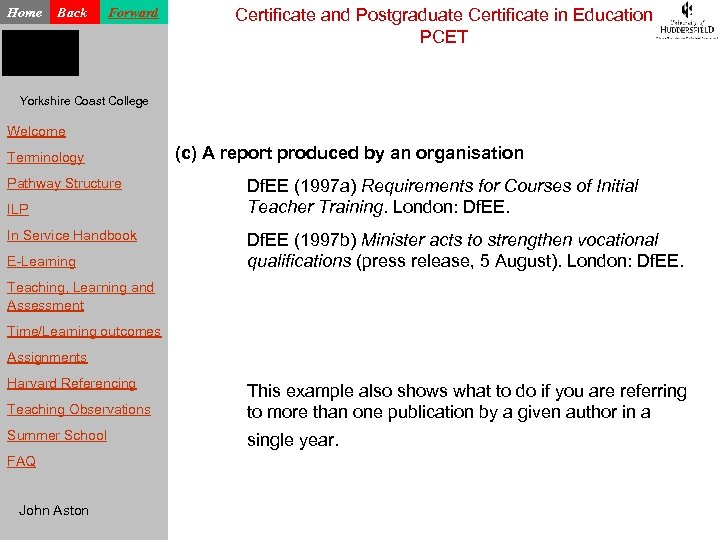
Home Back Forward Certificate and Postgraduate Certificate in Education PCET Yorkshire Coast College Welcome Terminology Pathway Structure ILP In Service Handbook E-Learning (c) A report produced by an organisation Df. EE (1997 a) Requirements for Courses of Initial Teacher Training. London: Df. EE (1997 b) Minister acts to strengthen vocational qualifications (press release, 5 August). London: Df. EE. Teaching, Learning and Assessment Time/Learning outcomes Assignments Harvard Referencing Teaching Observations Summer School FAQ John Aston This example also shows what to do if you are referring to more than one publication by a given author in a single year.
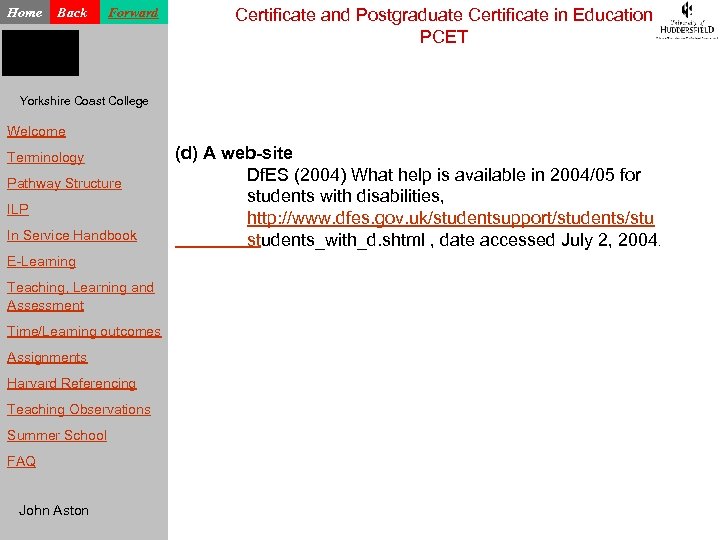
Home Back Forward Certificate and Postgraduate Certificate in Education PCET Yorkshire Coast College Welcome Terminology Pathway Structure ILP In Service Handbook E-Learning Teaching, Learning and Assessment Time/Learning outcomes Assignments Harvard Referencing Teaching Observations Summer School FAQ John Aston (d) A web-site Df. ES (2004) What help is available in 2004/05 for students with disabilities, http: //www. dfes. gov. uk/studentsupport/students/stu students_with_d. shtml , date accessed July 2, 2004.
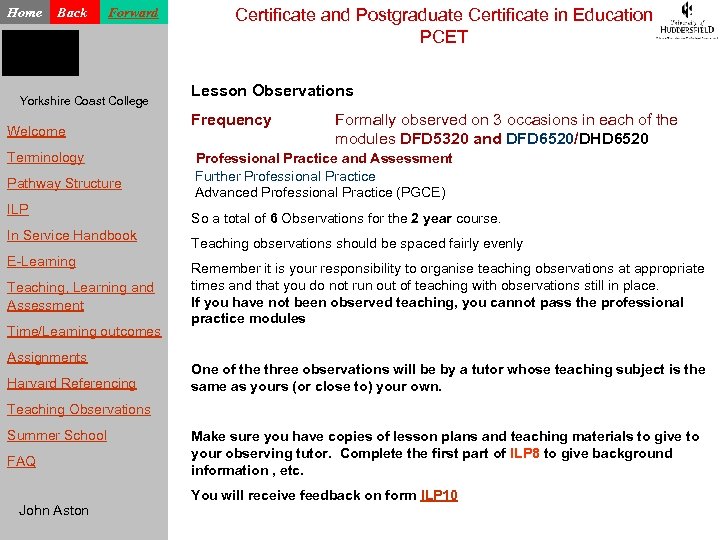
Home Back Forward Yorkshire Coast College Welcome Terminology Pathway Structure ILP In Service Handbook E-Learning Teaching, Learning and Assessment Time/Learning outcomes Assignments Harvard Referencing Certificate and Postgraduate Certificate in Education PCET Lesson Observations Frequency Formally observed on 3 occasions in each of the modules DFD 5320 and DFD 6520/DHD 6520 Professional Practice and Assessment Further Professional Practice Advanced Professional Practice (PGCE) So a total of 6 Observations for the 2 year course. Teaching observations should be spaced fairly evenly Remember it is your responsibility to organise teaching observations at appropriate times and that you do not run out of teaching with observations still in place. If you have not been observed teaching, you cannot pass the professional practice modules One of the three observations will be by a tutor whose teaching subject is the same as yours (or close to) your own. Teaching Observations Summer School FAQ John Aston Make sure you have copies of lesson plans and teaching materials to give to your observing tutor. Complete the first part of ILP 8 to give background information , etc. You will receive feedback on form ILP 10
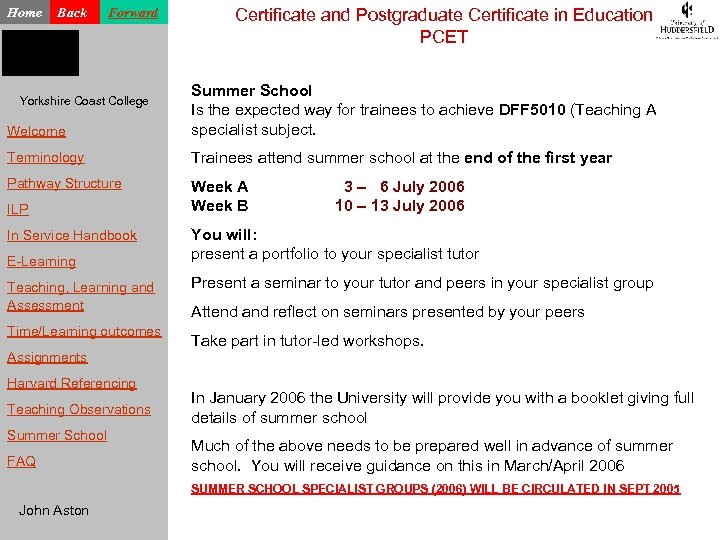
Home Back Forward Certificate and Postgraduate Certificate in Education PCET Welcome Summer School Is the expected way for trainees to achieve DFF 5010 (Teaching A specialist subject. Terminology Trainees attend summer school at the end of the first year Pathway Structure Week A Week B Yorkshire Coast College ILP In Service Handbook E-Learning Teaching, Learning and Assessment Time/Learning outcomes 3 – 6 July 2006 10 – 13 July 2006 You will: present a portfolio to your specialist tutor Present a seminar to your tutor and peers in your specialist group Attend and reflect on seminars presented by your peers Take part in tutor-led workshops. Assignments Harvard Referencing Teaching Observations Summer School FAQ In January 2006 the University will provide you with a booklet giving full details of summer school Much of the above needs to be prepared well in advance of summer school. You will receive guidance on this in March/April 2006 SUMMER SCHOOL SPECIALIST GROUPS (2006) WILL BE CIRCULATED IN SEPT 2005 John Aston
Home Back Forward Yorkshire Coast College Welcome Terminology Pathway Structure ILP In Service Handbook Certificate and Postgraduate Certificate in Education PCET FAQ (Frequently Asked Questions) What is the difference between the Certificate and Postgraduate Certificate in Education? How long will it take? Does the Pathway confer Qualified Teacher Status (QTS) for work in Schools? E-Learning What do I do if I change personal details (such as my address)? Teaching, Learning and Assessment What times do I need to attend? Time/Learning outcomes What do I do if I am ill and unable to attend? Assignments Harvard Referencing What work do I have to do to pass a module and gain the credit points? Teaching Observations How much time will I need to devote to studies? Summer School FAQ John Aston How much reading do I need to do? Is there a reading list?
Home Back Forward Yorkshire Coast College Welcome Certificate and Postgraduate Certificate in Education PCET How do I reference my reading? Must I use a computer in my work for the pathway? Terminology Pathway Structure ILP In Service Handbook E-Learning Teaching, Learning and Assessment Time/Learning outcomes Assignments Harvard Referencing Teaching Observations Summer School FAQ John Aston May I use email? How am I assessed on my teaching? What is "reflection"?
Home Back Forward Yorkshire Coast College Welcome Terminology Pathway Structure ILP In Service Handbook E-Learning Teaching, Learning and Assessment Time/Learning outcomes Assignments Harvard Referencing Teaching Observations Summer School FAQ John Aston Certificate and Postgraduate Certificate in Education PCET What is the difference between the Certificate and Postgraduate Certificate in Education? Any trainee enrolled on the pathway is entitled to work for a Certificate in Education. In order to gain a Postgraduate Certificate in Education (PGCE) you need to be a graduate or equivalent of a recognised university (at the beginning of the pathway or, exceptionally, at the beginning of year two) and have gained 60 credit points at honours level. How long will it take? In-service trainees will normally take two years to complete the pathway Does the Pathway confer Qualified Teacher Status (QTS) for work in Schools? No. The awards are specifically for the post-compulsory sector and do not lead to QTS. What do I do if I change personal details (such as my address)? You should inform your centre and also send the change of personal details form (at the end of this handbook) to the pathway Administrative Assistant, Julie Gledhill (School of Education and Professional Development, University of Huddersfield, Lockside, Queensgate, Huddersfield, West Yorkshire, HD 1 3 DH). Julie can also be contacted on email at j. a. gledhill@hud. ac. uk.
Home Back Forward Yorkshire Coast College Welcome Terminology Pathway Structure ILP In Service Handbook E-Learning Teaching, Learning and Assessment Time/Learning outcomes Assignments Harvard Referencing Teaching Observations Summer School FAQ John Aston Certificate and Postgraduate Certificate in Education PCET What times do I need to attend? Thursday 1 pm to 5 pm What do I do if I am ill and unable to attend? Keep your tutors informed at all times when you are unable to attend through ill health or personal difficulty. It is vital that you do keep tutors informed especially where your progress and rate of achieving credit is hampered by illness or personal difficulty. Please note that if you do not attend for three weeks without contacting your Centre Manager you may be withdrawn from the pathway What work do I have to do to pass a module and gain the credit points? Each module specification tells you exactly what learning outcomes you must achieve. Standard assignments are available for use by In-Service trainees. How much time will I need to devote to studies? All our modules are based on the assumption that trainees will spend around 100 hours on their studies, for each 10 credit module. Some modules are 10 and some 20 credit points and therefore around 200 hours of investment will be required for the 20 point modules. These average study times include the tutor inputs and group meetings
Home Back Forward Yorkshire Coast College Welcome Terminology Pathway Structure ILP In Service Handbook E-Learning Certificate and Postgraduate Certificate in Education PCET Must I use a computer in my work for the course? Teachers in all sectors of education and training need to utilise Information & Communications Technology (ICT) to enhance learning as well as in preparation and administration. For this reason, ICT is a key transferable skill within the course. You will be expected to use ICT (where appropriate) in your teaching and also in your own learning on the course. Your assessed written work should always be word-processed unless there is good reason for it to be presented in some other form. If you are not confident, or lack ICT skills, there will be provision in your centre to undertake development activities. May I use email? You will have access to the University email system once you are registered and enrolled at the University (see the section on E-learning). If you prefer Time/Learning outcomes to use your own email address, you should arrange for email to be Assignments forwarded from your University account as the University may send important communications by email. You will find that email is an effective Harvard Referencing way of contacting tutors at the University and is becoming more reliable Teaching Observations than the telephone as tutors spend a large amount of time away from their Summer School desks. Teaching, Learning and Assessment FAQ John Aston
Home Back Forward Yorkshire Coast College Welcome Terminology Pathway Structure ILP Certificate and Postgraduate Certificate in Education PCET How much reading do I need to do? Reading is an essential part of the learning process and therefore you will be expected to read widely in the discipline of education and training. Although much of this reading could be in the form of books and journal articles, remember that the educational newspapers, such as the Times Educational Supplement, or Higher Education Supplement (published on Fridays) and the Guardian (published on Tuesday) are a rich source of articles and features, particularly in relation to national policy. In Service Handbook Is there a reading list? There are two sources for reading lists. Each module specification includes Teaching, Learning and a reading list for that module. There is also an indicative reading list for Assessment post-compulsory education and training, which is circulated to all tutors and Time/Learning outcomes centres operating the course. The reading list is combined with a course reader, which contains a number of significant recent articles dealing with Assignments post-compulsory education and training. Copies are available through your Harvard Referencing Centre at a nominal charge to cover printing and binding. E-Learning Teaching Observations Summer School FAQ John Aston How am I assessed on my teaching? There are two modules (totalling 40 credit points) dealing with the practice of teaching, which will be assessed in part by your tutors in teaching observations. A tutor will visit you during each module and you will log a total of at least 12 hours of teaching for each of these modules.
Home Back Forward Certificate and Postgraduate Certificate in Education PCET Yorkshire Coast College Welcome Terminology Pathway Structure ILP In Service Handbook John. aston@ycoastco. ac. uk E-Learning Teaching, Learning and Assessment Time/Learning outcomes Assignments Harvard Referencing Teaching Observations Summer School FAQ John Aston Phone 01723 356134
Скачать презентацию Home Back Forward Yorkshire Coast College Welcome Terminology
ad036c4c91a192f4593cb098741e3a42.ppt