


 Скачать презентацию Holt African American History Chapter 12 Holt
418fd9c96a9d046f63dd2f87cded5576.ppt
- Количество слайдов: 50
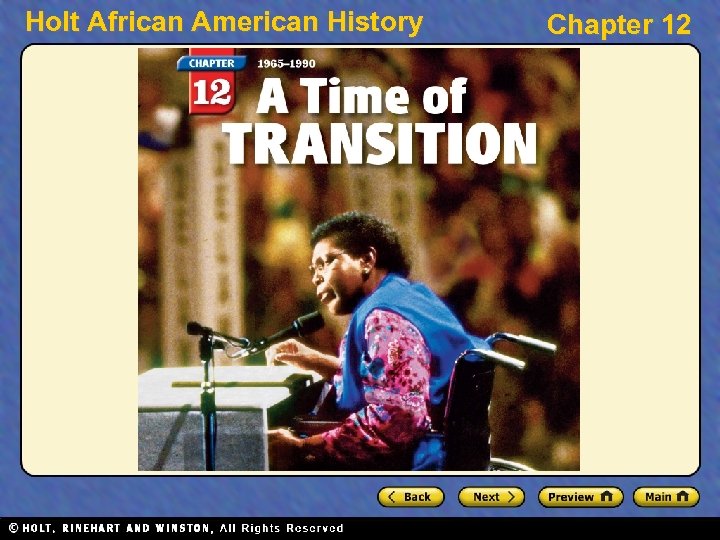 Holt African American History Chapter 12
 Holt African American History Chapter 12 A Time of Transition Section 1 Making Political Gains Section 2 The African Connection Section 3 Economic and Social Challenges
 Holt African American History Chapter 12 Section 1: Making Political Gains Main Idea In the 1970 s and 1980 s more black Americans became involved in the political process. Reading Focus • What were some of the key political gains made by African Americans in the 1970 s and 1980 s? • What are the arguments for and against affirmative action? • What policies did conservative leaders support? • How did the black community respond to conservatism?
 Holt African American History Chapter 12 Building Background Thanks to the successes of the civil rights movement of the 1950 s and 1960 s, black Americans made great strides towards full equality. The 1970 s and 1980 s proved to be a time of transition as African Americans tested their new political strength. During this period, blacks rose to power politically and took on key issues for all Americans.
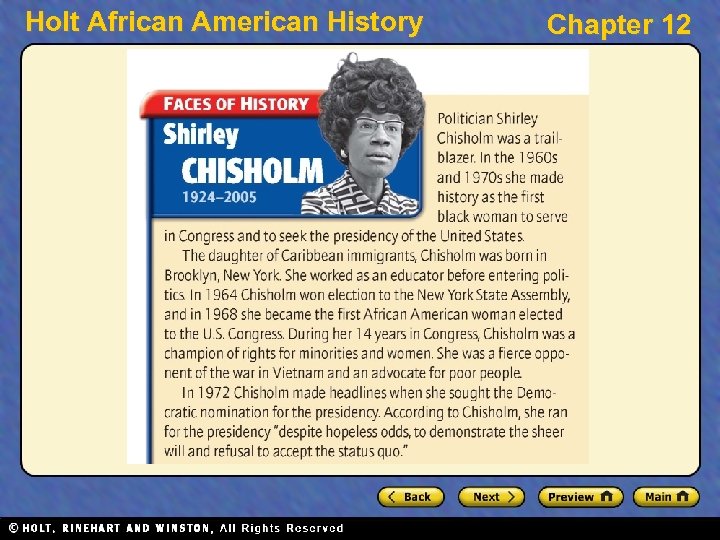
 Holt African American History Chapter 12 The Rise of African American Politicians African Americans made great strides during the 1950 s and 1960 s, and by early 1970 s would enter mainstream politics on local and national levels. Entering the Political World Black Members of Congress • President Lyndon Johnson appointed Thurgood Marshall to the Supreme Court and Patricia Harris as U. S. Ambassador • In 1969 nine African American members of the House of Representatives formed caucus • Republican Edward Brooke elected to the U. S. Senate in 1966; he was the first black so elected since Reconstruction • Shirley Chisholm became 1 st black woman elected to Congress • Organization formed to represent and unite black members of Congress; now called the Congressional Black Caucus • Open to all members, the group primarily represents Democrats; group had 43 members in 2007
 Holt African American History Chapter 12
 Holt African American History Chapter 12 The Gary Convention • National Black Political Convention held in Gary, Indiana in 1972 – The several thousand present included politicians, social activists, and students – Social and political leaders Jesse Jackson and Louis Farrakhan • Goal of convention to identify ways to address key issues among the black community – Despite disagreements, delegates drafted a formal platform – Known as the National Black Political Agenda – Focused health care, housing, and the economy • Encouraged African Americans to seek political office – Social and economic improvement only through political strength • African Americans began entering political world in greater numbers
 Holt African American History Chapter 12 Black Political Leaders • Rose to prominence on national and local political scenes during the 1970 s and 1980 s • From local sheriffs to U. S. senators, black politicians determined to make a difference Two Leading Politicians • Douglas Wilder first won election to the Virginia state senate before eventually becoming the first elected black governor in U. S. history • Texan Barbara Jordan served in the U. S. House of Representatives • Best remembered for her role in congressional hearings on the impeachment of President Richard Nixon
 Holt African American History Chapter 12 Reading Check Draw Conclusions Why did some people believe that social and economic improvements could come only with political strength? Answer(s): They thought that political power would allow them to make improvements.
 Holt African American History Chapter 12 Affirmative Action One of Key Issues Idea’s History • Affirmative action—the policy of giving special consideration to women and nonwhites to correct years of discrimination • Dates back to Roosevelt in 1940 s; defense companies prohibited from discriminating against job seekers • Actively promotes the admittance of minorities to schools or the workplace • Civil Rights Act of 1964 expanded prohibition to cover all companies • Goal is to help correct the underrepresentation of women and minorities in certain occupations and educational institutions • 1965 Johnson established the policy of affirmative action by issuing an executive order for companies to increase minority representation
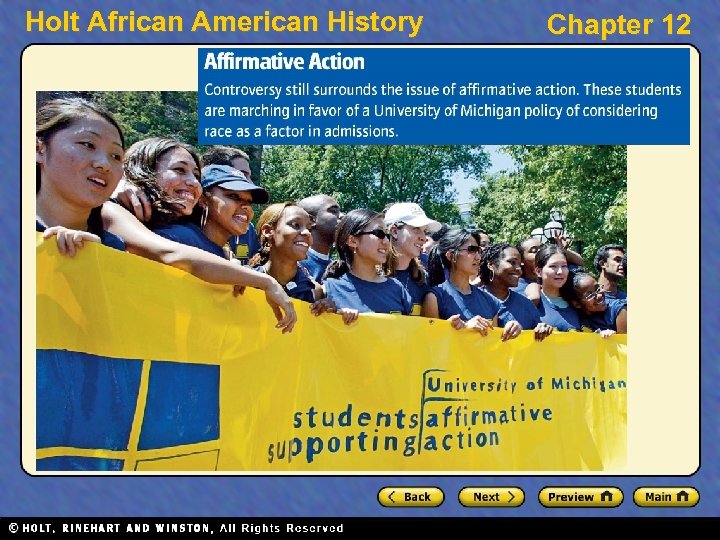
 Holt African American History Chapter 12 Extent of Practices Extended for Women Supporters • Affirmative action extended to include women in 1967 • Companies, agencies had hiring goals; schools created programs with spots set aside • Argued needed to improve job and educational opportunities • Level the playing field • Enhances diversity in schools and workplaces Critics Challenges to Policy • Opponents say promotes selection based on race rather than merit • Raises issues of “reverse discrimination” • Court cases being argued • Supreme Court ruling in 1978 on Bakke case that set-aside programs were unconstitutional • Still a hotly contested issue
 Holt African American History Chapter 12
 Holt African American History Reading Check Recall What is the goal of affirmative action? Answer(s): to help correct years of underrepresentation of minorities in schools and the workplace Chapter 12
 Holt African American History Chapter 12 The Conservative Era New Political Era • In late 1970 s U. S. politics changing with growing conservative ideology taking hold • Ronald Reagan’s election in 1980 kicked off a new conservative era The Reagan Years • Focused on restoring national prosperity and strength • Called for return to smaller government, lower taxes, and conservative moral values; opposed liberal social and racial policies New Agendas • Called for an end to affirmative action, gun control, and huge federal budgets • Made dramatic budget cuts; resulted in less money for federal programs such as food stamps, student loans, and unemployment compensation
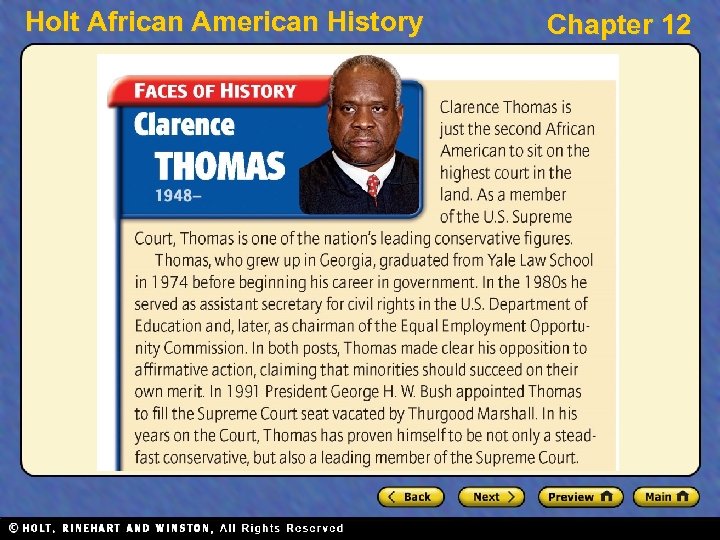
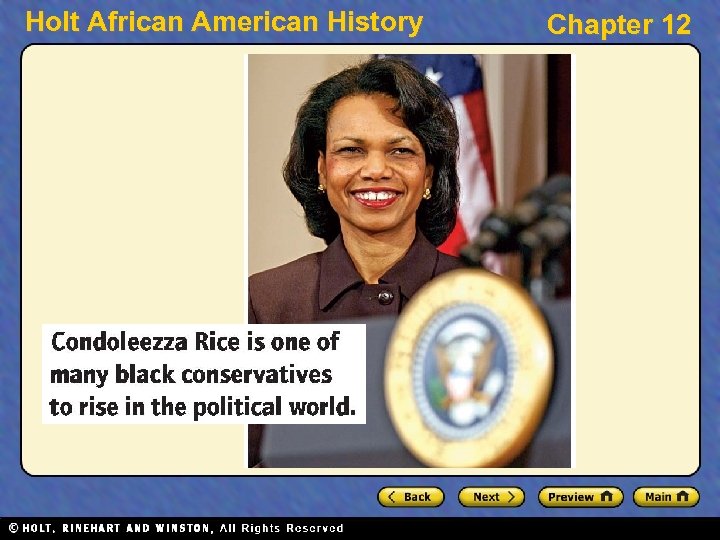
 Holt African American History Chapter 12 Black Conservatives • Rise of new group of conservative black politicians – One of the leading black conservatives in the 1980 s was Alan Keyes; trained as a diplomat; in 1983 named ambassador to the United Nations – Colin Powell also a Reagan appointee; serving in various positions until finally being named Chairman of the Joint Chiefs of Staff • Leaders in the 1990 s – Clarence Thomas appointed to Supreme Court in 1991; J. C. Watts of Oklahoma elected U. S. Representative; Condoleezza Rice served as a special adviser on national security to President George H. W. Bush • Conservatives now – Colin Powell appointed Secretary of State in 2001; was first African American to hold position; was succeeded in 2005 by Condoleezza Rice – National Leadership Network of Black Conservatives – The American Civil Rights Institute (ACRI) opposes affirmative action policies across the nation
 Holt African American History Chapter 12
 Holt African American History Chapter 12
 Holt African American History Chapter 12 Reading Check Identify Cause and Effect What led to the rise of the conservative movement? Answer(s): the election of President Ronald Reagan in 1980
 Holt African American History Chapter 12 Reaction to Conservatism Opposition to Conservatives Blacks Negatively Affected • Many black Americans felt new conservative economic and social programs hurt their communities • By 1985, unemployment rate at 15 percent for African Americans; rate was 5 percent for whites • With economic recession of 1980, unemployment rose, homelessness increased, and spending cuts were made in housing and education • 30 percent of African Americans lived below the poverty line; 11 percent of white Americans lived below this line • Poor African Americans were hit very hard by new policies • African Americans were ready for change
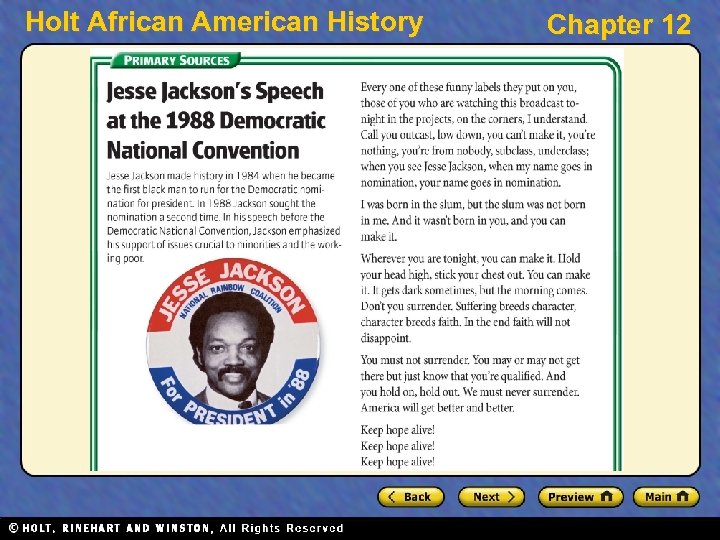
 Holt African American History Chapter 12 Jesse Jackson Seeks the Presidency • Leading liberal black politician of 1980 s was Jesse Jackson • A civil rights leader, Jackson turned to mainstream politics • 1983 voter registration drive help elect Harold Washington first black mayor of Chicago; later that year Jackson announced for president Making History • Jackson became first black man to seek presidential nomination of major political party; his 1984 campaign broke new ground • “Hands that picked cotton in 1884 will pick the President in 1994” • Convinced African Americans to register • Jackson failed to win the nomination but earned significant support
 Holt African American History Chapter 12
 Holt African American History Chapter 12 The Rainbow Coalition • Jackson used run for presidency to speak out against policies of conservative Republican administration – Brought together young people, minorities, and poor Americans – Formed Rainbow Coalition aimed at uniting unsatisfied voters to enact reform; coalition reflected the diversity of the United States • Jackson sought Democratic nomination again in 1988 – Rainbow Coalition attracted farmers, blue-collar workers, and environmentalists – Jackson made a strong showing; won eleven primaries – Was front-runner for short time • Jackson finished second to eventual nominee Dukakis – Jackson engineered extremely effective campaign – Was proof of new political heights for African Americans
 Holt African American History Chapter 12 Reading Check Analyze Why did Jesse Jackson appeal to many voters? Answer(s): He appealed to voters, including the poor and minorities, who were unsatisfied with conservative politics.
 Holt African American History Chapter 12 Section 2: The African Connection Main Idea After 1940 major changes came to Africa as former colonies demanded independence and South Africans sought to end years of racial division. Reading Focus • How did nationalism bring about changes in Africa? • What was apartheid, and how did it shape life in South Africa? • What led activists around the world to protest apartheid, and what was the result of their protests?
 Holt African American History Chapter 12 Building Background While African American activists were protesting for equal rights and making gains in U. S. politics, their counterparts in Africa were demanding their independence from European empires. In the 1950 s and 1960 s a wave of nationalism led to independence for many African nations. In the years that followed, African nations focused on rebuilding from decades of colonial rule.
 Holt African American History Chapter 12 African Nationalism • In 1940 s African nationalism on the rise – Africans demanded freedom from European powers; young African activists led nationalist movement – Pan-Africanism united people of African heritage in freedom struggle • Gold Coast a British colony – – Among first West African colonies to gain independence 1947 Kwame Nkrumah became leader of nationalist movement there Influenced by Du Bois and Garvey; used strikes and demonstrations National elections held in 1951 with huge victory for Nkrumah’s Convention People’s Party • Independence from Britain 1957 – Nkrumah became first prime minister of new nation of Ghana
 Holt African American History Chapter 12 Wars for Independence • Kenyan nationalists led rebellion against British control; • 1963 nationalist leader Jomo Kenyatta first prime minister of Kenya; year later became president • Algeria gained independence in 1962 after bloody war with France • 1970 s Guinea-Bissau, Mozambique, and Angola independent Most Nations Independent • By 1980 s most African nations won independence • European powers withdrew; left African nations with task of building new government and rebuilding economies • Difficulties with ethnic conflicts and civil war in several countries
 Holt African American History Chapter 12 Reading Check Identify What methods did some African countries use to achieve independence? Answer(s): Strikes, protests, rebellions, warfare
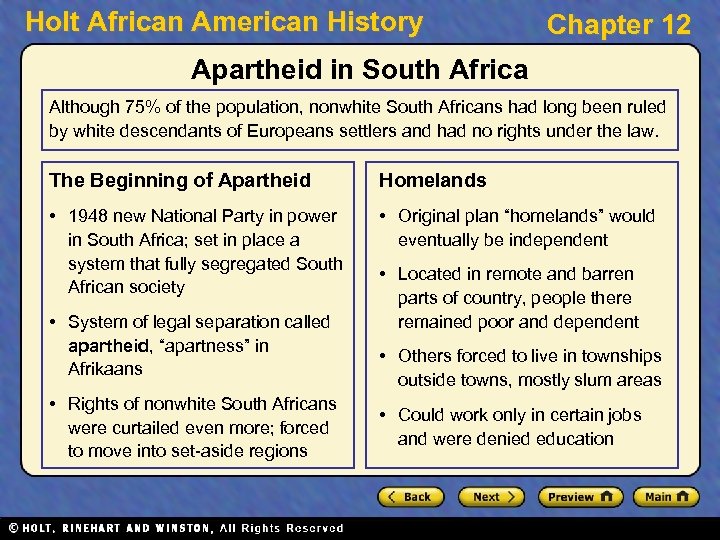 Holt African American History Chapter 12 Apartheid in South Africa Although 75% of the population, nonwhite South Africans had long been ruled by white descendants of Europeans settlers and had no rights under the law. The Beginning of Apartheid Homelands • 1948 new National Party in power in South Africa; set in place a system that fully segregated South African society • Original plan “homelands” would eventually be independent • System of legal separation called apartheid, “apartness” in Afrikaans • Rights of nonwhite South Africans were curtailed even more; forced to move into set-aside regions • Located in remote and barren parts of country, people there remained poor and dependent • Others forced to live in townships outside towns, mostly slum areas • Could work only in certain jobs and were denied education
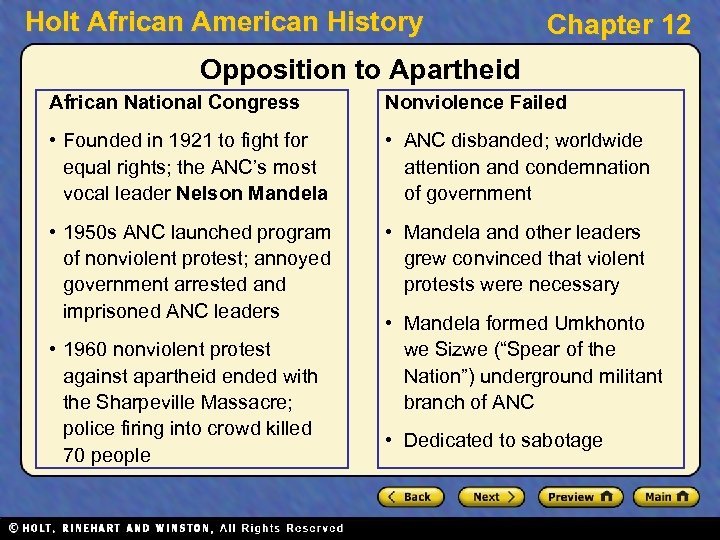 Holt African American History Chapter 12 Opposition to Apartheid African National Congress Nonviolence Failed • Founded in 1921 to fight for equal rights; the ANC’s most vocal leader Nelson Mandela • ANC disbanded; worldwide attention and condemnation of government • 1950 s ANC launched program of nonviolent protest; annoyed government arrested and imprisoned ANC leaders • Mandela and other leaders grew convinced that violent protests were necessary • 1960 nonviolent protest against apartheid ended with the Sharpeville Massacre; police firing into crowd killed 70 people • Mandela formed Umkhonto we Sizwe (“Spear of the Nation”) underground militant branch of ANC • Dedicated to sabotage
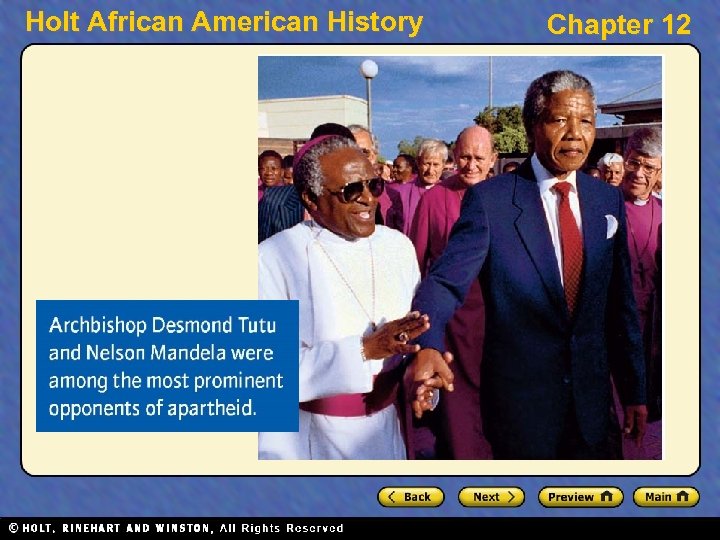
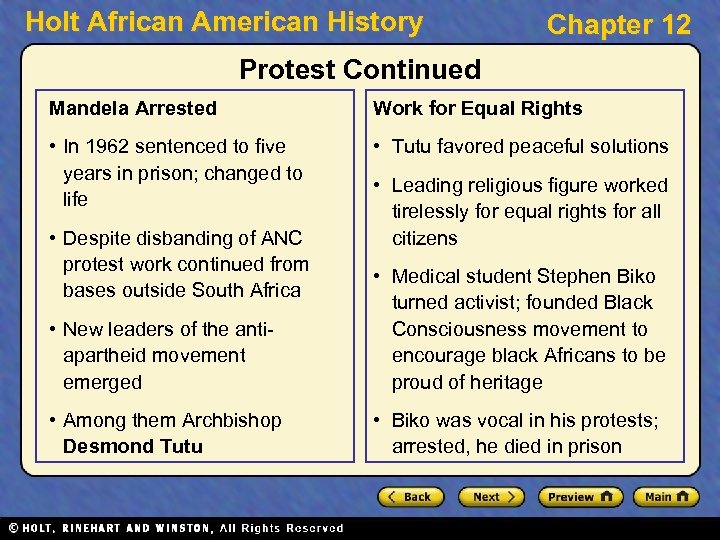 Holt African American History Chapter 12 Protest Continued Mandela Arrested Work for Equal Rights • In 1962 sentenced to five years in prison; changed to life • Tutu favored peaceful solutions • Despite disbanding of ANC protest work continued from bases outside South Africa • Leading religious figure worked tirelessly for equal rights for all citizens • New leaders of the antiapartheid movement emerged • Medical student Stephen Biko turned activist; founded Black Consciousness movement to encourage black Africans to be proud of heritage • Among them Archbishop Desmond Tutu • Biko was vocal in his protests; arrested, he died in prison
 Holt African American History Chapter 12 Reading Check Summarize What methods did South Africans use to protest against apartheid? Answer(s): nonviolent protests, sabotage, the Black Consciousness Movement
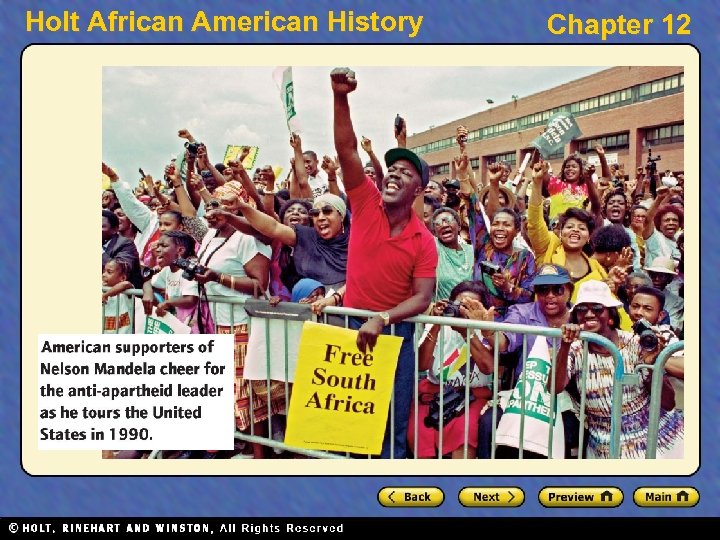
 Holt African American History Chapter 12 African Americans Take on Apartheid Slow Beginnings • Early 1960 s Western nations traded heavily with South Africa; western governments did not want to suspend trade with South Africa • Some international organizations moved quickly against apartheid; United Nations voted to ban arms sales to South Africa in 1963; WHO and others ousted South Africa from ranks; South Africa excluded from Olympics International Protests • European and U. S. citizens protested against apartheid; public opinion finally led European and U. S. lawmakers to act against apartheid • In 1985 both the UK and the U. S. leveled sanctions, penalties intended to force a country to change its policies, against the South African government • Companies began a policy of divestment, or shedding of business ties
 Holt African American History Chapter 12
 Holt African American History Chapter 12 The End of Apartheid Pressure Succeeds • 1989 South African government began to dismantle apartheid system • President F. W. de Klerk lifted ban on anti-apartheid rallies; restored legal status of ANC; and ordered Mandela released after 27 years imprisonment Mandela Free • Nelson Mandela spoke out; urging that sanctions stay in place until the “total elimination of apartheid and the extension of the vote to all people. ” • Mandela also recalled being inspired by traditions in American history Dismantling of Apartheid • 1991 all apartheid laws repealed; three years later country held first all-races election, the ANC won majority of seats; Mandela elected president • Mandela and de Klerk shared 1993 Nobel Prize for work to end apartheid
 Holt African American History Chapter 12
 Holt African American History Chapter 12 Reading Check Explain How did the United States help bring an end to apartheid in South Africa? Answer(s): American protests and sanctions helped force the South African government to change its policies.
 Holt African American History Chapter 12 Section 3: Economic and Social Challenges Main Idea During the last part of the twentieth century, African Americans addressed a variety of economic and social issues. Reading Focus • What steps did Americans take to address the issue of urban poverty? • What social challenges did African Americans experience?
 Holt African American History Chapter 12 Building Background The 1970 s and 1980 s saw dramatic improvements in equal rights and political opportunities for African Americans. However, difficulties still loomed for many African Americans as they attempted to deal with economic and social issues.
 Holt African American History Chapter 12 Urban Poverty • Poverty and the Inner City – Black Americans moved to northern cities in first half of 1900 s; jobs and opportunities available in inner-city neighborhoods – Overcrowded conditions, deteriorating housing, and racial tensions in inner-cities; white city dwellers began move to suburbs – Inner-city neighborhoods became dominated by African American and other minorities • Serious Decline in 1970 s – Factories moved out of cities; jobs scarce, high unemployment – Poverty and crime rates on rise; but gains from 1960 s allowed middleclass blacks to leave for the suburbs – City governments collected less taxes; neighborhoods became rundown; difficult to escape poverty of inner city
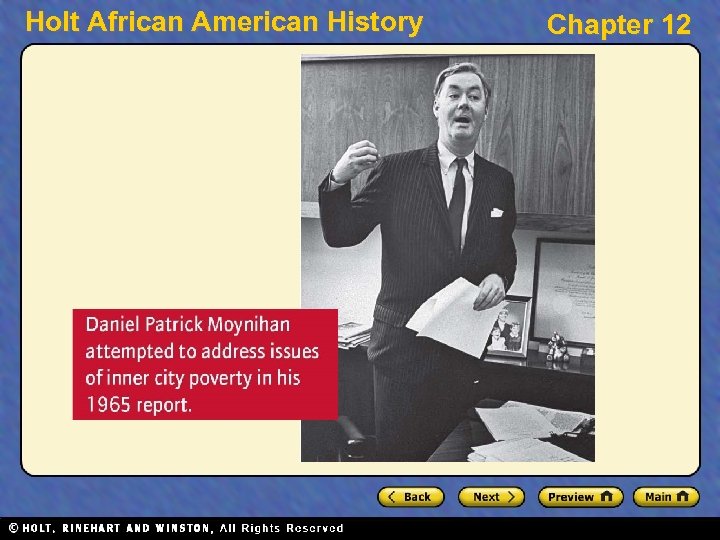
 Holt African American History Chapter 12 The Moynihan Report • Intense debate triggered by 1965 findings of government study on poverty in inner cities • The Moynihan Report attempted to identify the causes of economic troubles among inner-city black Americans • Concluded much of the poverty based on decline of two-parent families; Moynihan claimed the black family was in crisis Theory of Report • Growing number of single-parent families had negative effect on inner-city African American society; most earned less than two-parent households; poverty levels increased; more single mothers on government aid • Social problems leading to juvenile delinquency, drop-out rates, and drug addiction could be traced to decline in traditional two-parent families • Moynihan argued that a unified national effort was required to address problems
 Holt African American History Chapter 12
 Holt African American History Chapter 12 Response to the Moynihan Report The Moynihan Report generated intense controversy, and Americans were divided over its conclusions. Lyndon Johnson and others supported the report. Supporters Critics • In speech at Howard University, Johnson called on black students and the government to work to strengthen the black family • Many outraged at findings; felt it fueled stereotypes • Supporters contended that strengthening black families would help lessen inner-city poverty and reliance on government aid • But most reaction to the report was negative • Economic and social troubles result of years of discrimination; not result of family structure • Moynihan charged with racism; and with “blaming the victim” • James Farmer of CORE and activist Bayard Rustin opposed the findings; report was rejected
 Holt African American History Chapter 12 The Family Assistance Plan Moynihan Tries Again Black Support • 1969 Moynihan undertook efforts to aid poor families • African American leaders hoped the annual income and job training would help pull some out of poverty • Helped to draft the Family Assistance Plan (FAP) a program to give poor families annual income of $1, 600 provided they work or attend job training • Goal was to eliminate bureaucratic welfare programs such as food stamps or Medicaid • Nixon claimed FAP was a method for putting people back to work • Plan had many critics • Some feared program too expensive • Others believed income proposed not enough to provide for families • Result of opposition—plan failed to pass both houses of Congress
 Holt African American History Chapter 12 Reading Check Analyze What arguments did opponents of the Moynihan Report put forth? Answer(s): They argued that it was based on stereotypes of African Americans and blamed African Americans for the economic problems they faced.
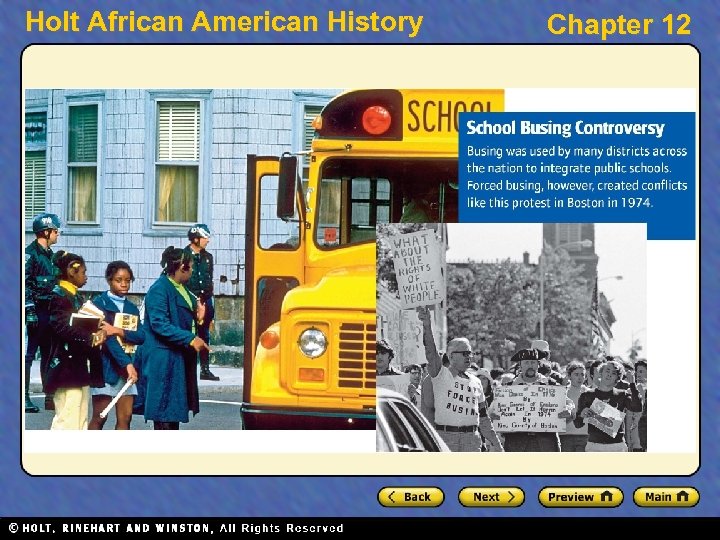
 Holt African American History Chapter 12 Social Issues School Busing • After federal pressure majority of schools in the South had integrated by the late 1960 s; but issues remained about integration of students in classes and school-related activities • In the North many urban school remained largely segregated because of the way segregated neighborhoods developed • Mid-1960 s pressure to integrate urban schools led Berkeley, California officials to implement a school busing plan to desegregate by transporting students from one part of the city to another • Federal courts began ordering some schools to implement busing as a solution to segregation • Busing met fierce opposition; parents objected to having students go long distances to sometimes dangerous neighborhoods; some violent protests • Despite opposition, school busing remained in place through the 1980 s
 Holt African American History Chapter 12
 Holt African American History Chapter 12 Educational Opportunities Important social issue • Leaders hoped to improve educational opportunities for young blacks • 1964 government began the Head Start program; main focus to help preschool-age children from low-income families prepare to start school “A Nation at Risk” • 1980 s report on nation’s public schools found them in serious decline; educators and officials looked for ways to improve education • Many programs aimed at students less likely to complete their education Students • New focus on programs to help students from nation’s impoverished inner cities, members of minority groups, or students learning English • Schools offer mentoring and tutoring; programs to keep students in schools
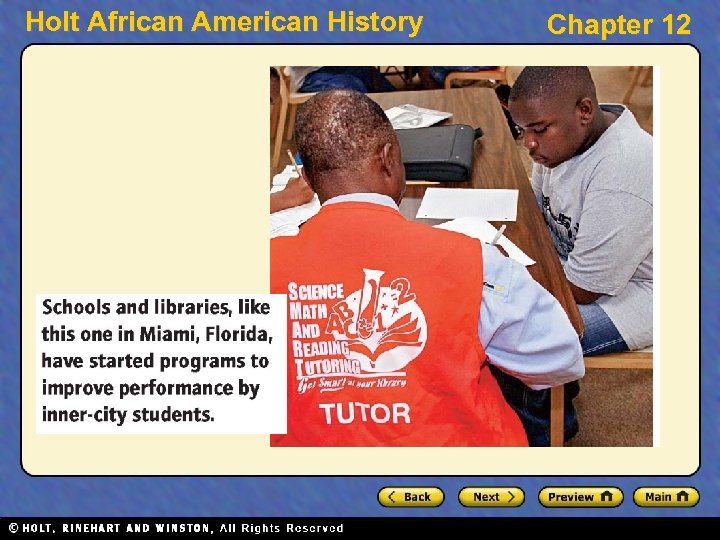 Holt African American History Chapter 12
 Holt African American History Chapter 12 Reading Check Explain What social challenges faced African Americans, and how were they addressed? Answer(s): challenges—a lack of fully integrated schools in many northern cities, the need for better education opportunities addressed—school busing, Head Start program