


 Скачать презентацию HL 7 Services-Aware Enterprise Architecture Framework SAEAF SAEAF
e33ce1abfbc8af1390b0b5d92fde75ca.ppt
- Количество слайдов: 75
 HL 7 Services-Aware Enterprise Architecture Framework (SAEAF) SAEAF Education Series Session 1: Introduction and Overview September 2009 3/17/2018 5: 19 AM
 SAEAF Education Series Overview The SAEAF Education Series includes the following sessions: • Part 1: Introduction and Overview to SAEAF • Part 2: Behavioral Framework • Part 3: Enterprise Conformance and Compliance Framework • Part 4: SAEAF Governance • Part 5: SAEAF Examples Page 2
 SAEAF Education Series (1): Part 1: Introduction and Overview to SAEAF The Introduction and Overview includes the following topics: • SAEAF background • SAEAF Value Proposition: Working Interoperability • SAEAF Facts and the Lens of SAEAF • SAEAF, Service-Oriented Architecture (SOA), and Enterprise Architecture (EA): Core Principles • History of Services in Health Level 7 (HL 7) • Implications of putting SAEAF into practice • Summary Page 3
 SAEAF Education Series (2): Part 2: Behavioral Framework • The Behavioral Framework session includes the following topics: • Contracts, Roles, Collaborations • Implementation Patterns for the Behavioral Framework • Mapping to HL 7 Dynamic Model Page 4
 SAEAF Education Series (3): Part 3: Enterprise Conformance and Compliance Framework • The Enterprise Conformance and Compliance Framework (ECCF) session includes the following topics: • The multidimensional world of: – Conformance – Compliance – Consistency – Certification – Traceability, Jurisdiction, and Provenance • Layered Specifications and Layered ECCF • Relationship of ECCF to SAEAF Governance Page 5
 SAEAF Education Series (4): Part 4: SAEAF Governance • The SAEAF Governance session includes the following topics: • Role of Technical Steering Committee (TSC) • Role of Architect Board (Ar. B) • Role of Other Standards Developing Organizations (SDO) • Organizational Impacts Page 6
 SAEAF Education Series (5): Part 5: SAEAF Examples • The SAEAF Examples session includes the following topics: • Service Interoperability Paradigm • Message Interoperability Paradigm • Document Interoperability Paradigm Page 7
 SAEAF Series Part 1: Introduction and Overview to SAEAF (1) • Prerequisites – No SAEAF prerequisites – Essential: Familiarity with the problems of achieving working interoperability in the healthcare / life sciences / clinical research domain – Helpful: General knowledge of HL 7 • Outcomes – Understanding of the organizational principles and contexts around which SAEAF was developed – General understanding of core components of SAEAF – Preparation for all other SAEAF Education materials Page 8
 SAEAF Series Part 1: Introduction and Overview to SAEAF (2): What is SAEAF? The HL 7 Services-Aware Enterprise Architecture Framework (SAEAF) provides consistency between all HL 7 artifacts, and enables a standardized approach to Enterprise Architecture development and implementation, and a way to measure the consistency. SAEAF is a way of thinking about producing specifications that explicitly describe the governance, information, and behavioral semantics that are needed to achieve computable semantic working interoperability. The intended information transmission technology might use a services, messaging, or document exchange approach. Page 9
 SAEAF Series Part 1: Key Definitions • Artifact: Any portion of a specification that is controlled and can be versioned. For example, an artifact can be a model, a document, or an XML schema, for example. • Services-aware: The definition and use of services technology and the interoperability standards, including the exchange of messages and sharing of documents. Page 10
 Background (1): A “Services-Aware Enterprise Architecture for HL 7” • April 08: HSSP-sponsored “Services in Healthcare” conference, Chicago, IL (attended by HL 7 CTO) • May 08: HL 7 CTO asks the HL 7 Ar. B to “develop a straw man proposal for services development within the context of an HL 7 Enterprise Architecture. ” – Specify the artifacts and processes necessary to allow HL 7 to define specifications for SOA integration. – Define an HL 7 Enterprise Architecture Framework (EAF) which contextualizes HL 7 specifications in a SOA environment. – Consider services first, but also include messages or documents as Interoperability Paradigms. – Make HL 7 EAF services-aware, not services-specific. Page 11
 Background (2): A “Services-Aware Enterprise Architecture for HL 7” • Summer 08: HL 7 Executive Committee agreed to sponsor three face-to-face “Ar. B EAF Jump Start” meetings. – Modeled after “Left-Hand Side of the RIM” project (1998) – Three 3 -day meetings in June, July, August, 2008 • Transparent process with open attendance: Published agendas, minutes, and work-in-progress artifacts. • Jump-Start goal: How should services and other IP artifacts, such as messages and documents, be defined, specified, implemented, and governed within HL 7. • September 08: CTO and TSC requested that the initial results of the Jump-Start process be presented at the Vancouver workgroup (WG) meeting. Page 12
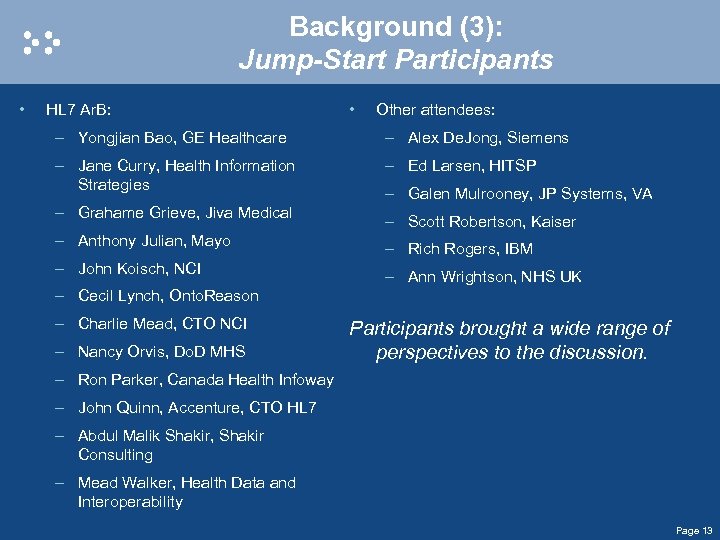 Background (3): Jump-Start Participants • HL 7 Ar. B: • Other attendees: – Yongjian Bao, GE Healthcare – Alex De. Jong, Siemens – Jane Curry, Health Information Strategies – Ed Larsen, HITSP – Grahame Grieve, Jiva Medical – Anthony Julian, Mayo – John Koisch, NCI – Galen Mulrooney, JP Systems, VA – Scott Robertson, Kaiser – Rich Rogers, IBM – Ann Wrightson, NHS UK – Cecil Lynch, Onto. Reason – Charlie Mead, CTO NCI – Nancy Orvis, Do. D MHS Participants brought a wide range of perspectives to the discussion. – Ron Parker, Canada Health Infoway – John Quinn, Accenture, CTO HL 7 – Abdul Malik Shakir, Shakir Consulting – Mead Walker, Health Data and Interoperability Page 13
 Background (4): A “Services-Aware Enterprise Architecture for HL 7” • The Jump-Start deliverables include the following: – “Services-aware” EA framework “informed by” service specification considerations and industry experience – Identification and initial specification of required infrastructure that is currently missing or incomplete in HL 7 • Behavioral Framework (BF) • Enterprise Conformance and Compliance Framework (ECCF) • Governance Framework (GF) – Operational vision for SAEAF deployment Page 14
 Background (5): A “Services-Aware Enterprise Architecture for HL 7” • Implications of putting SAEAF into practice: – Organizational impact within HL 7 and between HL 7 and other organizations – Tooling impact • Additional SAEAF considerations include: – Use and reuse of existing HL 7 artifacts: • Reference Information Model (RIM) • Data types • Clinical Document Architecture (CDA) • Refined Message Information Models (RMIMs) • Vocabulary • Electronic Health Record System Functional Model (EHRS-FM) Page 15
 Background (6): A “Services-Aware Enterprise Architecture for HL 7” • SAEAF is services-aware but not services-specific. • SAEAF is not Service-Oriented Architecture. – The three HL 7 Interoperability Paradigms (HL 7 Unified Field Theory) consider: • Messages • Documents • Services • The SAEAF work draws on “service-aware principles, ” such as: – Contracts, roles, and collaborations (“behavior”) – Conformance and compliance – Governance Page 16
 SAEAF Background (7) • September 2008 – Initial SAEAF draft is released. – TSC formally adopts SAEAF as “path forward” for EAS. – Board of Directors endorses the SAEAF and TSC position. – TSC proposes “Alpha project” for SAEAF deployment. • April 09: Staffed and funded. • Candidate projects identified (all IPs). – Details of project are in a separate deck (5) and document. • Focus is on education and change management. – Scalability – Governance – Backward compatibility Page 17
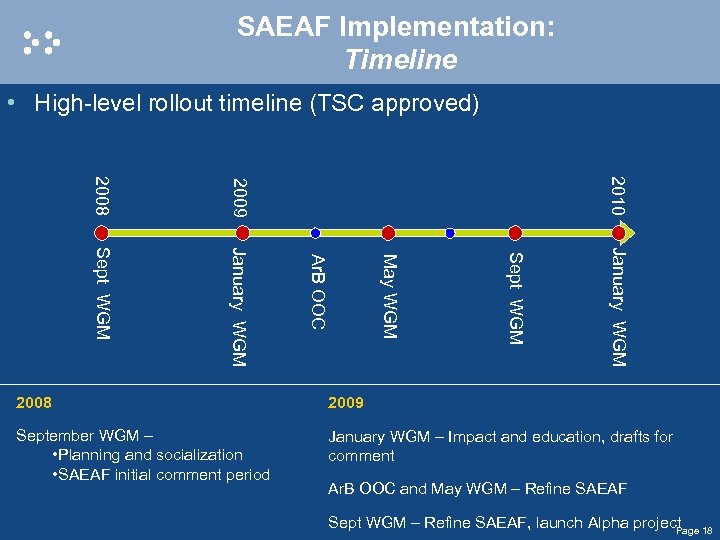 SAEAF Implementation: Timeline • High-level rollout timeline (TSC approved) 2010 January WGM Sept WGM January WGM May WGM 2009 Sept WGM Ar. B OOC 2008 2009 September WGM – • Planning and socialization • SAEAF initial comment period January WGM – Impact and education, drafts for comment Ar. B OOC and May WGM – Refine SAEAF Sept WGM – Refine SAEAF, launch Alpha project Page 18
 SAEAF Value Proposition (1): Working Interoperability • Working Interoperability: – Is the collection of structures, processes, and components that support Computable Semantic Interoperability in a Conformance and Compliance Framework. – SAEAF facilitates the explicit and layered expression of the set of static, functional, and behavioral semantics that collectively enable Working Interoperability. – The specifications for enabling Working Interoperability must be defined in such a manner so as to ensure that they are usable, useful, and durable. These specifications are implementable in a variety of deployment contexts in a repeatable, understandable manner. Page 19
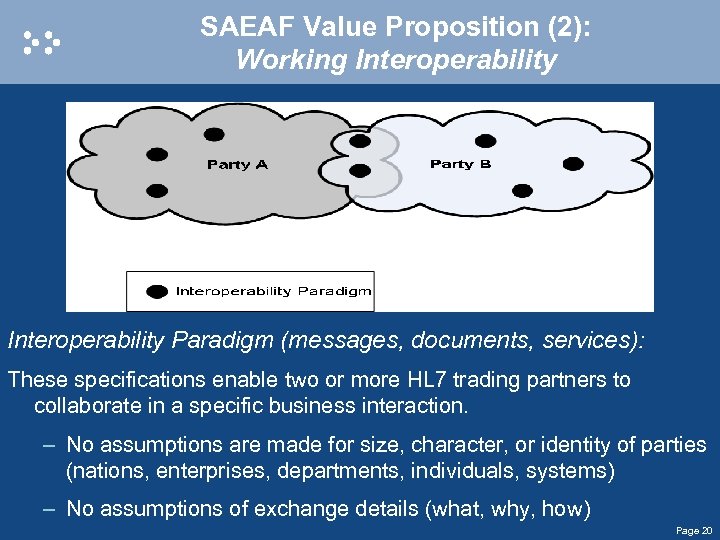 SAEAF Value Proposition (2): Working Interoperability Paradigm (messages, documents, services): These specifications enable two or more HL 7 trading partners to collaborate in a specific business interaction. – No assumptions are made for size, character, or identity of parties (nations, enterprises, departments, individuals, systems) – No assumptions of exchange details (what, why, how) Page 20
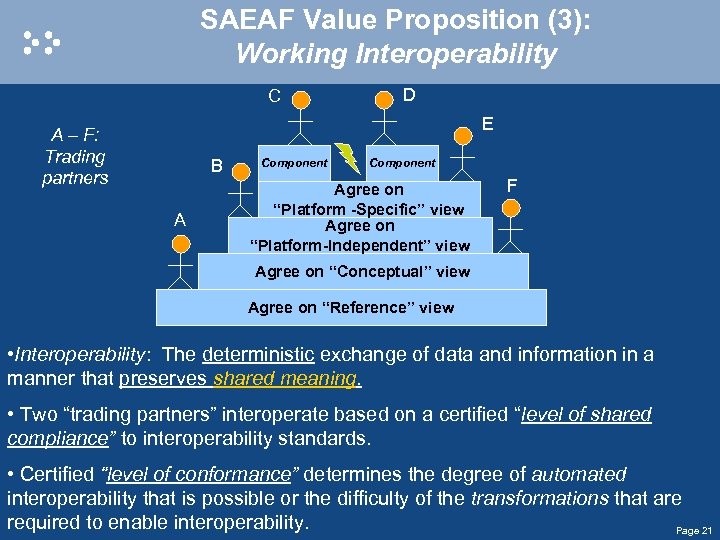 SAEAF Value Proposition (3): Working Interoperability C D E A – F: Trading partners B A Component Agree on “Platform -Specific” view Agree on “Platform-Independent” view F Agree on “Conceptual” view Agree on “Reference” view • Interoperability: The deterministic exchange of data and information in a manner that preserves shared meaning. • Two “trading partners” interoperate based on a certified “level of shared compliance” to interoperability standards. • Certified “level of conformance” determines the degree of automated interoperability that is possible or the difficulty of the transformations that are required to enable interoperability. Page 21
 SAEAF Facts (1) Architecture: “A set of resources, relationships, and processes that collectively define a system and its products-of-value. ” • HL 7 deals with both internal and external architectures: 1. HL 7’s goal is producing products of value (specifications) that make it easy to accomplish working interoperability with external architectures. 2. HL 7 specifications are enabling working interoperability in the healthcare, life sciences, and clinical research areas. (These architectures are all external to HL 7. ) Page 22
 SAEAF Facts (2) SAEAF… – Has structural, relationship, and process implications for architecture #1. – Is a set of frameworks for producing specifications that support aspects of HL 7 architecture #2. • SAEAF is not meant to be a “complete” Enterprise Architecture. • SAEAF focuses on the critical interoperability aspects of HL 7 specifications in each of the three HL 7 Interoperability Paradigms. – Defines the artifacts and specification semantics needed to support interoperability in healthcare, life sciences, and clinical research. Page 23
 SAEAF Facts (3) The 3 component frameworks of SAEAF include: – Behavioral Framework (deck 2) • Specification of integration semantics of IT components • Linkage of integration semantics to real-world behaviors – Conformance and Compliance Framework (deck 3) • Layered to enable “degrees” of conformance and compliance – Governance Framework (deck 4) • Internal HL 7 governance • HL 7 relationships to other organizations that specify standards • Relationships among parties that are implementing working interoperability. – Informational Framework (in development) Page 24
 SAEAF Facts (4) SAEAF… – is now stable enough to begin “pilot” implementations which: • Produce SAEAF-compliant message, document, and service specifications. • Use and provide feedback for SAEAF-centric education. • Perform through Change management processes for SAEAF. • Report to the TSC or its designate. • The focus of TSC activities going forward is: – Education – Change management – Alpha projects in all Interoperability Paradigms Page 25
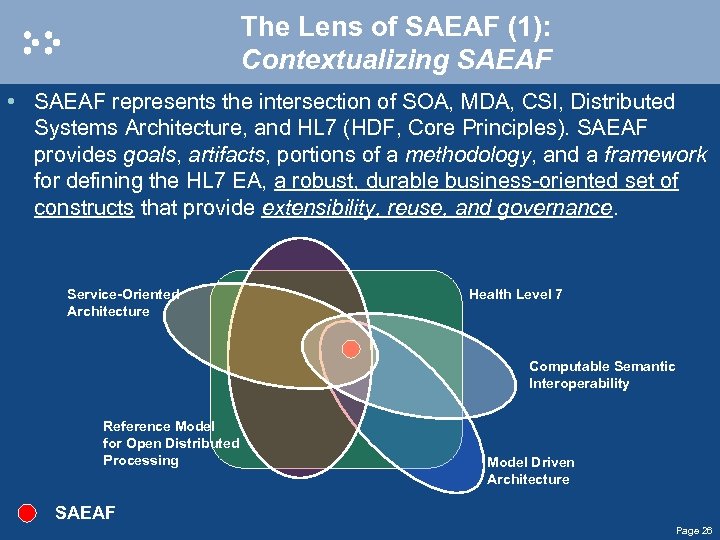 The Lens of SAEAF (1): Contextualizing SAEAF • SAEAF represents the intersection of SOA, MDA, CSI, Distributed Systems Architecture, and HL 7 (HDF, Core Principles). SAEAF provides goals, artifacts, portions of a methodology, and a framework for defining the HL 7 EA, a robust, durable business-oriented set of constructs that provide extensibility, reuse, and governance. Service-Oriented Architecture Health Level 7 Computable Semantic Interoperability Reference Model for Open Distributed Processing Model Driven Architecture SAEAF Page 26
 The Lens of SAEAF (2): Services-Oriented Architecture • Service-Oriented Architecture (SOA) – SAEAF is “services-aware; ” not “just about services. ” • Service awareness (at the architecture level) has a need for: – Behavioral Framework built around contracts and roles. – Well-defined Conformance and Compliance Framework. – Focus on Governance. – Attention to “separation of concerns” (static vs. dynamic). – Technology-independent specifications. Page 27
 The Lens of SAEAF (3): Model-Driven Architecture (MDA) enables the following: – Levels of abstraction that layer complexity from conceptual through logical to implementation • Supports SOA thinking • Supports partitioning of artifacts to layers of Conformance and Compliance Framework – Solid tooling support Page 28
 The Lens of SAEAF (4): Computable Semantic Interoperability (CSI) – Pillar #1: Common model across all domains-of-interest – Pillar #2: Model #1 bound to robust data-type specification – Pillar #3: Methodology for binding terms from concept-based terms – Pillar #4: A formally-defined process for specifying the static and behavioral semantics of the interoperability scenario Page 29
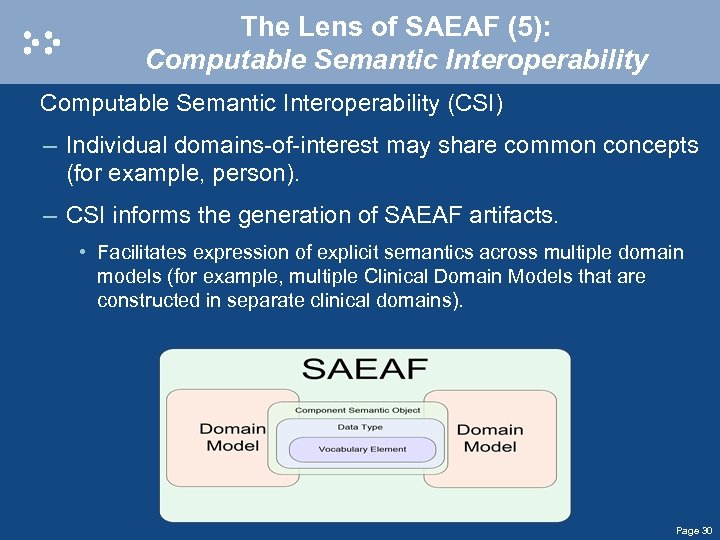 The Lens of SAEAF (5): Computable Semantic Interoperability (CSI) – Individual domains-of-interest may share common concepts (for example, person). – CSI informs the generation of SAEAF artifacts. • Facilitates expression of explicit semantics across multiple domain models (for example, multiple Clinical Domain Models that are constructed in separate clinical domains). Page 30
 The Lens of SAEAF (6): RM-ODP Reference Model for Open Distributed Processing (RM-ODP) – ISO standard – Viewpoints and ontology for human semantic interoperability and for creating specifications of distributed systems Page 31
 RM-ODP (1): ISO Standard (RM – ODP, ISO/IEC IS 10746 | ITU-T X. 900 ) • SAEAF uses the Reference Model for Open Distributed Processing (RM-ODP) as its common language for categorizing the various artifacts. – Five viewpoints in which Conformance Statements are made: • Enterprise and business viewpoint • Informational viewpoint • Computational viewpoint • Engineering viewpoint – Viewpoints in which Conformance Statements are validated (conformance tested): • Technology viewpoint Page 32
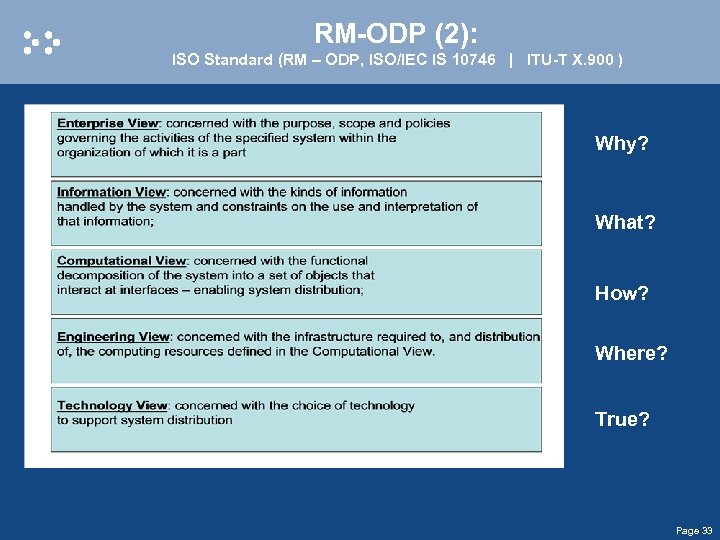 RM-ODP (2): ISO Standard (RM – ODP, ISO/IEC IS 10746 | ITU-T X. 900 ) Why? What? How? Where? True? Page 33
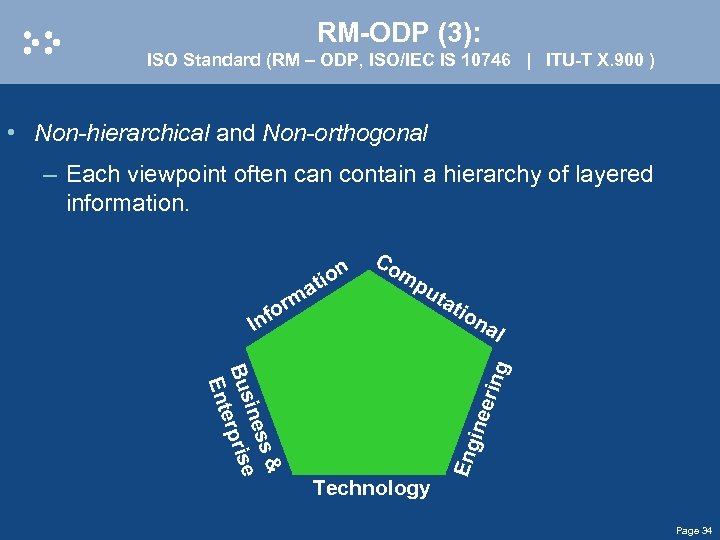 RM-ODP (3): ISO Standard (RM – ODP, ISO/IEC IS 10746 | ITU-T X. 900 ) • Non-hierarchical and Non-orthogonal – Each viewpoint often can contain a hierarchy of layered information. ion s& ines Bus erprise Ent ring al inee r Technology Eng o nf I at m Co mp uta t Page 34
 The Lens of the SAEAF (7): Health Level 7 – SAEAF takes several enterprise architecture best practices and approaches, and contextualizes them to HL 7, as follows: • Use of existing HL 7 artifacts – Core principles – HL 7 Development Framework (HDF) – Refined Message Information Models (RMIM) – And others • Awareness of HL 7 business context • Dedication to HL 7 mission and goals of Working Interoperability Page 35
 SAEAF, SOA, and EA (1): Core Principles • Objectives of the SAEAF project: – Facilitate organization-wide development of service specifications: • Enable Unified Field Theory; that is, contextualizing and using SAEAF principles, processes, and practices in the development of other HL 7 specifications (messages, documents, and services). – Define explicitly and support: • Behavioral Framework (deck 2) – Contract-based integration – Functional specification • Conformance and Compliance Framework (deck 3) – Traceability of requirements • Explicit expression of policy and governance (deck 4) Page 36
 SAEAF, SOA, and EA (2): Core Principles • SAEAF draws on a “combination of forces. ” – Existing HL 7 artifacts (RIM, ADTs, CDA, and so on) – RM-ODP methodology and framework as the lingua franca – Application Model-Driven Architecture (MDA) – Commitment to and framework for achieving Computable Semantic Interoperability (CSI) – Necessity of a Conformance and Compliance Framework • “…the micrometer, T-square, and plumb-bob of an Enterprise Architecture…” – Service-awareness using SOA perspectives and explicit framework Page 37
 SAEAF, SOA, and EA (3): Core Principles • Given the value proposition (Working Interoperability), the following requirements show the need for: – Definition of data and information to be exchanged – Definition of functions that enable or perform the exchange – Traceable mappings of functions to real-world events and business processes – Reference terms and language for sorting and discussing the above – Engineering deployment topologies and technology bindings to achieve Working Interoperability Page 38
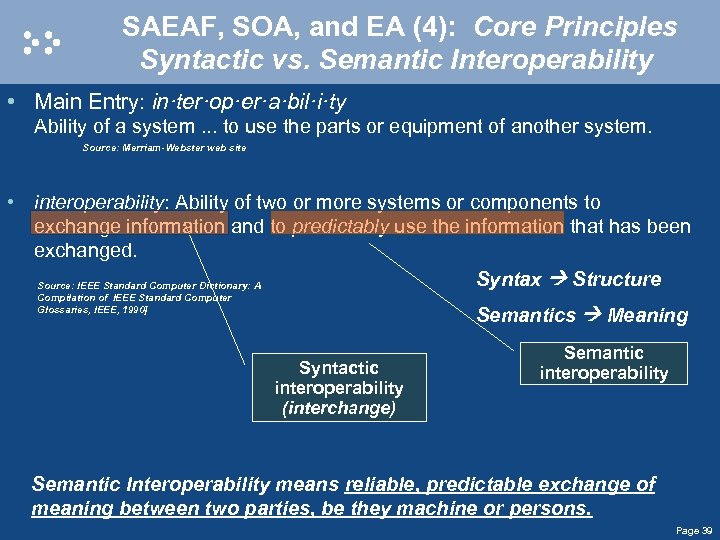 SAEAF, SOA, and EA (4): Core Principles Syntactic vs. Semantic Interoperability • Main Entry: in·ter·op·er·a·bil·i·ty Ability of a system. . . to use the parts or equipment of another system. Source: Merriam-Webster web site • interoperability: Ability of two or more systems or components to exchange information and to predictably use the information that has been exchanged. Syntax Structure Source: IEEE Standard Computer Dictionary: A Compilation of IEEE Standard Computer Glossaries, IEEE, 1990] Semantics Meaning Syntactic interoperability (interchange) Semantic interoperability Semantic Interoperability means reliable, predictable exchange of meaning between two parties, be they machine or persons. Page 39
 SAEAF, SOA, and EA (5): Core Principles Pillars of CSI 1. Common model is across all domains-of-interest. – Information Model vs. Data Model – Domain Analysis Model – Semantics of shared concepts – Includes optional dynamic or behavioral semantics • Functions • Behavior • Interactions 2. Static Model is bound to a robust data-type specification. – HL 7 V 3 Abstract Data Type specification (R 2) – ISO Data Type specification Page 40
 SAEAF, SOA, and EA (6): Core Principles Pillars of Computable Semantic Interoperability 3. Methodology is for binding terms from concept-based terminologies. – Domain-specific semantics bound to cross-domain concepts 4. A formally-defined process specifies the static and behavioral semantics of the interoperability scenario, for example: – – Service interfaces and interactions semantics (contracts, service roles, interactions) – • RM-ODP- and MDA-based Service Specification Methodology for specifying exchange or wire format CSI Pillars form a key component of Working Interoperability. Page 41
 SAEAF, SOA, and EA (7): Core Principles Integration vs. Interoperability • Implementers need a framework to provide: – Computable Semantic Interoperability (CSI) – • Measurable goals • “Plug and play” patterns of implementation • Incremental adoption that yields incremental benefit – Implementable specifications • Including governance as modeled, testable specifications • Reflect the semantics of integration (CSI) – Conformance and Compliance Model • Implementation needs to fit with the way organizations model, use, and test components. • Implementation Guides (“Are you ready? How does this work with our new ABC Interface Engine? ”) Page 42
 SAEAF, SOA, and EA (8): Core Principles Integration vs. Interoperability “Enterprise Architecture is more than just an implementation or technology perspective. ” • Each instance of integration is simple, though not necessarily easy. – Engineers of any single system understand it well enough to allow integration with any other system. – Integration is an manufacturing and implementation issue, such as deployment of computational components. • Interoperability is an engineering and architectural concern that creates multiple context-specific integration solutions. – The complexity and high-change rate of healthcare information requires Working Interoperability; and therefore, requires an Enterprise Architecture Specification. Page 43
 SAEAF, SOA, and EA (9): Core Principles Enterprise Integration Paradigms • Service and services-aware perspectives use integration semantics that need to be explicit. – Integration semantics: • Static (“the data”) • Functional (“What data goes in and comes out? ”) • Behavioral (“Who interacts with whom? ”) • Business Context (“Who is interacting where and why? ”) – Integration semantics approximate RM-OPD viewpoints: • Static informational • Functional and behavioral computational • Business context enterprise, computational, engineering – Integration points between interacting components are testable and enforceable. Page 44
 SAEAF, SOA, and EA (10): Core Principles Summary: Services and Service Awareness (1) • Services and services-aware perspectives are supported by various artifacts that: • Allow them to be specified technologically neutrally. • Support conformance. • Provide a framework for specification of various semantics. • Are necessary for integrating systems across the enterprise. Page 45
 SAEAF, SOA, and EA (11): Core Principles Summary: Services and Service Awareness (2) • Services and services-aware perspectives are not technologyspecific per se. • These perspectives are a framework for approaching the problem of how to design distributed capabilities (sharing information and functions). • SAEAF is not defining just “services; ” SAEAF is defining an approach to describing services. – SAEAF is using perspectives from the SOA world; hence the phrase “services-aware perspective. ” • Services are not equivalent to Web Services. Page 46
 SAEAF, SOA, and EA (12): Core Principles Services and Service Awareness (3) • Because services cannot directly use the object-oriented principles (for example, encapsulation, polymorphism, and inheritance), it is necessary to construct a set of principles that support service-oriented definition and design. • Enterprise Architecture is the framework that provides the service-specification foundation and, thus plays a critical role in successful service design. Page 47
 SAEAF, SOA, and EA (13): Core Principles Summary: Services and Service Awareness (4) • The following principles are considered essential for enterprise-level service specifications, which explicitly define testable, verifiable four-dimensioned service contracts: – Virtualization – Composition – Unity of purpose and separation of concerns – Parsimony – Technology independence – Specification supports a layered conformance policy. • These principles are validated and coordinated in the Service Classification Scheme, as well as in crafting individual services using Specification Best Practices. Page 48
 History of Services in HL 7 (1) • Early efforts included: – Electronic Business using e. Xtensible Markup Language (eb. XML) – Web Service Profile for HL 7 • In 2005, the Health Services Specification Project (HSSP) set these goals: – HL 7 established an agreement with the Object Management Group (OMG) to share intellectual capital to support the cooperative development of healthcare-specific services. • HL 7 would specify requirements and some analysis artifacts (Service Functional Model). • OMG would create the technical specification with industry. Page 49
 History of Services in HL 7 (2) • In support of HSSP, HL 7 formed the SOA work group. • HL 7 produced several Service Functional Models (SFMs) balloted as Draft Standard for Trial Use (DSTUs): – Resource Locate and Update Service (RLUS) – Entity Identification Service (EIS) – Decision Support Service (DSS) – Clinical Research Functional Query Service (CRFQS) – These SFMs are currently in-progress: • Privacy and Security Services (PASS) • Service Provider Registry (SPR) Page 50
 History of Services in HL 7 (3): Alignment of SAEAF and HSSP: Artifacts • The artifacts produced by SAEAF and HSSP are similar. However, their processes are quite different. • The Service Functional Model (SFM) is essentially the same as the SAEAF Analysis Specification artifact. • SFM should be readily interchangeable for coordinating HL 7 SAEAF and HSSP. Page 51
 History of Services in HL 7 (4): Alignment of SAEAF and HSSP: Process • HSSP shows how HL 7 and OMG can work together to produce specifications. HL 7 wants to reuse semantics and OMG wants to reuse application components. – The Service Specification Framework served as one of the inputs into the SAEAF. – SAEAF extends the HL 7 portion of HSSP by defining Logical and Platform specifications within HL 7. • Functional profiles and semantic profiles • OMG is interested in aligning these SAEAF artifacts with OMG artifacts. • SAEAF allows artifacts to be built outside of HL 7. • Both the SAEAF and the HSSP processes support Model. Driven Architecture (MDA) and constraint patterns. Page 52
 History of Services in HL 7 (5) • HL 7, services, HSSP, and OMG – The HSSP process provides one way of intersection between HL 7 and OMG. • The HSSP process is an example of creating constrained specifications that are based on the SAEAF Analysis Specification outside of HL 7. – Other intersections include MDA, SOA ML, United Modeling Language (UML), and Business Process Definition Metamodel (BPDM). – The HSSP process is encouraged and facilitated by greater specification on the HL 7 side. • The ongoing HL 7/OMG relationship is considered important to both organizations. Page 53
 History of Services in HL 7 (6) • The HSSP process exposed other Standards Developing Organizations (SDOs) to the initial aspects of HL 7 Service Specifications. • SAEAF enables HL 7 standards to “stand on their own” or be built in collaboration with other organizations (for example, OMG). – These standards are consumable and implementable within the context of a formal Conformance and Compliance Framework. • The Ar. B drew heavily on HSSP and the NCI’s ca. BIG® experience in developing the SAEAF. Page 54
 History of Services in HL 7 (7) • Services – even as abstractions – have helped surface gaps in the HL 7 pantheon of work products: – Explicit representation of functional and dynamic (behavioral) semantics. – Flexible integration points with multiple system architectures. • The development of the SAEAF drew heavily on service-based constructs. Page 55
 History of Services in HL 7 (8): Ar. B Position on HSSP (1) • Following discussions with HSSP representatives, the Ar. B affirms that the HSSP framework is in conceptual alignment with the HL 7 SAEAF for both processes and artifacts. • In particular, the MDA-based process, such as the HSSP Service Specification Framework, produces a Service Functional Model, a Platform-Independent Model, and a Platform-Specific model that are, in principle, in alignment with the HL 7 SAEAF. Note that this alignment is between the overarching HSSP process and artifacts -- which by definition include at least two participating organizations (for example, HL 7 and OMG) -- and HL 7 as the sole producer of SAEAFcompliant processes and artifacts. Page 56
 History of Services in HL 7 (9): Ar. B Position on HSSP (2) • This distinction is important because it is likely that the SAEAF framework will result in processes and artifacts produced completely within HL 7 which are not necessarily defined in the HSSP, thereby resulting in some degree of non-alignment. As the SAEAF artifacts and processes mature, it remains an open question as to how (or if) any variations between the SAEAF and the HSSP will be addressed. Page 57
 Implementing SAEAF – Impact of Change (1): Intra-HL 7 Implications (1) • HL 7 Interoperability Paradigms (messages, documents, and services) – A fully-specified Domain Analysis Model (DAM) is the critical success factor on the road to WI. The DAM: • Provides traceability to logical and physical levels. • Binds informational and computational viewpoints. • Serves as placeholder for the remaining conformance statements for the RM-ODP viewpoints. • Serves as placeholder for additional policy or governance topics. Page 58
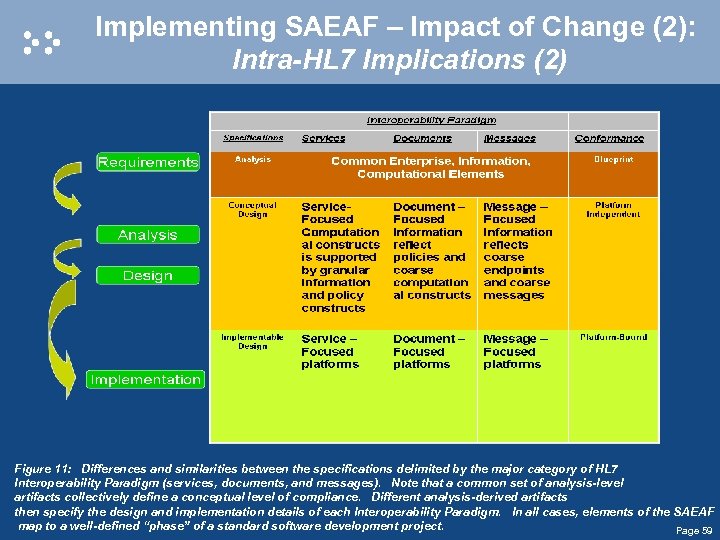 Implementing SAEAF – Impact of Change (2): Intra-HL 7 Implications (2) Figure 11: Differences and similarities between the specifications delimited by the major category of HL 7 Interoperability Paradigm (services, documents, and messages). Note that a common set of analysis-level artifacts collectively define a conceptual level of compliance. Different analysis-derived artifacts then specify the design and implementation details of each Interoperability Paradigm. In all cases, elements of the SAEAF map to a well-defined “phase” of a standard software development project. Page 59
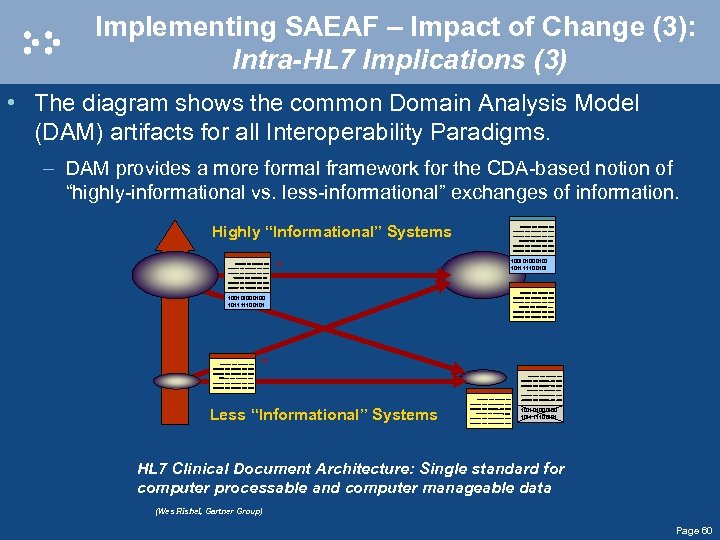 Implementing SAEAF – Impact of Change (3): Intra-HL 7 Implications (3) • The diagram shows the common Domain Analysis Model (DAM) artifacts for all Interoperability Paradigms. – DAM provides a more formal framework for the CDA-based notion of “highly-informational vs. less-informational” exchanges of information. Highly “Informational” Systems * 1001 0100 1011 1110 0101 * Less “Informational” Systems 1001 0100 1011 1110 0101 HL 7 Clinical Document Architecture: Single standard for computer processable and computer manageable data (Wes Rishel, Gartner Group) Page 60
 Implementing SAEAF – Impact of Change (4): Intra-HL 7 Implications (4) • HL 7 Work Groups – Much of recent reorganization aligns well with SAEAF: • Project-based activity vs. static “vertical” organization • Promotion of fully-specified services to the level of “equal” with messages and documents requires a group to develop the details of specific normative specifications for services. – The Service Specification Normative artifacts includes: » Normative artifact for Contract. » Normative artifact for Service Role Specification. Page 61
 Implementing SAEAF – Impact of Change (5): Inter-HL 7 Implications (1) • HL 7 has a number of explicit (memorandum of understanding) and implicit relationships with other SDOs. • Ar. B recommends that these relationships all be made as explicit as possible regarding SAEAF. • For specific examples and more details, see the SAEAF Introduction and Governance documents. Page 62
 Implementing SAEAF – Impact of Change (6): Inter-HL 7 Implications (2) • Object Management Group (OMG) – SAEAF artifacts might accelerate OMG ability to produce implementations of “healthcare services. ” • HL 7 could supply “full Conceptual and PIM-level” artifacts as input into OMG RFP process. – SAEAF expects to significantly leverage • MDA-based transforms • SOA Pro/UML Metamodel for Services (UMPL) • Business Process Definition Metamodel (BPDM) • Business Process Modeling Notation (BPMN) Page 63
 Implementing SAEAF – Impact of Change (7): Inter-HL 7 Implications (3) • CBDI Consultancy – Ar. B used CBDI Service taxonomy to inform SAEAF. • W 3 C – SAEAF will leverage CDL and WS-* specifications. – Orlando meeting marked kick-off of HL 7, OMG, W 3 C, and HCLS collaboration. • OASIS – Ar. B will continue to monitor the Normative SOA architecture for input from both a “pure services” and “services-aware” perspective. Page 64
 Implementing SAEAF – Impact of Change (8): Inter-HL 7 Implications (4) • Joint Interoperability Council (JIC) – HL 7 – ISO – European Committee for Standardization (CEN) – Clinical Data Interchange Standards Consortium (CDISC) – CSI Pillar #2 is supported by ISO 21090, a product of JIC effort. – HL 7 plans to move SAEAF into the JIC dialogue. • National Institute of Standards and Technology (NIST) is introducing ECCF into NIST testing of HL 7 artifacts and systems. Page 65
 Implementing SAEAF – Impact of Change (9): Tooling and Open Health Tools (1) • Tooling and Open Health Tools – Focusing on Working Interoperability and the critical role of architecture. – Adopting SAEAF ECCF for use in tool specification. • Mission and Charter To enable the adoption, development, and deployment of an evolving set of interoperable tools. These tools support the development and deployment of software that enables computable semantic interoperability in the health-care, life sciences, and clinical research domains. Tools are defined as any software component that is not a clinical end-user application, although such software components may form part of an enduser application. Tools are intended to be useful and usable for their intended purpose and to interoperate with each other. Page 66
 Implementing SAEAF – Impact of Change (10): Tooling and Open Health Tools (2) • Mission and Charter (cont’d) The OHT Architecture Project operates under the Open Health Tools Development Policy and Process (described at http: //www. openhealthtools. org/Documents/Open%20 Health%20 Tools%20%20 Development%20 Process. pdf). This project is chartered by the Board to articulate and adopt a formal architecture framework, architecture principles, and best practices that are focused on relevant interoperability and the use of standards. As its initial goal, the Architecture Project will develop and architecture framework that will enable the evolutionary development of an OHT Platform architecture consistent with the various enterprise architectures built and deployed by OHT stakeholders. Page 67
 Implementing SAEAF – Impact of Change (11): Tooling and Open Health Tools (3) • Mission and Charter (cont’d) Deliverables include: – A set of architecture principles. – A tool classification mechanism that enable stakeholders to contribute and have access to architecture artifacts that underlie the tools. – A set of templates, patterns, and processes that enable interoperability of OHT tools. – Identification of potential barriers to interoperability and recommendations to overcome them. – A recommendation to the board of a governance process to assist in the harvesting, categorization, and custodianship of architecture artifacts. – An internal and external communication plan. Page 68
 SAEAF Summary (1) • SAEAF is not a replacement for, or an alternative to, HL 7’s existing products, engagements, or offerings. • SAEAF is an effort to reframe, encompass, and support existing HL 7 work streams, and to focus them around a more explicit framework for expressing interoperability semantics. • SAEAF is the result of a shared belief by the HL 7 CTO, Ar. B, and TSC that the Health Enterprise requires this level of specificity and rigor to achieve scalable, agile interoperability. – HL 7 is establishing a leadership position in this discussion. Page 69
 SAEAF Summary (2) • HL 7 SAEAF aligns with strategic direction of national healthcentric organizations: – US Department of Defense / VA – Healthcare Information Technology Standards Panel (HITSP) – Canada Health Infoway – NCI CBIIT (ca. BIG®, BIG Health®) – National e-Health Transition Authority (Ne. HTA) • HL 7 SAEAF aligns with other industry standards: – WS-CDL – SOA Pro – HISA Page 70
 SAEAF Summary (3) • The HL 7 Services-Aware Enterprise Architecture Framework (SAEAF) provides a framework for specification of standardized “artifacts that enable Working Interoperability, ” which the HL 7 community can use regardless of the chosen Interoperability Paradigm (messages, documents, and services). • The SAEAF defines specific artifacts that provides traceability from requirements through analysis to design and implementation. • SAEAF-compliant specifications align with conformance levels specified in a Conformance and Compliance Framework (CCF) that enable HL 7 consumers to adopt HL 7 specifications in different contexts at different levels of interoperability. Page 71
 SAEAF Summary (4) • The HL 7 Services Aware Enterprise Architecture Framework identifies and defines the language, processes, and artifacts for: – An Enterprise Architecture appropriate for an SDO using services or services-aware thinking as a backbone concept. – Developing and deploying standards to enable Working Interoperability. • Services (and SOA) are not technology per se; they are: – A framework for approaching how to design distributed capabilities (information and functionality sharing). – Not equivalent to Web Services (although service constructs as well as other Interoperability Paradigm constructs may be realized using Web Services technology). Page 72
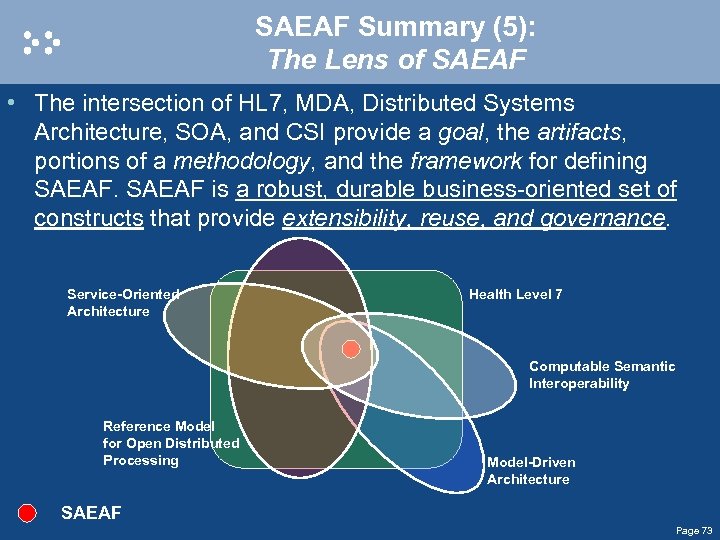 SAEAF Summary (5): The Lens of SAEAF • The intersection of HL 7, MDA, Distributed Systems Architecture, SOA, and CSI provide a goal, the artifacts, portions of a methodology, and the framework for defining SAEAF is a robust, durable business-oriented set of constructs that provide extensibility, reuse, and governance. Service-Oriented Architecture Health Level 7 Computable Semantic Interoperability Reference Model for Open Distributed Processing Model-Driven Architecture SAEAF Page 73
 SAEAF Summary (6): Conclusion SAEAF: A “Services-Aware Enterprise Architecture for HL 7” • “Services-aware but not services-specific” – Consideration given to three HL 7 “interoperability paradigms” (“HL 7 Unified Field Theory”) • Messages • Documents • Services • The SAEAF work draws on “service-centric principles, ” such as: – Contracts and behavior – Separation of concerns – Conformance and compliance – Governance Page 74
 Page 75