


 Скачать презентацию HL 7 Electronic Data Exchange in Health Care
0c4274611704190001e96c1f4c93819d.ppt
- Количество слайдов: 20
 HL 7 Electronic Data Exchange in Health Care W. Ed Hammond, Ph. D. President, AMIA Vice-chair, Technical Steering Committee, HL 7 Co-chair, Vocabulary Technical Committee, HL 7 Co-chair, EHR SIG, HL 7 Convenor, ISO TC 215, WG 2 Professor, Community & Family Medicine, Duke University
 Why standards in health care? • There is an assumed and inherent need to share data in the health care setting. The data are of many types and form and will be used for multiple purposes. • We must share both data and knowledge for both improved health care and for economic reasons. • Sharing becomes economically possible only if interoperability exists. • Interoperability occurs only if a full set of standards in health care exist. Duke University
 Inpatient setting • Inpatient systems consist of many heterogeneous systems that must be integrated for efficient and effective care. • Service requirements that are essential parts of hospital information systems require communication between the requestor of a service and the supplier of the service. • Automated capture of data is most economical, most accurate, and most complete. • Patient safety and improved quality of care require the integration of data without the loss of information among many systems. Duke University
 Steps to making a standard • • Awareness of need for standard Critical mass of technical expertise to create standard – Must insure fairness and not competitive advantage to a single vendor – Expertise must be both technical and domain • • MUST involve vendors, providers, consultants, government Global acceptance of standard – Requires education, balanced voting • • Vendor implementation of standard usually driven by consumer pressure to implement Visible reduction in cost and effort of interfaces as a result of standard Duke University
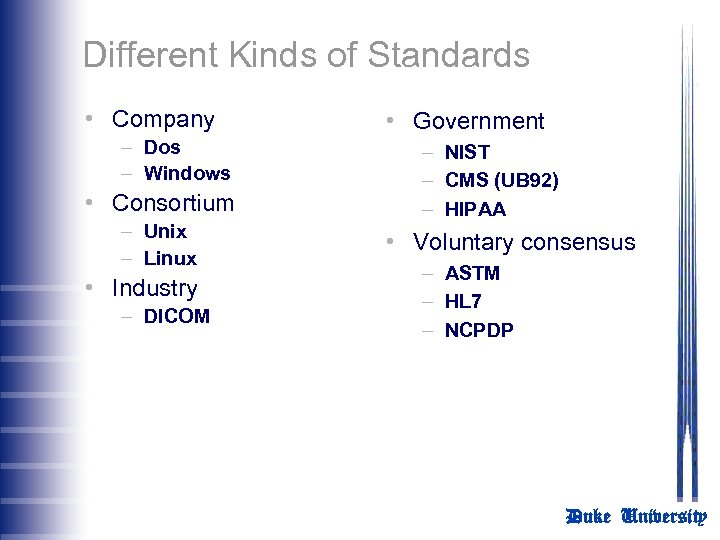 Different Kinds of Standards • Company – Dos – Windows • Consortium – Unix – Linux • Industry – DICOM • Government – NIST – CMS (UB 92) – HIPAA • Voluntary consensus – ASTM – HL 7 – NCPDP Duke University
 Consensus Standards • • Volunteer-driven Not full-time commitment Uneven levels of participation Uneven levels of understanding Required resolution of negatives Prone to compromise, often leading to ambiguity Specialized balloting process (ANSI: requires 90% approval at membership level) Duke University
 Multiple talents required for success • Administrative structure that supports the process but does not get in its way. • Political process that removes barriers to acceptance and implementation • Technical process that produces technically sound standard • Open process that does not slow or hinder production of standard • Funding process to create a standard in shortest, reasonable time • Commitment to life cycle of maintenance and update Duke University
 A bit of history … • HL 7 began in 1987 to permit the creation of an affordable Hospital Information System from a “best of breed” approach. • Standard was based on an implicit model based purely on the experience of the developers. • Limitations in technology defined the characteristics of the standard: characterbased, character delimiters, position-defined. • First efforts addressed most important and frequent requirements. • Speed was important. • Acceptance took time. Duke University
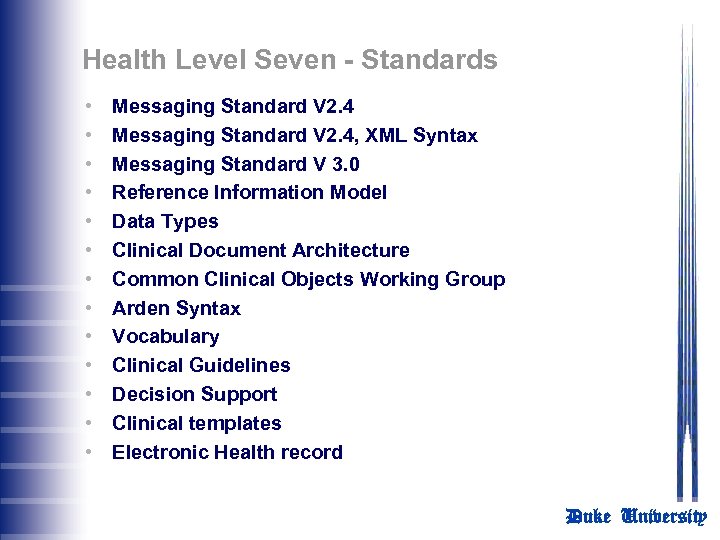 Health Level Seven - Standards • • • • Messaging Standard V 2. 4, XML Syntax Messaging Standard V 3. 0 Reference Information Model Data Types Clinical Document Architecture Common Clinical Objects Working Group Arden Syntax Vocabulary Clinical Guidelines Decision Support Clinical templates Electronic Health record Duke University
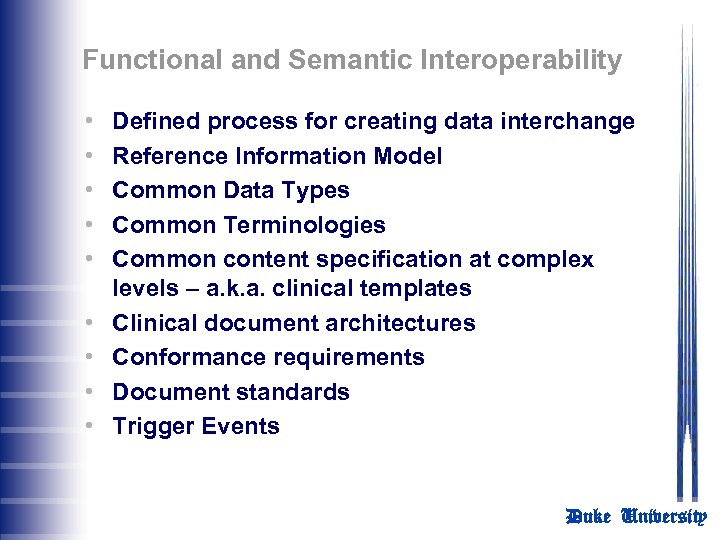 Functional and Semantic Interoperability • • • Defined process for creating data interchange Reference Information Model Common Data Types Common Terminologies Common content specification at complex levels – a. k. a. clinical templates Clinical document architectures Conformance requirements Document standards Trigger Events Duke University
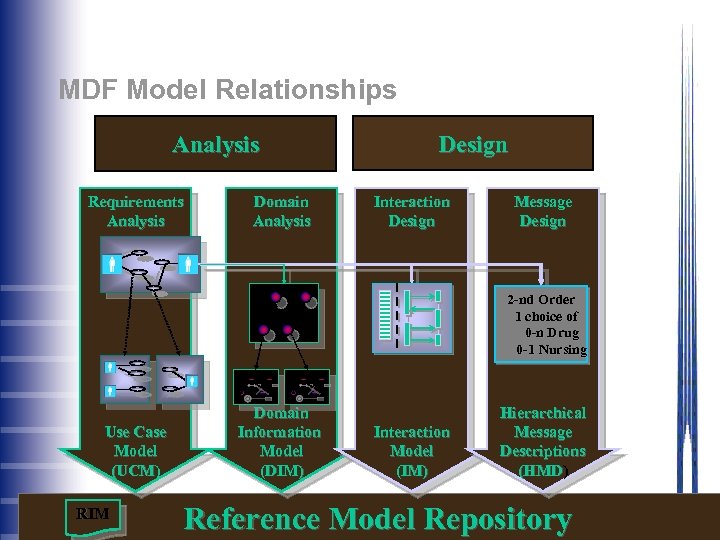 MDF Model Relationships Analysis Requirements Analysis Domain Analysis Design Interaction Design Message Design 2 -nd Order 1 choice of 0 -n Drug 0 -1 Nursing Use Case Model (UCM) RIM Domain Information Model (DIM) Interaction Model (IM) Hierarchical Message Descriptions (HMD) Reference Model Repository. Duke University
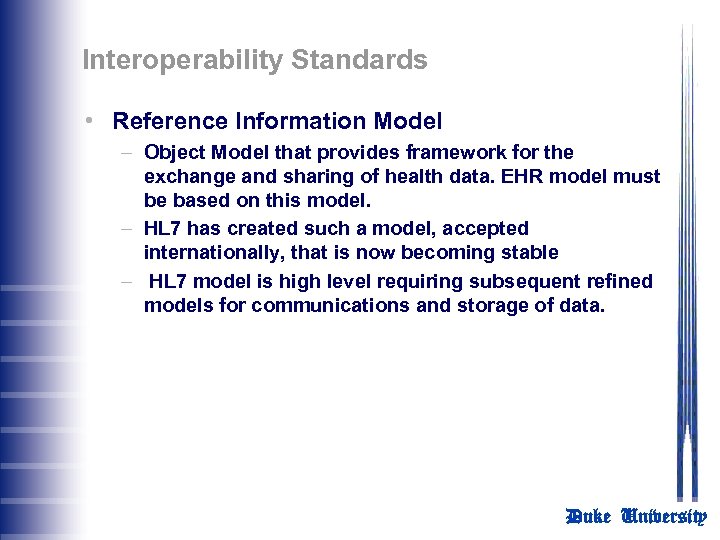 Interoperability Standards • Reference Information Model – Object Model that provides framework for the exchange and sharing of health data. EHR model must be based on this model. – HL 7 has created such a model, accepted internationally, that is now becoming stable – HL 7 model is high level requiring subsequent refined models for communications and storage of data. Duke University
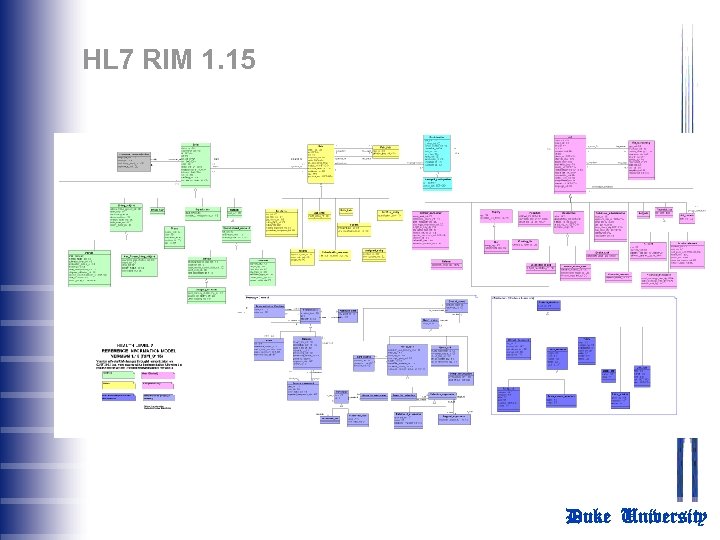 HL 7 RIM 1. 15 Duke University
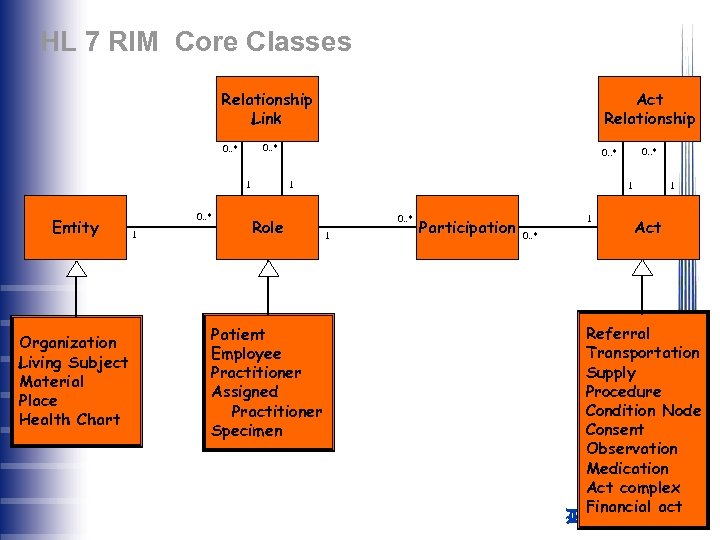 HL 7 RIM Core Classes Relationship Link 0. . * 1 Entity Organization Living Subject Material Place Health Chart 0. . * 1 Act Relationship 0. . * 1 Role Patient Employee Practitioner Assigned Practitioner Specimen 1 0. . * 1 Participation 1 0. . * 1 Act Referral Transportation Supply Procedure Condition Node Consent Observation Medication Act complex Financial act Duke University
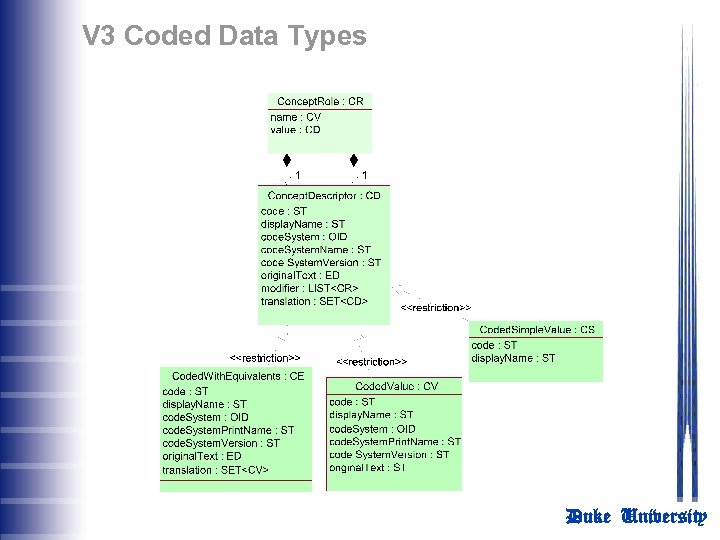 V 3 Coded Data Types Duke University
 Clinical Document Architecture • XML-based definition of clinical documents such as discharge summaries, op notes, progress notes, radiology reports, etc. • HL 7 has ANSI approved standards. Work is based on 3 levels: (1) header; (2) header plus body structure and section headings; (3) element content specification and identification Duke University
 Interoperability Standards (Concepts) • Clinical Data Model – Defines detail clinical object structures – Examples • CEN GPICS • HL 7: 3 M Clinical Data Models • HL 7: Common Message Element Types • HL 7: Clinical Templates • GEHR: Archetypes • ISO TC 215 WG 2 has work item to harmonize these common conceptual elements (CHICS) • Require registry Duke University
 Implementation/Conformance • Most frequently, ambiguity and options remain in standards at all levels. Total interoperability requires a precise definition of what will be sent to whom under what circumstances. • One example of this approach is DEEDS. • NEDSS will also provide this level of specification. Duke University
 Methods • Work can be performed by a knowledgeable few; then get buy-in from group • Require use of standards by law • Sell value of standards; create a market • Demonstrations to prove standards work and to get publicity • Give publicity to vendors that use standards • Convince users to demand standards • Buy from vendors who use standards • Reduce confusion in market place caused by multiple, competing standards. Duke University
 Final advice • Total adherence to standard is most economical approach • Mapping of “your standard” to the standard is inefficient, expensive, out of date, and wrong. • A business case must be made for switching to the standard. Then the switch must be made in a timely fashion. • Governments must support standards. • If you know what must be done, do it now! Duke University