 Скачать презентацию HL 7 Conformance Testing with Message Maker Robert
b37fccfcaa465a001c9966da8133b121.ppt
- Количество слайдов: 24



HL 7 Conformance Testing with Message Maker Robert Snelick National Institute of Standards & Technology (NIST) rsnelick@nist. gov http: //www. nist. gov/messagemaker
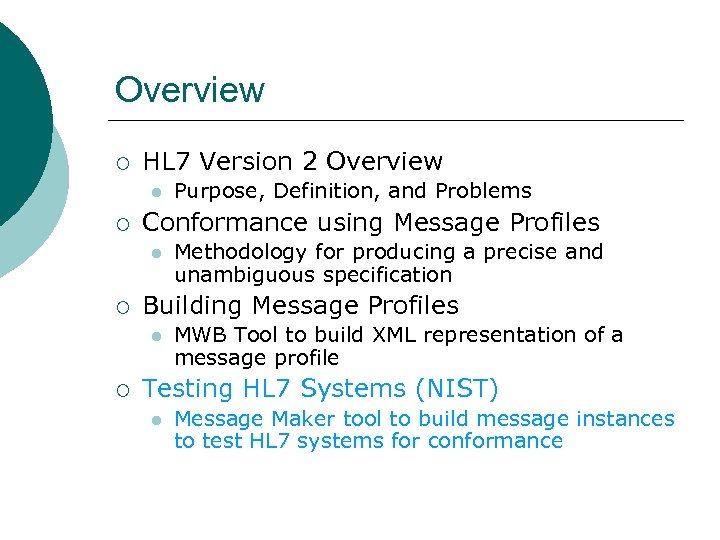
Overview ¡ HL 7 Version 2 Overview l ¡ Conformance using Message Profiles l ¡ Methodology for producing a precise and unambiguous specification Building Message Profiles l ¡ Purpose, Definition, and Problems MWB Tool to build XML representation of a message profile Testing HL 7 Systems (NIST) l Message Maker tool to build message instances to test HL 7 systems for conformance
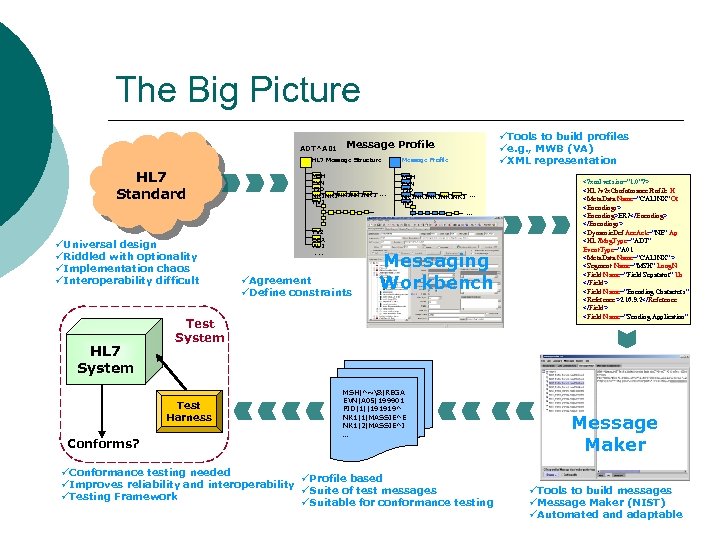
The Big Picture ADT^A 01 üTools to build profiles üe. g. , MWB (VA) üXML representation Message Profile HL 7 Message Structure HL 7 Standard Message Profile MSH EVN PID NK 1 NK 1. . . PV 1 MSH EVN PID NK 1 NK 1. . . PV 1 . . . üUniversal design üRiddled with optionality üImplementation chaos üInteroperability difficult HL 7 System PV 2 OBX AL 1. . . üAgreement üDefine constraints Messaging Workbench Test System Test Harness Conforms? PV 2 OBX AL 1 . . . MSH|^~&|REGA EVN|A 05|199901 PID|1||191919^ NK 1|1|MASSIE^E NK 1|2|MASSIE^I … üConformance testing needed üProfile based üImproves reliability and interoperability üSuite of test messages üTesting Framework üSuitable for conformance testing <? xml version="1. 0"? > <HL 7 v 2 x. Conformance. Profile H <Meta. Data Name="CALINX" Or <Encodings> <Encoding>ER 7</Encoding> </Encodings> <Dynamic. Def Acc. Ack="NE" Ap <HL 7 Msg. Type=“ADT" Event. Type=“A 01 <Meta. Data Name="CALINX" > <Segment Name="MSH" Long. N <Field Name="Field Separator" Us </Field> <Field Name="Encoding Characters" <Reference>2. 16. 9. 2</Reference </Field> <Field Name="Sending Application" Message Maker üTools to build messages üMessage Maker (NIST) üAutomated and adaptable
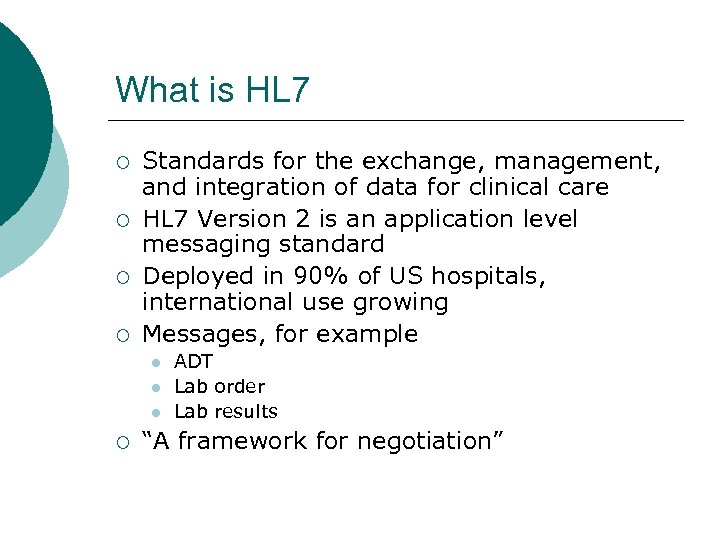
What is HL 7 ¡ ¡ Standards for the exchange, management, and integration of data for clinical care HL 7 Version 2 is an application level messaging standard Deployed in 90% of US hospitals, international use growing Messages, for example l l l ¡ ADT Lab order Lab results “A framework for negotiation”
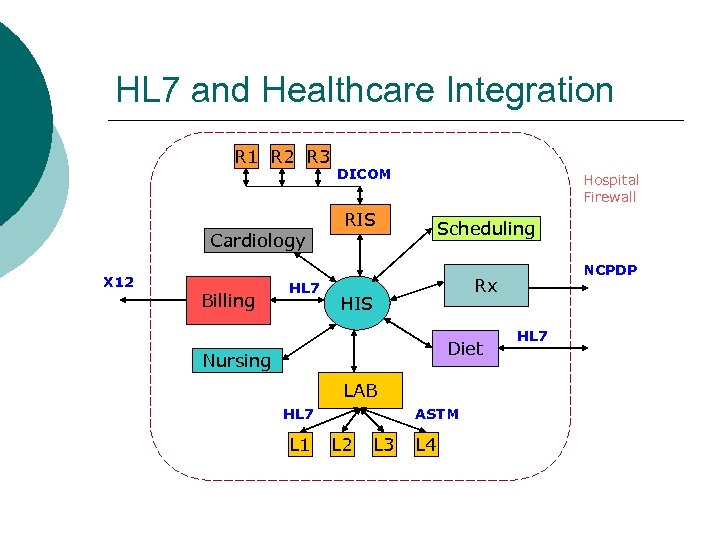
HL 7 and Healthcare Integration R 1 R 2 R 3 Cardiology X 12 Billing HL 7 DICOM RIS Hospital Firewall Scheduling Rx HIS Diet Nursing LAB HL 7 L 1 ASTM L 2 L 3 NCPDP L 4 HL 7
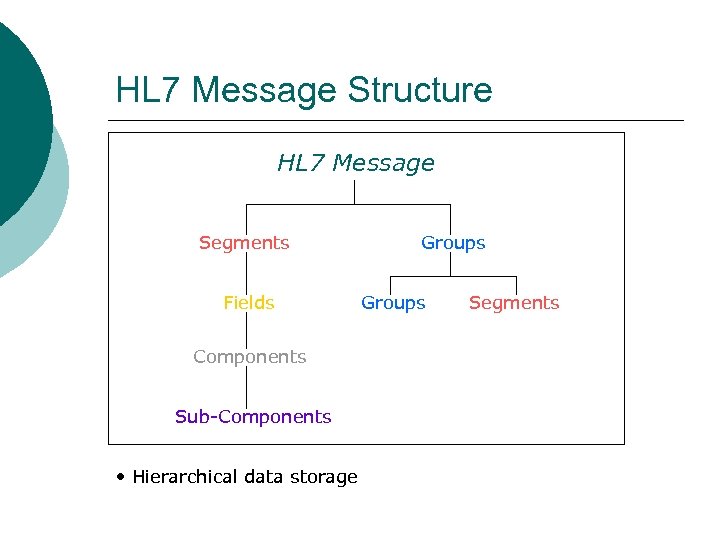
HL 7 Message Structure HL 7 Message Segments Fields Components Sub-Components • Hierarchical data storage Groups Segments
![Message Definition ADT^A 04^ADT_A 01 MSH EVN PID [ PD 1 ] [{ ROL](https://present5.com/presentation/b37fccfcaa465a001c9966da8133b121/image-7.jpg "Message Definition ADT^A 04^ADT_A 01 MSH EVN PID [ PD 1 ] [{ ROL")
Message Definition ADT^A 04^ADT_A 01 MSH EVN PID [ PD 1 ] [{ ROL }] [{ NK 1 }] PV 1 [ PV 2 ] Segment event (admit a patient) • Hundreds of segments and events • Segments are defined once . . . [{ GT 1 } ] [{ IN 1 [ IN 2 ] [{ IN 3 }] [{ ROL }] }] [ ACC ] [ UB 1 ] [ UB 2 ] [ PDA ] • Message maps to a real world • Each message selects from a library of segments Group • Think of them as data structures (or classes) {} Segment can repeat [] Segment is optional
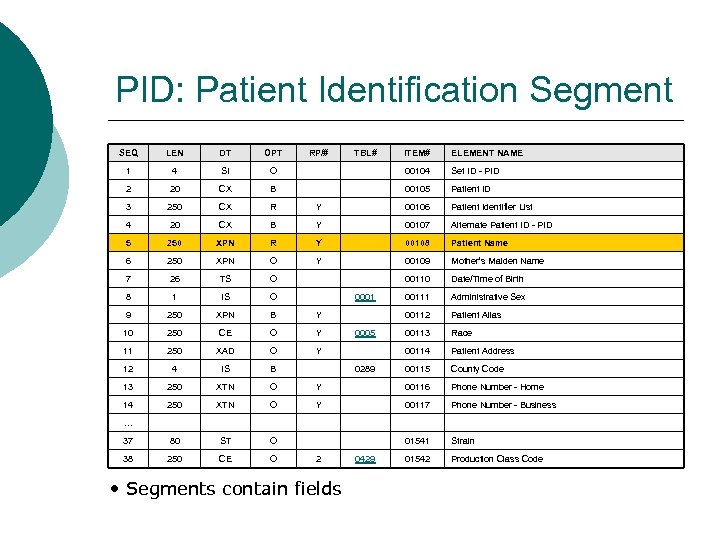
PID: Patient Identification Segment SEQ LEN DT OPT 1 4 SI 2 20 3 RP/# TBL# ITEM# ELEMENT NAME O 00104 Set ID - PID CX B 00105 Patient ID 250 CX R Y 00106 Patient Identifier List 4 20 CX B Y 00107 Alternate Patient ID - PID 5 250 XPN R Y 00108 Patient Name 6 250 XPN O Y 00109 Mother’s Maiden Name 7 26 TS O 00110 Date/Time of Birth 8 1 IS O 00111 Administrative Sex 9 250 XPN B Y 00112 Patient Alias 10 250 CE O Y 00113 Race 11 250 XAD O Y 00114 Patient Address 12 4 IS B 00115 County Code 13 250 XTN O Y 00116 Phone Number - Home 14 250 XTN O Y 00117 Phone Number - Business 37 80 ST O 01541 Strain 38 250 CE O 01542 Production Class Code 0001 0005 0289 … 2 • Segments contain fields 0429
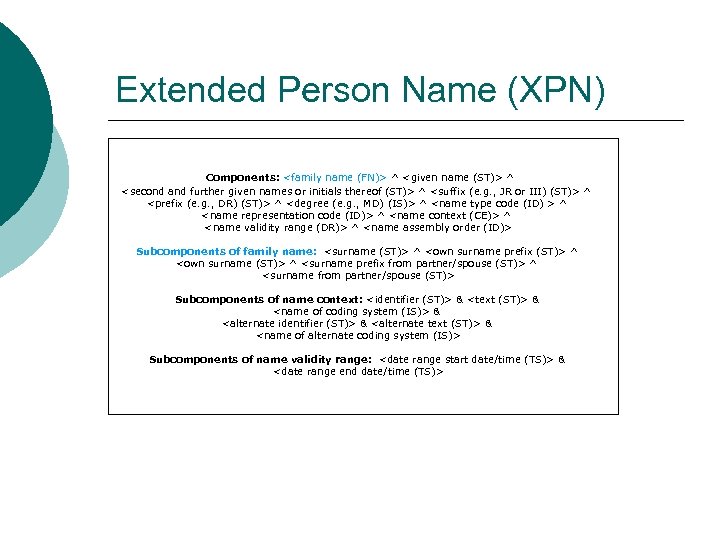
Extended Person Name (XPN) Components: <family name (FN)> ^ <given name (ST)> ^ <second and further given names or initials thereof (ST)> ^ <suffix (e. g. , JR or III) (ST)> ^ <prefix (e. g. , DR) (ST)> ^ <degree (e. g. , MD) (IS)> ^ <name type code (ID) > ^ <name representation code (ID)> ^ <name context (CE)> ^ <name validity range (DR)> ^ <name assembly order (ID)> Subcomponents of family name: <surname (ST)> ^ <own surname prefix (ST)> ^ <own surname (ST)> ^ <surname prefix from partner/spouse (ST)> ^ <surname from partner/spouse (ST)> Subcomponents of name context: <identifier (ST)> & <text (ST)> & <name of coding system (IS)> & <alternate identifier (ST)> & <alternate text (ST)> & <name of alternate coding system (IS)> Subcomponents of name validity range: <date range start date/time (TS)> & <date range end date/time (TS)>
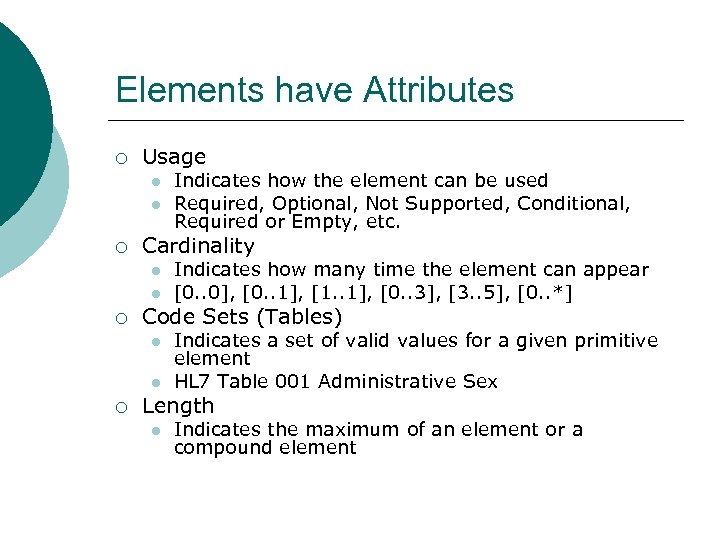
Elements have Attributes ¡ Usage l l ¡ Cardinality l l ¡ Indicates how many time the element can appear [0. . 0], [0. . 1], [1. . 1], [0. . 3], [3. . 5], [0. . *] Code Sets (Tables) l l ¡ Indicates how the element can be used Required, Optional, Not Supported, Conditional, Required or Empty, etc. Indicates a set of valid values for a given primitive element HL 7 Table 001 Administrative Sex Length l Indicates the maximum of an element or a compound element
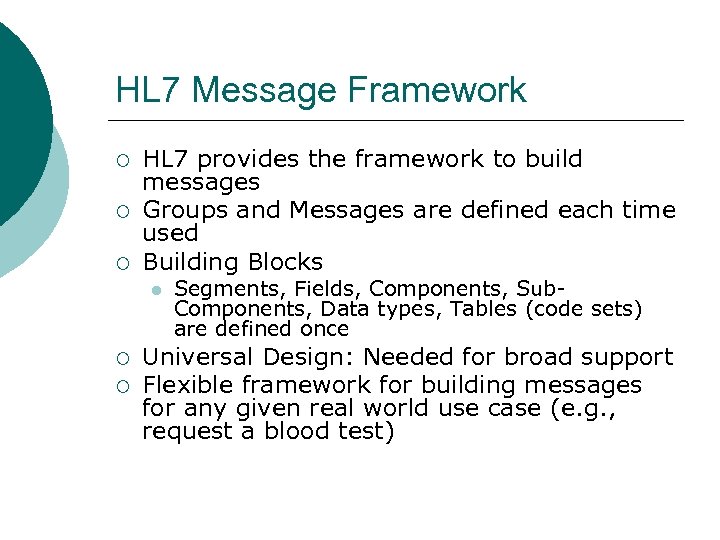
HL 7 Message Framework ¡ ¡ ¡ HL 7 provides the framework to build messages Groups and Messages are defined each time used Building Blocks l ¡ ¡ Segments, Fields, Components, Sub. Components, Data types, Tables (code sets) are defined once Universal Design: Needed for broad support Flexible framework for building messages for any given real world use case (e. g. , request a blood test)
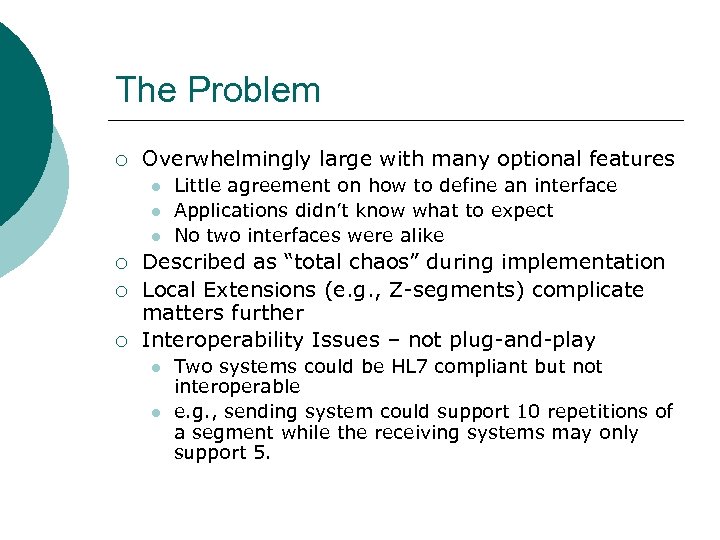
The Problem ¡ Overwhelmingly large with many optional features l l l ¡ ¡ ¡ Little agreement on how to define an interface Applications didn’t know what to expect No two interfaces were alike Described as “total chaos” during implementation Local Extensions (e. g. , Z-segments) complicate matters further Interoperability Issues – not plug-and-play l l Two systems could be HL 7 compliant but not interoperable e. g. , sending system could support 10 repetitions of a segment while the receiving systems may only support 5.
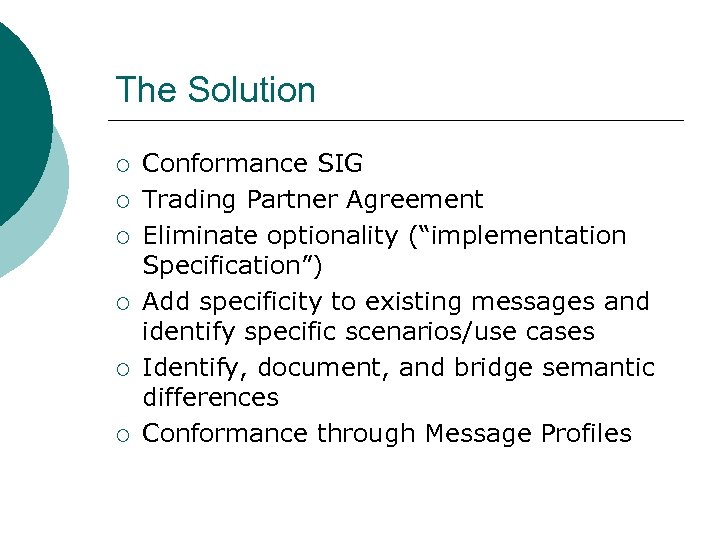
The Solution ¡ ¡ ¡ Conformance SIG Trading Partner Agreement Eliminate optionality (“implementation Specification”) Add specificity to existing messages and identify specific scenarios/use cases Identify, document, and bridge semantic differences Conformance through Message Profiles
Message Profile Defined ¡ ¡ ¡ Refinement of the HL 7 Standard Provides an unambiguous specification of a standard HL 7 message Measurable l l ¡ Parts of a Message Profile l l l ¡ What data will be passed in the message The format in which the data will be passed The acknowledgement responsibilities of the sender and the receiver Message instances can be validated against a message profile Use case model Static Definition Dynamic Definition Represented as an XML document (HL 7 XML)
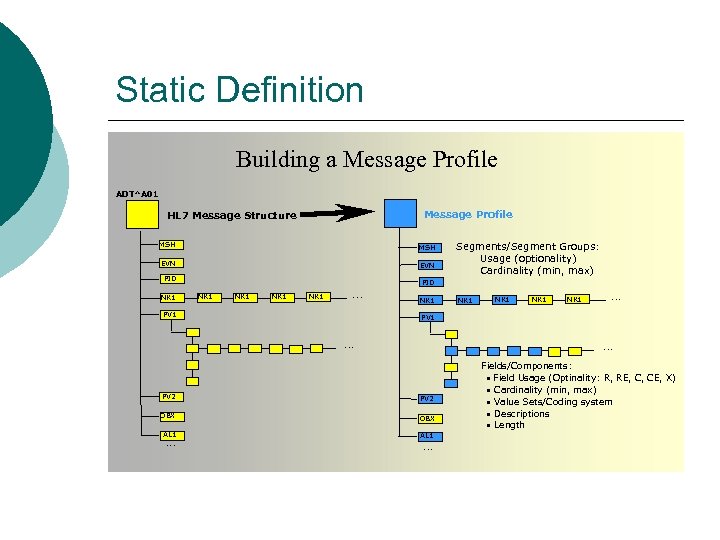
Static Definition Building a Message Profile ADT^A 01 Message Profile HL 7 Message Structure MSH EVN PID NK 1 NK 1 NK 1 . . . PV 1 . . . PV 2 OBX AL 1 . . . Segments/Segment Groups: Usage (optionality) Cardinality (min, max) . . . Fields/Components: • Field Usage (Optinality: R, RE, C, CE, X) • Cardinality (min, max) • Value Sets/Coding system • Descriptions • Length
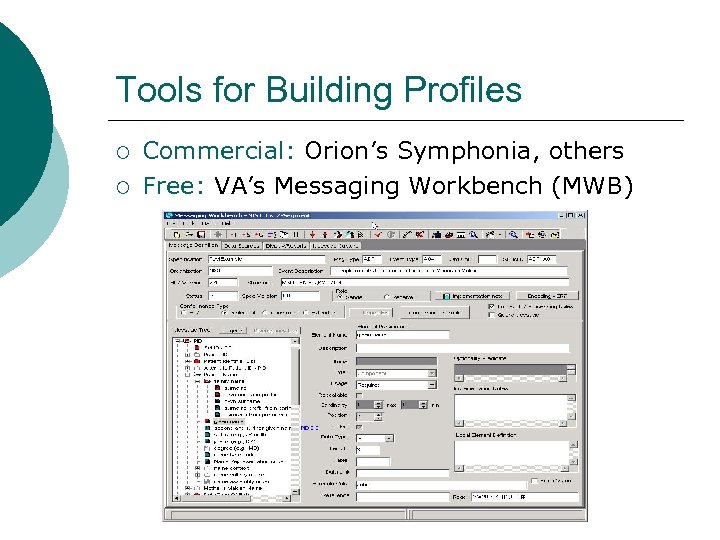
Tools for Building Profiles ¡ ¡ Commercial: Orion’s Symphonia, others Free: VA’s Messaging Workbench (MWB)
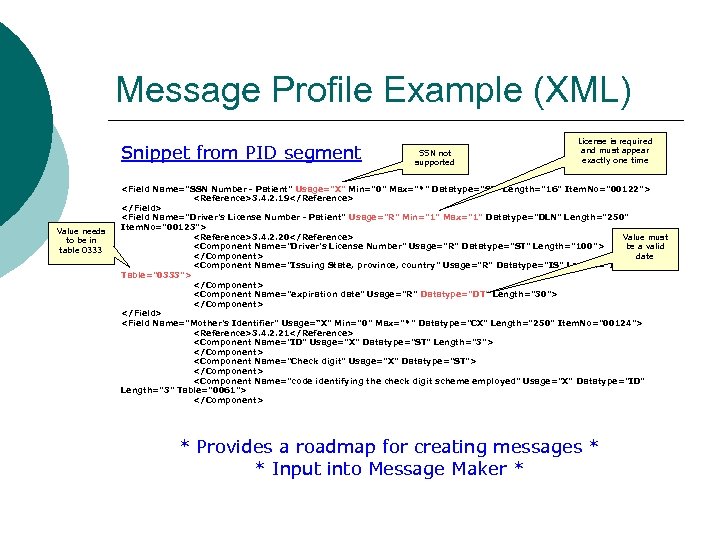
Message Profile Example (XML) Snippet from PID segment Value needs to be in table 0333 SSN not supported License is required and must appear exactly one time <Field Name="SSN Number - Patient" Usage="X" Min="0" Max="*" Datatype="ST" Length="16" Item. No="00122"> <Reference>3. 4. 2. 19</Reference> </Field> <Field Name="Driver's License Number - Patient" Usage="R" Min="1" Max="1" Datatype="DLN" Length="250" Item. No="00123"> <Reference>3. 4. 2. 20</Reference> Value must be a valid <Component Name="Driver's License Number" Usage="R" Datatype="ST" Length="100"> date </Component> <Component Name="Issuing State, province, country" Usage="R" Datatype="IS" Length="10" Table="0333"> </Component> <Component Name="expiration date" Usage="R" Datatype="DT" Length="30"> </Component> </Field> <Field Name="Mother's Identifier" Usage=“X" Min="0" Max="*" Datatype="CX" Length="250" Item. No="00124"> <Reference>3. 4. 2. 21</Reference> <Component Name="ID" Usage="X" Datatype="ST" Length="3"> </Component> <Component Name="Check digit" Usage="X" Datatype="ST"> </Component> <Component Name="code identifying the check digit scheme employed" Usage="X" Datatype="ID" Length="3" Table="0061"> </Component> * Provides a roadmap for creating messages * * Input into Message Maker *
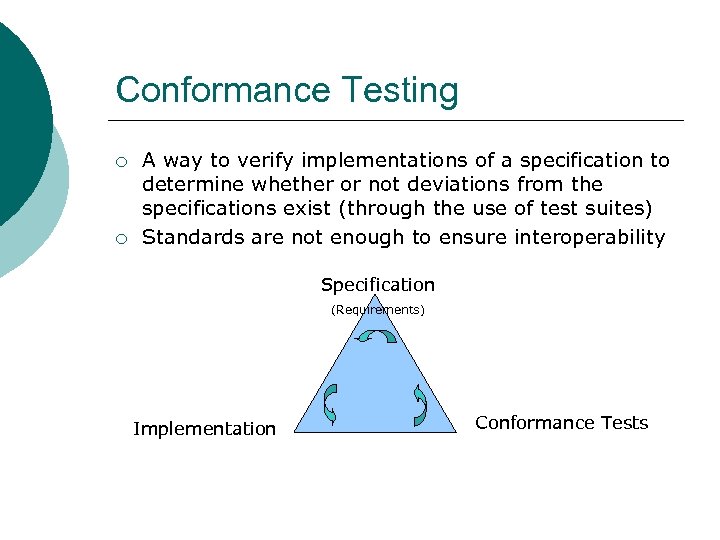
Conformance Testing ¡ ¡ A way to verify implementations of a specification to determine whether or not deviations from the specifications exist (through the use of test suites) Standards are not enough to ensure interoperability Specification (Requirements) Implementation Conformance Tests
Benefits of Conformance Testing ¡ Increase probability that products are implemented correctly l l l ¡ Increased likelihood of portability and interoperability l l ¡ ¡ ¡ Contains required functionality Behaves as expected Performs functions in a known manner Portability – the ability to move software or applications among different systems Interoperability – the ability of two or more systems to exchange and use information Provides a feedback loop for developers Increases buyer’s confidence in a product and substantiate seller’s claim Not locked into purchasing from a single vendor
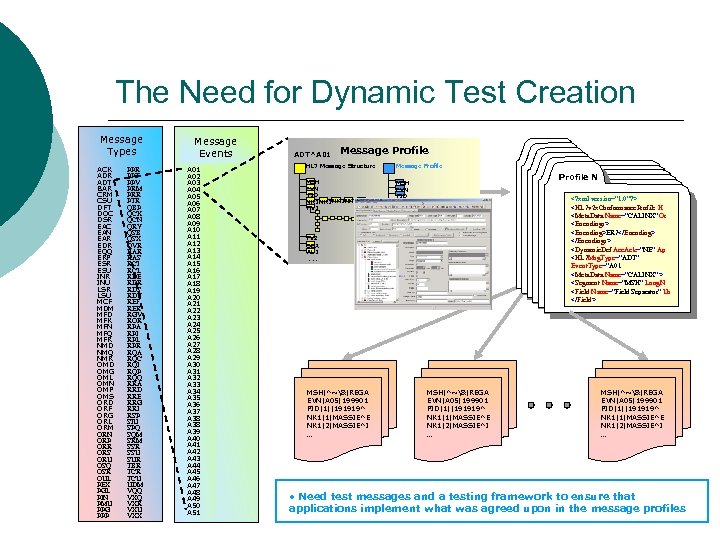
The Need for Dynamic Test Creation Message Types ACK ADR ADT BAR CRM CSU DFT DOC DSR EAC EAN EAR EDR EQQ ERP ESR ESU INR INU LSR LSU MCF MDM MFD MFK MFN MFQ MFR NMD NMQ NMR OMD OMG OML OMN OMP OMS ORD ORF ORG ORL ORM ORN ORP ORR ORS ORU OSQ OSR OUL PEX PGL PIN PMU PPG PPP PPR PPT PPV PRM PRR PTR QBP QCK QCN QRY QSB QSX QVR RAS RCI RCL RDE RDR RDS RDY REF RER RGV ROR RPA RPI RPL RPR RQA RQC RQI RQP RQQ RRA RRD RRE RRG RRI RSP SIU SPQ SQM SRM SSR SSU SUR TBR TCU UDM VQQ VXR VXU VXX Message Events A 01 A 02 A 03 A 04 A 05 A 06 A 07 A 08 A 09 A 10 A 11 A 12 A 13 A 14 A 15 A 16 A 17 A 18 A 19 A 20 A 21 A 22 A 23 A 24 A 25 A 26 A 27 A 28 A 29 A 30 A 31 A 32 A 33 A 34 A 35 A 36 A 37 A 38 A 39 A 40 A 41 A 42 A 43 A 44 A 45 A 46 A 47 A 48 A 49 A 50 A 51 ADT^A 01 Message Profile HL 7 Message Structure Message Profile MSH EVN PID NK 1 NK 1. . . PV 1 MSH EVN PID NK 1 NK 1. . . PV 1 . . . PV 2 OBX AL 1. . . Profile N Message Profile § explicitly defines § § Message defines explicitly Profile Message Profile explicitly defines message <? xml version="1. 0"? > components § explicitly defines at message components at H <HL 7 v 2 x. Conformance. Profile message components each § explicitly defines at Or level <Meta. Data Name="CALINX" message each level components at § implementable level § § each <Encodings> implementable each level <Encoding>ER 7</Encoding> implementable specification § § implementable specification </Encodings> specification § still sites defined. Acc. Ack="NE" Ap their <Dynamic. Def § § specification still sites defined their specification still sites defined own§ profiles (many) their <HL 7 Msg. Type=“ADT" still sites defined own§ profiles (many) their own still sites(many) their profiles defined Event. Type=“A 01 § nature profilesbeast of the (many) § § own <Meta. Data Name="CALINX" > nature profiles (many) own of the beast nature of the beast <Segment § § nature of. Name="MSH" Long. N nature of the beast <Field Name="Field Separator" Us </Field> MSH|^~&|REGA EVN|A 05|199901 PID|1||191919^ NK 1|1|MASSIE^E NK 1|2|MASSIE^I … • Need test messages and a testing framework to ensure that applications implement what was agreed upon in the message profiles
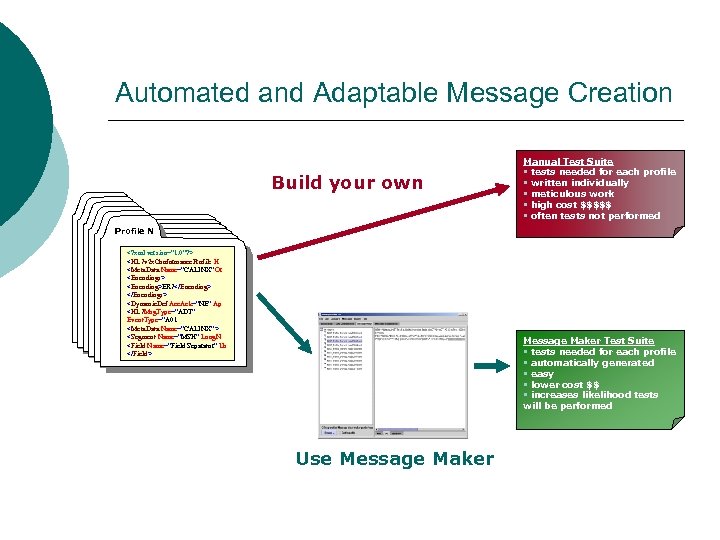
Automated and Adaptable Message Creation Build your own Profile N Message Profile § § Message defines explicitly Profile Message Profile explicitly defines § § Message defines at explicitly Profile message <? xml version="1. 0"? > components explicitly defines message components at H <HL 7 v 2 x. Conformance. Profile message components at Or each § explicitly defines at level <Meta. Data Name="CALINX" message each level components message § § each level components at implementable each <Encodings> level implementable <Encoding>ER 7</Encoding> § § each level implementable specification </Encodings> implementable § § specification still§sites defined. Acc. Ack="NE" Ap their specification <Dynamic. Def still sites specification § § profiles defined their still sites(many) their defined own still <HL 7 Msg. Type=“ADT" sites(many) their defined own§ profiles defined their still sites Event. Type=“A 01 § § own profiles (many) nature profiles (many) own of the beast nature profiles (many) of the Name="CALINX" > beast § § own<Meta. Data. Name="MSH" Long. N nature of the beast <Segment nature of the beast § nature Name="Field Separator" Us of the beast <Field Manual Test Suite § tests needed for each profile § written individually § meticulous work § high cost $$$$$ § often tests not performed Message Maker Test Suite § tests needed for each profile § automatically generated § easy § lower cost $$ § increases likelihood tests will be performed </Field> Use Message Maker
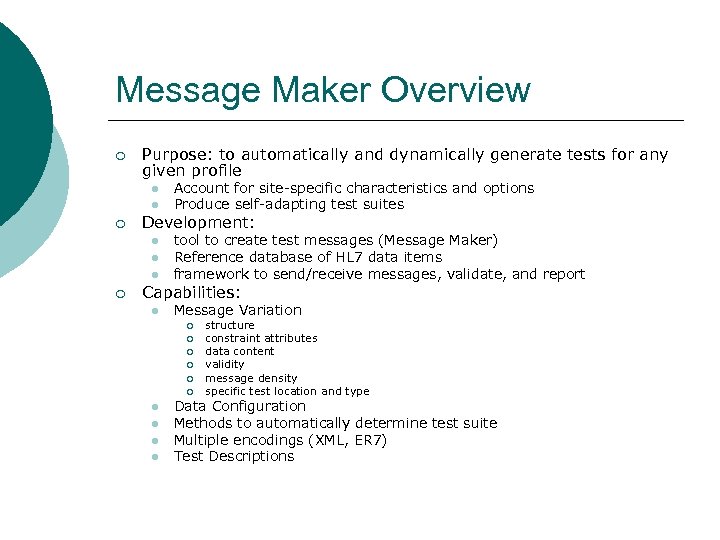
Message Maker Overview ¡ Purpose: to automatically and dynamically generate tests for any given profile l l ¡ Development: l l l ¡ Account for site-specific characteristics and options Produce self-adapting test suites tool to create test messages (Message Maker) Reference database of HL 7 data items framework to send/receive messages, validate, and report Capabilities: l Message Variation ¡ ¡ ¡ l l structure constraint attributes data content validity message density specific test location and type Data Configuration Methods to automatically determine test suite Multiple encodings (XML, ER 7) Test Descriptions
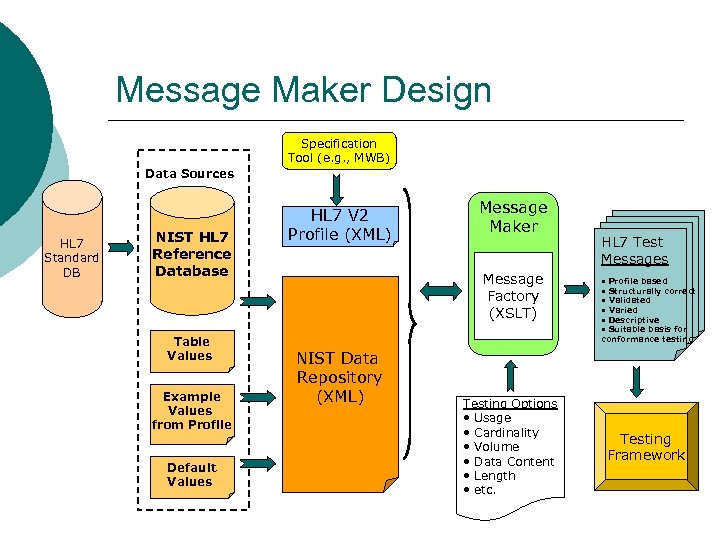
Message Maker Design Specification Tool (e. g. , MWB) Data Sources HL 7 Standard DB NIST HL 7 Reference Database Table Values Example Values from Profile Default Values HL 7 V 2 Profile (XML) Message Maker Message Factory (XSLT) NIST Data Repository (XML) Testing Options • Usage • Cardinality • Volume • Data Content • Length • etc. HL 7 Test Messages • • • Profile based Structurally correct Validated Varied Descriptive Suitable basis for conformance testing Testing Framework
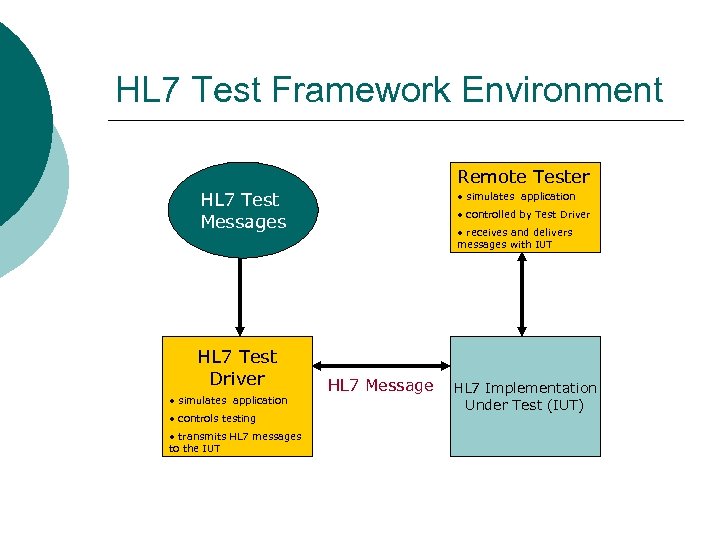
HL 7 Test Framework Environment Remote Tester HL 7 Test Messages HL 7 Test Driver • simulates application • controls testing • transmits HL 7 messages to the IUT • simulates application • controlled by Test Driver • receives and delivers messages with IUT HL 7 Message HL 7 Implementation Under Test (IUT)
Скачать презентацию HL 7 Conformance Testing with Message Maker Robert
b37fccfcaa465a001c9966da8133b121.ppt