


 Скачать презентацию HKALE Microeconomics n Chapter 3 Consumer Demand 1 -The MUV
fa26df669437a445a9810dfc32525e6c.ppt
- Количество слайдов: 66
 HKALE Microeconomics n Chapter 3: Consumer Demand(1)-The MUV Approach and Exchange By Mr. LAU san-fat CH 3 -Consumer's Demand(1) 1
 Six Basic Postulates 1. Each individual desires more goods and has many goals. 2. For each individual, some goods are scare. 3. Postulate of substitution: economic goods are substitutable, i. e. each person is willing to forsake some of a good to get more of other goods. By Mr. LAU san-fat CH 3 -Consumer's Demand(1) 2
 Six Basic Postulates 4. Postulate of diminishing MUV: the more of a good one has, the larger the TUV, but the lower the MUV of a unit. 5. Not all individuals have identical tastes and preferences. 6. Individuals are innovative but logically consistent in making choice. By Mr. LAU san-fat CH 3 -Consumer's Demand(1) 3
 Use Value and Exchange Value n Value can be referred to use value or exchange/market value. n (Personal) use value (or value in use) of a unit of a good is defined as the maximum amount of another good which a person is willing to forgo in order to obtain it. n Exchange value (or value in exchange) is defined as the amount of some other goods or money that a consumer has to pay for a given amount of a good in the market. By Mr. LAU san-fat CH 3 -Consumer's Demand(1) 4
 Use Value Vs. Exchange Value n The use value of a good is the maximum amount of other good one is willing to give up for obtaining that good. n The exchange value of a good is, however, the amount of other good to be exchanged within a transaction. By Mr. LAU san-fat CH 3 -Consumer's Demand(1) 5
 Use Value Vs. Exchange Value n Use value is subjective. n However, exchange value is an objective concept because it can be measured, e. g. an apple can be exchanged with two lemons in a transaction. By Mr. LAU san-fat CH 3 -Consumer's Demand(1) 6
 Use Value Vs. Exchange Value n The use value of a good depends on how people evaluate the good(i. e. individual preference) or is positively related to the number of its uses. n However, the exchange value of a good depends on the demand for and the supply of the good, i. e. depending on the degree of scarcity. By Mr. LAU san-fat CH 3 -Consumer's Demand(1) 7
 Use Value Vs. Exchange Value n The use value of a good may be measured by the amount of money one is willing to sacrifice. n The exchange value of a good, however, if measured in terms of money, is called money price; if measured in terms of other good, it is called relative price. By Mr. LAU san-fat CH 3 -Consumer's Demand(1) 8
 Use Value Vs. Exchange Value n Paradox of value: the use value of a good may not be in proportion to its exchange rate. n Example: water has high use value but low exchange value, while diamond has low use value but high exchange value. By Mr. LAU san-fat CH 3 -Consumer's Demand(1) 9
 Value Vs. Cost: Differences n Value is the max. amount of other good one is willing to forgo for obtaining a good. n Cost is the value of the highest-valued option forgone in making a decision. By Mr. LAU san-fat CH 3 -Consumer's Demand(1) 10
 Value Vs. Cost: Differences n Value is a reflection of an individual's preference. n Cost, however, as an ex-ante concept, is a constraint of behavior. By Mr. LAU san-fat CH 3 -Consumer's Demand(1) 11
 Value Vs. Cost: Differences n The value of a free good may be positive while the cost of a free good, however, is zero. n Value arises when people make personal valuation while cost arises because of scarcity. By Mr. LAU san-fat CH 3 -Consumer's Demand(1) 12
 Value Vs. Cost: Similarities n They are measured in terms of other goods. n They are expressed in terms of 'maximum' amount of other good. n They can affect decision-making. By Mr. LAU san-fat CH 3 -Consumer's Demand(1) 13
 Value Vs. Cost n Cost and value are not necessarily related. In fact, cost and value are used to derive the decision-making process of individuals. n Example: a hair cut poorer than anticipated only reduces its value, but it does not raise its cost. The cost of the hair cut will rise if the time involved in getting it done, increases in value. By Mr. LAU san-fat CH 3 -Consumer's Demand(1) 14
 Cost Vs. Price n Cost is the highest-valued option forgone while price is the physical exchange rate of one good for another good. n Cost arises because of scarcity, no choice hence results in no cost. However, price arises because of exchange, no exchange hence leads to no price. By Mr. LAU san-fat CH 3 -Consumer's Demand(1) 15
 Cost Vs. Price n Cost still exists in an one-man economy while price is absent in one-man economy because of no interpersonal exchange. By Mr. LAU san-fat CH 3 -Consumer's Demand(1) 16
 TUV, AUV & MUV n n n Total use value (TUV) is the maximum total amount of another good that one is willing to pay for the entire quantity of a good. Average use value (AUV) is the total use value divided by the number of units (Q) of a good, i. e. TUV/Q Marginal use value (MUV) is the maximum amount of another good that a person is willing to pay for an extra unit of a good. MUV= TUV/ Q=slope of TUV curve. By Mr. LAU san-fat CH 3 -Consumer's Demand(1) 17
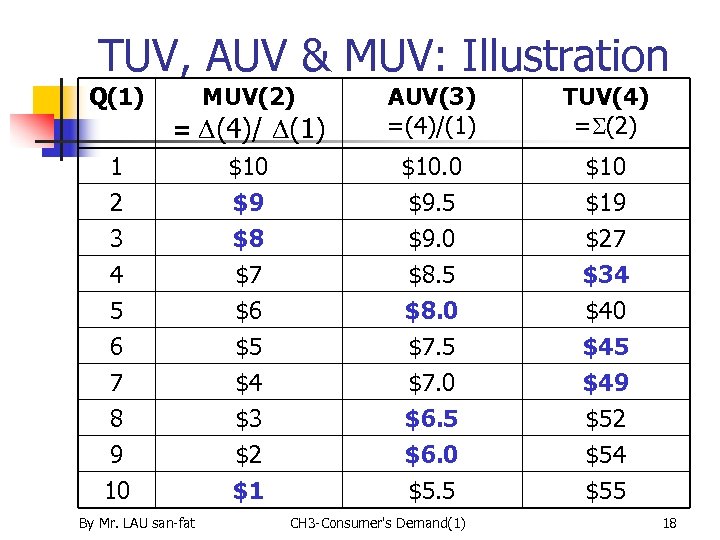 TUV, AUV & MUV: Illustration Q(1) MUV(2) = (4)/ (1) AUV(3) =(4)/(1) TUV(4) = (2) 1 2 $10 $9 $10. 0 $9. 5 $10 $19 3 4 5 6 7 8 9 10 $8 $7 $6 $5 $4 $3 $2 $1 $9. 0 $8. 5 $8. 0 $7. 5 $7. 0 $6. 5 $6. 0 $5. 5 $27 $34 $40 $45 $49 $52 $54 $55 By Mr. LAU san-fat CH 3 -Consumer's Demand(1) 18
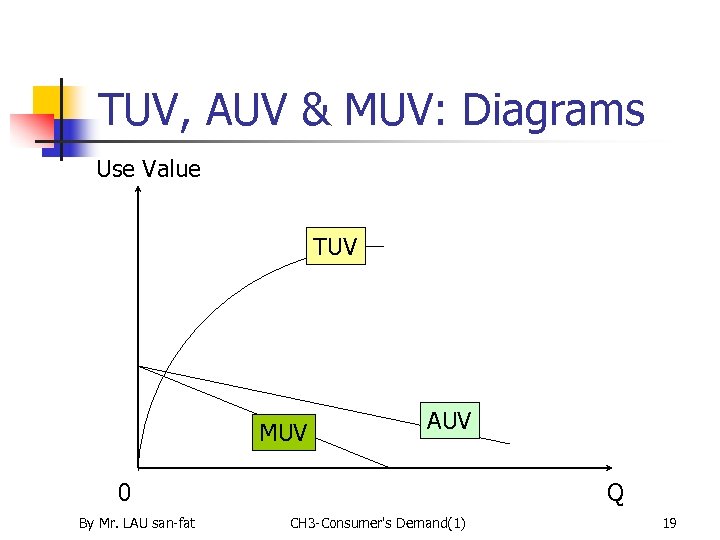 TUV, AUV & MUV: Diagrams Use Value TUV MUV AUV 0 By Mr. LAU san-fat Q CH 3 -Consumer's Demand(1) 19
 The Marginal Use Value Curve n n n A MUV curve slopes downward indicating that as one's holdings of a good get larger, there is a decrease in one's marginal personal value for that good. The position or height of the whole curve varies positively with the wealth (or number of other goods) a person has: it shifts upward for superior goods and downward for inferior goods. With different tastes or preferences, the MUV curves are not identical for everyone. By Mr. LAU san-fat CH 3 -Consumer's Demand(1) 20
 Price, MUV & Consumer's Equilibrium n n In making consumption, individuals will compare its cost (P) with expected benefits (MUV) of a good. If MUV>P, it is beneficial to buy and thus bringing down MUV until decreasing MUV=P. If, however, MUV
 Demand Curve and MUV Curve n A consumer's MUV curve of a good can be regarded as an ordinary individual demand curve for that good because: n n given the MUV curve, one maximizes his gain by equating his MUV with the market price. it tells how many units one consumes given any level of market prices. By Mr. LAU san-fat CH 3 -Consumer's Demand(1) 22
 Price, Total Revenue, Average Revenue & Marginal Revenue n n Total revenue, TR=PXQ Average revenue n n AR=TR/Q Then, AR=(PXQ)/Q Thus, AR=P Marginal revenue, MR= TR/ Q By Mr. LAU san-fat CH 3 -Consumer's Demand(1) 23
 Demand Curve & Average Revenue (AR) Curve n n n Demand curve reflects relationship between P & Qd while AR curve reflects AR & Qd(=Qs=Qt at equilibrium). As P=MUV and P=AR, P=AR=MUV Hence, AR curve=D curve=MUV curve By Mr. LAU san-fat CH 3 -Consumer's Demand(1) 24
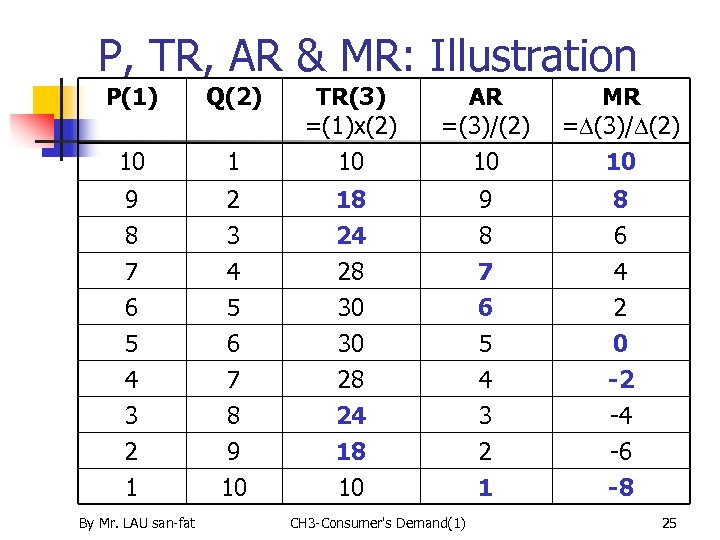 P, TR, AR & MR: Illustration P(1) Q(2) AR =(3)/(2) 10 MR = (3)/ (2) 1 TR(3) =(1)x(2) 10 10 9 2 18 9 8 8 7 6 5 4 3 2 1 3 4 5 6 7 8 9 10 24 28 30 30 28 24 18 10 8 7 6 5 4 3 2 1 6 4 2 0 -2 -4 -6 -8 By Mr. LAU san-fat CH 3 -Consumer's Demand(1) 10 25
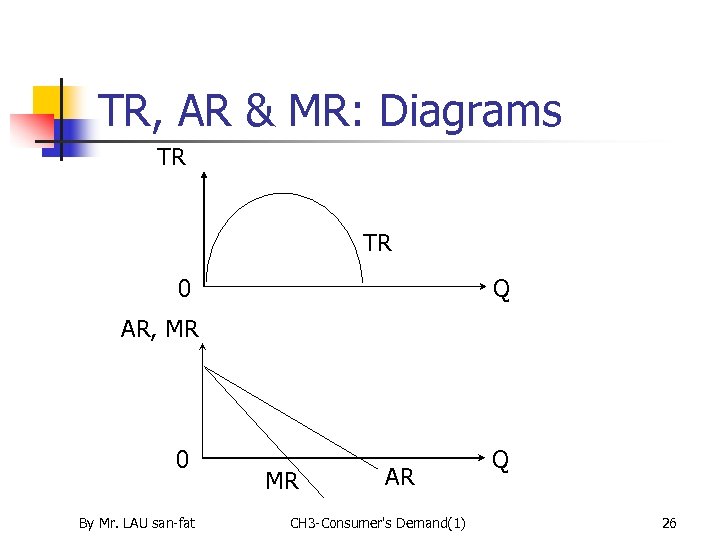 TR, AR & MR: Diagrams TR TR 0 Q AR, MR 0 By Mr. LAU san-fat MR AR CH 3 -Consumer's Demand(1) Q 26
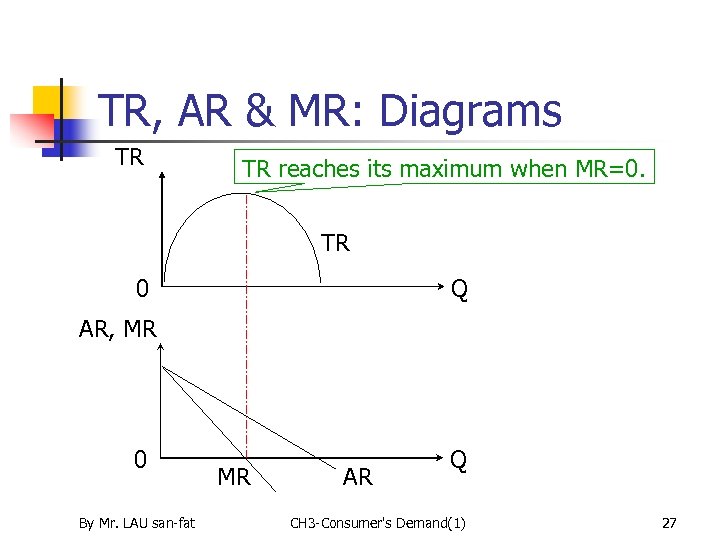 TR, AR & MR: Diagrams TR TR reaches its maximum when MR=0. TR 0 Q AR, MR 0 By Mr. LAU san-fat MR AR Q CH 3 -Consumer's Demand(1) 27
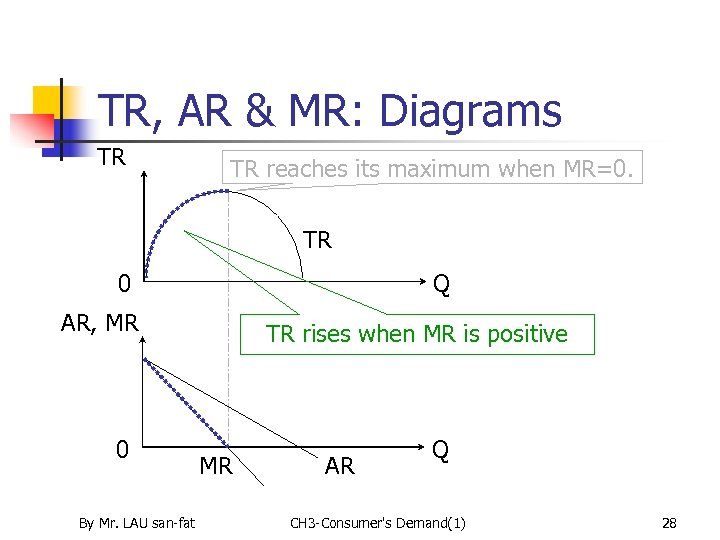 TR, AR & MR: Diagrams TR TR reaches its maximum when MR=0. TR 0 Q AR, MR 0 By Mr. LAU san-fat TR rises when MR is positive MR AR Q CH 3 -Consumer's Demand(1) 28
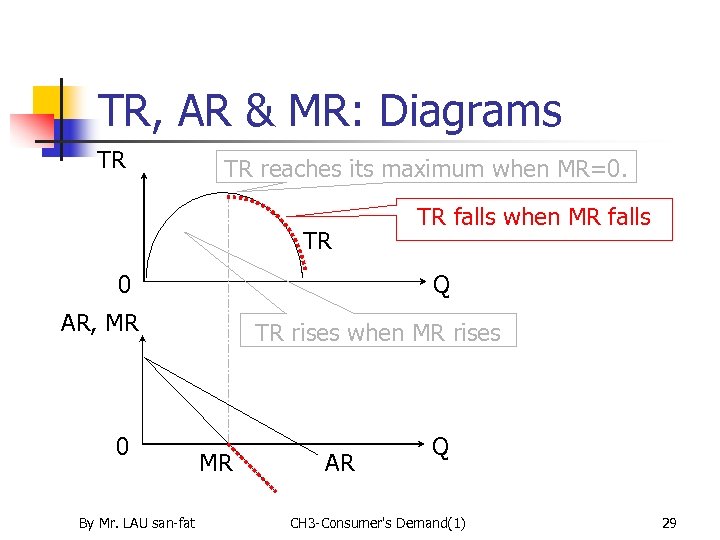 TR, AR & MR: Diagrams TR TR reaches its maximum when MR=0. TR 0 Q AR, MR 0 By Mr. LAU san-fat TR falls when MR falls TR rises when MR rises MR AR Q CH 3 -Consumer's Demand(1) 29
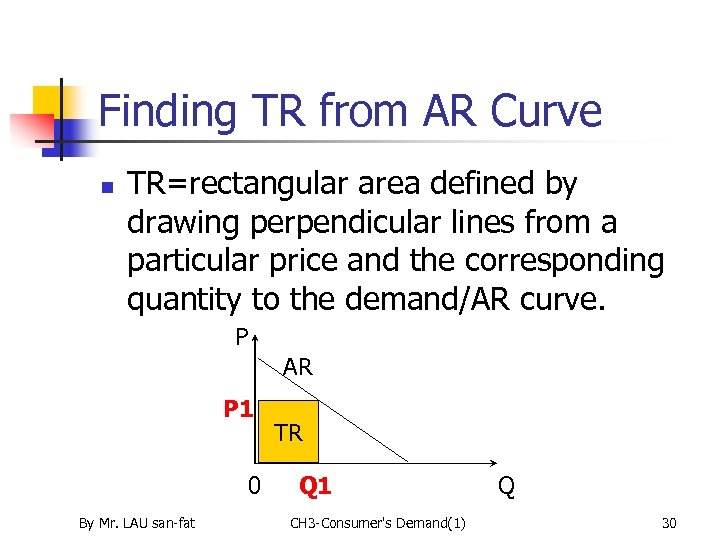 Finding TR from AR Curve n TR=rectangular area defined by drawing perpendicular lines from a particular price and the corresponding quantity to the demand/AR curve. P AR P 1 0 By Mr. LAU san-fat TR Q 1 CH 3 -Consumer's Demand(1) Q 30
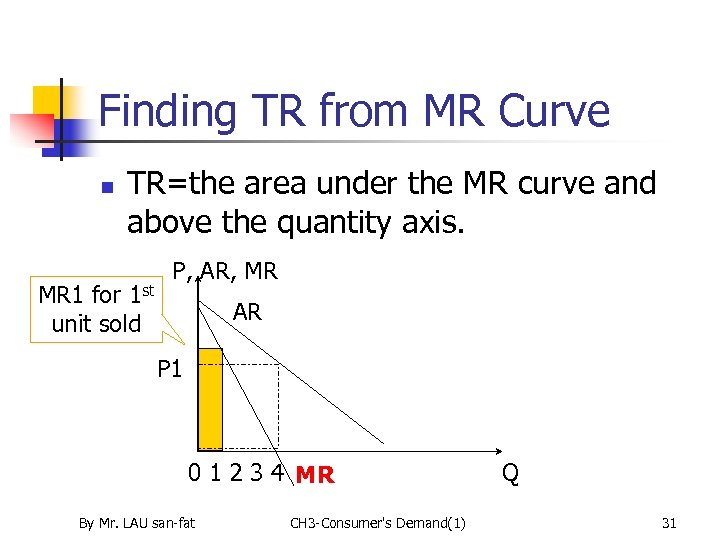 Finding TR from MR Curve n TR=the area under the MR curve and above the quantity axis. MR 1 for 1 st unit sold P, AR, MR AR P 1 0 1 2 3 4 MR By Mr. LAU san-fat CH 3 -Consumer's Demand(1) Q 31
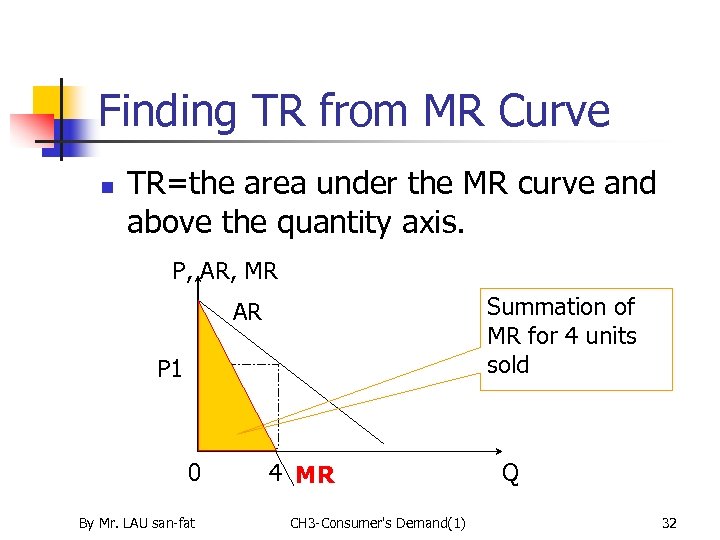 Finding TR from MR Curve n TR=the area under the MR curve and above the quantity axis. P, AR, MR Summation of MR for 4 units sold AR P 1 TR 0 By Mr. LAU san-fat 4 MR CH 3 -Consumer's Demand(1) Q 32
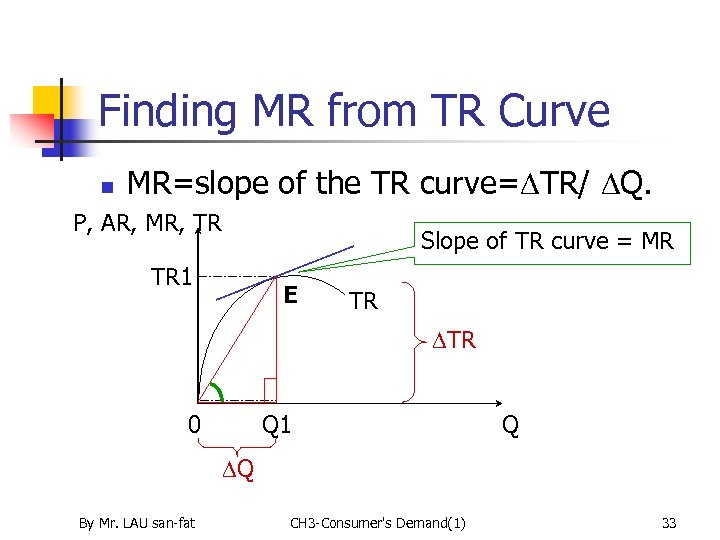 Finding MR from TR Curve n MR=slope of the TR curve= TR/ Q. P, AR, MR, TR TR 1 Slope of TR curve = MR E TR TR 0 Q 1 Q Q By Mr. LAU san-fat CH 3 -Consumer's Demand(1) 33
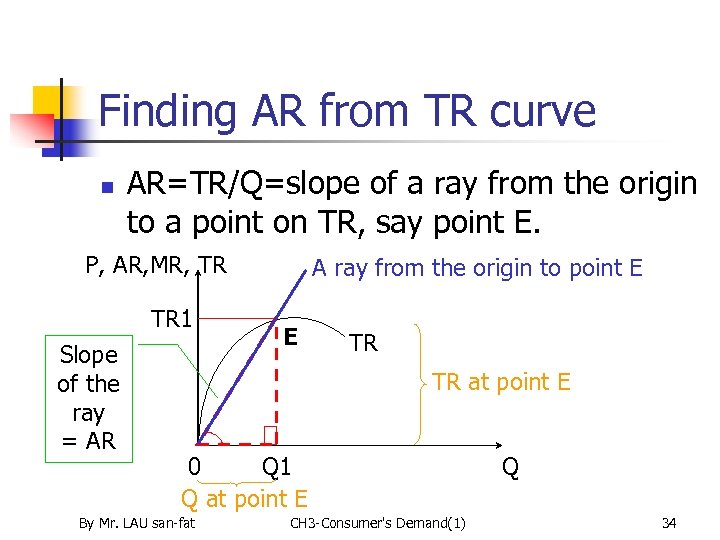 Finding AR from TR curve n AR=TR/Q=slope of a ray from the origin to a point on TR, say point E. P, AR, MR, TR TR 1 Slope of the ray = AR A ray from the origin to point E E TR TR at point E 0 Q 1 Q at point E By Mr. LAU san-fat CH 3 -Consumer's Demand(1) Q 34
 Why is Price Larger Than MR? n n n Because a cut in price is made to sell more units, the extra revenue will be less than the price received on the extra unit sold. However, the new uniform price at which an extra unit is sold is lower on ALL the units formerly sold at the higher price. Reduction in revenue on the quantity previously sold at the higher price will offset part of (or possibly more than) the price received on the extra unit sold. By Mr. LAU san-fat CH 3 -Consumer's Demand(1) 35
 Why is Price Larger Than MR? n n n Thus, the net revenue increase or MR from selling one more at the new, lower price will always be less than the price received on that extra unit – less by the amount of reduced revenue on all the units formerly salable at the old, higher price. With different pricing tactics, say price discrimination, MR could be equal to P. MR =P 2(Q 2 -Q 1)-(P 1 -P 2)Q 1 By Mr. LAU san-fat CH 3 -Consumer's Demand(1) 36
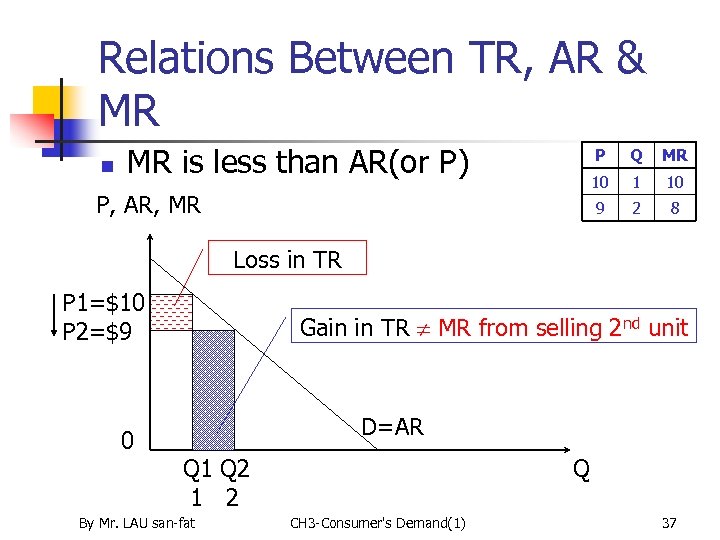 Relations Between TR, AR & MR n MR is less than AR(or P) P MR 10 1 10 9 P, AR, MR Q 2 8 Loss in TR P 1=$10 P 2=$9 0 Gain in TR MR from selling 2 nd unit D=AR Q 1 Q 2 1 2 By Mr. LAU san-fat Q CH 3 -Consumer's Demand(1) 37
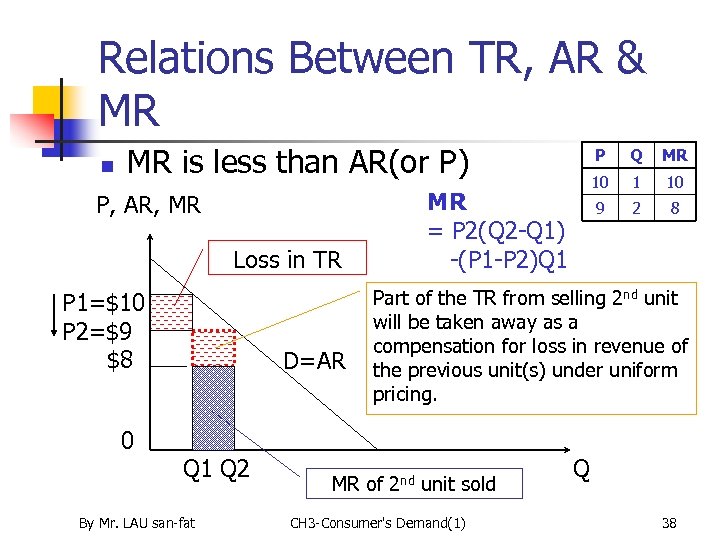 Relations Between TR, AR & MR n MR is less than AR(or P) P, AR, MR Loss in TR P 1=$10 P 2=$9 $8 0 D=AR Q 1 Q 2 By Mr. LAU san-fat P MR 10 1 10 9 MR = P 2(Q 2 -Q 1) -(P 1 -P 2)Q 1 Q 2 8 Part of the TR from selling 2 nd unit will be taken away as a compensation for loss in revenue of the previous unit(s) under uniform pricing. MR of 2 nd unit sold CH 3 -Consumer's Demand(1) Q 38
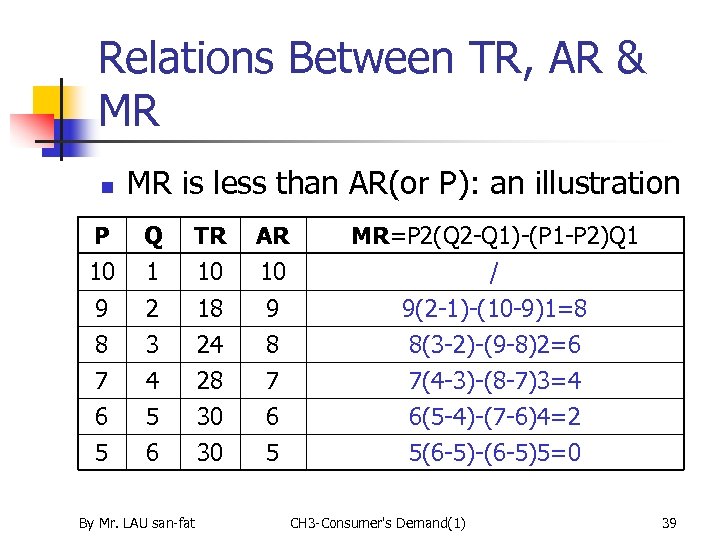 Relations Between TR, AR & MR n MR is less than AR(or P): an illustration P 10 Q 1 TR 10 AR 10 MR=P 2(Q 2 -Q 1)-(P 1 -P 2)Q 1 / 9 8 2 3 18 24 9 8 9(2 -1)-(10 -9)1=8 8(3 -2)-(9 -8)2=6 7 6 5 4 5 6 28 30 30 7 6 5 7(4 -3)-(8 -7)3=4 6(5 -4)-(7 -6)4=2 5(6 -5)-(6 -5)5=0 By Mr. LAU san-fat CH 3 -Consumer's Demand(1) 39
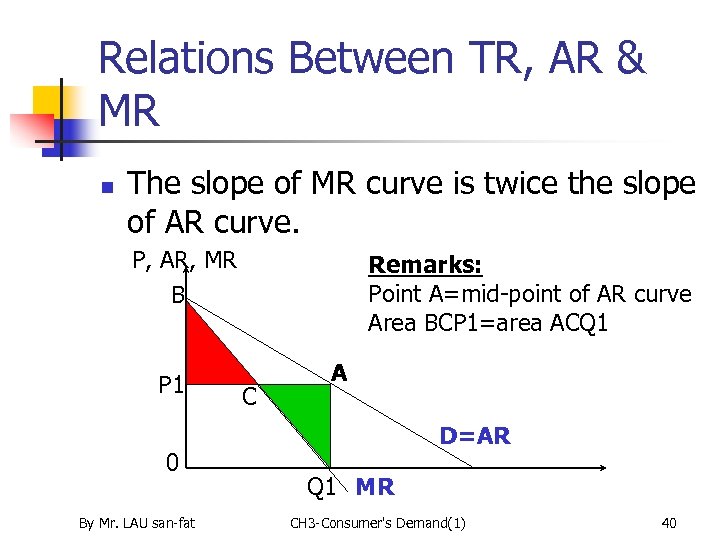 Relations Between TR, AR & MR n The slope of MR curve is twice the slope of AR curve. P, AR, MR B P 1 0 By Mr. LAU san-fat Remarks: Point A=mid-point of AR curve Area BCP 1=area ACQ 1 C A D=AR Q 1 MR CH 3 -Consumer's Demand(1) 40
 TEV, AEV & MEV n (Total)Exchange value (TEV) of a specified quantity of a good is the actual amount of money(or some other goods) that one has to pay for that entire specific quantity. n n TEV=PXQ TEV=Total revenue(TR)=Total expenditure(TE) =Total market value(TMV) By Mr. LAU san-fat CH 3 -Consumer's Demand(1) 41
 TEV, AEV & MEV n n n Average exchange value(AEV) of a specified quantity of a good is the average revenue received by the seller, i. e. AEV=AR=TEV/Q. Marginal exchange value(MEV) is the actual amount of money or some other goods one pays for an extra unit of the good, i. e. MEV= TEV/ Q. Under uniform pricing/single per-unit pricing arrangement, price refers to AEV or AR. By Mr. LAU san-fat CH 3 -Consumer's Demand(1) 42
 Consumer's Surplus (CS) n CS is the extra amount the consumer is willing to pay over and above what he or she actually pays, given quantity demanded. n n n CS=TUV-TEV for a given quantity CS=MUV-P for an extra unit It is assumed that the CS is calculated under uniform pricing (or single per-unit pricing). By Mr. LAU san-fat CH 3 -Consumer's Demand(1) 43
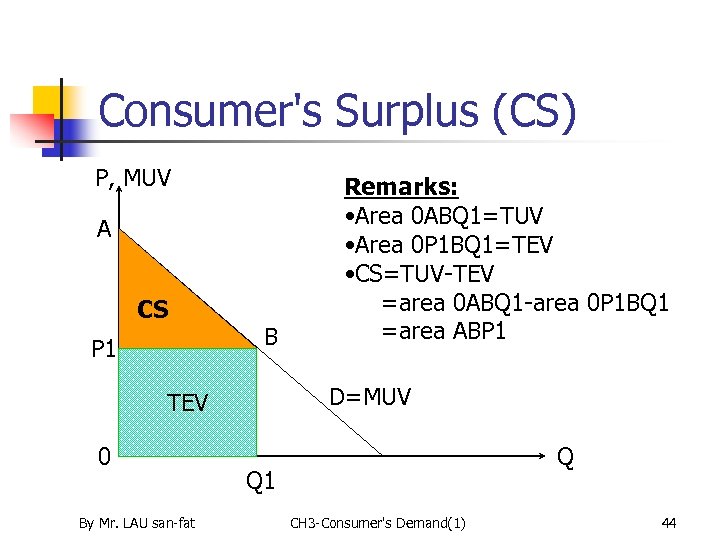 Consumer's Surplus (CS) P, MUV A CS P 1 B D=MUV TEV 0 By Mr. LAU san-fat Remarks: • Area 0 ABQ 1=TUV • Area 0 P 1 BQ 1=TEV • CS=TUV-TEV =area 0 ABQ 1 -area 0 P 1 BQ 1 =area ABP 1 Q Q 1 CH 3 -Consumer's Demand(1) 44
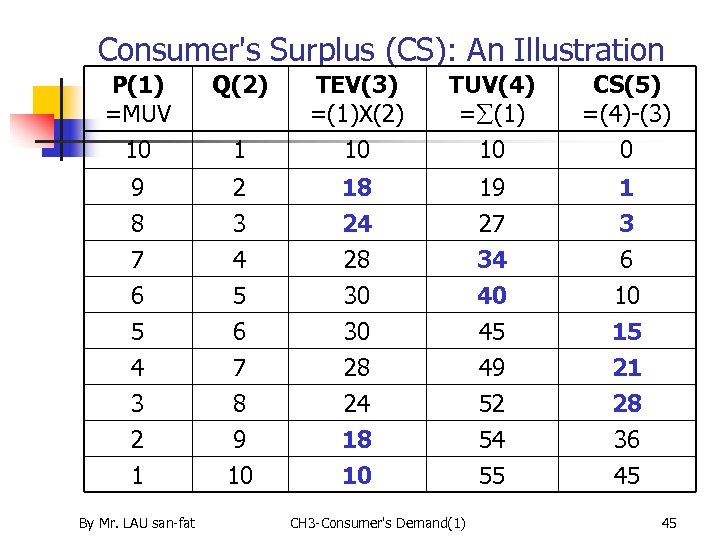 Consumer's Surplus (CS): An Illustration P(1) =MUV 10 Q(2) TUV(4) = (1) 1 TEV(3) =(1)X(2) 10 10 CS(5) =(4)-(3) 0 9 2 18 19 1 8 7 6 5 4 3 2 1 3 4 5 6 7 8 9 10 24 28 30 30 28 24 18 10 27 34 40 45 49 52 54 55 3 6 10 15 21 28 36 45 By Mr. LAU san-fat CH 3 -Consumer's Demand(1) 45
 Paradox of Value n Adam Smith pointed out in his book, 'The Wealth of Nations', that the things (e. g. water) which have the greatest value in use frequently have little or no value in exchange and those (e. g. diamond) which have the greatest value in exchange frequently have little value in use. By Mr. LAU san-fat CH 3 -Consumer's Demand(1) 46
 Resolving The Paradox of Value n n The paradox arises from confusing total and marginal use values with market values. The exchange value of a good is determined by its relative scarcity and its MUV, but not its TUV. The more scarce the good, the higher its MUV will be, thus demanding a higher price(or average exchange value); vice versa. While a good with higher TUV would bring a larger consumer's surplus and thus more benefit. By Mr. LAU san-fat CH 3 -Consumer's Demand(1) 47
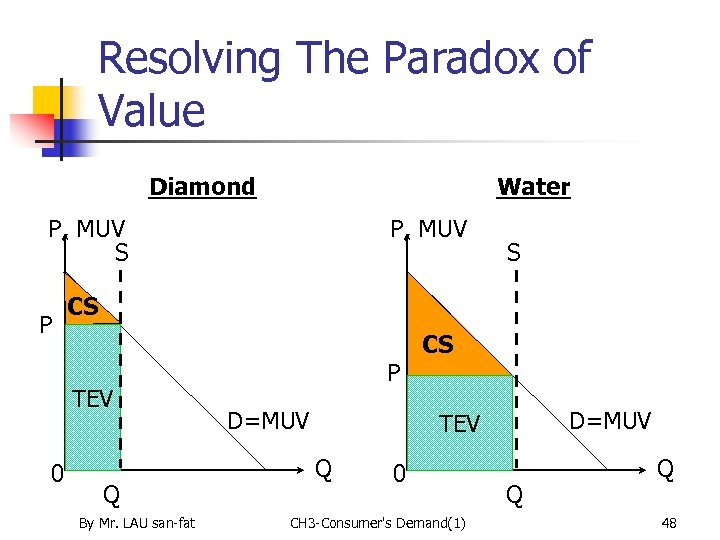 Resolving The Paradox of Value Diamond Water P, MUV S P S CS TEV 0 P, MUV Q By Mr. LAU san-fat P D=MUV CS D=MUV TEV Q 0 CH 3 -Consumer's Demand(1) Q Q 48
 Ways to Extract Consumer's Surplus(1) n By all-or-nothing pricing tactic n n n Consumers either purchase a good at a stipulated quantity at a given price, or not at all. The price under an all-or-nothing arrangement is set in accordance with the AUV of the last unit, i. e. P=AUV. As the TUV of the good becomes the same as its TEV, CS is then fully exploited. By Mr. LAU san-fat CH 3 -Consumer's Demand(1) 49
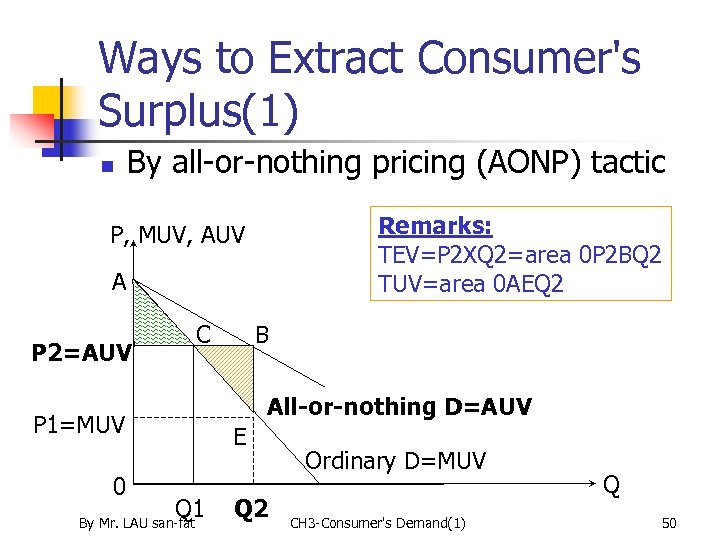 Ways to Extract Consumer's Surplus(1) n By all-or-nothing pricing (AONP) tactic Remarks: TEV=P 2 XQ 2=area 0 P 2 BQ 2 TUV=area 0 AEQ 2 P, MUV, AUV A C P 2=AUV All-or-nothing D=AUV P 1=MUV 0 B E Q 1 By Mr. LAU san-fat Q 2 Ordinary D=MUV CH 3 -Consumer's Demand(1) Q 50
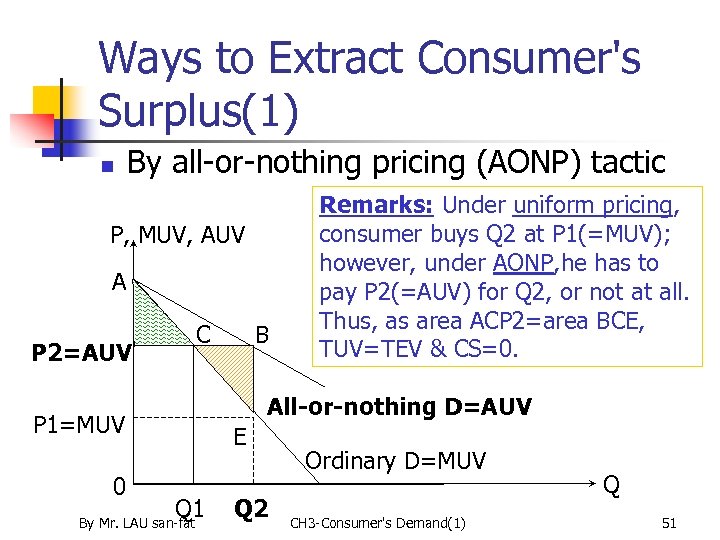 Ways to Extract Consumer's Surplus(1) n By all-or-nothing pricing (AONP) tactic P, MUV, AUV A C P 2=AUV All-or-nothing D=AUV P 1=MUV 0 B Remarks: Under uniform pricing, consumer buys Q 2 at P 1(=MUV); however, under AONP, he has to pay P 2(=AUV) for Q 2, or not at all. Thus, as area ACP 2=area BCE, TUV=TEV & CS=0. E Q 1 By Mr. LAU san-fat Q 2 Ordinary D=MUV CH 3 -Consumer's Demand(1) Q 51
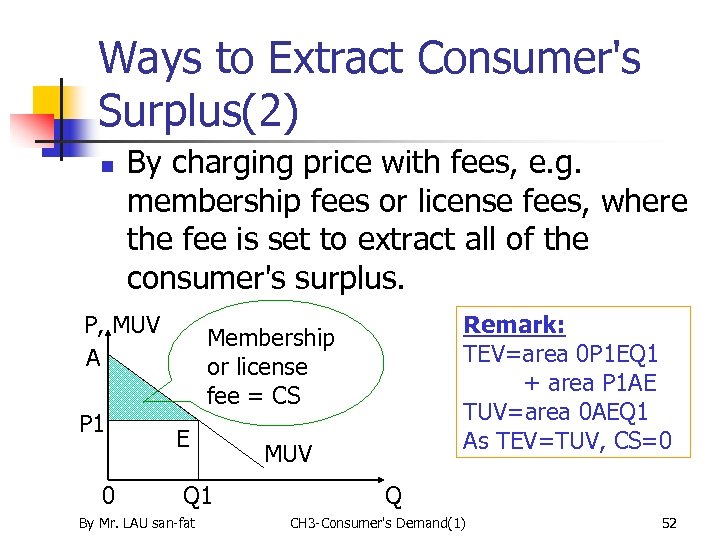 Ways to Extract Consumer's Surplus(2) n By charging price with fees, e. g. membership fees or license fees, where the fee is set to extract all of the consumer's surplus. P, MUV A P 1 0 Remark: TEV=area 0 P 1 EQ 1 + area P 1 AE TUV=area 0 AEQ 1 As TEV=TUV, CS=0 Membership or license fee = CS E Q 1 By Mr. LAU san-fat MUV Q CH 3 -Consumer's Demand(1) 52
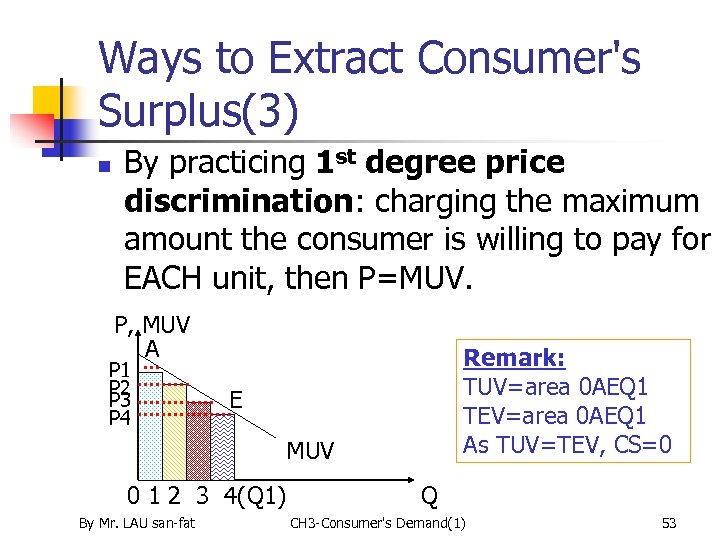 Ways to Extract Consumer's Surplus(3) n By practicing 1 st degree price discrimination: charging the maximum amount the consumer is willing to pay for EACH unit, then P=MUV. P, MUV A P 1 P 2 P 3 P 4 Remark: TUV=area 0 AEQ 1 TEV=area 0 AEQ 1 As TUV=TEV, CS=0 E MUV 0 1 2 3 4(Q 1) By Mr. LAU san-fat Q CH 3 -Consumer's Demand(1) 53
 Why does Exchange Occur? n n It is commonly, but wrongly, believed that people trade because they have a surplus of some goods. In fact, trade or exchange occurs because participants find it mutually beneficial, because people place different marginal valuations on scarce goods. By Mr. LAU san-fat CH 3 -Consumer's Demand(1) 54
 Assumptions behind the Simple Exchange Model 1. Private property rights exist. 2. Transaction costs are zero. 3. There is no production taken place, i. e. the stock of any good is fixed. By Mr. LAU san-fat CH 3 -Consumer's Demand(1) 55
 Conditions for Conducting Mutually Beneficial Exchange n n Trade occurs when participants have different marginal use value curves, even though they have the same initial endowment of a good. Trade is still possible even trading parties have the same MUV curves, if their initial endowments are different. By Mr. LAU san-fat CH 3 -Consumer's Demand(1) 56
 Exchange without Production n The individual with higher MUV will be the buyer while the one with lower MUV will act as the seller. The seller is willing to engage an exchange if the price he receives is higher than or equal to the forgone MUV. The buyer, however, will buy a unit only if what he actually pays (P) is lower than or equal to what he receives(MUV). By Mr. LAU san-fat CH 3 -Consumer's Demand(1) 57
 Exchange without Production n The actual trading price then lies between the different initial MUVs of the traders. The equilibrium price is indicated at where the two MUV curves intersect. Exchange brings the MUVs of a good to both parties to equality, and no further trade would be mutually desired. By Mr. LAU san-fat CH 3 -Consumer's Demand(1) 58
 Exchange without Production n Gains from exchange to the buyer: n n n Gains from exchange to the seller: n n n Per unit gain = MUV – P Total gain = TUV – TEV Per unit gain = P – MUV forgone Total gain = TEV – TUV forgone However, the distribution of gains from exchange depends on the bargaining power or pricing tactics of both trading parties. By Mr. LAU san-fat CH 3 -Consumer's Demand(1) 59
 Exchange without Production n If the buyer has higher bargaining power, he will enjoy most or all of the gains from trade by obtaining the lowest possible price. If, however, the seller has higher bargaining power, he will capture most or all of the gains from trade by requesting the highest possible price. As with normal shaped MUV curves, both parties share the gains from trade. By Mr. LAU san-fat CH 3 -Consumer's Demand(1) 60
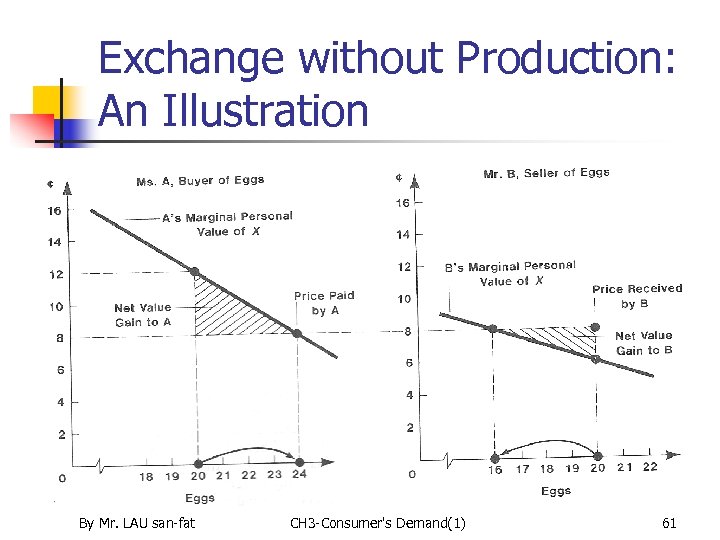 Exchange without Production: An Illustration By Mr. LAU san-fat CH 3 -Consumer's Demand(1) 61
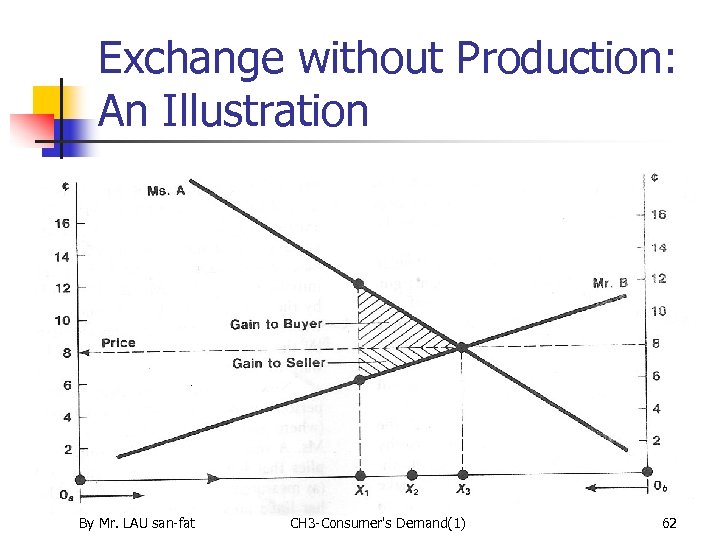 Exchange without Production: An Illustration By Mr. LAU san-fat CH 3 -Consumer's Demand(1) 62
 Transaction Costs & Exchange n n n There are substantial costs of finding trade possibilities, or assessing the true characteristics or qualities of goods, and of negotiating exchange contracts and arranging for such legal protections as warranties. With the presence of transaction costs, the gain from trade to traders are thus reduced. As a maximizer, traders will seek ways to reduce transaction costs and maximize their gains from trade. And this could be done by employing middlemen and using money. By Mr. LAU san-fat CH 3 -Consumer's Demand(1) 63
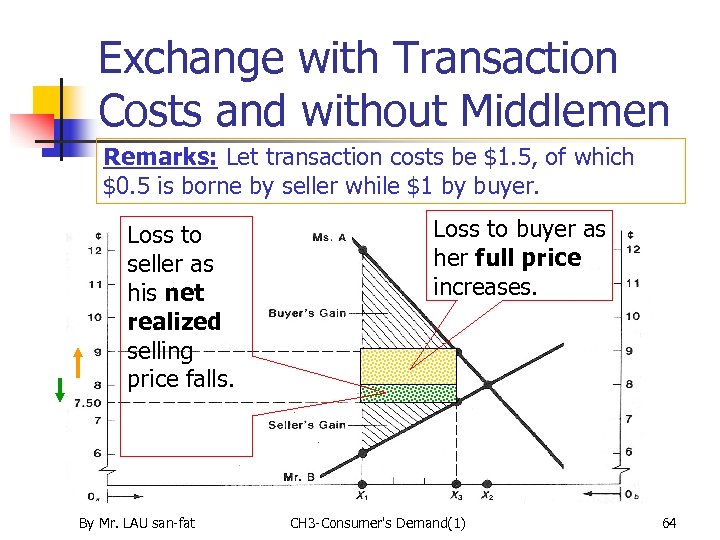 Exchange with Transaction Costs and without Middlemen Remarks: Let transaction costs be $1. 5, of which $0. 5 is borne by seller while $1 by buyer. Loss to seller as his net realized selling price falls. By Mr. LAU san-fat Loss to buyer as her full price increases. CH 3 -Consumer's Demand(1) 64
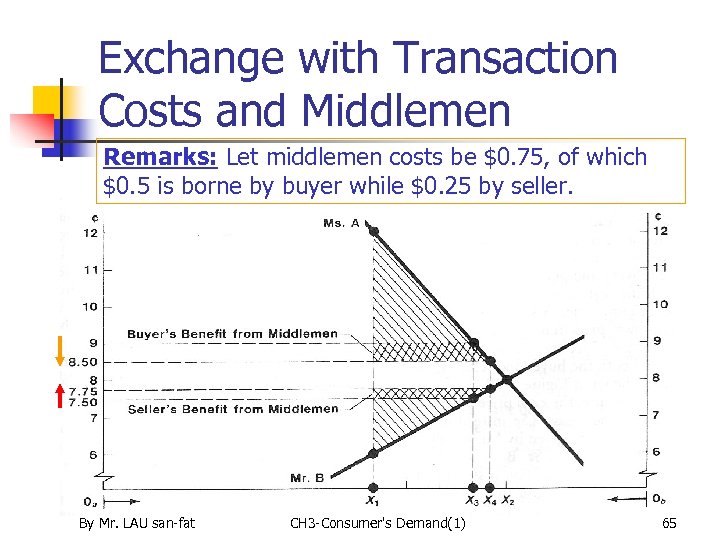 Exchange with Transaction Costs and Middlemen Remarks: Let middlemen costs be $0. 75, of which $0. 5 is borne by buyer while $0. 25 by seller. By Mr. LAU san-fat CH 3 -Consumer's Demand(1) 65
 Exchange with Transaction Costs and Middlemen n n Whenever the fees charged by middlemen for arranging and facilitating an exchange is lower than the transaction costs being borne by traders in conducting prepurchase search and production inspection, trade is still beneficial. In an open market, competition among middlemen reduces the spread between their buying and selling prices to one that just covers the costs of providing their services at the quality wanted by the consumers. By Mr. LAU san-fat CH 3 -Consumer's Demand(1) 66