


 Скачать презентацию HIVI HIV Initiative of Kaiser Permanente and Care
49a997bdcb366ec2484c3f03eb580b00.ppt
- Количество слайдов: 49
 HIVI HIV Initiative of Kaiser Permanente and Care Management Institute HIV in the US in 2010 and Beyond --Where We’re Going (I Think…) Michael Horberg, MD MAS FACP Director, HIV/AIDS Kaiser Permanente Clinical Lead, HIV/AIDS, Care Management Institute Slide 1
 The required language… Ø At the conclusion of this presentation, you should be able to: § Identify the clinical implications that the key elements of President Obama's HIV/AIDS principles will have on your practice. § Utilize HIV quality performance measures to assess and identify areas for improvement in the care of individuals with HIV in your practice. Ø I do not intend to discuss any non-FDA-approved or investigational uses of any products/devices in this presentation. Slide 2
 “When one of our fellow citizens becomes infected with HIV every nine-and-a-half minutes, the epidemic affects all Americans. ” --President Barack Obama Slide 3
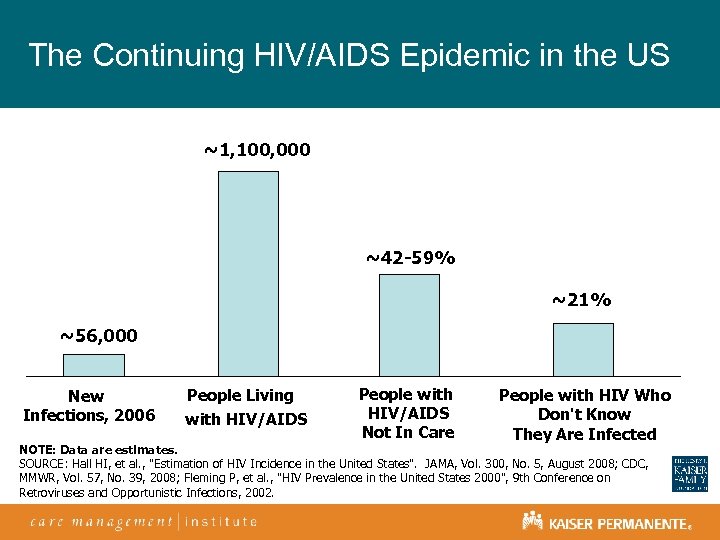 The Continuing HIV/AIDS Epidemic in the US ~1, 100, 000 ~42 -59% ~21% ~56, 000 New Infections, 2006 People Living with HIV/AIDS People with HIV/AIDS Not In Care People with HIV Who Don't Know They Are Infected NOTE: Data are estimates. SOURCE: Hall HI, et al. , "Estimation of HIV Incidence in the United States". JAMA, Vol. 300, No. 5, August 2008; CDC, MMWR, Vol. 57, No. 39, 2008; Fleming P, et al. , "HIV Prevalence in the United States 2000", 9 th Conference on Retroviruses and Opportunistic Infections, 2002.
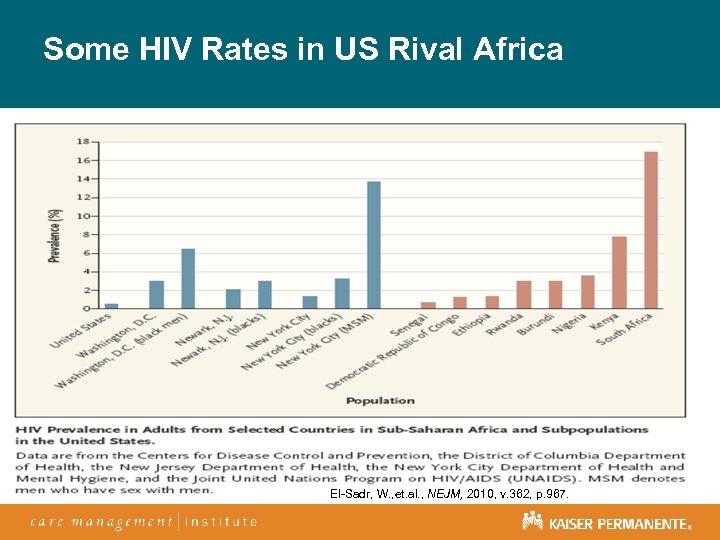 Some HIV Rates in US Rival Africa El-Sadr, W. , et. al. , NEJM, 2010, v. 362, p. 967.
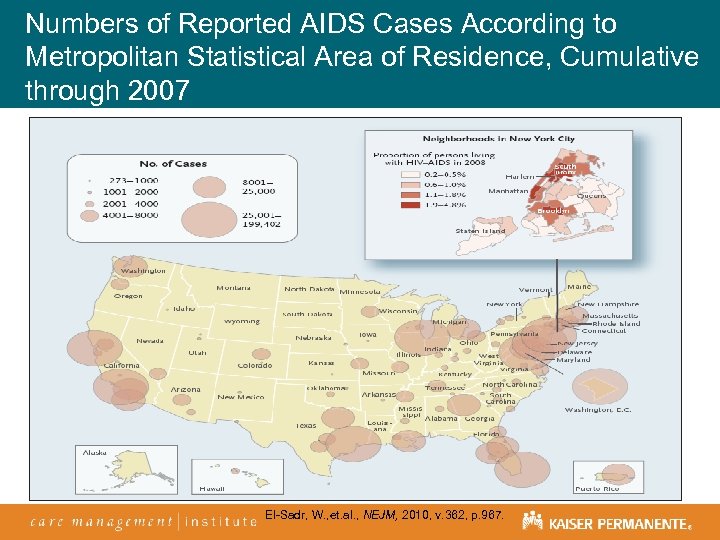 Numbers of Reported AIDS Cases According to Metropolitan Statistical Area of Residence, Cumulative through 2007 El-Sadr, W. , et. al. , NEJM, 2010, v. 362, p. 967.
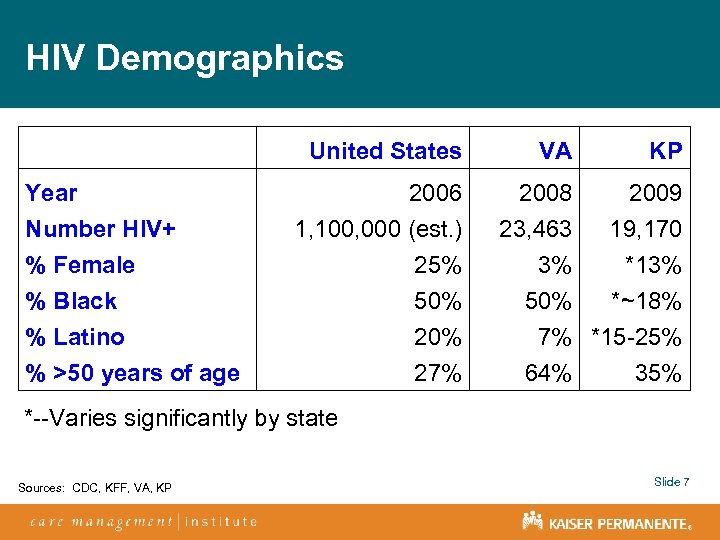 HIV Demographics United States Year Number HIV+ % Female VA KP 2006 1, 100, 000 (est. ) 25% 2008 23, 463 3% 2009 19, 170 *13% % Black % Latino % >50 years of age 50% 27% 50% *~18% 7% *15 -25% 64% 35% *--Varies significantly by state Sources: CDC, KFF, VA, KP Slide 7
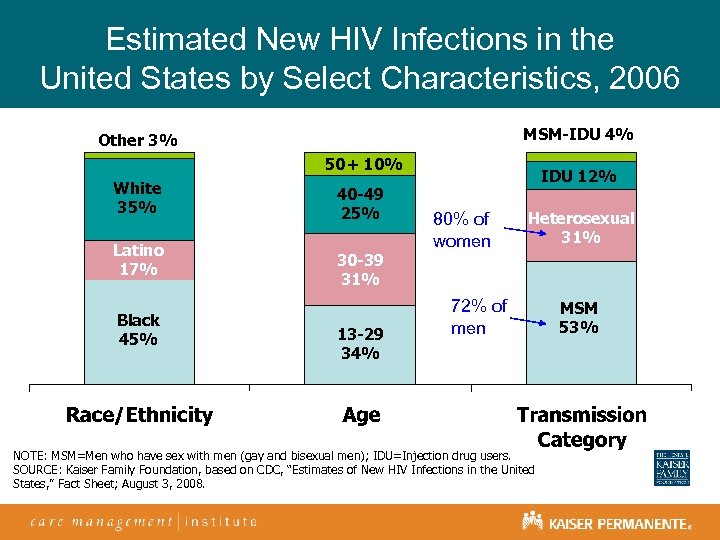 Estimated New HIV Infections in the United States by Select Characteristics, 2006 MSM-IDU 4% Other 3% 50+ 10% White 35% Latino 17% Black 45% 40 -49 25% 30 -39 31% 13 -29 34% IDU 12% 80% of women Heterosexual 31% 72% of men NOTE: MSM=Men who have sex with men (gay and bisexual men); IDU=Injection drug users. SOURCE: Kaiser Family Foundation, based on CDC, “Estimates of New HIV Infections in the United States, ” Fact Sheet; August 3, 2008. MSM 53%
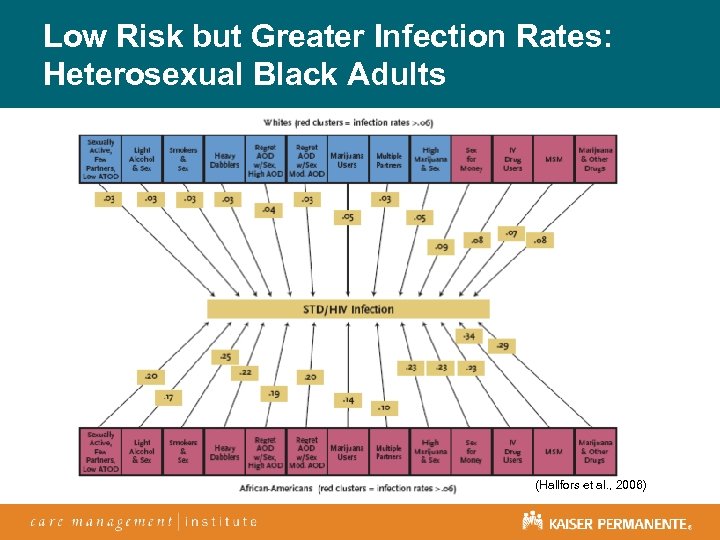 Low Risk but Greater Infection Rates: Heterosexual Black Adults (Hallfors et al. , 2006)
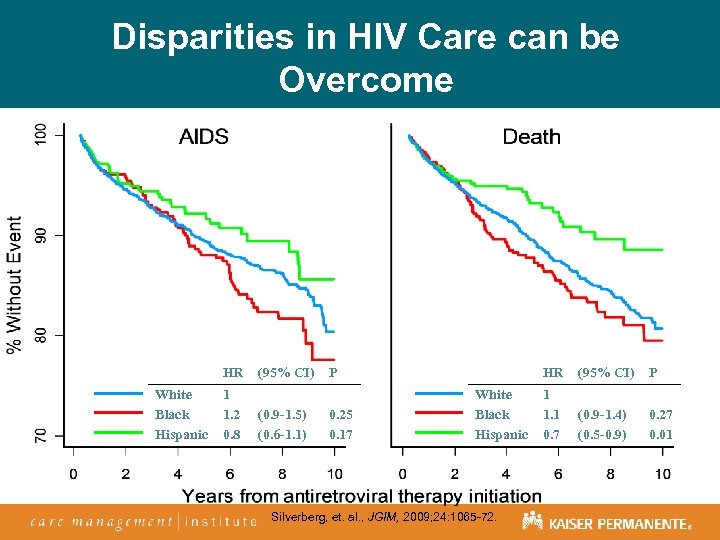 Disparities in HIV Care can be Overcome HR White Black Hispanic 1 1. 2 0. 8 (95% CI) (0. 9 -1. 5) (0. 6 -1. 1) P 0. 25 0. 17 HR White Black Hispanic Silverberg, et. al. , JGIM, 2009; 24: 1065 -72. (95% CI) P 1 1. 1 0. 7 (0. 9 -1. 4) (0. 5 -0. 9) 0. 27 0. 01
 A great success! 952 cases 177 cases
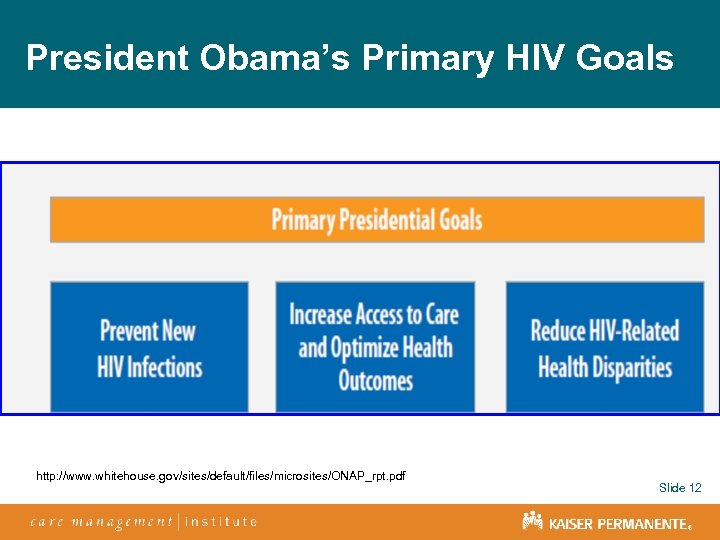 President Obama’s Primary HIV Goals http: //www. whitehouse. gov/sites/default/files/microsites/ONAP_rpt. pdf Slide 12
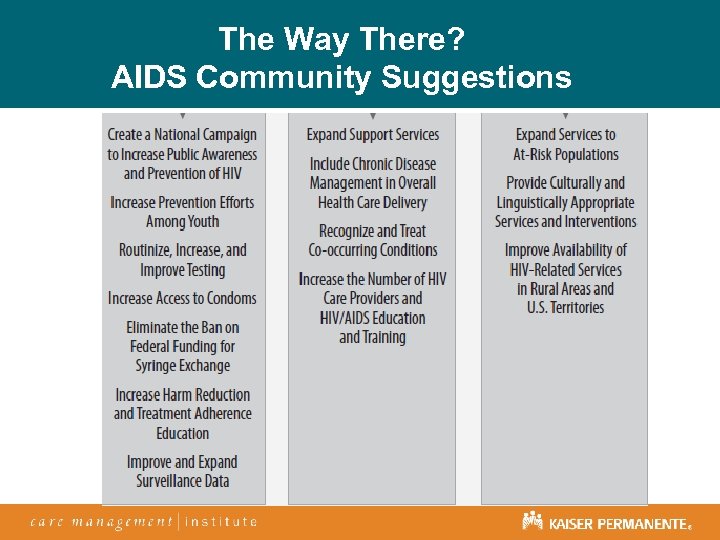 The Way There? AIDS Community Suggestions
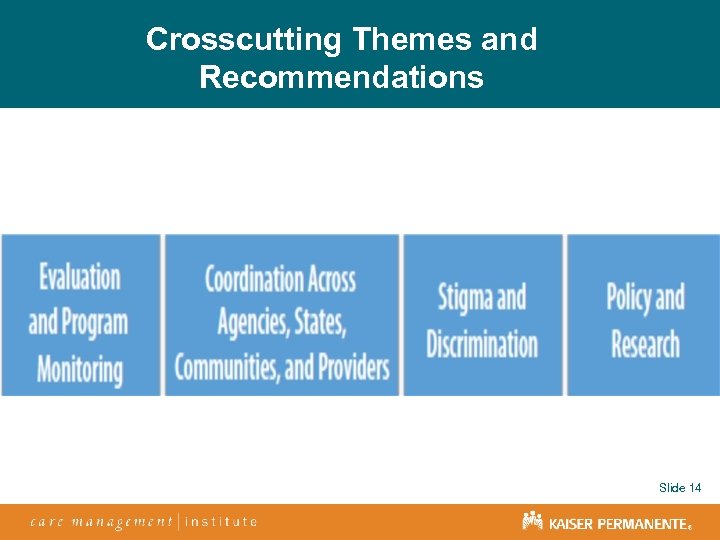 Crosscutting Themes and Recommendations Slide 14
 Step 1: Identifying Undiagnosed and Prevent New Infections Ø These two points cannot be separated Ø Test patients for HIV § Remove testing barriers § Routinize testing Ø Counsel patients on how to prevent HIV § However, not tied to testing anymore Ø “Sexual health as a vital sign”? Ø Can’t treat HIV if you haven’t diagnosed it § Repeat regularly if risk behavior present CDC, MMWR, September 22, 2006 / 55(RR 14); 1 -17
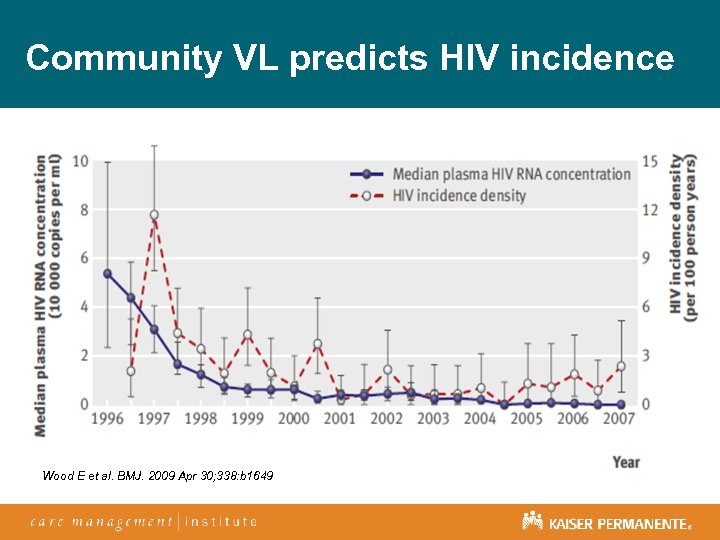 Community VL predicts HIV incidence Wood E et al. BMJ. 2009 Apr 30; 338: b 1649
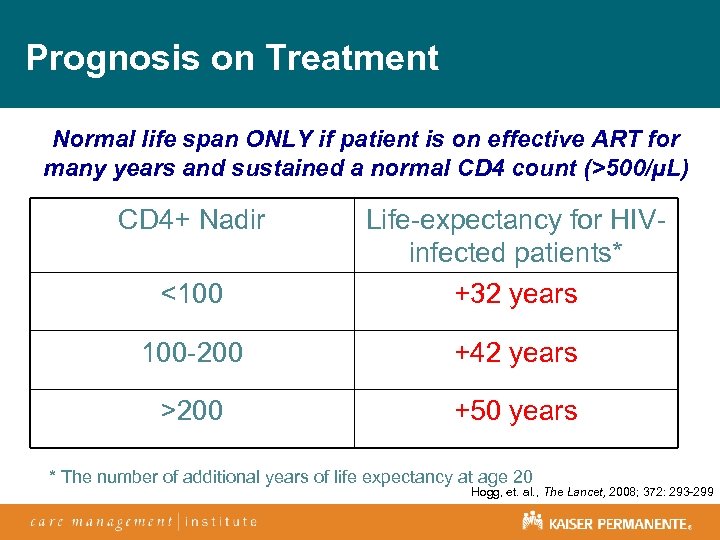 Prognosis on Treatment Normal life span ONLY if patient is on effective ART for many years and sustained a normal CD 4 count (>500/µL) CD 4+ Nadir <100 Life-expectancy for HIVinfected patients* +32 years 100 -200 +42 years >200 +50 years * The number of additional years of life expectancy at age 20 Hogg, et. al. , The Lancet, 2008; 372: 293 -299
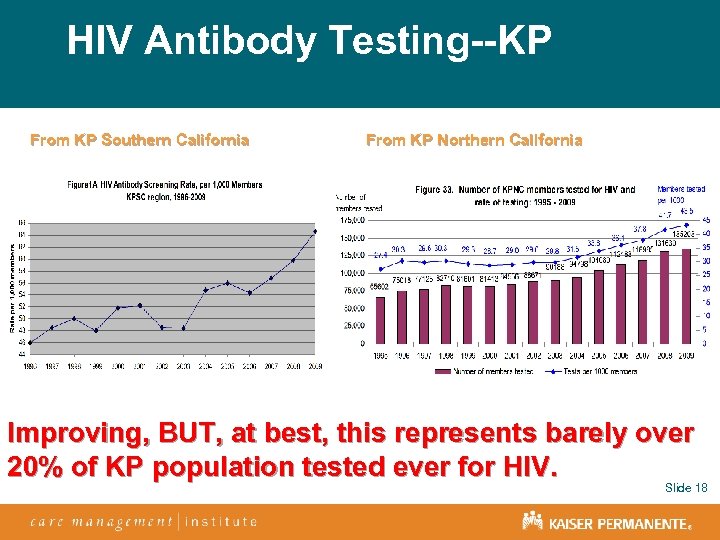 HIV Antibody Testing--KP From KP Southern California From KP Northern California Improving, BUT, at best, this represents barely over 20% of KP population tested ever for HIV. Slide 18
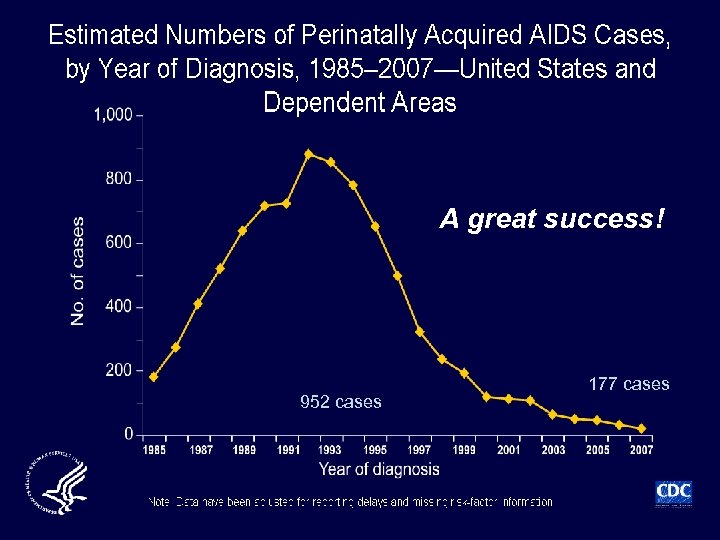
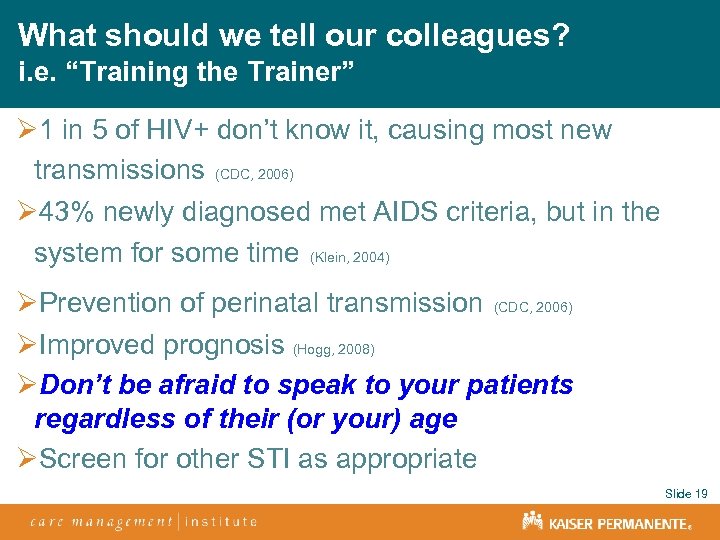 What should we tell our colleagues? i. e. “Training the Trainer” Ø 1 in 5 of HIV+ don’t know it, causing most new transmissions (CDC, 2006) Ø 43% newly diagnosed met AIDS criteria, but in the system for some time (Klein, 2004) ØPrevention of perinatal transmission (CDC, 2006) ØImproved prognosis (Hogg, 2008) ØDon’t be afraid to speak to your patients regardless of their (or your) age ØScreen for other STI as appropriate Slide 19
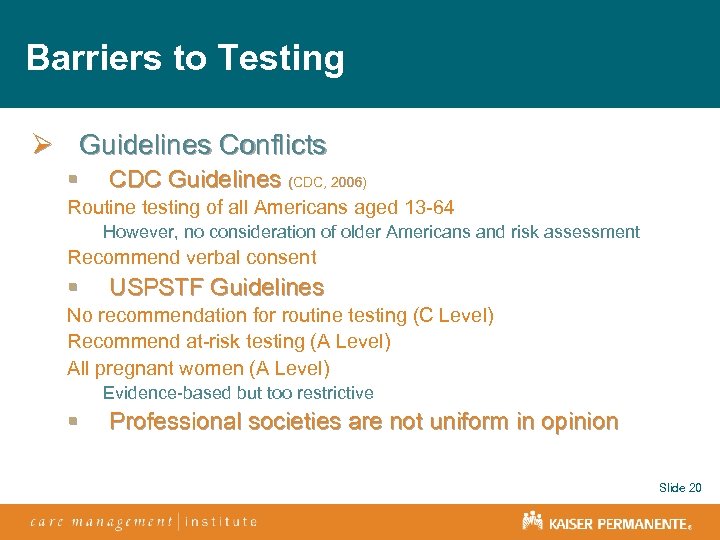 Barriers to Testing Ø Guidelines Conflicts § CDC Guidelines (CDC, 2006) Routine testing of all Americans aged 13 -64 However, no consideration of older Americans and risk assessment Recommend verbal consent § USPSTF Guidelines No recommendation for routine testing (C Level) Recommend at-risk testing (A Level) All pregnant women (A Level) Evidence-based but too restrictive § Professional societies are not uniform in opinion Slide 20
 Barriers to Testing (continued) Ø Written informed consent considered hardship by providers § Time consuming, burdensome § Not for other sexually transmitted infections or routine blood tests § 40+ states DC, and VA no longer require written consent Ø Only California and DC mandate coverage of testing costs Ø Medicare now covering targeted HIV testing Ø Preventive services included in healthcare reform Slide 21
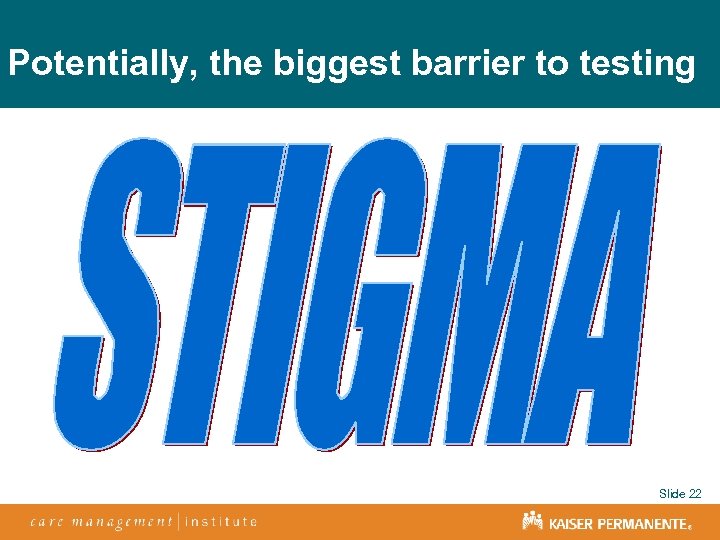 Potentially, the biggest barrier to testing Slide 22
 Lack of Quality Metrics Ø No nationally accepted metric on HIV testing § None in HEDIS, AMA PQRI § VA and KP measure stage of disease at time of diagnosis Ø There are HIV care metrics Ø Many have called for HIV testing measurements Again, you can’t treat if not diagnosed Slide 23
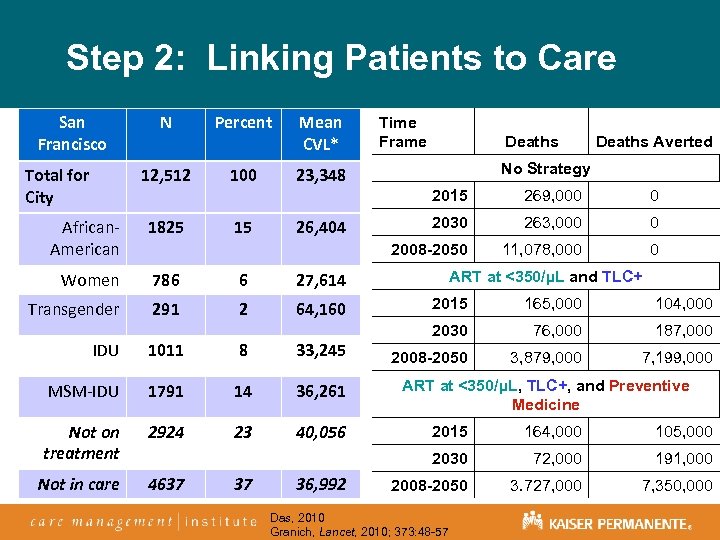 Step 2: Linking Patients to Care San Francisco Percent Mean CVL* 12, 512 Total for City N 100 23, 348 Time Frame Deaths Averted No Strategy 2015 1825 15 26, 404 Women 786 6 291 2 64, 160 2030 263, 000 0 11, 078, 000 0 27, 614 Transgender 0 2008 -2050 African. American 269, 000 IDU 1011 8 33, 245 MSM-IDU 1791 14 36, 261 Not on treatment 2924 23 40, 056 Not in care 4637 ART at <350/µL and TLC+ 2015 165, 000 104, 000 2030 76, 000 187, 000 2008 -2050 3, 879, 000 7, 199, 000 ART at <350/µL, TLC+, and Preventive Medicine 36, 992 164, 000 105, 000 2030 37 2015 72, 000 191, 000 2008 -2050 3. 727, 000 7, 350, 000 Das, 2010 Granich, Lancet, 2010; 373: 48 -57
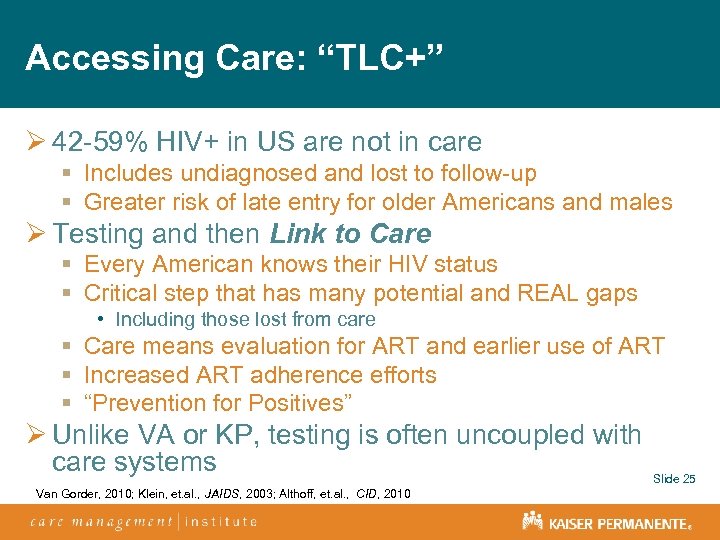 Accessing Care: “TLC+” Ø 42 -59% HIV+ in US are not in care § Includes undiagnosed and lost to follow-up § Greater risk of late entry for older Americans and males Ø Testing and then Link to Care § Every American knows their HIV status § Critical step that has many potential and REAL gaps • Including those lost from care § Care means evaluation for ART and earlier use of ART § Increased ART adherence efforts § “Prevention for Positives” Ø Unlike VA or KP, testing is often uncoupled with care systems Van Gorder, 2010; Klein, et. al. , JAIDS, 2003; Althoff, et. al. , CID, 2010 Slide 25
 Step 3: Not Just Accessing Care Ø Accessing care should mean accessing high quality HIV care § What does this mean? § Who is qualified to deliver such care? § How can we assure that quality care is being delivered? Ø Again, not all guidelines agree Ø Likely key element of implementation of national HIV/AIDS strategy Slide 26
 Step 3: Not Just Accessing Care (continued) Ø But who decides what is quality care? § Professional societies, government? § Coalition Ø Who is held accountable? § And how—monetarily? Ø Must have consistency across service systems § Public and Private § Measures and reporting should be “harmonious” Ø Do we have the capacity? Slide 27
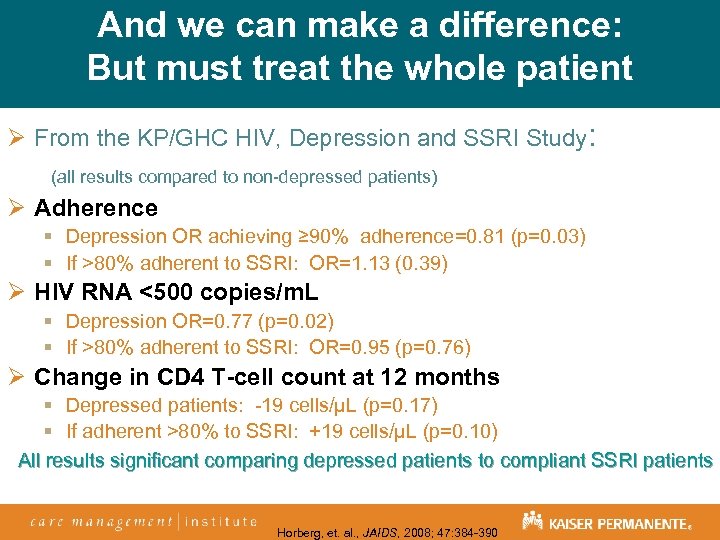 And we can make a difference: But must treat the whole patient Ø From the KP/GHC HIV, Depression and SSRI Study: (all results compared to non-depressed patients) Ø Adherence § Depression OR achieving ≥ 90% adherence=0. 81 (p=0. 03) § If >80% adherent to SSRI: OR=1. 13 (0. 39) Ø HIV RNA <500 copies/m. L § Depression OR=0. 77 (p=0. 02) § If >80% adherent to SSRI: OR=0. 95 (p=0. 76) Ø Change in CD 4 T-cell count at 12 months § Depressed patients: -19 cells/µL (p=0. 17) § If adherent >80% to SSRI: +19 cells/µL (p=0. 10) All results significant comparing depressed patients to compliant SSRI patients Horberg, et. al. , JAIDS, 2008; 47: 384 -390
 Are We Optimizing the Workforce? (VA) 2% Managing Co-Morbidities (N=199) Office of Public Health, VHA, 2010
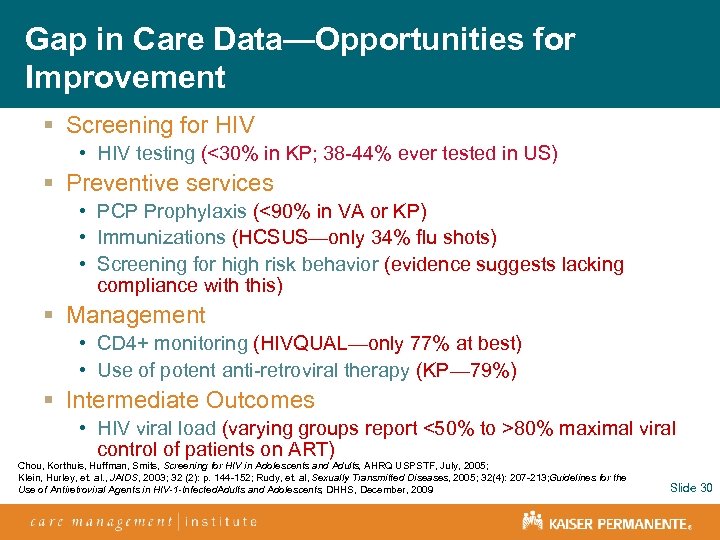 Gap in Care Data—Opportunities for Improvement § Screening for HIV • HIV testing (<30% in KP; 38 -44% ever tested in US) § Preventive services • PCP Prophylaxis (<90% in VA or KP) • Immunizations (HCSUS—only 34% flu shots) • Screening for high risk behavior (evidence suggests lacking compliance with this) § Management • CD 4+ monitoring (HIVQUAL—only 77% at best) • Use of potent anti-retroviral therapy (KP— 79%) § Intermediate Outcomes • HIV viral load (varying groups report <50% to >80% maximal viral control of patients on ART) Chou, Korthuis, Huffman, Smits, Screening for HIV in Adolescents and Adults, AHRQ USPSTF, July, 2005; Klein, Hurley, et. al. , JAIDS, 2003; 32 (2): p. 144 -152; Rudy, et. al, Sexually Transmitted Diseases, 2005; 32(4): 207 -213; Guidelines for the Use of Antiretroviral Agents in HIV-1 -Infected. Adults and Adolescents, DHHS, December, 2009 Slide 30
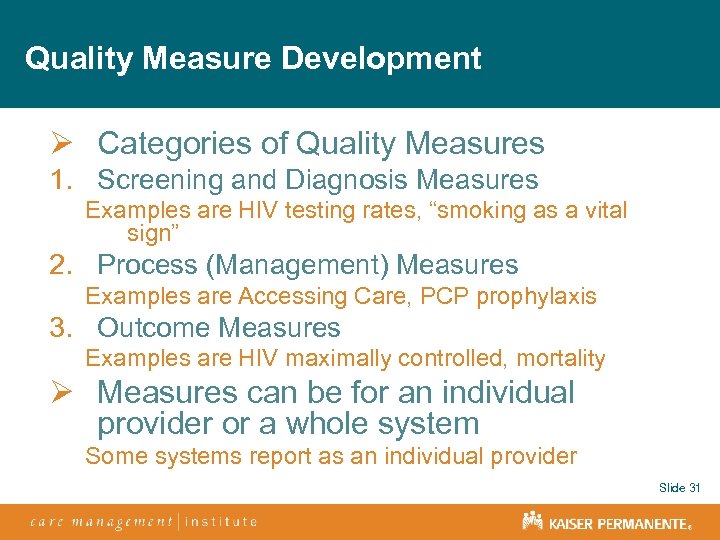 Quality Measure Development Ø Categories of Quality Measures 1. Screening and Diagnosis Measures Examples are HIV testing rates, “smoking as a vital sign” 2. Process (Management) Measures Examples are Accessing Care, PCP prophylaxis 3. Outcome Measures Examples are HIV maximally controlled, mortality Ø Measures can be for an individual provider or a whole system Some systems report as an individual provider Slide 31
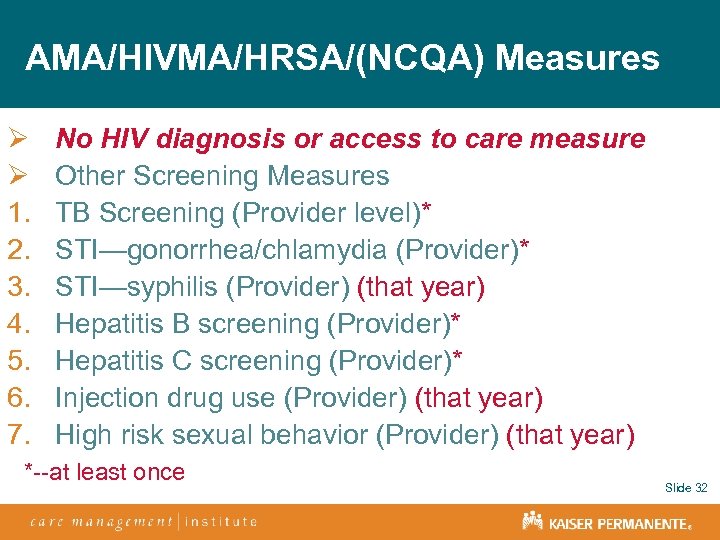 AMA/HIVMA/HRSA/(NCQA) Measures Ø Ø 1. 2. 3. 4. 5. 6. 7. No HIV diagnosis or access to care measure Other Screening Measures TB Screening (Provider level)* STI—gonorrhea/chlamydia (Provider)* STI—syphilis (Provider) (that year) Hepatitis B screening (Provider)* Hepatitis C screening (Provider)* Injection drug use (Provider) (that year) High risk sexual behavior (Provider) (that year) *--at least once Slide 32
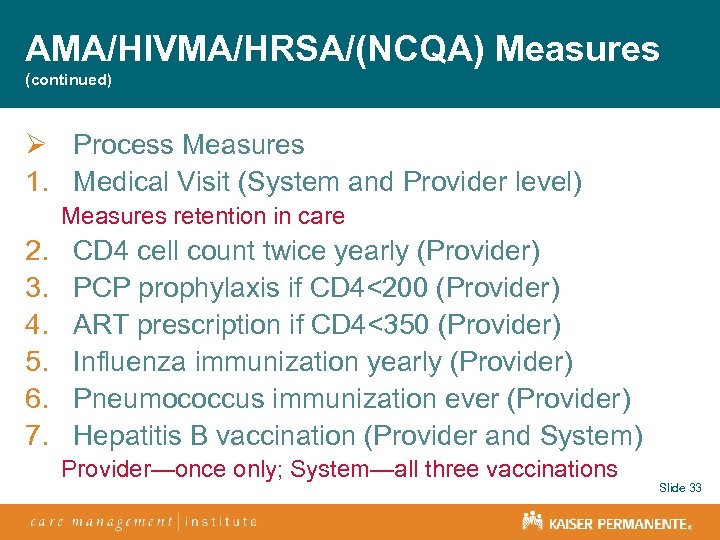 AMA/HIVMA/HRSA/(NCQA) Measures (continued) Ø Process Measures 1. Medical Visit (System and Provider level) Measures retention in care 2. 3. 4. 5. 6. 7. CD 4 cell count twice yearly (Provider) PCP prophylaxis if CD 4<200 (Provider) ART prescription if CD 4<350 (Provider) Influenza immunization yearly (Provider) Pneumococcus immunization ever (Provider) Hepatitis B vaccination (Provider and System) Provider—once only; System—all three vaccinations Slide 33
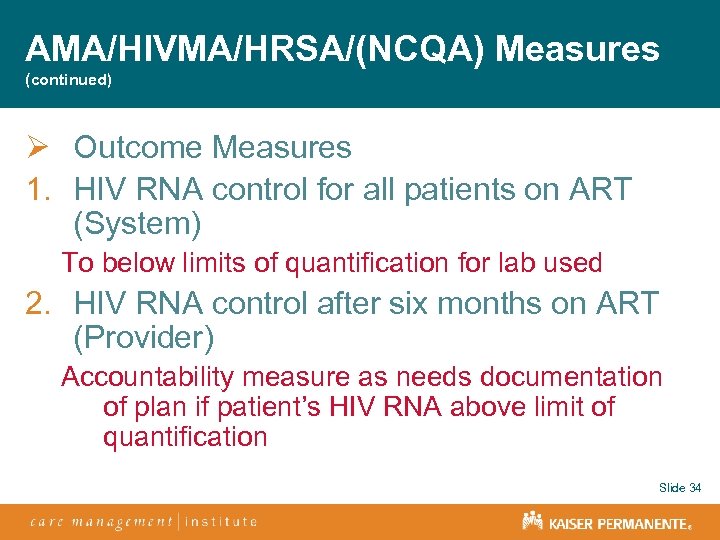 AMA/HIVMA/HRSA/(NCQA) Measures (continued) Ø Outcome Measures 1. HIV RNA control for all patients on ART (System) To below limits of quantification for lab used 2. HIV RNA control after six months on ART (Provider) Accountability measure as needs documentation of plan if patient’s HIV RNA above limit of quantification Slide 34
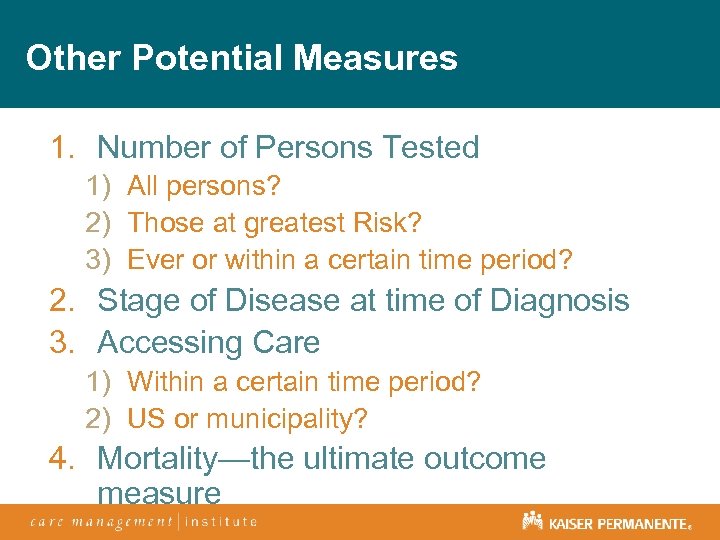 Other Potential Measures 1. Number of Persons Tested 1) All persons? 2) Those at greatest Risk? 3) Ever or within a certain time period? 2. Stage of Disease at time of Diagnosis 3. Accessing Care 1) Within a certain time period? 2) US or municipality? 4. Mortality—the ultimate outcome measure
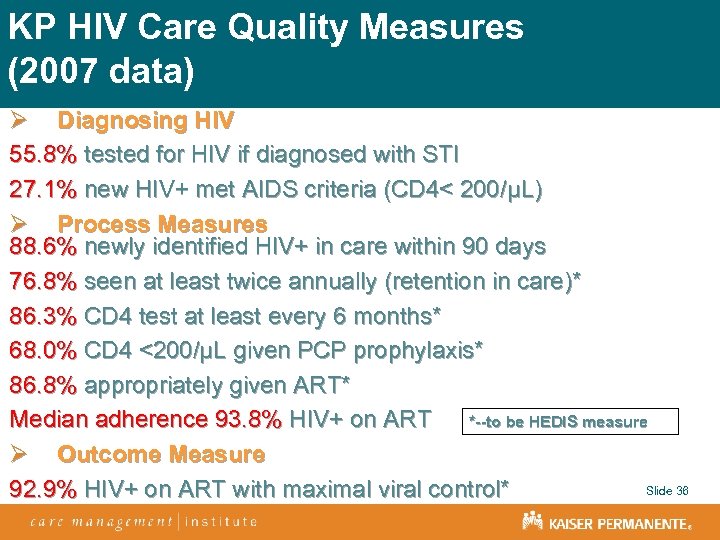 KP HIV Care Quality Measures (2007 data) Ø Diagnosing HIV 55. 8% tested for HIV if diagnosed with STI 27. 1% new HIV+ met AIDS criteria (CD 4< 200/µL) Ø Process Measures 88. 6% newly identified HIV+ in care within 90 days 76. 8% seen at least twice annually (retention in care)* 86. 3% CD 4 test at least every 6 months* 68. 0% CD 4 <200/µL given PCP prophylaxis* 86. 8% appropriately given ART* *--to be HEDIS measure Median adherence 93. 8% HIV+ on ART Ø Outcome Measure Slide 36 92. 9% HIV+ on ART with maximal viral control*
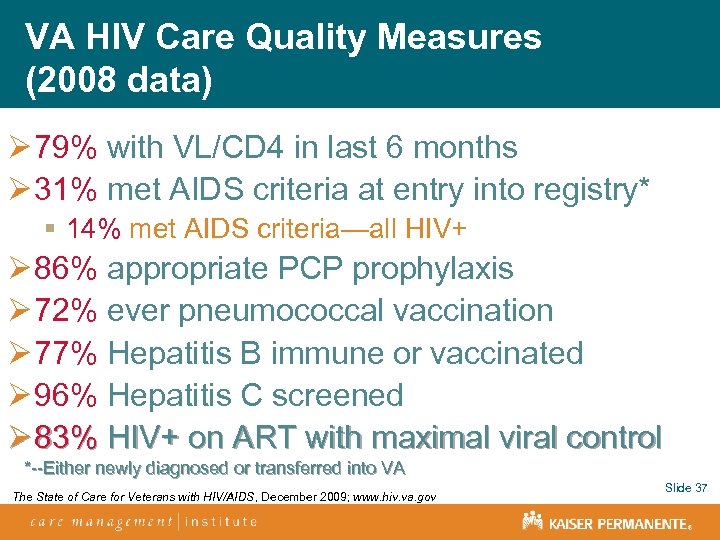 VA HIV Care Quality Measures (2008 data) Ø 79% with VL/CD 4 in last 6 months Ø 31% met AIDS criteria at entry into registry* § 14% met AIDS criteria—all HIV+ Ø 86% appropriate PCP prophylaxis Ø 72% ever pneumococcal vaccination Ø 77% Hepatitis B immune or vaccinated Ø 96% Hepatitis C screened Ø 83% HIV+ on ART with maximal viral control *--Either newly diagnosed or transferred into VA The State of Care for Veterans with HIV/AIDS, December 2009; www. hiv. va. gov Slide 37
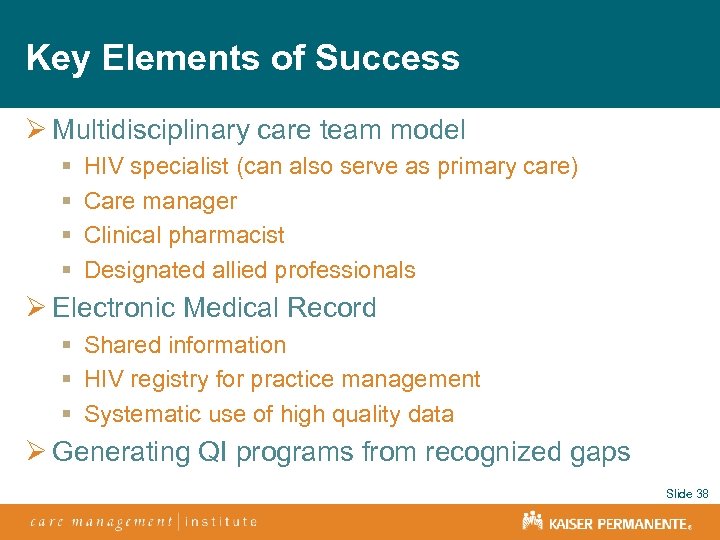 Key Elements of Success Ø Multidisciplinary care team model § § HIV specialist (can also serve as primary care) Care manager Clinical pharmacist Designated allied professionals Ø Electronic Medical Record § Shared information § HIV registry for practice management § Systematic use of high quality data Ø Generating QI programs from recognized gaps Slide 38
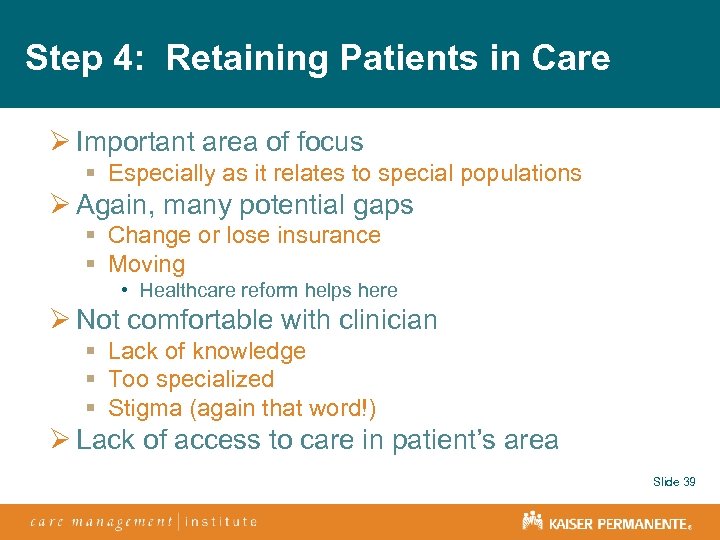 Step 4: Retaining Patients in Care Ø Important area of focus § Especially as it relates to special populations Ø Again, many potential gaps § Change or lose insurance § Moving • Healthcare reform helps here Ø Not comfortable with clinician § Lack of knowledge § Too specialized § Stigma (again that word!) Ø Lack of access to care in patient’s area Slide 39
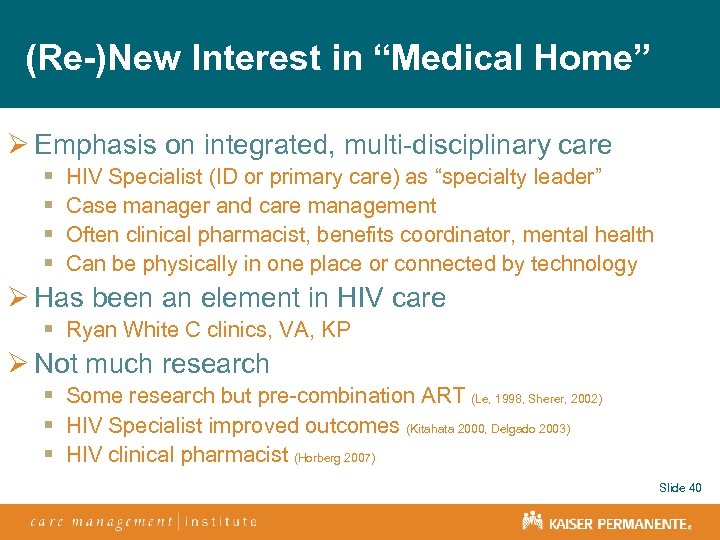 (Re-)New Interest in “Medical Home” Ø Emphasis on integrated, multi-disciplinary care § § HIV Specialist (ID or primary care) as “specialty leader” Case manager and care management Often clinical pharmacist, benefits coordinator, mental health Can be physically in one place or connected by technology Ø Has been an element in HIV care § Ryan White C clinics, VA, KP Ø Not much research § Some research but pre-combination ART (Le, 1998, Sherer, 2002) § HIV Specialist improved outcomes (Kitahata 2000, Delgado 2003) § HIV clinical pharmacist (Horberg 2007) Slide 40
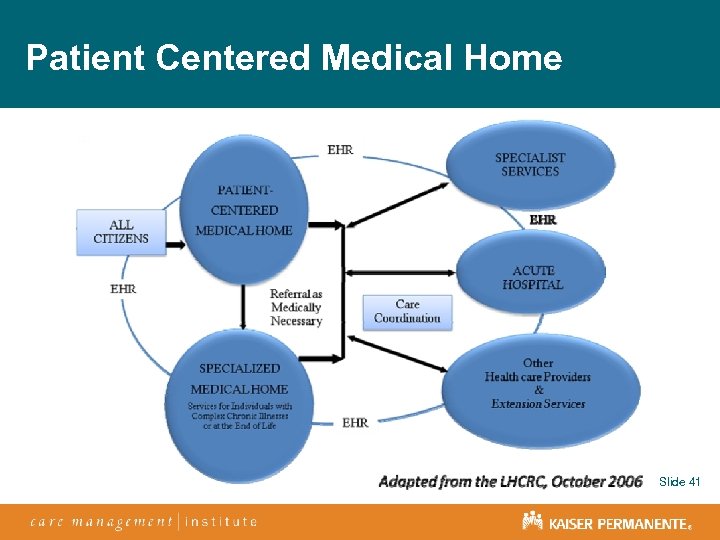 Patient Centered Medical Home Slide 41
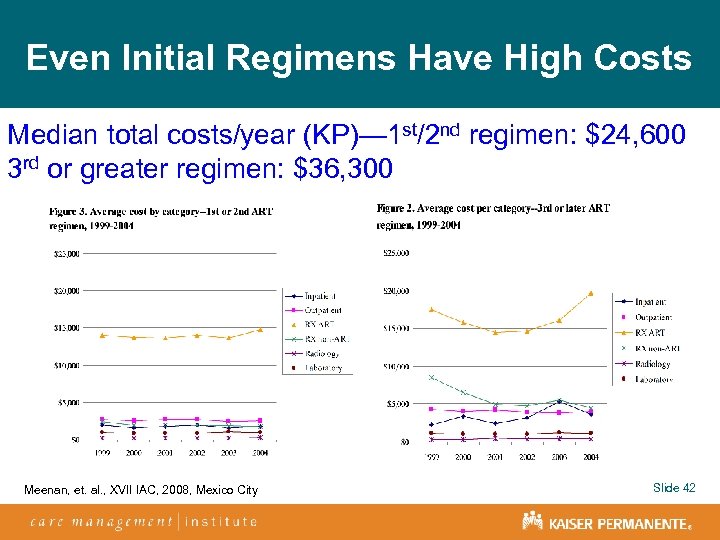 Even Initial Regimens Have High Costs Median total costs/year (KP)— 1 st/2 nd regimen: $24, 600 3 rd or greater regimen: $36, 300 Meenan, et. al. , XVII IAC, 2008, Mexico City Slide 42
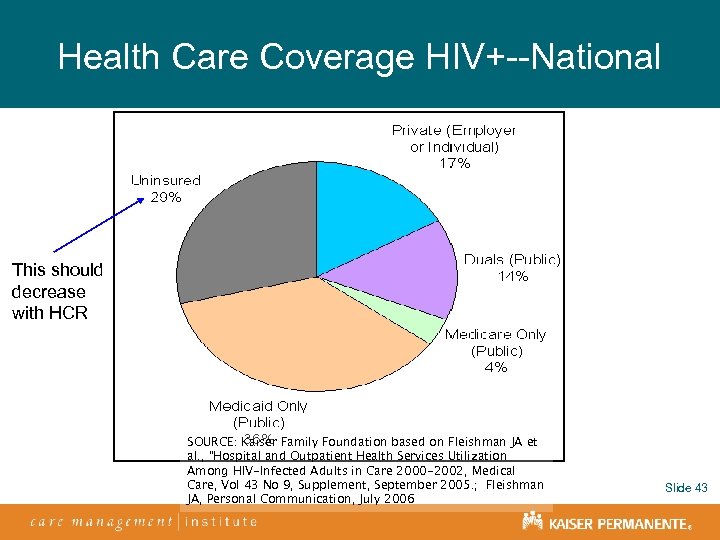 Health Care Coverage HIV+--National This should decrease with HCR SOURCE: Kaiser Family Foundation based on Fleishman JA et al. , “Hospital and Outpatient Health Services Utilization Among HIV-Infected Adults in Care 2000 -2002, Medical Care, Vol 43 No 9, Supplement, September 2005. ; Fleishman JA, Personal Communication, July 2006 Slide 43
 Step 5: Remove Disparities Ø Stigma is rampant in HIV § Both at testing and at accessing care Ø Patients must feel valued, at ease, and have faith in healthcare providers Ø Community must support HIV+ patients and those at risk § Faith based organizations can assist here § Public-private partnerships likely of use Ø Standards of care can help if established and enforced Slide 44
 Step 5: Remove Disparities (continued) Ø Need to improve outreach to youth and older Americans § Consider newer technologies (do you tweet? ) § Got to where they are; not where you are Ø Remove language barriers and health illiteracy Ø Consider gender issues Ø STOP HOMOPHOBIA AND RACISM!!! Slide 45
 Healthcare Reform and HIV Ø It will increase the number of people in care § But likely not until 2014 Ø It removes pre-existing condition clauses Ø It promotes community healthcare Ø It promotes prevention (USPSTF “A”, “B”) Ø It mandates care for many There are gaps between HCR and HIV needs Slide 46
 National HIV/AIDS Strategy Ø First domestic HIV strategic plan § Akin to PEPFAR and US Global AIDS Strategy Ø It will set goals based on the President’s principles for HIV care in US Ø Implementation will be key § Coordination of federal agencies (including VA) § Coordination of Public and Private § PACHA will have role (citizens’ representation) Slide 47
 “Working together, I am confident that we can stop the spread of HIV and ensure that those affected get the care and support they need. ” --President Barack Obama The great work continues. Thank you. Slide 48
 Special Thanks Drs. Kathleen Squires and John Brooks VA: Ø Ron Valdiserri White House Office of National AIDS Policy: Ø Jeff Crowley Ø Greg Millett KP: Ø Amanda Charbonneau Ø Leo Hurley Ø Daniel Klein Ø Michael Silverberg Ø William Towner Project Inform: Ø Dana Van Gorder Slide 49