


 Скачать презентацию HIV in South Asia Understanding and Responding to
026a50b56ebf6a0c2a75f21b5c7572c9.ppt
- Количество слайдов: 56
 HIV in South Asia: Understanding and Responding to a Heterogeneous Epidemic David Wilson The Global HIV/AIDS Program World Bank 28 November, 2005
 INTRODUCTION(1 -1) q. HIV highly heterogeneous q. Reached most places at similar time, but spread very differently q. Understanding heterogeneity critical – as Africa shows
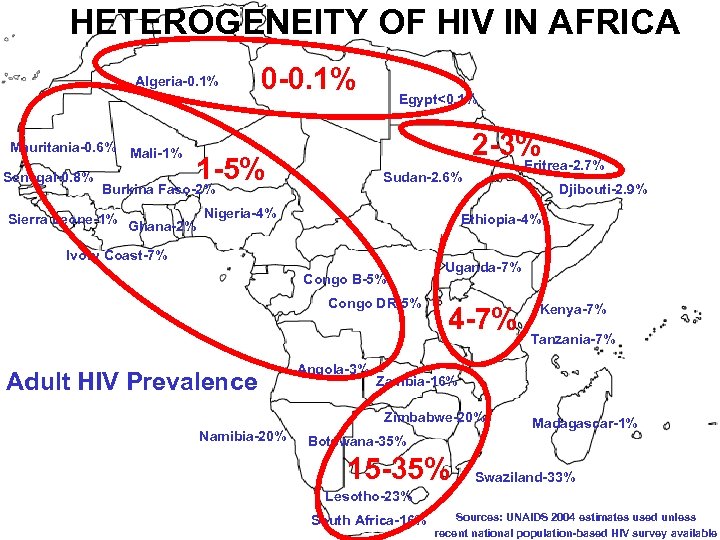 HETEROGENEITY OF HIV IN AFRICA Algeria-0. 1% 0 -0. 1% Egypt<0. 1% Mauritania-0. 6% Mali-1% Senegal-0. 8% 1 -5% Burkina Faso-2% Sierra Leone-1% Ghana-2% Sudan-2. 6% Nigeria-4% Djibouti-2. 9% Ethiopia-4% Ivory Coast-7% Congo B-5% Congo DR-5% Adult HIV Prevalence 2 -3% Eritrea-2. 7% Angola-3% Uganda-7% 4 -7% Tanzania-7% Zambia-16% Zimbabwe-20% Namibia-20% Kenya-7% Madagascar-1% Botswana-35% 15 -35% Swaziland-33% Lesotho-23% South Africa-16% Sources: UNAIDS 2004 estimates used unless recent national population-based HIV survey available
 HETEROGENEITY OF HIV: AFRICAN EVIDENCE(1 -1) q. Given diversity in Africa, what about Asia q. Senegal and South Africa aren’t one epidemic – AP and UP aren’t either q. India alone has continental epidemic q. What causes diversity of HIV in Africa – and implications for South Asia?
 HETEROGENEITY OF HIV: CONCURRENT SEXUAL PARTNERSHIPS(1 -2) q. How does HIV infectiousness vary over disease stages and how do acute infection and structure of sexual partnerships influence transmission? q. Sexual partnerships serial – one after another – or concurrent – overlapping
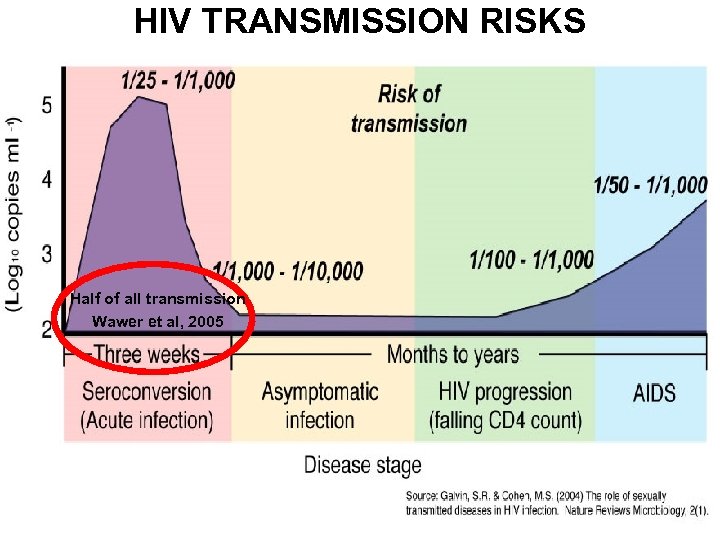 HIV TRANSMISSION RISKS Half of all transmission Wawer et al, 2005
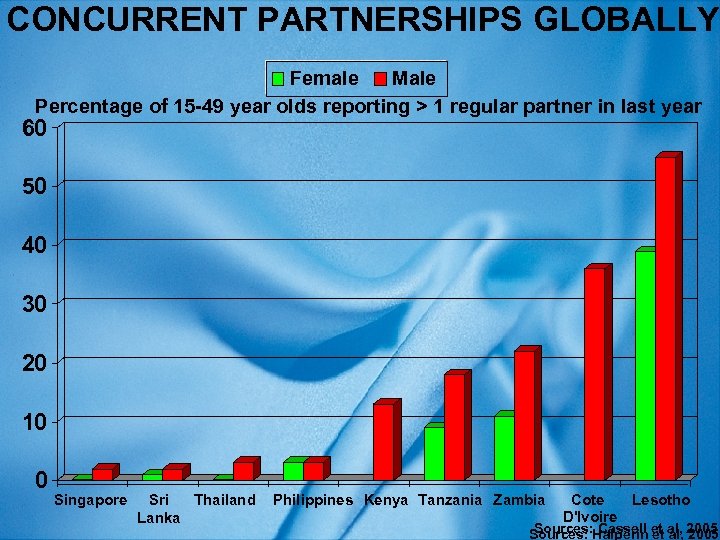 CONCURRENT PARTNERSHIPS GLOBALLY Female Male Percentage of 15 -49 year olds reporting > 1 regular partner in last year 60 50 40 30 20 10 0 Singapore Sri Thailand Lanka Philippines Kenya Tanzania Zambia Cote D'Ivoire Lesotho Sources: Cassell et al, 2005 Sources: Halperin et al, 2005
 HETEROGENEITY OF HIV: CONCURRENT SEXUAL PARTNERSHIPS(2 -2) q. Concurrent partnerships less common in Asia q. Morris showed that without differences in numbers of partners, HIV transmission 10 fold greater with concurrent partnerships – q. Concurrent partnerships explained differences between Uganda and Thailand’s epidemics q. South Asia’s epidemics unlikely to be driven by concurrent sexual networks in general population
 HETEROGENEITY OF HIV: MALE CIRCUMCISION(1 -1) q Meta-analyses - circumcised men 50 -70% less likely to get HIV q Ecological studies - male circumcision major factor in variations in Africa’s HIV epidemic q Randomized trial in South Africa - male circumcision reduced HIV transmission by 60+% q In Asia, circumcision’s primary importance ISN’T as intervention, but as determinant of epidemic potential q In highly circumcised countries – Pakistan, Bangladesh and Afghanistan in South Asia and Indonesia and Philippines in East Asia (which have nearly billion people) – heterosexual transmission may be limited (currently below 0. 1%) – unless other factors ignite it – which they may
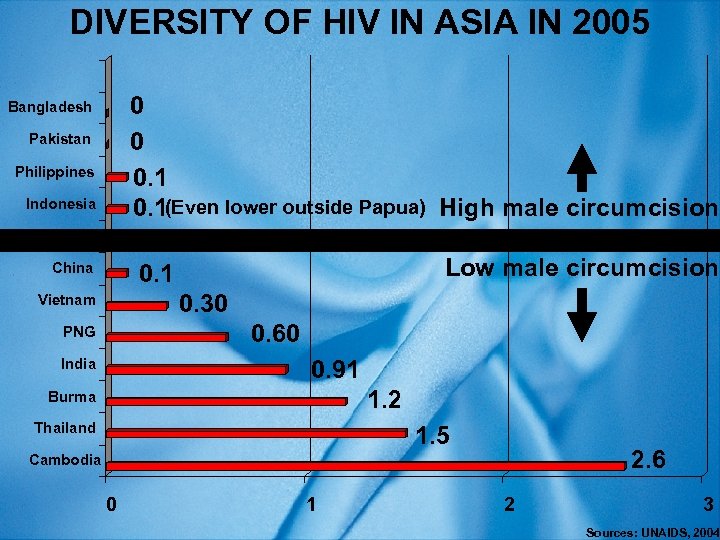 DIVERSITY OF HIV IN ASIA IN 2005 0 0 0. 1(Even lower outside Papua) High male circumcision Bangladesh Pakistan Philippines Indonesia Fiji China Low male circumcision 0. 1 0. 30 Vietnam 0. 60 PNG India 0. 91 1. 2 Burma Thailand 1. 5 2. 6 Cambodia 0 1 2 3 Sources: UNAIDS, 2004
 HETEROGENEITY OF HIV: THE LETHAL COCKTAIL(1 -1) q. Concurrent sexual partnerships and limited male circumcision fuel and match that lit Southern Africa’s uniquely explosive epidemics – together, these factors may increase HIV transmission 30 -fold – explaining much heterogeneity in HIV epidemic potential
 TRANSMISSION DYNAMICS(1 -4) q. African evidence underscores importance of understanding transmission dynamics q. Conventional definition - epidemic concentrated until 1%, then generalized obscures understanding of HIV transmission patterns q. Need revised definition: q. Concentrated - transmission largely among vulnerable groups and vulnerable group interventions would reduce overall infection q. Generalized - transmission mainly outside vulnerable groups and would continue despite effective vulnerable group
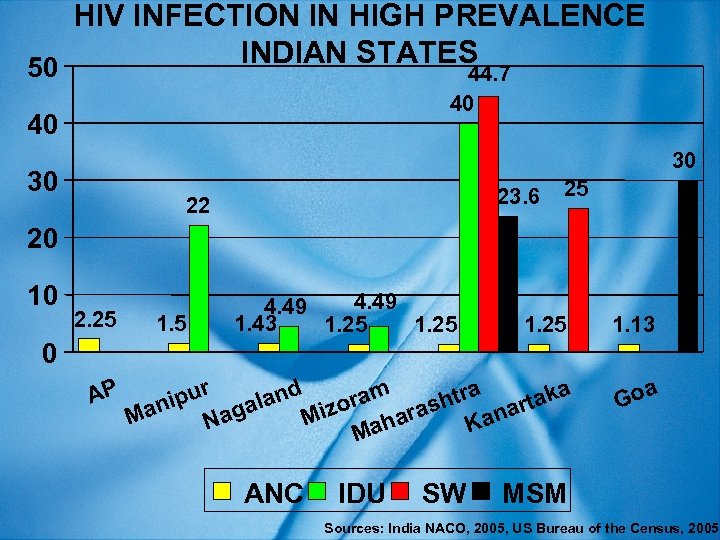 HIV INFECTION IN HIGH PREVALENCE INDIAN STATES 50 44. 7 40 40 30 30 23. 6 22 25 20 10 2. 25 1. 5 4. 49 1. 43 1. 25 1. 13 d a a pur i lan izoram ashtr tak r aga Man ar M ana N K Mah Goa 0 AP ANC IDU SW MSM Sources: India NACO, 2005, US Bureau of the Census, 2005
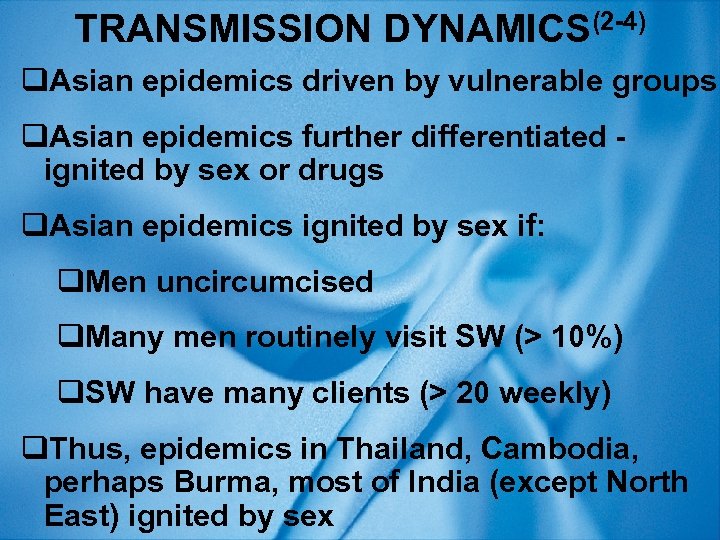 TRANSMISSION DYNAMICS(2 -4) q. Asian epidemics driven by vulnerable groups q. Asian epidemics further differentiated ignited by sex or drugs q. Asian epidemics ignited by sex if: q. Men uncircumcised q. Many men routinely visit SW (> 10%) q. SW have many clients (> 20 weekly) q. Thus, epidemics in Thailand, Cambodia, perhaps Burma, most of India (except North East) ignited by sex
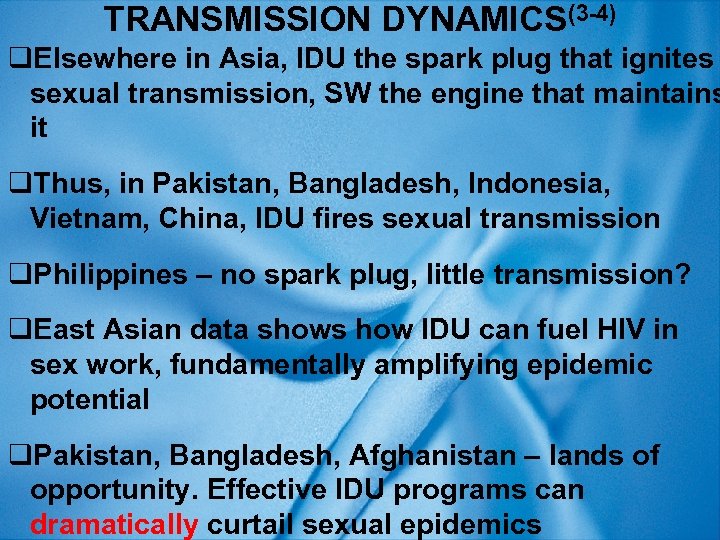 TRANSMISSION DYNAMICS(3 -4) q. Elsewhere in Asia, IDU the spark plug that ignites sexual transmission, SW the engine that maintains it q. Thus, in Pakistan, Bangladesh, Indonesia, Vietnam, China, IDU fires sexual transmission q. Philippines – no spark plug, little transmission? q. East Asian data shows how IDU can fuel HIV in sex work, fundamentally amplifying epidemic potential q. Pakistan, Bangladesh, Afghanistan – lands of opportunity. Effective IDU programs can dramatically curtail sexual epidemics
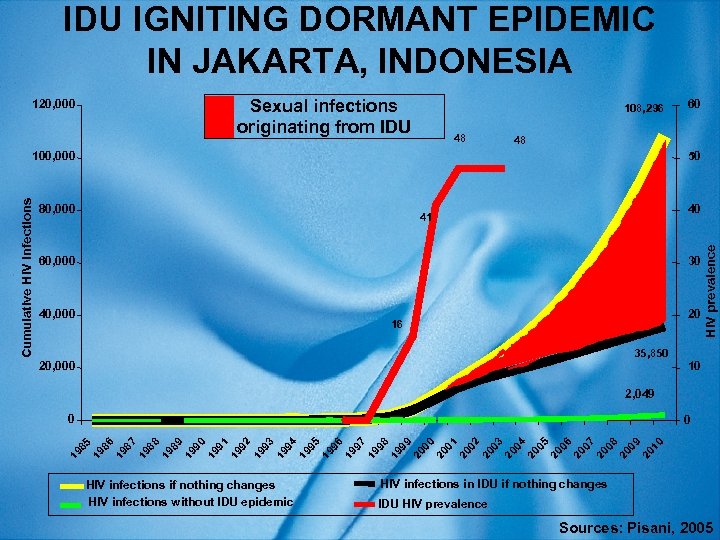 IDU IGNITING DORMANT EPIDEMIC IN JAKARTA, INDONESIA Sexual infections originating from IDU 120, 000 108, 296 48 48 100, 000 50 40 41 30 60, 000 40, 000 20 16 35, 850 20, 000 HIV prevalence 80, 000 10 2, 049 0 90 19 91 19 92 19 93 19 94 19 95 19 96 19 97 19 98 19 99 20 00 20 01 20 02 20 03 20 04 20 05 20 06 20 07 20 08 20 09 20 10 19 89 19 88 87 19 19 19 86 0 85 19 Cumulative HIV infections 60 HIV infections if nothing changes HIV infections without IDU epidemic HIV infections in IDU if nothing changes IDU HIV prevalence Sources: Pisani, 2005
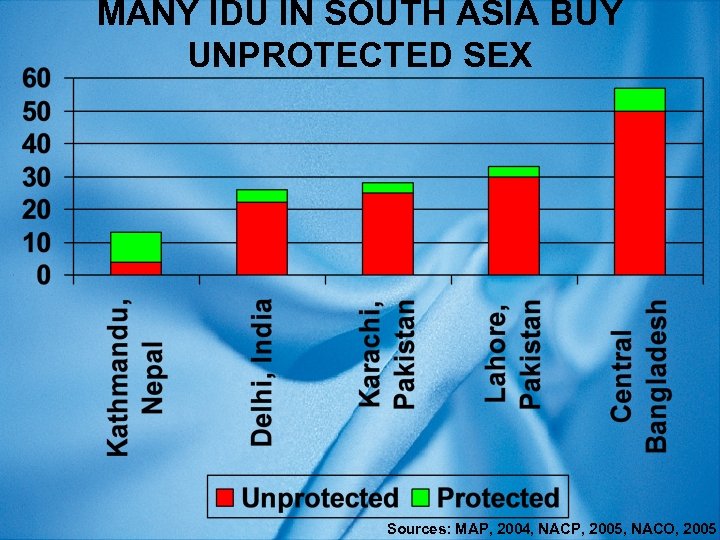 MANY IDU IN SOUTH ASIA BUY UNPROTECTED SEX Sources: MAP, 2004, NACP, 2005, NACO, 2005
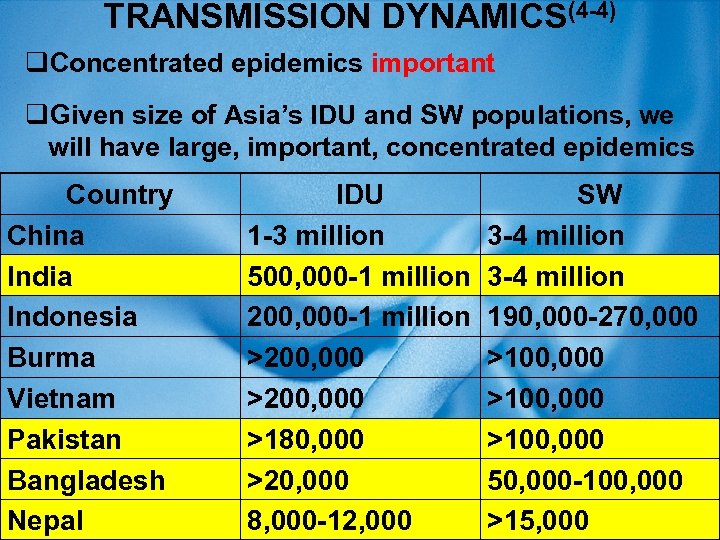 TRANSMISSION DYNAMICS(4 -4) q. Concentrated epidemics important q. Given size of Asia’s IDU and SW populations, we will have large, important, concentrated epidemics Country China India Indonesia Burma Vietnam Pakistan Bangladesh Nepal IDU 1 -3 million 500, 000 -1 million 200, 000 -1 million >200, 000 >180, 000 >20, 000 8, 000 -12, 000 SW 3 -4 million 190, 000 -270, 000 >100, 000 50, 000 -100, 000 >15, 000
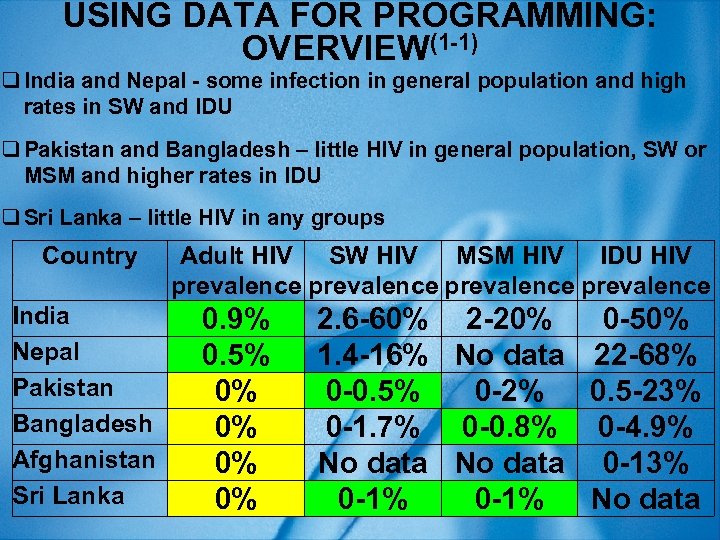 USING DATA FOR PROGRAMMING: OVERVIEW(1 -1) q India and Nepal - some infection in general population and high rates in SW and IDU q Pakistan and Bangladesh – little HIV in general population, SW or MSM and higher rates in IDU q Sri Lanka – little HIV in any groups Country India Nepal Pakistan Bangladesh Afghanistan Sri Lanka Adult HIV SW HIV MSM HIV IDU HIV prevalence 0. 9% 0. 5% 0% 0% 2. 6 -60% 2 -20% 0 -50% 1. 4 -16% No data 22 -68% 0 -0. 5% 0 -2% 0. 5 -23% 0 -1. 7% 0 -0. 8% 0 -4. 9% No data 0 -13% 0 -1% No data
 USING DATA FOR PROGRAMMING: DATA ROBUSTNESS(1 -1) q. India relies on ANC data - data emerging from other sources q. Possible upward bias of higher prevalence mainly urban sites counteracted by downward bias of lower prevalence female rates q. India’s ANC and vulnerable group data considerable but uneven, especially in North q. Nepal – data limited, especially for general population q. Bangladesh and recently Pakistan - high quality bio-behavioral surveillance of
 1. 2 ANC AND POPULATION DATA IN TAMIL NADU 1 0. 8 0. 6 0. 4 0. 2 0 8 99 1 NC A 19 99 NC A 0 00 2 NC A 2 1 00 NC A 20 02 NC A 20 03 NC A 04 NC A 20 E CH P AI N OP 20 03 TN OP P 0 20 4 N Sources: NACO, 2005, APAC, 2005, Celentano et al, 2004
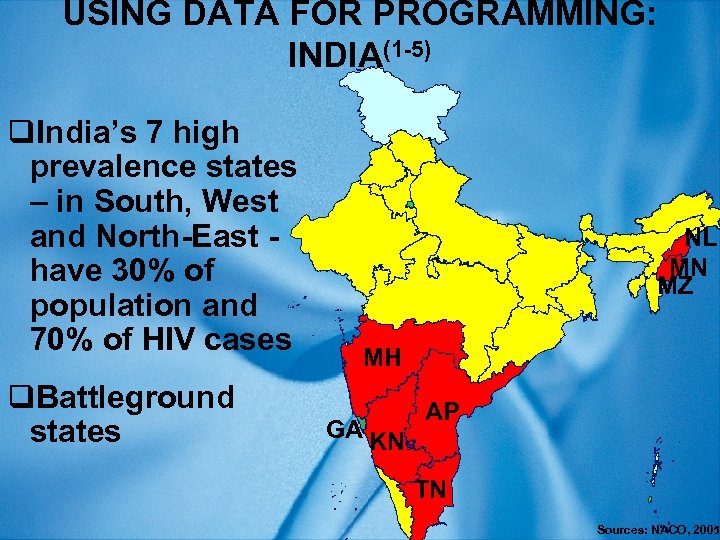 USING DATA FOR PROGRAMMING: INDIA(1 -5) q. India’s 7 high prevalence states – in South, West and North-East have 30% of population and 70% of HIV cases q. Battleground states NL MN MZ MH GA KN AP TN Sources: NACO, 2005
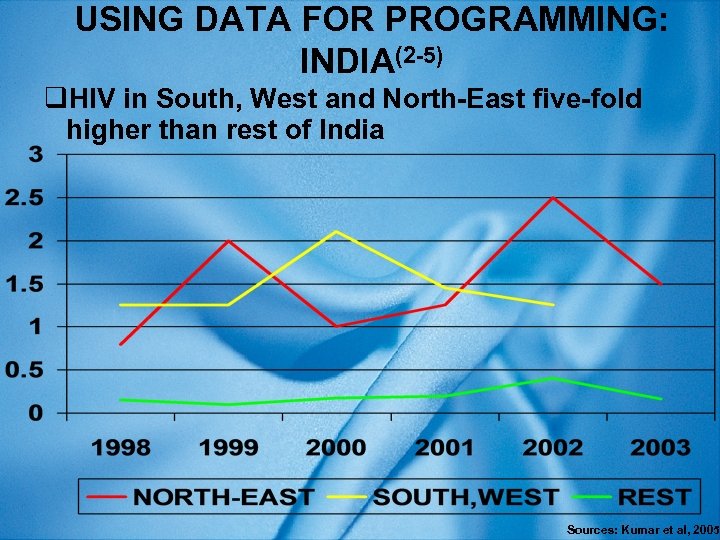 USING DATA FOR PROGRAMMING: INDIA(2 -5) q. HIV in South, West and North-East five-fold higher than rest of India Sources: Kumar et al, 2005
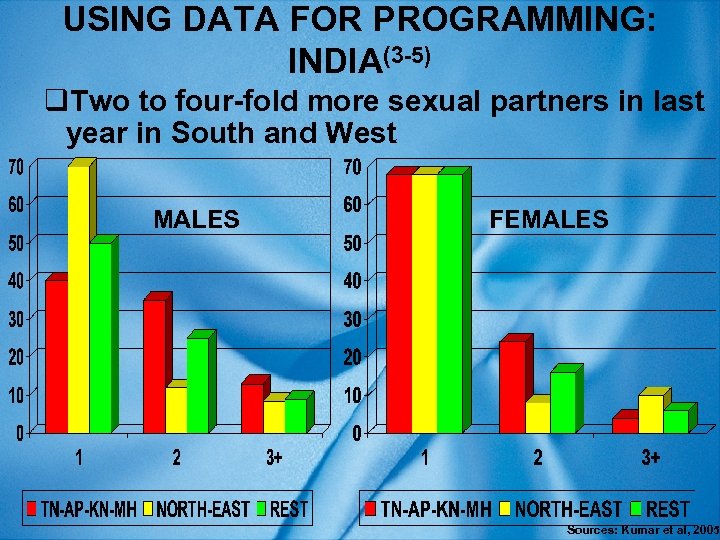 USING DATA FOR PROGRAMMING: INDIA(3 -5) q. Two to four-fold more sexual partners in last year in South and West MALES FEMALES Sources: Kumar et al, 2005
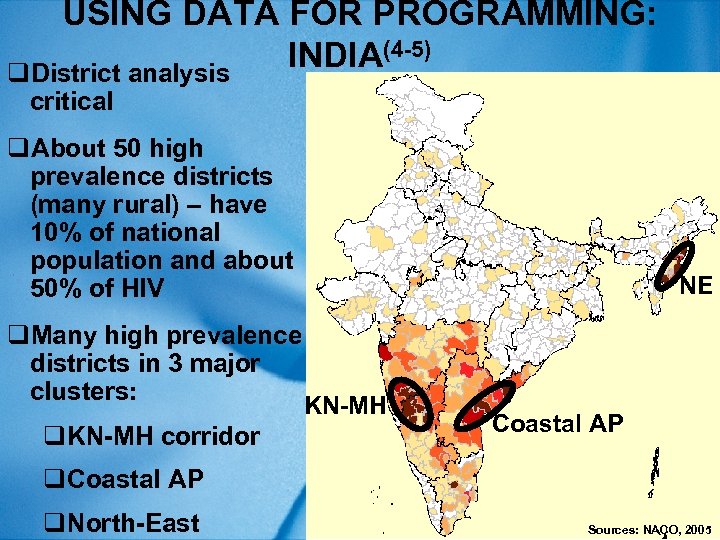 USING DATA FOR PROGRAMMING: INDIA(4 -5) q. District analysis critical q. About 50 high prevalence districts (many rural) – have 10% of national population and about 50% of HIV q. Many high prevalence districts in 3 major clusters: q. KN-MH corridor NE KN-MH Coastal AP q. North-East Sources: NACO, 2005
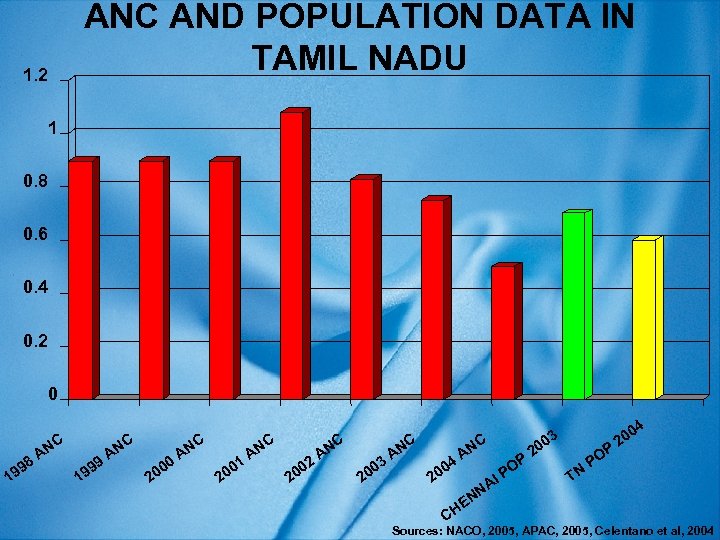
 USING DATA FOR PROGRAMMING: INDIA(5 -5) Summary q. India’s epidemic containable - as TN shows q. Ignited by IDU in North-West and SW elsewhere q. Requires highly disaggregated analysis and response – focusing on high prevalence districts and blocks q. Likely to be determined in 30 -50 key districts in 7 key states
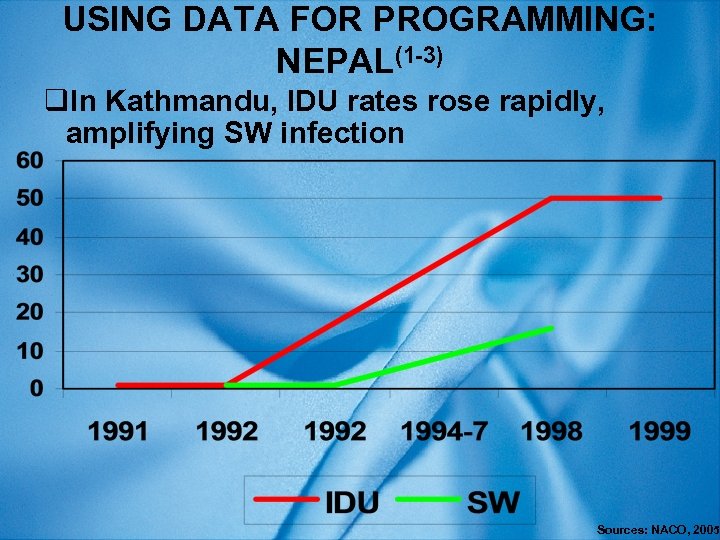 USING DATA FOR PROGRAMMING: NEPAL(1 -3) q. In Kathmandu, IDU rates rose rapidly, amplifying SW infection Sources: NACO, 2005
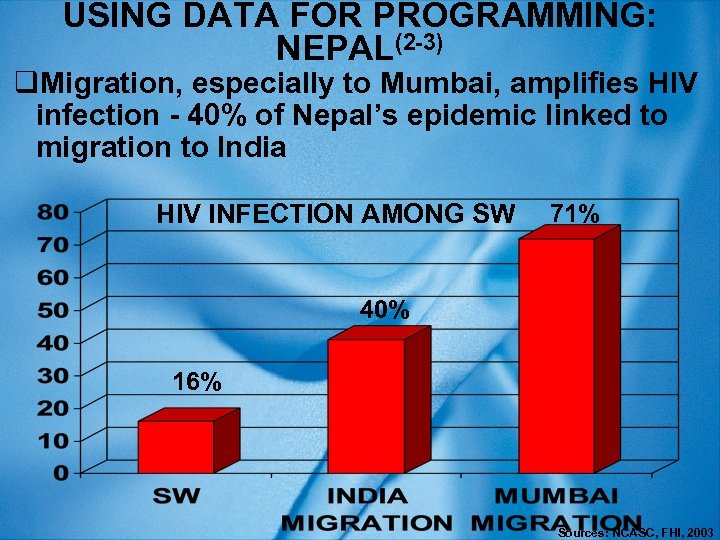 USING DATA FOR PROGRAMMING: NEPAL(2 -3) q. Migration, especially to Mumbai, amplifies HIV infection - 40% of Nepal’s epidemic linked to migration to India HIV INFECTION AMONG SW 71% 40% 16% Sources: NCASC, FHI, 2003
 USING DATA FOR PROGRAMMING: NEPAL(3 -3) Summary q. Nepal’s epidemic comparable to India’s and more severe than recognized q. Driven by IDU and SW and migrants, particularly SW migrating to Mumbai q. Instability hinders response innovative partnerships vital
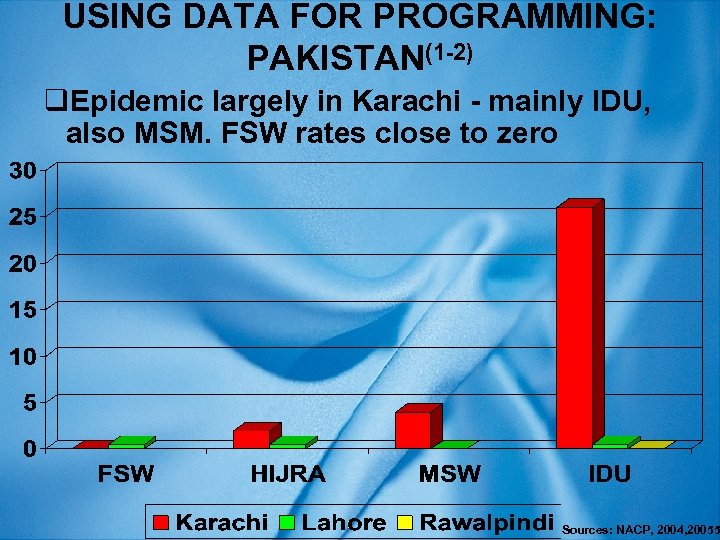 USING DATA FOR PROGRAMMING: PAKISTAN(1 -2) q. Epidemic largely in Karachi - mainly IDU, also MSM. FSW rates close to zero Sources: NACP, 2004, 20055
 USING DATA FOR PROGRAMMING: PAKISTAN(2 -2) Summary q. Molecular epidemiology shows HIV strains in Karachi new – rising fast q. Pakistan today – lessons from Indonesia a decade ago q. Without immediate large-scale, IDU and SW programs, HIV injected into previously resilient, low-prevalence female and male SW networks, fundamentally transforming epidemic character and potential
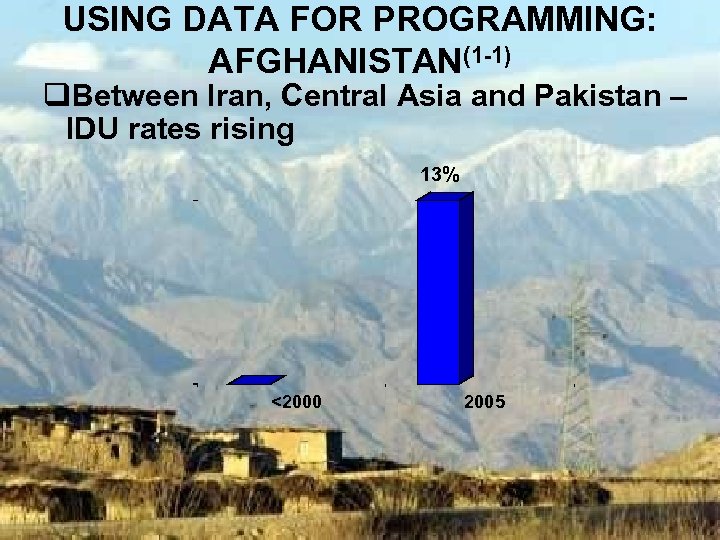 USING DATA FOR PROGRAMMING: AFGHANISTAN(1 -1) q. Between Iran, Central Asia and Pakistan – IDU rates rising 13% <2000 2005
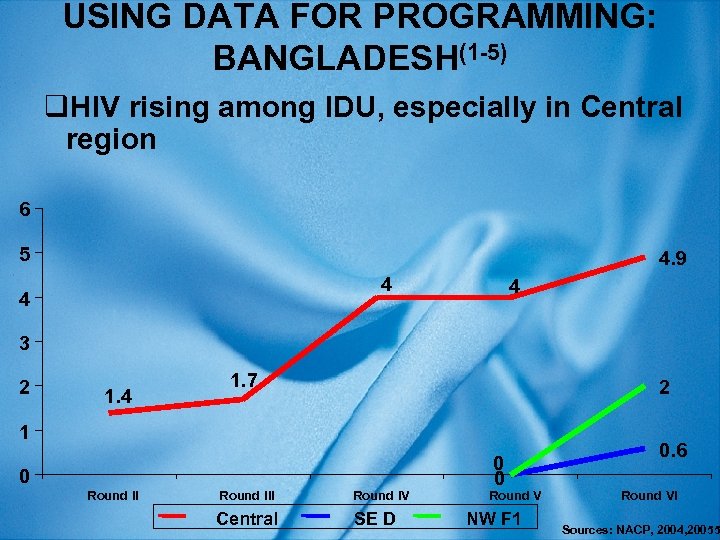 USING DATA FOR PROGRAMMING: BANGLADESH(1 -5) q. HIV rising among IDU, especially in Central region 6 5 4. 9 4 4 4 3 2 1. 4 1. 7 2 1 0 Round III Round IV Central SE D 0 0 Round V NW F 1 0. 6 Round VI Sources: NACP, 2004, 20055
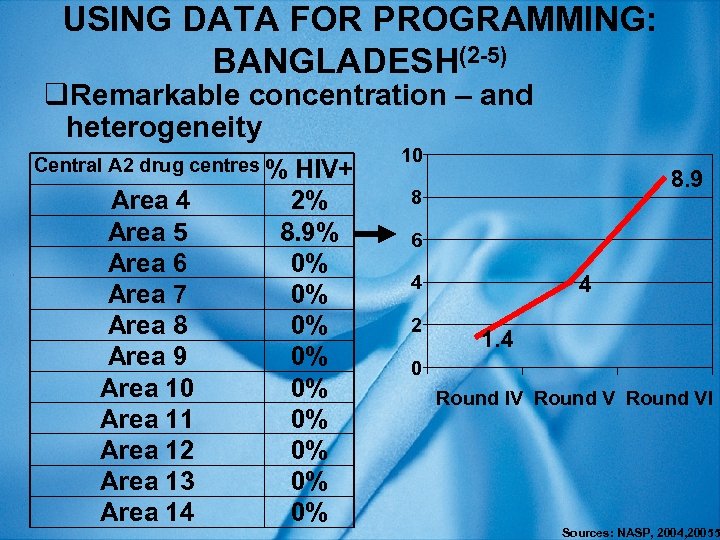 USING DATA FOR PROGRAMMING: BANGLADESH(2 -5) q. Remarkable concentration – and heterogeneity Central A 2 drug centres % Area 4 Area 5 Area 6 Area 7 Area 8 Area 9 Area 10 Area 11 Area 12 Area 13 Area 14 HIV+ 2% 8. 9% 0% 0% 0% 10 8. 9 8 6 4 4 2 1. 4 0 Round IV Round VI Sources: NASP, 2004, 20055
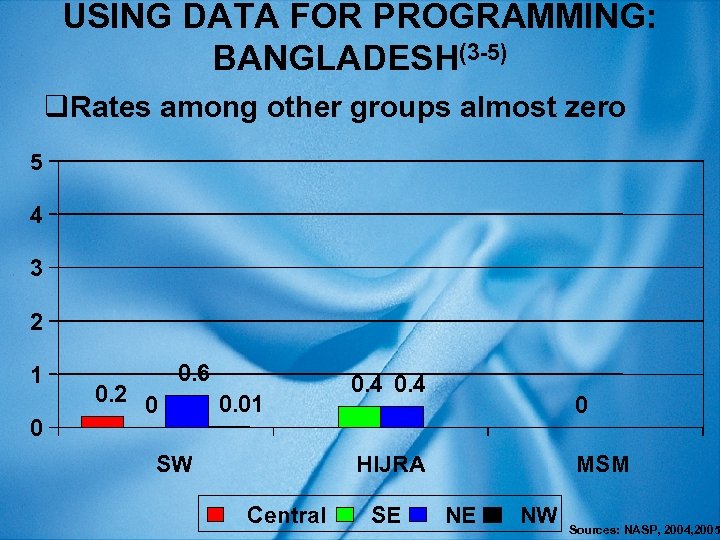 USING DATA FOR PROGRAMMING: BANGLADESH(3 -5) q. Rates among other groups almost zero 5 4 3 2 1 0 0. 2 0 0. 6 0. 01 SW 0. 4 0 HIJRA Central SE MSM NE NW Sources: NASP, 2004, 2005
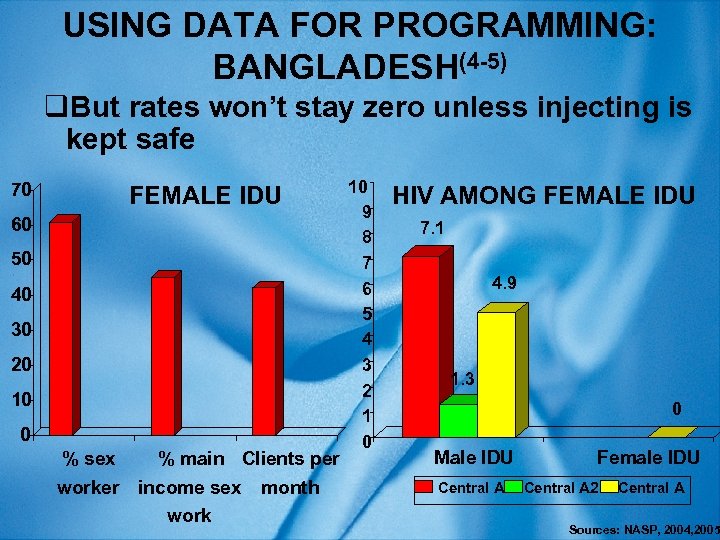 USING DATA FOR PROGRAMMING: BANGLADESH(4 -5) q. But rates won’t stay zero unless injecting is kept safe 70 FEMALE IDU 60 50 40 30 20 10 0 % sex worker % main Clients per income sex work month 10 9 8 7 6 5 4 3 2 1 0 HIV AMONG FEMALE IDU 7. 1 4. 9 1. 3 0 Male IDU Female IDU Central A 1 Central A 2 Central A Sources: NASP, 2004, 2005
 USING DATA FOR PROGRAMMING: BANGLADESH (5 -5) Summary q. Epidemic highly focused among IDU in defined localities q. Ultra-intensive focus on these areas and large-scale national IDU, SW and MSM programs can prevent further transmission q. Some programs already slowing HIV transmission?
 USING DATA FOR PROGRAMMING: SRI LANKA(1 -1) Summary q. Sri Lanka’s epidemic contingent on likelihood of transition to IDU q. Priorities: q. Establish early warning system to detect growth in IDU q. Build capacity to manage opiate addiction now q. And keep SW safe
 RECOMMENDATIONS: HIV IN SOUTH ASIA CAN BE CONTAINED(1 -1) q. South Asia’s HIV epidemics can be curbed q. Have sufficient knowledge to tackle South Asia’s epidemics - challenge is to sharpen focus and strengthen implementation
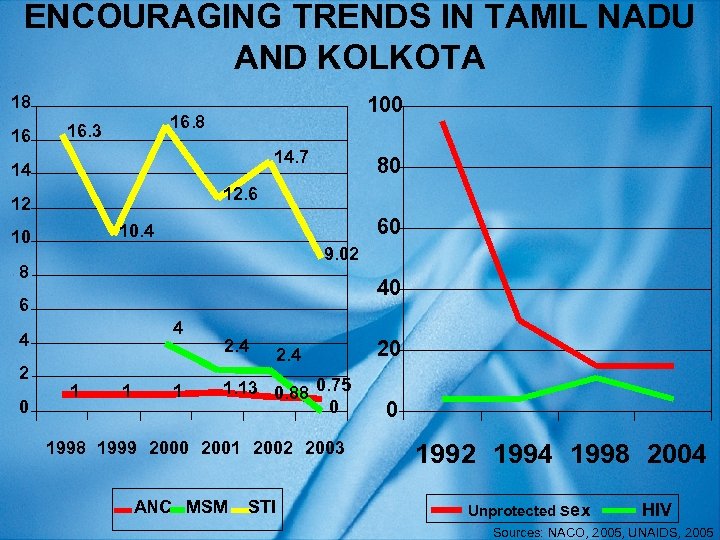 ENCOURAGING TRENDS IN TAMIL NADU AND KOLKOTA 18 16 100 16. 8 16. 3 14. 7 14 80 12. 6 12 60 10. 4 10 9. 02 8 40 6 4 4 2 0 1 1 1 2. 4 20 1. 13 0. 88 0. 75 0 0 1998 1999 2000 2001 2002 2003 ANC MSM STI 1992 1994 1998 2004 Unprotected sex HIV Sources: NACO, 2005, UNAIDS, 2005
 RECOMMENDATIONS: TWO-PRONGED APPROACH(1 -1) q. Need two pronged approach q. First, implementing high quality, high coverage programs for major vulnerable groups q. Second, reducing stigma and addressing underlying structural determinants of epidemic
 FIREFIGHTING
 AND FIREBREAKS
 NOT ONE INFERNO BUT MANY LOCAL FIRES
 RECOMMENDATIONS: FOCUS(1 -3) q. Vital to understand heterogeneity of HIV and to focus – dissipation of focus major limitation of HIV programs q. Geographic foci include 30 -50 highest prevalence districts in India’s seven highest prevalence states, Karachi in Pakistan and two neighborhoods in Bangladesh where over half of HIV+ IDU found
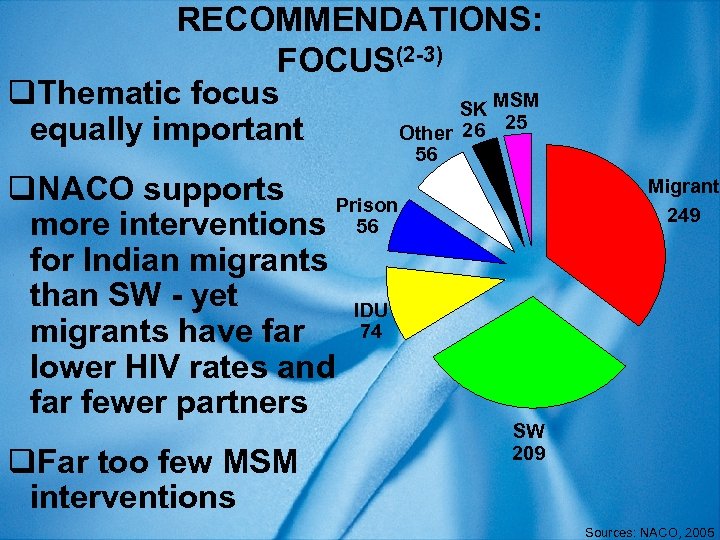 RECOMMENDATIONS: FOCUS(2 -3) q. Thematic focus SK MSM 25 Other 26 equally important 56 q. NACO supports Prison more interventions 56 for Indian migrants than SW - yet IDU 74 migrants have far lower HIV rates and far fewer partners q. Far too few MSM interventions Migrant 249 SW 209 Sources: NACO, 2005
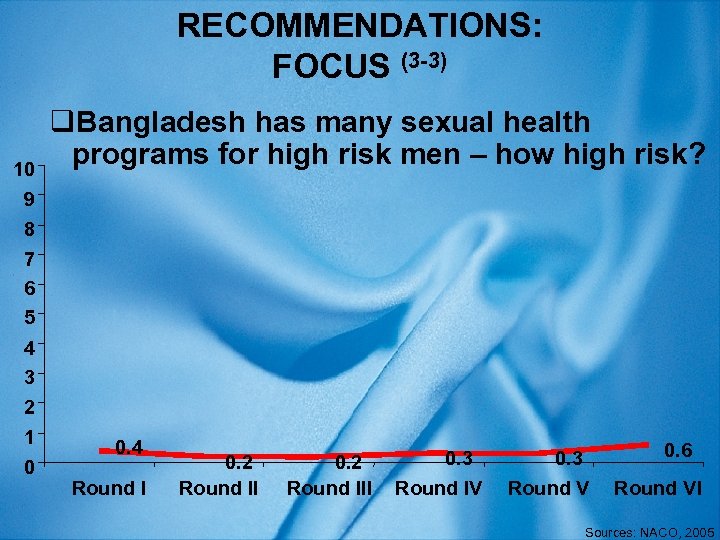 RECOMMENDATIONS: FOCUS (3 -3) 10 9 q. Bangladesh has many sexual health programs for high risk men – how high risk? 8 7 6 5 4 3 2 1 0 0. 4 Round I 0. 2 Round III 0. 3 Round IV 0. 3 Round V 0. 6 Round VI Sources: NACO, 2005
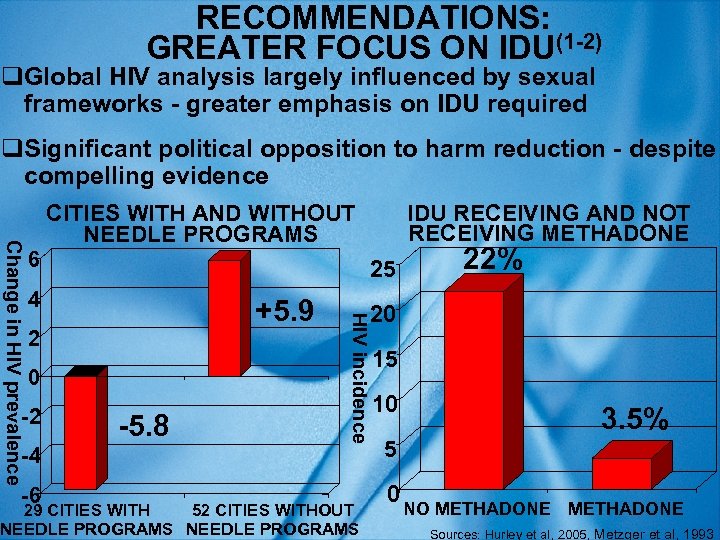 RECOMMENDATIONS: GREATER FOCUS ON IDU(1 -2) q. Global HIV analysis largely influenced by sexual frameworks - greater emphasis on IDU required q. Significant political opposition to harm reduction - despite compelling evidence 6 25 4 +5. 9 2 0 -2 -4 -6 -5. 8 29 CITIES WITH 52 CITIES WITHOUT NEEDLE PROGRAMS 22% 20 HIV incidence Change in HIV prevalence IDU RECEIVING AND NOT RECEIVING METHADONE CITIES WITH AND WITHOUT NEEDLE PROGRAMS 15 10 3. 5% 5 0 NO METHADONE Sources: Hurley et al, 2005, Metzger et al, 1993
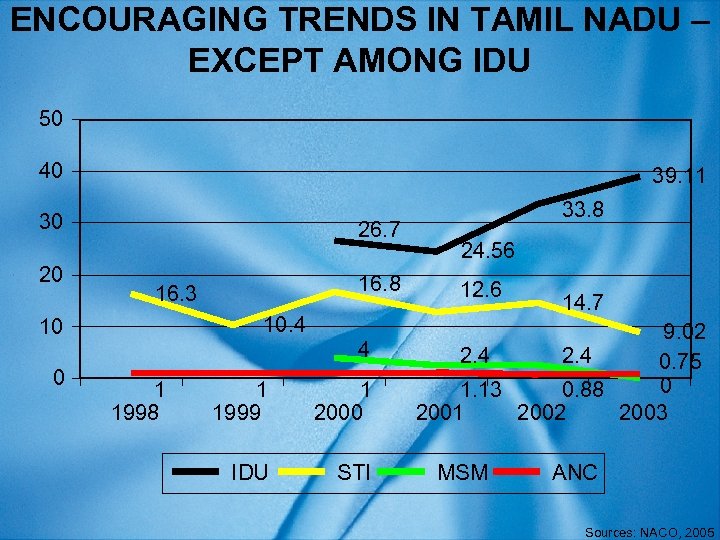 ENCOURAGING TRENDS IN TAMIL NADU – EXCEPT AMONG IDU 50 40 39. 11 30 20 26. 7 10. 4 10 0 16. 8 16. 3 4 1 1998 1 1999 1 2000 IDU STI 33. 8 24. 56 12. 6 14. 7 9. 02 2. 4 0. 75 0 1. 13 0. 88 2001 2002 2003 MSM ANC Sources: NACO, 2005
 RECOMMENDATIONS GREATER FOCUS ON IDU(2 -2) q. Epidemic potential in Pakistan, Bangladesh, Afghanistan hugely influenced by effectiveness of IDU programs today
 RECOMMENDATIONS: GREATER FOCUS ON MSM (1 -1) q. MSM third pillar of epidemic and response – considerable MSM activity, increasing HIV rates, especially among hijra and MSW q. Yet, too little surveillance, analysis, modeling and programming – only 2% of Indian interventions
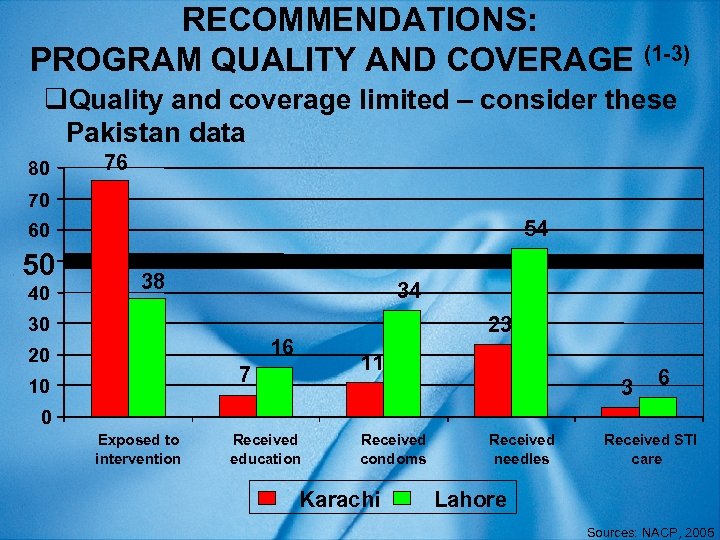 RECOMMENDATIONS: PROGRAM QUALITY AND COVERAGE (1 -3) q. Quality and coverage limited – consider these Pakistan data 80 76 70 54 60 50 40 38 34 30 23 16 20 11 7 10 3 6 0 Exposed to intervention Received education Received condoms Karachi Received needles Received STI care Lahore Sources: NACP, 2005
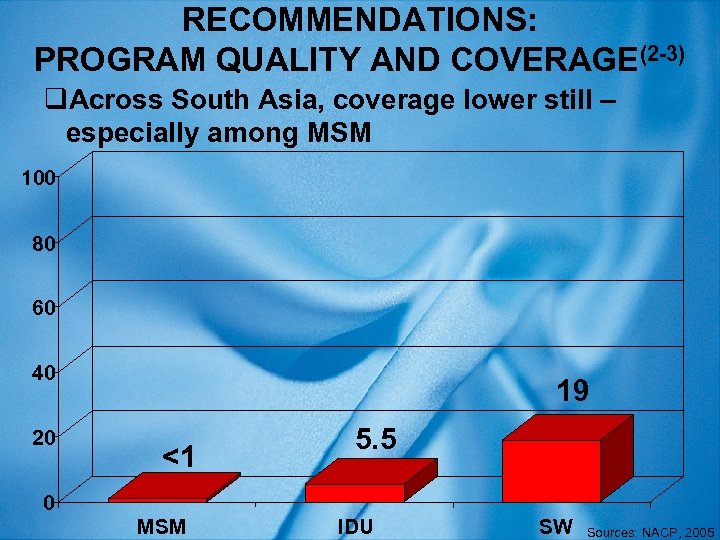 RECOMMENDATIONS: PROGRAM QUALITY AND COVERAGE(2 -3) q. Across South Asia, coverage lower still – especially among MSM 100 80 60 40 20 0 19 <1 MSM 5. 5 IDU SW Sources: NACP, 2005
 RECOMMENDATIONS PROGRAM QUALITY AND COVERAGE(3 -3) q. Combine laser focus on highest prevalence areas and communities with commitment to expand coverage nationwide q. High coverage of adequate interventions better than low coverage of perfect interventions – small behavior change on large scale better than large behavior change on small scale
 RECOMMENDATIONS STRUCTURAL INTERVENTIONS(1 -1) q Easier to achieve scale with contextual than individual level interventions - examples include: q. Legal/policy interventions - protecting vulnerable groups and undocumented migrants, reducing trafficking, removing risk and stigma from carrying condoms or needles q. Regulatory interventions - 100% condom use programs, regulating enterprises to mitigate induced risk q. Institutional interventions - institutionalizing safe injecting rooms, detoxification and substitution programs q. Market interventions - liberalizing needle or condom sales, subsidized condom, syringe or bleach social marketing programs q. Voucher programs - for needles, STI or BBV treatment q. Normative interventions – to promote safer sexual and gender norms
 CONCLUSION(1 -1) q. HIV in South Asia eminently preventable – 99. 6% of South Asians uninfected q. Notwithstanding challenges, South Asia deserves credit for growing commitment and action q. With better use of existing knowledge, focus, implementation and coverage, HIV containable