 Скачать презентацию HIV AIDS Global Policy Training Program Ernesto De
17b870dc605946dbe0e66cd9e8bd349d.ppt
- Количество слайдов: 26



HIV/AIDS: Global Policy & Training Program Ernesto De La Torre External program overview March, 2008 © Chevron Corporation 2007 PGPA Internal Communications 5/22/07
Global HIV/AIDS Policy & Training Business Case © Chevron Corporation 2007 PGPA Internal Communications 5/22/07
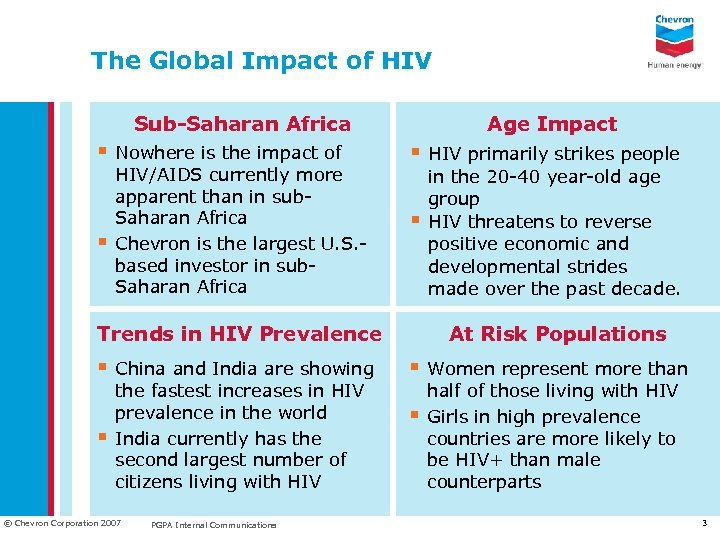
The Global Impact of HIV Sub-Saharan Africa § § Nowhere is the impact of HIV/AIDS currently more apparent than in sub. Saharan Africa Chevron is the largest U. S. based investor in sub. Saharan Africa Age Impact § § Trends in HIV Prevalence § § China and India are showing the fastest increases in HIV prevalence in the world India currently has the second largest number of citizens living with HIV © Chevron Corporation 2007 PGPA Internal Communications HIV primarily strikes people in the 20 -40 year-old age group HIV threatens to reverse positive economic and developmental strides made over the past decade. At Risk Populations § § Women represent more than half of those living with HIV Girls in high prevalence countries are more likely to be HIV+ than male counterparts 3
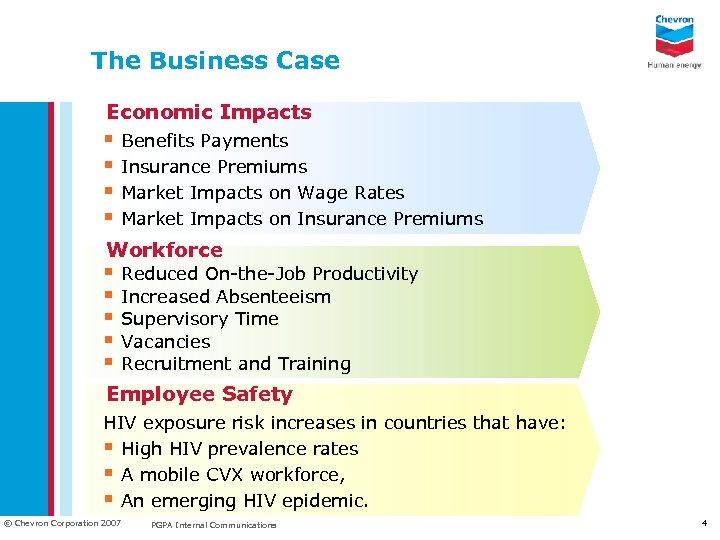
The Business Case Economic Impacts § § Benefits Payments Insurance Premiums Market Impacts on Wage Rates Market Impacts on Insurance Premiums Workforce § § § Reduced On-the-Job Productivity Increased Absenteeism Supervisory Time Vacancies Recruitment and Training Employee Safety HIV exposure risk increases in countries that have: § High HIV prevalence rates § A mobile CVX workforce, § An emerging HIV epidemic. © Chevron Corporation 2007 PGPA Internal Communications 4
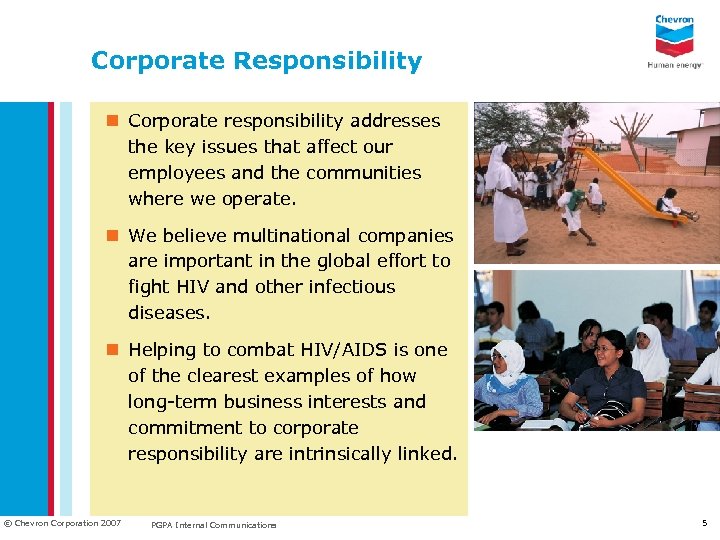
Corporate Responsibility n Corporate responsibility addresses the key issues that affect our employees and the communities where we operate. n We believe multinational companies are important in the global effort to fight HIV and other infectious diseases. n Helping to combat HIV/AIDS is one of the clearest examples of how long-term business interests and commitment to corporate responsibility are intrinsically linked. © Chevron Corporation 2007 PGPA Internal Communications 5
Global HIV/AIDS Policy & Training Development & Implementation © Chevron Corporation 2007 PGPA Internal Communications 5/22/07
Best Practices World-Class Corporate HIV/AIDS Programs include the following: n A systematic needs assessment for HIV/AIDS n A company-wide HIV/AIDS policy n Awareness and prevention programs n Voluntary counseling and testing (confidentiality maintained) n Anti-retroviral treatment and support for employees and dependents n Partnerships with local community resources, government and private sector groups © Chevron Corporation 2007 PGPA Internal Communications 7
Key Implementation Steps n Conduct Situation Analysis n Develop a Timeline n Gain Support n Assemble Resources n Conduct Management Team Training n Initiate Communications and Conduct Initial Assessment n Secure Access for Benefits, Testing and Treatment n Conduct Prevention, Education and Awareness Training n Monitor Implementation © Chevron Corporation 2007 PGPA Internal Communications 8
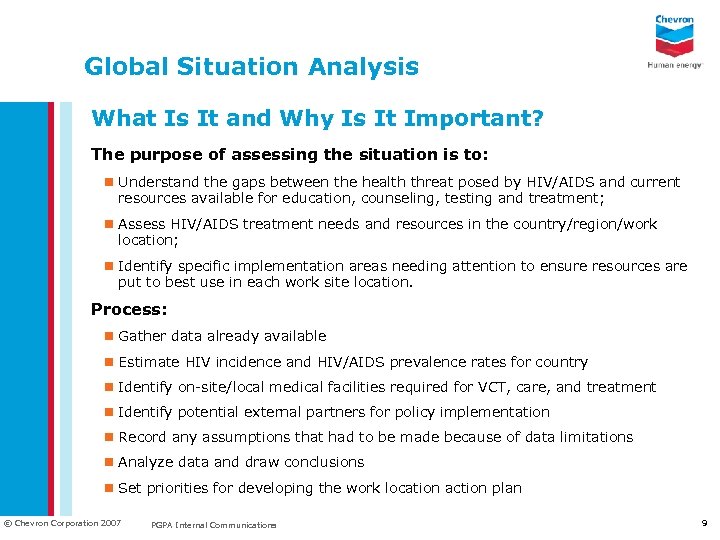
Global Situation Analysis What Is It and Why Is It Important? The purpose of assessing the situation is to: n Understand the gaps between the health threat posed by HIV/AIDS and current resources available for education, counseling, testing and treatment; n Assess HIV/AIDS treatment needs and resources in the country/region/work location; n Identify specific implementation areas needing attention to ensure resources are put to best use in each work site location. Process: n Gather data already available n Estimate HIV incidence and HIV/AIDS prevalence rates for country n Identify on-site/local medical facilities required for VCT, care, and treatment n Identify potential external partners for policy implementation n Record any assumptions that had to be made because of data limitations n Analyze data and draw conclusions n Set priorities for developing the work location action plan © Chevron Corporation 2007 PGPA Internal Communications 9
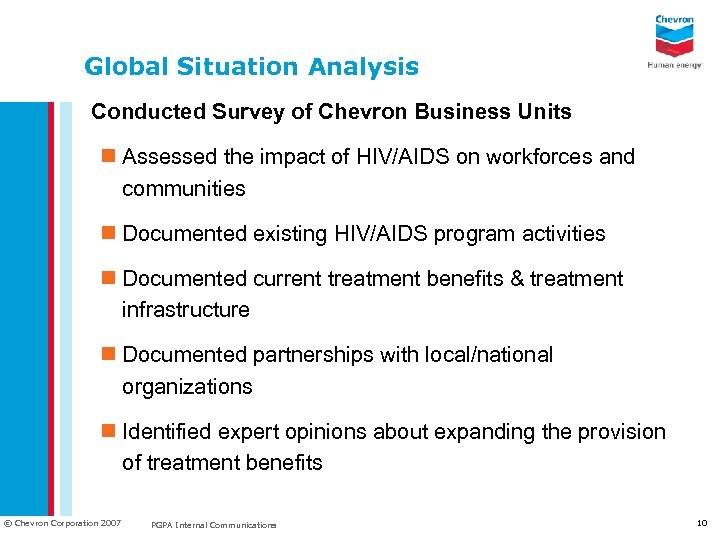
Global Situation Analysis Conducted Survey of Chevron Business Units n Assessed the impact of HIV/AIDS on workforces and communities n Documented existing HIV/AIDS program activities n Documented current treatment benefits & treatment infrastructure n Documented partnerships with local/national organizations n Identified expert opinions about expanding the provision of treatment benefits © Chevron Corporation 2007 PGPA Internal Communications 10
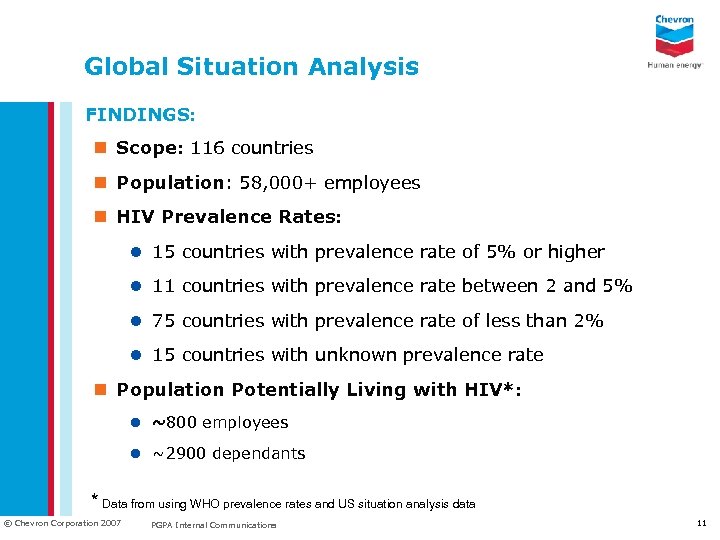
Global Situation Analysis FINDINGS: n Scope: 116 countries n Population: 58, 000+ employees n HIV Prevalence Rates: l 15 countries with prevalence rate of 5% or higher l 11 countries with prevalence rate between 2 and 5% l 75 countries with prevalence rate of less than 2% l 15 countries with unknown prevalence rate n Population Potentially Living with HIV*: l ~800 employees l ~2900 dependants * Data from using WHO prevalence rates and US situation analysis data © Chevron Corporation 2007 PGPA Internal Communications 11
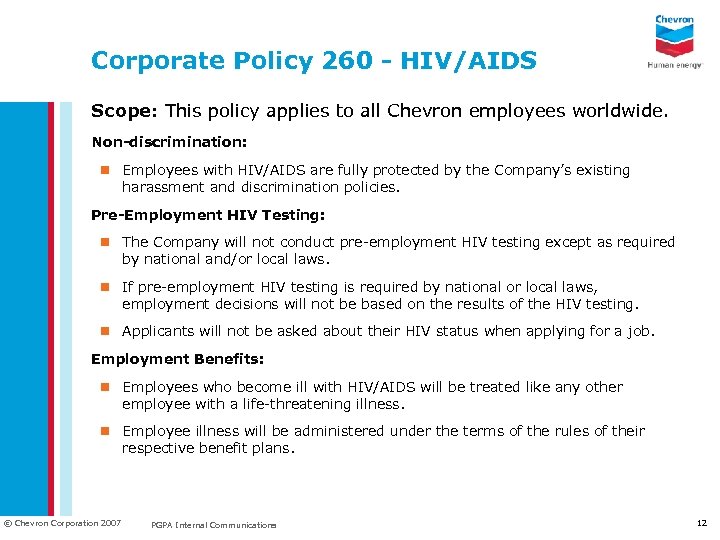
Corporate Policy 260 - HIV/AIDS Scope: This policy applies to all Chevron employees worldwide. Non-discrimination: n Employees with HIV/AIDS are fully protected by the Company’s existing harassment and discrimination policies. Pre-Employment HIV Testing: n The Company will not conduct pre-employment HIV testing except as required by national and/or local laws. n If pre-employment HIV testing is required by national or local laws, employment decisions will not be based on the results of the HIV testing. n Applicants will not be asked about their HIV status when applying for a job. Employment Benefits: n Employees who become ill with HIV/AIDS will be treated like any other employee with a life-threatening illness. n Employee illness will be administered under the terms of the rules of their respective benefit plans. © Chevron Corporation 2007 PGPA Internal Communications 12
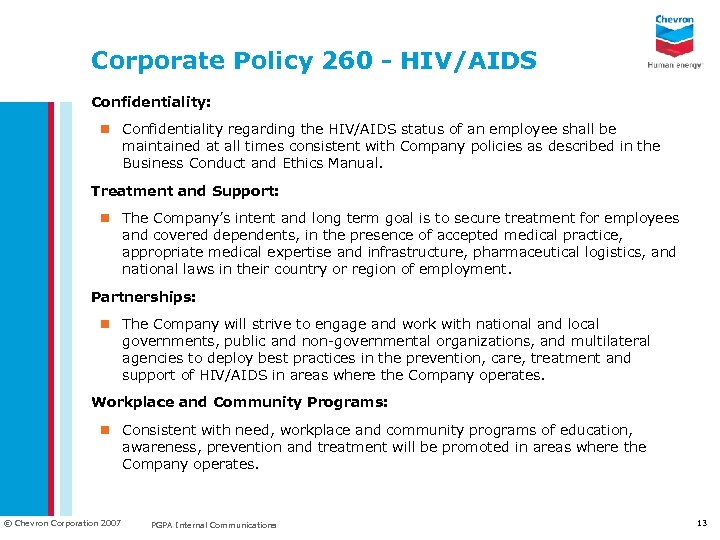
Corporate Policy 260 - HIV/AIDS Confidentiality: n Confidentiality regarding the HIV/AIDS status of an employee shall be maintained at all times consistent with Company policies as described in the Business Conduct and Ethics Manual. Treatment and Support: n The Company’s intent and long term goal is to secure treatment for employees and covered dependents, in the presence of accepted medical practice, appropriate medical expertise and infrastructure, pharmaceutical logistics, and national laws in their country or region of employment. Partnerships: n The Company will strive to engage and work with national and local governments, public and non-governmental organizations, and multilateral agencies to deploy best practices in the prevention, care, treatment and support of HIV/AIDS in areas where the Company operates. Workplace and Community Programs: n Consistent with need, workplace and community programs of education, awareness, prevention and treatment will be promoted in areas where the Company operates. © Chevron Corporation 2007 PGPA Internal Communications 13
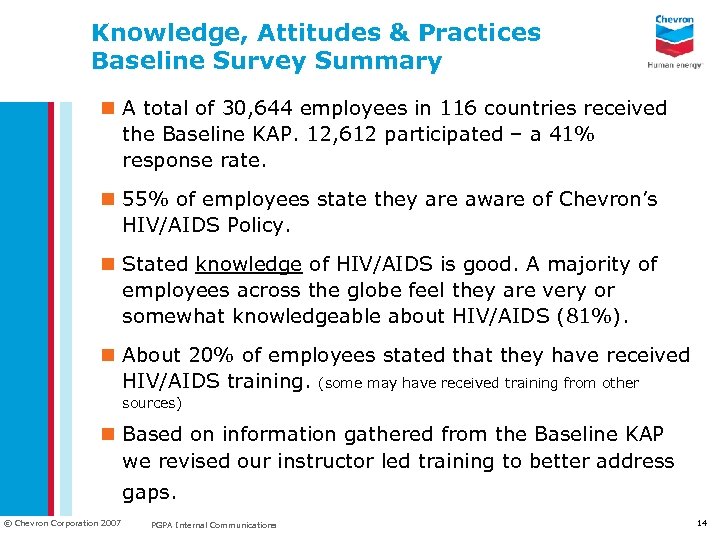
Knowledge, Attitudes & Practices Baseline Survey Summary n A total of 30, 644 employees in 116 countries received the Baseline KAP. 12, 612 participated – a 41% response rate. n 55% of employees state they are aware of Chevron’s HIV/AIDS Policy. n Stated knowledge of HIV/AIDS is good. A majority of employees across the globe feel they are very or somewhat knowledgeable about HIV/AIDS (81%). n About 20% of employees stated that they have received HIV/AIDS training. (some may have received training from other sources) n Based on information gathered from the Baseline KAP we revised our instructor led training to better address gaps. © Chevron Corporation 2007 PGPA Internal Communications 14
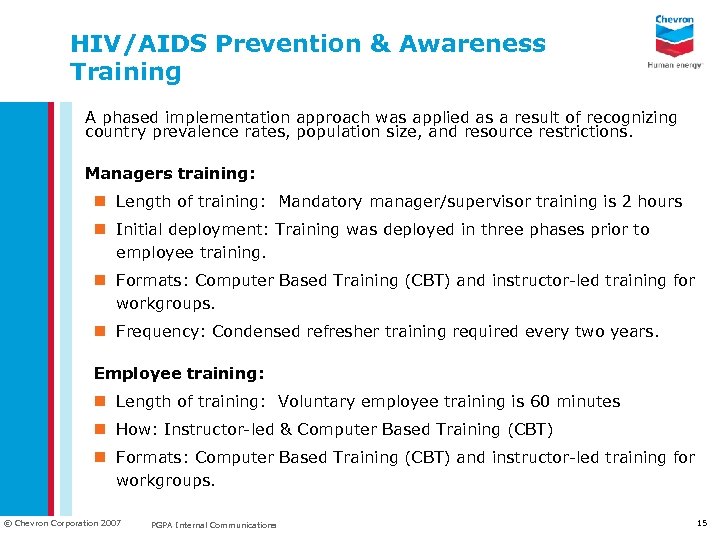
HIV/AIDS Prevention & Awareness Training A phased implementation approach was applied as a result of recognizing country prevalence rates, population size, and resource restrictions. Managers training: n Length of training: Mandatory manager/supervisor training is 2 hours n Initial deployment: Training was deployed in three phases prior to employee training. n Formats: Computer Based Training (CBT) and instructor-led training for workgroups. n Frequency: Condensed refresher training required every two years. Employee training: n Length of training: Voluntary employee training is 60 minutes n How: Instructor-led & Computer Based Training (CBT) n Formats: Computer Based Training (CBT) and instructor-led training for workgroups. © Chevron Corporation 2007 PGPA Internal Communications 15
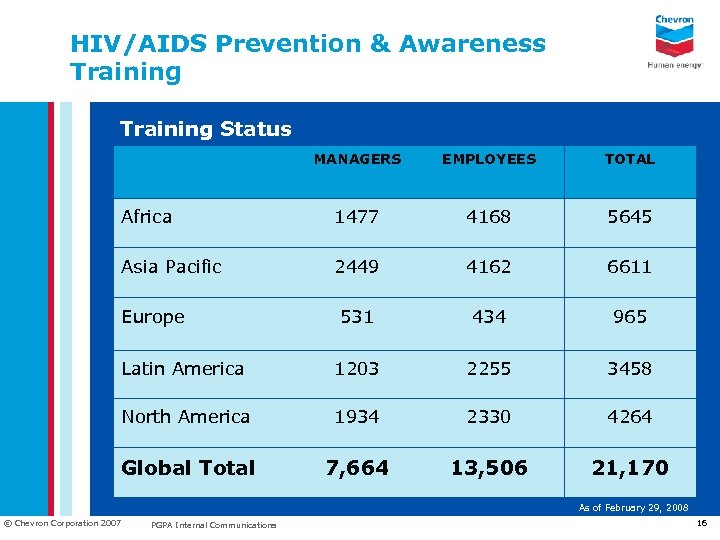
HIV/AIDS Prevention & Awareness Training Status MANAGERS EMPLOYEES TOTAL Africa 1477 4168 5645 Asia Pacific 2449 4162 6611 531 434 965 Latin America 1203 2255 3458 North America 1934 2330 4264 Global Total 7, 664 13, 506 21, 170 Europe As of February 29, 2008 © Chevron Corporation 2007 PGPA Internal Communications 16
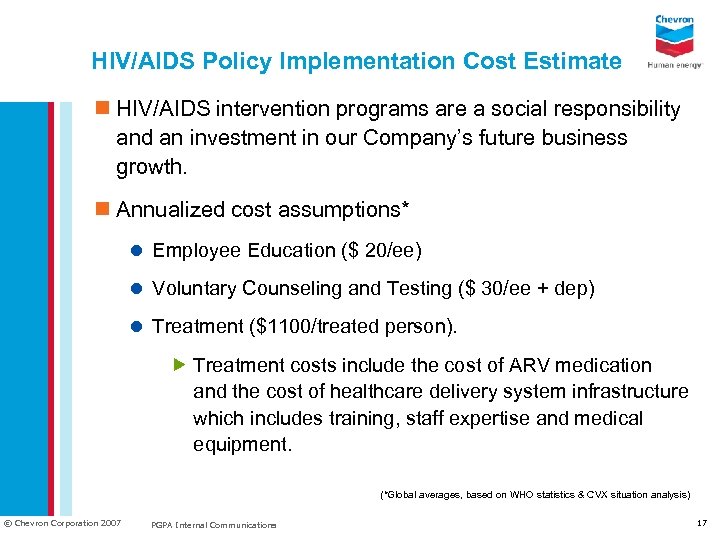
HIV/AIDS Policy Implementation Cost Estimate n HIV/AIDS intervention programs are a social responsibility and an investment in our Company’s future business growth. n Annualized cost assumptions* l Employee Education ($ 20/ee) l Voluntary Counseling and Testing ($ 30/ee + dep) l Treatment ($1100/treated person). Treatment costs include the cost of ARV medication and the cost of healthcare delivery system infrastructure which includes training, staff expertise and medical equipment. (*Global averages, based on WHO statistics & CVX situation analysis) © Chevron Corporation 2007 PGPA Internal Communications 17
Partnerships • We currently have developed partnerships with 75 NGOs (including Positive Action as Work, Kitzpositive, Malaysian AIDS Foundation, CARE Cambodia, Thailand Business Coalition on AIDS, SMARTWork Vietnam, UNICEF, Australian Red Cross, Sociedade Viva Cazuza, Action SIDA Martinique, SF AIDS Foundation, Shanti and many others). • We have partnered and are partnering with almost 30 Corporations in Africa, Latin America, Asia Pacific and North America (including Standard Bank, British American Tobacco, Shell, SAB Miller, De Beers, Anglo, Kraft, IBM and Procter & Gamble among others). • We are part of a consortium of corporations through the Harvard Kennedy School for Business and Government/CSR Initiative , including General Motors, Coca-Cola, Abbott Laboratories, Pfizer, Bristol Meyers Squibb. • We have been working in partnership with Pangaea Global AIDS Foundation to develop the Manager and Employee Training as well as Testing and Treatment Guidelines for Chevron’s Global Physicians. • In addition, we partner with the Global Business Coalition on HIV/AIDS as well as the Corporate Council on Africa HIV/AIDS Working Group © Chevron Corporation 2007 PGPA Internal Communications 18
Appendix n Supporting material n GBC material © Chevron Corporation 2007 PGPA Internal Communications 5/22/07
Partners (partial list) n Global Business Coalition (including Transatlantic Partners Against AIDS) n Populations Services International n Pangaea Global AIDS Foundation/San Francisco AIDS Foundation n UNAIDS & UNDP n Coca Cola n Desmond Tutu HIV Foundation (South Africa) n Thailand Business Coalition on AIDS (South East Asia) n Family Health International (South East Asia) n People. Management (Southern Africa) n Smart. Works (Vietnam) n ADIRA (Southern Africa) © Chevron Corporation 2007 PGPA Internal Communications 20
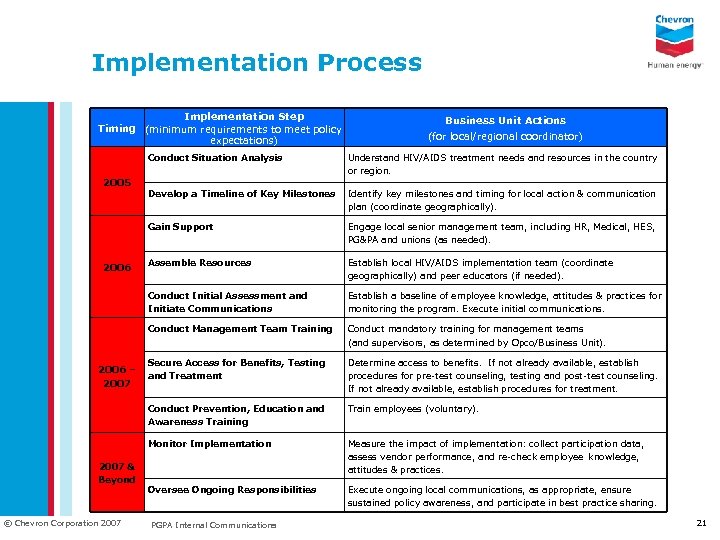
Implementation Process Implementation Step Timing (minimum requirements to meet policy expectations) Business Unit Actions (for local/regional coordinator) Conduct Situation Analysis Identify key milestones and timing for local action & communication plan (coordinate geographically). Engage local senior management team, including HR, Medical, HES, PG&PA and unions (as needed). Assemble Resources Establish local HIV/AIDS implementation team (coordinate geographically) and peer educators (if needed). Conduct Initial Assessment and Initiate Communications Establish a baseline of employee knowledge, attitudes & practices for monitoring the program. Execute initial communications. Conduct Management Team Training 2006 Develop a Timeline of Key Milestones Gain Support 2005 Understand HIV/AIDS treatment needs and resources in the country or region. Conduct mandatory training for management teams (and supervisors, as determined by Opco/Business Unit). © Chevron Corporation 2007 Determine access to benefits. If not already available, establish procedures for pre-test counseling, testing and post-test counseling. If not already available, establish procedures for treatment. Train employees (voluntary). Monitor Implementation 2007 & Beyond Secure Access for Benefits, Testing and Treatment Conduct Prevention, Education and Awareness Training 2006 – 2007 Measure the impact of implementation: collect participation data, assess vendor performance, and re-check employee knowledge, attitudes & practices. Oversee Ongoing Responsibilities Execute ongoing local communications, as appropriate, ensure sustained policy awareness, and participate in best practice sharing. PGPA Internal Communications 21
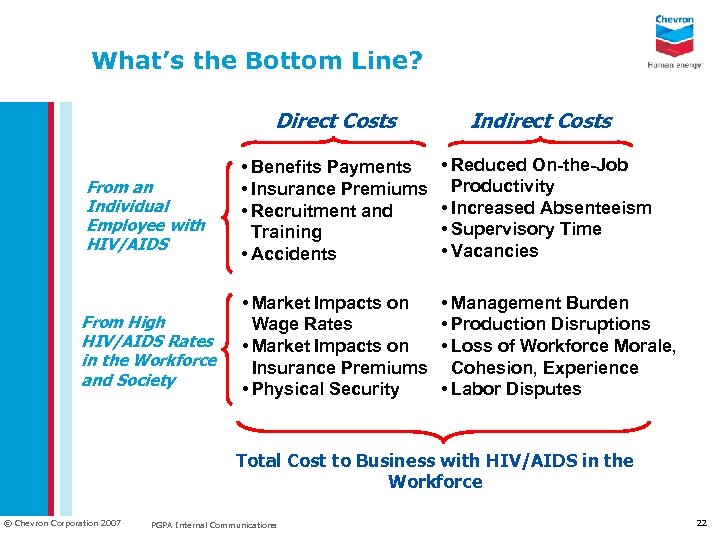
What’s the Bottom Line? Direct Costs Indirect Costs From an Individual Employee with HIV/AIDS • Benefits Payments • Insurance Premiums • Recruitment and Training • Accidents • Reduced On-the-Job Productivity • Increased Absenteeism • Supervisory Time • Vacancies From High HIV/AIDS Rates in the Workforce and Society • Market Impacts on Wage Rates • Market Impacts on Insurance Premiums • Physical Security • Management Burden • Production Disruptions • Loss of Workforce Morale, Cohesion, Experience • Labor Disputes Total Cost to Business with HIV/AIDS in the Workforce © Chevron Corporation 2007 PGPA Internal Communications 22
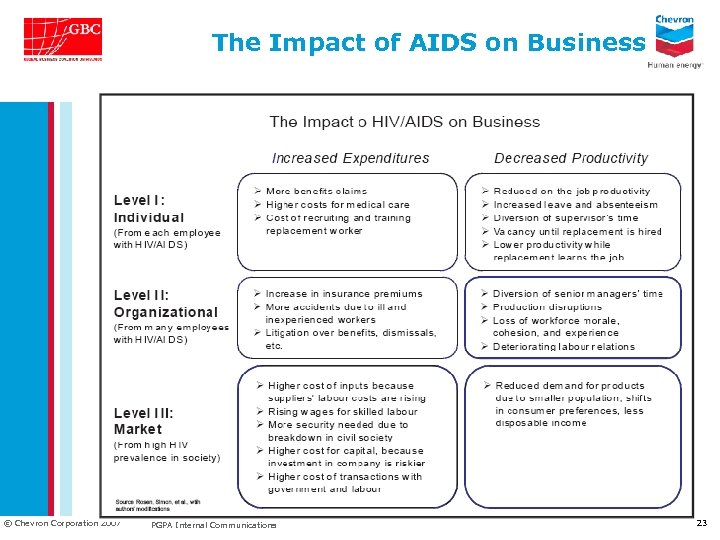
The Impact of AIDS on Business © Chevron Corporation 2007 PGPA Internal Communications 23
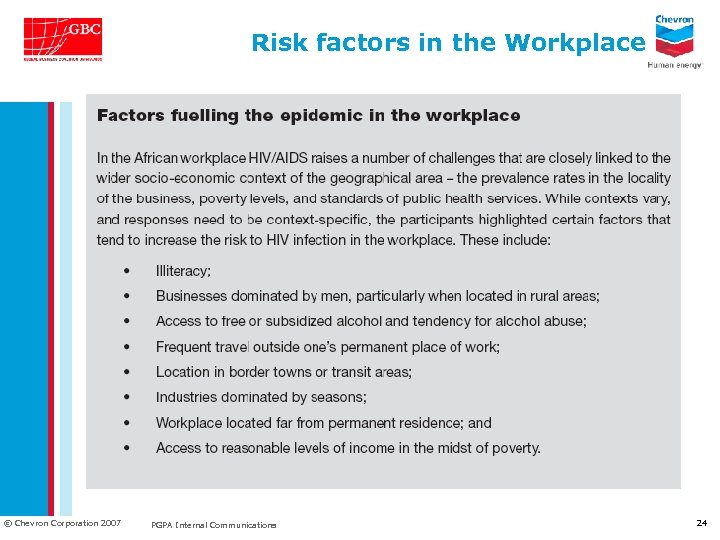
Risk factors in the Workplace © Chevron Corporation 2007 PGPA Internal Communications 24
Public Opinion GBC Survey: US Consumer Attitudes towards Business and AIDS Survey Results: Ø 96% of consumers surveyed feel that AIDS is a serious issue. Ø 71% of individuals surveyed believe that companies should be “actively” involved in fighting AIDS. Ø 67% of consumers surveyed would pay more for a brand “if they knew that the extra money was going specifically to a program to fight AIDS. ” © Chevron Corporation 2007 PGPA Internal Communications 25
Corporate Responsibility Through business operations, companies impact communities – for heavy industries: • Increase in economic activity, employment and construction (in remote locations) • Migrant workforce, social disruption, altered population dynamics (new production facilities, refineries etc. ) • Transport of goods and materials (trucking routes) © Chevron Corporation 2007 PGPA Internal Communications 26
Скачать презентацию HIV AIDS Global Policy Training Program Ernesto De
17b870dc605946dbe0e66cd9e8bd349d.ppt