


 Скачать презентацию HIT Design for Teamwork and Communication Unit 5
d1f79400d1c725bb24025298936f8a44.ppt
- Количество слайдов: 25
 HIT Design for Teamwork and Communication Unit 5 c: Tools to Enhance Communication and Care Coordination. This material was developed by Johns Hopkins University, funded by the Department of Health and Human Services, Office of the National Coordinator for Health Information Technology under Award Number IU 24 OC 000013.
 Objective • Describe ways in which HIT design can enhance communication and care coordination. Component 12/Unit 5 Health IT Workforce Curriculum 2. 0/Spring 2011 Version 2
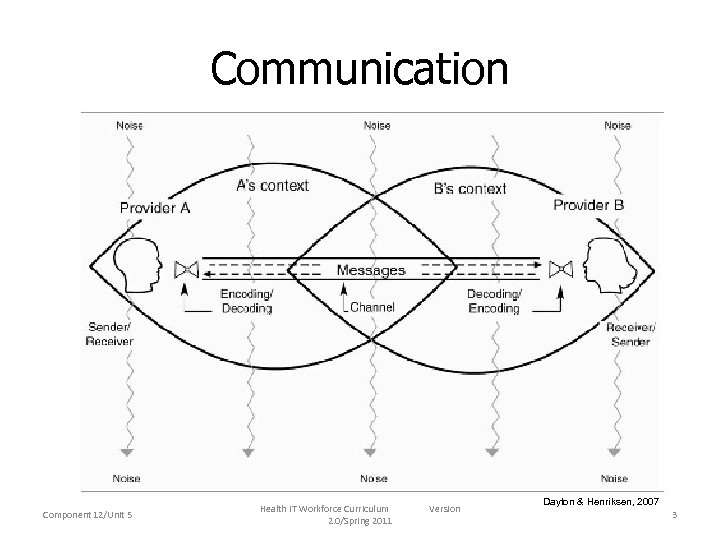 Communication Component 12/Unit 5 Health IT Workforce Curriculum 2. 0/Spring 2011 Version Dayton & Henriksen, 2007 3
 Communication Failure A major contributor to adverse events in health care! Component 12/Unit 5 Health IT Workforce Curriculum 2. 0/Spring 2011 Version 4
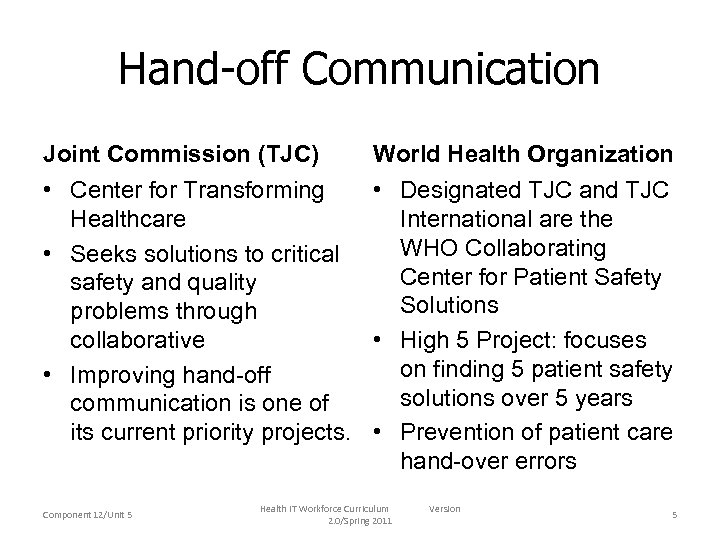 Hand-off Communication Joint Commission (TJC) World Health Organization • Center for Transforming • Designated TJC and TJC Healthcare International are the WHO Collaborating • Seeks solutions to critical Center for Patient Safety safety and quality Solutions problems through collaborative • High 5 Project: focuses on finding 5 patient safety • Improving hand-off solutions over 5 years communication is one of its current priority projects. • Prevention of patient care hand-over errors Component 12/Unit 5 Health IT Workforce Curriculum 2. 0/Spring 2011 Version 5
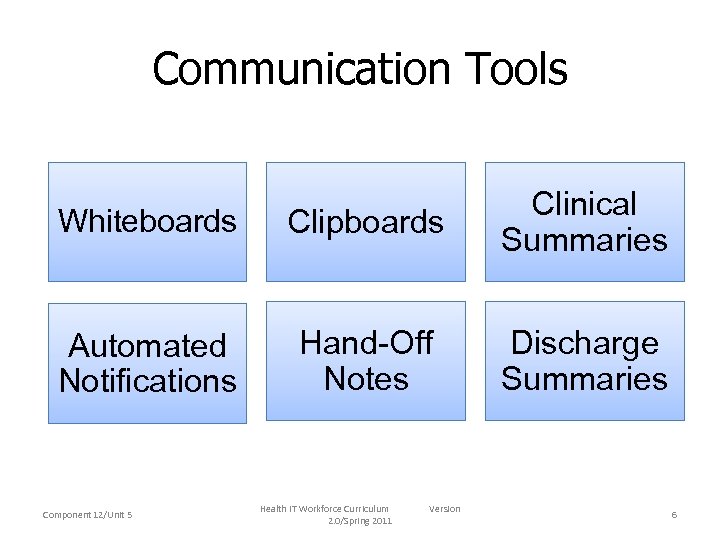 Communication Tools Whiteboards Clipboards Clinical Summaries Automated Notifications Hand-Off Notes Discharge Summaries Component 12/Unit 5 Health IT Workforce Curriculum 2. 0/Spring 2011 Version 6
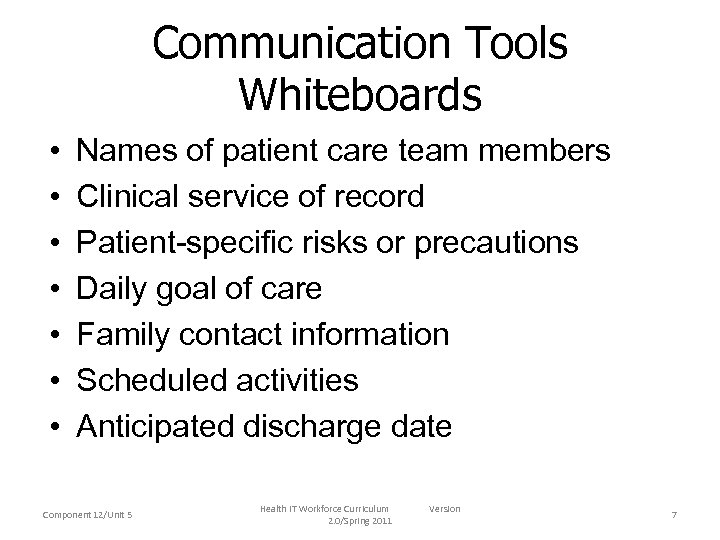 Communication Tools Whiteboards • • Names of patient care team members Clinical service of record Patient-specific risks or precautions Daily goal of care Family contact information Scheduled activities Anticipated discharge date Component 12/Unit 5 Health IT Workforce Curriculum 2. 0/Spring 2011 Version 7
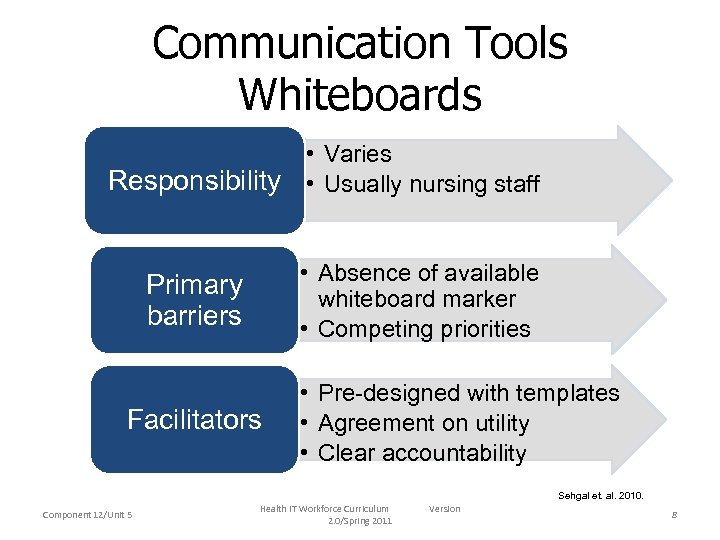 Communication Tools Whiteboards Responsibility • Varies • Usually nursing staff Primary barriers • Absence of available whiteboard marker • Competing priorities Facilitators • Pre-designed with templates • Agreement on utility • Clear accountability Sehgal et. al. 2010. Component 12/Unit 5 Health IT Workforce Curriculum 2. 0/Spring 2011 Version 8
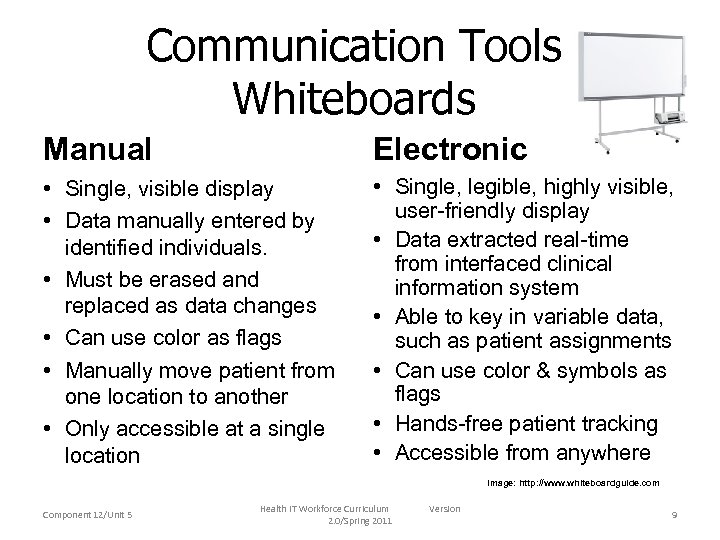 Communication Tools Whiteboards Manual Electronic • Single, visible display • Data manually entered by identified individuals. • Must be erased and replaced as data changes • Can use color as flags • Manually move patient from one location to another • Only accessible at a single location • Single, legible, highly visible, user-friendly display • Data extracted real-time from interfaced clinical information system • Able to key in variable data, such as patient assignments • Can use color & symbols as flags • Hands-free patient tracking • Accessible from anywhere Image: http: //www. whiteboardguide. com Component 12/Unit 5 Health IT Workforce Curriculum 2. 0/Spring 2011 Version 9
 Communication Tools “Clipboard” Tools • Paper-based • May be entirely manual or print-out from EHR • Single data source • Multiple data sources • Print-outs may require whitening-out or crossing-out non-essential items • Manual forms may entail bundling (organizing pieces of information and taping them together) • Both can require annotating Image: http: //www. bleachernation. com Component 12/Unit 5 Health IT Workforce Curriculum 2. 0/Spring 2011 Version 10
 Communication Tools Clinical Summary Tools • Electronic; designed to be viewed on-line • Facilitate communication, discussion, planning • Provider-Provider • Team-Team • Facility-Facility • Pull clinical data into one view • • Vital signs (high, low, most current, ranges) Significant events, problems, allergies, medications Daily goals, progress toward outcomes Other patient-specific information Component 12/Unit 5 Health IT Workforce Curriculum 2. 0/Spring 2011 Version 11
 Communication Tools Automated Notifications • Facilitate human-computer interaction • Examples: • Electronic referral requests (criteria-based) • Electronic communication of abnormal diagnostic test results (alert notifications) • Prescription transmission (provider-to-pharmacy transmission) through provider order entry • Researchers use multiple qualitative methods to analyze tasks • Are new error sources introduced by these tools? Component 12/Unit 5 Health IT Workforce Curriculum 2. 0/Spring 2011 Version 12
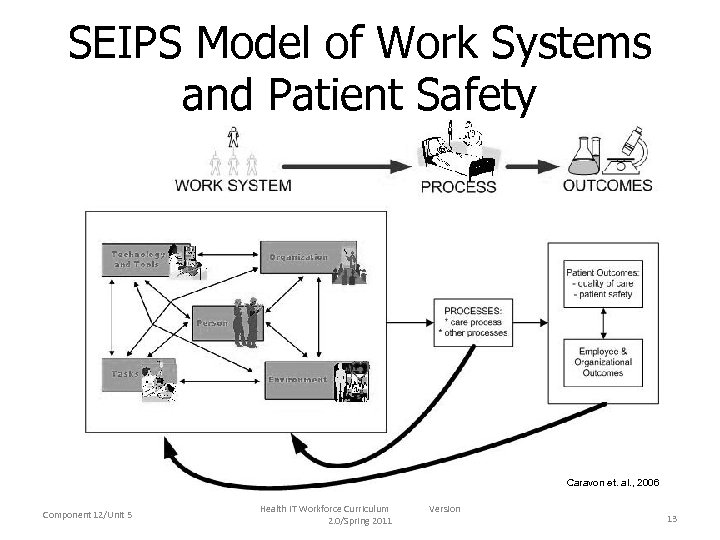 SEIPS Model of Work Systems and Patient Safety Caravon et. al. , 2006 Component 12/Unit 5 Health IT Workforce Curriculum 2. 0/Spring 2011 Version 13
 Communication Tools Automatic Notification • Maintenance of critical information in longitudinal record with automatic data transfer to latest encounter record • Automatic flag and link sent to latest encounter record to indicate presence of patient information in longitudinal record Component 12/Unit 5 Health IT Workforce Curriculum 2. 0/Spring 2011 Version 14
 Communication Tools Hand-Off Notes • Provide structured content and process for all types of hand-offs • Shift-to-shift • Cross-coverage • Lunch/break coverage • Can pull relevant data to a summary note, and add to-do section for immediate needs. Component 12/Unit 5 Health IT Workforce Curriculum 2. 0/Spring 2011 Version 15
 Communication Tools Discharge Summaries • Provide structured content & process for discharges • Electronic summaries can be automatically faxed to post-discharge providers/agencies • Discharge worksheets can be designed to populate patient discharge instructions in patient-friendly language, including the new Home Medication List Component 12/Unit 5 Health IT Workforce Curriculum 2. 0/Spring 2011 Version 16
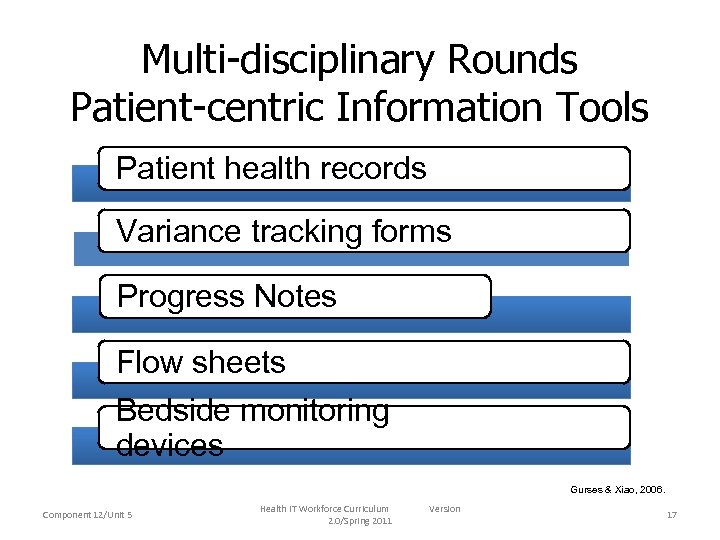 Multi-disciplinary Rounds Patient-centric Information Tools Patient health records Variance tracking forms Progress Notes Flow sheets Bedside monitoring devices Gurses & Xiao, 2006. Component 12/Unit 5 Health IT Workforce Curriculum 2. 0/Spring 2011 Version 17
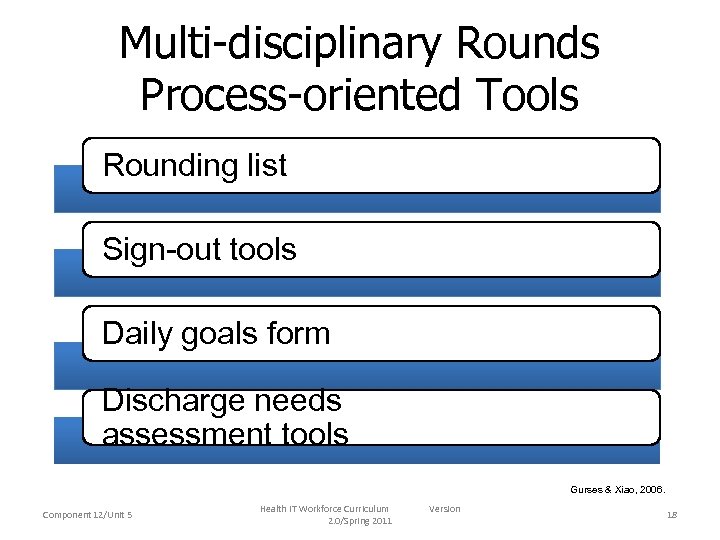 Multi-disciplinary Rounds Process-oriented Tools Rounding list Sign-out tools Daily goals form Discharge needs assessment tools Gurses & Xiao, 2006. Component 12/Unit 5 Health IT Workforce Curriculum 2. 0/Spring 2011 Version 18
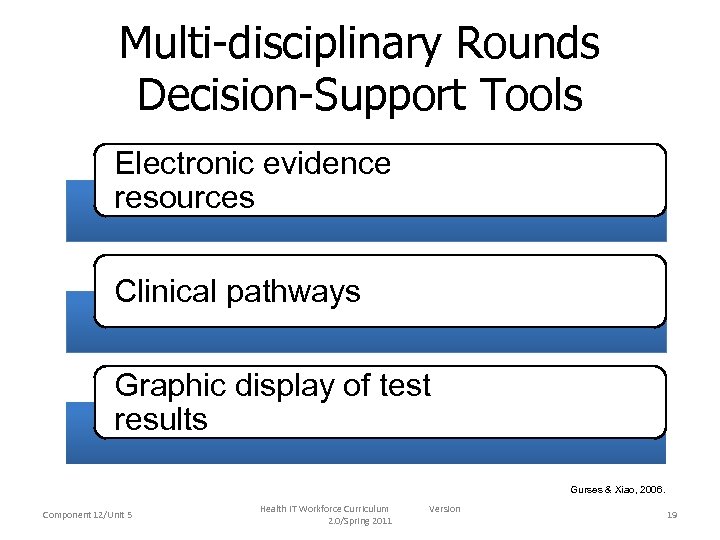 Multi-disciplinary Rounds Decision-Support Tools Electronic evidence resources Clinical pathways Graphic display of test results Gurses & Xiao, 2006. Component 12/Unit 5 Health IT Workforce Curriculum 2. 0/Spring 2011 Version 19
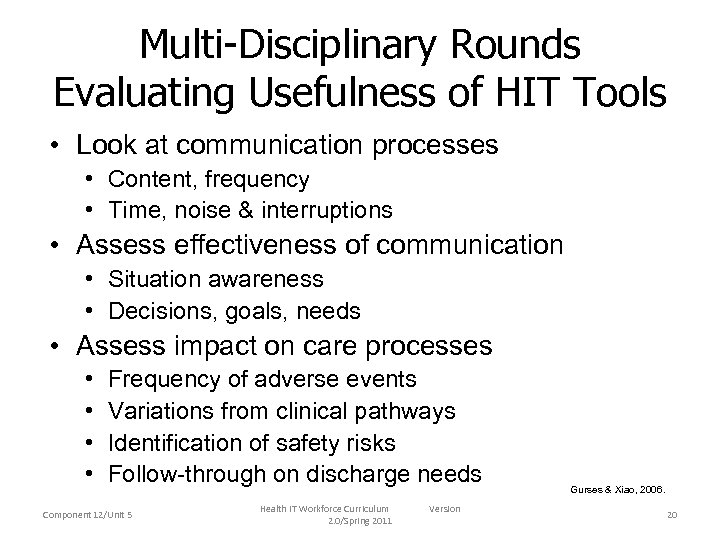 Multi-Disciplinary Rounds Evaluating Usefulness of HIT Tools • Look at communication processes • Content, frequency • Time, noise & interruptions • Assess effectiveness of communication • Situation awareness • Decisions, goals, needs • Assess impact on care processes • • Frequency of adverse events Variations from clinical pathways Identification of safety risks Follow-through on discharge needs Component 12/Unit 5 Health IT Workforce Curriculum 2. 0/Spring 2011 Version Gurses & Xiao, 2006. 20
 Summary • Effective communication is a necessary prerequisite to improving care coordination • Highest risk of ineffective communication occurs during hand-off & transitions of care • Health IT can both enhance & hinder effective communication & care coordination • HIT professionals are instrumental in implementing information & communication technologies to support interdisciplinary care coordination Component 12/Unit 5 Health IT Workforce Curriculum 2. 0/Spring 2011 Version 21
 References • Anderson J. Evaluation in health informatics: social network analysis. Computers in Biology and Medicine. 2002; 32: 179 -193. • Abraham J, Reddy MC. Challenges to inter-departmental coordination of patient transfers: a workflow perspective. Int J Med Inform. 2010 Feb; 79(2): 112 -22. Epub 2009 Dec 14. • AHRQ & Department of Defense. Team. STEPPS. 2006. • Apker J, Mallak LA, Applegate EB, Gibson SC, Ham JJ, Johnson NA, Street RL. Exploring emergency physician-hospitalist handoff interactions: development of the handoff communication assessment. Annals of Emergency Medicine. 2010; 55(2); 161 -170 • Austin JL. How to do things with words. Oxford University Press: England. 1962 • Benham-Hutkins MM, Effken J. Multi-professional patterns and methods of communication during patient handoffs. International Journal of Medical Informatics. 2010; 79(4): 252 -267. Component 12/Unit 5 Health IT Workforce Curriculum 2. 0/Spring 2011 Version 22
 References • • • Carayon P, Hundt AS, Karsh B-T, Gurses AP, Alvarado CJ, Smith M, Brennan PF. Work System Design for Patient Safety: The SEIPS Model. Quality & Safety in Health Care. 2006; 15(1): i 50 -i 58. Dayton E, Henriksen K. Communication failure: basic components, contributing factors, and the call for structure. Joint Commission Journal on Quality and Patient Safety. 2007; 33(1): 34 -47. Edwards A. Fitzpatrick LA, Augustine S, Trzebucki A, Cheng SL, Presseau C, Mersmann C, Heckmann B, Kachnowski S. Int J. Med Infrom. 2009 Sep; 78(9): 629 -37. Epub 2009 May 23. Gurses AP. A systematic review of the literature on Multidisciplinary rounds to design information technology. Journal of the American Medical Informatics Association. 2006; 13(3): 267 -276. Hysong, S. J. , Sawhney, M. K. , Wilson, L. , Sittig, D. F. , Esquivel, A. , Watford, M. , Davis, T. , Espades, D. , & Singh, H. (2009). Improving outpatient safety through effective electronic communications: a study protocol. Implementation Science, 4: 62 Component 12/Unit 5 Health IT Workforce Curriculum 2. 0/Spring 2011 Version 23
 References • Kripalani S, Le. Fevre F, Phillips CO, Williams MV, Basaviah P, Baker DW. Deficits in communication and information transfer between hospital-based and primary care physicians. Implications for patient safety and continuity of care. JAMA. 2007; 297(8): 831 -841. • Medsphere. org Openvisita. c 2009 -2010. Available from: http: //medsphere. org/plugins/screenshots/resources/screenshots/ope nvista-cis-patient-summary. png • O’Malley AS, Grossman JM, Cohen GR, Kemper NM, Pham HH. Are electronic medical records helpful for care coordination? Experiences of physician practices. J Gen Intern Med 2010; 25(3): 177 -185 • Riesenberg LA, Leitzsch J, Massucci JL, Jaeger J, Rosenfeld JC, Patow C, Padmore JS, Karpovich KP. Residents’ and attending physicians’ handoffs: a systematic review of the literature. Academic Medicine. 2009; 84(12): 1775 -1787. Component 12/Unit 5 Health IT Workforce Curriculum 2. 0/Spring 2011 Version 24
 References • Sehgal NL, Green A, Vidyarthi AR, Blegen MA, Wachter RM. Patient whiteboards as a communication tool in the hospital setting: a survey of pracices and recommendaitons. Journal of Hospital Medicine. 2010; 5(4): 234 -239. • Sorby ID, Nytro O. Analysis of communicative behavior: profiling roles and activities. International Journal of Medical Informatics. 2010; 79(6): e 144 -e 151. Component 12/Unit 5 Health IT Workforce Curriculum 2. 0/Spring 2011 Version 25