


 Скачать презентацию History of Ukrainian Culture Lecturer Galyna Miasoid
lecture 1.ppt
- Количество слайдов: 17
 History of Ukrainian Culture Lecturer: Galyna Miasoid
 Lecture 1 Introduction to “History of Ukrainian Culture” course Lecturer: Galyna Miasoid
 The subject of the course “History of Ukrainian culture” is the culture of the Ukrainian people, as well as culture of its ancestors on the main lands of their settlement. The course studies various aspects: socioeconomic, political, cultural, and religious.
 Definitions of Culture l l from Latin “cultus”, which means adoration of Gods and ancestors something that provides us to the top, makes our level higher upbringing process, education, and development achievements of spiritual culture, scientific knowledge, arts, moral perfection, and all things related to education
 Culture Definition in 1982 Declaration of UNESCO l Culture is a complex of material, spiritual, intellectual and emotional characteristics of society that includes not only big variety of arts, but also way of life, the main rules of human being, system of values, traditions and beliefs
 “Artifacts” are non-material, synthetic things created by man All cultural things are created by human being
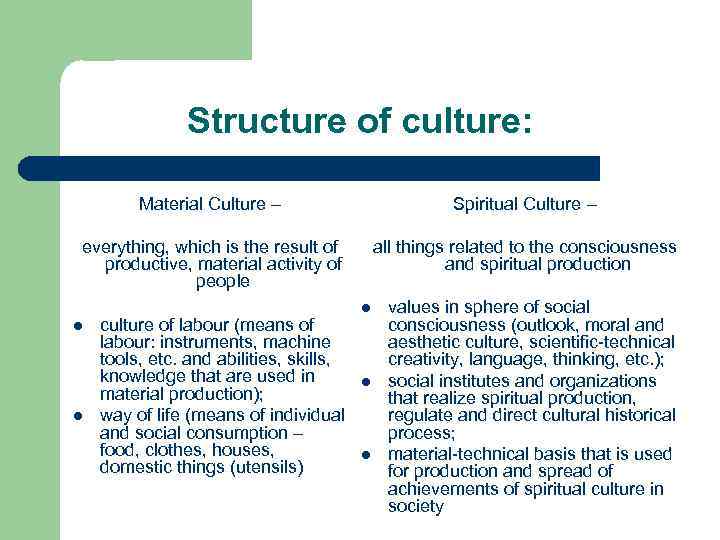 Structure of culture: Material Culture – Spiritual Culture – everything, which is the result of productive, material activity of people all things related to the consciousness and spiritual production l l culture of labour (means of labour: instruments, machine tools, etc. and abilities, skills, knowledge that are used in material production); way of life (means of individual and social consumption – food, clothes, houses, domestic things (utensils) l l l values in sphere of social consciousness (outlook, moral and aesthetic culture, scientific-technical creativity, language, thinking, etc. ); social institutes and organizations that realize spiritual production, regulate and direct cultural historical process; material-technical basis that is used for production and spread of achievements of spiritual culture in society
 Both material and spiritual cultures are the results of human activity l material production l is directed on satisfaction of material needs of people, on creation of “material body of culture”, material things spiritual production is the production of ideas, conceptions, experiences, scientific systems, norms and traditions of human existence
 Forms of culture: l l Elitist culture – is a form of culture, which products are available to a narrow circle of high society representatives (as it requires knowledge). Mass culture – the products of this form are available to a wide range of society. Basic culture – is a system of values, principles, ideals characteristic of the society. Subculture – is a system of symbols, beliefs, forms of thinking, values characteristic of a particular group people (for example, medical culture).
 Culture performs the following functions: l l l l 1. Adaptive (protective): Culture provides adaptation of a man and society to the environment. 2. Epistemological (cognitive): Culture contains the entire sum of human knowledge about the world and means of it practical application. 3. Informative (translational): Culture stores and transmits social experience. 4. Communicative: Culture provides the communication of people with each other (forming conditions and means of communication). 5. Normative (regulatory): Culture regulates behaviour of both social groups and individuals. 6. Integrative: Culture helps to bring people together into a state, a nation, communities etc. 7. Socializing: Culture links individuals to public life, contributes to social experience, social role, etc. assimilation by a certain society members. 8. Humanistic (man-making): Assimilating cultural standards, a man becomes more than a biological creature. In other words, only culture makes a person really a human.
 World culture is a mosaic of national cultures l Ukrainian culture is the part of world culture. Our culture has both Oriental and Occidental elements, but in spite of all influences it is deep, original and folk culture.
 Ukrainian culture vs Culture of Ukraine l Ukrainian culture is the result of creativity of all Ukrainians (even those groups and communities that live abroad) l Culture of Ukraine includes masterpieces of representatives of other nations and cultures, but they exist and were created on the territory of Ukraine or the Crimean peninsula
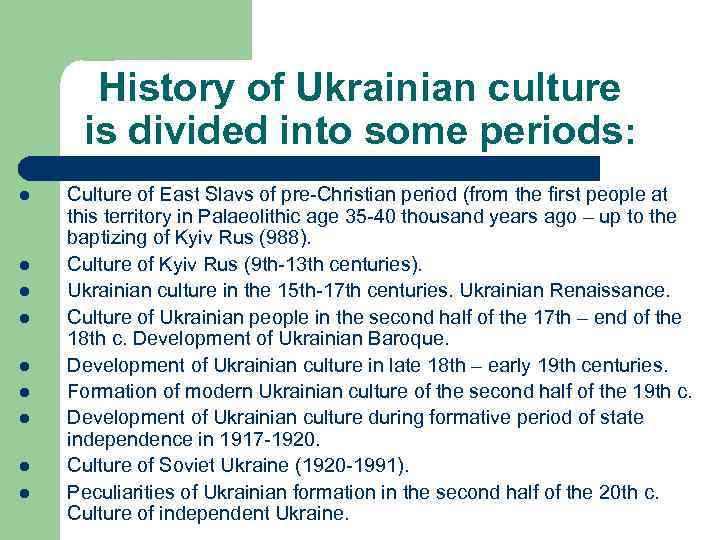 History of Ukrainian culture is divided into some periods: l l l l l Culture of East Slavs of pre-Christian period (from the first people at this territory in Palaeolithic age 35 -40 thousand years ago – up to the baptizing of Kyiv Rus (988). Culture of Kyiv Rus (9 th-13 th centuries). Ukrainian culture in the 15 th-17 th centuries. Ukrainian Renaissance. Culture of Ukrainian people in the second half of the 17 th – end of the 18 th c. Development of Ukrainian Baroque. Development of Ukrainian culture in late 18 th – early 19 th centuries. Formation of modern Ukrainian culture of the second half of the 19 th c. Development of Ukrainian culture during formative period of state independence in 1917 -1920. Culture of Soviet Ukraine (1920 -1991). Peculiarities of Ukrainian formation in the second half of the 20 th c. Culture of independent Ukraine.
 Lecture 1 Introduction to “History of Ukrainian Culture” course Lecturer: Galyna Miasoid
 Get ready to participate in the seminar. Study independently Prepare an oral or written report on the topics: l Subject and tasks of “History of Ukrainian Culture”. l Definition of culture. l Structure of culture. l Forms of culture. l Functions culture performs. l Place of culture in our life and society. l Ukrainian culture in a context of world culture (theme 1).
 Individual practical tasks on theme 1: Prepare synopses on the following topics: l Culture genesis. l Cultural shock. Prepare a Power. Point presentation of: l A student’s national culture. l Cultures of different regions of Ukraine. l Religion(s) of a student’s country.
 Thank you for your work! Next lecture theme: Sources of Ukrainian culture