



 HISTORY OF THE KAZAKHSTAN ARCHITECTURE Lecture 1
 Lecture 1. Ancient times 1. Main stages of development of Kazakhstan material culture 2. Geographical, cultural and historical regions of Kazakhstan 3. The most ancient monuments in the territory of Kazakhstan: - sites and caves; - settlements and dwellings; - memorial and cult constructions; - megaliths
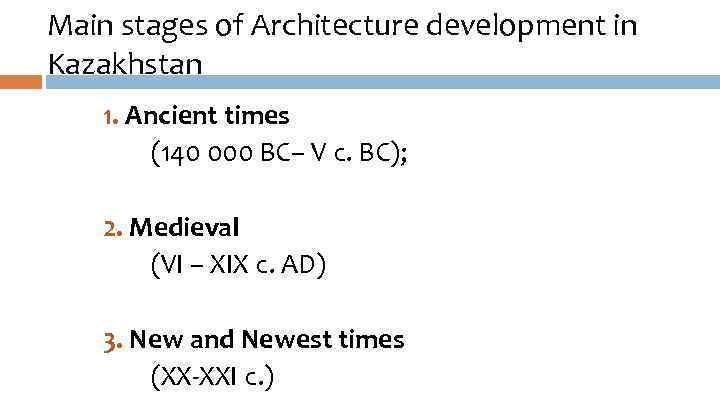 Main stages of Architecture development in Kazakhstan 1. Ancient times (140 000 BC– V c. BC); 2. Medieval (VI – XIX c. AD) 3. New and Newest times (XX-XXI c. )
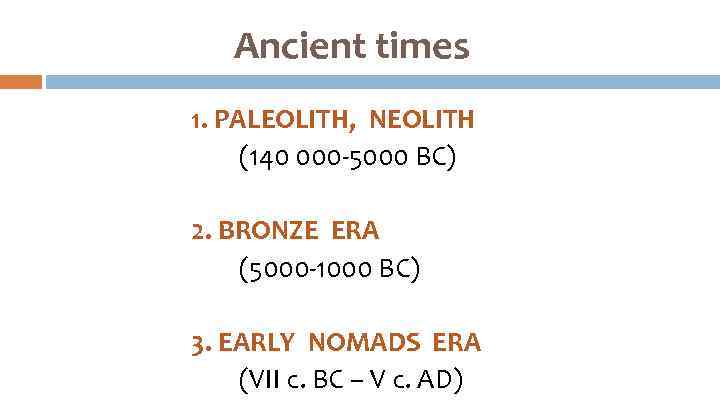 Ancient times 1. PALEOLITH, NEOLITH (140 000 -5000 BC) 2. BRONZE ERA (5000 -1000 BC) 3. EARLY NOMADS ERA (VII c. BC – V c. AD)
 Medieval times 1. 2. 3. 4. 5. Period of Turkic khaganates (VI-IX centuries); Karakhanid’s Era (X-XII centuries); The Mongolian period (XIII – 1 st part of the XV century); Period of the Kazakh khanates (2 nd part of the XV-XVIII centuries); Kazakhstan as a part of the Russian Empire (XIX – the head of the XX century);
 New and Newest times 1. Soviet period (ХХ c. ); 2. Independence period (since 1990).
 Geographical, cultural and historical regions – architectural schools of Kazakhstan 1. 2. 3. 4. Central and Northern Kazakhstan Eastern Kazakhstan Southern and Southeast Kazakhstan Western Kazakhstan
 Paleolithic monuments (140, 000 -40, 000 BC) The most ancient workshop Zhetykonyr Caves (Kazy-Kurt, Karatau, Bayan-Aul, Karkaraly, Ulytau (Central Kazakhstan); Bukhtarma, New and Nikolsky caves (Eastern Kazakhstan) Settlements Kanay (Eastern Kazakhstan), Kalkan (Southeast Kazakhstan).
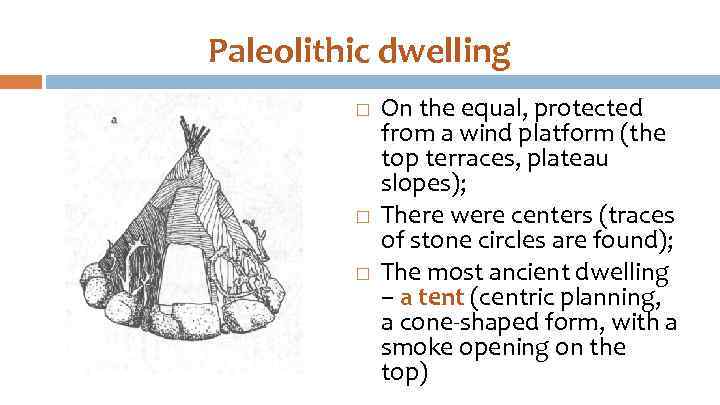 Paleolithic dwelling On the equal, protected from a wind platform (the top terraces, plateau slopes); There were centers (traces of stone circles are found); The most ancient dwelling – a tent (centric planning, a cone-shaped form, with a smoke opening on the top)
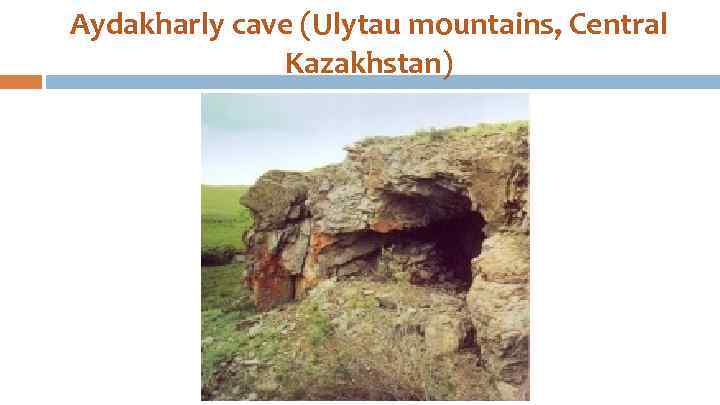 Aydakharly cave (Ulytau mountains, Central Kazakhstan)
 Neolithic monuments Types of Neolythic sites: Spring (Satchy-kyz, Eastern Kazakhstan region) River (Makhandzhar, Nothern Kazakhstan region) Lake (Shatpakol, Atyrau Region) Cave (Karaungur, Southern Kazakhstan region)
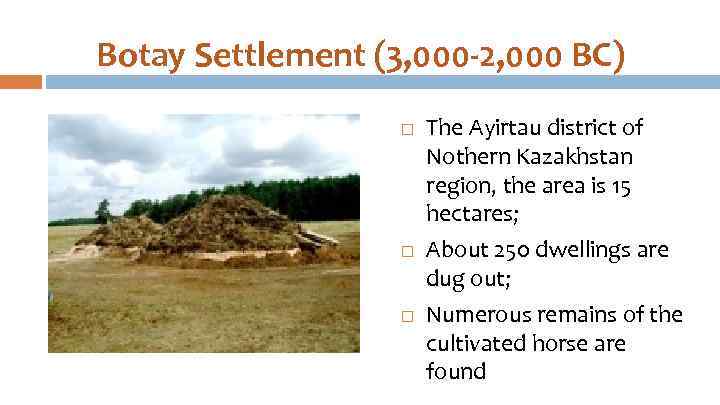 Botay Settlement (3, 000 -2, 000 BC) The Ayirtau district of Nothern Kazakhstan region, the area is 15 hectares; About 250 dwellings are dug out; Numerous remains of the cultivated horse are found
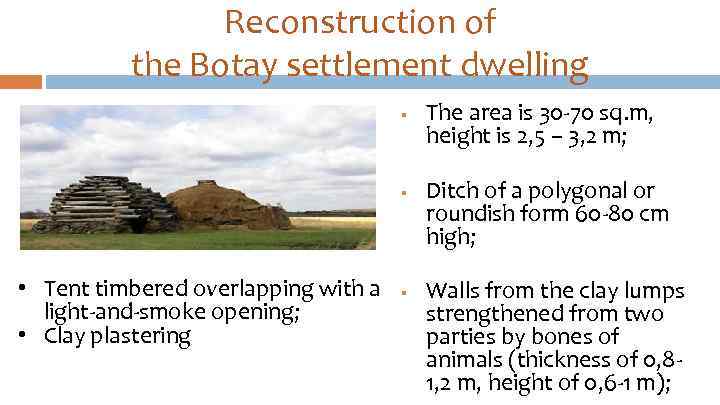 Reconstruction of the Botay settlement dwelling § § • Tent timbered overlapping with a light-and-smoke opening; • Clay plastering § The area is 30 -70 sq. m, height is 2, 5 – 3, 2 m; Ditch of a polygonal or roundish form 60 -80 cm high; Walls from the clay lumps strengthened from two parties by bones of animals (thickness of 0, 81, 2 m, height of 0, 6 -1 m);
 Settlements of Andronov culture (XVIII-XII c. BC) Alekseev settlement (Kostanay region); Sadchikov settlement (Kostanay region); Atasu settlement (Jana-Arka district of the Karaganda region); Settlements of Buguly 1, 2, 3; Akbauyr, Shortandy-Bulak, Senkebay (Shet district of the Karaganda region); Tagibay settlement (Bayan-Aul district). In total more than 60 settlements and 200 large burial grounds are revealed.
 Atasu settlement (XV-XII c. BC) The area is about 15 hectares; Has ring-shaped planning with an open central area; The remains of 35 structures are found (22 – inhabited semi-dugouts of 80 -250 sq. m); Rectangular and square planning of dwellings, some rooms are connected by underground corridors; Overlapping on wooden columns; 4 central columns bear a pyramidal-and-step tent.
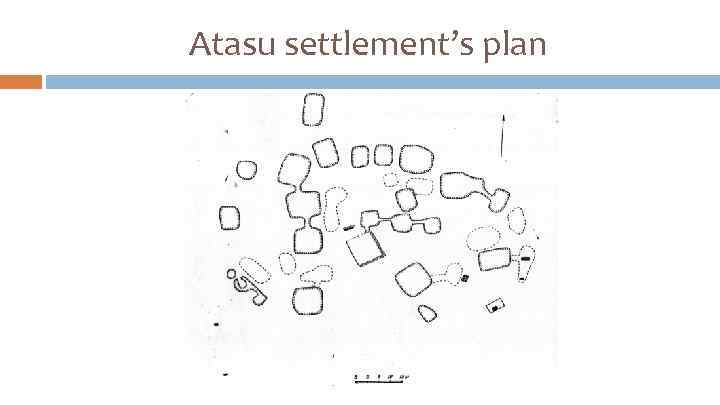 Atasu settlement’s plan
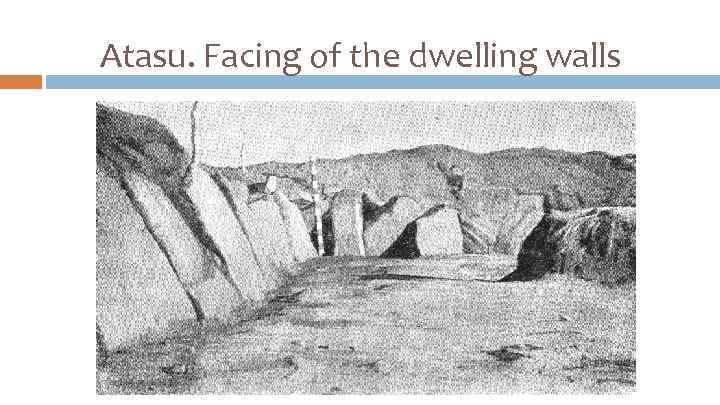 Atasu. Facing of the dwelling walls
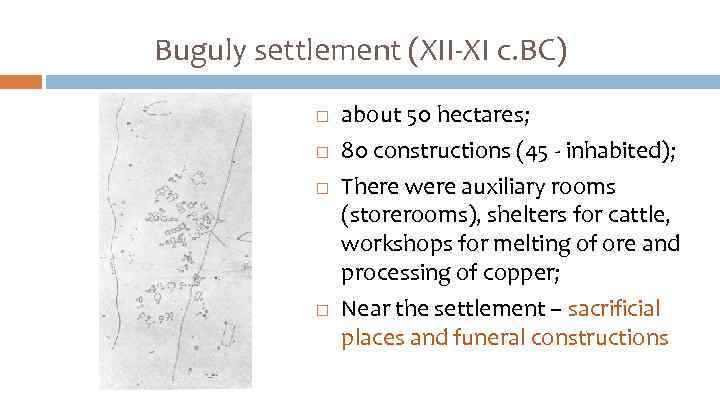 Buguly settlement (XII-XI c. BC) about 50 hectares; 80 constructions (45 - inhabited); There were auxiliary rooms (storerooms), shelters for cattle, workshops for melting of ore and processing of copper; Near the settlement – sacrificial places and funeral constructions
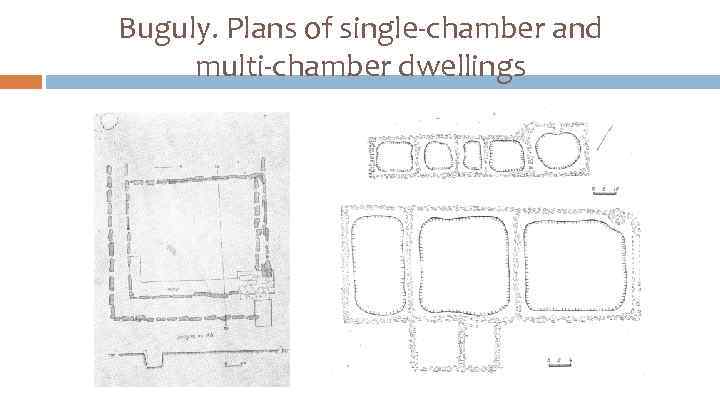 Buguly. Plans of single-chamber and multi-chamber dwellings
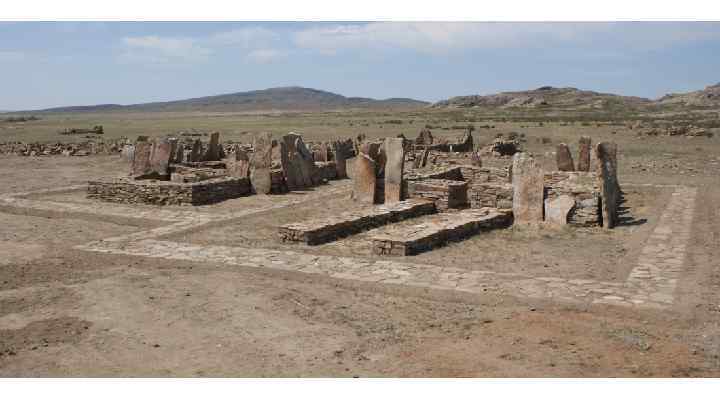
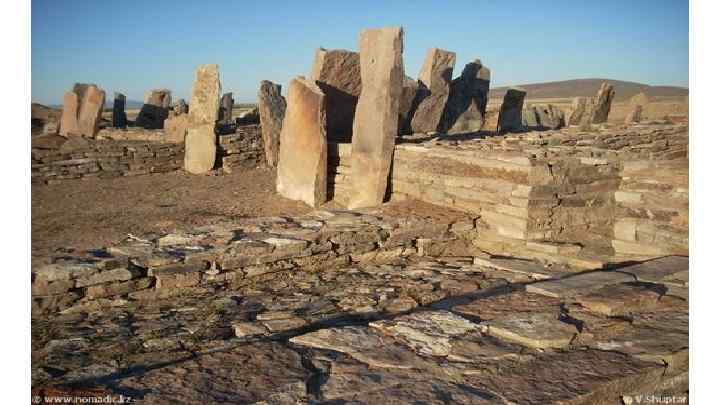
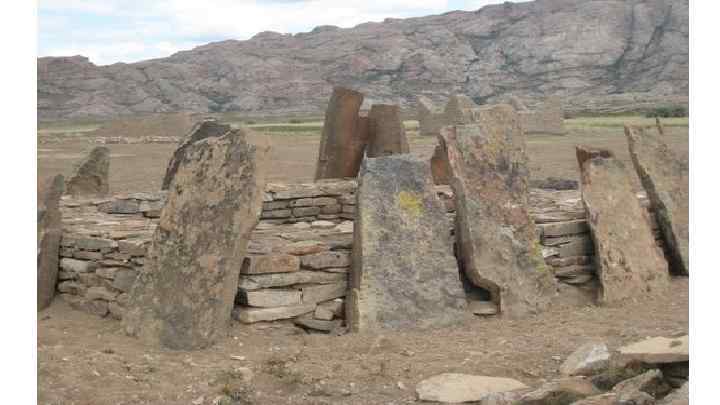
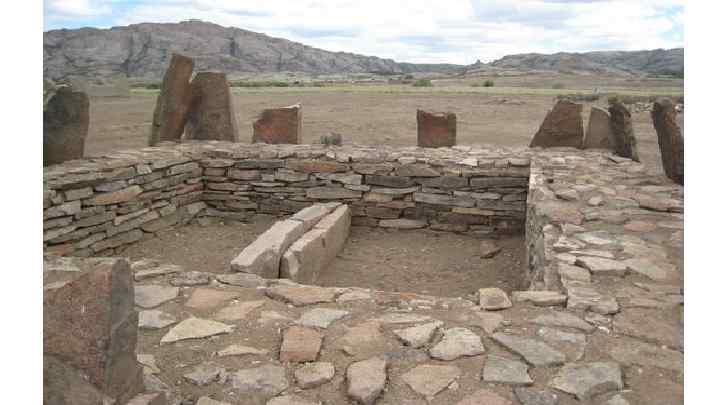
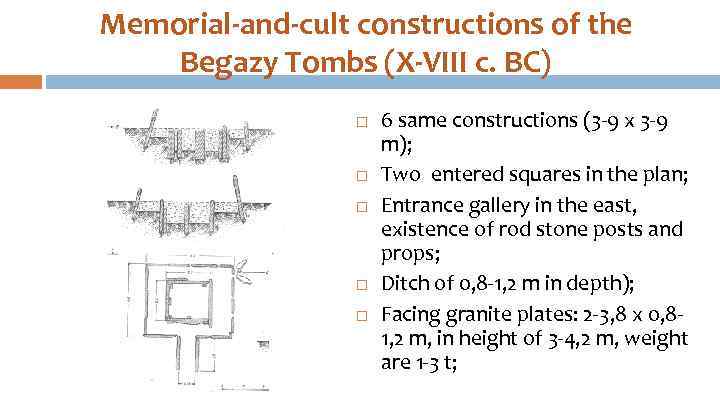 Memorial-and-cult constructions of the Begazy Tombs (X-VIII c. BC) 6 same constructions (3 -9 x 3 -9 m); Two entered squares in the plan; Entrance gallery in the east, existence of rod stone posts and props; Ditch of 0, 8 -1, 2 m in depth); Facing granite plates: 2 -3, 8 x 0, 81, 2 m, in height of 3 -4, 2 m, weight are 1 -3 t;
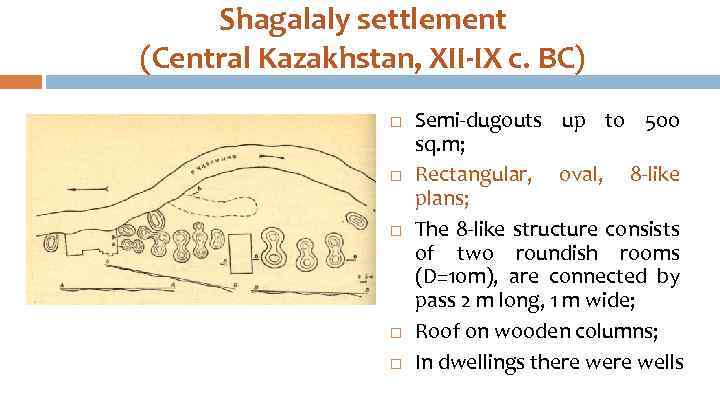 Shagalaly settlement (Central Kazakhstan, XII-IX c. BC) Semi-dugouts up to 500 sq. m; Rectangular, oval, 8 -like plans; The 8 -like structure consists of two roundish rooms (D=10 m), are connected by pass 2 m long, 1 m wide; Roof on wooden columns; In dwellings there wells
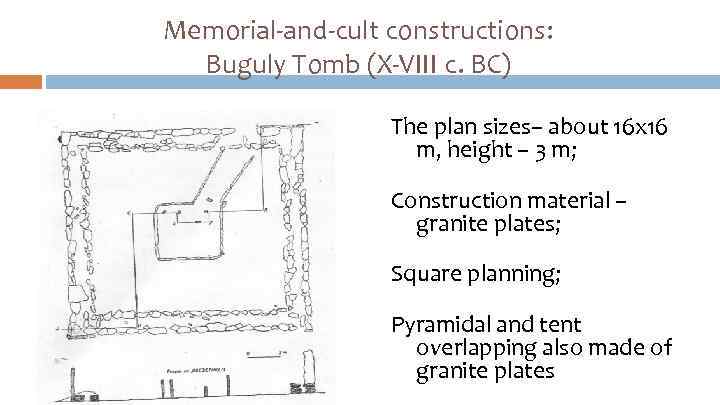 Memorial-and-cult constructions: Buguly Tomb (X-VIII c. BC) The plan sizes– about 16 х16 m, height – 3 m; Construction material – granite plates; Square planning; Pyramidal and tent overlapping also made of granite plates
 Megalithic structures Avenues of menhirs (the single: alyp-tas, dau-tas, bagana-tas, sym-tas; groups: korgan-tas, rope-tas); Kotan-tas – ring-shaped protections made of the big stone blocks with an embankment or without; Stone boxes Besik-tas; Dolmens (square or rectangular in the plan); Zist; Cromlechs and plate fencings.
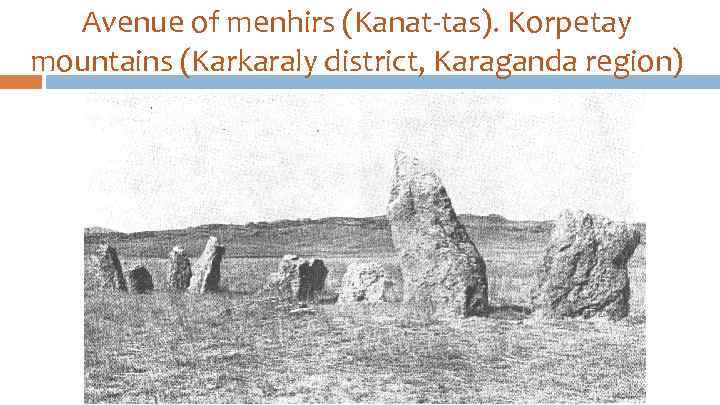 Avenue of menhirs (Kanat-tas). Korpetay mountains (Karkaraly district, Karaganda region)
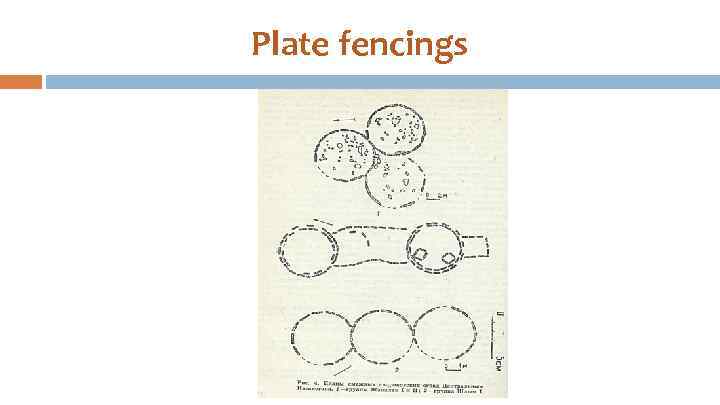 Plate fencings
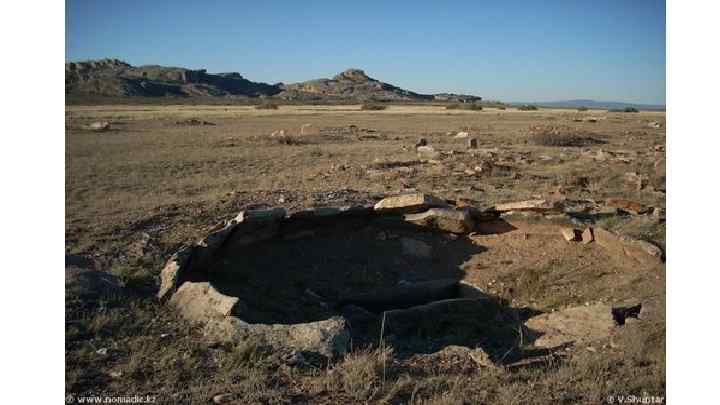
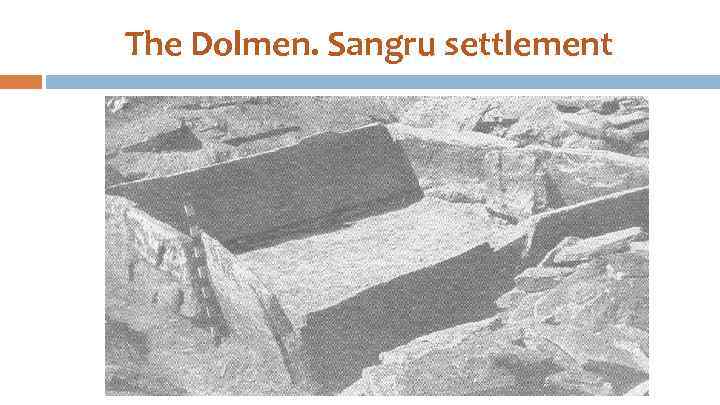 The Dolmen. Sangru settlement
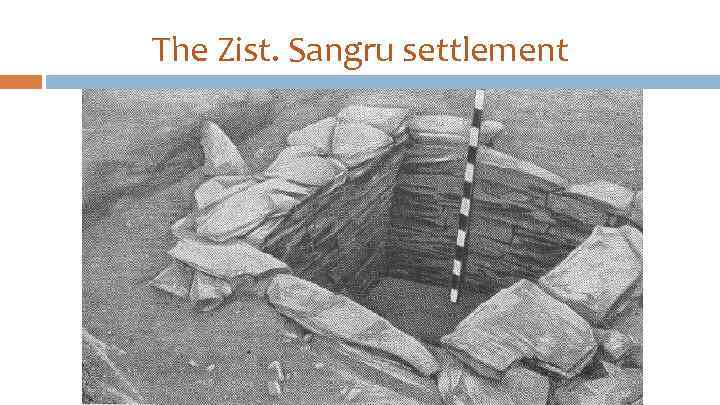 The Zist. Sangru settlement
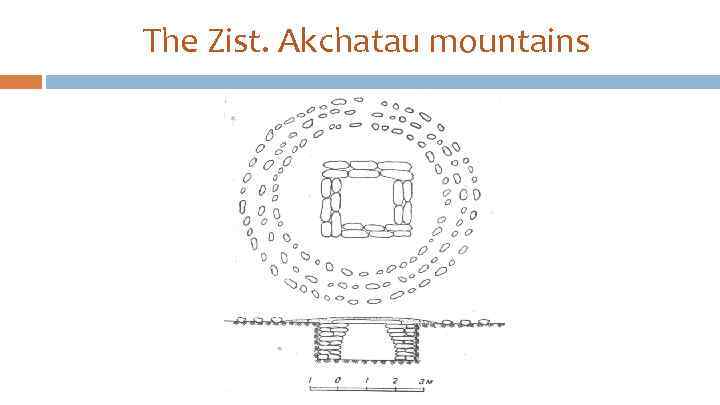 The Zist. Akchatau mountains
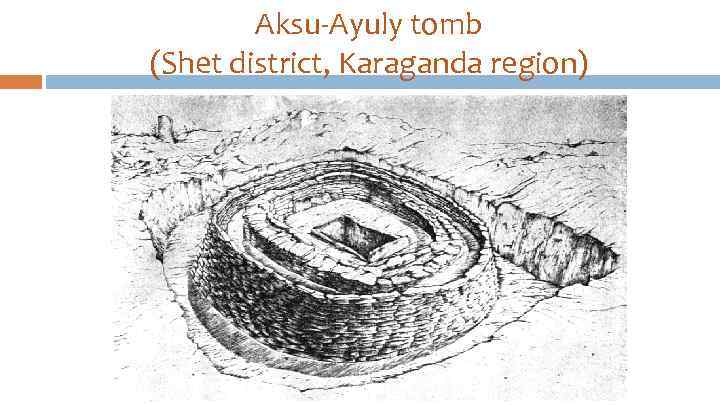 Aksu-Ayuly tomb (Shet district, Karaganda region)
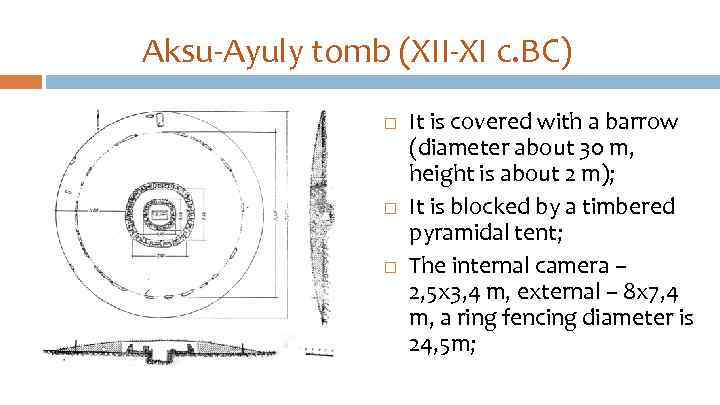 Aksu-Ayuly tomb (XII-XI c. BC) It is covered with a barrow (diameter about 30 m, height is about 2 m); It is blocked by a timbered pyramidal tent; The internal camera – 2, 5 х3, 4 m, external – 8 х7, 4 m, a ring fencing diameter is 24, 5 m;
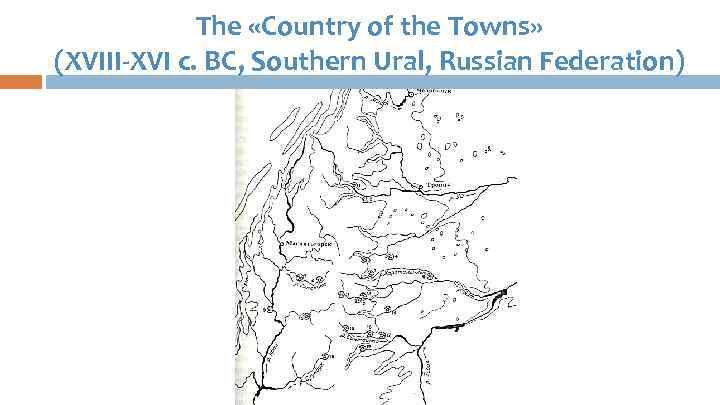 The «Country of the Towns» (XVIII-XVI c. BC, Southern Ural, Russian Federation)
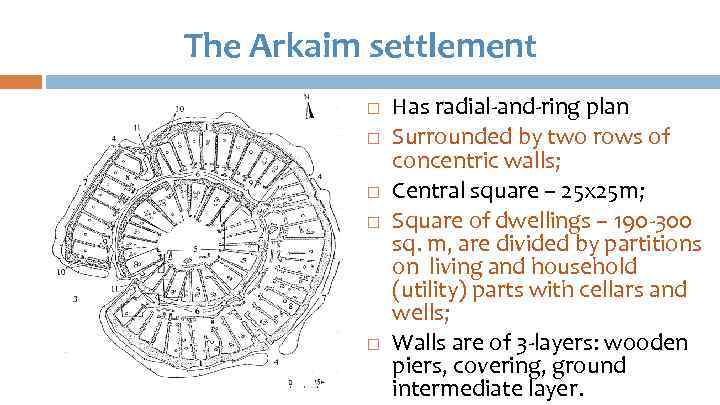 The Arkaim settlement Has radial-and-ring plan Surrounded by two rows of concentric walls; Central square – 25 x 25 m; Square of dwellings – 190 -300 sq. m, are divided by partitions on living and household (utility) parts with cellars and wells; Walls are of 3 -layers: wooden piers, covering, ground intermediate layer.
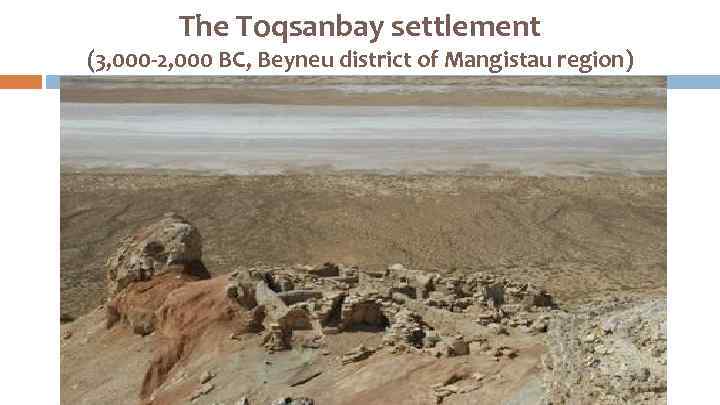 The Toqsanbay settlement (3, 000 -2, 000 BC, Beyneu district of Mangistau region)
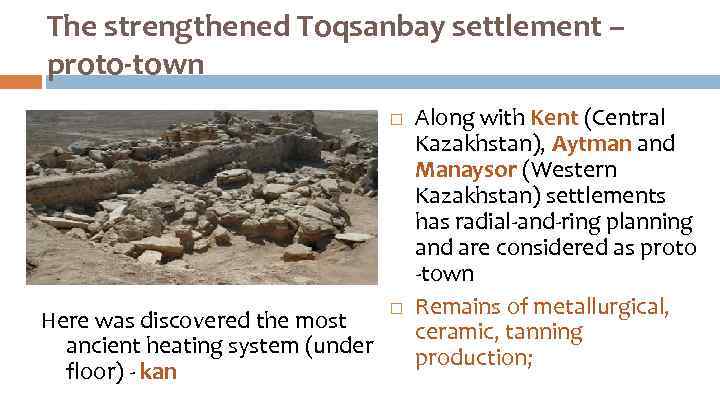 The strengthened Toqsanbay settlement – proto-town Here was discovered the most ancient heating system (under floor) - kan Along with Kent (Central Kazakhstan), Aytman and Manaysor (Western Kazakhstan) settlements has radial-and-ring planning and are considered as proto -town Remains of metallurgical, ceramic, tanning production;