


 Скачать презентацию HISTORY OF RAIL WAYS IS IN ENGLAND USA
Английский Сережа,люблю тебя,родной.pptx
- Количество слайдов: 11
 HISTORY OF RAIL WAYS IS IN ENGLAND USA
 USA
USA
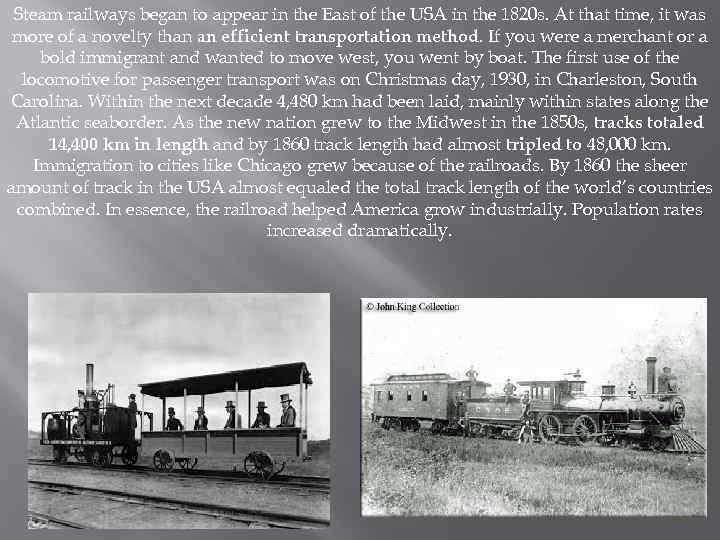 Steam railways began to appear in the East of the USA in the 1820 s. At that time, it was more of a novelty than an efficient transportation method. If you were a merchant or a bold immigrant and wanted to move west, you went by boat. The first use of the locomotive for passenger transport was on Christmas day, 1930, in Charleston, South Carolina. Within the next decade 4, 480 km had been laid, mainly within states along the Atlantic seaborder. As the new nation grew to the Midwest in the 1850 s, tracks totaled 14, 400 km in length and by 1860 track length had almost tripled to 48, 000 km. Immigration to cities like Chicago grew because of the railroads. By 1860 the sheer amount of track in the USA almost equaled the total track length of the world’s countries combined. In essence, the railroad helped America grow industrially. Population rates increased dramatically.
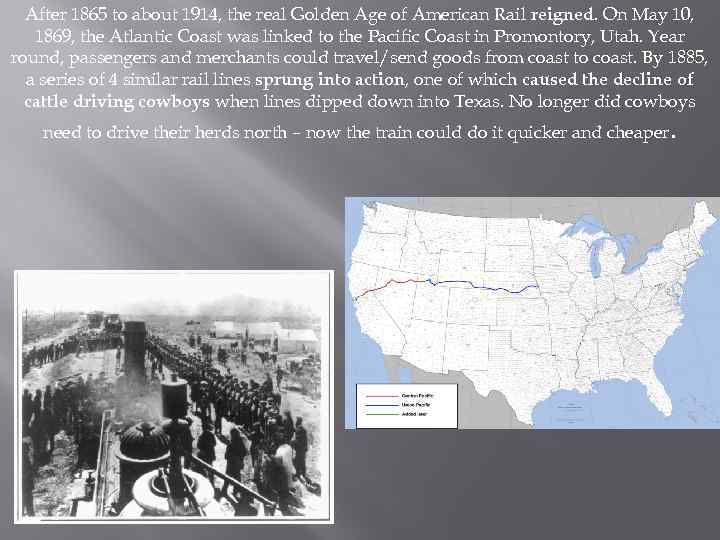 After 1865 to about 1914, the real Golden Age of American Rail reigned. On May 10, 1869, the Atlantic Coast was linked to the Pacific Coast in Promontory, Utah. Year round, passengers and merchants could travel/send goods from coast to coast. By 1885, a series of 4 similar rail lines sprung into action, one of which caused the decline of cattle driving cowboys when lines dipped down into Texas. No longer did cowboys need to drive their herds north – now the train could do it quicker and cheaper.
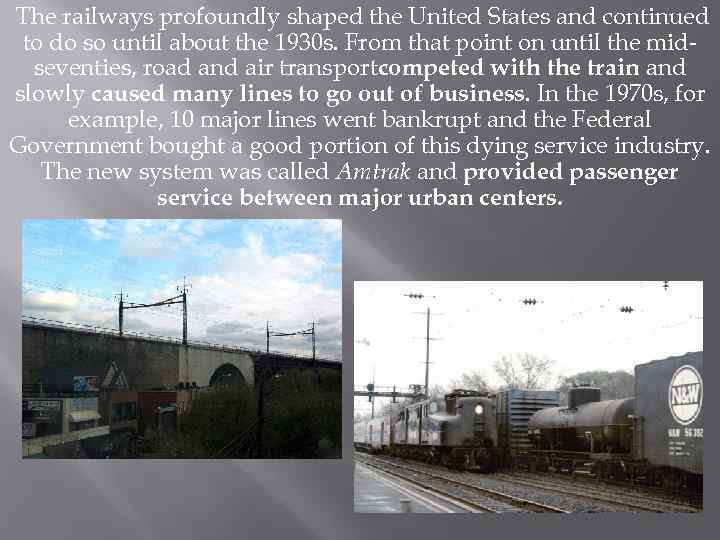 The railways profoundly shaped the United States and continued to do so until about the 1930 s. From that point on until the midseventies, road and air transportcompeted with the train and slowly caused many lines to go out of business. In the 1970 s, for example, 10 major lines went bankrupt and the Federal Government bought a good portion of this dying service industry. The new system was called Amtrak and provided passenger service between major urban centers.
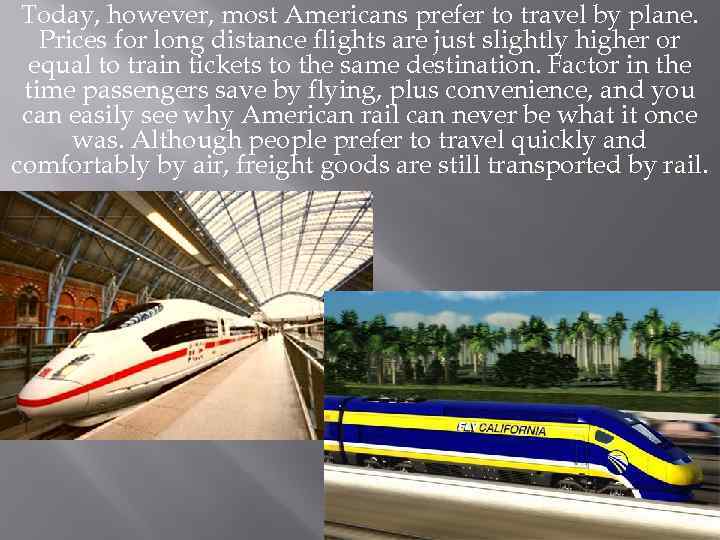 Today, however, most Americans prefer to travel by plane. Prices for long distance flights are just slightly higher or equal to train tickets to the same destination. Factor in the time passengers save by flying, plus convenience, and you can easily see why American rail can never be what it once was. Although people prefer to travel quickly and comfortably by air, freight goods are still transported by rail.
 ENGLAND
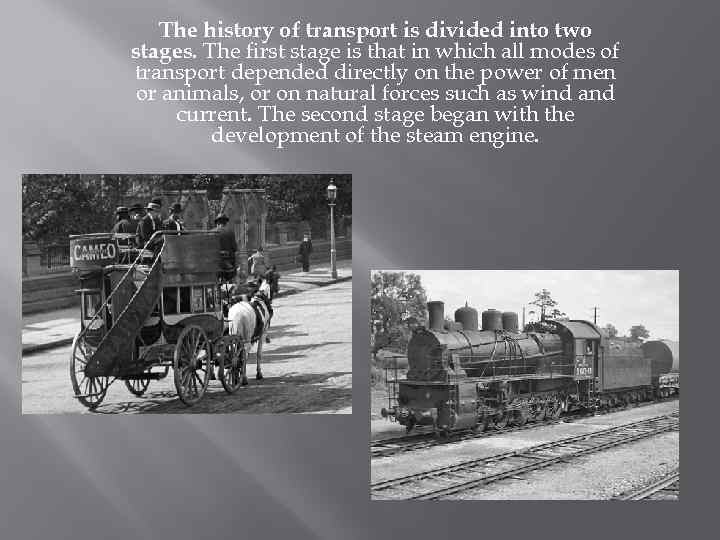 The history of transport is divided into two stages. The first stage is that in which all modes of transport depended directly on the power of men or animals, or on natural forces such as wind and current. The second stage began with the development of the steam engine.
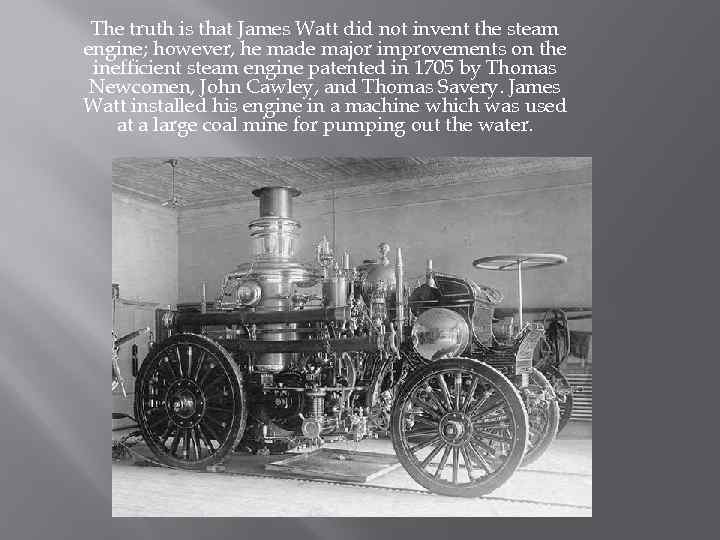 The truth is that James Watt did not invent the steam engine; however, he made major improvements on the inefficient steam engine patented in 1705 by Thomas Newcomen, John Cawley, and Thomas Savery. James Watt installed his engine in a machine which was used at a large coal mine for pumping out the water.
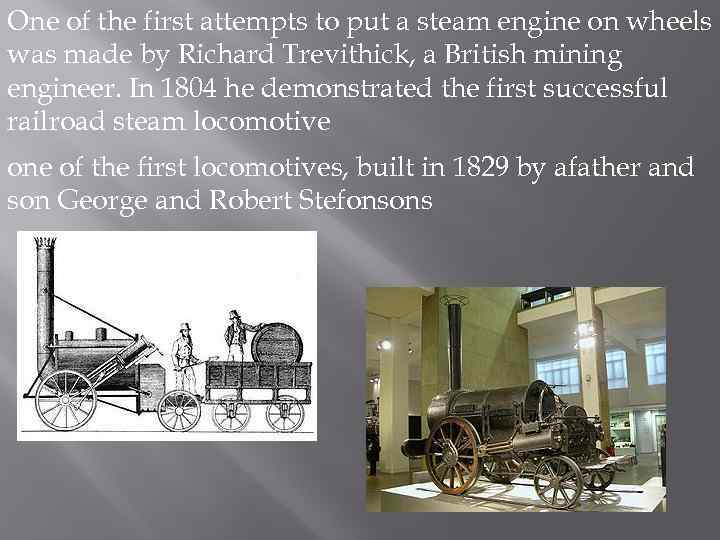 One of the first attempts to put a steam engine on wheels was made by Richard Trevithick, a British mining engineer. In 1804 he demonstrated the first successful railroad steam locomotive one of the first locomotives, built in 1829 by afather and son George and Robert Stefonsons
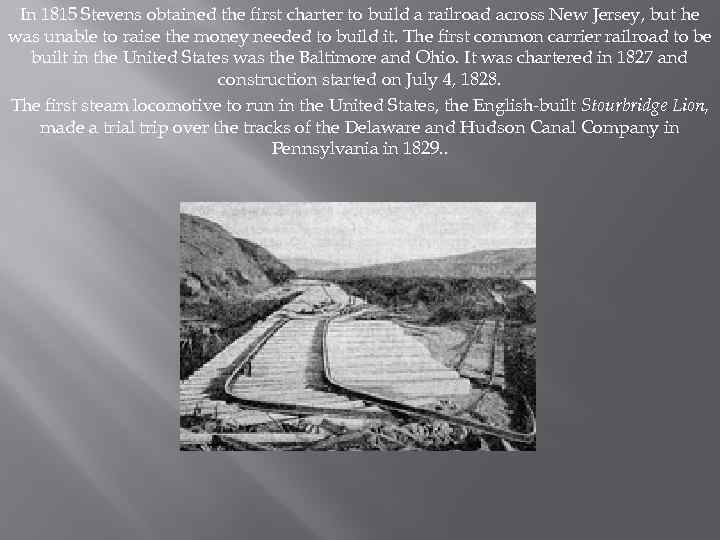 In 1815 Stevens obtained the first charter to build a railroad across New Jersey, but he was unable to raise the money needed to build it. The first common carrier railroad to be built in the United States was the Baltimore and Ohio. It was chartered in 1827 and construction started on July 4, 1828. The first steam locomotive to run in the United States, the English-built Stourbridge Lion, made a trial trip over the tracks of the Delaware and Hudson Canal Company in Pennsylvania in 1829. .