


 Скачать презентацию History of Occupational Therapy 1900 -1939 ARTS AND
d04827fd55c33de3157a95ed397647ea.ppt
- Количество слайдов: 28
 History of Occupational Therapy 1900 -1939: ARTS AND CRAFTS MOVEMENT AND THE INFLUENCE OF WWI
 Time line 1900: US Population Increases Progressive era fuels reform Increase of women in the work place 1917: US enters WWI 1919: WWI ends (Treaty of Versailles) 1920: Women gain the right to vote 1929: Great depression
 Women’s Movement and Influence Goal: establish selves outside of domestic sphere Argument for: Morally superior Naturally nurturing Alturistic Reform impulses Christian charity Helping the poor or “the suffering” Gender roles clearly defined within this period Men: leadership in the public sector Women: Establish institutes
 Hull House Established by Jane Addams and Ellen Gates Starr All female and secular society for political and professional training Believed in scientific method for learning about social issues Goal: Bridge gap between middle-class reformers and the poor Developed strong political ties with influential men and women in Chicago Meeting house for supporters of contemporary social movements Chicago Arts and Crafts Society
 Anti-Modernism Reaction to industrialism, emphasis on hand-made products Equated idle hands with immoral character Linked to the arts & crafts movement, appreciation for meaning in simplicity (Transcendentalism)
 “This emphasis on the work ethic and on the idea that idleness produces an immoral character appears to have been intimately linked to early occupational therapy philosophy and to the artsand-crafts movement or anti-modernism” (Gutman, 1995, p. 259)
 Arts and Crafts Movement British roots “humans, not machines, completed objects; therefore, work was not abstracted from life but had a place at its very core” -Ruskin Relevance to American happenings Machine “gimcrackery”
 Arts & Crafts Reaches America Quality of design Natural materials Handmade designs Simple in design Quality of life “handicraft clubs” “arts-and-crafts societies”
 Meanwhile in Medicine… Advances Shift towards a scientific foundation “Disease was understood in terms of physiological processes rather than in terms of suffering or personal disorientation; specialists concerned themselves with organs and tissues rather than the whole patient” (Levin, 1987, p. 249)
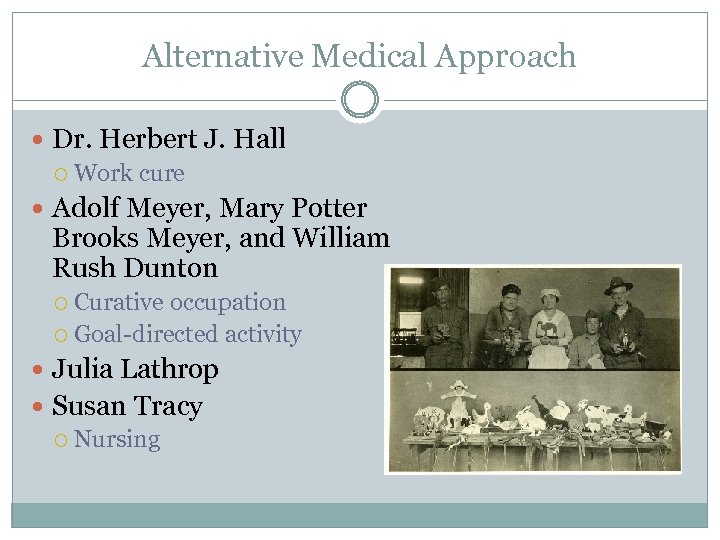 Alternative Medical Approach Dr. Herbert J. Hall Work cure Adolf Meyer, Mary Potter Brooks Meyer, and William Rush Dunton Curative occupation Goal-directed activity Julia Lathrop Susan Tracy Nursing
 “These progressive physicians, Meyer, Hall, and Dunton, worked with social caretakers Lathrop and Tracy to link the holistic treatment of the past with the modern, scientific approaches” (Levin, 1987, p. 250)
 Sheltered Workshops Items sold in shops Three purposes Employ talented people who could earn a living by making authentic objects To give spiritual support to craftspeople who pursued crafts as an avocation To help employ the mentally and physically handicapped
 “The early occupational therapy link to the arts-and- crafts movement did not end with the demise of therapeutic workshop. ”
 Slagle and Meyer Unite Belief that life should become as routine as possible Meyer’s research on the “unbalanced” cycles of schizophrenia Habit training= practice model Meyers and Slagle when at Henry Phipps Clinic at John Hopkins
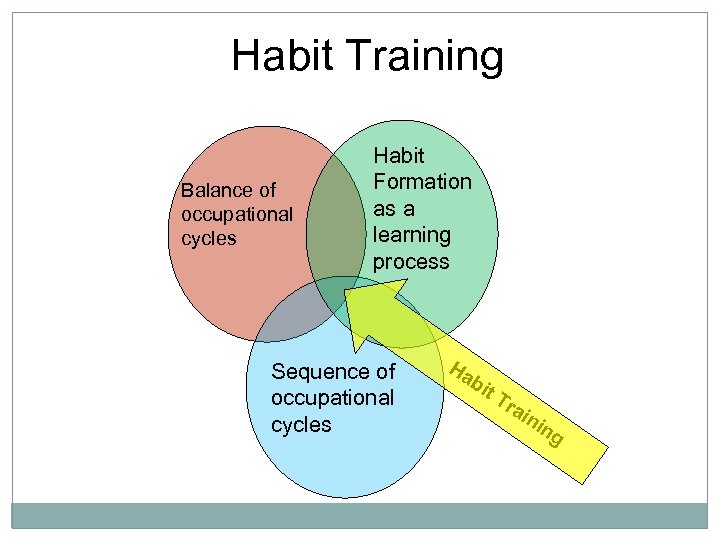 Habit Training Balance of occupational cycles Habit Formation as a learning process Sequence of occupational cycles Ha bit Tr ain ing
 Roots of Rehabilitation in War US Army rehabilitation program based on English reconstruction model “Bedside occupation and curative workshops” Army Division of Orthopedics British colonel Robert Jones’ Orthopedic rehabilitation back in war Society’s social & moral responsibility
 Reconstruction Aides 1918: Walter Reed Hospital (DC), Orthopedic Department uses physiotherapists & occupational therapists “The employment of reconstruction aides [is] inadvisable […] it is not desirable to employ women in this type of work in military hospitals” Commanding officers begin to call for more
 Evolution of reconstruction aides Requirements established for R. A. position Educational training (medical disabilities, anatomy, physiology) Demonstrate 3 fields occupation (crafts) Reasons for pursuing career: Economic necessity Contribute something to society Experienced ACTIVITIES OF MEANING, PURPOSE
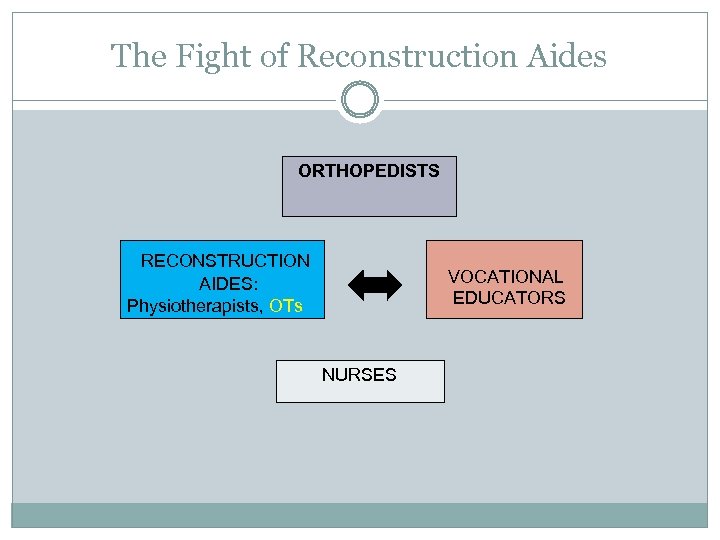 The Fight of Reconstruction Aides ORTHOPEDISTS RECONSTRUCTION AIDES: Physiotherapists, OTs VOCATIONAL EDUCATORS NURSES
 After WWI Medical orientation in OT -curriculums First occupational therapy program -Milwaukee
 Elizabeth Upham Started 1 st OT program at Milwaukee Downer College Taught Intensive work in crafts Lectures covering medical, psychology, sociology, economics and theory Hospital practice training
 Elizabeth Upham Believed in moral character improvement through purposeful activity Established the program to align OT with stronger medical affiliation and offered more structured course work to gain more credibility for the profession
 Elizabeth Upham Suggested a person “who becomes an independent wage-earner adds to the resource of the country, while every one who cannot increases the drain of dependents” (p. 259, Gutman, 1995).
 Organizations National Society for promotion of Occupational Therapy First meeting in 1917 Only six people attended; FIRST NAME? ? Barton, Isabel Newton, Eleanor Clark Stagle, William Dunton Jr, Thomas Kinder and Susan Cox Johnson By 3 rd meeting in 1919 300 people attended Changed name to AOTA in 1921
 Academia First issue of Archives of Occupational Therapy published in 1922 by AOTA Later became known as American Journal of Occupational Therapy (AJOT)
 Federal Industrial Rehabilitation Act Passed in 1923 Mandated hospitals that were caring for people with industrial injuries or illness to use OT program goal is to allow disabled individuals to be “restored to useful, remunerative employment and to selfrespecting, self-supporting lives” (Clark, 1945, p. 504)
 Contributions we see now… Multidisciplinary Holistic Mostly women Curriculum Standardization Balance AOTA
 References Crark, D. (1945). Industrial hygiene and the expandable federal state vocational rehabilitation program. American Journal of Public Health, 35, 504 Gutman, S. A. (1995). Influence of the U. S. military and occupational therapy reconstruction aides in World War I on the development of occupational therapy. The American Journal of Occupational Therapy, 49 (3), 256 -262. Levine, R. (1987). The influence of the arts-and-crafts movement on the professional status of occupational therapy. The American Journal of Occupational Therapy, 41 (4), 248 -254. Reed, K. L, & Sanderson, S. N. (1999). Concepts of occupational therapy. p. 238 -241. Philadelphia: Lippincott Williams & Wilkins HIIIIII RASHNIIIIIIII