



 History of mind games
 Introduction All of mind games had a different ways of creations. We think that it depended on age, situation, culture and etc.
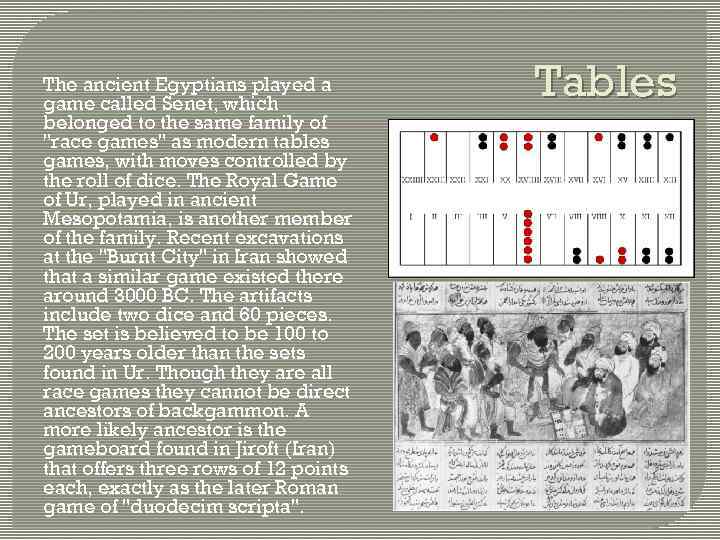 The ancient Egyptians played a game called Senet, which belonged to the same family of "race games" as modern tables games, with moves controlled by the roll of dice. The Royal Game of Ur, played in ancient Mesopotamia, is another member of the family. Recent excavations at the "Burnt City" in Iran showed that a similar game existed there around 3000 BC. The artifacts include two dice and 60 pieces. The set is believed to be 100 to 200 years older than the sets found in Ur. Though they are all race games they cannot be direct ancestors of backgammon. A more likely ancestor is the gameboard found in Jiroft (Iran) that offers three rows of 12 points each, exactly as the later Roman game of "duodecim scripta". Tables
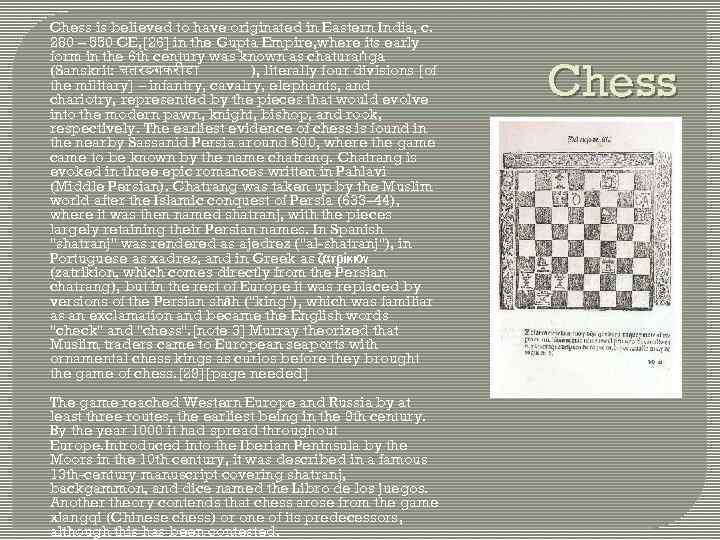 Chess is believed to have originated in Eastern India, c. 280 – 550 CE, [26] in the Gupta Empire, where its early form in the 6 th century was known as chaturaṅga (Sanskrit: चतरङगकर ड ), literally four divisions [of the military] – infantry, cavalry, elephants, and chariotry, represented by the pieces that would evolve into the modern pawn, knight, bishop, and rook, respectively. The earliest evidence of chess is found in the nearby Sassanid Persia around 600, where the game came to be known by the name chatrang. Chatrang is evoked in three epic romances written in Pahlavi (Middle Persian). Chatrang was taken up by the Muslim world after the Islamic conquest of Persia (633– 44), where it was then named shatranj, with the pieces largely retaining their Persian names. In Spanish "shatranj" was rendered as ajedrez ("al-shatranj"), in Portuguese as xadrez, and in Greek as ζατρίκιον (zatrikion, which comes directly from the Persian chatrang), but in the rest of Europe it was replaced by versions of the Persian shāh ("king"), which was familiar as an exclamation and became the English words "check" and "chess". [note 3] Murray theorized that Muslim traders came to European seaports with ornamental chess kings as curios before they brought the game of chess. [29][page needed] The game reached Western Europe and Russia by at least three routes, the earliest being in the 9 th century. By the year 1000 it had spread throughout Europe. Introduced into the Iberian Peninsula by the Moors in the 10 th century, it was described in a famous 13 th-century manuscript covering shatranj, backgammon, and dice named the Libro de los juegos. Another theory contends that chess arose from the game xiangqi (Chinese chess) or one of its predecessors, although this has been contested. Chess
 Draughts Ancient games A similar game has been played for thousands of years. A board resembling a draughts board was found in Ur dating from 3000 BC. In the British Museum are specimens of ancient Egyptian checkerboards, found with their pieces in burial chambers, and the game was played by Queen Hatasu. Plato mentioned a game, πεττεια or petteia, as being of Egyptian origin, [8] and Homer also mentions it. The method of capture was placing two pieces either side of the opponent's piece. It was said to have been played during the Trojan War. The Romans played a derivation of petteia called latrunculi, or the game of the Little Soldiers.
 Conclusion Finally we decided that culture affected on development of those mind games.