 Скачать презентацию History of labour law International
43560a2d3349ef446f7f95d9eb633271.ppt
- Количество слайдов: 78




• History of labour law • International Labor Organization • Egypt's Long Labor History
Part One Labor law General provisions General Characteristics of labor law Chapter one Contract of employment General provisions Trial period Working Conditions The Duration of Work HOLIDAYS AND VACATIONS Working Conditions of Women
Chapter two Employer's obligations 1 - Prohibition of discrimination, and equal treatment 2. Occupational safety and health 3 - -Information on principal terms of work 4 -Employer's obligation to offer work to a part-time employee 5 -Information on vacancies 6 - Minimum pay in the absence of a collective agreement 7 - Pay during illness Employees 8 -The employee's right to pay in the case of impediment to work - Exceptional paydays Payment of pay
Chapter three Employees' obligations • Occupational safety and health • Competing activity • Business and trade secrets • Agreement of non-competition • Family leave • Child-care leave • Interruption of partial child-care leave • Obligation to pay remuneration • Return to work
Chapter four Lay-offs • Definition of lay-off • Grounds for lay-offs • Advance explanation hearing the employee • Lay-off certificate and
Chapter Five Termination of an employment contract • Fixed-term contracts • Retirement age • Re-employment of an employee • Financial and production-related grounds for termination • Bankruptcy or death of the employer
Chapter Six Cancellation of the employment contract • Lapse of cancellation right • Procedures for terminating an employment contract • Appealing to the grounds for termination • Hearing the employee and the employer • Employer's duty to explain • An employer's notification to the employment office • Experience of the employee • Delivery of notice on the termination of an employment contract •
Chapter Seven Dismissal unfair Definition of Dismissal unfair Procedure to be followed Step 1: written statement of grounds for action and invitation to meeting Step 2: the hearing Step 3: appeal
Chapter Eight Breach of contract • Breach of contract by your employer • Mediation • Legal action • Employment Tribunal • Civil courts • Breach of contract by an employee
Part Two Strikes • History • Categories of strikes • Strikebreakers • Union strikebreaking • Methods used by employers to deal with strikes • Strike preparation • Strike breaking • Union busting • Lockout
Chapter One Child labor • Child labor involves at least one of the following characteristics : • Child labor can be found in nearly every industry • Causes of Child Labor • Poverty and unemployment levels are high • Existing laws or codes of conduct are often violated • Laws and enforcement are often inadequate • Ending Child Labor
Chapter Two Women labor • Paid employment globally • Laws protecting women's rights as workers • Barriers to equal participation • Access to education and training • Access to capital • Discrimination within occupations • Gender inequality by social class
• Definition of law • A group of rules, general and abstract, which govern the behavior and the relationships of the individuals in the society and which are imposed by sanctions enforced by the competent public authorities.
Public and Private laws • Public law is that part of law which governs the relations of citizens with the state, and of one state with another. • Thus, public law includes: public International Law, Constitutional law, Administrative law, Criminal law, and Financial law.
Private law • Private law is that part of law which governs the relations of citizens among themselves. • It includes the civil law in its widest sense Commercial law, labor law, law of civil procedure and the Private International law
• History of labor law • Since the industrial revolution the labour movement has been concerned how economic globalisation would weaken the bargaining power of workers, as their employers could move to hire workers abroad without the protection of the labour standards at home.
• In the Fourth Annual International Congress in 1869, the following was resolved: • the extension of the principle of free trade, which induces between nations such a competition that the interest of the workman is liable to be lost sight of and sacrificed in the fierce international race between capitalists, demands that such [unions] should be still further extended and made international.
International labour law • International labour law (also called "labour standards") is the body of rules spanning public and private international law which concern the rights and duties of employees, employers, trade unions and governments in regulating the workplace. •
• • The International Labour Organization and the World Trade Organization have been the main international bodies involved in reform labour markets. • The International Monetary Fund and the World Bank have indirectly driven changes in labour policy by demanding structural adjustment conditions for receiving loans or grants.
• International Labor Organization • Following World War I , the Treaty of Versailles contained the first constitution of a new International Labour Organisation founded on the principle that • "labour is not a commodity", and for the reason that "peace can be established only if it is based upon social justice".
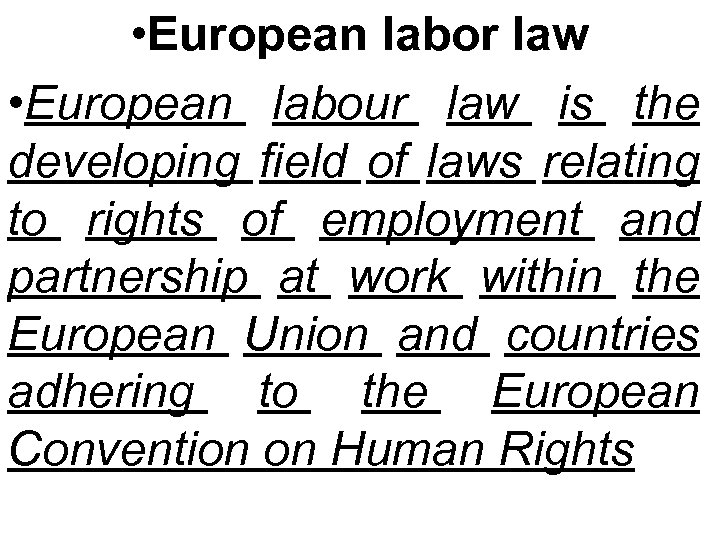
• European labor law • European labour law is the developing field of laws relating to rights of employment and partnership at work within the European Union and countries adhering to the European Convention on Human Rights
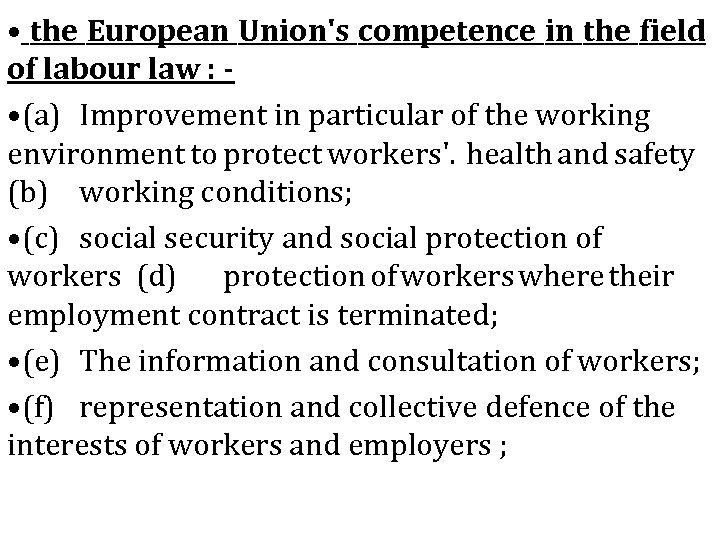
• the European Union's competence in the field of labour law : • (a) Improvement in particular of the working environment to protect workers'. health and safety (b) working conditions; • (c) social security and social protection of workers (d) protection of workers where their employment contract is terminated; • (e) The information and consultation of workers; • (f) representation and collective defence of the interests of workers and employers ;
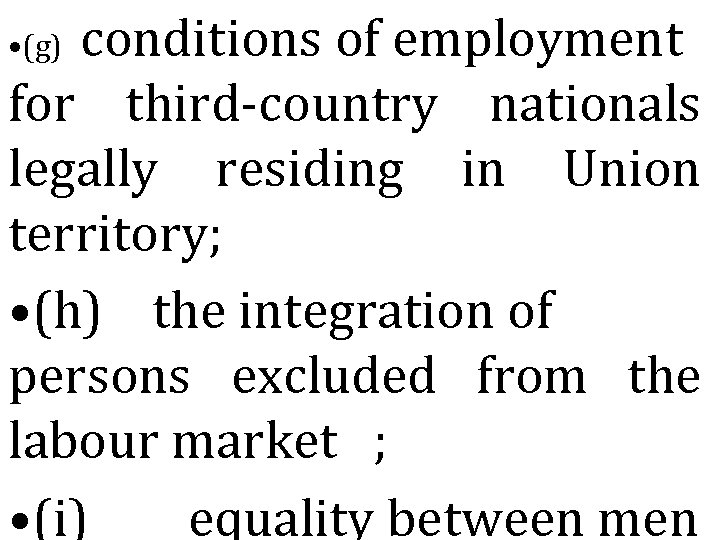
conditions of employment for third-country nationals legally residing in Union territory; • (h) the integration of persons excluded from the labour market ; • (i) equality between men • (g)
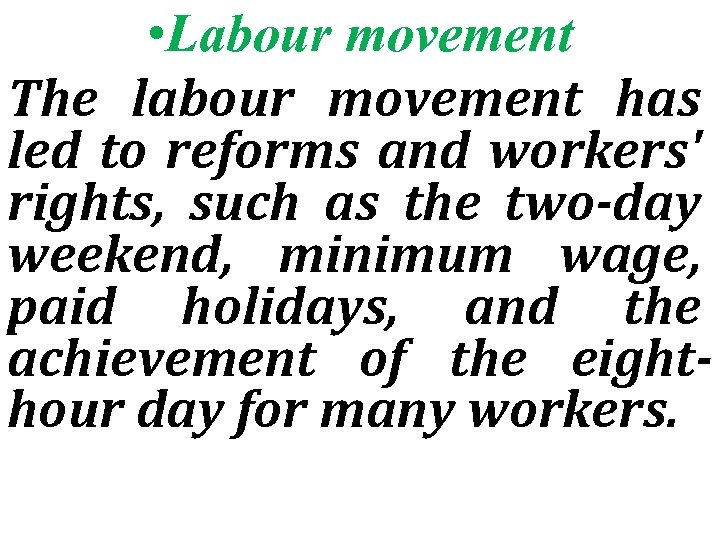
• Labour movement The labour movement has led to reforms and workers' rights, such as the two-day weekend, minimum wage, paid holidays, and the achievement of the eighthour day for many workers.
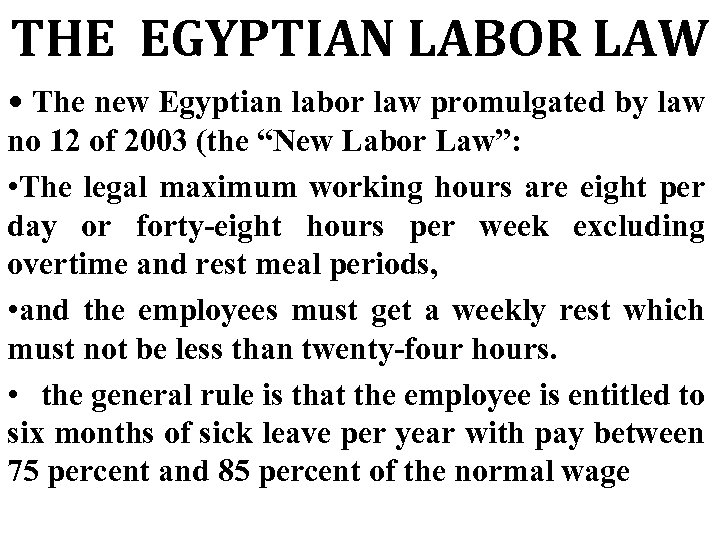
THE EGYPTIAN LABOR LAW • The new Egyptian labor law promulgated by law no 12 of 2003 (the “New Labor Law”: • The legal maximum working hours are eight per day or forty-eight hours per week excluding overtime and rest meal periods, • and the employees must get a weekly rest which must not be less than twenty-four hours. • the general rule is that the employee is entitled to six months of sick leave per year with pay between 75 percent and 85 percent of the normal wage
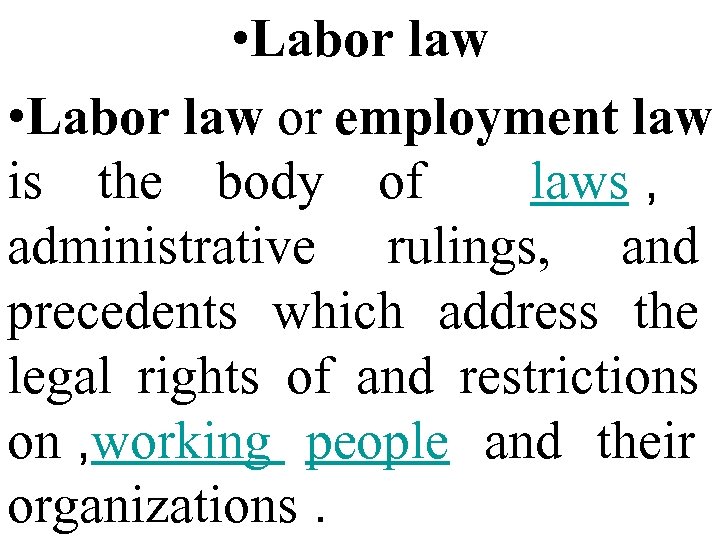
• Labor law or employment law is the body of laws , administrative rulings, and precedents which address the legal rights of and restrictions on , working people and their organizations.
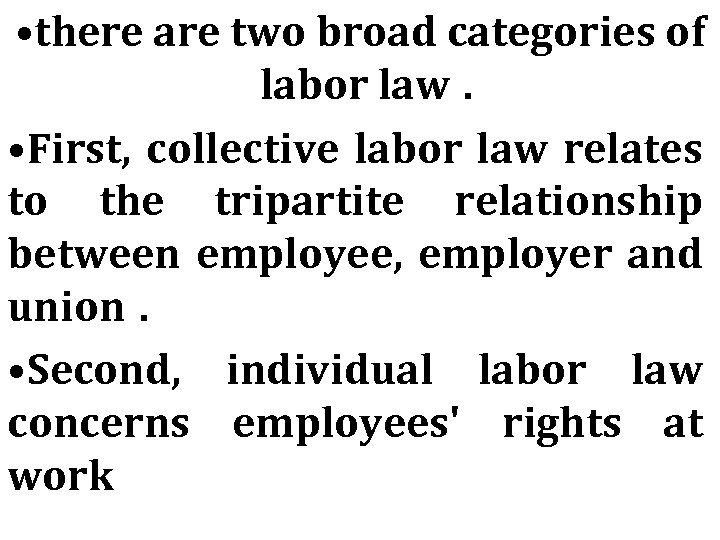
• there are two broad categories of labor law. • First, collective labor law relates to the tripartite relationship between employee, employer and union. • Second, individual labor law concerns employees' rights at work
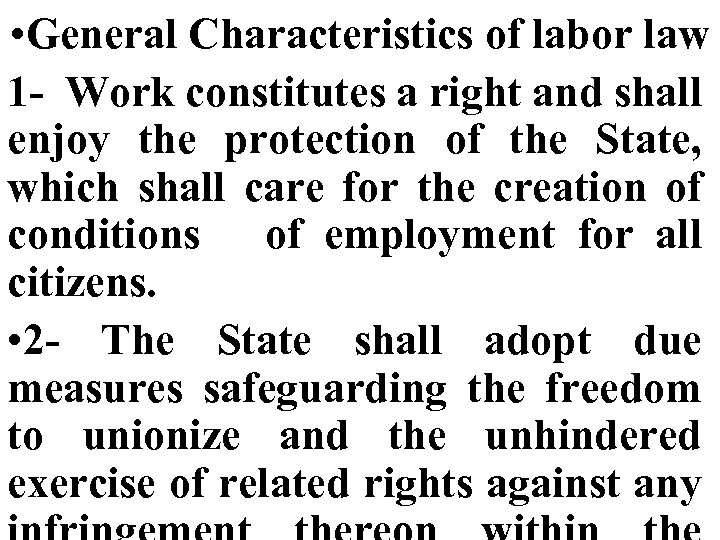
• General Characteristics of labor law 1 - Work constitutes a right and shall enjoy the protection of the State, which shall care for the creation of conditions of employment for all citizens. • 2 - The State shall adopt due measures safeguarding the freedom to unionize and the unhindered exercise of related rights against any
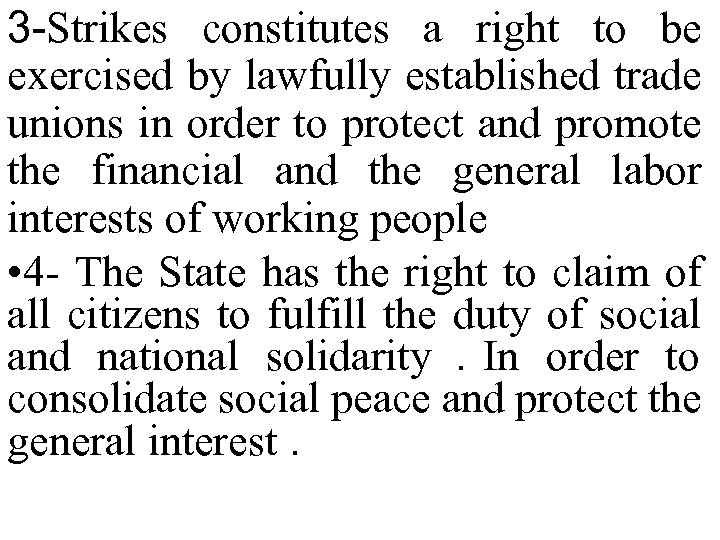
3 -Strikes constitutes a right to be exercised by lawfully established trade unions in order to protect and promote the financial and the general labor interests of working people • 4 - The State has the right to claim of all citizens to fulfill the duty of social and national solidarity . In order to consolidate social peace and protect the general interest.
Contract of employment
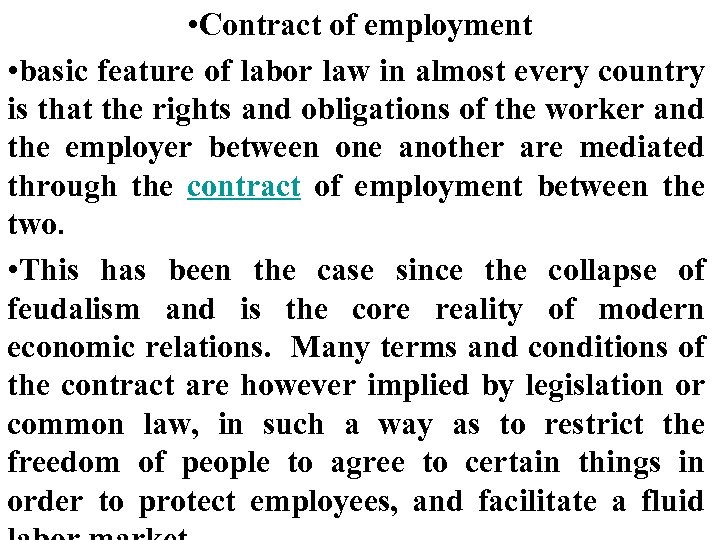
• Contract of employment • basic feature of labor law in almost every country is that the rights and obligations of the worker and the employer between one another are mediated through the contract of employment between the two. • This has been the case since the collapse of feudalism and is the core reality of modern economic relations. Many terms and conditions of the contract are however implied by legislation or common law, in such a way as to restrict the freedom of people to agree to certain things in order to protect employees, and facilitate a fluid
• In the US for example, majority of state laws allow for employment to be "at will", meaning the employer can terminate an employee from a position for any reason, so long as the reason is not an illegal reason, including a termination in violation of public policy. • One example in many countries is the duty to provide written particulars of employment with the essentialia negotii ( Latin for essential terms) to an employee. • This aims to allow the employee to know concretely what to expect and is expected; in terms of wages, holiday rights, notice in the event of dismissal, job description and so on. • An employer may not legally offer a contract in which the employer pays the worker less than a minimum wage.
• General provisions An employment contract, or ‘contract of employment’, is an agreement between an employer and an employee which sets out their employment rights, responsibilities and duties. These are called the ‘terms' of the contract.
• Trial period • The employer and the employee may agree on a trial period of a maximum of four months starting from the beginning of the work. • During the trial period, the employment contract may be cancelled by either party The employment contract may not
• Working Conditions • Emoluments • All official receipts collected by a worker by virtue of the employment agreement including the wages, salary, family allowances, and housing, food and transport expenses • The wages must be paid at regular intervals on working days and during working hours in cash and in the
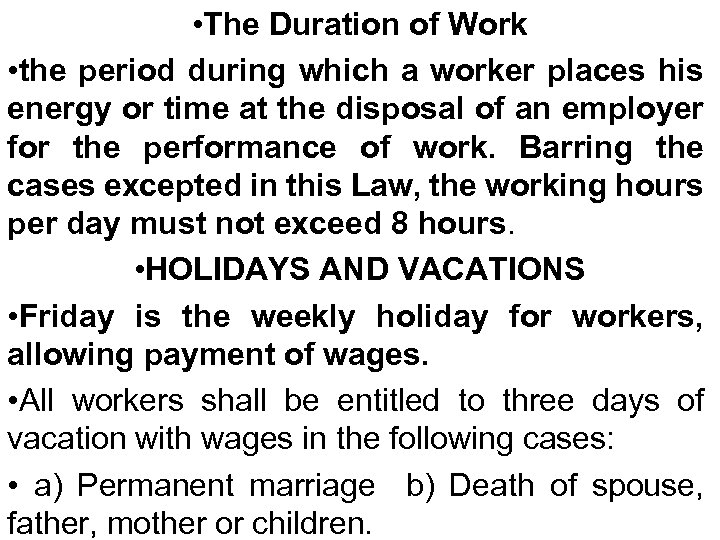
• The Duration of Work • the period during which a worker places his energy or time at the disposal of an employer for the performance of work. Barring the cases excepted in this Law, the working hours per day must not exceed 8 hours. • HOLIDAYS AND VACATIONS • Friday is the weekly holiday for workers, allowing payment of wages. • All workers shall be entitled to three days of vacation with wages in the following cases: • a) Permanent marriage b) Death of spouse, father, mother or children.
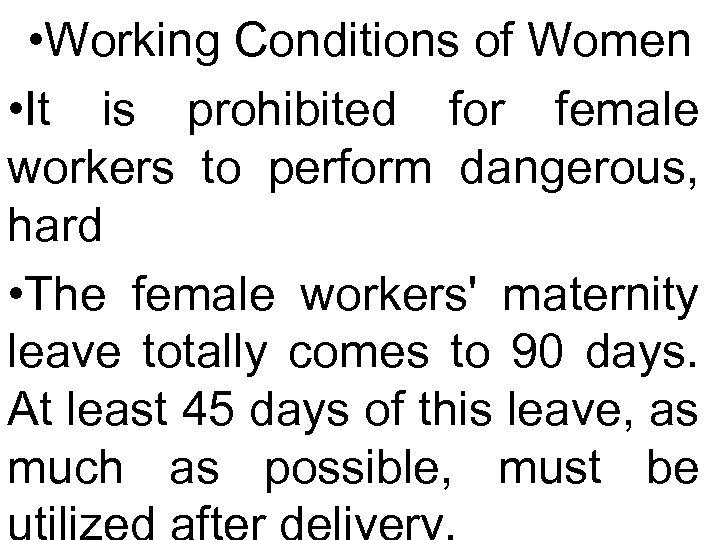
• Working Conditions of Women • It is prohibited for female workers to perform dangerous, hard • The female workers' maternity leave totally comes to 90 days. At least 45 days of this leave, as much as possible, must be
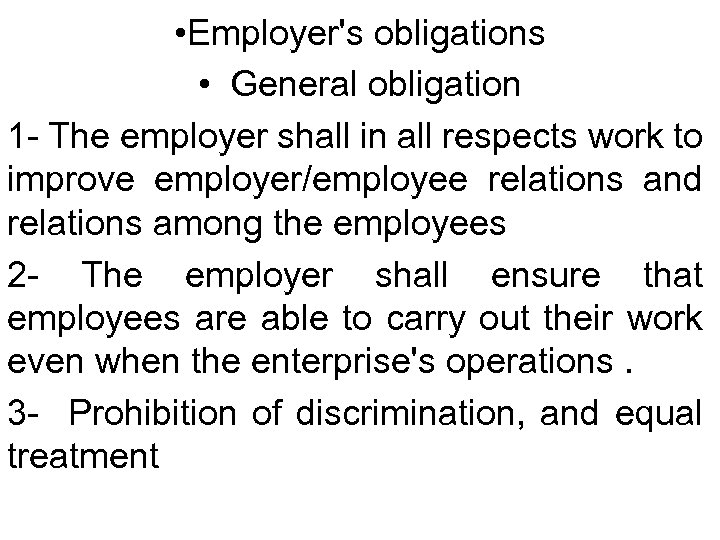
• Employer's obligations • General obligation 1 - The employer shall in all respects work to improve employer/employee relations and relations among the employees 2 - The employer shall ensure that employees are able to carry out their work even when the enterprise's operations. 3 - Prohibition of discrimination, and equal treatment
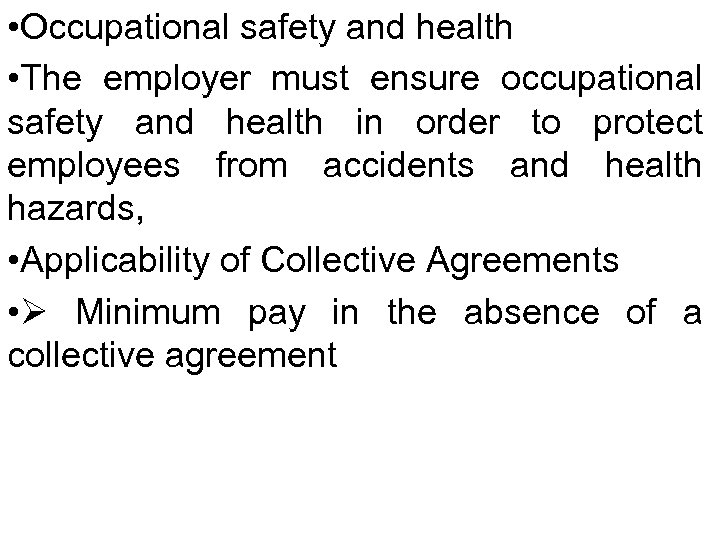
• Occupational safety and health • The employer must ensure occupational safety and health in order to protect employees from accidents and health hazards, • Applicability of Collective Agreements • Minimum pay in the absence of a collective agreement
• Pay during illness Employees • Who are prevented from performing their work by an illness or accident are entitled to pay during illness • Pay period on termination of employment relationship • When an employment relationship ends, the pay period also ends • Exceptional paydays • If an employee's pay falls due on a Sunday, a religious holiday, Independence Day, May 1 , Christmas or Midsummer Eve, or a Saturday
Employees' obligations General obligations Employees shall perform their work carefully, observing the instructions concerning performance issued by the employer within its competence In their activities, • Competing activity Employees shall not do work for another party or engage in such activity that would, taking the nature of the work and the individual employee's position into account,
Employment Contract Provisions • General provisions • Employment contract ( entered into by an employee, or jointly by several employees as a team, agreeing personally to perform work for an employer under the employer's direction and supervision in return for pay or some other remuneration . • Act applies regardless of the absence of any agreement on remuneration, if the facts indicate that the work was not intended to be performed without remuneration.
• 2 - Form and duration of employment contract • An employment contract may be oral, written or electronic. An employment contract is valid indefinitely unless it has, for a justified reason, been made for a specific fixed term Contracts made for a fixed term on the employer's initiative without a justified reason, and consecutive fixed-term contracts concluded without a justified reason , shall be considered valid indefinitely.
• 3 Contracts of employment with minors and other legally incompetent persons • Provisions concerning the right of a person under 18 years of age to conclude a contract of employment and the right of the person having the care and custody of a young employee to ' cancel a contract of employment concluded by a minor are laid down in the Young Workers 'A person who has been declared legally incompetent or whose competence has been limited under the Act on Guardianship may conclude and terminate a contract of employment on his own behalf.
5 - Transfer of rights and obligations • • The parties to the contract of employment shall not assign any of their rights or obligations under a contract of employment to a third party without the other party's consent, unless otherwise provided below. A claim that has fallen due may, however, be so assigned without the consent of the other party .
• If with the employee's consent, the employer assigns an employee for use by another employer) user enterprise , ( the right to direct and supervise the work is transferred to the user enterprise together with the obligations stipulated for the employer directly related to the performance of the work and its arrangement.
• Employer's obligations • General obligation • The employer shall in all respects work to improve employer/employee relations and relations among the employees. • The employer shall ensure that employees are able to carry out their work even when the enterprise's operations, the work to be carried out or the work methods are changed or developed. • The employer shall strive to further the employees' opportunities to develop themselves according to their abilities so that they can advance in their careers.
Payment of pay Pay shall be paid to the employee in cash or, if so agreed, to a financial institution designated by the employee. The employer shall bear the cost of the latter method . The payment shall be made or the pay shall be withdrawn able on the due date On payment, the employer shall give the employee a calculation showing the amount of the pay and the grounds for its determination.
Exceptional paydays 1 If an employee's pay falls due on a Sunday, a religious holiday, Independence Day, May 1 , Christmas or Midsummer Eve, or a Saturday that is not a holiday it shall be deemed to fall due on the preceding working day
• Prohibition of discrimination, and equal treatment • The employer shall not exercise any unjustified discrimination against employees on the basis of age, health, disability, national or ethnic origin, nationality, sexual orientation, language , religion, opinion, belief, family ties, trade union activity, political activity or any other comparable circumstance Provisions on the prohibition of discrimination based on gender are laid down in the Act on Equality between Women and Men ( The definition of discrimination, prohibition on sanctions and burden of proof in cases concerning discrimination are laid down in the Non-Discrimination Act
• Occupational safety and health • The employer must ensure occupational safety and health in order to protect employees from accidents and health hazards, as provided in the Occupational Safety If the working duties or conditions of a pregnant employee endanger the health of the employee or the fetus and if the hazard cannot be eliminated from the work or working conditions, the employee shall if possible be transferred to other duties suitable in terms of her working capacity and skills for the period of pregnancy Provisions on the employee's right to special maternity leave.
• Employees' obligations • General obligations • Employees shall perform their work carefully, observing the instructions concerning performance issued by the employer within its competence. • In their activities, employees shall avoid everything that conflicts with the actions reasonably required of employees in their position.
• Competing activity • During the term of employment, employees shall not embark on any action to prepare for competing activities as cannot be deemed acceptable, taking into account what is stipulated in paragraph 1 • . An employer which recruits a person whom it knows to be impeded from work on the basis of paragraph 1 is liable for any loss caused to the previous employer jointly with the employee .
• Family leave • 1 - Maternity, special maternity, paternity and parental leave • Employees shall be entitled to take leave from work during maternity, special maternity , paternity and parental benefit periods as referred to in the Sickness Insurance Act • . Employees shall be entitled to take parental leave in one or two periods, the minimum duration of which shall be 12 working days.
• Child-care leave • Employees are entitled to take child-care leave in order to care for their child or some other child living permanently in their household until the child reaches the age of three . • The entitlement to child-care leave of a parent of an adopted child, however, continues until a period two years has elapsed from the adoption, or at the most until the time the child starts school
• Reasons for changing an employment contract • a. An employer's need • An employer sometimes needs to make changes to working practice because of economic circumstances. The business may need to be reorganized, moved to a new location, or there may need to be changes because of new laws or regulations.
• Things that might change include: • rates of pay • working time (for example, longer or shorter hours, different days) • your duties and responsibilities • the duties and responsibilities of your immediate boss • the location of where you work
• b. Employees' need • Employees might also ask to change the terms of their contract. For example, you might want: • better pay (you don’t have an automatic right to a pay rise, unless it’s in your contract) • improved working conditions • more holiday • different working hours • to work flexible hours • to work part-time
• Breach of contract : A contract of employment is a legally binding agreement between you and your employer. A breach of contract happens when either you or your employer breaks one of the terms (for example, if your employer doesn't pay your wages, or you don't work the agreed hours). • Not all the terms of a contract are written down. A breach may be of a verbally agreed term, a written term, or an 'implied' term of a contract. Your pay has special extra protection and in some situations your employer may be prevented from taking money out of your pay even if this
• Breach of contract by your employer • If you think there's been a breach of contract, check the terms of your contract to make sure. • If there has, you should try to sort out the problem directly with your employer first of all. • A- Mediation • Before taking legal action, you could try other ways of resolving the dispute if your employer agrees. For example, you might try mediation through Acas (or the Labour Relations Agency if you work in Northern Ireland).
• B -Legal action • If you can't sort out the problem with your employer, you can decide to take legal action. Think carefully before taking any legal action against your employer. Ask yourself what you want to achieve and how much it will cost. • Also remember that taking legal action might prompt your employer to take out a counterclaim against you if they feel they have one
• C- Employment Tribunal • If you do decide to take legal action, it can either be through an Employment Tribunal (Industrial Tribunal in Northern Ireland) or through a civil court. To make a breach of contract claim through an Employment Tribunal, your employment must have ended. • D- Civil courts • To make a claim while you are still employed you will normally go through the small claims track of the county court or other civil court. • The time limit for making your claim to a civil court is longer than the time limit for complaining to an Employment Tribunal. The award that a civil court could make is unlimited.
Strikes • Strike action , often simply called a strike , is a work stoppage caused by the mass refusal of employees to perform work . A strike usually takes place in response to employee grievances. • Strikes are sometimes used to put pressure on governments to change policies. Occasionally, strikes destabilise the rule of a particular political
• 2 - Categories of strikes : • Most strikes are undertaken by labor unions during collective bargaining. The object of collective bargaining is to obtain a contract (an agreement between the union and the company) which may include a no-strike clause which prevents strikes, or penalizes the union and/or the workers if they walk out while the contract is in force.
• Strikes without formal union authorization are also known as wildcat strikes. In many countries, wildcat strikes do not enjoy the same legal protections as recognized union strikes, and may result in penalties for the union members who participate or their union. • The same often applies in the case of strikes conducted without an official ballot of the union membership, as is required in some countries such as the United Kingdom .
• A strike may consist of workers refusing to attend work or picketing outside the workplace to prevent or dissuade people from working in their place or conducting business with their employer. Less frequently workers may occupy the workplace, but refuse either to do their jobs or to leave. This is known as a sit-down strike.
• Strikes may be specific to a particular workplace, employer, or unit within a workplace, or they may encompass an entire industry, or every worker within a city or country. Strikes that involve all workers or a number of large and important groups of workers, in a particular community or region are known as general strikes. • Under some circumstances, strikes may take place in order to put pressure on the State or other authorities or may be a response to unsafe conditions in the workplace.
• A jurisdictional strike in United States labor law refers to a concerted refusal to work undertaken by a union to assert its members' right to particular job assignments and to protest the assignment of disputed work to members of another union or to unorganized workers. • A student strike has the students (sometimes supported by faculty) not attending schools.
• A hunger strike is a deliberate refusal to eat. Hunger strikes are often used in prisons as a form of political protest. Like student strikes, a hunger strike aims to worsen the public image of the target.
• Methods used by employers to deal with strikes • 1 - Most strikes called by unions are somewhat predictable; they typically occur after the contract has expired. • However, not all strikes are called by union organizations — some strikes have been called in an effort to pressure employers to recognize unions.
• 2 - Strike preparation Companies which produce products for sale will frequently increase inventories prior to a strike. Salaried employees may be called upon to take the place of strikers, which may entail advance training. • If the company has multiple locations, personnel may be redeployed to meet the needs of reduced staff. Companies may also take out strike insurance prior to an anticipated strike, to help offset the losses which the strike would cause.
• 3 - Strike breaking • Some companies negotiate with the union during a strike; other companies may see a strike as an opportunity to eliminate the union. • This is sometimes accomplished by the importation of replacement workers, strikebreakers or "scabs".
• Union busting One method of inhibiting a strike is elimination of the union that may launch it, which is sometimes accomplished through union busting. • Union busting campaigns may be orchestrated by labor relations consultants , and may utilize the services of labor spies , or asset protection services. • Similar services may be engaged during attempts to defeat organizing drives. A modern example of a union buster is The Burke Group.
• Violence • Historically, some employers have attempted to break union strikes by force. One of the most famous examples of this occurred during the Homestead Strike of 1892 • other capitalists, have used the US military to gun down and kill strikers

 Скачать презентацию History of labour law International
43560a2d3349ef446f7f95d9eb633271.ppt