


 Скачать презентацию History of Health Care State Standard n
b71103b2b71b4e84e7800b71ee0d4c94.ppt
- Количество слайдов: 63
 History of Health Care
 State Standard n 1) Synthesize information found in news media, professional journals, and trade magazines to create a report and/or presentation on the historical evolution of healthcare in the United States. Use a timeline or other graphic to illustrate major developments beginning with the first medical school through today.
 Objectives Students will: • • Identify medical/health care milestones that have led to advances in health care. Predict where and how factors such as cost, managed care, technology, and aging population, access to care, alternative therapies, and lifestyle behavior may affect various health delivery system models.
 4000 BC – 3000 BC Primitive Times n n n Illness and diseases were a punishment from the Gods Tribal witch doctors treated illness with ceremonies Herbs and plants used as medicines (morphine and digitalis) Trepanation or trephining (surgically removig a piece of bone from the skull) Average life span was 20 years
 3000 BC – 300 BC Ancient Egyptians Physicians were priests n Bloodletting or leeches used as medical treatment n Average life span was 20 -30 years n
 1700 BC – AD 220 Ancient Chinese n n n Believed in the need to treat the whole body by curing the spirit and nourishing the body Recorded a pharmacopoeia of medications based mainly on the use of herbs Used therapies such as acupuncture Began to search for medical reasons for illness Average life span was 20 -30 years
 1200 BC – 200 BC Ancient Greeks n n n First to observe the human body and the effects of disease – led to modern medical sciences. Believed illness is a result of natural causes Used therapies such as massage, art therapy, and herbal treatment Stressed diet and exercise as ways to prevent disease Average life span was 25 -35 years
 753 BC – AD 410 Ancient Romans n n n First to organize medical care by providing care for injured soldiers Later hospitals were religious and charitable institutions in monasteries and convents First public health and sanitation systems by building sewers and aqueducts Galen established belief that the body was regulated by four body humors; blood, phlegm, black bile, and yellow bile Life span was 25 -35 years
 AD 400 – AD 800 Dark Ages Emphasis on saving the soul and study of medicine was prohibited n Prayer and divine intervention were used to treat illness & disease n Monks and priests provided custodial care for sill people n Medications were mainly herbal mixtures n Average life span was 20 -30 years n
 AD 800 – AD 1400 Middle Ages n n n Renewed interest in medical practices of Greek and Romans Bubonic Plague killed 75% of population in Europe and Asia Major diseases included smallpox, diptheria, tuberculosis, typhoid, the plaque, and malaria Arabs began requiring physicians pass examinations and obtain licenses Average life span was 20 -35 years
 AD 1350 – AD 1650 Renaissance Dissection of body led to increased understanding of anatomy and physiology n Invention of printing press allowed medical knowledge to be shared n First anatomy book was published by Andreas Vesalius (1514 -1564) n Average life span was 30 -40 years n
 16 th and 17 th Centuries n n n Cause of disease still not known – many people died from infections Invention of the microscope allowed physicians to see disease-causing organisms. Apothecaries (early pharmicists) made, prescribed, and sold medications Ambroise Pare (1510 -1590), a French surgeon, known as the Father of Modern Surgery established use of ligatures to stop bleeding Average life span 35 -45 years
 18 th Century Gabriel Fahrenheit (1686 -1736) created the first mercury thermometer n John Hunter (1728 -1793), established scientific surgical procedures and introduced tube feeding n Benjamin Franklin invented bifocals n Average life span 40 -50 years n
 19 th Century n n n Rapid advancements due to discoveries of microorganisms, anesthesia, and vaccinations Infection control developed once microorganisms were associated with disease Formal training for nurses began Women became active participants in health care Average life span 40 -60 years
 20 th Century n n Increased knowledge about the role of blood in the body ABO blood groups discovered Found out how white blood cells protect against disease New medications were developed n n Insulin discovered and used to treat diabetes Antibiotics developed to fight infections Vaccines were developed New machines developed n n n Kidney Dialysis Machine Heart Lung Machine Surgical and diagnostic techniques developed to cure once fatal conditions
 20 th Century (continued) n n n n Organ Transplants Test tube babies Implanted first artificial heart Health Care Plans developed to help pay the cost of care Medicare and Medicaid marked the entry of the federal government into the health care arena HMOs provided an alternative to private insurance Hospice organized
 21 st Century n n The first totally implantable artificial heart was placed in a patient in Louisville, Ky. In 2001 The threat of bioterrorism lead to smallpox vaccination of the military and first responders in 2002 The Netherlands became the first country in the world to legalize euthanasia in 2002 The Human Genome Project to identify all of the approximately 20, 000 to 25, 000 genes in the human
 21 st Century n n Stem cells were used in the treatments of disease early in the 2000’s and lead to increased research in the treatment of cancer and other diseases President George W. Bush approved federal funding for research using only existing lines of embryonic stem cells in 2001 Advanced Cell Technology announced it cloned a human embryo in 2001 but the embryo did not survive The U. S. FDA approved the use of the abortion pill RU-486 IN 200
 21 st Century n n n The standards for Privacy of Individually Identifiable Health Information, required under the Health Insurance Portability and Accountability Act (HIPPA) of 1996, went into effect in 2003 The Medicare Prescription Drug Improvement and Modernization Act was passed in 2003 Vaccinations for cervical cancer and herpes zoster (shingles) in 2006
 Potential for 21 st Century Cures for AIDS, cancer, and heart disease n Genetic manipulation to prevent inherited disease n Nerves in the brain and spinal cord are regenerated to prevent paralysis n Antibiotics are developed that do not allow pathogens to develop resistance n Average life span 90 -100 years n
 Individual Contributions
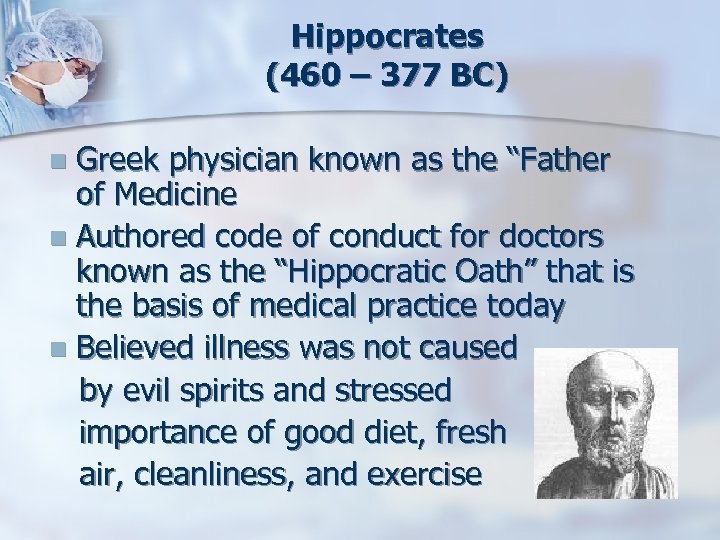 Hippocrates (460 – 377 BC) Greek physician known as the “Father of Medicine n Authored code of conduct for doctors known as the “Hippocratic Oath” that is the basis of medical practice today n Believed illness was not caused by evil spirits and stressed importance of good diet, fresh air, cleanliness, and exercise n
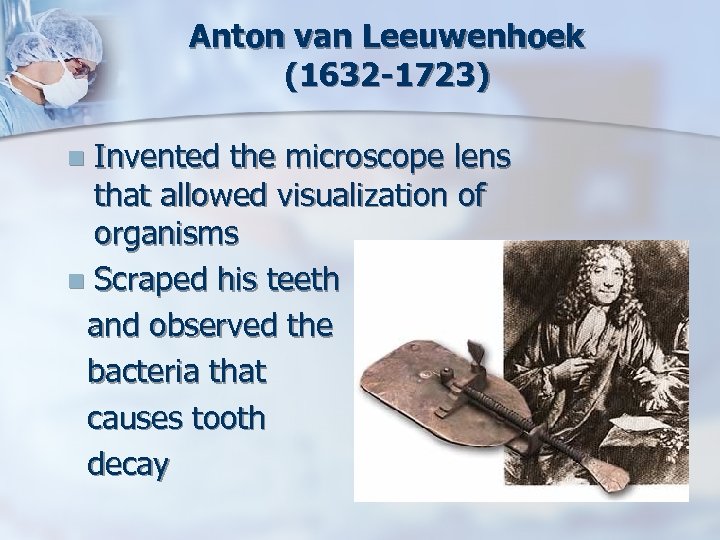 Anton van Leeuwenhoek (1632 -1723) Invented the microscope lens that allowed visualization of organisms n Scraped his teeth and observed the bacteria that causes tooth decay n
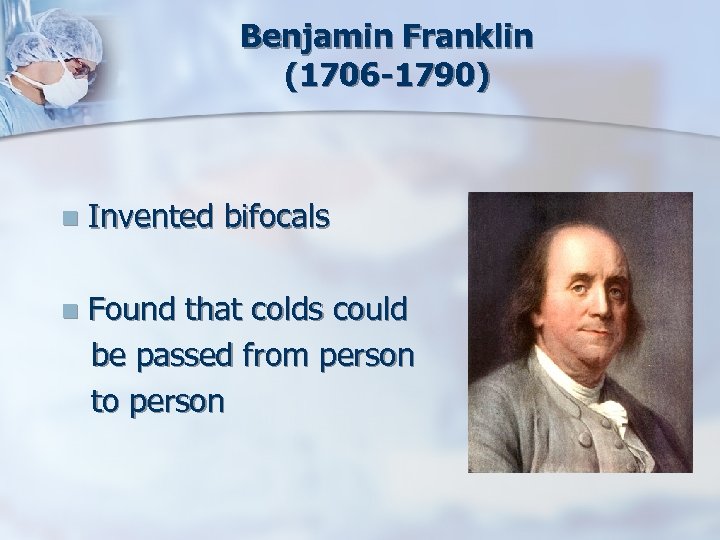 Benjamin Franklin (1706 -1790) n Invented bifocals n Found that colds could be passed from person to person
 Ephraim Mc. Dowell (1771 -1 1830) Surgeon from Danville, Ky. n Performed the first ovariotomy (surgical removal of the ovary) - to remove a 22 pound tumor n
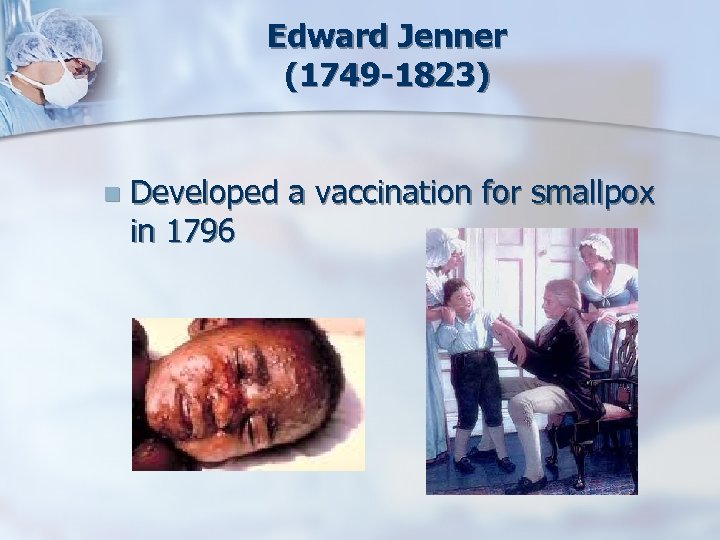 Edward Jenner (1749 -1823) n Developed a vaccination for smallpox in 1796
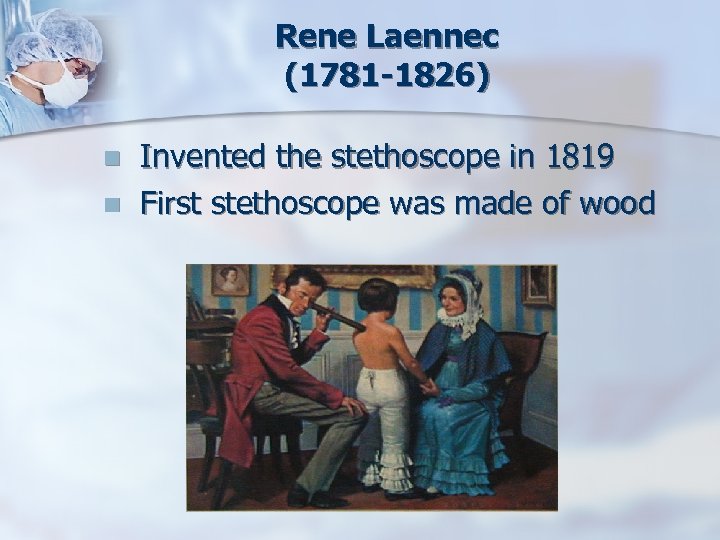 Rene Laennec (1781 -1826) n n Invented the stethoscope in 1819 First stethoscope was made of wood
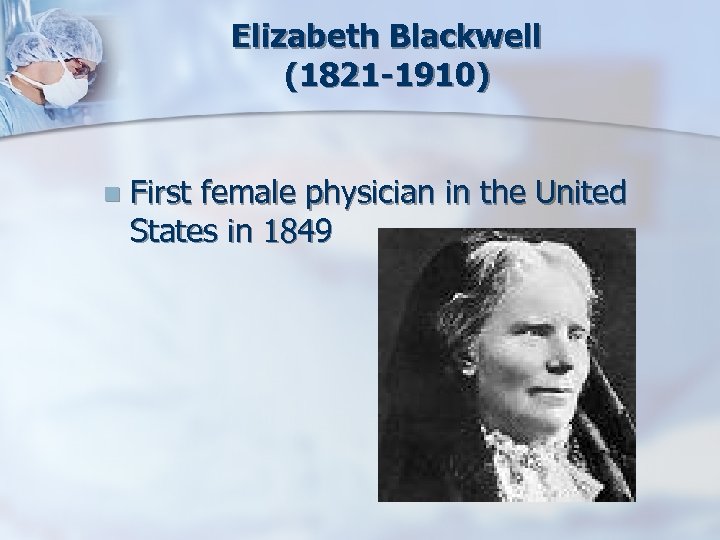 Elizabeth Blackwell (1821 -1910) n First female physician in the United States in 1849
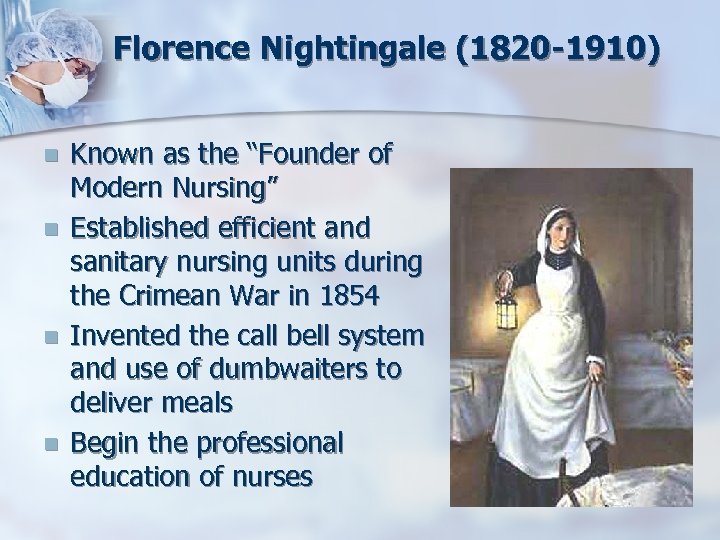 Florence Nightingale (1820 -1910) n n Known as the “Founder of Modern Nursing” Established efficient and sanitary nursing units during the Crimean War in 1854 Invented the call bell system and use of dumbwaiters to deliver meals Begin the professional education of nurses
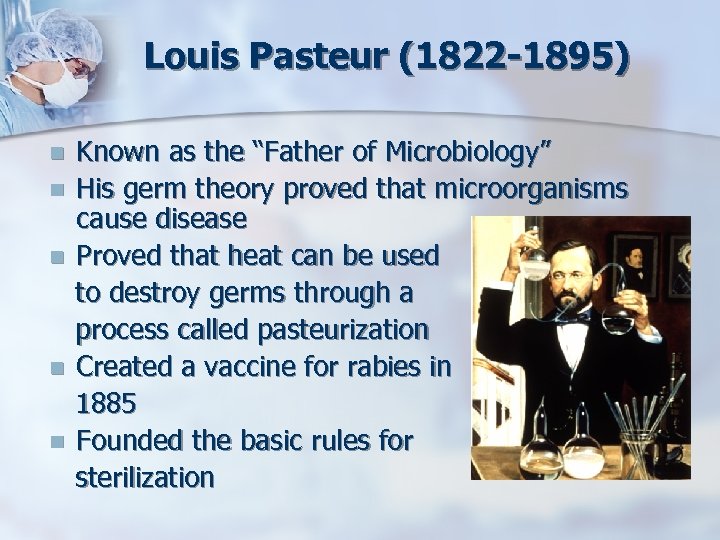 Louis Pasteur (1822 -1895) n n n Known as the “Father of Microbiology” His germ theory proved that microorganisms cause disease Proved that heat can be used to destroy germs through a process called pasteurization Created a vaccine for rabies in 1885 Founded the basic rules for sterilization
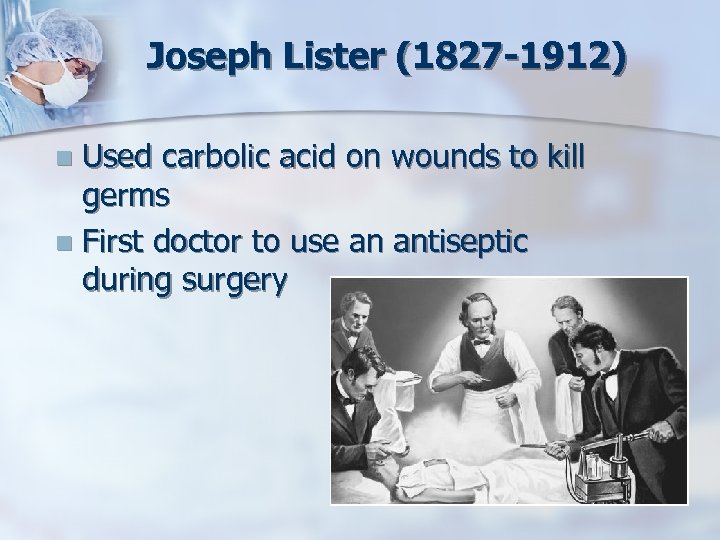 Joseph Lister (1827 -1912) Used carbolic acid on wounds to kill germs n First doctor to use an antiseptic during surgery n
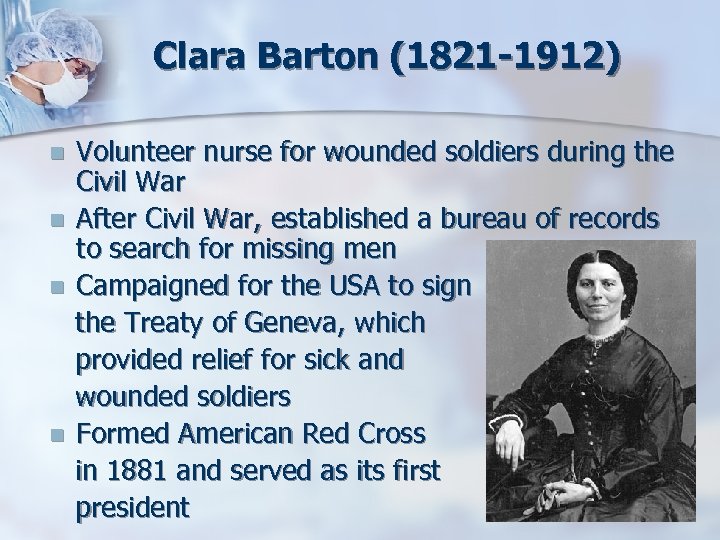 Clara Barton (1821 -1912) n n Volunteer nurse for wounded soldiers during the Civil War After Civil War, established a bureau of records to search for missing men Campaigned for the USA to sign the Treaty of Geneva, which provided relief for sick and wounded soldiers Formed American Red Cross in 1881 and served as its first president
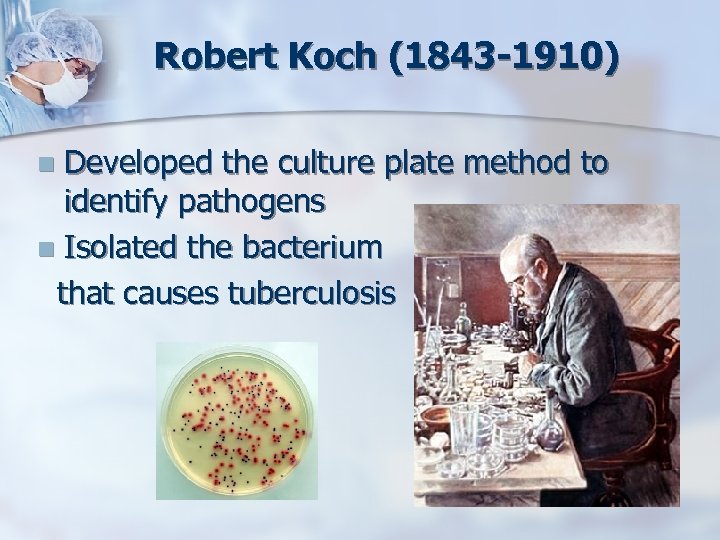 Robert Koch (1843 -1910) Developed the culture plate method to identify pathogens n Isolated the bacterium that causes tuberculosis n
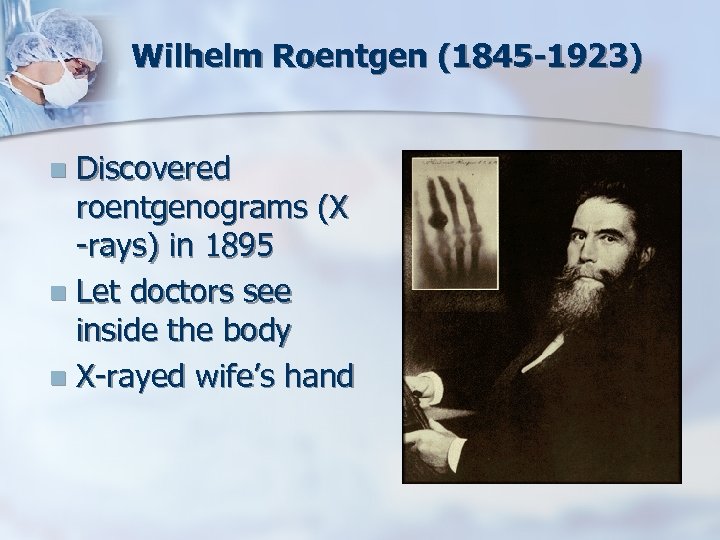 Wilhelm Roentgen (1845 -1923) Discovered roentgenograms (X -rays) in 1895 n Let doctors see inside the body n X-rayed wife’s hand n
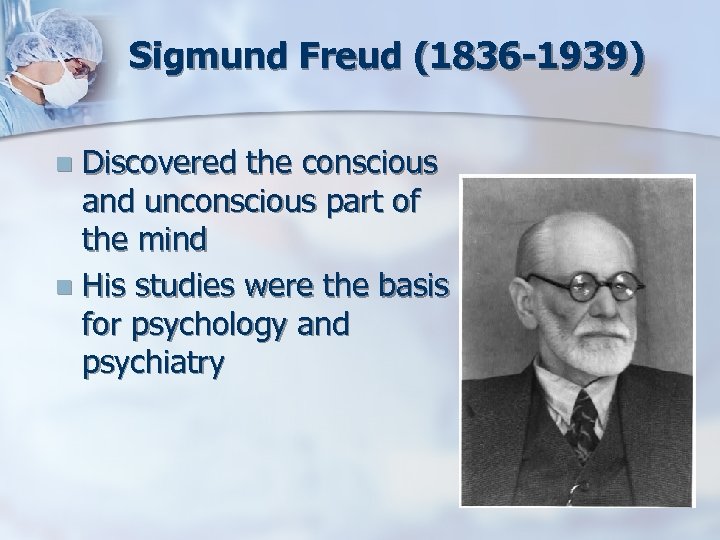 Sigmund Freud (1836 -1939) Discovered the conscious and unconscious part of the mind n His studies were the basis for psychology and psychiatry n
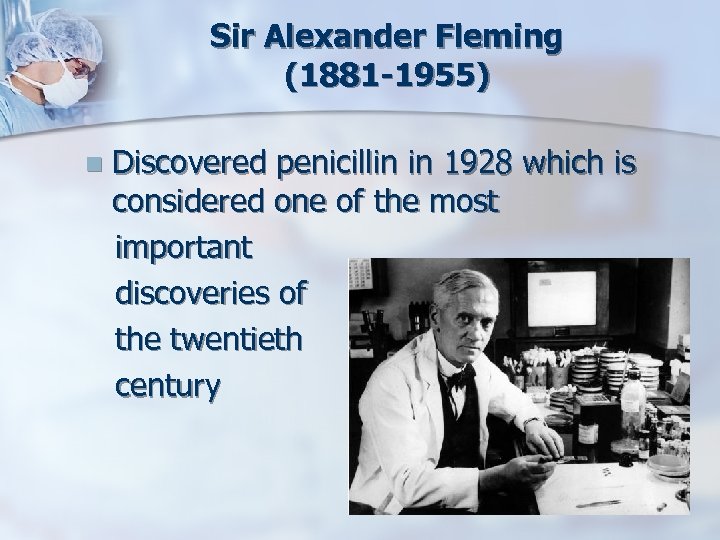 Sir Alexander Fleming (1881 -1955) n Discovered penicillin in 1928 which is considered one of the most important discoveries of the twentieth century
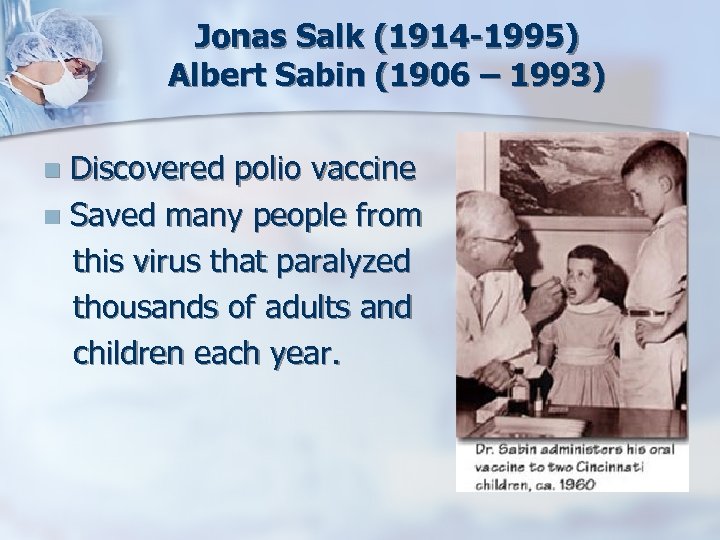 Jonas Salk (1914 -1995) Albert Sabin (1906 – 1993) Discovered polio vaccine n Saved many people from this virus that paralyzed thousands of adults and children each year. n
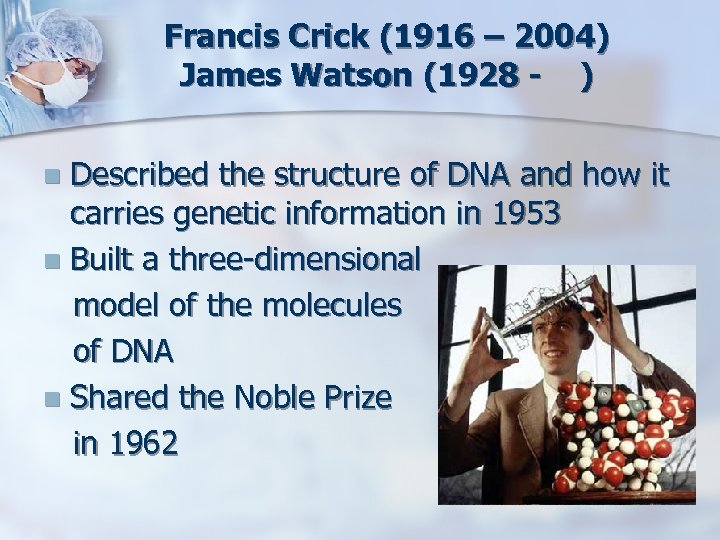 Francis Crick (1916 – 2004) James Watson (1928 - ) Described the structure of DNA and how it carries genetic information in 1953 n Built a three-dimensional model of the molecules of DNA n Shared the Noble Prize in 1962 n
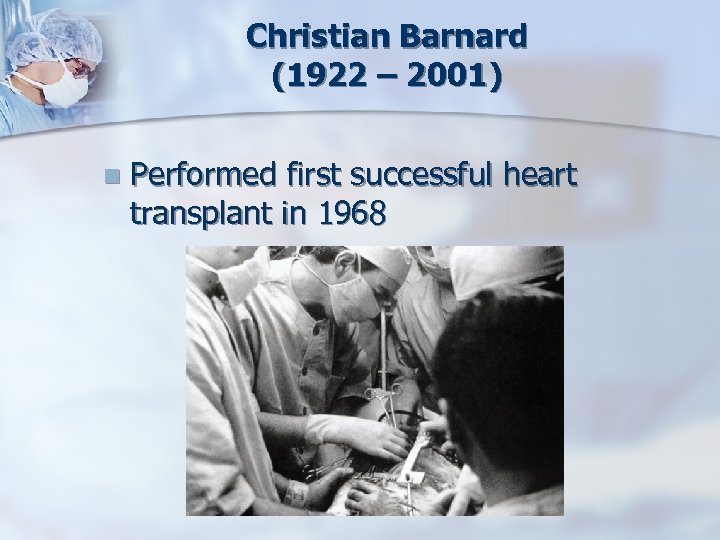 Christian Barnard (1922 – 2001) n Performed first successful heart transplant in 1968
 Robert Jarvik n Creator of the first artificial heart n On December 2, 1982, it was implanted into Barney Clark, who lived for the next 112 days n The second patient, William Schroeder, lived for 620 days
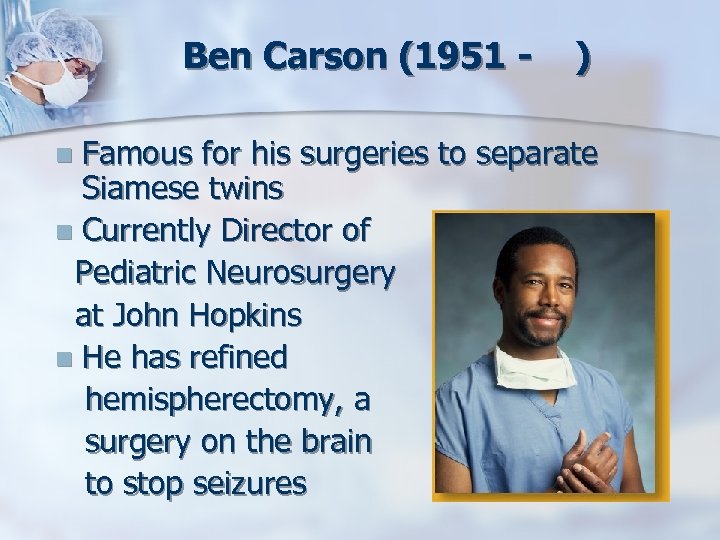 Ben Carson (1951 - ) Famous for his surgeries to separate Siamese twins n Currently Director of Pediatric Neurosurgery at John Hopkins n He has refined hemispherectomy, a surgery on the brain to stop seizures n
 Activity Create time lines for the history of health care. Show the top 10 events/persons you believe are most important in the development of modern-day health care. n on a separate sheet of paper. write an summary explaining why you believe these events are most important n
 Current Trends in Health Care
 State Standard n 1) Synthesize information found in news media, professional journals, and trade magazines to create a report and/or presentation on the historical evolution of healthcare in the United States. Use a timeline or other graphic to illustrate major developments beginning with the first medical school through today.
 Objectives Students will: • • Identify medical/health care milestones that have led to advances in health care. Predict where and how factors such as cost, managed care, technology, and aging population, access to care, alternative therapies, and lifestyle behavior may affect various health delivery system models.
 Cost Containment n Cost of health care began rising due to: n n Technological advances Aging population Health-related lawsuits Cost Containment measures include: n n n Diagnostic related groups (DRG) Combination of services Outpatient services Mass or bulk purchasing Early intervention and preventive services
 n Health care facilities specialized to include: n Home health care n Hospice care n Geriatric care n Types of facilities n Omnibus Budget Reconciliation Act (OBRA) n Telemedicine
 n Emphasis on promoting wellness of the whole individual: n Physical wellness n Emotional wellness n Social wellness n Mental and intellectual wellness n Spiritual Wellness n Holistic Health
 n Alternative and Complementary Methods of Health Care n Chinese medicine practitioners n Chiropractors n Homeopaths n Hypnotists n Naturopaths
 n National Health Care Plan n Has become a leading topic of debate due to the increasing number of uninsured Americans n Education and preparation for a potential pandemic n Due to the high rate international travel, the possibility for a devastating pandemic has increased
 Bioengineering n Includes fields in which problems are solved by the design of technologies used in biology and medicine n for example: n genetic engineering n additive manufacturing used in health n stem cell research n organ and tissue transplants
 Genetic Engineering n Is the use of technology to change DNA code n transfer of genetic material of living cells to make them capable of performing new functions n Uses are still being developed n many more studies must be done to discover its full potential and to verify and improve the safety of procedures n many individuals question the ethics and
 Genetic Engineering n Has applications in health science including: n the use of genes to make drugs specific to a disorder n the use of genes to choose drugs and dosages which will be most effective for a specific patient n the use of specific genes to create more effective vaccines
 Genetic Engineering n Has applications in health science including: n the isolating of genes to study in the hope of curing hereditary diseases n known as gene therapy n the duplicating of genes to use them in a different part of the body or even in a different person’s body n known as cloning
 Stem Cells n Are undifferentiated cells n they can divide to become any number of different types of cells n skin cells, muscle cells, etc. n makes them good candidates for research in medicine n if they can be stimulated to become organ cells, they can be used to aid patients in need of transplant
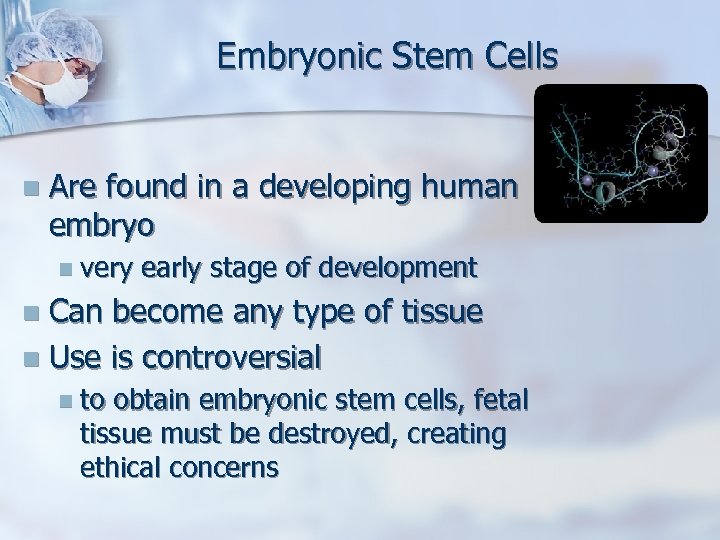 Embryonic Stem Cells n Are found in a developing human embryo n very early stage of development Can become any type of tissue n Use is controversial n n to obtain embryonic stem cells, fetal tissue must be destroyed, creating ethical concerns
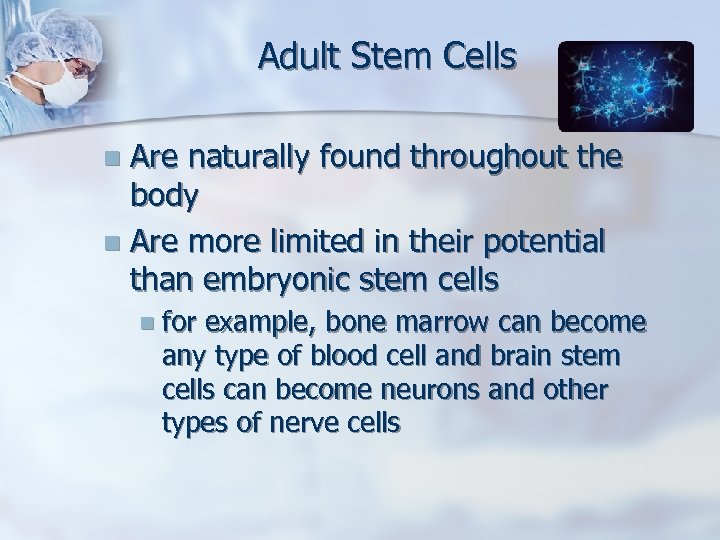 Adult Stem Cells Are naturally found throughout the body n Are more limited in their potential than embryonic stem cells n n for example, bone marrow can become any type of blood cell and brain stem cells can become neurons and other types of nerve cells
 Cord Blood Stem Cells n n Are taken from the umbilical cord n structure attaching a fetus to the womb Are hematopoietic stem cells n can differentiate into any blood cell type n similar to those in bone marrow Can be stored right after birth for later use Have been successfully used in treating many diseases n leukemia (cancer of white blood cells) n anemia (too few functioning blood cells) n eye tumors
 Transplants n Are operations in which a healthy organ or tissue from another person is placed in the patient’s body n when medical conditions cause organ or tissue failure n organs and tissues include: • • • heart liver kidneys lungs pancreas • small intestine • corneas • skin • veins • blood • • heart valves tendons ligaments bones
 Transplants n n May come from a deceased donor n in cases where the organ is necessary for survival n for example, the heart May come from a live donor n in cases where a person has more than one of the organ and can survive after losing one n for example, the kidney n in cases where a portion of the organ can be taken and the organ has the ability to regenerate and regain full function n for example, the liver
 Transplants n Require: n the donor and patient have compatible blood types and similar organ size n relatives are preferred living donors n the organ be placed in the patient quickly after having been removed from the donor n time allowances vary by organ n the patient take drugs to prevent the risk of transplant rejection n the immune system may view the new organ or tissue as a foreign threat and attack it
 Transplant Technology n Continues to advance n doctors are developing new procedures to decrease the chances of transplant rejection n by preparing the patient’s immune system with specific drugs before transplant n by transplanting bone marrow along with the necessary organ n systems are being developed to: n allow organs to remain outside of the human body for extended periods n enhance the health of donated organs before transplant
 Activity n Stem Cells: Where Do You Stand? Perform research on the topic of medical use of stem cells. As you do your research, answer the following questions: n What are stem cells n How have stem cells been used in the past n When were they first used n How are stem cells used currently n What are some of the potential negative and positive results that might occur with the use of stem cells in a medical procedure n Why is there controversy surrounding the use of stem cells n ****You will be writing an essay over the information that you just researched and your thoughts about stem cells. Do you think this is a good idea, why or why not.